
Report Feature
Wall Art Market Trends and Forecast
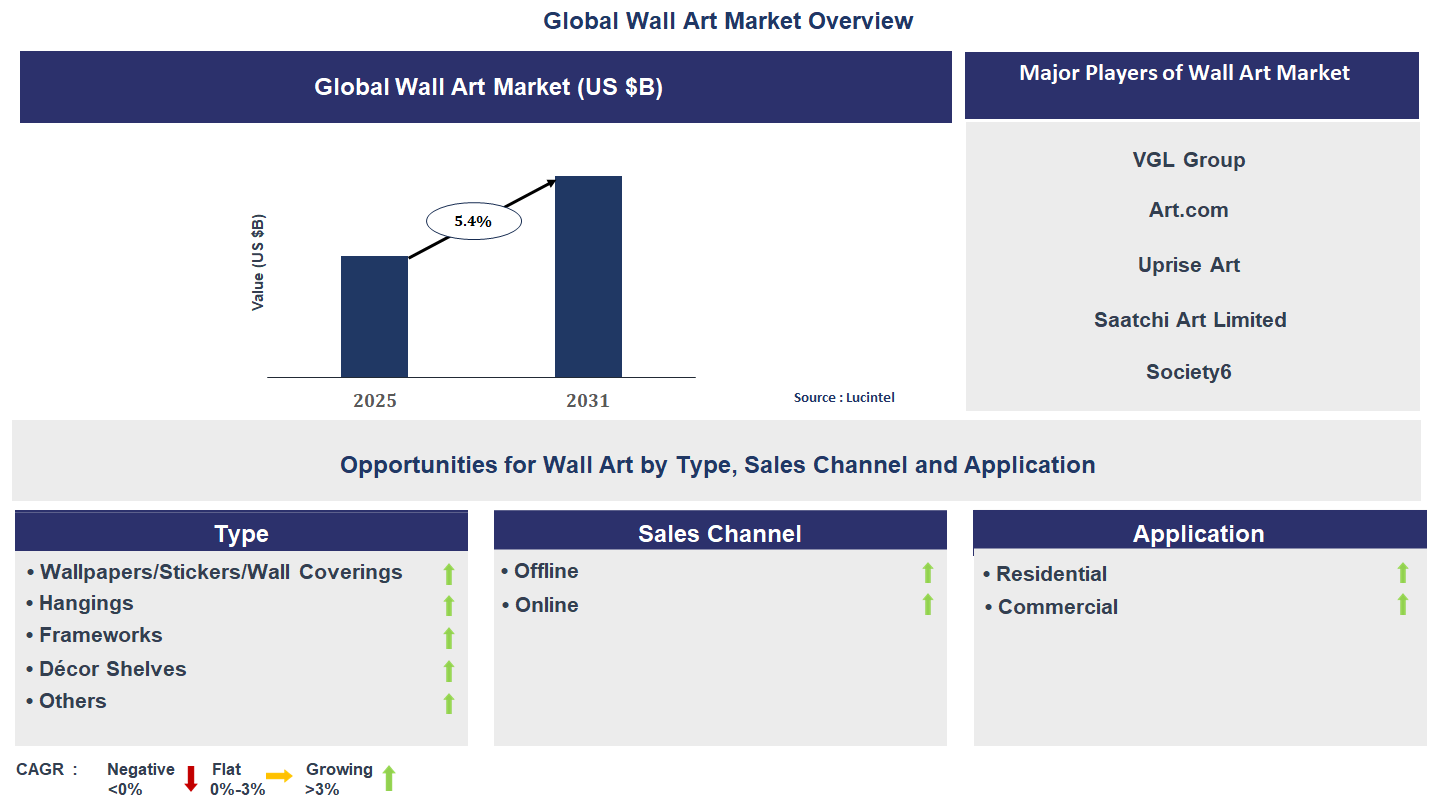
The future of the global wall art market looks promising with opportunities in the residential and commercial markets. The global wall art market is expected to grow with a CAGR of 5.4% from 2025 to 2031. The major drivers for this market are the increasing demand for personalized wall art, the rising popularity of digital printing techniques, and the growing trend of home decor customization.• Lucintel forecasts that, within the type category, wallpapers/sticker/wall covering is expected to witness the highest growth over the forecast period.
• Within the application category, residential is expected to witness higher growth.
• In terms of region, APAC is expected to witness the highest growth over the forecast period. Gain valuable insights for your business decisions with our comprehensive 150+ page report. Sample figures with some insights are shown below.
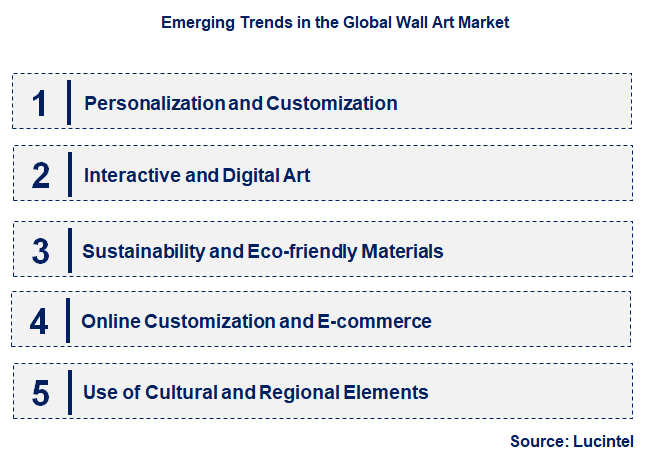
Emerging Trends in the Wall Art Market
The market for wall art is changing with many prominent trends influencing the way consumers buy and engage with art. Technological innovation, environmental considerations, and shifting consumer attitudes are among the drivers. The following are five of the most important trends that are making a big difference.• Personalization and Customization: Shoppers are looking for more customized wall decor that is tailored to their own personal tastes. From customized portraits to customized quotes and digital artworks, the market is demanding more individualized and bespoke pieces. This is driven by the online channels where customers can simply design and have customized artworks ordered. Personalization is bringing an emotive value to the artwork and enables consumers to build a more personalized and emotional home space.
• Interactive and Digital Art: Digital and interactive wall art is on the rise with increasing smart home technology. Digital prints, LED art, and even augmented reality (AR) artwork pieces are all the rage. Smart frames that cycle through a collection of artworks are all the rage in smart homes today, enabling consumers to update their wall art without the need to replace it physically. Such interactive arts provide a more enhanced degree of interaction and versatility and attract technology-enabled consumers.
• Sustainability and Eco-friendly Materials: With growing awareness about the environment, consumers are shifting towards sustainable and eco-friendly wall art. Bamboo, reclaimed wood, and organic cotton are gaining prominence as popular choices. Several artists and producers are also employing sustainable inks and dyes to produce art that reduces its environmental footprint. Requests for sustainability are being extended to packaging as well, with brands increasingly providing recyclable and biodegradable packaging for wall art products.
• Online Customization and E-commerce: The trend of online shopping is still influencing the market of wall art. Online stores offer a huge array of products for customers, ranging from low-cost mass-produced prints to specialist limited-edition art. Moreover, online customization software helps clients to upload their photos or choose designs with ease to design custom wall art. This trend has also helped consumers to easily locate and buy paintings that meet their taste, as well as contribute to independent artists.
• Use of Cultural and Regional Elements: Consumers in international markets are being increasingly attracted to wall art featuring cultural and regional elements. Traditional forms of art such as Madhubani and Warli in India are being merged with modern-day designs. Likewise, in Japan, there is a coming together of traditional Ukiyo-e prints and contemporary styles. It indicates a shift towards greater appreciation for locally produced art and craftsmanship, coupled with a use of global influences. These new trends are redefining the market for wall art by making it more interactive, personalized, and sustainable. The fusion of technology with convention, coupled with a keen interest in customization and sustainability, is developing an exciting and varied marketplace for consumers.
Recent Development in the Wall Art Market
The market for wall art has experienced various recent trends, specifically due to technological advancement, shifting consumer tastes, and the move toward more sustainable activities. Such trends are shaping the production, sale, and consumption of wall art across the world. There is an increasing demand for customized, environmentally friendly, and digitally connected products, affecting major players in the market.• Customization and Personalization Boom: Among the most important trends in the wall art industry is the boom of customized and personalized products. People are making more demand for artwork that reflects their individual style and personality. This has resulted in the creation of online tools and platforms enabling customers to create their own wall art, be it through customized photos, personalized portraits, or customized prints. The need for customized items is high especially in Western markets, where people appreciate individuality in interior decoration.
• Integration of Technology in Wall Art: Another important evolution is the incorporation of technology into wall art. There are digital art, smart frames, and even interactive artwork. Firms are leveraging technologies such as augmented reality (AR) to enrich the consumer experience so that viewers can engage with art in fresh and creative ways. Smart frames showcasing rotating pictures or digital art galleries are becoming trendy as customers seek ease and adaptability in home decorating.
• Sustainability and Eco-friendly Materials: A visible change towards sustainability is being seen in the wall art industry. Customers are progressively focusing on sustainable products, and usage of green materials such as bamboo, reclaimed wood, and natural fibers has grown in consequence. It is being influenced by increased knowledge of the environmental challenges facing the world and reduced carbon footprint on home decor. Companies are reacting to this through embracing environmentally friendly production methods and utilizing non-toxic paint and dyes to create their artworks.
• Expansion of Online Sales Channels: The market for wall art has experienced a massive movement towards selling online, especially in markets such as the United States, China, and Europe. Online platforms such as Etsy, Amazon, and Wayfair are facilitating easy purchasing of numerous types of wall art, from inexpensive prints to expensive, original work. The growth of online marketplaces has also enabled individual artists to access a wider customer base, thus offering more varied and specialized products.
• Influencer and Artist Collaborations: Brands are pairing up with influencers and artists to design special, limited-edition collections. This trend is particularly sought after in countries such as the U.S. and Japan, where demand among consumers for distinctive, one-off products is increasing. Social media influencer and artist collaborations enable brands to access targeted consumer audiences, stimulating sales and increasing brand visibility. These trends mean that the market for wall art is becoming more innovative, individualized, and accessible. Driven by customization, technology, and sustainability, the market is changing to address the new tastes of consumers.
Strategic Growth Opportunities in the Wall Art Market
The wall art industry is ready to take off, with a number of strategic opportunities arising in multiple applications. As consumer tastes evolve towards customization, sustainability, and embedding technology, companies are able to capitalize on these themes to increase market presence. Following are five strategic opportunities for growth that are likely to shape the future of the wall art industry.• Customized and Personal Wall Art: With ongoing demand for customized products, there is a large opportunity for companies to extend their product base in custom wall art. By enabling customers to design exclusive pieces, be it by customized prints or personal photos, businesses can access a large growth segment that appreciates uniqueness and self-expression. Facilitating easy customization through online platforms is the way to win this opportunity.
• Digital and Smart Art Integration: The convergence of digital technology in wall art presents a distinctive growth value proposition. Smart frames, digital prints, and interactable art updatable remotely or seen rotating in galleries are increasingly popular. Brands integrating augmented reality (AR) or digital art subscription could leverage the expanding base of tech-embracing consumers looking for innovative and dynamic home design options.
• Sustainability and Green Art: Consumers are becoming more concerned about sustainability, and hence, green wall art presents a strong growth opportunity. Providing products that are made from sustainably sourced materials like reused wood, natural fibers, and biodegradable paints will appeal to consumers who care about the environment. Companies that integrate sustainability into their manufacturing processes and materials will surely gain prominence in the market.
• Emerging Markets Growth: The market for wall art is growing strongly in emerging markets such as India and China, where increasing urbanization and disposable incomes are fueling demand for home furnishing. By providing affordable yet fashionable wall art products that cater to these markets, businesses can access new consumers. Localization of the designs, including use of local art styles or cultural imagery, can also help increase demand.
• Artist and Influencer Collaborations: Collaborating with artists, designers, and influencers is an strong growth opportunity. Exclusive collections and limited-edition art pieces can create buzz and bring in new customers. Collaborations not only bring in sales but also increase brand visibility and credibility, especially with well-known artists or influencers who have large followings. These strategic opportunity areas point to the ability of businesses to innovate and expand their products in the wall art space. By emphasizing personalization, digital presence, green space, new markets, and influencer partnerships, firms can gain more mileage in this expanding and evolving market.
Wall Art Market Driver and Challenges
The market for wall art is driven by various drivers and issues that contribute to its development and growth. Technology, consumer behavior, and the economy all contribute to the direction of the market. Despite this, there are also issues, like the disruption of supply chains and competition, that businesses have to overcome to be successful. The factors responsible for driving the wall art market include: 1. Home Decor Demand Growth: The rising popularity of interior design and home decor is one of the key drivers of the wall art industry. People are spending money on beautifying homes, especially because they are spending more time indoors as a result of remote work trends. Wall art is important in making homes more personalized, and with more individuals working on their home environments, the need for wall art rises. 2. Technological Innovation in Art Manufacturing: New printing techniques and digital art software are simplifying and cheaper to manufacture high-end wall art. Digital printing methods, for instance, enable mass production of artwork at lower prices, making it more accessible to consumers. The technology also makes it possible for artists to develop more complex and varied designs, which attract a wider market. 3. Personalization Shift: With consumers increasingly wanting one-of-a-kind and customized products, demand for customized wall art keeps rising. Online stores where consumers can design their own wall art are doing well, and options for customization like personalized prints, family portraits, or custom designs are gaining traction. 4. Increasing Demand for Sustainable Products: As the environment gains more attention, consumers are increasingly opting for eco-friendly and sustainable products. Brands that adopt sustainable materials and environmentally-friendly production processes in their wall art segment are poised to appeal to environmentally aware consumers. 5. Growing E-commerce Platforms: Increased e-commerce has facilitated consumers to have access to a vast number of wall art choices from home. Websites such as Amazon, Etsy, and Wayfair have ensured it is easy for consumers to buy everything ranging from cheap prints to expensive, unique works of art. Challenges in the wall art market are: 1. Increasing Raw Material Prices: Increases in the price of raw materials, including wood, canvas, and printing inks, can affect the affordability of wall art. Producers have to strike a balance between production prices and pricing strategies in order to compete and still uphold quality. Higher raw material prices can also affect the profitability of small and independent artists. 2. Supply Chain Problems: International supply chain delays have impacted delivery of raw materials and finished goods within a timely manner. Delayed shipping and logistics issues can extend lead times for wall art shipments, potentially causing customer dissatisfaction. Supply chain disruptions may also incur higher shipping costs and decreased availability of some materials. 3. High Market Competition: The market for wall art is extremely competitive, with many companies providing the same product. It becomes difficult for brands to differentiate and acquire market share due to this. Well-established brands need to concentrate on quality, innovation in design, and customer interaction to remain ahead of competitors. The wall art industry is being influenced by a variety of drivers, such as growing demand for household accessories, advancements in technology, and changing consumer behavior towards personalization and environmental sustainability. Nevertheless, threats such as rising raw material prices, logistical disruptions, and high competition threaten stability in the market. To thrive, companies need to innovate, remain flexible, and ensure that they address changing consumer expectations.List of Wall Art Companies
Companies in the market compete on the basis of product quality offered. Major players in this market focus on expanding their manufacturing facilities, R&D investments, infrastructural development, and leverage integration opportunities across the value chain. With these strategies wall art companies cater increasing demand, ensure competitive effectiveness, develop innovative products & technologies, reduce production costs, and expand their customer base. Some of the wall art companies profiled in this report include-• VGL Group
• Art.com
• Uprise Art
• Saatchi Art Limited
• Society6
• Minted
• Artsy
• 1stdibs.com
• Artnet Worldwide Corporation
• Artspace
Wall Art Market by Segment
The study includes a forecast for the global wall art market by type, sales channel, application, and region.Wall Art Market by Type [Value from 2019 to 2031]:
• Wallpapers/Stickers/Wall Coverings
• Hangings
• Frameworks
• Décor Shelves
• Others
Wall Art Market by Sales Channel [Value from 2019 to 2031]:
• Offline
• Online
Wall Art Market by Application [Value from 2019 to 2031]:
• Residential
• Commercial
Wall Art Market by Region [Value from 2019 to 2031]:
• North America
• Europe
• Asia Pacific
• The Rest of the World
Country Wise Outlook for the Wall Art Market
The market for wall art is undergoing significant changes based on consumer preferences for customized and visually interesting designs. Advances in technology, such as digital printing and expansion in e-commerce, have popularized wall art among a worldwide population. Also, growing interest in interior decoration and home decor has resulted in a surge in demand for different types of wall art in the United States, China, Germany, India, and Japan. Each of these nations has its own set of trends based on local preferences, socio-economic indicators, and design sensibilities, driving rapid changes in the market.• United States: In the USA, the market for wall art has seen an upsurge as home decorating and interior design gain popularity. Customers are looking for more personalized, one-of-a-kind items that they can customize according to their preferences. Digital art, canvas prints, and framed photography are popular, and websites such as Etsy and Amazon provide a vast range of choices. The demand for environmentally friendly materials has also increased, with most artists and producers using sustainable production techniques. Moreover, the growth of remote work has been accompanied by increased investment in home offices, which has increased the demand for wall art used to decorate such areas.
• China: Chinas market for wall art is growing exponentially as urbanization and increasing disposable incomes bring increased focus on home decoration. Chinese consumers are turning towards modern, minimalist pieces, with a focus on nature and heritage Chinese elements such as calligraphy and landscape painting. Technology integration in wall art, including digital artworks displayed through smart frames, has become fashionable. Online websites are vital in promoting sales, with Taobao and JD.com, the online titans, providing plenty of affordable and luxury wall art pieces. The market for DIY and custom wall art is also increasing as more individuals seek to make their homes personal.
• Germany: The wall art industry in Germany is dominated by a keen sense of minimalist and modern design. There is a preference among German consumers for quality materials and construction, and sustainability is high up on their list of priorities. Abstract, geometric forms and monochrome prints as wall art are favored, in keeping with the design sensibilities of the country. German consumers are also becoming more interested in environmentally friendly and ethically sourced products, and manufacturers have responded by using sustainable production processes.
• India: The Indian market for wall art is expanding as more individuals opt for contemporary styles in addition to the traditional Indian art forms. Indian consumers are adding bright, hand-painted motifs and ethnic artwork, including Madhubani and Warli paintings, to their homes. At the same time, there is growing enthusiasm for contemporary wall art, including digital prints and abstracts. With growing disposable income and an expanding middle class, an increasing number of consumers are spending on home furnishings. The success of websites such as Flipkart and Amazon has facilitated greater access to various wall art designs, ranging from affordable to luxury.
• Japan: Japans wall art industry is a combination of the traditional and the modern, with consumers drawn to both timeless Japanese art styles and modern minimalist design. Ukiyo-e prints, calligraphy, and Zen-related paintings dominate, but increasing interest can be seen in abstract paintings and photography. Japanese consumers prefer products that promote simplicity, quality, and craftsmanship. Sustainability is also high on the agenda, with consumers preferring eco-friendly material. The growth of online shopping platforms has opened up wall art availability, offering consumers more choice and convenience.

Features of the Global Wall Art Market
Market Size Estimates: Wall art market size estimation in terms of value ($B). Trend and Forecast Analysis: Market trends (2019 to 2024) and forecast (2025 to 2031) by various segments and regions. Segmentation Analysis: Wall art market size by type, sales channel, application, and region in terms of value ($B). Regional Analysis: Wall art market breakdown by North America, Europe, Asia Pacific, and Rest of the World. Growth Opportunities: Analysis of growth opportunities in different types, sales channels, applications, and regions for the wall art market. Strategic Analysis: This includes M&A, new product development, and competitive landscape of the wall art market. Analysis of competitive intensity of the industry based on Porter’s Five Forces model.
FAQ
Q1. What is the growth forecast for wall art market? Answer: The global wall art market is expected to grow with a CAGR of 5.4% from 2025 to 2031. Q2. What are the major drivers influencing the growth of the wall art market? Answer: The major drivers for this market are the increasing demand for personalized wall art, the rising popularity of digital printing techniques, and the growing trend of home decor customization. Q3. What are the major segments for wall art market? Answer: The future of the wall art market looks promising with opportunities in the residential and commercial markets. Q4. Who are the key wall art market companies? Answer: Some of the key wall art companies are as follows:• VGL Group
• Art.com
• Uprise Art
• Saatchi Art Limited
• Society6
• Minted
• Artsy
• 1stdibs.com
• Artnet Worldwide Corporation
• Artspace Q5. Which wall art market segment will be the largest in future? Answer: Lucintel forecasts that, within the type category, wallpapers/sticker/wall covering is expected to witness the highest growth over the forecast period. Q6. In wall art market, which region is expected to be the largest in next 5 years? Answer: In terms of region, APAC is expected to witness the highest growth over the forecast period. Q7. Do we receive customization in this report? Answer: Yes, Lucintel provides 10% customization without any additional cost.
Table of Contents
List of Figures
List of Tables
Methodology
- In-depth interviews of the major players in this market
- Detailed secondary research from competitors’ financial statements and published data
- Extensive searches of published works, market, and database information pertaining to industry news, company press releases, and customer intentions
- A compilation of the experiences, judgments, and insights of Lucintel’s professionals, who have analyzed and tracked this market over the years.


Buy Now
Choose a license that fits your team. Instant PDF delivery.
Prices exclude taxes. Instant delivery. Custom licensing available on request.
Key Questions
- • What are some of the most promising, high-growth opportunities for the wall art market by type (wallpapers/stickers/wall coverings, hangings, frameworks, décor shelves, and others), sales channel (offline and online), application (residential and commercial), and region (North America, Europe, Asia Pacific, and the Rest of the World)?
- • Which segments will grow at a faster pace and why?
- • Which region will grow at a faster pace and why?
- • What are the key factors affecting market dynamics? What are the key challenges and business risks in this market?
- • What are the business risks and competitive threats in this market?
- • What are the emerging trends in this market and the reasons behind them?
- • What are some of the changing demands of customers in the market?
- • What are the new developments in the market? Which companies are leading these developments?
- • Who are the major players in this market? What strategic initiatives are key players pursuing for business growth?
- • What are some of the competing products in this market and how big of a threat do they pose for loss of market share by material or product substitution?
- • What M&A activity has occurred in the last 5 years and what has its impact been on the industry? For any questions related to Wall Art Market, Wall Art Market Size, Wall Art Market Growth, Wall Art Market Analysis, Wall Art Market Report, Wall Art Market Share, Wall Art Market Trends, Wall Art Market Forecast, Wall Art Companies, write Lucintel analyst at email: helpdesk@lucintel.com. We will be glad to get back to you soon.


