
Report Feature
Walk-Behind Trowel Market Trends and Forecast
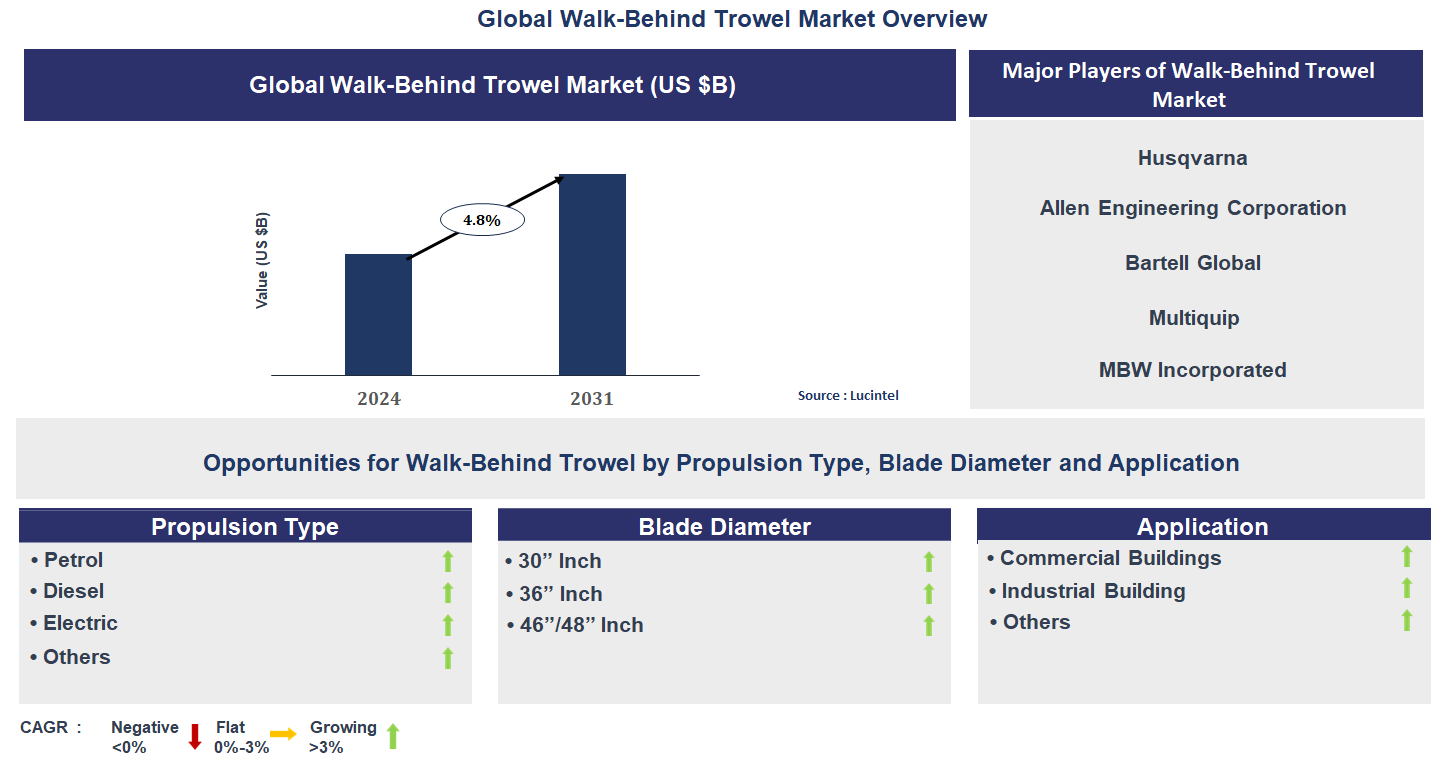
The future of the global walk-behind trowel market looks promising with opportunities in the commercial building and industrial building markets. The global walk-behind trowel market is expected to grow with a CAGR of 4.8% from 2025 to 2031. The major drivers for this market are the increasing demand for efficient concrete finishing, the rising construction projects in urban areas, and the growing preference for automated trowel machines.• Lucintel forecasts that, within the propulsion type category, electric is expected to witness the highest growth over the forecast period.
• Within the application category, commercial building is expected to witness higher growth.
• In terms of region, APAC is expected to witness the highest growth over the forecast period. Gain valuable insights for your business decisions with our comprehensive 150+ page report. Sample figures with some insights are shown below.
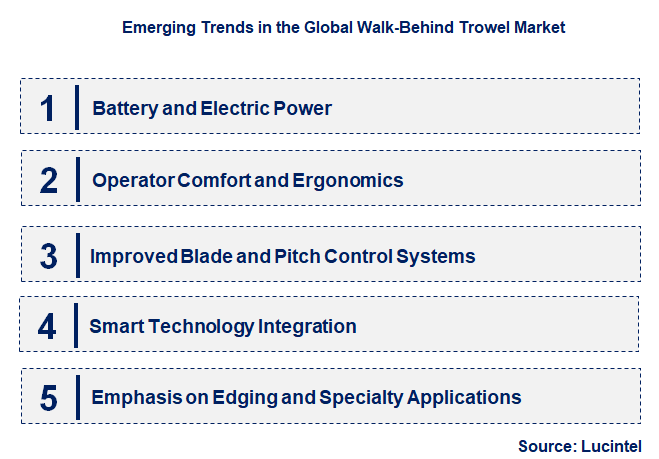
Emerging Trends in the Walk-Behind Trowel Market
The walk-behind trowel industry is experiencing a revolution based on a drive towards increased productivity, better safety, and green practices. These new trends are revolutionizing the design, functionality, and use of these machines, taking the industry away from conventional mechanical models. The use of state-of-the-art technology, concern with ergonomic design, and transition to alternative power sources are at the leading edge of this revolution. These trends are not just addressing the requirements of a contemporary construction industry but are also providing new market opportunities and competitive success for manufacturers.• Battery and Electric Power: The market is experiencing a significant trend towards battery and electric walk-behind trowels. This is fueled by a requirement for low-emission machines, especially for indoor and city-based projects where air quality is a priority. Advances in battery technology have improved power output and extended running time, making these units a suitable and appealing option to standard gasoline-powered equipment. This trend is consistent with international environmental standards and the industry’s shift toward cleaner practices.
• Operator Comfort and Ergonomics: More emphasis is being placed on ergonomic design to minimize operator fatigue and risk of repetitive strain injury. Manufacturers are building machines with adjustable handles, vibration-dampening technology, and better balance. This trend responds to the physical requirements of concrete finishing and wants to make the work more comfortable and safer for operators. Prioritizing user well-being, manufacturers are not just fulfilling safety requirements but also enhancing the general user experience and market attractiveness of their products.
• Improved Blade and Pitch Control Systems: One important trend is the creation of more sophisticated blade and pitch control systems. New walk-behind trowels are being fitted with accurate, simple-to-calculate controls that enable users to finely adjust the blade angle to produce a flawless finish. Some of the models now come with hydrostatic transmissions and variable speed controls that provide more control and versatility. This trend plays a significant role in producing high-quality, professional-level concrete surfaces in an array of applications.
• Smart Technology Integration: Smart technology is now being integrated into walk-behind trowels. This involves using digital displays and sensors to track engine diagnostics, fuel levels, and other most important operational information. Some designs even have GPS and IoT connectivity to locate the equipment on the job site, remotely monitor performance, and aid in maintenance scheduling. This is a trend of offering contractors data-driven insights to streamline workflow and better manage their equipment fleet.
• Emphasis on Edging and Specialty Applications: While the common walk-behind trowels apply to large slabs, there has been an emerging trend of creating specialty models for edging and other specialty applications. Rotating ring edging trowels provide the ability to precisely finish up against walls and around obstructions. This trend emphasizes a shift toward the offering of a full range of tools that are capable of addressing all facets of a concrete finishing job, from the expansive open spaces to the complex corners and edges. These trends are transforming the walk-behind trowel industry by forcing manufacturers to reinvent and design more efficient, safer, and technologically more advanced machines. The sector is transitioning from basic mechanical equipment to a new generation of smart, ergonomic, and green devices. This change is prompted by the requirements of the modern construction sector that prioritizes productivity, quality, and environmental sustainability, radically altering how concrete floors are finished globally.
Recent Development in the Walk-Behind Trowel Market
The walk-behind trowel industry has witnessed several key developments, spurred by a mixture of technological advancement and changing needs in the global construction sector. These developments are geared towards enhancing efficiency, boosting the safety of the operators, as well as improving overall finish quality of concrete. The industry is shifting toward advanced, easy-to-use, and more powerful machines that are capable of serving the needs of a diverse spectrum of projects, ranging from residential slabs to commercial floors.• Hydrostatic Drive Systems: One of the most significant advancements is the widespread use of hydrostatic drive systems for walk-behind trowels. In contrast to conventional mechanical drives, hydrostatic systems offer smoother, more accurate control over rotation and blade speed. This enables the operator to be in control of the machine more effectively, which results in a higher-quality, more uniform finish, particularly for harder or more intricate concrete mixes. This innovation is bringing professional-level finishing to more people and making it more consistent, no matter what level of experience the operator has.
• Power and Engine Advanced Technology: There has been significant evolution in the technology of engines, where manufacturers are placing emphasis on fuel-efficient, powerful, and low-emission engines. Not only does this assist companies to meet environmentally stringent regulations but also lowers running costs for contractors. Another trend that has seen significant development is the creation of durable electric and battery-powered models, providing a clean, quiet, and powerful solution for use in indoor jobs where gasoline fumes are an issue.
• Anti-Vibration and Ergonomic Handles: In order to compensate for the physical fatigue of operators, one of the major developments has been the inclusion of anti-vibration technology and ergonomic handles. These are intended to dampen and absorb the vibrations from the rotor and engine and prevent operator fatigue as well as the likelihood of long-term illnesses. This emphasis on the health of the operator is a reaction to the industry requirement to obtain and maintain quality labor, making the work easier and safer.
• Integrated Fume and Dust Control: As more focus is being placed on on-site safety, integrated dust and fume control systems are now being integrated into some contemporary walk-behind trowels. Vacuum attachments to trap concrete dust when finishing or exhaust systems that vent away from the operator can be included in these systems. This innovation is essential in producing a healthier working environment and is a main selling factor in areas with rigorous occupational health regulations.
• Enhanced Blade and Float Pan Materials: Also improving are the materials for blades and float pans. High-quality, abrasion-resistant steel and other long-lasting alloys are being utilized to help lengthen the lifespan of these parts, minimizing the frequency of replacement. This means less maintenance expense and less downtime for contractors. They improve the finish to be better, more even, and they directly address contractor requests for more long-lasting and sturdy equipment. These new innovations are all combining to reshape the walk-behind trowel industry by setting a new standard for performance, safety, and durability. The industry is shifting towards highly engineered products that not only deliver power and efficiency but also are smart and user-focused. These advances are enabling contractors to obtain better results faster, improving the entire concrete finishing operation to be more productive and less labor-intensive.
Strategic Growth Opportunities in the Walk-Behind Trowel Market
The walk-behind trowel market provides a range of strategic growth opportunities in leading applications, fueled by continuing construction activity and the need for more sophisticated concrete finishes. Targeting specific end-user segments and their specific requirements allows manufacturers and suppliers to effectively respond to these opportunities and gain a competitive edge. The business is not only about creating a better machine but also about comprehending and satisfying various needs of various projects, ranging from small domestic work to large industrial complexes.• Residential Slabs and Flooring: Residential construction and remodeling offers an enormous growth opportunity. With an increasing number of houses being constructed and remodeled, there is a consistent demand for equipment to complete concrete slabs for basements, patios, and garages. The strategic potential here is to design and sell small, easy-to-use, and inexpensive walk-behind trowels that are attractive to professional residential builders as well as to the increasing do-it-yourself market. Lightweight products with uncomplicated controls are especially suited to this use.
• Commercial and Industrial Floors: The commercial and industrial markets, such as warehouses, factories, and shopping centers, represent an important opportunity for growth based on their high-volume concrete floor needs. These applications require high-performance, rugged, and dependable machines capable of covering large areas quickly with a high-quality, dense finish. The strategic play is to concentrate on designing aggressive, heavy-duty walk-behind trowels with sophisticated features and a sound service network that can accommodate the demanding needs of large contractors.
• High-Rise Decks and Small Spaces: High-rise building construction presents a specialized opportunity for walk-behind trowels. These applications tend to be completion of concrete on high decks and in close quarters where larger, ride-on trowels might not be convenient. The market opportunity is to become a specialist in and market lightweight, high-maneuverability machines. These units have to be strong enough to provide good finishing quality but small enough to be transported and used in tight, high working environments.
• Concrete Polishing and Restoration: Another increasing use is concrete polishing and restoration. Walk-behind trowels can be utilized in the early phases of a polish cycle to produce a dense, even surface. The strategic opportunity is the sales of walk-behind trowels specifically for this use, with features such as variable speed controls and custom blades. This section provides an opportunity to address the decorative concrete market and offer solutions for revitalizing old floors, which is a growing trend in commercial and residential applications.
• Rental and Equipment Leasing: The rental of equipment is a huge growth potential. Most contractors, small to medium-sized ones, would rather rent than buy high-value machinery. The strategic opportunity is to find partnerships with equipment rental outlets to provide broad distribution of walk-behind trowels. This way, manufacturers can extend their market penetration without having contractors make a heavy initial outlay, thus widening the entire customer base and machine utilization. These growth prospects are influencing walk-behind trowel market by accelerating a more segmented and application-specific product approach. Through their understanding and segmentation of the specific requirements of various end-users, from home builders to industrial contractors and rental markets, businesses can open up new revenue sources. The future of the market is in offering customized solutions that ensure value, efficiency, and performance for all forms of concrete finishing work.
Walk-Behind Trowel Market Driver and Challenges
Walk-behind trowel market is driven by a mix of key drivers and challenges that determine its growth path and competition. The drivers primarily stem from a strong construction sector and ongoing efforts in technology advancements. The challenges, on the other hand, are based on economic instability and issues related to manpower. It is important to understand this dynamic interaction to enable market players to formulate sound strategies. The factors responsible for driving the walk-behind trowel market include: 1. Expanding Building Sector: One of the major drivers of the market is the worldwide expansion of the building industry. Urbanization, infrastructure construction, and a consistent rise in residential and commercial projects lead to a permanent demand for concrete finishing equipment. Walk-behind trowels are used in these applications, as they give a premium finish to floors, slabs, and decks, making them a must-have for contractors and builders globally. 2. Productivity and Efficiency Requirements: With increasing labor costs and a lack of skilled finishers in most areas, there is considerable demand for equipment that can boost productivity. Walk-behind trowels cut significantly the time and effort needed to complete a concrete slab relative to hand finishing methods. This productivity saving equates to lower project cost and quicker completion times, which is a major consideration for contractors to invest in such machinery. 3. Technological Developments: Continuous technological advances are the primary market driver. Companies are continually creating more efficient machines with features such as sophisticated ergonomic designs, enhanced engine technology for fuel consumption, and hydrostatic drive systems for enhanced control. The availability of electric and battery-powered models also responds to new market demands for low-emissions and reduced noise, further pushing uptake. 4. Focus on Finish Quality: There is a growing need for high-quality, flat, and durable concrete surfaces, especially in commercial and industrial uses such as warehouses and factories. Walk-behind trowels are essential to get the level of finish. The requirement of a professional-grade surface that is wear-resistant is one of the primary drivers because it guarantees the long-term functionality and integrity of the concrete floor. 5. Rental Market Growth: The growth of the equipment rental market is a major driving force. Numerous contractors, particularly those engaged in smaller projects or with limited resources, opt to rent instead of buying costly machinery. This trend opens up walk-behind trowels to more users, thus growing their total utilization and market coverage. Challenges in the walk-behind trowel market are: 1. Volatile Raw Material Prices: The industry is confronted with volatile raw material prices, especially for steel and other metals employed in production. Price volatility can result in rising costs of production, and these may be transferred to the final consumer, impacting the tool affordability and slowing market growth, particularly in price-sensitive markets. 2. Fierce Competition: The market for walk-behind trowels is very competitive, with numerous manufacturers. This competition is intense and can result in price wars and pressure on profit margins. Low-cost offerings from emerging economies present a substantial threat to existing, high-quality brands, which have to keep innovating in order to keep their premium prices justified. 3. Shortage of Skilled Labor: Although demand for productivity equipment stems from a labor shortage, that same shortage is a challenge. A shortage of skilled operators who are trained to maintain and operate advanced machinery can stifle adoption of highly advanced, high-tech walk-behind trowels. This constrains the market for certain of the more complex models, especially where training resources are limited. In brief, the walk-behind trowel market is growing strongly with a vibrant construction industry and a need for more productive, technology-driven, and ergonomic equipment. This growth is moderated by challenges like raw material price fluctuations, high competition, and a lack of skilled labor. The success of the industry in countering these challenges by emphasizing innovation, quality, and user-focused design will determine its sustained performance and future growth.List of Walk-Behind Trowel Companies
Companies in the market compete on the basis of product quality offered. Major players in this market focus on expanding their manufacturing facilities, R&D investments, infrastructural development, and leverage integration opportunities across the value chain. With these strategies walk-behind trowel companies cater increasing demand, ensure competitive effectiveness, develop innovative products & technologies, reduce production costs, and expand their customer base. Some of the walk-behind trowel companies profiled in this report include-• Husqvarna
• Allen Engineering Corporation
• Bartell Global
• Multiquip
• MBW Incorporated
• Beton Tool Company
• Barikell
• Menegotti Group
• Contec Maschinenbau & Entwicklungstechnik
• Henan Ideal Machinery Equipment
Walk-Behind Trowel Market by Segment
The study includes a forecast for the global walk-behind trowel market by propulsion type, blade diameter, application, and region.Walk-Behind Trowel Market by Propulsion Type [Value from 2019 to 2031]:
• Petrol
• Diesel
• Electric
• Others
Walk-Behind Trowel Market by Blade Diameter [Value from 2019 to 2031]:
• 30” Inch
• 36” Inch
• 46”/48” Inch
Walk-Behind Trowel Market by Application [Value from 2019 to 2031]:
• Commercial Buildings
• Industrial Building
• Others
Walk-Behind Trowel Market by Region [Value from 2019 to 2031]:
• North America
• Europe
• Asia Pacific
• The Rest of the World
Country Wise Outlook for the Walk-Behind Trowel Market
The walk-behind trowel market is witnessing dramatic transformation through a worldwide upsurge in construction and infrastructure development. The market is shifting direction towards higher efficiency, greater user safety, and better quality of finishing. The trend is a reflection of higher labor costs as well as an escalating demand for better quality, long-lasting concrete surface finishing. The market is also witnessing a transition towards more complex technology and ergonomic construction to minimize operator fatigue and maximize productivity. This change is witnessed in large markets, with each having its own distinct set of drivers and innovation.• United States: The walk-behind trowel market is mature in the United States and is driven by high demand for high-performance equipment in commercial and industrial applications. New technologies involve an increased emphasis on strong, but fuel-saving, gasoline engines and the inclusion of precision-improving features like adjustable handles and blade pitch controls. There has also been increasing demand for electric and battery-powered models, especially for indoor works, to achieve more stringent environmental standards and enhance air quality on the job site.
• China: The Chinese walk-behind trowel market is growing strongly on the back of enormous urbanization and massive infrastructure projects. Whereas price continues to be an important consideration, there is a noticeable shift towards better quality, professional-grade equipment. Local manufacturers are putting money into research and development in order to create more advanced equipment that is on par with imported names. The market is also witnessing a greater uptake of mechanized concrete finishing machinery to deal with manpower shortages and the requirements of quick construction schedules.
• Germany: Germany’s walk-behind trowel market is dominated by a focus on accuracy, reliability, and adherence to high safety and environmental standards. High-end, well-engineered machines for professional use are the priority. Ergonomic designs are increasingly becoming a priority for manufacturers so that operators experience more comfort and less physical stress. Demand for quiet and emission-free models is also consistently present, evident of the country’s embrace of sustainability and prioritization of specialized, high-performance equipment.
• India: The walk-behind trowel business in India is at a critical growth stage, with government efforts to build infrastructure and a thriving real estate industry driving demand. The business is significantly price-sensitive, with strong demand for rugged, value-for-money, and simple maintenance machines. But with the growing organized construction industry, demand is shifting slowly towards semi-automatic and electric models. The emergence of e-commerce websites is bringing a greater range of domestic and foreign brands to a larger pool of contractors.
• Japan: The Japanese market is very advanced, with a high demand for light, compact, and high-performance trowels. Recent innovations revolve around technological progress, with emphasis on manufacturing machines that are convenient to operate in confined spaces, such as those encountered within congested cityscapes. There is a deep focus on accuracy and mechanization to provide top-grade finishes. The market is also witnessing the introduction of sophisticated sensors and controls to enhance efficiency and uniformity in finishing concrete.

Features of the Global Walk-Behind Trowel Market
Market Size Estimates: Walk-behind trowel market size estimation in terms of value ($B). Trend and Forecast Analysis: Market trends (2019 to 2024) and forecast (2025 to 2031) by various segments and regions. Segmentation Analysis: Walk-behind trowel market size by propulsion type, blade diameter, application, and region in terms of value ($B). Regional Analysis: Walk-behind trowel market breakdown by North America, Europe, Asia Pacific, and Rest of the World. Growth Opportunities: Analysis of growth opportunities in different propulsion types, blade diameter, applications, and regions for the walk-behind trowel market. Strategic Analysis: This includes M&A, new product development, and competitive landscape of the walk-behind trowel market. Analysis of competitive intensity of the industry based on Porter’s Five Forces model.
FAQ
Q1. What is the growth forecast for walk-behind trowel market? Answer: The global walk-behind trowel market is expected to grow with a CAGR of 4.8% from 2025 to 2031. Q2. What are the major drivers influencing the growth of the walk-behind trowel market? Answer: The major drivers for this market are the increasing demand for efficient concrete finishing, the rising construction projects in urban areas, and the growing preference for automated trowel machines. Q3. What are the major segments for walk-behind trowel market? Answer: The future of the walk-behind trowel market looks promising with opportunities in the commercial building and industrial building markets. Q4. Who are the key walk-behind trowel market companies? Answer: Some of the key walk-behind trowel companies are as follows:• Husqvarna
• Allen Engineering Corporation
• Bartell Global
• Multiquip
• MBW Incorporated
• Beton Tool Company
• Barikell
• Menegotti Group
• Contec Maschinenbau & Entwicklungstechnik
• Henan Ideal Machinery Equipment Q5. Which walk-behind trowel market segment will be the largest in future? Answer: Lucintel forecasts that, within the propulsion type category, electric is expected to witness the highest growth over the forecast period. Q6. In walk-behind trowel market, which region is expected to be the largest in next 5 years? Answer: In terms of region, APAC is expected to witness the highest growth over the forecast period. Q7. Do we receive customization in this report? Answer: Yes, Lucintel provides 10% customization without any additional cost.
Table of Contents
List of Figures
List of Tables
Methodology
- In-depth interviews of the major players in this market
- Detailed secondary research from competitors’ financial statements and published data
- Extensive searches of published works, market, and database information pertaining to industry news, company press releases, and customer intentions
- A compilation of the experiences, judgments, and insights of Lucintel’s professionals, who have analyzed and tracked this market over the years.


Buy Now
Choose a license that fits your team. Instant PDF delivery.
Prices exclude taxes. Instant delivery. Custom licensing available on request.
Key Questions
- • What are some of the most promising, high-growth opportunities for the walk-behind trowel market by propulsion type (petrol, diesel, electric, and others), blade diameter (30” inch, 36” inch, and 46”/48” inch), application (commercial buildings, industrial building, and others), and region (North America, Europe, Asia Pacific, and the Rest of the World)?
- • Which segments will grow at a faster pace and why?
- • Which region will grow at a faster pace and why?
- • What are the key factors affecting market dynamics? What are the key challenges and business risks in this market?
- • What are the business risks and competitive threats in this market?
- • What are the emerging trends in this market and the reasons behind them?
- • What are some of the changing demands of customers in the market?
- • What are the new developments in the market? Which companies are leading these developments?
- • Who are the major players in this market? What strategic initiatives are key players pursuing for business growth?
- • What are some of the competing products in this market and how big of a threat do they pose for loss of market share by material or product substitution?
- • What M&A activity has occurred in the last 5 years and what has its impact been on the industry? For any questions related to Walk-Behind Trowel Market, Walk-Behind Trowel Market Size, Walk-Behind Trowel Market Growth, Walk-Behind Trowel Market Analysis, Walk-Behind Trowel Market Report, Walk-Behind Trowel Market Share, Walk-Behind Trowel Market Trends, Walk-Behind Trowel Market Forecast, Walk-Behind Trowel Companies, write Lucintel analyst at email: helpdesk@lucintel.com. We will be glad to get back to you soon.


