
Report Feature
Volt VAR Management Market Trends and Forecast
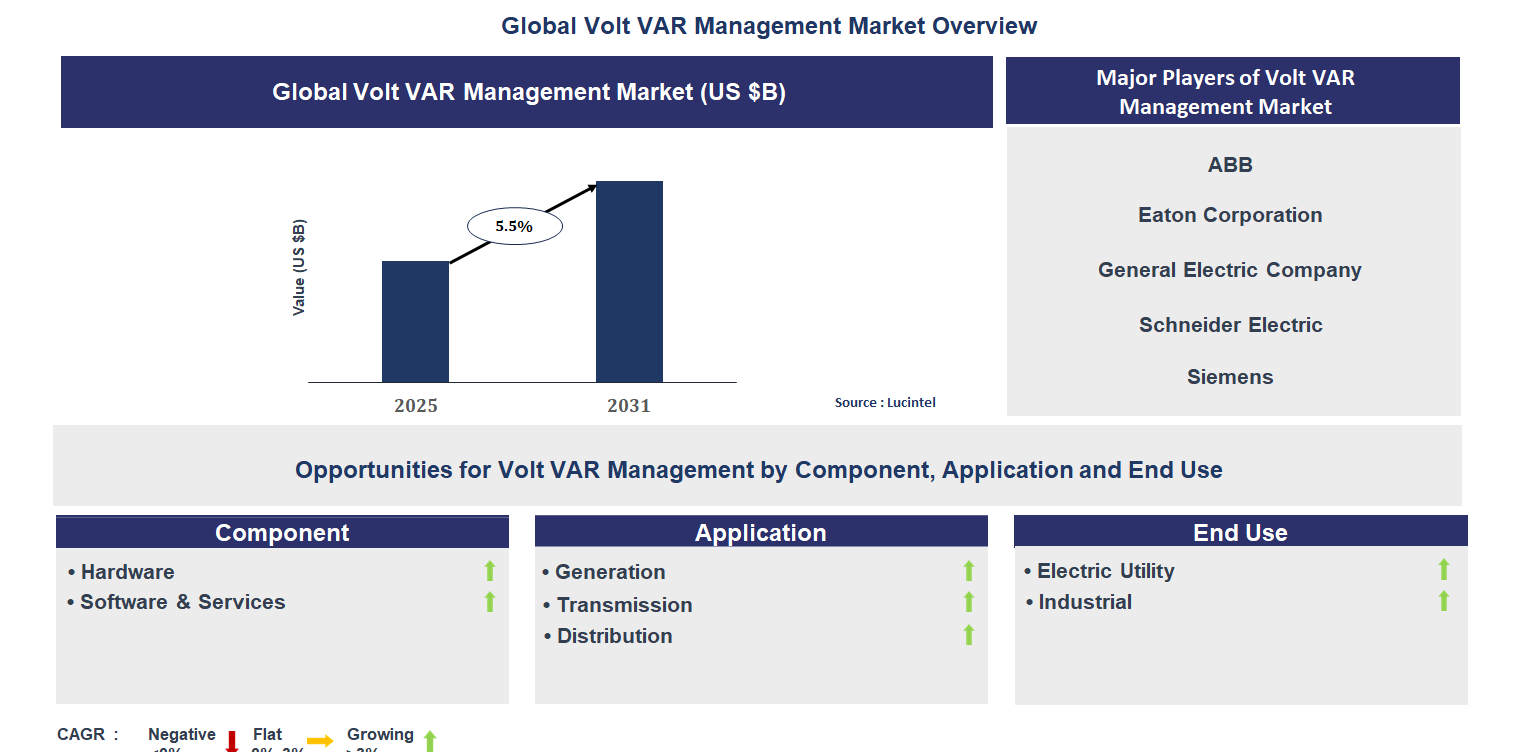
The future of the global volta VAR management market looks promising with opportunities in the electric utility and industrial markets. The global volta VAR management market is expected to grow with a CAGR of 5.5% from 2025 to 2031. The major drivers for this market are the increasing demand for efficient power distribution, the rising integration of renewable energy sources, and the growing need for grid stability solutions.• Lucintel forecasts that, within the application category, distribution is expected to witness the highest growth over the forecast period.
• Within the end use category, electric utility is expected to witness higher growth.
• In terms of region, APAC is expected to witness the highest growth over the forecast period. Gain valuable insights for your business decisions with our comprehensive 150+ page report. Sample figures with some insights are shown below.
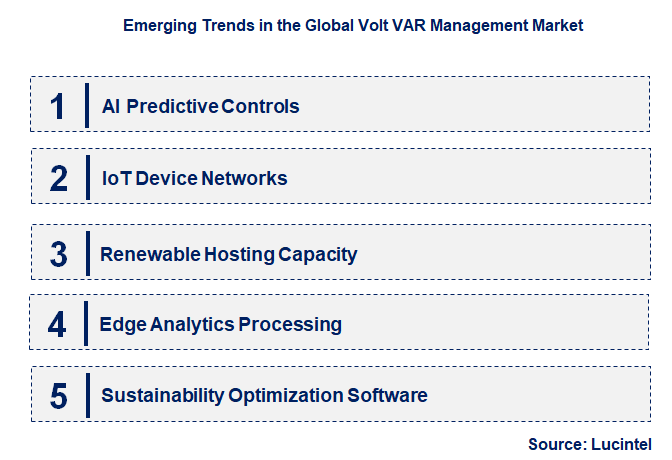
Emerging Trends in the Volt VAR Management Market
The volt VAR management market is shifting toward intelligent, integrated systems amid smart grid expansions. Trends emphasize AI and digital tools for proactive optimization, enabling utilities to handle renewable variability and demand fluctuations effectively.• AI Predictive Controls: AI algorithms are enabling forecast-based VAR adjustments for dynamic grid responses. This trend enhances accuracy in voltage management, cuts energy wastage, and supports autonomous operations, transforming utilities into proactive entities with reduced manual oversight.
• IoT Device Networks: Widespread IoT sensors are providing real-time data for granular Volt VAR monitoring. Their impact includes faster anomaly detection and customized optimizations, boosting grid reliability and enabling scalable deployments in diverse environments.
• Renewable Hosting Capacity: Advanced controls are expanding integration limits for intermittent sources like solar. This fosters higher renewable shares without stability trade-offs, accelerating decarbonization and unlocking ancillary services for revenue diversification.
• Edge Analytics Processing: Localized computing at grid edges is speeding up VAR decision-making. It minimizes communication delays, strengthens microgrid autonomy, and improves fault resilience, ideal for remote or congested network segments.
• Sustainability Optimization Software: Tools linking VAR to emission tracking are promoting eco-focused strategies. This drives regulatory alignment, incentivizes green investments, and positions utilities as leaders in low-carbon infrastructure. These trends are reshaping the volt VAR management market by fostering agility and intelligence. They overcome traditional limitations, expand application scopes, and integrate sustainability, solidifying VVOs role in resilient energy systems.
Recent Development in the Volt VAR Management Market
Key developments in the volt VAR management market center on digital innovations and collaborative integrations for grid enhancements. These progressions are essential for voltage precision, loss mitigation, and renewable accommodation in evolving power infrastructures.• AI Optimization Platforms: New AI platforms are automating VAR tuning for predictive grid stability. This streamlines complex operations, lowers response times, and integrates with legacy systems, empowering utilities to manage peaks efficiently.
• Smart Compensator Deployments: Rugged IoT compensators are being rolled out for feeder-level control. Their role in reactive support reduces overloads, enhances power flow, and supports distributed energy resources seamlessly.
• Utility-Tech Partnerships: Alliances are co-developing hybrid VVO solutions for tailored grids. Such collaborations accelerate innovations, standardize interfaces, and broaden access to advanced controls across regions.
• Substation Sensor Upgrades: Enhanced sensors in substations enable precise voltage profiling. This improves data granularity, aids in loss forecasting, and facilitates proactive adjustments for reliable distribution.
• Analytics Scenario Tools: Refined software for VVO simulations is aiding strategic planning. It optimizes renewable siting, minimizes curtailments, and boosts economic viability through data-informed decisions. These developments are impacting the volt VAR management market by driving interoperability and efficiency. They ease adoption barriers, spur ecosystem growth, and embed VVO deeper into sustainable grid architectures.
Strategic Growth Opportunities in the Volt VAR Management Market
Growth opportunities in the volt VAR management market arise from sector-specific needs for optimized power flows amid electrification. Specialized applications are leveraging VVO for enhanced stability, opening avenues in high-growth areas like renewables and industry.• Utility Feeder Regulation: Feeder-focused VVO maximizes throughput in transmission lines. It curtails losses, integrates distributed generation, and enables demand balancing, vital for utility-scale efficiency.
• Industrial Load Balancing: Tailored systems manage reactive demands in factories. This safeguards machinery, optimizes energy use, and reduces downtime, supporting manufacturing competitiveness.
• Solar Farm Integration: Dynamic controls stabilize outputs from photovoltaic arrays. They maximize yields, ease grid connections, and monetize flexibility, propelling renewable project viability.
• Urban Microgrid Autonomy: Localized VVO in city networks handles variable loads. It fosters resilience, enables peer-to-peer trading, and cuts urban outage risks effectively.
• Commercial Energy Hubs: Building-integrated solutions tune voltages for HVAC and lighting. They lower costs, meet sustainability goals, and enhance occupant services through reliable power. These opportunities are impacting the volt VAR management market by tailoring solutions to niches. They amplify demand diversity, encourage innovations, and reinforce VVOs integral function in modernized energy delivery.
Volt VAR Management Market Driver and Challenges
The volt VAR management market is influenced by tech integrations, economic efficiencies, and policy alignments favoring grid upgrades. These elements are critical for voltage control, energy savings, and alignment with broader electrification goals. The factors responsible for driving the volt VAR management market include: 1. Smart Grid Expansions: Intelligent network rollouts demand VVO for real-time management. This spurs advanced deployments, uniform voltages, and loss reductions, aiding utilities in load handling. 2. Renewable Energy Influx: Intermittent sources necessitate VAR support for stability. It increases hosting potential, aids clean transitions, and complies with emission targets. 3. Efficiency Regulation Pushes: Mandates for power conservation drive VVO adoptions. Incentives cut costs, ensure standards, and attract funding for modernization efforts. 4. IoT Analytics Evolutions: Sensor and AI progressions refine VVO accuracy. This enables predictive tuning, isolation of issues, and bespoke strategies for reliability. 5. Grid Investment Waves: Funding for infrastructure favors VVO projects. It hastens retrofits, unifies standards, and extends reach in varied markets. Challenges in the volt VAR management market are: 1. Legacy Integration Complexities: Merging VVO with old systems risks mismatches. This raises retrofit needs, customization burdens, and rollout delays, calling for compatible designs. 2. Deployment Cost Barriers: Sophisticated setups burden smaller operators financially. Hurdles limit expansions, stressing scalable models for inclusive access. 3. Cyber Risk Exposures: Digitized VVO invites threats to grid integrity. Mitigation adds safeguards and expenses, prioritizing secure architectures. Drivers and challenges in the volt VAR management market create forward momentum, as advancements counter hurdles. This balance promotes innovation, accessibility, and durability, anchoring VVO in evolving power paradigms.List of Volt VAR Management Companies
Companies in the market compete on the basis of product quality offered. Major players in this market focus on expanding their manufacturing facilities, R&D investments, infrastructural development, and leverage integration opportunities across the value chain. With these strategies volta VAR management companies cater increasing demand, ensure competitive effectiveness, develop innovative products & technologies, reduce production costs, and expand their customer base. Some of the volta VAR management companies profiled in this report include-• ABB
• Eaton Corporation
• General Electric Company
• Schneider Electric
• Siemens
• Landis+Gyr
• Dominion Voltage
Volt VAR Management Market by Segment
The study includes a forecast for the global volta VAR management market by component, application, end use, and region.Volt VAR Management Market by Component [Value from 2019 to 2031]:
• Hardware
• Software & Services
Volt VAR Management Market by Application [Value from 2019 to 2031]:
• Generation
• Transmission
• Distribution
Volt VAR Management Market by End Use [Value from 2019 to 2031]:
• Electric Utility
• Industrial
Volt VAR Management Market by Region [Value from 2019 to 2031]:
• North America
• Europe
• Asia Pacific
• The Rest of the World
Country Wise Outlook for the Volt VAR Management Market
The volt VAR management market is evolving with smart grid advancements and renewable integrations, optimizing voltage stability for efficient power distribution. Nations are leveraging AI and IoT for real-time controls, addressing grid challenges from electrification surges and supporting sustainable energy transitions across utilities and industries.• United States: Analytics Integration Surge The United States is advancing Volt VAR through AI-driven analytics and IoT-enabled devices for precise grid voltage regulation. Utilities are deploying smart compensators to enhance operational efficiency, reducing losses and bolstering reliability in distribution networks amid rising renewable penetrations.
• China: Smart Grid Hardware Upgrades China is expanding Volt VAR capabilities via hardware enhancements in high-demand feeders for smart grid frameworks. These upgrades improve power quality in industrial zones, minimizing reactive losses and facilitating seamless electrification in vast urban and manufacturing landscapes.
• Germany: AI Optimization Platforms Germany is innovating with AI-enabled platforms for grid voltage tuning in renewable-heavy systems. Breakthroughs in optimization tools promote dynamic control, ensuring stability and compliance with energy directives while enhancing integration in manufacturing and distribution sectors.
• India: Renewable Control Pilots India is progressing Volt VAR through pilots integrating controls with solar and wind for voltage stability. These efforts bridge infrastructure gaps, support rural grids, and drive efficiency in expanding networks for industrial and residential applications.
• Japan: Low-Voltage Tech Focus Japan is refining Volt VAR technologies for low-voltage distribution with advanced utility solutions. Regulatory-driven advancements enhance precision control, improving resilience in urban setups and aligning with high-tech energy demands.

Features of the Global Volt VAR Management Market
Market Size Estimates: Volt var management market size estimation in terms of value ($B). Trend and Forecast Analysis: Market trends (2019 to 2024) and forecast (2025 to 2031) by various segments and regions. Segmentation Analysis: Volt var management market size by component, application, end use, and region in terms of value ($B). Regional Analysis: Volt var management market breakdown by North America, Europe, Asia Pacific, and Rest of the World. Growth Opportunities: Analysis of growth opportunities in different component, application, end use, and regions for the volta VAR management market. Strategic Analysis: This includes M&A, new product development, and competitive landscape of the volta VAR management market. Analysis of competitive intensity of the industry based on Porter’s Five Forces model.
FAQ
Q1. What is the growth forecast for volta VAR management market? Answer: The global volta VAR management market is expected to grow with a CAGR of 5.5% from 2025 to 2031. Q2. What are the major drivers influencing the growth of the volta VAR management market? Answer: The major drivers for this market are the increasing demand for efficient power distribution, the rising integration of renewable energy sources, and the growing need for grid stability solutions. Q3. What are the major segments for volta VAR management market? Answer: The future of the volta VAR management market looks promising with opportunities in the electric utility and industrial markets. Q4. Who are the key volta VAR management market companies? Answer: Some of the key volta VAR management companies are as follows:• ABB
• Eaton Corporation
• General Electric Company
• Schneider Electric
• Siemens
• Landis+Gyr
• Dominion Voltage Q5. Which volta VAR management market segment will be the largest in future? Answer: Lucintel forecasts that, within the application category, distribution is expected to witness the highest growth over the forecast period. Q6. In volta VAR management market, which region is expected to be the largest in next 5 years? Answer: In terms of region, APAC is expected to witness the highest growth over the forecast period. Q7. Do we receive customization in this report? Answer: Yes, Lucintel provides 10% customization without any additional cost.
Table of Contents
List of Figures
List of Tables
Methodology
- In-depth interviews of the major players in this market
- Detailed secondary research from competitors’ financial statements and published data
- Extensive searches of published works, market, and database information pertaining to industry news, company press releases, and customer intentions
- A compilation of the experiences, judgments, and insights of Lucintel’s professionals, who have analyzed and tracked this market over the years.


Buy Now
Choose a license that fits your team. Instant PDF delivery.
Prices exclude taxes. Instant delivery. Custom licensing available on request.
Key Questions
- • What are some of the most promising, high-growth opportunities for the volta VAR management market by component (hardware and software & services), application (generation, transmission, and distribution), end use (electric utility and industrial), and region (North America, Europe, Asia Pacific, and the Rest of the World)?
- • Which segments will grow at a faster pace and why?
- • Which region will grow at a faster pace and why?
- • What are the key factors affecting market dynamics? What are the key challenges and business risks in this market?
- • What are the business risks and competitive threats in this market?
- • What are the emerging trends in this market and the reasons behind them?
- • What are some of the changing demands of customers in the market?
- • What are the new developments in the market? Which companies are leading these developments?
- • Who are the major players in this market? What strategic initiatives are key players pursuing for business growth?
- • What are some of the competing products in this market and how big of a threat do they pose for loss of market share by material or product substitution?
- • What M&A activity has occurred in the last 5 years and what has its impact been on the industry? For any questions related to Volt VAR Management Market, Volt VAR Management Market Size, Volt VAR Management Market Growth, Volt VAR Management Market Analysis, Volt VAR Management Market Report, Volt VAR Management Market Share, Volt VAR Management Market Trends, Volt VAR Management Market Forecast, Volt VAR Management Companies, write Lucintel analyst at email: helpdesk@lucintel.com. We will be glad to get back to you soon.


