
Market Report · July 16, 2026

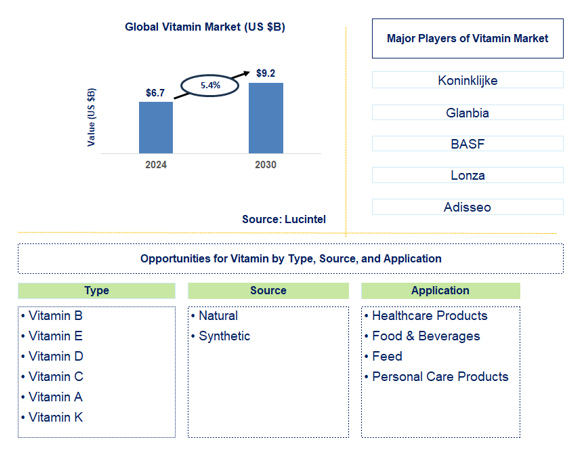
Key data points: The market size in 2030 = $9.2 billion, growth forecast = 5.4% annually for the next 6 years. Scroll below to get more insights. This market report covers trends, opportunities, and forecasts in the global vitamin market to 2030 by type (vitamin B, vitamin E, vitamin D, vitamin C, vitamin A, and vitamin K), source (natural and synthetic), application (healthcare products, food & beverages, feed, and personal care products), and region (North America, Europe, Asia Pacific, and the Rest of the World)
We'll send your sample report shortly.
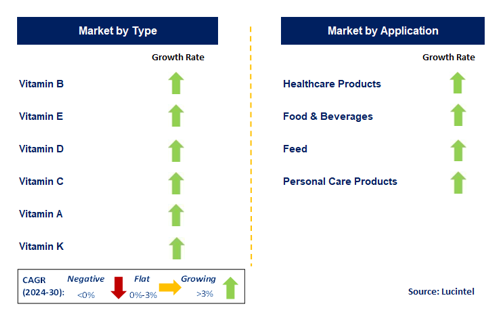
• Lucintel forecasts that, within the type category, vitamin B is expected to witness the highest growth over the forecast period due to its widespread usage in the production of cosmetics, dairy items, dietary supplements, and pharmaceuticals.
• In terms of regions, APAC will remain the largest region over the forecast period due to existence of major manufacturing units and significant demand for vitamins from processed foods, feed, and personal care industries in the region. Gain valuable insight for your business decisions with our comprehensive 150+ page report
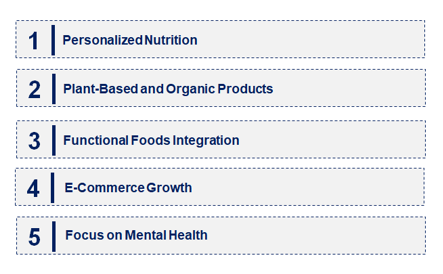
• Personalized Nutrition: Personalized vitamin solutions for individual health profiles are now possible through advances in genetic testing and AI. This trend allows customized recommendations, including dietary supplements that improve efficacy, hence increasing consumer satisfaction.
• Plant-Based and Organic Products: Today’s customers exhibit a growing interest in organic and plant-based vitamins, reflecting their larger preference for natural products. This has led to new product formulations and a wider range of market options.
• Functional Foods Integration: Essential vitamins are increasingly incorporated into functional food and beverages. This trend particularly targets health-conscious consumers who seek practical ways to boost their nutrients from everyday products.
• E-Commerce Growth: The expansion of e-commerce platforms has made vitamins more accessible worldwide, enhancing distribution efficiency and offering a broader range of products to consumers.
• Focus on Mental Health: People are becoming more interested in vitamins that support mental health and enhance cognition. As a result, formulations targeting stress, mood, and brain health are being developed. Emerging trends such as personalized nutrition, plant-based products, functional foods, e-commerce, and a focus on mental health have dramatically changed the vitamin market. These changes have led to increased innovation, diversification of product lines, and improved customer experiences, thereby creating a more individualized vitamin platform.
• Technological Advancements: Technologies like AI-powered recommendations and personalized vitamin subscriptions have drastically changed the consumer selection process for vitamins. These technologies provide customized solutions based on an individual’s medical records.
• Rise of Plant-Based Vitamins: Consumers now prefer organic and plant-based vitamins because they are eco-friendly. Consequently, new product formulas are being developed to meet market demands.
• Functional Foods and Beverages: Functional foods are now including essential elements such as vitamins, allowing people to take necessary nutrients with their daily meals without extra effort.
• Expansion of E-Commerce Channels: The growth of online sales platforms globally has made vitamins more accessible anytime and anywhere. In simple terms, the ease of purchase and wider choices are now available through web-based sales channels.
• Enhanced Product Delivery Systems: Delivery mechanisms have improved with the development of gummies, powders, and drinkable vitamins. These shifts cater to customers’ desires for more enjoyable and user-friendly vitamin products. Technological advances, product formulation changes, e-commerce growth, and improved delivery methods are contributing to the development of the vitamin market. These innovations improve the consumer experience, increase market coverage, and expand business within the sector.
• Personalized Vitamin Solutions: Developing personalized vitamin offerings based on genetic and health data can cater to the growing demand for customized nutrition. This is an opportunity where AI-based platforms collect and analyze genetic data to inform the creation of unique products.
• Expansion of Plant-Based Options: Investing in plant-based and organic vitamin products aligns with the rising consumer preference for natural and sustainable solutions. There is a need to launch new versions with higher quality standards.
• Integration with Functional Foods: Incorporating vitamins into functional foods or drinks helps producers reach health-conscious consumers who prefer easy nutrient sources. In other words, it means making food items with added nutrients like vitamins.
• E-Commerce Growth: Companies should sell their goods via online platforms because it will be easier for them to access global markets. This approach involves enhancing web-based sales channels and digital marketing strategies that attract consumers worldwide.
• Focus on Mental Health Products: The emerging consumer interest in mental well-being has created a need for vitamins that aim to enhance cognitive function. This is an opportunity to design specific compositions for mood, brain health, and stress management. Strategic growth opportunities in personalized solutions, plant-based options, functional foods, e-commerce, and mental health products are shaping the vitamin market. Utilizing these aspects will lead to innovations that can increase market penetration and meet changing consumer demands.
• Technological Advancements: Innovations such as personalized nutrition and AI-driven recommendations are enhancing product offerings and consumer engagement. These technologies provide tailored solutions and improve the effectiveness of vitamin supplements.
• Growing Health Consciousness: Increasing awareness of health and wellness is driving demand for vitamins. Consumers focus more on preventive healthcare and buy supplements to support their general well-being.
• Expansion of E-Commerce: With online stores emerging in different parts of the world, it is becoming easier to go global with vitamin sales. Online sales channels facilitate wider distribution and provide consumers with a greater range of product choices.
• Rise in Functional Foods: Adding vitamins to functional foods meets customer needs for tasty dietetic products that simplify nutrition without sacrificing health benefits. This trend contributes to innovative food products with added vitamins.
• Focus on Sustainability: Consumer preference for sustainable and plant-based products is influencing the vitamin market. Companies should thus develop environmentally friendly and organic sources of vitamins. Challenges in the vitamin market are:
• Regulatory Compliance: Product safety compliance with complex regulations can be difficult; adherence to international standards is crucial before entering any foreign market to build trust.
• Price Sensitivity: Market growth is affected by consumers' price sensitivity. Therefore, quality must be balanced with cost, and the product must remain affordable without compromising on standards to succeed in the market.
• Market Saturation: There are too many types of vitamins in the market. Continuous innovation and effective marketing strategies are required to differentiate offerings and maintain a competitive advantage. The vitamin market has several drivers, including technological advancements, health consciousness, e-commerce growth, functional foods, and sustainability. However, challenges such as regulatory compliance, price sensitivity, and market saturation block efforts aimed at achieving sustainable growth and success.
• Koninklijke
• Glanbia
• BASF
• Lonza
• Adisseo
• Vitablend
• SternVitamin
• Vitamin B
• Vitamin E
• Vitamin D
• Vitamin C
• Vitamin A
• Vitamin K
• Natural
• Synthetic
• Healthcare Products
• Food & Beverages
• Feed
• Personal Care Products
• North America
• Europe
• Asia Pacific
• The Rest of the World
• United States: Recent developments in the United States include an upsurge in customized vitamin supplements, boosted by advances in genetic testing and AI. These are now tailored to individual health conditions, such as plant-based or organic options, depending on consumer preferences. This is accompanied by improved bioavailability products like gummies and powders.
• China: Increasing health awareness, coupled with rising disposable incomes, has fueled the growth of the Chinese vitamin market. Some of the latest changes include the introduction of high-quality international vitamin brands and products tailored to local food habits. Packaging and distribution improvements are also notable, with a strong inclination towards e-commerce channels due to growing demand. Recently, there has been a focus on immunomodulatory vitamins due to public health concerns.
• Germany: In Germany, scientific evidence supports the dominance of supplements in the market, while regulatory compliance is highly observed. The latest generation of their products has scientifically proven benefits, and vegan or vegetarian vitamins have become popular alternatives. Additionally, there is an interest in micronutrient supplements aimed at supporting mental well-being and cognitive function. German consumers prioritize ingredient sourcing accountability and efficacy.
• India: With increased awareness about healthy living among people, the Indian vitamin market is evolving rapidly due to the growing middle-class population. Recent trends show that it is now easier to obtain various types of vitamins through online platforms or retail chains, especially when searching online within India. There is also an emphasis on affordable yet high-quality vitamins meant for different health conditions. Innovative packaging and product formulation approaches aim to enhance consumer convenience while addressing region-specific health concerns.
• Japan: Longevity and wellness have driven recent developments in Japan’s vitamin market. Other observed changes include vitamins for joint pain, anti-aging, and general wellness. Recent trends show a focus on addressing specific health concerns such as stress or digestive system issues. The development of convenient delivery systems, like sachets or drinkable vitamins, is becoming a new trend.


• Koninklijke
• Glanbia
• BASF
• Lonza
• Adisseo
• Vitablend
• SternVitamin Q6. Which vitamin market segment will be the largest in future? Answer: Lucintel forecasts that vitamin B is expected to witness the highest growth over the forecast period due to its widespread usage in the production of cosmetics, dairy items, dietary supplements, and pharmaceuticals. Q7. In vitamin market, which region is expected to be the largest in next 5 years? Answer:
• In terms of regions, APAC will remain the largest region over the forecast period due to existence of major manufacturing units and significant demand for vitamins from processed foods, feed, and personal care industries in the region. Q.8 Do we receive customization in this report? Answer: Yes, Lucintel provides 10% customization without any additional cost.


Choose a license that fits your team. Instant PDF delivery.
Prices exclude taxes. Instant delivery. Custom licensing available on request.
Market Report · July 16, 2026
Market Report · July 15, 2026
Market Report · July 15, 2026
Trusted partner for strategic intelligence and business growth


Receive a complimentary market analysis tailored to your industry. Our analysts will identify key growth opportunities and competitive dynamics specific to your business.

Market size, growth rate, and key trend analysis for your specific sector.

Top competitor positioning and market share analysis.

Strategic recommendations backed by data-driven insights.
Get curated market intelligence and competitive moves straight to your inbox.
By subscribing, you agree to receive our monthly insights. Unsubscribe anytime.
Receive a complimentary market analysis tailored to your industry. Our analysts will identify key growth opportunities and competitive dynamics specific to your business.
Market size, growth rate, and key trend analysis for your specific sector.
Top competitor positioning and market share analysis.
Strategic recommendations backed by data-driven insights.
Get curated market intelligence, emerging trends, and competitive moves straight to your inbox each month.
By subscribing, you agree to receive our monthly insights. Unsubscribe anytime.
We'll send your sample report shortly.