
Report Feature
Virtual Training Market Trends and Forecast
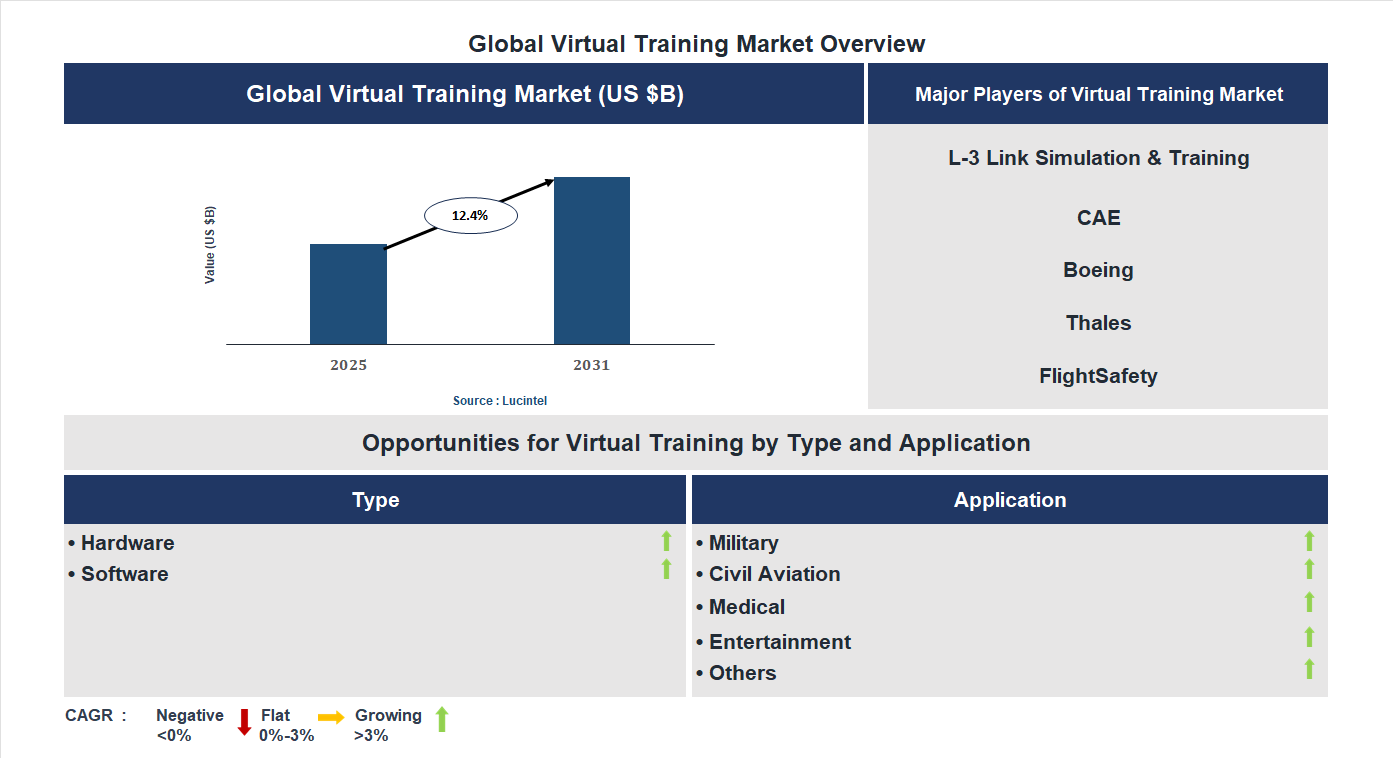
The future of the global virtual training market looks promising with opportunities in the military, civil aviation, medical, and entertainment markets. The global virtual training market is expected to grow with a CAGR of 12.4% from 2025 to 2031. The major drivers for this market are the increasing demand for remote employee skill development, the rising adoption of VR AR training solutions, and growing focus on cost effective learning programs.• Lucintel forecasts that, within the type category, software is expected to witness higher growth over the forecast period.
• Within the application category, military is expected to witness the highest growth.
• In terms of region, APAC is expected to witness the highest growth over the forecast period. Gain valuable insights for your business decisions with our comprehensive 150+ page report. Sample figures with some insights are shown below.
Emerging Trends in the Virtual Training Market
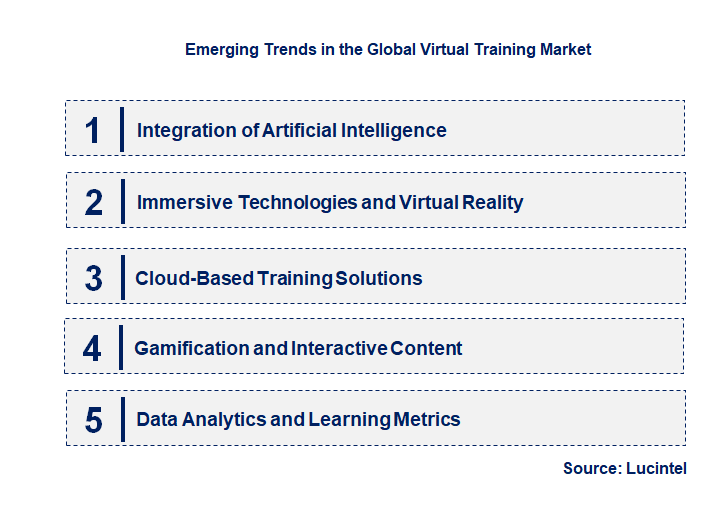
The virtual training market is experiencing rapid growth driven by technological advancements, changing workforce needs, and the increasing demand for flexible learning solutions. As organizations seek cost-effective, scalable, and engaging training methods, the market is evolving with innovative approaches and expanding applications across various industries. The COVID-19 pandemic accelerated adoption, highlighting the importance of remote learning environments. These developments are transforming traditional training paradigms, making virtual training more accessible, personalized, and interactive. The following key trends illustrate how the market is shaping the future of corporate and educational training landscapes.• Integration of Artificial Intelligence (AI): AI-powered virtual training platforms are enabling personalized learning experiences by adapting content to individual learner needs. These systems analyze user performance and preferences to deliver tailored modules, increasing engagement and retention. AI also facilitates automated assessments and real-time feedback, enhancing the overall effectiveness of training programs. As AI technology advances, virtual training becomes more intuitive, scalable, and capable of addressing diverse learning styles, thereby improving outcomes and reducing training costs.
• Immersive Technologies and Virtual Reality (VR): The adoption of VR and augmented reality (AR) is creating immersive training environments that simulate real-world scenarios. These technologies enhance experiential learning, especially in fields like healthcare, manufacturing, and aviation, where hands-on practice is crucial. VR provides safe, cost-effective, and repeatable training sessions, reducing risks and resource expenditure. As hardware becomes more affordable and content development more streamlined, immersive training is becoming mainstream, offering engaging and highly effective learning experiences that boost skill acquisition and confidence.
• Cloud-Based Training Solutions: Cloud technology is enabling scalable, flexible, and easily accessible virtual training platforms. Organizations can deploy and update training content rapidly without extensive infrastructure investments. Cloud-based solutions support live streaming, on-demand content, and collaborative learning, fostering a more connected and interactive environment. This trend allows for seamless integration with existing enterprise systems and supports remote and distributed teams, making training more inclusive and adaptable to various organizational needs.
• Gamification and Interactive Content: Incorporating game elements into virtual training enhances motivation, engagement, and knowledge retention. Features like leaderboards, badges, and challenges incentivize learners and promote active participation. Interactive content such as quizzes, simulations, and scenario-based exercises make learning more dynamic and enjoyable. This approach caters to diverse learning preferences and encourages continuous improvement. As gamification becomes more sophisticated, it is transforming virtual training into a more compelling and effective experience, leading to better learner outcomes and higher completion rates.
• Data Analytics and Learning Metrics: Advanced analytics tools are providing insights into learner behavior, progress, and training effectiveness. Organizations can track engagement levels, assessment scores, and skill development in real-time, enabling data-driven decision-making. These insights help tailor future training programs, identify knowledge gaps, and measure ROI more accurately. The integration of analytics fosters a culture of continuous improvement and personalization, ensuring training remains relevant and impactful. As data capabilities expand, virtual training providers can deliver more targeted, efficient, and measurable learning experiences. In summary, these emerging trends are fundamentally reshaping the virtual training market by making learning more personalized, immersive, accessible, engaging, and data-driven. They are enabling organizations to deliver more effective training at scale, fostering a more skilled and adaptable workforce while reducing costs and increasing flexibility. As technology continues to evolve, the market is poised for further innovation and growth, transforming how knowledge is acquired and applied across industries.
Recent Development in the Virtual Training Market
The virtual training market has experienced significant growth driven by technological advancements, increased demand for remote learning, and the need for cost-effective training solutions across various industries. The COVID-19 pandemic accelerated adoption, highlighting the importance of virtual platforms for education and corporate training. As organizations seek flexible, scalable, and engaging training methods, the market continues to evolve rapidly. Innovations in immersive technologies, such as virtual reality (VR) and augmented reality (AR), are transforming the training landscape. This dynamic environment presents numerous opportunities and challenges, shaping the future of virtual training globally.• Adoption of Immersive Technologies: The integration of VR and AR in virtual training has revolutionized learning experiences by providing realistic, interactive environments. This development enhances engagement, retention, and practical skill acquisition, especially in sectors like healthcare, manufacturing, and military training. Companies investing in immersive tech are gaining competitive advantages through improved training outcomes and reduced costs associated with traditional methods.
• Growth of Cloud-Based Platforms: Cloud technology has facilitated scalable, accessible, and cost-effective virtual training solutions. Cloud platforms enable real-time collaboration, easy content updates, and seamless access across devices and locations. This development has expanded the reach of virtual training, especially for remote and distributed teams, fostering global learning ecosystems and reducing infrastructure costs for organizations.
• Increased Use of Artificial Intelligence: AI-driven virtual training platforms now offer personalized learning paths, automated assessments, and adaptive feedback. AI enhances learner engagement by tailoring content to individual needs and tracking progress efficiently. This innovation improves training effectiveness, accelerates skill development, and reduces the burden on trainers, making virtual training more efficient and learner-centric.
• Strategic Partnerships and Collaborations: Major technology firms, educational institutions, and corporations are forming alliances to develop advanced virtual training solutions. These collaborations focus on integrating cutting-edge technologies, expanding content libraries, and creating industry-specific training modules. Such partnerships accelerate innovation, improve content quality, and broaden market reach, fostering a more competitive and diverse virtual training ecosystem.
• Regulatory and Standardization Initiatives: Governments and industry bodies are establishing standards and guidelines for virtual training quality, data security, and accessibility. These initiatives aim to ensure consistent, reliable, and secure training experiences across platforms. Regulatory developments build trust among users, promote wider adoption, and facilitate international recognition of virtual training certifications. In summary, these developments are significantly transforming the virtual training market by enhancing technological capabilities, expanding accessibility, and improving training quality. The adoption of immersive tech, cloud platforms, AI, strategic collaborations, and regulatory frameworks collectively drive market growth, making virtual training more effective, scalable, and widely accepted across industries worldwide.
Strategic Growth Opportunities in the Virtual Training Market
The virtual training market is experiencing rapid expansion driven by technological advancements, increasing demand for remote learning solutions, and the need for cost-effective training methods across various industries. As organizations seek flexible and scalable training options, key applications are emerging as significant growth drivers. These opportunities are transforming how companies and educational institutions deliver content, enhance engagement, and improve learning outcomes. The evolving landscape presents numerous avenues for innovation and market penetration, making it essential for stakeholders to identify and capitalize on these growth prospects to stay competitive and meet the rising demand for virtual training solutions.• Corporate Training: Enhanced employee development : Virtual training offers scalable, cost-effective solutions for corporate skill development, onboarding, and compliance training, leading to improved productivity and reduced training costs.
• Education & E-Learning: Remote learning expansion : The adoption of virtual training in education enables access to quality education regardless of location, fostering inclusive learning environments and supporting lifelong learning initiatives.
• Healthcare & Medical Training: Skill enhancement and compliance : Virtual platforms facilitate continuous medical education, surgical simulations, and compliance training, improving healthcare delivery and patient safety.
• Government & Defense: Secure, remote training solutions : Virtual training provides secure, remote environments for military and government personnel, ensuring readiness and compliance without logistical constraints.
• Manufacturing & Industrial Training: On-site and remote skill development : Virtual training supports complex machinery operation, safety protocols, and maintenance procedures, reducing downtime and enhancing workforce safety. In summary, these growth opportunities are significantly impacting the virtual training market by broadening application scope, increasing adoption across sectors, and driving innovation. They enable organizations to deliver more effective, flexible, and scalable training solutions, ultimately fostering a more skilled and adaptable workforce. This evolution is positioning the market for sustained growth and technological advancement in the coming years.
Virtual Training Market Driver and Challenges
The virtual training market is influenced by a variety of technological, economic, and regulatory factors that shape its growth and development. Advances in digital technology, increased internet penetration, and the proliferation of smart devices have made virtual training more accessible and effective. Economic factors such as rising training costs and the need for scalable solutions drive organizations toward virtual platforms. Regulatory frameworks around data security and privacy also impact how providers develop and deliver content. Additionally, the ongoing COVID-19 pandemic has accelerated adoption, highlighting the importance of remote learning solutions. These drivers and challenges collectively determine the trajectory of the virtual training market, influencing innovation, adoption rates, and overall market stability. The factors responsible for driving the virtual training market include:-• Technological Advancements: The rapid evolution of digital technologies, including high-speed internet, cloud computing, and AI, has significantly enhanced virtual training capabilities. These innovations enable immersive, interactive, and personalized learning experiences, making virtual training more engaging and effective. As technology continues to improve, organizations are more inclined to adopt virtual training solutions to meet their workforce development needs efficiently. The integration of augmented reality (AR) and virtual reality (VR) further enriches training modules, providing realistic simulations that improve skill acquisition and retention. This technological progress is expected to sustain the market’s growth by offering innovative and scalable training options.
• Increasing Adoption of E-Learning Platforms: The rising preference for flexible, on-demand learning options is a key driver. Organizations across various sectors are shifting from traditional classroom training to virtual platforms to reduce costs and improve accessibility. E-learning platforms facilitate remote training for geographically dispersed employees, enabling consistent and standardized content delivery. The proliferation of mobile devices and broadband connectivity has further supported this trend, allowing learners to access training anytime and anywhere. The growing acceptance of virtual training in corporate, academic, and government sectors underscores its importance as a cost-effective and scalable solution, fueling market expansion.
• Impact of COVID-19 Pandemic: The pandemic has acted as a catalyst for virtual training adoption worldwide. Lockdowns and social distancing measures restricted physical gatherings, prompting organizations to seek remote learning alternatives. This sudden shift accelerated investments in virtual training infrastructure and content development. Companies recognized the benefits of virtual training, such as reduced travel costs and increased flexibility, leading to sustained adoption even post-pandemic. The pandemic also highlighted the need for resilient training systems capable of supporting remote workforces, thereby reinforcing the importance of virtual training solutions in ensuring business continuity and workforce development.
• Growing Focus on Skill Development and Workforce Training: As industries evolve rapidly, there is an increasing emphasis on continuous skill development to maintain competitiveness. Virtual training offers a scalable and cost-effective way to upskill employees across various levels and geographies. Organizations are leveraging virtual platforms to deliver specialized training, certifications, and compliance programs efficiently. Governments and educational institutions are also promoting virtual training to address skill gaps and improve employability. This focus on lifelong learning and workforce readiness is expected to sustain demand for virtual training solutions, driving market growth through innovative content and delivery methods.
• Cost-Effectiveness and Scalability: Virtual training significantly reduces costs associated with traditional training methods, such as venue rentals, travel, and instructor fees. It allows organizations to train large numbers of employees simultaneously without geographical constraints. The scalability of virtual platforms makes it easier to update content and customize training modules to meet specific organizational needs. This cost-efficiency and flexibility make virtual training an attractive option for businesses seeking to optimize training budgets while expanding their learning programs. As companies continue to prioritize cost savings and operational efficiency, the market for virtual training is poised for continued growth. The challenges facing this virtual training market include:-
• Data Security and Privacy Concerns: As virtual training relies heavily on digital platforms, safeguarding sensitive information becomes critical. Data breaches and cyberattacks pose significant risks, potentially compromising personal and corporate data. Regulatory compliance with data protection laws such as GDPR adds complexity to platform development and deployment. Organizations are cautious about adopting virtual training solutions that do not meet stringent security standards, which can hinder market growth. Ensuring robust cybersecurity measures and transparent data policies is essential to build trust and facilitate wider adoption of virtual training platforms.
• Technological Barriers and Digital Divide: Despite technological advancements, disparities in internet access and device availability remain significant challenges, especially in developing regions. Limited infrastructure can restrict the reach of virtual training, creating a digital divide that hampers inclusive growth. Additionally, varying levels of digital literacy among users can affect engagement and learning outcomes. Overcoming these barriers requires investments in infrastructure, user-friendly platforms, and targeted training programs. Addressing these issues is crucial for expanding the market and ensuring equitable access to virtual training solutions globally.
• Resistance to Change and Adoption Challenges: Organizational inertia and resistance from employees or management can slow the adoption of virtual training. Some stakeholders prefer traditional face-to-face methods due to familiarity or skepticism about the effectiveness of virtual learning. Implementing new technologies also involves change management challenges, including training staff to use new platforms and overcoming cultural barriers. Without proper change management strategies, organizations may face delays or underutilization of virtual training solutions, limiting their potential benefits and market growth. In summary, the virtual training market is driven by technological innovations, increasing adoption of e-learning, pandemic-induced shifts, focus on skill development, and cost efficiencies. However, challenges such as data security, digital divide, and resistance to change pose significant hurdles. These factors collectively influence the pace and scope of market growth, requiring stakeholders to address barriers while leveraging technological and strategic opportunities. The market’s future will depend on how effectively these drivers are harnessed and challenges mitigated to create inclusive, secure, and innovative virtual training ecosystems.
List of Virtual Training Companies
Companies in the market compete on the basis of product quality offered. Major players in this market focus on expanding their manufacturing facilities, R&D investments, infrastructural development, and leverage integration opportunities across the value chain. With these strategies virtual training companies cater increasing demand, ensure competitive effectiveness, develop innovative products & technologies, reduce production costs, and expand their customer base. Some of the virtual training companies profiled in this report include-• L-3 Link Simulation & Training
• CAE
• Boeing
• Thales
• FlightSafety
• Airbus
• Lockheed Martin
• BAE Systems
• Raytheon
• Saab AB
Virtual Training Market by Segment
The study includes a forecast for the global virtual training market by type, application, and region.Virtual Training Market by Type [Value from 2019 to 2031]:
• Hardware
• Software
Virtual Training Market by Application [Value from 2019 to 2031]:
• Military
• Civil Aviation
• Medical
• Entertainment
• Others
Virtual Training Market by Region [Value from 2019 to 2031]:
• North America
• Europe
• Asia Pacific
• The Rest of the World
Country Wise Outlook for the Virtual Training Market
The virtual training market has experienced rapid growth globally, driven by technological advancements, increased remote work, and the need for flexible learning solutions. As organizations seek cost-effective and scalable training methods, countries are adopting innovative approaches to enhance their workforce capabilities. The COVID-19 pandemic accelerated this shift, making virtual training an essential component of corporate and educational strategies worldwide. Each country is leveraging unique technological, regulatory, and cultural factors to shape their virtual training landscape, resulting in diverse developments and opportunities across the globe.• United States: The US has seen significant investments in immersive technologies like AR and VR for virtual training, with major corporations partnering with tech firms to develop advanced simulation programs. The government is also promoting digital skills through federal initiatives, and universities are expanding online certification courses to meet rising demand. The adoption of AI-driven personalized learning platforms is further enhancing training effectiveness.
• China: China is rapidly expanding its virtual training infrastructure, focusing on integrating AI and big data to customize learning experiences. The government supports digital education initiatives, encouraging the development of virtual classrooms and online vocational training. Major tech companies are investing heavily in virtual training platforms, especially in sectors like manufacturing and healthcare, to upskill the workforce and promote digital literacy.
• Germany: Germany emphasizes high-quality, industry-specific virtual training solutions, particularly in manufacturing and engineering sectors. The country is investing in digital transformation projects to modernize vocational training and apprenticeships. There is a growing trend toward blended learning models combining virtual and hands-on training, supported by government funding and industry partnerships to ensure workforce competitiveness.
• India: Indias virtual training market is booming, driven by a large, young population and increasing internet penetration. Edtech startups are innovating with localized content and affordable solutions to reach rural and underserved areas. The government’s Digital India initiative promotes online skilling programs, especially in IT, healthcare, and agriculture, aiming to bridge skill gaps and create employment opportunities.
• Japan: Japan is focusing on integrating virtual training with robotics and AI to address aging workforce challenges. The country is investing in virtual simulations for technical and soft skills development, particularly in manufacturing and service industries. Government policies support lifelong learning and digital upskilling, with a focus on creating resilient, adaptable workforce training systems amid demographic shifts.

Features of the Global Virtual Training Market
Market Size Estimates: Virtual training market size estimation in terms of value ($B). Trend and Forecast Analysis: Market trends (2019 to 2024) and forecast (2025 to 2031) by various segments and regions. Segmentation Analysis: Virtual training market size by type, application, and region in terms of value ($B). Regional Analysis: Virtual training market breakdown by North America, Europe, Asia Pacific, and Rest of the World. Growth Opportunities: Analysis of growth opportunities in different types, applications, and regions for the virtual training market. Strategic Analysis: This includes M&A, new product development, and competitive landscape of the virtual training market. Analysis of competitive intensity of the industry based on Porter’s Five Forces model.
FAQ
Q1. What is the growth forecast for virtual training market? Answer: The global virtual training market is expected to grow with a CAGR of 12.4% from 2025 to 2031. Q2. What are the major drivers influencing the growth of the virtual training market? Answer: The major drivers for this market are the increasing demand for remote employee skill development, the rising adoption of VR AR training solutions, and growing focus on cost effective learning programs. Q3. What are the major segments for virtual training market? Answer: The future of the virtual training market looks promising with opportunities in the military, civil aviation, medical, and entertainment markets. Q4. Who are the key virtual training market companies? Answer: Some of the key virtual training companies are as follows:• L-3 Link Simulation & Training
• CAE
• Boeing
• Thales
• FlightSafety
• Airbus
• Lockheed Martin
• BAE Systems
• Raytheon
• Saab AB Q5. Which virtual training market segment will be the largest in future? Answer: Lucintel forecasts that, within the type category, software is expected to witness higher growth over the forecast period. Q6. In virtual training market, which region is expected to be the largest in next 5 years? Answer: In terms of region, APAC is expected to witness the highest growth over the forecast period. Q7. Do we receive customization in this report? Answer: Yes, Lucintel provides 10% customization without any additional cost.
Table of Contents
List of Figures
List of Tables
Methodology
- In-depth interviews of the major players in this market
- Detailed secondary research from competitors’ financial statements and published data
- Extensive searches of published works, market, and database information pertaining to industry news, company press releases, and customer intentions
- A compilation of the experiences, judgments, and insights of Lucintel’s professionals, who have analyzed and tracked this market over the years.


Buy Now
Choose a license that fits your team. Instant PDF delivery.
Prices exclude taxes. Instant delivery. Custom licensing available on request.
Key Questions
- • What are some of the most promising, high-growth opportunities for the virtual training market by type (hardware and software), application (military, civil aviation, medical, entertainment, and others), and region (North America, Europe, Asia Pacific, and the Rest of the World)?
- • Which segments will grow at a faster pace and why?
- • Which region will grow at a faster pace and why?
- • What are the key factors affecting market dynamics? What are the key challenges and business risks in this market?
- • What are the business risks and competitive threats in this market?
- • What are the emerging trends in this market and the reasons behind them?
- • What are some of the changing demands of customers in the market?
- • What are the new developments in the market? Which companies are leading these developments?
- • Who are the major players in this market? What strategic initiatives are key players pursuing for business growth?
- • What are some of the competing products in this market and how big of a threat do they pose for loss of market share by material or product substitution?
- • What M&A activity has occurred in the last 5 years and what has its impact been on the industry? For any questions related to Virtual Training Market, Virtual Training Market Size, Virtual Training Market Growth, Virtual Training Market Analysis, Virtual Training Market Report, Virtual Training Market Share, Virtual Training Market Trends, Virtual Training Market Forecast, Virtual Training Companies, write Lucintel analyst at email: helpdesk@lucintel.com. We will be glad to get back to you soon.


