
Report Feature
Virtual Host Market Trends and Forecast
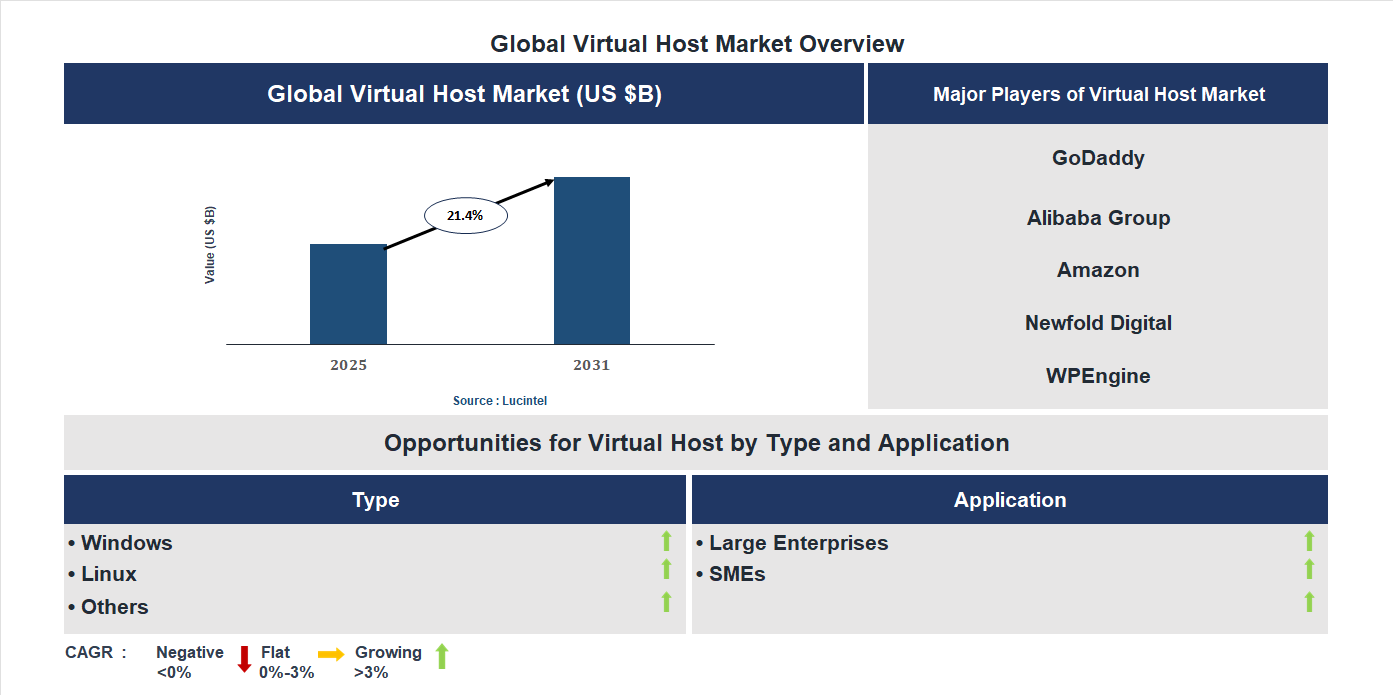
The future of the global virtual host market looks promising with opportunities in the large enterprise and SME markets. The global virtual host market is expected to grow with a CAGR of 21.4% from 2025 to 2031. The major drivers for this market are the increasing demand for scalable hosting solutions, the rising adoption of virtualized server environments, and the growing need for cost efficient web hosting.• Lucintel forecasts that, within the type category, linux is expected to witness higher growth over the forecast period.
• Within the application category, SME is expected to witness higher growth.
• In terms of region, APAC is expected to witness the highest growth over the forecast period. Gain valuable insights for your business decisions with our comprehensive 150+ page report. Sample figures with some insights are shown below.
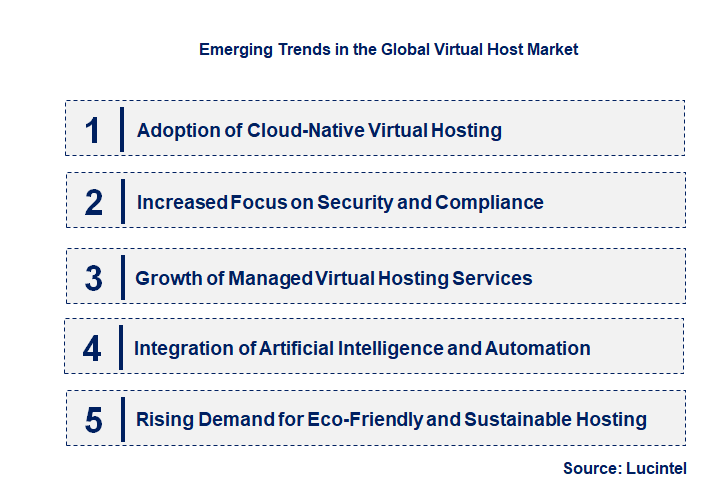
Emerging Trends in the Virtual Host Market
The virtual host market is experiencing rapid growth driven by technological advancements, increasing demand for flexible hosting solutions, and the shift towards cloud-based infrastructure. As businesses seek scalable, cost-effective, and customizable hosting options, the market is evolving with innovative solutions that cater to diverse needs. Emerging trends are shaping the competitive landscape, influencing customer preferences, and driving market expansion. These developments are not only transforming how virtual hosting services are delivered but also redefining the overall digital infrastructure landscape. Understanding these key trends is essential for stakeholders aiming to capitalize on new opportunities and stay ahead in this dynamic market.• Adoption of Cloud-Native Virtual Hosting: This trend involves integrating virtual hosting solutions with cloud-native technologies such as containers and microservices. It enables greater scalability, flexibility, and efficiency, allowing businesses to deploy and manage applications seamlessly across hybrid and multi-cloud environments. The shift enhances performance, reduces costs, and improves resource utilization, making virtual hosting more adaptable to modern digital demands. As organizations increasingly adopt cloud-native architectures, the demand for compatible virtual hosting solutions is expected to rise significantly, driving market growth and innovation.
• Increased Focus on Security and Compliance: With rising cyber threats and stringent data regulations, security and compliance have become critical in the virtual hosting market. Providers are investing in advanced security features such as encryption, intrusion detection, and regular audits to protect data integrity and privacy. Compliance with standards like GDPR, HIPAA, and PCI DSS is also prioritized, ensuring that virtual hosting services meet legal and industry requirements. This focus reassures customers, fosters trust, and differentiates providers in a competitive landscape, ultimately expanding market adoption among sensitive and regulated industries.
• Growth of Managed Virtual Hosting Services: Managed services are gaining popularity as businesses seek hassle-free hosting solutions that require minimal technical expertise. Providers now offer comprehensive management, including monitoring, maintenance, security, and support, allowing clients to focus on core activities. This trend caters to small and medium-sized enterprises (SMEs) and non-technical users, broadening the market base. The convenience, reliability, and expert support associated with managed services are driving their adoption, fueling market expansion and encouraging providers to develop more sophisticated, customer-centric offerings.
• Integration of Artificial Intelligence and Automation: AI-driven tools and automation are transforming virtual hosting by optimizing resource allocation, predicting failures, and enhancing user experience. Automated provisioning, scaling, and troubleshooting reduce downtime and operational costs. AI analytics help providers understand usage patterns and improve service delivery. This integration leads to smarter, more efficient virtual hosting environments that adapt dynamically to changing demands. As AI becomes more accessible, its incorporation into virtual hosting solutions is expected to accelerate, offering competitive advantages and elevating service quality across the market.
• Rising Demand for Eco-Friendly and Sustainable Hosting: Environmental concerns are prompting providers to adopt green practices, such as energy-efficient data centers, renewable energy sources, and carbon offset initiatives. Customers increasingly prefer eco-friendly hosting options, influencing market offerings and corporate strategies. Sustainable practices not only reduce carbon footprints but also appeal to environmentally conscious consumers and businesses. This trend is driving innovation in infrastructure design and operational efficiency, positioning eco-friendly virtual hosting as a key differentiator. As sustainability becomes a priority, the market is likely to see increased investment in green technologies and practices. In summary, these emerging trends are fundamentally reshaping the virtual host market by promoting greater flexibility, security, efficiency, and sustainability. They are enabling providers to meet evolving customer expectations, adapt to technological innovations, and compete more effectively in a rapidly changing digital landscape. As these trends continue to develop, they will drive further growth, innovation, and market transformation.
Recent Development in the Virtual Host Market
The virtual host market has experienced significant growth driven by the increasing demand for scalable, cost-effective hosting solutions across various industries. As businesses shift towards digital transformation, the need for reliable and flexible hosting environments has become paramount. Recent developments reflect technological advancements, strategic partnerships, and evolving customer preferences, shaping the future landscape of virtual hosting services. These changes are influencing market dynamics, competitive strategies, and service offerings, ultimately impacting the adoption rate and market size. Understanding these key developments provides insight into the markets trajectory and potential opportunities for stakeholders.• Adoption of Cloud-Based Virtual Hosting: The shift towards cloud infrastructure has enabled virtual hosts to offer more scalable and flexible solutions, reducing costs and improving performance for clients. This development has expanded market reach, especially among small and medium-sized enterprises seeking affordable hosting options, thereby increasing overall market penetration.
• Integration of AI and Automation: Incorporating artificial intelligence and automation tools into virtual hosting platforms has enhanced management efficiency, security, and customer experience. Automated provisioning and troubleshooting reduce downtime and operational costs, making services more attractive and competitive in the market.
• Strategic Partnerships and Collaborations: Major players are forming alliances with cloud providers, software firms, and hardware vendors to expand service offerings and improve infrastructure. These collaborations facilitate innovation, broaden customer bases, and enable faster deployment of advanced hosting solutions, strengthening market position.
• Focus on Security and Compliance: With rising cyber threats and regulatory requirements, virtual hosts are prioritizing security features and compliance certifications. Enhanced security measures and compliance support attract enterprise clients, boosting market confidence and driving growth in high-value segments.
• Emergence of Niche and Specialized Services: The market is witnessing the rise of niche virtual hosting services tailored for specific industries such as healthcare, finance, and e-commerce. These specialized solutions address unique regulatory and operational needs, creating new revenue streams and expanding market diversity. In summary, these developments are collectively transforming the virtual host market by increasing service flexibility, security, and specialization. They are driving innovation, expanding customer bases, and fostering competitive differentiation, which ultimately accelerates market growth and broadens opportunities for industry participants.
Strategic Growth Opportunities in the Virtual Host Market
The virtual host market is experiencing rapid expansion driven by increasing demand for flexible, scalable, and cost-effective hosting solutions across various industries. As digital transformation accelerates, businesses seek innovative ways to optimize their online presence, leading to new growth opportunities. Key applications such as cloud computing, e-commerce, media streaming, enterprise IT, and education are pivotal in shaping this markets trajectory. These sectors are adopting virtual hosting to enhance performance, reduce costs, and improve user experience. Understanding these growth opportunities helps stakeholders capitalize on emerging trends and stay competitive in a dynamic digital landscape.• Cloud Computing: Expansion of virtual hosting in cloud services enhances scalability and resource management, enabling businesses to deploy applications quickly and efficiently. This growth reduces infrastructure costs and improves agility, attracting startups and large enterprises alike. As cloud adoption accelerates, virtual hosts become essential for providing reliable, on-demand computing power, fostering innovation and digital transformation.
• E-commerce: Virtual hosting supports the rapid growth of online retail platforms by offering secure, high-performance environments. It allows e-commerce businesses to handle fluctuating traffic volumes, ensure website uptime, and deliver seamless shopping experiences. This application drives revenue growth and customer satisfaction, making virtual hosting indispensable for competitive online retail strategies.
• Media Streaming: The demand for high-quality, uninterrupted streaming services relies heavily on virtual hosting solutions. These platforms require scalable, robust infrastructure to manage large data loads and deliver content globally. Virtual hosts enable media companies to expand their reach, improve streaming quality, and reduce latency, thereby enhancing viewer engagement and retention.
• Enterprise IT: Virtual hosting plays a critical role in enterprise IT infrastructure by providing flexible, secure, and cost-effective solutions for data management and application deployment. It supports remote work, disaster recovery, and data security initiatives. This growth opportunity helps enterprises optimize operations, reduce IT overhead, and accelerate digital transformation efforts.
• Education: The shift towards online learning platforms has increased demand for virtual hosting solutions that support virtual classrooms, content delivery, and student management systems. These solutions ensure reliable access, scalability, and security for educational institutions. Virtual hosting facilitates remote education, broadening access and improving learning outcomes. In summary, these key growth opportunities are significantly impacting the virtual host market by driving innovation, improving operational efficiency, and expanding service offerings across diverse sectors. As organizations increasingly rely on virtual hosting solutions, market growth is expected to accelerate, fostering a more connected and digital future.
Virtual Host Market Driver and Challenges
The virtual host market is influenced by a variety of technological, economic, and regulatory factors that shape its growth and development. Rapid advancements in cloud computing, increasing demand for scalable hosting solutions, and the proliferation of online content are key technological drivers. Economic factors such as the rising adoption of digital transformation initiatives by businesses and the decreasing costs of hosting infrastructure further propel market expansion. Regulatory considerations, including data privacy laws and compliance standards, also impact market dynamics. However, the market faces challenges like security concerns, high infrastructure costs, and intense competition, which can hinder growth. Understanding these drivers and challenges is essential for stakeholders to navigate the evolving landscape effectively. The factors responsible for driving the virtual host market include:• Technological Advancements: Rapid innovations in cloud computing and virtualization technologies have significantly enhanced the efficiency, scalability, and flexibility of virtual hosting solutions. These advancements enable businesses to deploy and manage their online infrastructure more effectively, reducing costs and improving performance. The integration of AI and automation tools further optimizes resource allocation and system management, attracting more organizations to adopt virtual hosting. As technology continues to evolve, the market is expected to experience sustained growth driven by improved service offerings and increased adoption across various sectors.
• Growing Digital Transformation: Businesses across industries are increasingly embracing digital transformation to improve operational efficiency and customer engagement. Virtual hosting plays a crucial role in this shift by providing scalable, cost-effective, and reliable online infrastructure. The demand for cloud-based services, e-commerce platforms, and digital content delivery fuels the need for virtual hosting solutions. As organizations seek to modernize their IT infrastructure, the market benefits from a surge in demand, especially among small and medium-sized enterprises looking for affordable hosting options.
• Cost Efficiency and Scalability: Virtual hosting offers significant cost advantages over traditional dedicated hosting by allowing multiple clients to share resources on a single physical server. This shared environment reduces capital expenditure and operational costs for businesses. Additionally, virtual hosting provides scalability, enabling organizations to easily upgrade or downgrade their resources based on demand without significant infrastructure investments. This flexibility appeals to startups and growing companies, driving market expansion as they seek affordable and adaptable hosting solutions to support their growth.
• Increasing Adoption of Cloud Services: The proliferation of cloud computing has been a major driver for the virtual host market. Cloud services offer on-demand resource provisioning, high availability, and disaster recovery capabilities, making them attractive to organizations seeking reliable hosting options. Virtual hosting is integral to cloud infrastructure, facilitating the deployment of scalable applications and services. The shift towards hybrid and multi-cloud environments further accelerates demand, as businesses look for flexible hosting solutions that can seamlessly integrate with their existing IT ecosystems.
• Rising Internet Penetration and Content Consumption: The exponential increase in internet users and online content consumption globally has created a substantial demand for virtual hosting services. Content providers, streaming platforms, and e-commerce sites require robust hosting solutions to ensure high performance and minimal downtime. The growth of social media, online gaming, and digital entertainment has also contributed to this trend. As internet penetration deepens, especially in emerging markets, the market for virtual hosting is poised for continued growth driven by the need to support expanding digital audiences. The challenges facing this virtual host market include:
• Security Concerns: As virtual hosting involves sharing resources and data across multiple tenants, security remains a critical concern. Cyber threats such as data breaches, malware, and DDoS attacks pose risks to both service providers and clients. Ensuring data privacy and compliance with regulations like GDPR adds complexity to security management. Failure to address these concerns can lead to loss of customer trust, legal penalties, and increased costs for security measures, potentially hindering market growth and adoption.
• High Infrastructure and Maintenance Costs: While virtual hosting reduces costs compared to dedicated hosting, initial setup and ongoing maintenance of infrastructure can be expensive. Upgrading hardware, ensuring high availability, and implementing robust security protocols require significant investment. Small and medium-sized enterprises may find these costs prohibitive, limiting their ability to adopt virtual hosting solutions. Additionally, rapid technological changes necessitate continuous upgrades, further escalating expenses and impacting profitability for providers.
• Intense Market Competition: The virtual host market is highly competitive, with numerous providers ranging from global giants to local players. Price wars, service differentiation, and customer retention strategies intensify competition, often leading to reduced profit margins. New entrants face challenges in establishing trust and infrastructure, while existing providers must innovate constantly to maintain their market share. This competitive landscape can slow market growth and create barriers for smaller or emerging companies trying to penetrate the market. In summary, the virtual host market is driven by technological innovations, digital transformation, cost advantages, cloud adoption, and increasing internet usage. However, security issues, high infrastructure costs, and fierce competition pose significant challenges. These factors collectively influence market dynamics, requiring stakeholders to balance growth opportunities with risk management. Overall, the market is poised for continued expansion, provided that players effectively address these challenges and leverage emerging technological trends.
List of Virtual Host Companies
Companies in the market compete on the basis of product quality offered. Major players in this market focus on expanding their manufacturing facilities, R&D investments, infrastructural development, and leverage integration opportunities across the value chain. With these strategies virtual host companies cater increasing demand, ensure competitive effectiveness, develop innovative products & technologies, reduce production costs, and expand their customer base. Some of the virtual host companies profiled in this report include-• GoDaddy
• Alibaba Group
• Amazon
• Newfold Digital
• WPEngine
• Baidu
• HUAWEI
• DigitalOcean
• InMotion Hosting
• Liquid Web
Virtual Host Market by Segment
The study includes a forecast for the global virtual host market by type, application, and region.Virtual Host Market by Type [Value from 2019 to 2031]:
• Windows
• Linux
• Others
Virtual Host Market by Application [Value from 2019 to 2031]:
• Large Enterprises
• SMEs
Virtual Host Market by Region [Value from 2019 to 2031]:
• North America
• Europe
• Asia Pacific
• The Rest of the World
Country Wise Outlook for the Virtual Host Market
The virtual host market has experienced significant growth driven by increasing demand for scalable, cost-effective hosting solutions across various industries. Technological advancements, rising cloud adoption, and the need for enhanced security have propelled market expansion globally. Countries are adopting innovative strategies to improve infrastructure, integrate AI, and enhance user experience. Regulatory changes and cybersecurity concerns also influence market dynamics. As digital transformation accelerates, the virtual hosting landscape continues to evolve, with key players investing in new technologies and expanding their service portfolios to meet diverse customer needs. This report highlights recent developments in the United States, China, Germany, India, and Japan.• United States: The US market has seen rapid adoption of cloud-based virtual hosting solutions, driven by major tech companies and startups. Innovations in AI and machine learning are being integrated to optimize performance and security. Data privacy regulations like GDPR influence service offerings, prompting providers to enhance compliance measures. The rise of hybrid cloud environments and edge computing further boost demand for flexible virtual hosting options. Major players are investing in infrastructure upgrades and expanding data center networks to support growing digital needs.
• China: China’s virtual host market is expanding swiftly, supported by government initiatives promoting digital infrastructure and cloud computing. Local providers are gaining ground by offering cost-effective, scalable solutions tailored to domestic businesses. The integration of 5G technology enhances the performance and connectivity of virtual hosting services. E-commerce and online gaming sectors are significant drivers, pushing providers to innovate with high-performance hosting options. Regulatory policies focus on data sovereignty and cybersecurity, shaping the development of the market.
• Germany: The German market emphasizes data security and compliance with strict EU regulations, such as GDPR. Providers are investing in secure, environmentally sustainable data centers to meet corporate and governmental demands. There is a growing trend toward hybrid and private cloud solutions for sensitive data management. The adoption of containerization and virtualization technologies is increasing, enabling more flexible and efficient hosting environments. German companies are also focusing on energy-efficient infrastructure to align with sustainability goals, fostering innovation in green hosting solutions.
• India: India’s virtual host market is experiencing rapid growth due to increasing internet penetration and digital transformation initiatives. Local providers are expanding their infrastructure to cater to small and medium-sized enterprises (SMEs). Cloud adoption is accelerating, driven by government schemes like Digital India. The market is witnessing a surge in demand for affordable, scalable hosting services, including shared and VPS hosting. Startups and e-commerce platforms are key users, pushing providers to innovate with cost-effective, reliable solutions. Regulatory frameworks are evolving to support secure and compliant hosting services.
• Japan: The Japanese market is characterized by high adoption of advanced virtualization technologies and a focus on security and reliability. Major providers are investing in cutting-edge data centers with disaster recovery and backup capabilities. The rise of IoT and AI applications is increasing demand for specialized virtual hosting solutions. Companies are adopting hybrid cloud models to balance flexibility and security. Regulatory compliance, especially concerning data privacy, remains a priority. The market is also seeing a push toward environmentally friendly data centers, aligning with Japan’s sustainability initiatives.

Features of the Global Virtual Host Market
Market Size Estimates: Virtual host market size estimation in terms of value ($B). Trend and Forecast Analysis: Market trends (2019 to 2024) and forecast (2025 to 2031) by various segments and regions. Segmentation Analysis: Virtual host market size by type, application, and region in terms of value ($B). Regional Analysis: Virtual host market breakdown by North America, Europe, Asia Pacific, and Rest of the World. Growth Opportunities: Analysis of growth opportunities in different types, applications, and regions for the virtual host market. Strategic Analysis: This includes M&A, new product development, and competitive landscape of the virtual host market. Analysis of competitive intensity of the industry based on Porter’s Five Forces model.
FAQ
Q1. What is the growth forecast for virtual host market? Answer: The global virtual host market is expected to grow with a CAGR of 21.4% from 2025 to 2031. Q2. What are the major drivers influencing the growth of the virtual host market? Answer: The major drivers for this market are the increasing demand for scalable hosting solutions, the rising adoption of virtualized server environments, and the growing need for cost efficient web hosting. Q3. What are the major segments for virtual host market? Answer: The future of the virtual host market looks promising with opportunities in the large enterprise and SME markets. Q4. Who are the key virtual host market companies? Answer: Some of the key virtual host companies are as follows:• GoDaddy
• Alibaba Group
• Amazon
• Newfold Digital
• WPEngine
• Baidu
• HUAWEI
• DigitalOcean
• InMotion Hosting
• Liquid Web Q5. Which virtual host market segment will be the largest in future? Answer: Lucintel forecasts that, within the type category, linux is expected to witness higher growth over the forecast period. Q6. In virtual host market, which region is expected to be the largest in next 5 years? Answer: In terms of region, APAC is expected to witness the highest growth over the forecast period. Q7. Do we receive customization in this report? Answer: Yes, Lucintel provides 10% customization without any additional cost.
Table of Contents
List of Figures
List of Tables
Methodology
- In-depth interviews of the major players in this market
- Detailed secondary research from competitors’ financial statements and published data
- Extensive searches of published works, market, and database information pertaining to industry news, company press releases, and customer intentions
- A compilation of the experiences, judgments, and insights of Lucintel’s professionals, who have analyzed and tracked this market over the years.


Buy Now
Choose a license that fits your team. Instant PDF delivery.
Prices exclude taxes. Instant delivery. Custom licensing available on request.
Key Questions
- • What are some of the most promising, high-growth opportunities for the virtual host market by type (windows, linux, and others), application (large enterprises and SMEs), and region (North America, Europe, Asia Pacific, and the Rest of the World)?
- • Which segments will grow at a faster pace and why?
- • Which region will grow at a faster pace and why?
- • What are the key factors affecting market dynamics? What are the key challenges and business risks in this market?
- • What are the business risks and competitive threats in this market?
- • What are the emerging trends in this market and the reasons behind them?
- • What are some of the changing demands of customers in the market?
- • What are the new developments in the market? Which companies are leading these developments?
- • Who are the major players in this market? What strategic initiatives are key players pursuing for business growth?
- • What are some of the competing products in this market and how big of a threat do they pose for loss of market share by material or product substitution?
- • What M&A activity has occurred in the last 5 years and what has its impact been on the industry? For any questions related to Virtual Host Market, Virtual Host Market Size, Virtual Host Market Growth, Virtual Host Market Analysis, Virtual Host Market Report, Virtual Host Market Share, Virtual Host Market Trends, Virtual Host Market Forecast, Virtual Host Companies, write Lucintel analyst at email: helpdesk@lucintel.com. We will be glad to get back to you soon.


