
Report Feature
Video Surveillance Cloud Storage Market Trends and Forecast
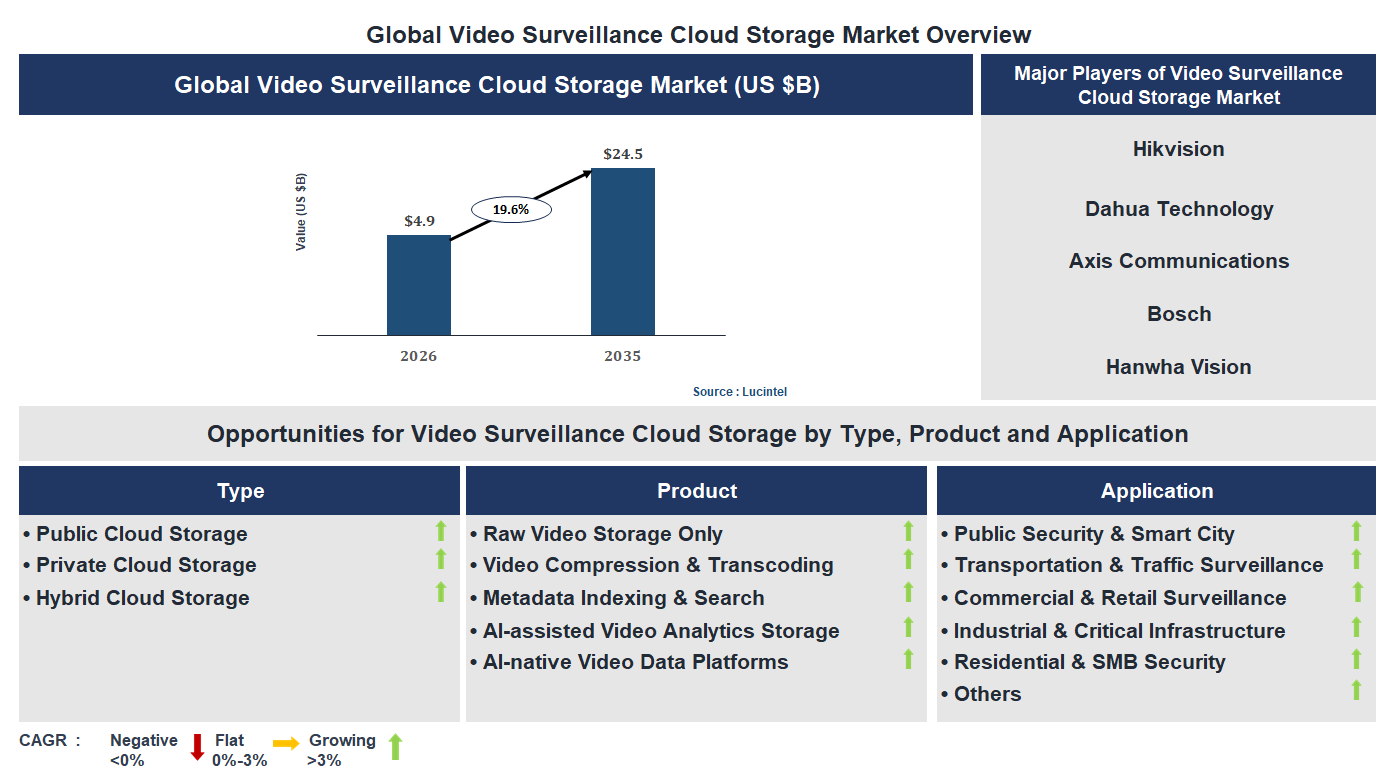
The future of the global video surveillance cloud storage market looks promising with opportunities in the public security & smart city, transportation & traffic surveillance, commercial & retail surveillance, industrial & critical infrastructure, and residential & SMB security markets. The global video surveillance cloud storage market is expected to reach an estimated $24.5 billion by 2035 with a CAGR of 19.6% from 2026 to 2035. The major drivers for this market are the increasing adoption of cloud-based solutions, the rising demand for data security, and the growing need for remote video access.• Lucintel forecasts that, within the type category, hybrid cloud storage is expected to witness the highest growth over the forecast period.
• Within the application category, public security & smart city is expected to witness the highest growth.
• In terms of region, APAC is expected to witness the highest growth over the forecast period. Gain valuable insights for your business decisions with our comprehensive 150+ page report. Sample figures with some insights are shown below.
Emerging Trends in the Video Surveillance Cloud Storage Market
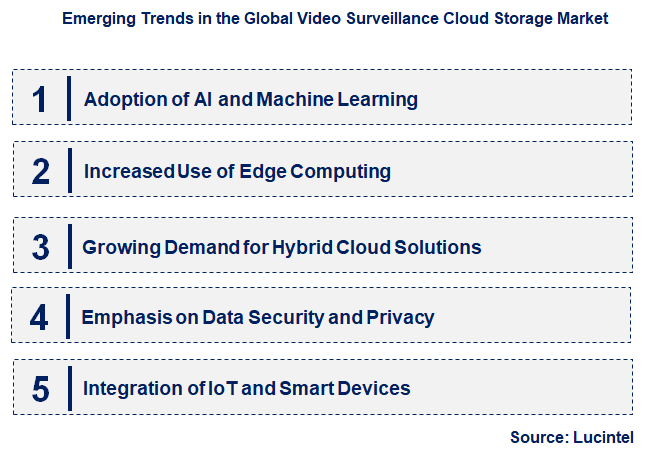
The video surveillance cloud storage market is experiencing rapid growth driven by technological advancements, increasing security concerns, and the shift towards digital solutions. As organizations seek more flexible, scalable, and cost-effective storage options, the market is evolving with innovative trends that redefine how surveillance data is stored, managed, and analyzed. These developments are not only enhancing security capabilities but also enabling smarter, more integrated surveillance systems. The following key trends highlight the transformative changes shaping this market, reflecting a move towards more efficient, accessible, and intelligent cloud storage solutions for video surveillance.• Adoption of AI and Machine Learning: Integration of AI and ML technologies is revolutionizing cloud storage in video surveillance by enabling real-time analytics, facial recognition, and behavior analysis. These capabilities improve threat detection, reduce false alarms, and facilitate proactive security measures. As AI becomes more sophisticated, cloud storage platforms are increasingly equipped to handle large data volumes with advanced processing, making surveillance smarter and more responsive. This trend enhances operational efficiency and security outcomes, driving higher adoption rates across various sectors. Increased Use of Edge Computing: Edge computing is emerging as a complementary technology to cloud storage, allowing data processing closer to the source. This reduces latency, bandwidth consumption, and storage costs while enabling faster decision-making. In video surveillance, edge devices can pre-process footage before transmitting relevant data to the cloud, optimizing storage and analysis. This trend supports real-time monitoring and enhances system reliability, especially in remote or bandwidth-constrained environments. The synergy between edge and cloud computing is creating more efficient, scalable surveillance solutions. Growing Demand for Hybrid Cloud Solutions: Organizations are increasingly adopting hybrid cloud models that combine on-premises infrastructure with public or private cloud storage. This approach offers flexibility, data control, and cost management, catering to diverse security and compliance requirements. Hybrid solutions enable seamless data migration, backup, and disaster recovery, ensuring continuous surveillance operations. As data volumes grow, hybrid cloud strategies are becoming essential for managing large-scale surveillance systems efficiently while maintaining security and regulatory compliance. Emphasis on Data Security and Privacy: With the rise in cloud storage usage, data security and privacy have become paramount. Market players are investing in advanced encryption, access controls, and compliance with regulations such as GDPR and CCPA. Secure cloud platforms help prevent unauthorized access, data breaches, and tampering, which are critical concerns in surveillance applications. This trend underscores the importance of building trust with customers by ensuring robust security measures, thereby fostering wider adoption of cloud storage solutions in sensitive environments like government, healthcare, and corporate sectors. Integration of IoT and Smart Devices: The proliferation of IoT devices and smart cameras is significantly impacting the cloud storage market. These devices generate vast amounts of data that require scalable storage solutions. Cloud platforms are evolving to support seamless integration with IoT ecosystems, enabling centralized management, remote access, and real-time analytics. This trend enhances the capabilities of surveillance systems, making them more interconnected, intelligent, and adaptable to various operational needs. The integration of IoT with cloud storage is driving innovation and expanding the market’s reach across industries. In summary, these trends are fundamentally reshaping the video surveillance cloud storage market by making systems more intelligent, flexible, and secure. The adoption of AI, edge computing, hybrid solutions, enhanced security, and IoT integration is creating a more efficient and responsive surveillance landscape. These developments are enabling organizations to better protect assets, ensure compliance, and leverage data-driven insights, ultimately transforming the way surveillance data is stored, analyzed, and utilized.
Recent Development in the Video Surveillance Cloud Storage Market
The video surveillance cloud storage market is experiencing rapid growth driven by technological advancements, increasing security concerns, and the shift towards remote monitoring solutions. As organizations seek scalable, cost-effective, and accessible storage options, cloud-based solutions are becoming essential. Innovations in data security, AI integration, and flexible service models are shaping the future landscape. These developments are transforming how surveillance data is stored, accessed, and managed, creating new opportunities for providers and users alike.• Growing Adoption of Cloud Storage Solutions: The shift from traditional on-premises storage to cloud-based platforms is accelerating, driven by the need for scalable, cost-efficient, and easily accessible storage options. Organizations benefit from reduced infrastructure costs, enhanced data management, and remote access capabilities. This trend is expanding the market, especially among small and medium-sized enterprises seeking flexible security solutions. As cloud technology matures, increased adoption will further drive market growth and innovation.
• Integration of Artificial Intelligence and Analytics: AI-powered analytics are revolutionizing video surveillance by enabling real-time threat detection, facial recognition, and behavior analysis. Cloud storage facilitates seamless integration of these advanced features, providing enhanced security and operational efficiency. This development allows for smarter surveillance systems that can automatically flag suspicious activities, reducing manual monitoring efforts. The impact is significant, as it improves response times, enhances security protocols, and opens new revenue streams for service providers.
• Enhanced Data Security and Privacy Measures: As data breaches and cyber threats rise, providers are investing in robust security protocols, including encryption, multi-factor authentication, and compliance with data privacy regulations. These measures build trust among users and ensure sensitive surveillance data remains protected. Improved security features are critical for market expansion, especially in sectors like government, banking, and healthcare. This focus on data integrity and privacy is fostering confidence and encouraging broader adoption of cloud storage solutions.
• Development of Flexible and Subscription-Based Service Models: Cloud storage providers are offering customizable plans, pay-as-you-go pricing, and tiered services to meet diverse customer needs. This flexibility lowers entry barriers and allows organizations to scale storage according to their requirements. Subscription models also enable predictable costs and easier budget management. Such adaptable offerings are attracting a wider customer base, fostering market growth, and encouraging innovation in service delivery.
• Increasing Focus on Data Compliance and Regulatory Standards: Governments and industry bodies are implementing stricter regulations regarding data storage, privacy, and security. Cloud storage providers are adapting by ensuring compliance with standards like GDPR, HIPAA, and others. This focus on regulatory adherence reassures clients and facilitates market expansion into highly regulated sectors. It also drives the development of specialized solutions that meet specific legal requirements, further strengthening the market’s credibility and growth potential. The overall impact of these developments is a dynamic, expanding market characterized by innovative, secure, and flexible solutions. As technology advances and regulatory frameworks evolve, the video surveillance cloud storage market is poised for sustained growth, offering enhanced security, efficiency, and scalability for users worldwide.
Strategic Growth Opportunities in the Video Surveillance Cloud Storage Market
The video surveillance cloud storage market is experiencing rapid expansion driven by increasing security concerns, technological advancements, and the need for scalable, cost-effective storage solutions. As organizations seek reliable and accessible video data management, cloud storage offers flexibility, enhanced security, and real-time access. Growing adoption across various sectors such as retail, transportation, and government is creating significant opportunities for market players to innovate and expand their offerings, ultimately transforming traditional surveillance systems into more intelligent, connected, and efficient solutions.• Growing Demand for Scalable Storage Solutions: As surveillance networks expand, the need for scalable cloud storage becomes critical. Cloud platforms allow organizations to easily increase storage capacity without significant infrastructure investments, supporting high-resolution video data and longer retention periods. This flexibility enables businesses to adapt quickly to evolving security needs, reduce hardware costs, and improve data management efficiency, fueling market growth.
• Increasing Adoption of AI and Analytics in Cloud-based Surveillance: Integration of AI and analytics with cloud storage enhances video monitoring capabilities. Cloud platforms facilitate real-time data processing, facial recognition, behavior analysis, and event detection, enabling proactive security measures. This convergence improves operational efficiency, reduces false alarms, and provides actionable insights, making cloud-based surveillance more intelligent and attractive to various industries, thereby expanding market opportunities.
• Rising Demand for Remote Access and Centralized Management: Cloud storage enables remote monitoring and management of surveillance footage from any location with internet access. This capability is vital for organizations with multiple sites, providing centralized control, quick incident response, and streamlined operations. The convenience and flexibility offered by cloud solutions are driving adoption across sectors, especially in remote or distributed environments, contributing significantly to market growth.
• Increasing Focus on Data Security and Compliance: As video data becomes more valuable, ensuring its security and compliance with regulations is paramount. Cloud providers are investing in advanced encryption, access controls, and compliance certifications to address these concerns. Enhanced security features build trust among users, encouraging wider adoption of cloud storage solutions for sensitive surveillance data, and opening new avenues for market expansion.
• Expansion of IoT Integration with Cloud Surveillance Systems: The integration of IoT devices with cloud storage enables seamless data collection from various sensors and cameras. This interconnected ecosystem supports smarter surveillance, predictive maintenance, and automated alerts. The synergy between IoT and cloud storage enhances situational awareness and operational efficiency, attracting industries seeking comprehensive security solutions, and driving overall market growth through innovative, connected surveillance infrastructures. These growth opportunities collectively are transforming the video surveillance cloud storage market into a dynamic, innovative sector. The integration of advanced technologies, increased scalability, and focus on security are expanding market reach across industries. As organizations prioritize flexible, intelligent, and secure surveillance solutions, the market is poised for sustained growth, fostering innovation and competitive differentiation among providers.
Video Surveillance Cloud Storage Market Driver and Challenges
The video surveillance cloud storage market is influenced by a variety of technological, economic, and regulatory factors. Rapid advancements in cloud computing and data analytics have revolutionized how surveillance data is stored and managed, offering scalable and cost-effective solutions. Economic factors such as increasing security budgets and the rising need for remote monitoring drive market growth. Regulatory frameworks concerning data privacy and security also shape market dynamics, requiring compliance and adaptation from service providers. Additionally, technological innovations like AI integration and IoT connectivity enhance system capabilities, further propelling the market forward. However, challenges such as data security concerns, high implementation costs, and regulatory complexities pose significant hurdles. Understanding these drivers and challenges is essential for stakeholders to navigate this evolving landscape effectively. The factors responsible for driving the video surveillance cloud storage market include:• Technological Advancements: Rapid innovations in cloud computing, AI, and IoT have enabled more efficient, scalable, and intelligent surveillance storage solutions. These technologies facilitate real-time data processing, advanced analytics, and remote access, making cloud storage more attractive for surveillance applications. As technology continues to evolve, providers can offer enhanced features like predictive analytics and automated threat detection, increasing market adoption. The integration of AI also improves data management, reduces false alarms, and enhances security, thereby expanding the market’s potential.
• Growing Security Concerns: Increasing incidents of crime, terrorism, and vandalism worldwide have heightened the demand for reliable surveillance systems. Cloud storage offers a flexible and scalable solution for storing large volumes of video data, ensuring that security agencies and organizations can access footage remotely and securely. The need for continuous monitoring and quick retrieval of evidence has made cloud storage an essential component of modern security infrastructure, fueling market growth across various sectors, including retail, transportation, and government.
• Cost-Effectiveness and Scalability: Cloud storage eliminates the need for extensive on-premises infrastructure, reducing capital expenditure and maintenance costs. Its pay-as-you-go model allows organizations to scale storage capacity according to their needs, avoiding over-provisioning. This flexibility is particularly appealing for small and medium-sized enterprises seeking affordable security solutions. As cloud technology becomes more affordable and accessible, the market benefits from increased adoption driven by cost savings and operational efficiency.
• Increasing Adoption of IoT and AI: The proliferation of IoT devices and AI-powered analytics has transformed surveillance systems into intelligent networks capable of real-time threat detection and automated responses. Cloud storage acts as the backbone for these data-intensive applications, providing the necessary infrastructure to handle vast amounts of video data. This integration enhances security effectiveness, operational efficiency, and data insights, encouraging organizations to migrate to cloud-based solutions and expanding the market.
• Regulatory and Data Privacy Frameworks: Evolving data privacy laws such as GDPR and CCPA impose strict guidelines on data collection, storage, and sharing. Cloud storage providers must ensure compliance, which influences service offerings and operational practices. While these regulations can pose challenges, they also create opportunities for providers to develop secure, compliant solutions that build trust with customers. Navigating regulatory landscapes is crucial for market players aiming to expand globally and maintain a competitive advantage. The challenges in the video surveillance cloud storage market are:
• Data Security and Privacy Concerns: Storing sensitive surveillance footage in the cloud raises significant security risks, including data breaches and unauthorized access. Organizations are cautious about entrusting critical security data to third-party providers, especially given the increasing sophistication of cyberattacks. Ensuring robust encryption, access controls, and compliance with privacy laws is essential but can be complex and costly. These concerns may hinder adoption, particularly among government agencies and large enterprises that require high levels of security and confidentiality.
• High Implementation and Operational Costs: Although cloud storage reduces infrastructure costs, initial setup, migration, and ongoing management can be expensive. Organizations need to invest in compatible hardware, skilled personnel, and security measures to ensure seamless integration. For small and medium-sized businesses, these costs can be prohibitive, limiting market penetration. Additionally, recurring subscription fees may accumulate over time, impacting long-term affordability and deterring some potential users.
• Regulatory and Legal Challenges: Navigating diverse and evolving data privacy laws across different regions complicates cloud storage deployment. Compliance requirements may involve complex data residency rules, audit trails, and reporting obligations, increasing operational complexity and costs. Non-compliance can result in hefty fines and legal repercussions, discouraging organizations from adopting cloud solutions. These regulatory hurdles require continuous monitoring and adaptation, posing a significant challenge for providers aiming for global expansion. In summary, the video surveillance cloud storage market is driven by technological innovations, increasing security needs, cost efficiencies, and the integration of IoT and AI. However, concerns over data security, high costs, and complex regulatory environments present notable challenges. These factors collectively shape the market’s growth trajectory, requiring stakeholders to balance innovation with risk management. As technology advances and regulations evolve, the market is poised for continued expansion, provided that providers address security and compliance concerns effectively. The overall impact of these drivers and challenges will determine the pace and nature of future growth, influencing strategic decisions and investment opportunities within the industry.
List of Video Surveillance Cloud Storage Companies
Companies in the market compete on the basis of product quality offered. Major players in this market focus on expanding their manufacturing facilities, R&D investments, infrastructural development, and leverage integration opportunities across the value chain. With these strategies video surveillance cloud storage companies cater increasing demand, ensure competitive effectiveness, develop innovative products & technologies, reduce production costs, and expand their customer base. Some of the video surveillance cloud storage companies profiled in this report include-• Hikvision
• Dahua Technology
• Axis Communications
• Bosch
• Hanwha Vision
• Motorola Solutions
• Uniview
• Huawei
• Kedacom
• Arlo Technologies
Video Surveillance Cloud Storage Market by Segment
The study includes a forecast for the global video surveillance cloud storage market by type, product, application, and region.Video Surveillance Cloud Storage Market by Type [Value from 2019 to 2035]:
• Public Cloud Storage
• Private Cloud Storage
• Hybrid Cloud Storage
Video Surveillance Cloud Storage Market by Product [Value from 2019 to 2035]:
• Raw Video Storage Only
• Video Compression & Transcoding
• Metadata Indexing & Search
• AI-assisted Video Analytics Storage
• AI-native Video Data Platforms
Video Surveillance Cloud Storage Market by Application [Value from 2019 to 2035]:
• Public Security & Smart City
• Transportation & Traffic Surveillance
• Commercial & Retail Surveillance
• Industrial & Critical Infrastructure
• Residential & SMB Security
• Others
Video Surveillance Cloud Storage Market by Region [Value from 2019 to 2035]:
• North America
• Europe
• Asia Pacific
• The Rest of the World
Country Wise Outlook for the Video Surveillance Cloud Storage Market
The video surveillance cloud storage market has experienced rapid growth driven by increasing security concerns, technological advancements, and the shift towards cloud-based solutions. As organizations seek scalable, cost-effective, and accessible storage options, key players and governments are investing heavily in this sector. The markets evolution is marked by innovations in AI integration, enhanced data security, and expanding adoption across various industries. Different countries are adopting unique strategies based on their technological infrastructure, regulatory environment, and security needs, shaping the global landscape of video surveillance cloud storage.• United States: The US market has seen significant growth with major tech companies launching advanced cloud storage solutions tailored for surveillance. Increased adoption by law enforcement and private sectors is driven by AI-powered analytics and real-time monitoring capabilities. Regulatory frameworks emphasizing data privacy, such as the CCPA, influence market strategies. Cloud providers are expanding infrastructure to support high-resolution video storage, and partnerships with security firms are becoming more common. The US remains a leader in integrating IoT and AI with cloud storage for enhanced surveillance efficiency.
• China: China’s market is rapidly expanding, supported by government initiatives promoting smart city projects and surveillance infrastructure. Major domestic companies like Hikvision and Dahua are developing cloud storage solutions integrated with AI and facial recognition technologies. The government’s emphasis on public safety and urban management accelerates adoption. Cloud storage services are increasingly being used for large-scale surveillance networks, with a focus on data security and centralized management. The market is also characterized by rapid innovation and aggressive deployment of new technologies.
• Germany: Germany’s market emphasizes data privacy and security, aligning with strict EU regulations such as GDPR. Companies are adopting hybrid cloud solutions to balance security and accessibility. There is a focus on integrating AI for smarter analytics while ensuring compliance with privacy laws. The market is driven by demand from critical infrastructure, transportation, and retail sectors. German firms are investing in secure, scalable cloud storage systems that prioritize data sovereignty and protection, fostering trust among users and regulators.
• India: The Indian market is witnessing rapid growth due to government initiatives like Smart Cities and Digital India. Cloud storage solutions are increasingly adopted by public safety agencies and private enterprises to manage vast surveillance networks. Local providers are emerging alongside global players, offering cost-effective, scalable options tailored to regional needs. The focus is on affordable, reliable storage with AI-driven analytics for crime prevention and traffic management. The expanding internet infrastructure and government support are key drivers of this market’s development.
• Japan: Japan’s market is characterized by high technological adoption and emphasis on security. Cloud storage solutions are integrated with AI and IoT for enhanced surveillance capabilities. The government promotes smart city projects and disaster management systems utilizing cloud-based video storage. Japanese companies are investing in secure, resilient cloud infrastructure to support critical infrastructure and urban safety. The market also sees a focus on data privacy and compliance with local regulations, fostering trust and widespread adoption of cloud surveillance solutions.

Features of the Global Video Surveillance Cloud Storage Market
Market Size Estimates: Video surveillance cloud storage market size estimation in terms of value ($B). Trend and Forecast Analysis: Market trends (2019 to 2025) and forecast (2026 to 2035) by various segments and regions. Segmentation Analysis: Video surveillance cloud storage market size by type, product, application, and region in terms of value ($B). Regional Analysis: Video surveillance cloud storage market breakdown by North America, Europe, Asia Pacific, and Rest of the World. Growth Opportunities: Analysis of growth opportunities in different types, products, applications, and regions for the video surveillance cloud storage market. Strategic Analysis: This includes M&A, new product development, and competitive landscape of the video surveillance cloud storage market. Analysis of competitive intensity of the industry based on Porter’s Five Forces model.
FAQ
Q1. What is the market size and growth forecast for video surveillance cloud storage market? Answer: The global video surveillance cloud storage market is expected to reach an estimated $24.5 billion by 2035 and grow with a CAGR of 19.6% from 2026 to 2035. Q2. What are the major drivers influencing the growth of the video surveillance cloud storage market? Answer: The major drivers for this market are the increasing adoption of cloud-based solutions, the rising demand for data security, and the growing need for remote video access. Q3. What are the major segments for video surveillance cloud storage market? Answer: The future of the video surveillance cloud storage market looks promising with opportunities in the public security & smart city, transportation & traffic surveillance, commercial & retail surveillance, industrial & critical infrastructure, and residential & SMB security markets. Q4. Who are the key video surveillance cloud storage market companies? Answer: Some of the key video surveillance cloud storage companies are as follows:• Hikvision
• Dahua Technology
• Axis Communications
• Bosch
• Hanwha Vision
• Motorola Solutions
• Uniview
• Huawei
• Kedacom
• Arlo Technologies Q5. Which video surveillance cloud storage market segment will be the largest in future? Answer: Lucintel forecasts that, within the type category, hybrid cloud storage is expected to witness the highest growth over the forecast period. Q6. In video surveillance cloud storage market, which region is expected to be the largest in next 5 years? Answer: In terms of region, APAC is expected to witness the highest growth over the forecast period. Q7. Do we receive customization in this report? Answer: Yes, Lucintel provides 10% customization without any additional cost.
Table of Contents
List of Figures
List of Tables
Methodology
- In-depth interviews of the major players in this market
- Detailed secondary research from competitors’ financial statements and published data
- Extensive searches of published works, market, and database information pertaining to industry news, company press releases, and customer intentions
- A compilation of the experiences, judgments, and insights of Lucintel’s professionals, who have analyzed and tracked this market over the years.


Buy Now
Choose a license that fits your team. Instant PDF delivery.
Prices exclude taxes. Instant delivery. Custom licensing available on request.
Key Questions
- • What are some of the most promising, high-growth opportunities for the video surveillance cloud storage market by type (public cloud storage, private cloud storage, and hybrid cloud storage), product (raw video storage only, video compression & transcoding, metadata indexing & search, AI-assisted video analytics storage, and AI-native video data platforms), application (public security & smart city, transportation & traffic surveillance, commercial & retail surveillance, industrial & critical infrastructure, residential & SMB security, and others), and region (North America, Europe, Asia Pacific, and the Rest of the World)?
- • Which segments will grow at a faster pace and why?
- • Which region will grow at a faster pace and why?
- • What are the key factors affecting market dynamics? What are the key challenges and business risks in this market?
- • What are the business risks and competitive threats in this market?
- • What are the emerging trends in this market and the reasons behind them?
- • What are some of the changing demands of customers in the market?
- • What are the new developments in the market? Which companies are leading these developments?
- • Who are the major players in this market? What strategic initiatives are key players pursuing for business growth?
- • What are some of the competing products in this market and how big of a threat do they pose for loss of market share by material or product substitution?
- • What M&A activity has occurred in the last 7 years and what has its impact been on the industry? For any questions related to Video Surveillance Cloud Storage Market, Video Surveillance Cloud Storage Market Size, Video Surveillance Cloud Storage Market Growth, Video Surveillance Cloud Storage Market Analysis, Video Surveillance Cloud Storage Market Report, Video Surveillance Cloud Storage Market Share, Video Surveillance Cloud Storage Market Trends, Video Surveillance Cloud Storage Market Forecast, Video Surveillance Cloud Storage Companies, write Lucintel analyst at email: helpdesk@lucintel.com. We will be glad to get back to you soon.


