
Report Feature
Vertiport Market Trends and Forecast
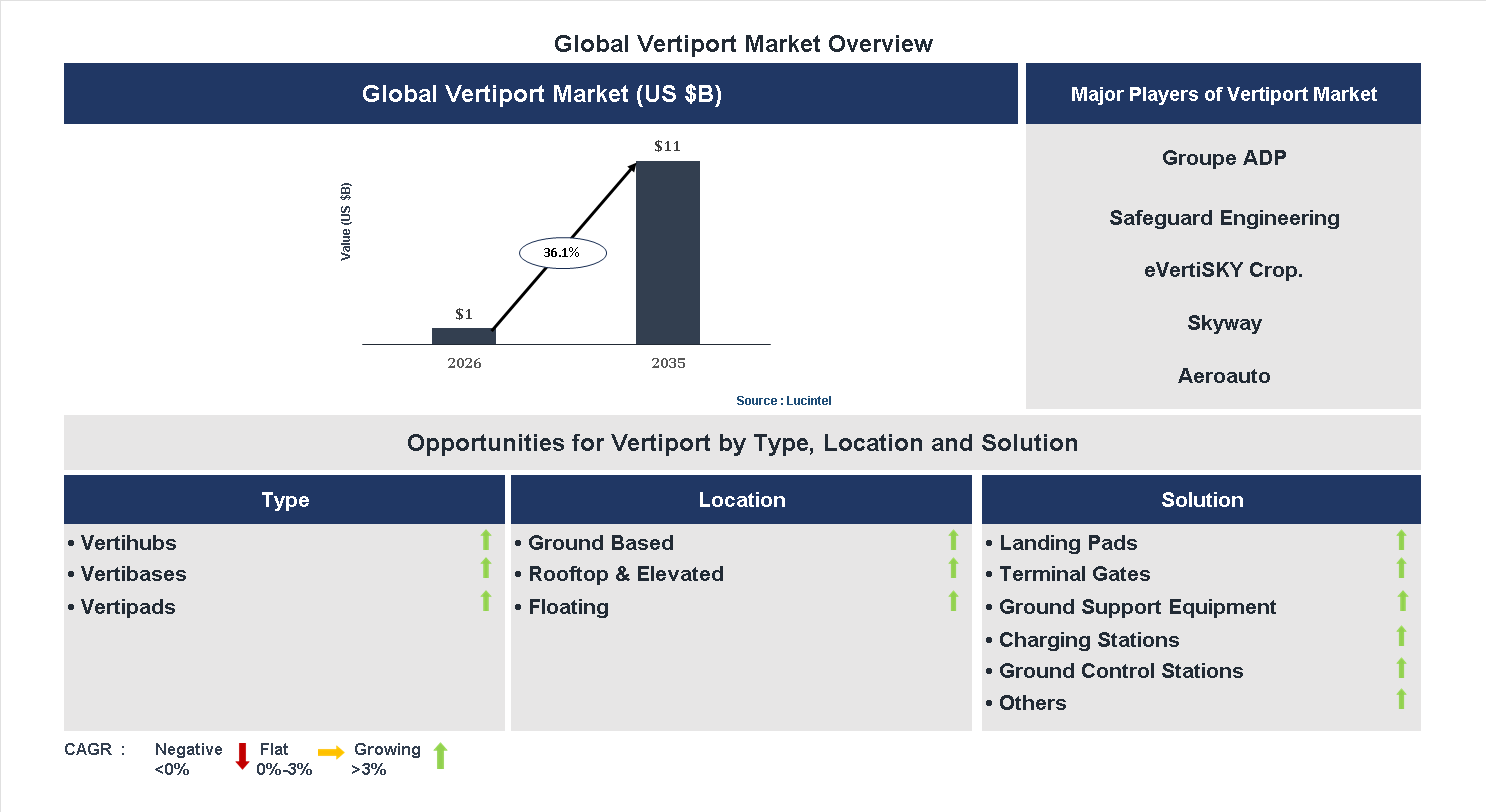
The future of the global vertiport market looks promising with opportunities in the landing pad, terminal gate, ground support equipment, charging station, and ground control station markets. The global vertiport market is expected to reach an estimated $11 billion by 2035 with a CAGR of 36.1% from 2026 to 2035. The major drivers for this market are the increasing demand for urban air mobility infrastructure, the rising investment in advanced vertiport development, and the growing adoption of electric vertical aircraft.• Lucintel forecasts that, within the type category, vertipad is expected to witness the highest growth over the forecast period.
• Within the solution category, landing pad is expected to witness the highest growth.
• In terms of region, North America is expected to witness the highest growth over the forecast period. Gain valuable insights for your business decisions with our comprehensive 150+ page report. Sample figures with some insights are shown below.
Emerging Trends in the Vertiport Market
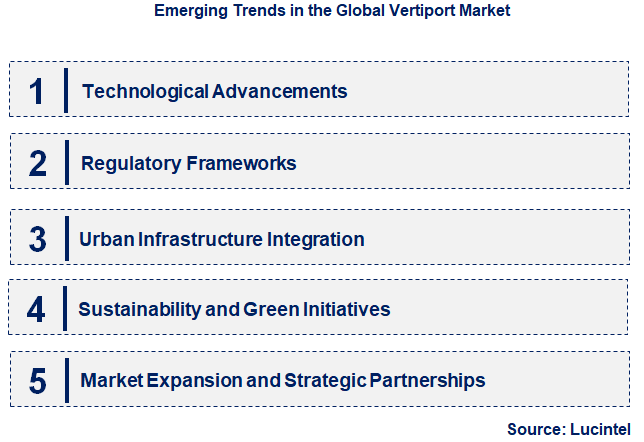
The vertiport market is experiencing rapid growth driven by advancements in urban air mobility, technological innovations, and increasing demand for efficient transportation solutions. As cities seek sustainable and less congested transit options, vertiports are emerging as critical infrastructure for electric vertical takeoff and landing (eVTOL) aircraft. This evolving landscape is characterized by strategic investments, regulatory developments, and technological breakthroughs that are shaping the future of urban mobility. These trends are not only transforming how people and goods move within cities but also redefining the infrastructure landscape, making urban air mobility a viable and integral part of modern transportation systems.• Technological Advancements: The development of eVTOL aircraft and related infrastructure is accelerating, enabling safer, quieter, and more efficient urban air mobility. Innovations in battery technology, autonomous navigation, and lightweight materials are enhancing aircraft performance and safety. These technological improvements are reducing costs and increasing the feasibility of vertiport deployment in urban areas, thus expanding market potential. As a result, the market is witnessing increased investments and partnerships aimed at integrating these advanced aircraft with vertiport networks, fostering a new era of urban transportation.
• Regulatory Frameworks: Governments and aviation authorities are establishing comprehensive regulations and standards for vertiport operations and urban air mobility. Clear regulatory guidelines are essential for ensuring safety, security, and interoperability of vertiport infrastructure and eVTOL aircraft. Progressive policies are encouraging private sector participation and facilitating the licensing, certification, and integration of vertiports into existing transportation networks. The evolving regulatory landscape is crucial for market growth, providing confidence to investors and operators while addressing safety concerns and operational challenges.
• Urban Infrastructure Integration: Vertiports are increasingly being integrated into existing urban infrastructure such as rooftops, parking garages, and dedicated land parcels. This integration aims to optimize space utilization and minimize urban disruption. Strategic placement near commercial centers, transportation hubs, and residential areas enhances accessibility and convenience for users. The trend toward seamless integration with ground transportation systems is making urban air mobility more practical and appealing, thereby expanding the market reach and encouraging city planners to incorporate vertiports into future urban development projects.
• Sustainability and Green Initiatives: The push for environmentally sustainable transportation solutions is significantly influencing the vertiport market. The adoption of electric aircraft and renewable energy sources for vertiport operations reduces carbon emissions and noise pollution. Green building practices and energy-efficient designs are becoming standard in vertiport construction. These initiatives align with global sustainability goals and attract environmentally conscious investors and users. The focus on sustainability is not only enhancing the market’s environmental credentials but also ensuring long-term viability amid increasing climate change concerns.
• Market Expansion and Strategic Partnerships: The vertiport market is witnessing rapid expansion through strategic collaborations between technology providers, urban planners, and transportation companies. These partnerships facilitate the development of integrated mobility ecosystems, combining vertiports with other transit modes. Market players are also exploring international markets, especially in regions with high urban congestion and supportive regulatory environments. This expansion is driving innovation, increasing infrastructure deployment, and creating new revenue streams. The collaborative approach is essential for overcoming challenges and accelerating the adoption of urban air mobility solutions globally. These emerging trends are collectively reshaping the vertiport market by fostering technological innovation, establishing regulatory clarity, integrating infrastructure seamlessly into urban environments, emphasizing sustainability, and expanding market reach through strategic partnerships. As these developments continue, urban air mobility is poised to become a mainstream component of future transportation networks, offering faster, greener, and more efficient urban travel options.
Recent Development in the Vertiport Market
The vertiport market is experiencing rapid growth driven by advancements in urban air mobility, technological innovations, and increasing demand for efficient transportation solutions. As cities seek sustainable and faster transit options, vertiports are emerging as critical infrastructure. These developments are transforming urban landscapes, creating new investment opportunities, and addressing congestion issues. Stakeholders are focusing on integrating vertiports into existing transportation networks, ensuring safety standards, and expanding operational capabilities to meet future demands.• Urban Air Mobility Integration: Vertiports are becoming essential for supporting urban air mobility, enabling seamless drone and eVTOL operations. This integration reduces ground traffic congestion, shortens travel times, and enhances connectivity within cities. As regulatory frameworks evolve, the market is poised for significant expansion, attracting investments from aerospace and infrastructure sectors. The development of dedicated vertiports will facilitate the mainstream adoption of aerial transportation, transforming urban mobility landscapes.
• Technological Innovations in Vertiport Design: Advances in automation, safety systems, and sustainable energy solutions are revolutionizing vertiport infrastructure. Smart designs incorporate electric charging stations, autonomous vehicle management, and real-time monitoring, improving efficiency and safety. These innovations lower operational costs and environmental impact, making vertiports more viable and attractive for investors. As technology progresses, vertiports will become more scalable, adaptable, and integrated into smart city ecosystems.
• Regulatory Frameworks and Safety Standards: Evolving regulations are establishing clear guidelines for vertiport construction, operation, and safety protocols. Governments and aviation authorities are collaborating to develop standards that ensure secure and reliable operations. This regulatory clarity boosts investor confidence, accelerates market entry, and promotes international standardization. Enhanced safety measures will also foster public trust, facilitating wider acceptance and integration of vertiport services into urban transportation networks.
• Strategic Partnerships and Market Expansion: Collaborations between aerospace firms, infrastructure developers, and city planners are driving market growth. These partnerships enable shared expertise, resource pooling, and faster deployment of vertiport facilities. Expanding into emerging markets and underserved urban areas offers new revenue streams and growth avenues. Strategic alliances will also support technological advancements and regulatory compliance, ensuring sustainable development and competitive advantage in the evolving vertiport landscape.
• Sustainability and Eco-Friendly Infrastructure: Emphasizing green energy sources and sustainable materials in vertiport construction reduces environmental impact. Incorporating solar panels, energy-efficient systems, and eco-friendly building practices aligns with global sustainability goals. This focus attracts environmentally conscious investors and city authorities seeking to promote green urban development. Sustainable vertiports will also contribute to reducing carbon footprints, supporting the broader transition to eco-friendly urban mobility solutions. These developments are significantly transforming the vertiport market by enhancing operational efficiency, safety, and sustainability. Integration with urban air mobility and technological innovations are expanding market reach and capabilities. Regulatory clarity and strategic partnerships are fostering confidence and accelerating deployment. Overall, these opportunities are positioning vertiports as vital infrastructure for future urban transportation, driving growth, attracting investments, and supporting sustainable, efficient, and innovative mobility solutions in cities worldwide.
Strategic Growth Opportunities in the Vertiport Market
The vertiport market is experiencing rapid growth driven by urban air mobility, technological advancements, and increasing demand for efficient transportation solutions. As cities seek sustainable and innovative transit options, vertiports are becoming essential infrastructure components. Opportunities for expansion span various applications, including passenger transport, cargo delivery, emergency services, and tourism. Strategic investments and technological integration are key to unlocking the full potential of this emerging market, promising significant economic and environmental benefits.• Expansion of Urban Air Mobility Infrastructure: Developing vertiports in strategic urban locations will facilitate seamless passenger and cargo movement, reducing congestion and travel time. Integration with existing transportation networks enhances accessibility and operational efficiency. Investment in scalable, modular vertiport designs allows for rapid deployment across multiple cities, supporting the growth of urban air mobility services. This expansion is crucial for establishing a reliable, widespread network that meets increasing demand for quick, eco-friendly transit options.
• Adoption of Advanced Technologies for Vertiport Operations: Implementing automation, AI, and IoT solutions can optimize vertiport management, safety, and maintenance. Smart systems enable real-time monitoring, efficient scheduling, and streamlined passenger processing, reducing wait times and operational costs. Integration of electric charging stations and renewable energy sources supports sustainability goals. These technological advancements will improve overall efficiency, safety, and user experience, making vertiports more attractive for commercial and private operators.
• Diversification into Cargo and Emergency Services: Vertiports are increasingly vital for cargo delivery, especially in congested urban areas, enabling rapid, contactless transportation of goods. Additionally, they serve critical roles in emergency response, providing quick access for medical evacuations and disaster relief. Developing specialized vertiports for these applications can open new revenue streams and enhance city resilience. Tailored infrastructure and regulatory frameworks will be essential to support these diverse operational needs effectively.
• Strategic Collaborations and Public-Private Partnerships: Collaborations between government agencies, aviation authorities, and private companies can accelerate vertiport development. Public-private partnerships facilitate funding, regulatory support, and technological innovation, reducing barriers to entry. Joint ventures enable shared expertise and resources, fostering scalable and compliant infrastructure. These partnerships are vital for establishing a robust, integrated vertiport network that aligns with urban planning and transportation policies.
• Focus on Sustainability and Eco-Friendly Design: Incorporating green building practices, renewable energy, and sustainable materials in vertiport construction minimizes environmental impact. Designing vertiports with energy-efficient systems and supporting electric vertical takeoff and landing (eVTOL) aircraft promotes eco-friendly operations. Sustainability initiatives can also attract government incentives and public support. Emphasizing environmental responsibility ensures long-term viability and aligns with global efforts to reduce urban carbon footprints. These strategic growth opportunities will significantly shape the vertiport market, fostering innovation, sustainability, and operational efficiency. Expanding infrastructure, adopting advanced technologies, diversifying applications, fostering collaborations, and prioritizing eco-friendly designs will drive market adoption and scalability. As these opportunities materialize, they will enable vertiports to become integral components of future urban transportation ecosystems, delivering economic, environmental, and societal benefits.
Vertiport Market Driver and Challenges
The vertiport market is influenced by a range of technological, economic, and regulatory factors that shape its growth trajectory. Advancements in urban air mobility technology, increasing investments from private and public sectors, and evolving regulatory frameworks are key drivers propelling the market forward. Simultaneously, challenges such as infrastructural complexities, regulatory uncertainties, and safety concerns pose significant hurdles. These factors collectively determine the pace and scope of market development, requiring stakeholders to navigate a dynamic landscape. Understanding these drivers and challenges is essential for strategic planning and sustainable growth in the vertiport industry. The factors responsible for driving the vertiport market include:-• Technological Innovation: The rapid development of electric vertical takeoff and landing (eVTOL) aircraft and related infrastructure has been a major catalyst. These innovations enable faster, quieter, and more efficient urban air mobility solutions, making vertiports a critical component. As technology matures, costs decrease, and operational capabilities expand, market adoption accelerates. This ongoing innovation attracts investments and encourages new entrants, fostering a competitive environment that drives market expansion.
• Urbanization and Population Growth: Increasing urbanization leads to congested city centers and overburdened transportation networks. Vertiports offer a solution by providing quick, efficient aerial transit options, reducing ground traffic congestion. Growing populations in metropolitan areas create a demand for innovative mobility solutions, prompting cities and private companies to invest in vertiport infrastructure. This trend is expected to significantly boost market growth as urban areas seek sustainable and scalable transportation alternatives.
• Regulatory Frameworks and Government Initiatives: Evolving regulations and supportive government policies are vital for market development. Many countries are establishing standards for vertiport construction, safety protocols, and air traffic management. Government initiatives aimed at promoting urban air mobility, including funding and pilot programs, facilitate market entry and expansion. Clear regulatory pathways reduce uncertainties for investors and operators, fostering confidence and accelerating deployment.
• Investment and Funding: The influx of venture capital, private equity, and government funding is fueling vertiport development. Investors recognize the markets potential for high growth and profitability, leading to increased funding for infrastructure projects. This financial support enables the construction of strategically located vertiports, technological upgrades, and operational scaling, thereby accelerating market penetration and innovation. The challenges in the vertiport market are:
• Infrastructure Development and Cost: Building vertiports involves significant infrastructural challenges, including land acquisition, zoning, and integration with existing transportation systems. The high capital expenditure required for construction, maintenance, and technological integration can hinder rapid deployment. Additionally, ensuring safety, noise mitigation, and environmental compliance adds complexity and costs, which may limit market expansion, especially in densely populated urban areas.
• Regulatory Uncertainty and Lack of Standardization: The absence of comprehensive, harmonized regulations across regions creates uncertainty for market players. Differing standards for safety, air traffic management, and certification processes can delay project approvals and increase compliance costs. This fragmentation hampers international expansion and discourages investment, slowing overall market growth.
• Safety and Security Concerns: Ensuring the safety of passengers, operators, and infrastructure is paramount. Risks related to technical failures, cybersecurity threats, and air traffic management pose significant challenges. Public acceptance depends heavily on perceived safety, and any incidents could undermine confidence in urban air mobility. Addressing these concerns requires rigorous safety protocols, advanced technology, and regulatory oversight, which can be resource-intensive and time-consuming. The vertiport market is driven by technological advancements, urbanization, supportive regulations, and investment inflows. However, infrastructural costs, regulatory inconsistencies, and safety concerns present notable challenges. These factors collectively influence the pace of market growth, requiring strategic navigation by stakeholders. While opportunities for expansion are substantial, addressing the challenges effectively will be crucial for sustainable development. The markets future depends on balancing innovation with regulation, safety, and infrastructure readiness to realize the full potential of urban air mobility solutions.
List of Vertiport Companies
Companies in the market compete on the basis of product quality offered. Major players in this market focus on expanding their manufacturing facilities, R&D investments, infrastructural development, and leverage integration opportunities across the value chain. With these strategies vertiport companies cater increasing demand, ensure competitive effectiveness, develop innovative products & technologies, reduce production costs, and expand their customer base. Some of the vertiport companies profiled in this report include-• Groupe ADP
• Safeguard Engineering
• eVertiSKY Crop.
• Skyway
• Aeroauto
• LILIUM
• Vports
• Ferrovial
• Volocopter GmbH
• UrbanV
Vertiport Market by Segment
The study includes a forecast for the global vertiport market by type, location, solution, and region.Vertiport Market by Type [Value from 2019 to 2035]:
• Vertihubs
• Vertibases
• Vertipads
Vertiport Market by Location [Value from 2019 to 2035]:
• Ground Based
• Rooftop & Elevated
• Floating
Vertiport Market by Solution [Value from 2019 to 2035]:
• Landing Pads
• Terminal Gates
• Ground Support Equipment
• Charging Stations
• Ground Control Stations
• Others
Vertiport Market by Region [Value from 2019 to 2035]:
• North America
• Europe
• Asia Pacific
• The Rest of the World
Country Wise Outlook for the Vertiport Market
The vertiport market is experiencing rapid growth driven by advancements in urban air mobility, technological innovations, and increasing investments from both public and private sectors. As cities seek sustainable and efficient transportation solutions, vertiports are emerging as critical infrastructure for electric vertical takeoff and landing (eVTOL) aircraft. The markets evolution is influenced by regulatory developments, technological progress, and expanding pilot projects across major economies. These developments reflect a global shift towards smarter, greener urban transportation systems, with key countries leading the way in innovation, infrastructure deployment, and policy support.• United States: The US market is at the forefront, with significant investments from companies like Uber and Joby Aviation. Regulatory frameworks are evolving to accommodate eVTOL operations, and several pilot projects are underway in cities such as Los Angeles and Dallas. The Federal Aviation Administration (FAA) is actively working on standards for vertiport certification, fostering a conducive environment for commercial deployment. Technological advancements in battery efficiency and aircraft design are accelerating market readiness.
• China: China is rapidly expanding its vertiport infrastructure, supported by government initiatives aimed at urban air mobility. Major tech and aviation firms, including Ehuang and DJI, are developing eVTOL aircraft and related infrastructure. Pilot programs are being tested in cities like Guangzhou and Shanghai, with a focus on integrating vertiports into existing urban transit networks. Regulatory policies are being refined to facilitate commercial operations, emphasizing safety and scalability.
• Germany: Germany is emphasizing sustainable urban mobility solutions, with several projects focusing on integrating vertiports into smart city plans. Companies like Volo copter are conducting extensive test flights and pilot programs in Berlin and Frankfurt. The German government is providing funding for research and development, and regulatory bodies are working on standards for vertiport construction and operation. The focus remains on eco-friendly designs and seamless integration with public transportation.
• India: India is exploring vertiport development as part of its broader urban mobility strategy. Pilot projects are being initiated in cities like Bangalore and Mumbai, with collaborations between government agencies and private firms. The emphasis is on addressing urban congestion and pollution through electric air mobility solutions. Regulatory frameworks are in early stages, but the government is actively promoting innovation and infrastructure development to support future commercial operations.
• Japan: Japan is leveraging its technological expertise to advance vertiport infrastructure, with ongoing projects in Tokyo and Osaka. The focus is on integrating vertiports with existing transportation hubs to facilitate last-mile connectivity. The government and private sector are investing in research on safety standards, noise reduction, and operational efficiency. Japan aims to become a leader in urban air mobility, emphasizing sustainability and technological innovation in vertiport deployment.

Features of the Global Vertiport Market
Market Size Estimates: Vertiport market size estimation in terms of value ($B). Trend and Forecast Analysis: Market trends (2019 to 2025) and forecast (2026 to 2035) by various segments and regions. Segmentation Analysis: Vertiport market size by type, location, solution, and region in terms of value ($B). Regional Analysis: Vertiport market breakdown by North America, Europe, Asia Pacific, and Rest of the World. Growth Opportunities: Analysis of growth opportunities in different types, location, solutions, and regions for the vertiport market. Strategic Analysis: This includes M&A, new product development, and competitive landscape of the vertiport market. Analysis of competitive intensity of the industry based on Porter’s Five Forces model.
FAQ
Q1. What is the vertiport market size? Answer: The global vertiport market is expected to reach an estimated $11 billion by 2035. Q2. What is the growth forecast for vertiport market? Answer: The global vertiport market is expected to grow with a CAGR of 36.1% from 2026 to 2035. Q3. What are the major drivers influencing the growth of the vertiport market? Answer: The major drivers for this market are the increasing demand for urban air mobility infrastructure, the rising investment in advanced vertiport development, and the growing adoption of electric vertical aircraft. Q4. What are the major segments for vertiport market? Answer: The future of the vertiport market looks promising with opportunities in the landing pad, terminal gate, ground support equipment, charging station, and ground control station markets. Q5. Who are the key vertiport market companies? Answer: Some of the key vertiport companies are as follows:• Groupe ADP
• Safeguard Engineering
• eVertiSKY Crop.
• Skyway
• Aeroauto
• LILIUM
• Vports
• Ferrovial
• Volocopter GmbH
• UrbanV Q6. Which vertiport market segment will be the largest in future? Answer: Lucintel forecasts that, within the type category, vertipad is expected to witness the highest growth over the forecast period. Q7. In vertiport market, which region is expected to be the largest in next 8 years? Answer: In terms of region, North America is expected to witness the highest growth over the forecast period. Q8. Do we receive customization in this report? Answer: Yes, Lucintel provides 10% customization without any additional cost.
Table of Contents
List of Figures
List of Tables
Methodology
- In-depth interviews of the major players in this market
- Detailed secondary research from competitors’ financial statements and published data
- Extensive searches of published works, market, and database information pertaining to industry news, company press releases, and customer intentions
- A compilation of the experiences, judgments, and insights of Lucintel’s professionals, who have analyzed and tracked this market over the years.


Buy Now
Choose a license that fits your team. Instant PDF delivery.
Prices exclude taxes. Instant delivery. Custom licensing available on request.
Key Questions
- • What are some of the most promising, high-growth opportunities for the vertiport market by type (vertihubs, vertibases, and vertipads), location (ground based, rooftop & elevated, and floating), solution (landing pads, terminal gates, ground support equipment, charging stations, ground control stations, and others), and region (North America, Europe, Asia Pacific, and the Rest of the World)?
- • Which segments will grow at a faster pace and why?
- • Which region will grow at a faster pace and why?
- • What are the key factors affecting market dynamics? What are the key challenges and business risks in this market?
- • What are the business risks and competitive threats in this market?
- • What are the emerging trends in this market and the reasons behind them?
- • What are some of the changing demands of customers in the market?
- • What are the new developments in the market? Which companies are leading these developments?
- • Who are the major players in this market? What strategic initiatives are key players pursuing for business growth?
- • What are some of the competing products in this market and how big of a threat do they pose for loss of market share by material or product substitution?
- • What M&A activity has occurred in the last 5 years and what has its impact been on the industry? For any questions related to Vertiport Market, Vertiport Market Size, Vertiport Market Growth, Vertiport Market Analysis, Vertiport Market Report, Vertiport Market Share, Vertiport Market Trends, Vertiport Market Forecast, Vertiport Companies, write Lucintel analyst at email: helpdesk@lucintel.com. We will be glad to get back to you soon.


