
Market Report · July 16, 2026

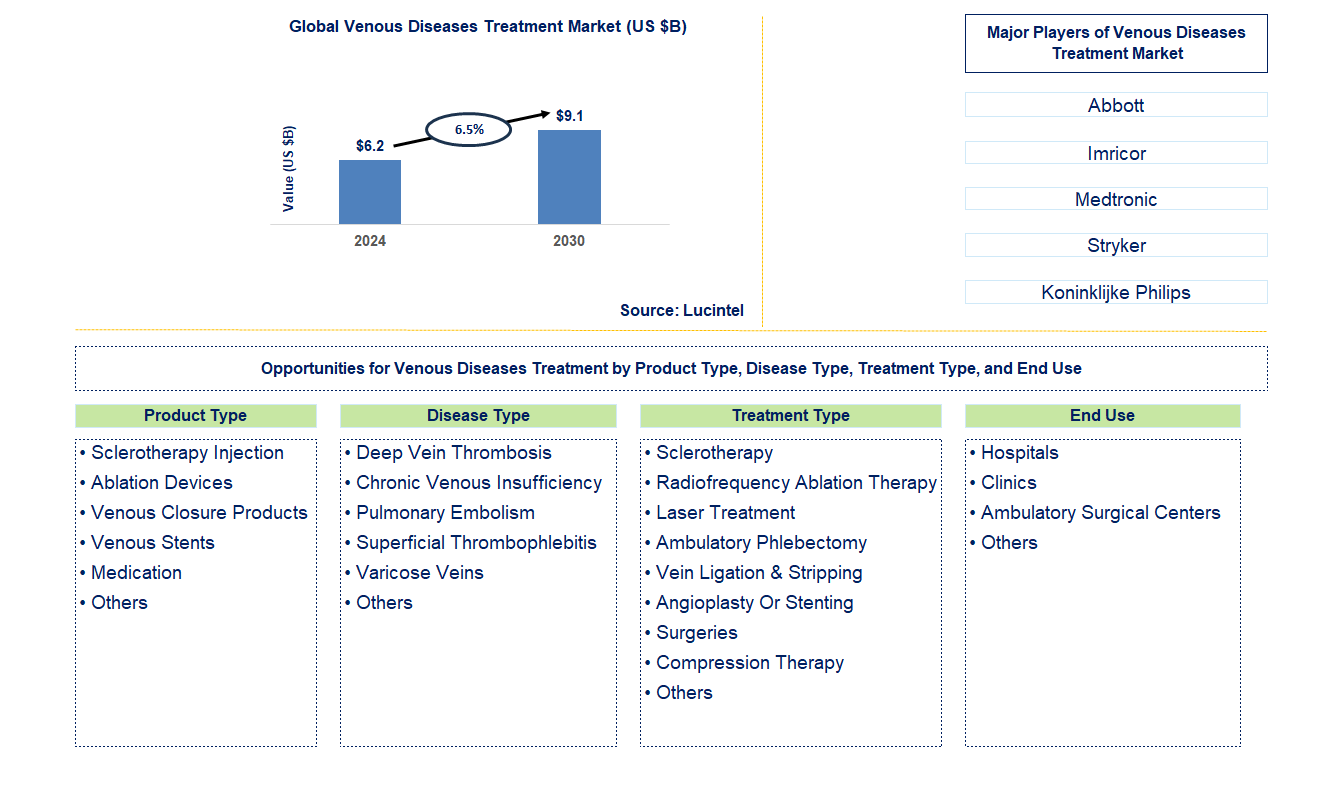
Key data points: The market size in 2030 = $9.1 billion, growth forecast = 6.5% annually next 6 years. Scroll below to get more insights. This market report covers trends, opportunities, and forecast in the global venous diseases treatment market to 2030 by product type (sclerotherapy injection, ablation devices, venous closure products, venous stents, medication, and others), disease type (deep vein thrombosis, chronic venous insufficiency, pulmonary embolism, superficial thrombophlebitis, varicose veins, and others), treatment type (sclerotherapy, radiofrequency ablation therapy, laser treatment, ambulatory phlebectomy, vein ligation & stripping, angioplasty or stenting, surgeries, compression therapy, and others), end use (hospitals, clinics, ambulatory surgical centers, and others), and region (North America, Europe, Asia Pacific, and the Rest of the World)
We'll send your sample report shortly.
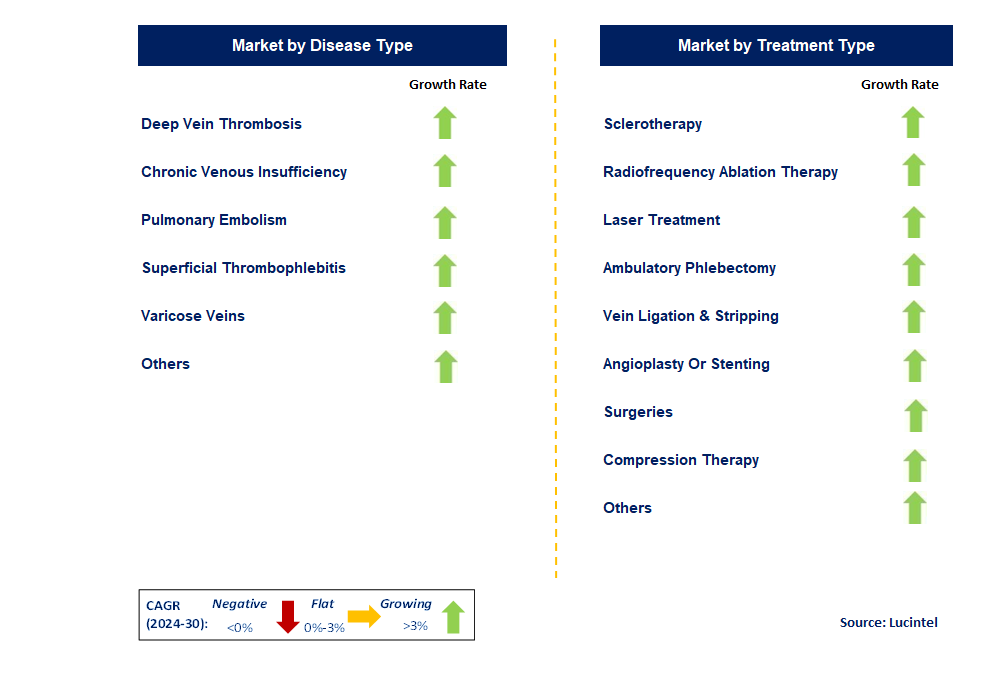
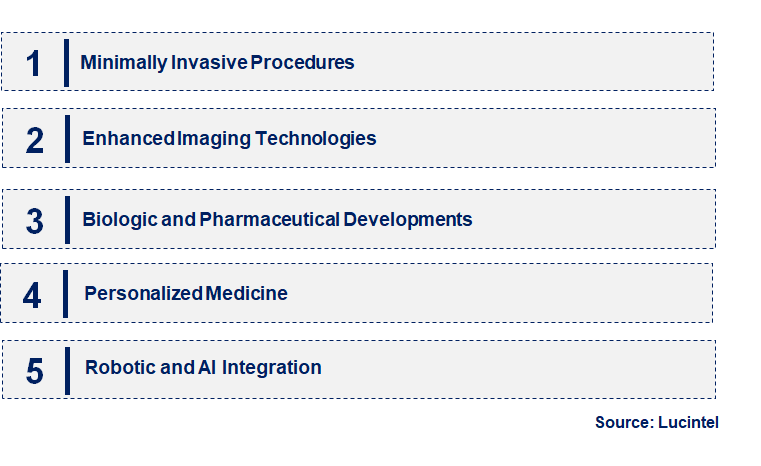
• Minimally Invasive Procedures: Nowadays, procedures that were cumbersome and painful several years ago such us endovenous laser therapy (EVLT) and radiofrequency ablation (RFA), used to treat venous diseases have become quick and painless for both the patients and the recovering period after such procedures. The surgical procedures practice is slowly being replaced by these methods as they provide the patients with effective options which have minimum side effects and convenient recovery periods.
• Enhanced Imaging Technologies: Enhanced imaging technologies that were previously lacking in conduit based venous interventions, such as high resolution duplex ultrasound and 3D imaging relevantly extend the boundaries of diagnostics and planning in treating of venous diseases. With such technologies, it becomes easier to effectively plan for treatment procedures and monitor results of treatments to avoid unnecessary expenditures and enhance outcomes.
• Biologic and Pharmaceutical Developments: New biologics and pharmacological treatments are being developed to treat venous disease in a better way. Development in this area, especially regarding sclerotherapy, newer sclerosing agents, and combined treatment are bringing about improved results with lower risks. These developments are improving treatment and customized therapies for different patient problems are being developed.
• Personalized Medicine: The use of personal medicine is improving and thus in focus research is studying the genetic and molecular tasks in venous disease. The side effect of the therapies extends beyond just adverse treatment results. Today surgical procedures are being performed on the premise that individual patient characteristics matter and that treatments must account for this fact.
• Robotic and AI Integration: Treatment of venous disease is now being supplemented by mechanical and artificial means including robotics and AI. Robotic surgical approaches and AI powered diagnosis are enhancing the quality of care by minimizing errors and enhancing efficiency which facilitates the administration of treatment rest progressively towards the achievement of favorable outcomes. All such trends bring change towards less invasive treatment of venous disease, enhanced diagnostic services as well as more efficient treatment. When used together, they promise better clinical outcomes, shorter recovery periods, and greater dependence on accurate and patient specific therapeutic strategies.
• Endovenous Laser Therapy: EVLT has brought a revolution in the varicose vein treatment philosophy, making it possible to perform the procedure without having to resort to invasive techniques such as vein stripping surgery. During the procedure, laser energy is applied to the veins to obliterate the veins which are of concern to the patient, and recovery is quick with minimal pain. Its increasing usage shows that there is an overall movement towards the minimally invasive ways of treating venous diseases.
• Radiofrequency Ablation: Radiofrequency ablation represents another important development in the management of venous diseases whereby radiofrequency energy is used to treat varicose veins. This does not include any surgical intervention and has a very high success rate with few complications. With the gradual advances in RFA technology, such comfort levels and effectiveness are expected to improve further.
• New Sclerotherapy Agents: Another important aspect of the current developments in sclerotherapy is the appearance of new drugs for sclerotherapy and the combination of various methods of treatment, making the therapy more effective and safe. These changes are leading to improved results in the obliteration of veins with less side effects broadening the choices available for both the patient and the clinician.
• Advanced Imaging Techniques: The diagnosis and treatment of venous diseases has been improved by the recent use of high-resolution duplex ultrasound and three–dimensional contractors. These tools allow visualization of details of the venous anatomy that were previously impossible or very limited and therefore enable precise evaluation and modification of a treatment plan resulting in improved treatment.
• Robotic-Assisted Surgery: Inclusion of the robotic systems into treatment of venous disease is enhancing the surgical accuracy and lowering procedure complications. Robotic surgeons are remarkable skilled persons who are medically trained and employed to perform surgical operations disguised as a live person but performed through a computer controlled robotic machine. These robotic-assisted techniques improve the control and precision in the execution of procedures which in turn leads to better surgical outcomes and reduced surgical durations. These key developments are transformational in the management of venous disease and are offering better and less invasive methods for treatment, enhancing the ability to diagnose the disease and improving the accuracy of interventions. The further progression of these technologies will only serve to improve the management of venous diseases.
• Technological Integration: Many opportunities in the growth of business are offered by the incorporation of the up to date technologies like advanced imaging and robotic systems. Such technologies allow for a higher accuracy of diagnosis as well as better treatment which helps the patients and increases the market of advanced venous disease treatment.
• Minimally Invasive Procedures: Currently there is an increasing need for less invasive procedures such as EVLT and RFA. The fact that many patients and health care providers prefer procedures that have a lower associated risk and shorter recovery time means that the market for these kinds of technologies is likely to grow, hence providing room for innovation and growth.
• Personalized Medicine Approaches: The trend towards the treatment of disease in a more individualized manner including genetic and molecular profiling holds considerable chances for growth. Venous disease management can be enhanced significantly by applying treatment according to patient profile and therefore paving way for new and enhanced treatment for growth of the market.
• Emerging Markets: There is a huge opportunity to grow the business of providing advanced venous disease treatments to new market areas. As healthcare facilities get better as well awareness increase, regions like Asia Pacific and Latin America are likely to be key expansion regions thus creating new market and growth opportunities.
• Combination therapies: The combination therapies which involve the application of therapeutics of more than one type is seen as presenting a growth opportunity. Thanks to these combinations, healthcare professionals treat more patients and improve the overall result by including such methods as sclerotherapy in the minimally traumatic procedures. These growth opportunities position the context where one can expect a better outcome in the management of venous diseases based on technology, individualized care and, availability in the market. Capitalizing on this opportunities can lead to enhanced treatment alternatives, better access to treatment, and even improved health outcomes.
• Abbott
• Imricor
• Medtronic
• Stryker
• Koninklijke Philips
• Baylis Medical
• Theraclion
• Sonablate
• Boston Scientific
• Olympus
• Sclerotherapy Injection
• Ablation Devices
• Venous Closure Products
• Venous Stents
• Medication
• Others
• Deep Vein Thrombosis
• Chronic Venous Insufficiency
• Pulmonary Embolism
• Superficial Thrombophlebitis
• Varicose Veins
• Others
• Sclerotherapy
• Radiofrequency Ablation Therapy
• Laser Treatment
• Ambulatory Phlebectomy
• Vein Ligation & Stripping
• Angioplasty Or Stenting
• Compression Therapy
• Others
• Hospitals
• Clinics
• Ambulatory Surgical Centers
• Others
• North America
• Europe
• Asia Pacific
• The Rest of the World
• United States: American rheumatology has seen significant progress with regards to the acceptance of techniques such as endovenous laser therapy (EVLT) and radiofrequency ablation (RFA) on patients with varicose veins. These minimally invasive procedures have successfully replaced vein stripping due to their healing times and efficiency. Furthermore, with the development of duplex ultrasonography, diagnosis has also improved, and this in its place has improved the treatment.
• China: In fact, China has been very quick in stepping up to the expanding horizons of modern treatment including the Clarivein® catheter which is an advanced minimally invasive deep vein treatment fusion which combines mechanical with chemical ablation of varicose veins with reduced pain. The country is also concentrating on reformation of treatment by adoption of different technologies such as 3D imaging to improve surgical accuracy and management strategies with the assistance of increasing number of specialized medical centers.
• Germany: This European nation is taking the lead as far as the advanced micro-invasive techniques and the new drug therapies for venous diseases are concerned. The appearance of new generation aqueous sclerotherapy agents and of new types of laser equipment has improved the outcome of treatment of patients. This country is also giving more emphasis on the research that looks into the genetic aspects of venous diseases to achieve precision medicine.
• India: In recent years, India has shown an increased use of EVLT and RFA as alternatives to surgical intervention. In addition to these advances, there is a growing focus on enhancing the awareness and availability of these treatments in urban and rural populations. There is a huge gap in the availability of affordable treatment options and in the training of health worker.
• Japan: The use of cryoablation for venous diseases is one of the new innovative methods brought up by Japan. There are also improvements in the therapeutic manipulations, especially by using modern imaging methods in combination with robot assisted operations. Japan is also focused on providing the early identification of targeted diseases by means of screening programs which lead to improved treatment course within the disease timeframe.
• Abbott
• Imricor
• Medtronic
• Stryker
• Koninklijke Philips
• Baylis Medical
• Theraclion
• Sonablate
• Boston Scientific
• Olympus Q6. Which venous diseases treatment market segment will be the largest in future? Answer: Lucintel forecasts that varicose veins will remain the largest segment due to the increasing cases of varicose veins and minimally invasive procedures to treat varicose veins. Q7. In venous diseases treatment market, which region is expected to be the largest in next 5 years? Answer: North America will remain the largest region due to growing number of varicose veins diseases among the US population, significantly growing aging population, and technological advancement of diagnosis and treatment in the region. Q.8 Do we receive customization in this report? Answer: Yes, Lucintel provides 10% customization without any additional cost.


Choose a license that fits your team. Instant PDF delivery.
Prices exclude taxes. Instant delivery. Custom licensing available on request.
Market Report · July 16, 2026
Market Report · July 15, 2026
Market Report · July 15, 2026
Trusted partner for strategic intelligence and business growth


Receive a complimentary market analysis tailored to your industry. Our analysts will identify key growth opportunities and competitive dynamics specific to your business.

Market size, growth rate, and key trend analysis for your specific sector.

Top competitor positioning and market share analysis.

Strategic recommendations backed by data-driven insights.
Get curated market intelligence and competitive moves straight to your inbox.
By subscribing, you agree to receive our monthly insights. Unsubscribe anytime.
Receive a complimentary market analysis tailored to your industry. Our analysts will identify key growth opportunities and competitive dynamics specific to your business.
Market size, growth rate, and key trend analysis for your specific sector.
Top competitor positioning and market share analysis.
Strategic recommendations backed by data-driven insights.
Get curated market intelligence, emerging trends, and competitive moves straight to your inbox each month.
By subscribing, you agree to receive our monthly insights. Unsubscribe anytime.
We'll send your sample report shortly.