
Report Feature
Vending Machine Telemetry Market Trends and Forecast
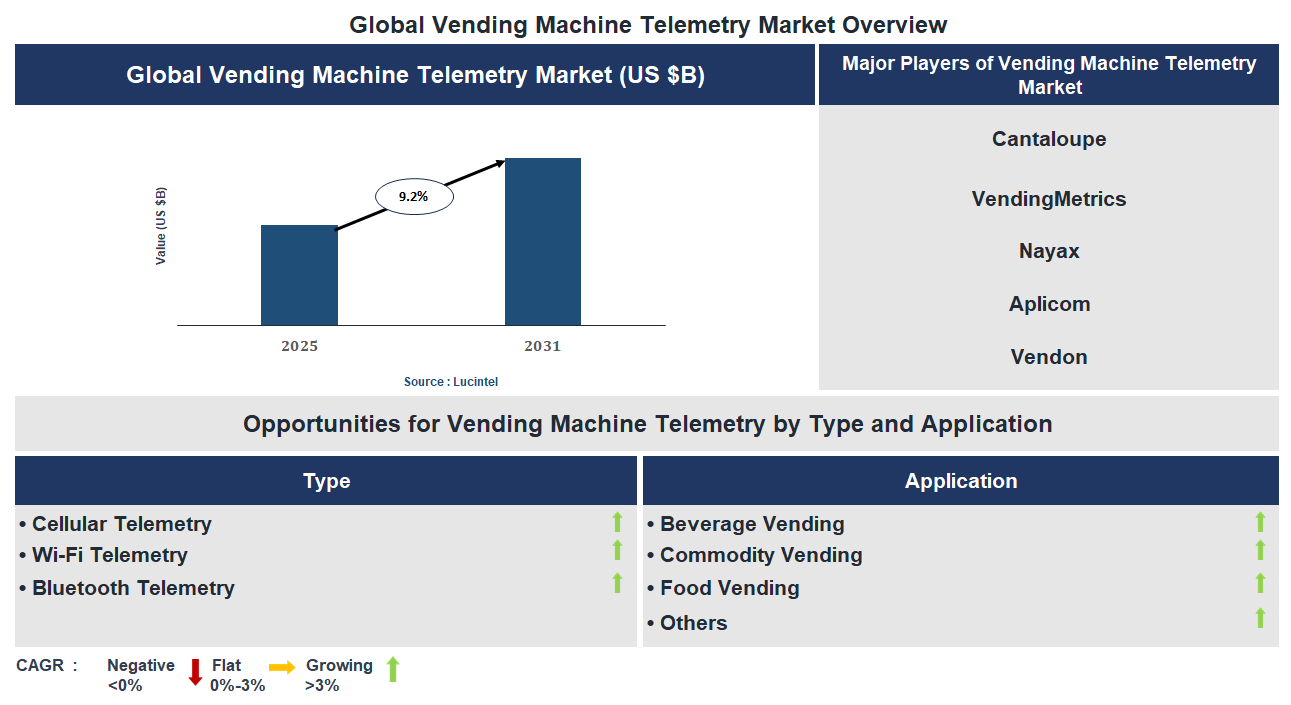
The future of the global vending machine telemetry market looks promising with opportunities in the beverage vending, commodity vending, and food vending markets. The global vending machine telemetry market is expected to grow with a CAGR of 9.2% from 2025 to 2031. The major drivers for this market are the increasing demand for real-time data monitoring, the rising adoption of cashless payments, and the growing need for operational efficiency solutions.• Lucintel forecasts that, within the type category, cellular telemetry is expected to witness the highest growth over the forecast period.
• Within the application category, food vending is expected to witness the highest growth.
• In terms of region, APAC is expected to witness the highest growth over the forecast period. Gain valuable insights for your business decisions with our comprehensive 150+ page report. Sample figures with some insights are shown below.
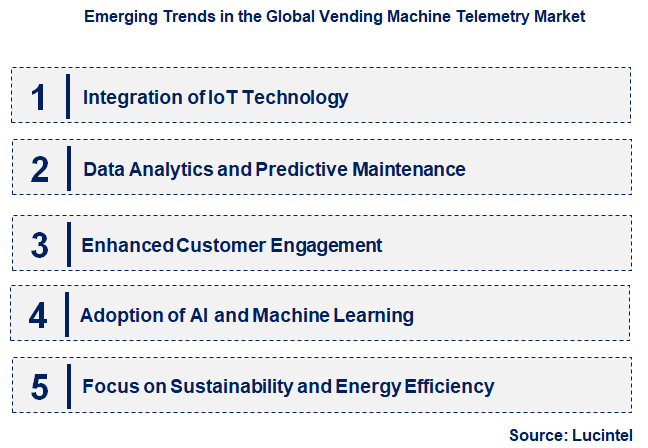
Emerging Trends in the Vending Machine Telemetry Market
The vending machine telemetry market is experiencing rapid growth driven by technological advancements and changing consumer preferences. As automation and data-driven decision-making become central to retail operations, companies are increasingly adopting telemetry solutions to optimize performance, enhance customer experience, and reduce operational costs. These developments are transforming traditional vending services into smarter, more efficient systems. The market's evolution is also influenced by the integration of IoT, AI, and data analytics, which enable real-time monitoring and predictive maintenance. This dynamic environment presents new opportunities and challenges, shaping the future landscape of vending machine management and service delivery.• Integration of IoT Technology: The adoption of Internet of Things (IoT) devices in vending machines allows for real-time data collection on sales, inventory, and machine health. This connectivity enables operators to monitor multiple machines remotely, quickly identify issues, and optimize stock levels. IoT integration enhances operational efficiency, reduces downtime, and improves customer satisfaction by ensuring product availability. As IoT technology becomes more affordable and widespread, its role in vending telemetry is expected to expand, leading to smarter, more responsive vending networks.
• Data Analytics and Predictive Maintenance: Advanced data analytics tools are being employed to analyze telemetry data for insights into machine performance and customer preferences. Predictive maintenance uses this data to forecast potential failures before they occur, minimizing downtime and repair costs. This proactive approach improves machine reliability and extends lifespan, ultimately reducing operational expenses. The ability to anticipate issues and optimize maintenance schedules is revolutionizing vending machine management, making it more cost-effective and reliable.
• Enhanced Customer Engagement: Telemetry solutions enable personalized marketing and improved customer experiences through data-driven insights. Vending operators can tailor product offerings based on consumer preferences and purchase patterns, increasing sales and customer loyalty. Additionally, digital interfaces and mobile payment options integrated with telemetry systems provide seamless, contactless transactions. These innovations meet evolving consumer expectations for convenience and customization, positioning vending machines as more interactive and engaging retail points.
• Adoption of AI and Machine Learning: Artificial Intelligence (AI) and machine learning algorithms are increasingly being integrated into telemetry systems to optimize operations further. AI can analyze large datasets to identify trends, optimize inventory management, and personalize product recommendations. Machine learning models improve over time, enhancing decision-making accuracy. This technological advancement enables vending operators to automate complex tasks, improve efficiency, and deliver a more tailored customer experience, thus gaining a competitive edge in the market.
• Focus on Sustainability and Energy Efficiency: Market players are prioritizing energy-efficient vending machines equipped with telemetry to monitor and reduce power consumption. These machines incorporate smart sensors and adaptive systems to optimize energy use during non-peak hours, contributing to sustainability goals. Additionally, telemetry data helps identify inefficient units and inform replacement strategies. The emphasis on eco-friendly solutions aligns with increasing consumer demand for sustainable practices and regulatory pressures, driving innovation and investment in greener vending technologies. In summary, these emerging trends are fundamentally reshaping the vending machine telemetry market by making vending operations more intelligent, efficient, and customer-centric. The integration of IoT, advanced analytics, AI, and sustainability initiatives is creating a more connected and sustainable vending ecosystem. These developments are not only enhancing operational performance but also redefining the consumer experience, positioning the market for continued growth and innovation.
Recent Development in the Vending Machine Telemetry Market
The vending machine telemetry market has experienced significant growth driven by technological advancements and increasing demand for data-driven management solutions. As businesses seek to optimize operations, reduce costs, and enhance customer experience, the integration of telemetry systems into vending machines has become essential. Recent developments reflect innovations in connectivity, data analytics, and automation, transforming traditional vending operations into smart, efficient systems. These changes are not only improving operational efficiency but also enabling new revenue streams and better inventory management. The following key developments highlight the current trajectory of this evolving market.• Integration of IoT Technology: The adoption of Internet of Things (IoT) devices in vending machines has enabled real-time data collection and remote monitoring. This development allows operators to track inventory levels, machine health, and sales performance instantly, reducing downtime and optimizing stock replenishment. The impact is increased operational efficiency and improved customer satisfaction through timely service.
• Advanced Data Analytics: Vendors are leveraging sophisticated analytics tools to interpret telemetry data, gaining insights into consumer preferences and purchasing patterns. This enables personalized marketing, targeted promotions, and better inventory planning. The result is enhanced sales performance and a more tailored customer experience, driving revenue growth.
• Enhanced Connectivity Solutions: The deployment of 4G/5G networks and Wi-Fi connectivity in vending machines ensures seamless data transmission. This development supports faster updates, remote diagnostics, and real-time alerts, minimizing maintenance costs and preventing machine failures. It enhances overall reliability and operational responsiveness.
• Automation and Contactless Payments: The integration of contactless payment systems and automated restocking features has streamlined transactions and reduced physical contact, especially important during health crises. This development improves user convenience, accelerates transactions, and broadens payment options, leading to increased sales and customer loyalty.
• Sustainability and Energy Efficiency: Recent innovations focus on energy-efficient components and eco-friendly materials in vending machines, driven by environmental concerns and regulations. Telemetry systems help monitor energy consumption, enabling operators to implement sustainable practices. This development reduces operational costs and aligns with corporate social responsibility goals. In summary, these developments are transforming the vending machine telemetry market by enhancing operational efficiency, customer engagement, and sustainability. The integration of IoT, advanced analytics, connectivity, automation, and eco-friendly practices is making vending machines smarter, more reliable, and more aligned with modern consumer expectations. This evolution is poised to drive continued growth and innovation in the market.
Strategic Growth Opportunities in the Vending Machine Telemetry Market
The vending machine telemetry market is experiencing rapid growth driven by technological advancements and increasing demand for data-driven operational efficiency. As businesses seek to optimize inventory management, reduce downtime, and enhance customer experience, telemetry solutions are becoming essential across various applications. This evolution presents multiple strategic growth opportunities that can significantly influence market dynamics. By focusing on key applications, companies can capitalize on emerging trends and expand their market share. The following are five key growth opportunities across different applications, each offering unique benefits and potential for market expansion.• Enhanced Inventory Management: Telemetry solutions enable real-time inventory tracking, reducing stockouts and overstock situations. This improves sales and customer satisfaction while minimizing waste. Retailers can optimize supply chain logistics, leading to cost savings and increased profitability. The ability to monitor vending machine performance remotely also reduces maintenance costs and downtime, creating a more efficient operation.
• Improved Customer Experience: Telemetry allows for better monitoring of vending machine status, ensuring product availability and freshness. It facilitates personalized service by analyzing purchase patterns, leading to targeted marketing and promotions. Enhanced operational insights help staff respond swiftly to issues, boosting customer satisfaction and loyalty. This application drives revenue growth through improved service quality.
• Asset Management and Compliance: Telemetry systems help healthcare providers monitor vending machines that dispense medications or health-related products, ensuring compliance with safety standards. Real-time data improves asset utilization and maintenance scheduling, reducing downtime. This application enhances patient safety and operational efficiency, supporting regulatory adherence and reducing costs associated with equipment failure.
• Workforce Convenience and Engagement: Telemetry-enabled vending machines provide employees with seamless access to snacks and beverages, improving workplace satisfaction. Data analytics help optimize product offerings based on consumption trends, increasing sales. Remote monitoring reduces maintenance efforts and ensures consistent service, fostering a positive work environment and supporting employee productivity.
• Integration with IoT and AI: The adoption of IoT and AI technologies in vending machines creates smarter, more interactive experiences. Telemetry data enables predictive maintenance, reducing machine failures and downtime. These advanced systems can personalize offerings and optimize energy consumption, leading to operational cost savings and enhanced customer engagement. This innovation positions the market for future growth in smart vending solutions. In summary, these growth opportunities are transforming the vending machine telemetry market by enhancing operational efficiency, customer experience, and compliance across various applications. Companies leveraging these developments can gain competitive advantages, expand their market presence, and meet evolving consumer demands. The integration of advanced telemetry solutions is set to drive sustained growth and innovation in this dynamic market.
Vending Machine Telemetry Market Driver and Challenges
The vending machine telemetry market is influenced by a variety of technological, economic, and regulatory factors that shape its growth and development. Advances in IoT technology enable real-time monitoring and data collection, improving operational efficiency. Economic factors such as increasing consumer demand for convenience and the need for cost-effective inventory management drive market expansion. Regulatory considerations, including data privacy laws and safety standards, also impact deployment strategies. Additionally, the integration of AI and machine learning enhances predictive maintenance and personalized customer experiences. These drivers collectively foster innovation and competitiveness, while challenges related to technological complexity, data security, and regulatory compliance pose hurdles that need to be addressed for sustained growth. The factors responsible for driving the vending machine telemetry market include:• Technological Advancements: The rapid evolution of IoT, AI, and data analytics technologies has revolutionized vending machine operations. Real-time telemetry enables remote monitoring of inventory levels, machine health, and sales data, leading to improved efficiency and reduced downtime. These innovations facilitate predictive maintenance, personalized marketing, and enhanced customer experiences. As technology becomes more affordable and accessible, vendors are increasingly adopting telemetry solutions to stay competitive. The integration of advanced sensors and connectivity options ensures seamless data flow, enabling smarter decision-making and operational agility, which significantly propels market growth.
• Growing Consumer Demand for Convenience: Modern consumers prioritize quick, easy access to products, prompting vending machine operators to upgrade their offerings. Telemetry systems enable remote inventory management, ensuring popular items are always in stock and reducing stockouts. This responsiveness enhances customer satisfaction and loyalty. Additionally, telemetry allows for dynamic pricing and targeted promotions based on real-time data, further attracting consumers. The convenience factor, combined with the ability to customize offerings and improve service speed, makes telemetry-enabled vending machines highly attractive, fueling market expansion across various sectors, including retail, hospitality, and healthcare.
• Cost Optimization and Operational Efficiency: Vending machine telemetry provides detailed insights into machine performance, sales patterns, and inventory levels, allowing operators to optimize maintenance schedules and reduce operational costs. Automated alerts for malfunctions or low stock levels minimize downtime and manual checks. Data-driven insights enable better route planning and inventory stocking, reducing waste and increasing profitability. These efficiencies translate into significant cost savings and improved margins for vending operators. As businesses seek to streamline operations and maximize ROI, the adoption of telemetry solutions becomes a strategic imperative, thereby driving market growth.
• Expansion of Smart Vending Solutions: The integration of telemetry with smart vending solutions is transforming traditional vending machines into intelligent, connected kiosks. These machines can offer cashless payments, personalized offers, and interactive interfaces, enhancing user engagement. Telemetry data supports the deployment of location-specific marketing campaigns and inventory customization, catering to diverse consumer preferences. The rise of smart vending is also driven by the increasing adoption of contactless payment methods and digital wallets, especially post-pandemic. This evolution not only improves customer experience but also opens new revenue streams, accelerating market penetration and technological innovation.
• Regulatory and Data Privacy Considerations: As telemetry systems collect vast amounts of data, regulatory frameworks concerning data privacy and security are becoming more stringent. Compliance with laws such as GDPR and local data protection regulations requires vendors to implement robust security measures. Failure to adhere can result in legal penalties and damage to brand reputation. Additionally, safety standards related to electronic devices and connectivity must be maintained to ensure consumer trust. Navigating these regulatory landscapes demands significant investment in cybersecurity and legal compliance, which can pose challenges for market players but also encourages the development of secure, compliant telemetry solutions. The challenges facing this vending machine telemetry market include:
• Technological Complexity and Integration Issues: Implementing telemetry solutions involves integrating various hardware components, software platforms, and network connectivity, which can be complex and costly. Compatibility issues between different vendors’ systems may hinder seamless operation. Additionally, the rapid pace of technological change requires continuous updates and staff training, increasing operational burdens. Small and medium-sized operators may find the initial investment and technical expertise required prohibitive. Overcoming these integration challenges is essential for widespread adoption, but the complexity can slow down market growth and innovation.
• Data Security and Privacy Risks: The collection and transmission of sensitive data through telemetry systems expose vending operators to cybersecurity threats such as hacking, data breaches, and malware attacks. Ensuring data privacy and security compliance is a significant challenge, especially with evolving regulations. Breaches can lead to financial losses, legal penalties, and erosion of customer trust. Developing secure systems requires substantial investment in cybersecurity infrastructure and ongoing monitoring. As data privacy concerns grow, operators must prioritize robust security measures, which can increase costs and complicate deployment.
• High Implementation and Maintenance Costs: Although telemetry offers operational benefits, the initial setup costs—including hardware, software, and connectivity infrastructure—can be substantial. Ongoing maintenance, software updates, and technical support further add to expenses. For many operators, especially smaller businesses, these costs may outweigh immediate benefits, delaying adoption. Additionally, the need for skilled personnel to manage and troubleshoot telemetry systems can pose a barrier. Balancing cost and benefit is critical, and high expenses may limit market penetration in price-sensitive regions or sectors. In summary, the vending machine telemetry market is driven by technological innovation, consumer demand for convenience, operational efficiencies, and the expansion of smart vending solutions. However, challenges such as technological complexity, data security risks, and high implementation costs must be addressed to sustain growth. These drivers foster a dynamic environment of innovation and competitiveness, while the challenges necessitate strategic investments and regulatory compliance. Overall, the market's future hinges on balancing technological advancements with effective risk management, ensuring scalable, secure, and cost-effective telemetry solutions that meet evolving consumer and business needs.
List of Vending Machine Telemetry Companies
Companies in the market compete on the basis of product quality offered. Major players in this market focus on expanding their manufacturing facilities, R&D investments, infrastructural development, and leverage integration opportunities across the value chain. With these strategies vending machine telemetry companies cater increasing demand, ensure competitive effectiveness, develop innovative products & technologies, reduce production costs, and expand their customer base. Some of the vending machine telemetry companies profiled in this report include-• Cantaloupe
• VendingMetrics
• Nayax
• Aplicom
• Vendon
• LinkitSoft
• Vianet
• SmVend
• VendLOG
• Telemetron
Vending Machine Telemetry Market by Segment
The study includes a forecast for the global vending machine telemetry market by type, application, and region.Vending Machine Telemetry Market by Type [Value from 2019 to 2031]:
• Cellular Telemetry
• Wi-Fi Telemetry
• Bluetooth Telemetry
Vending Machine Telemetry Market by Application [Value from 2019 to 2031]:
• Beverage Vending
• Commodity Vending
• Food Vending
• Others
Vending Machine Telemetry Market by Region [Value from 2019 to 2031]:
• North America
• Europe
• Asia Pacific
• The Rest of the World
Country Wise Outlook for the Vending Machine Telemetry Market
The vending machine telemetry market has experienced significant growth driven by technological advancements, increasing automation, and the demand for data-driven operational efficiency. Countries are adopting innovative solutions to enhance customer experience, optimize inventory management, and reduce maintenance costs. The integration of IoT and AI technologies has revolutionized vending machine management, enabling real-time monitoring and predictive analytics. As the market evolves, regulatory standards and consumer preferences continue to shape development strategies across different regions. The following summaries highlight recent developments in the United States, China, Germany, India, and Japan, reflecting their unique market dynamics and technological progress.• United States: The US market has seen rapid adoption of IoT-enabled vending machines, with major players investing in AI-powered analytics for inventory and maintenance optimization. There is a growing trend toward cashless payment systems and personalized customer experiences, driven by consumer demand for convenience. Companies are also integrating energy-efficient solutions to meet sustainability goals, and partnerships with tech firms are expanding the scope of telemetry applications.
• China: China’s vending machine telemetry market is expanding swiftly, fueled by urbanization and a high demand for convenience retail. Innovations include facial recognition payment systems and smart inventory management, which improve operational efficiency. The government’s push for smart city initiatives supports the deployment of connected vending solutions. Local manufacturers are increasingly adopting IoT technology to enhance machine performance and customer engagement.
• Germany: The German market emphasizes quality, security, and sustainability. Recent developments include the integration of contactless payment options and energy-saving features. Companies are focusing on data security and compliance with strict EU regulations. There is also a growing interest in eco-friendly vending machines with recyclable components and reduced energy consumption, aligning with Germany’s environmental commitments.
• India: The Indian vending machine telemetry market is witnessing rapid growth due to urbanization, rising disposable incomes, and a young population. Innovations include mobile payment integration and remote monitoring systems that improve operational efficiency in diverse environments. Local startups are exploring affordable, smart vending solutions tailored to regional preferences, and government initiatives are promoting digital payment adoption, further boosting market expansion.
• Japan: Japan’s market is characterized by advanced automation and high consumer expectations for quality and innovation. Recent developments include the deployment of AI-driven vending machines capable of personalized recommendations and multilingual interfaces. The focus on hygiene and contactless payments has increased, especially post-pandemic. Companies are also exploring sustainable practices, such as energy-efficient designs and recyclable materials, to meet environmental standards and consumer preferences.

Features of the Global Vending Machine Telemetry Market
Market Size Estimates: Vending machine telemetry market size estimation in terms of value ($B). Trend and Forecast Analysis: Market trends (2019 to 2024) and forecast (2025 to 2031) by various segments and regions. Segmentation Analysis: Vending machine telemetry market size by type, application, and region in terms of value ($B). Regional Analysis: Vending machine telemetry market breakdown by North America, Europe, Asia Pacific, and Rest of the World. Growth Opportunities: Analysis of growth opportunities in different types, applications, and regions for the vending machine telemetry market. Strategic Analysis: This includes M&A, new product development, and competitive landscape of the vending machine telemetry market. Analysis of competitive intensity of the industry based on Porter’s Five Forces model.
FAQ
Q1. What is the growth forecast for vending machine telemetry market? Answer: The global vending machine telemetry market is expected to grow with a CAGR of 9.2% from 2025 to 2031. Q2. What are the major drivers influencing the growth of the vending machine telemetry market? Answer: The major drivers for this market are the increasing demand for real-time data monitoring, the rising adoption of cashless payments, and the growing need for operational efficiency solutions. Q3. What are the major segments for vending machine telemetry market? Answer: The future of the vending machine telemetry market looks promising with opportunities in the beverage vending, commodity vending, and food vending markets. Q4. Who are the key vending machine telemetry market companies? Answer: Some of the key vending machine telemetry companies are as follows:• Cantaloupe
• VendingMetrics
• Nayax
• Aplicom
• Vendon
• LinkitSoft
• Vianet
• SmVend
• VendLOG
• Telemetron Q5. Which vending machine telemetry market segment will be the largest in future? Answer: Lucintel forecasts that, within the type category, cellular telemetry is expected to witness the highest growth over the forecast period. Q6. In vending machine telemetry market, which region is expected to be the largest in next 5 years? Answer: In terms of region, APAC is expected to witness the highest growth over the forecast period. Q7. Do we receive customization in this report? Answer: Yes, Lucintel provides 10% customization without any additional cost.
Table of Contents
List of Figures
List of Tables
Methodology
- In-depth interviews of the major players in this market
- Detailed secondary research from competitors’ financial statements and published data
- Extensive searches of published works, market, and database information pertaining to industry news, company press releases, and customer intentions
- A compilation of the experiences, judgments, and insights of Lucintel’s professionals, who have analyzed and tracked this market over the years.


Buy Now
Choose a license that fits your team. Instant PDF delivery.
Prices exclude taxes. Instant delivery. Custom licensing available on request.
Key Questions
- • What are some of the most promising, high-growth opportunities for the vending machine telemetry market by type (cellular telemetry, wi-fi telemetry, and bluetooth telemetry), application (beverage vending, commodity vending, food vending, and others), and region (North America, Europe, Asia Pacific, and the Rest of the World)?
- • Which segments will grow at a faster pace and why?
- • Which region will grow at a faster pace and why?
- • What are the key factors affecting market dynamics? What are the key challenges and business risks in this market?
- • What are the business risks and competitive threats in this market?
- • What are the emerging trends in this market and the reasons behind them?
- • What are some of the changing demands of customers in the market?
- • What are the new developments in the market? Which companies are leading these developments?
- • Who are the major players in this market? What strategic initiatives are key players pursuing for business growth?
- • What are some of the competing products in this market and how big of a threat do they pose for loss of market share by material or product substitution?
- • What M&A activity has occurred in the last 5 years and what has its impact been on the industry? For any questions related to Vending Machine Telemetry Market, Vending Machine Telemetry Market Size, Vending Machine Telemetry Market Growth, Vending Machine Telemetry Market Analysis, Vending Machine Telemetry Market Report, Vending Machine Telemetry Market Share, Vending Machine Telemetry Market Trends, Vending Machine Telemetry Market Forecast, Vending Machine Telemetry Companies, write Lucintel analyst at email: helpdesk@lucintel.com. We will be glad to get back to you soon.


