
Close Lucintel Chat
Didn't Find What You're Looking for?
Call us at +1972 636 5056 or write at helpdesk@Lucintel.com
Ask an Expert Provide Custom Requirements Download Sample Report Search Available Reports
  • helpdesk@Lucintel.com
  • |
  • Call Lucintel +1 972 636 5056
  • |
  • Login
  • |
  • Register
  • |
  • Search
  • |
'
...

The Impact of COVID-19 is included in Vehicular Simulator Market Report. Buy it today to get an advantage.

Request the impact of COVID-19 on your product or industry


Vehicular Simulator Market Trends and Forecast

The future of the global vehicular simulator market looks promising with opportunities in the military/defense, industrial / construction / heavy equipment, blue light, civilian, racing, and educational & training institution markets. The global vehicular simulator market is expected to grow with a CAGR of 8.3% from 2025 to 2031. The major drivers for this market are the increasing demand for driver training solutions, the rising adoption of autonomous vehicle technologies, and the growing need for realistic simulation experiences.

• Lucintel forecasts that, within the product type category, sim racing is expected to witness higher growth over the forecast period.
• Within the end use category, racing is expected to witness the highest growth.
• In terms of region, APAC is expected to witness the highest growth over the forecast period.
Gain valuable insights for your business decisions with our comprehensive 150+ page report. Sample figures with some insights are shown below.
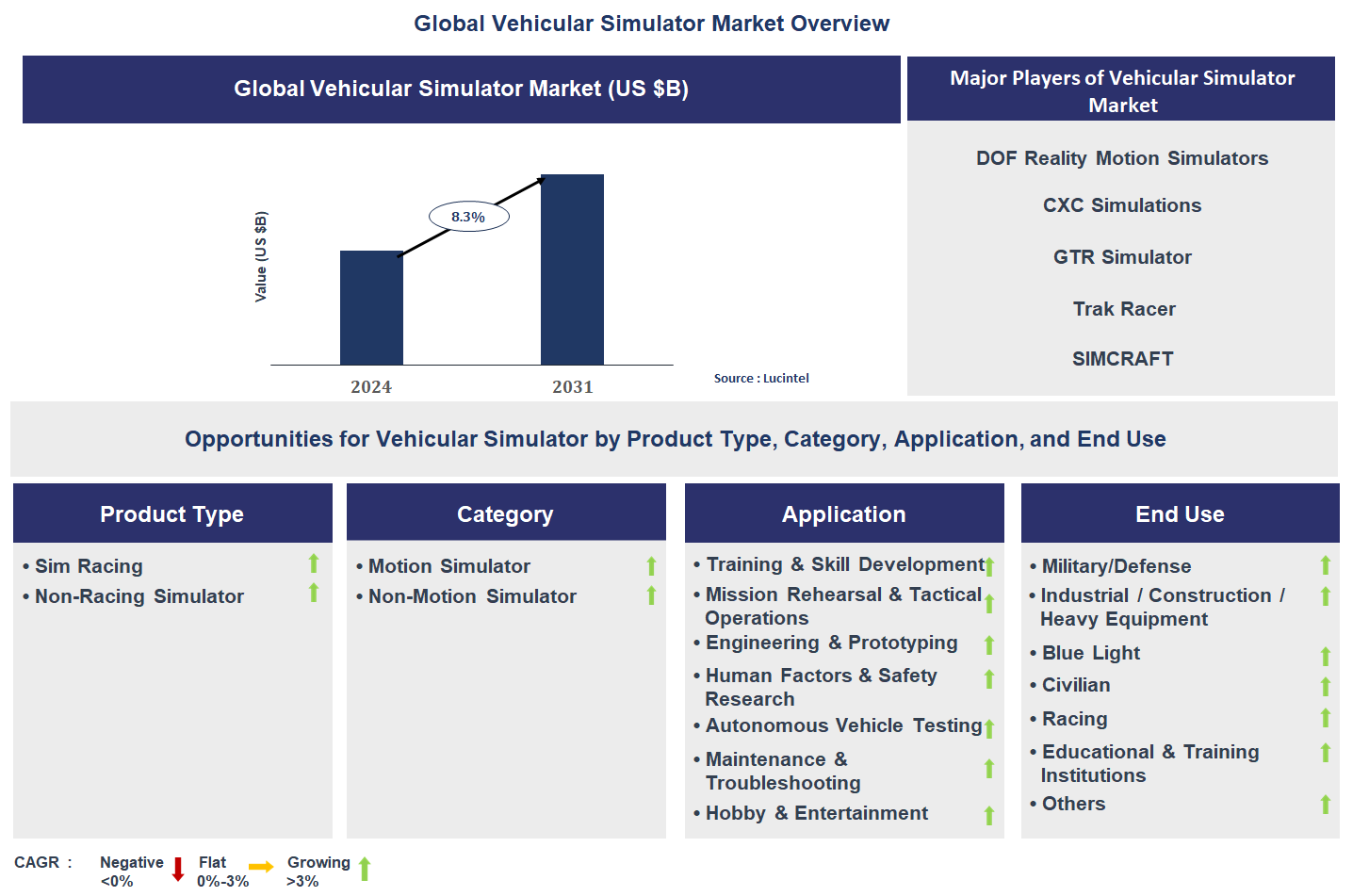
Vehicular Simulator Market Trends and Forecast

Emerging Trends in the Vehicular Simulator Market

The vehicular simulator market is being redefined by some fundamental emerging trends that are driving the industry to more realism, intelligence, and integration with other technologies. These trends reflect directly on the growing sophistication of contemporary automobiles and the demand for more effective and more comprehensive testing practices. The market is shifting from a mere tool for driver training and becoming a critical component of the overall vehicle development process.
• Artificial Intelligence and Machine Learning Integration: One of the most prominent trends is utilization of AI and machine learning (ML) to design more dynamic and realistic simulation scenarios. AI is capable of producing a limitless number of novel driving scenarios, including "edge-cases" that cannot easily be replicated in the real world. The effect is a better, more comprehensive test environment for autonomous car algorithms. AI simulators can also offer adaptive driver training, adapting scenarios to users’ particular needs and weaknesses, which is enhancing training efficacy.
• Cloud-Based Simulation Platforms: One of the new trends is the move towards cloud-based simulation platforms. This permits businesses to scale their testing on-demand, executing thousands of simulations concurrently without any huge on-premises hardware requirement. The effect is an accelerated and less expensive development process. Cloud-based environments facilitate effortless collaboration between geographically remote teams and democratize access to high-performance simulation capabilities for smaller startups and research facilities that may not be able to afford to buy dedicated equipment.
• Widespread Adoption of Digital Twins: Increasing use is being seen in the creation of digital twins of cars, parts, and even whole cities in a simulation. A digital twin is a virtual duplicate that precisely replicates its real-world equivalent. The effect is an optimized and forecasted development process. With digital twins, engineers are able to simulate the performance of a vehicle’s new systems or components under different conditions without the requirement for physical prototypes, which is saving time and money and speeding up innovation throughout the whole automotive value chain.
• Multi-Sensory and Haptic Feedback Systems: One major trend is the creation of more sophisticated multi-sensory and haptic feedback systems. These systems extend beyond visual feedback and consist of motion platforms, vibration systems, and realistic steering and pedal resistance to provide a highly immersive and realistic driving environment. The result is a more valuable tool for human factors research and driver training.
• Integration with Virtual Reality and Augmented Reality: One of the key trends is greater integration of VR and AR technology into vehicle simulators. VR headsets can deliver a richly immersive 360-degree experience, while AR can superimpose virtual data on real-world environments when training. The result is an easier, more intuitive user experience. This is especially vital for training situations where visual immersion is paramount, such as in emergency vehicle operators or military vehicle drivers that must practice a mission in a realistic setting.
These trends are all combined to fundamentally change the market by making vehicular simulators more intelligent, accessible, and adaptive, setting the stage for future growth at a major level as a central pillar of the contemporary automotive ecosystem.
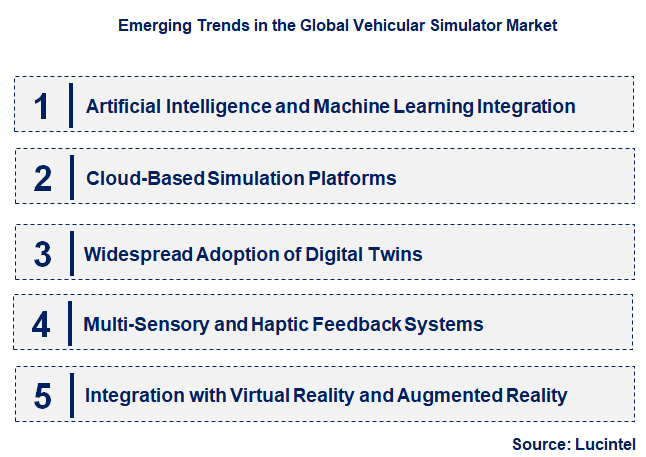
Emerging Trends in the Vehicular Simulator Market

Recent Development in the Vehicular Simulator Market

The vehicular simulator market is experiencing dynamic growth, which indicates a robust worldwide demand for advanced and efficient testing, training, and research equipment. The advances are not incremental but are actually revolutionizing the industry’s landscape. The emphasis is on enhancing the accuracy of simulations, developing their applications into new fields, and making more cost-efficient production practices. This is a significant time for the market as it continues to gain significance in many industries, ranging from autonomous vehicles and military training through to public transport and human factors studies.
• High-Fidelity Autonomous Vehicle Test Bed Development: One of the most significant developments is the development of high-fidelity virtual test beds particularly for autonomous vehicles. These platforms are able to mimic a broad variety of real-world driving scenarios and edge-cases that are too costly or hazardous to test in the real world. The effect is a faster and safer development process for AVs. By enabling companies to perform millions of kilometers of simulation tests, this development is a driving factor for the mass production of safe and reliable autonomous vehicles and their parts.
• Transition to Software-Centric Simulation: One of the most important developments is the transition of the market toward software-centric simulation solutions. While hardware is still relevant, the emphasis is more and more on the software that creates the scenarios, simulates vehicle dynamics, and delivers realistic sensor data. The effect is more flexibility and scalability. This enables over-the-air updates, direct integration with other computer software tools, and the possibility of running simulations on multiple computing platforms ranging from a single workstation to a gigantic cloud-based cluster.
• Integration of Digital Twin Technology: A newer trend is the widespread use of digital twin technology in vehicular simulation. Digital twins are accurate virtual copies of real-world vehicles and their components. The effect is a decrease in physical prototyping and testing. Through the creation of a digital twin for a vehicle, engineers have the ability to try out new components and systems in a simulated environment, saving considerable time and funds and enabling quicker design iterations and product verification prior to developing a physical prototype.
• State-of-the-Art Human-in-the-Loop Simulators: One significant advancement is the development of state-of-the-art human-in-the-loop (Hill) simulators that offer a very realistic and interactive experience to the user. These simulators feature high-fidelity motion platforms, authentic cockpits, and multi-channel visual outputs. The result is a more efficient tool for driver training and human factors studies. By recreating the actual physical sensations of driving, these simulators are being employed by driving schools, commercial fleets, and militaries to train drivers in a variety of real-world driving conditions in a safe manner.
• Increased Use in Smart Cities and Urban Development: One of the developments is the use of vehicular simulators in smart city and urban development. The simulators are being utilized to simulate the effects of new traffic management systems, public transport routes, and smart infrastructure. The result is an evidence-based method of developing a city. Through simulations, city developers can maximize traffic flow, minimize congestion, and enhance public safety prior to investing in expensive physical changes to infrastructure.
These advancements are all impacting the marketplace by making vehicular simulators more accurate, flexible, and vital for a vast array of industries, setting the sector up for a future of widespread and vital application.

Strategic Growth Opportunities in the Vehicular Simulator Market

The vehicular simulator market presents many strategic growth opportunities in major applications due to growing global demand for high-end transportation and smart systems. Those businesses able to capitalize on these opportunities will find long-term success. These opportunities carry over into niche industries that depend on the special characteristics of vehicular simulators. Strategic growth will result from the capacity to innovate in the market interpretation of data, miniaturization, and service delivery to accommodate the changing needs of industries.
• Autonomous Vehicle Development and Validation: One of the key strategic growth areas involves offering bespoke simulators for autonomous vehicle development and validation. This involves designing testbeds for sensors such as LiDAR and camera, and the AI software that runs the vehicle. The payoff is access to a high-margin B2B market that relies on trusted simulation to comply with strict safety and regulation expectations and shorten time to market.
• Commercial Fleet Safety and Training: The commercial fleet business is a significant strategic growth opportunity. Firms can create simulators specific to truck, bus, and logistics drivers to enhance skills, lower accident rates, and minimize fuel usage. The effect is a huge high-volume market segment interested in data-driven training to manage risk and optimize operation. Through the provision of a controlled and safe environment, simulators can respond to the chronic need for highly competent commercial drivers.
• Urban Mobility and Public Transportation: One strategic growth area is in the public transportation and urban mobility markets. There are opportunities to use simulators to train subway drivers and train drivers, and to simulate the effect of new urban mobility services on traffic patterns. The effect is a strong, non-cyclical customer base that appreciates reliability and mission-critical capability for achieving safety and efficiency of public transportation. Businesses can offer solutions that enable cities to maximize their infrastructure and planning.
• Defense and Military Applications: The defense and military sector is a key strategic growth area. Armies employ simulators to train troops to drive armored vehicles, tanks, and other tactical wheeled vehicles in a secure, controlled, and cost-effective environment. The result is a high-risk B2G market calling for tailored, high-fidelity solutions for mission rehearsal and driver training. With realistic simulations of battlefield scenarios, firms can become an integral contributor to national security.
• ADAS Research: The car industry is putting more emphasis on creating sophisticated driver-assistance systems (ADAS). Simulators play an important part in testing and verifying such systems, including adaptive cruise control, lane-keeping assist, and automatic emergency braking. The effect is an underlying B2B opportunity that is critical to a broad sector of automotive businesses. By giving the solutions to investigate and enhance ADAS, businesses can be a central partner in making cars safer.
These strategic expansion prospects are influencing the market through specialization and innovation. The industry is headed toward a future where customized, high-performance vehicular simulator solutions are vital to success in several, high-impact industries.

Vehicular Simulator Market Driver and Challenges

The vehicular simulator market is influenced by a combination of strong drivers and substantial challenges. The drivers are largely driven by the global trend towards autonomous and networked cars and the necessity for more efficient and secure testing. The obstacles, however, are technical complexity in producing a true simulation, being expensive, and lacking standardization. The long-term success of the markets will depend on its capacity to build upon its drivers while combating its obstacles systematically. The interplay among these forces will decide the rate and direction of the industry’s development.
The factors responsible for driving the vehicular simulator market include:
1. Autonomous Vehicle Development: The one biggest stimulant is the speed of development in autonomous vehicles (AVs). The necessity to test AV software in a safe and reproducible environment is driving an enormous demand for sophisticated simulators capable of mimicking a huge variety of real-world situations, which are either too dangerous or too expensive to test on public roads.
2. Driver and Road Safety: One of the prime drivers is the worldwide focus on enhancing driver and road safety. Governments and business sectors are employing simulators to train drivers for a range of vehicles, from automobiles to heavy trucks, that is lowering the occurrence of accidents and saving lives. It is a compelling, mission-critical use.
3. Reducing Costs and Time for Prototyping: High cost and time required in designing and testing physical prototypes are the biggest drivers. With a shift in testing to a virtual space, manufacturers can scale down their research and development expenses and shorten the time to market a new vehicle or a feature.
4. Computing Power Development: The ongoing development in computing power and graphics processing units (GPUs) is a significant catalyst. This technology provides the ability to create highly detailed and realistic virtual worlds, which is a prerequisite for correct modeling of vehicle dynamics and sensor data, making the simulator more effective and credible.
5. Increasing Demand from Emerging Industries: Increasing demand from emerging industries such as aerospace, military, and public transport is a key driver. These sectors need sophisticated simulators for pilot training, mission simulation, and city planning, which is broadening the market outside the conventional automotive market.
Challenges in the vehicular simulator market are:
1. Excessive Price of Full-Scale Simulators: One of the main issues is the excessive initial investment required for full-scale, high-fidelity simulators. These simulators cost millions of dollars, restricting their use to big companies, government institutions, and heavily funded research centers, making it difficult for smaller institutions to join them.
2. Fidelity and Realism of Simulation: One important challenge is the natural difficulty of simulating exactly to perfect fidelity and realism. Although simulators are now extremely sophisticated, duplicating all of the nuanced physical forces, environmental phenomena, and human responses of the real world is a problematic engineering challenge, which can impact the transferability of skills.
3. Lack of Standardization: The absence of worldwide standards for the simulation platforms and data formats is a major issue. This prevents various companies and software from being able to collaborate, which can discourage mass adoption of the technology and necessitate extensive custom integration efforts, boosting development time and expense for customers.
In conclusion, the market for vehicular simulators is propelled by powerful forces of technology and the requirements for enhanced safety and efficiency. It has to work around issues involving the high price of its systems, technical limitations in achieving ultimate realism, and a lack of industry standards to realize its full potential. The future of the industry lies in its capacity to deliver solutions that are not only high-performing but cost-effective, standardized, and versatile for a wide variety of applications.

List of Vehicular Simulator Companies

Companies in the market compete on the basis of product quality offered. Major players in this market focus on expanding their manufacturing facilities, R&D investments, infrastructural development, and leverage integration opportunities across the value chain. With these strategies vehicular simulator companies cater increasing demand, ensure competitive effectiveness, develop innovative products & technologies, reduce production costs, and expand their customer base. Some of the vehicular simulator companies profiled in this report include-
• DOF Reality Motion Simulators
• CXC Simulations
• GTR Simulator
• Trak Racer
• SIMCRAFT
• VESARO
• Cruden
• Ansible Motion Limited
• Vi-Grade
• SANLAB

Vehicular Simulator Market by Segment

The study includes a forecast for the global vehicular simulator market by product type, category, application, end use, and region.

Vehicular Simulator Market by Product Type [Value from 2019 to 2031]:


• Sim Racing
• Non-Racing Simulator

Vehicular Simulator Market by Category [Value from 2019 to 2031]:


• Motion Simulator
• Non-Motion Simulator

Vehicular Simulator Market by Application [Value from 2019 to 2031]:


• Training & Skill Development
• Mission Rehearsal & Tactical Operations
• Engineering & Prototyping
• Human Factors & Safety Research
• Autonomous Vehicle Testing
• Maintenance & Troubleshooting
• Hobby & Entertainment

Vehicular Simulator Market by End Use [Value from 2019 to 2031]:


• Military/Defense
• Industrial / Construction / Heavy Equipment
• Blue Light
• Civilian
• Racing
• Educational & Training Institutions
• Others

Vehicular Simulator Market by Region [Value from 2019 to 2031]:


• North America
• Europe
• Asia Pacific
• The Rest of the World

Country Wise Outlook for the Vehicular Simulator Market

The vehicular simulator industry is presently in the midst of a phase of accelerated development, propelled by the transformation of the global automotive industry towards connected, autonomous, shared, and electric (CASE) vehicles. Simulators are being transformed from mere training aids to advanced research and development platforms through which manufacturers can trim costs and expedite product development cycles. New developments concentrate on generating highly realistic virtual worlds, incorporating AI for increased scenario complexity, and offering cheaper and more universal solutions.
• United States: Recent United States developments are also dominated by the autonomous vehicle (AV) industry. High-fidelity simulation environments for AV testing and validation have a high priority. One of the prime developments is the general use of cloud-based simulation platforms, enabling enormous parallel testing of AV algorithms, which speeds up the development process and minimizes the need for expensive physical road tests. The market is also witnessing the growth of synthetic data generation as a means of producing enormous, high-quality sets of data for training autonomous system AI models capable of processing a huge variety of "edge-case" situations.
• China: China’s vehicular simulator market is booming on the back of its accelerating investment in intelligent and new energy vehicles. Recent advancements are concentrated on mass simulation for a large number of vehicles and city environments. There is high government incentive for intelligent driving technology, prompting enormous investment in simulation platforms that can test and prove L2 and above autonomous driving systems. One important development is the creation of "world models" based on AI to build virtual worlds that closely mimic reality, allowing data to be generated efficiently and long-tail, complex scenarios to be tested.
• Germany: The German market, which boasts precision engineering capabilities, is at the forefront of vehicular simulators for research and development. Current developments are spurred on by an emphasis on multi-physics as well as hardware-in-the-loop (Hill) simulation. There is increasing need for simulators that are capable of simulating advanced vehicle dynamics and the interaction between a vehicle’s electronic control units (ECUs) and its physical components. German businesses are leading the way in creating highly accurate digital twins of vehicles and their parts, enabling virtual validation and optimization of a vehicle’s handling behavior right down to its drivetrain.
• India: India’s vehicle simulator market is in a high-growth phase due to growing emphasis on driver training and safety. Recent trends are aimed at delivering cost-effective and user-friendly simulator solutions for a large domestic market. There is a keen demand for simulators for commercial vehicle and bus driver training to minimize accident rates and enhance public safety. One of the significant advances is the creation of small, screen-based simulators that offer an affordable and space-saving alternative to full-scale simulators, and are thus available for wider adoption by driving schools and commercial training facilities.
• Japan: The Japanese market has a tradition of leadership in automotive technology dating back many years and is characterized by a safety-oriented and high-engineering focus. Current developments focus on human factors research and advanced motion cueing systems. Japan also leads the way in employing vehicular simulators to analyze driver behavior, perception, and reaction time, which is required to develop effective Advanced Driver-Assistance Systems (ADAS).

Lucintel Analytics Dashboard

Features of the Global Vehicular Simulator Market

Market Size Estimates: Vehicular simulator market size estimation in terms of value ($B).
Trend and Forecast Analysis: Market trends (2019 to 2024) and forecast (2025 to 2031) by various segments and regions.
Segmentation Analysis: Vehicular simulator market size by various segments, such as by product type, category, application, end use, and region in terms of value ($B).
Regional Analysis: Vehicular simulator market breakdown by North America, Europe, Asia Pacific, and Rest of the World.
Growth Opportunities: Analysis of growth opportunities in different product types, categories, applications, end uses, and regions for the vehicular simulator market.
Strategic Analysis: This includes M&A, new product development, and competitive landscape of the vehicular simulator market.
Analysis of competitive intensity of the industry based on Porter’s Five Forces model.

Lucintel Consulting Services

FAQ

Q1. What is the growth forecast for vehicular simulator market?
Answer: The global vehicular simulator market is expected to grow with a CAGR of 8.3% from 2025 to 2031.
Q2. What are the major drivers influencing the growth of the vehicular simulator market?
Answer: The major drivers for this market are the increasing demand for driver training solutions, the rising adoption of autonomous vehicle technologies, and the growing need for realistic simulation experiences.
Q3. What are the major segments for vehicular simulator market?
Answer: The future of the vehicular simulator market looks promising with opportunities in the military/defense, industrial / construction / heavy equipment, blue light, civilian, racing, and educational & training institution markets.
Q4. Who are the key vehicular simulator market companies?
Answer: Some of the key vehicular simulator companies are as follows:
• DOF Reality Motion Simulators
• CXC Simulations
• GTR Simulator
• Trak Racer
• SIMCRAFT
• VESARO
• Cruden
• Ansible Motion Limited
• Vi-Grade
• SANLAB
Q5. Which vehicular simulator market segment will be the largest in future?
Answer: Lucintel forecasts that, within the product type category, sim racing is expected to witness higher growth over the forecast period.
Q6. In vehicular simulator market, which region is expected to be the largest in next 5 years?
Answer: In terms of region, APAC is expected to witness the highest growth over the forecast period.
Q7. Do we receive customization in this report?
Answer: Yes, Lucintel provides 10% customization without any additional cost.

This report answers following 11 key questions:

Q.1. What are some of the most promising, high-growth opportunities for the vehicular simulator market by product type (sim racing and non-racing simulator), category (motion simulator and non-motion simulator), application (training & skill development, mission rehearsal & tactical operations, engineering & prototyping, human factors & safety research, autonomous vehicle testing, maintenance & troubleshooting, and hobby & entertainment), end use (military/defense, industrial / construction / heavy equipment, blue light, civilian, racing, educational & training institutions, and others), and region (North America, Europe, Asia Pacific, and the Rest of the World)?
Q.2. Which segments will grow at a faster pace and why?
Q.3. Which region will grow at a faster pace and why?
Q.4. What are the key factors affecting market dynamics? What are the key challenges and business risks in this market?
Q.5. What are the business risks and competitive threats in this market?
Q.6. What are the emerging trends in this market and the reasons behind them?
Q.7. What are some of the changing demands of customers in the market?
Q.8. What are the new developments in the market? Which companies are leading these developments?
Q.9. Who are the major players in this market? What strategic initiatives are key players pursuing for business growth?
Q.10. What are some of the competing products in this market and how big of a threat do they pose for loss of market share by material or product substitution?
Q.11. What M&A activity has occurred in the last 5 years and what has its impact been on the industry?

For any questions related to Vehicular Simulator Market, Vehicular Simulator Market Size, Vehicular Simulator Market Growth, Vehicular Simulator Market Analysis, Vehicular Simulator Market Report, Vehicular Simulator Market Share, Vehicular Simulator Market Trends, Vehicular Simulator Market Forecast, Vehicular Simulator Companies, write Lucintel analyst at email: helpdesk@lucintel.com. We will be glad to get back to you soon.
                                           Table of Contents

            1. Executive Summary

            2. Market Overview

                        2.1 Background and Classifications
                        2.2 Supply Chain

            3. Market Trends & Forecast Analysis

                        3.1 Macroeconomic Trends and Forecasts
                        3.2 Industry Drivers and Challenges
                        3.3 PESTLE Analysis
                        3.4 Patent Analysis
                        3.5 Regulatory Environment
                        3.6 Global Vehicular Simulator Market Trends and Forecast

            4. Global Vehicular Simulator Market by Product Type

                        4.1 Overview
                        4.2 Attractiveness Analysis by Product Type
                        4.3 Sim Racing : Trends and Forecast 2025 to 2031
                        4.4 Non-Racing Simulator : Trends and Forecast 2025 to 2031

            5. Global Vehicular Simulator Market by Category

                        5.1 Overview
                        5.2 Attractiveness Analysis by Category
                        5.3 Motion Simulator : Trends and Forecast 2025 to 2031
                        5.4 Non-Motion Simulator : Trends and Forecast 2025 to 2031

            6. Global Vehicular Simulator Market by Application

                        6.1 Overview
                        6.2 Attractiveness Analysis by Application
                        6.3 Training & Skill Development : Trends and Forecast 2025 to 2031
                        6.4 Mission Rehearsal & Tactical Operations : Trends and Forecast 2025 to 2031
                        6.5 Engineering & Prototyping : Trends and Forecast 2025 to 2031
                        6.6 Human Factors & Safety Research : Trends and Forecast 2025 to 2031
                        6.7 Autonomous Vehicle Testing : Trends and Forecast 2025 to 2031
                        6.8 Maintenance & Troubleshooting : Trends and Forecast 2025 to 2031
                        6.9 Hobby & Entertainment : Trends and Forecast 2025 to 2031

            7. Global Vehicular Simulator Market by End Use

                        7.1 Overview
                        7.2 Attractiveness Analysis by End Use
                        7.3 Military/Defense : Trends and Forecast 2025 to 2031
                        7.4 Industrial / Construction / Heavy Equipment : Trends and Forecast 2025 to 2031
                        7.5 Blue Light : Trends and Forecast 2025 to 2031
                        7.6 Civilian : Trends and Forecast 2025 to 2031
                        7.7 Racing : Trends and Forecast 2025 to 2031
                        7.8 Educational & Training Institutions : Trends and Forecast 2025 to 2031
                        7.9 Others : Trends and Forecast 2025 to 2031

            8. Regional Analysis

                        8.1 Overview
                        8.2 Global Vehicular Simulator Market by Region

            9. North American Vehicular Simulator Market

                        9.1 Overview
                        9.2 North American Vehicular Simulator Market by Product Type
                        9.3 North American Vehicular Simulator Market by End Use
                        9.4 The United States Vehicular Simulator Market
                        9.5 Canadian Vehicular Simulator Market
                        9.6 Mexican Vehicular Simulator Market

            10. European Vehicular Simulator Market

                        10.1 Overview
                        10.2 European Vehicular Simulator Market by Product Type
                        10.3 European Vehicular Simulator Market by End Use
                        10.4 German Vehicular Simulator Market
                        10.5 French Vehicular Simulator Market
                        10.6 Italian Vehicular Simulator Market
                        10.7 Spanish Vehicular Simulator Market
                        10.8 The United Kingdom Vehicular Simulator Market

            11. APAC Vehicular Simulator Market

                        11.1 Overview
                        11.2 APAC Vehicular Simulator Market by Product Type
                        11.3 APAC Vehicular Simulator Market by End Use
                        11.4 Chinese Vehicular Simulator Market
                        11.5 Indian Vehicular Simulator Market
                        11.6 Japanese Vehicular Simulator Market
                        11.7 South Korean Vehicular Simulator Market
                        11.8 Indonesian Vehicular Simulator Market

            12. ROW Vehicular Simulator Market

                        12.1 Overview
                        12.2 ROW Vehicular Simulator Market by Product Type
                        12.3 ROW Vehicular Simulator Market by End Use
                        12.4 Middle Eastern Vehicular Simulator Market
                        12.5 South American Vehicular Simulator Market
                        12.6 African Vehicular Simulator Market

            13. Competitor Analysis

                        13.1 Product Portfolio Analysis
                        13.2 Operational Integration
                        13.3 Porter’s Five Forces Analysis
                                    • Competitive Rivalry
                                    • Bargaining Power of Buyers
                                    • Bargaining Power of Suppliers
                                    • Threat of Substitutes
                                    • Threat of New Entrants
                        13.4 Market Share Analysis

            14. Opportunities & Strategic Analysis

                        14.1 Value Chain Analysis
                        14.2 Growth Opportunity Analysis
                                    14.2.1 Growth Opportunity by Product Type
                                    14.2.2 Growth Opportunity by Category
                                    14.2.3 Growth Opportunity by Application
                                    14.2.4 Growth Opportunity by End Use
                        14.3 Emerging Trends in the Global Vehicular Simulator Market
                        14.4 Strategic Analysis
                                    14.4.1 New Product Development
                                    14.4.2 Certification and Licensing
                                    14.4.3 Mergers, Acquisitions, Agreements, Collaborations, and Joint Ventures

            15. Company Profiles of the Leading Players Across the Value Chain

                        15.1 Competitive Analysis
                        15.2 DOF Reality Motion Simulators
                                    • Company Overview
                                    • Vehicular Simulator Market Business Overview
                                    • New Product Development
                                    • Merger, Acquisition, and Collaboration
                                    • Certification and Licensing
                        15.3 CXC Simulations
                                    • Company Overview
                                    • Vehicular Simulator Market Business Overview
                                    • New Product Development
                                    • Merger, Acquisition, and Collaboration
                                    • Certification and Licensing
                        15.4 GTR Simulator
                                    • Company Overview
                                    • Vehicular Simulator Market Business Overview
                                    • New Product Development
                                    • Merger, Acquisition, and Collaboration
                                    • Certification and Licensing
                        15.5 Trak Racer
                                    • Company Overview
                                    • Vehicular Simulator Market Business Overview
                                    • New Product Development
                                    • Merger, Acquisition, and Collaboration
                                    • Certification and Licensing
                        15.6 SIMCRAFT
                                    • Company Overview
                                    • Vehicular Simulator Market Business Overview
                                    • New Product Development
                                    • Merger, Acquisition, and Collaboration
                                    • Certification and Licensing
                        15.7 VESARO
                                    • Company Overview
                                    • Vehicular Simulator Market Business Overview
                                    • New Product Development
                                    • Merger, Acquisition, and Collaboration
                                    • Certification and Licensing
                        15.8 Cruden
                                    • Company Overview
                                    • Vehicular Simulator Market Business Overview
                                    • New Product Development
                                    • Merger, Acquisition, and Collaboration
                                    • Certification and Licensing
                        15.9 Ansible Motion Limited
                                    • Company Overview
                                    • Vehicular Simulator Market Business Overview
                                    • New Product Development
                                    • Merger, Acquisition, and Collaboration
                                    • Certification and Licensing
                        15.10 Vi-Grade
                                    • Company Overview
                                    • Vehicular Simulator Market Business Overview
                                    • New Product Development
                                    • Merger, Acquisition, and Collaboration
                                    • Certification and Licensing
                        15.11 SANLAB
                                    • Company Overview
                                    • Vehicular Simulator Market Business Overview
                                    • New Product Development
                                    • Merger, Acquisition, and Collaboration
                                    • Certification and Licensing

            16. Appendix

                        16.1 List of Figures
                        16.2 List of Tables
                        16.3 Research Methodology
                        16.4 Disclaimer
                        16.5 Copyright
                        16.6 Abbreviations and Technical Units
                        16.7 About Us
                        16.8 Contact Us

                                               List of Figures


            Chapter 1

                        Figure 1.1: Trends and Forecast for the Global Vehicular Simulator Market

            Chapter 2

                        Figure 2.1: Usage of Vehicular Simulator Market
                        Figure 2.2: Classification of the Global Vehicular Simulator Market
                        Figure 2.3: Supply Chain of the Global Vehicular Simulator Market

            Chapter 3

                        Figure 3.1: Trends of the Global GDP Growth Rate
                        Figure 3.2: Trends of the Global Population Growth Rate
                        Figure 3.3: Trends of the Global Inflation Rate
                        Figure 3.4: Trends of the Global Unemployment Rate
                        Figure 3.5: Trends of the Regional GDP Growth Rate
                        Figure 3.6: Trends of the Regional Population Growth Rate
                        Figure 3.7: Trends of the Regional Inflation Rate
                        Figure 3.8: Trends of the Regional Unemployment Rate
                        Figure 3.9: Trends of Regional Per Capita Income
                        Figure 3.10: Forecast for the Global GDP Growth Rate
                        Figure 3.11: Forecast for the Global Population Growth Rate
                        Figure 3.12: Forecast for the Global Inflation Rate
                        Figure 3.13: Forecast for the Global Unemployment Rate
                        Figure 3.14: Forecast for the Regional GDP Growth Rate
                        Figure 3.15: Forecast for the Regional Population Growth Rate
                        Figure 3.16: Forecast for the Regional Inflation Rate
                        Figure 3.17: Forecast for the Regional Unemployment Rate
                        Figure 3.18: Forecast for Regional Per Capita Income
                        Figure 3.19: Driver and Challenges of the Vehicular Simulator Market

            Chapter 4

                        Figure 4.1: Global Vehicular Simulator Market by Product Type in 2019, 2024, and 2031
                        Figure 4.2: Trends of the Global Vehicular Simulator Market ($B) by Product Type
                        Figure 4.3: Forecast for the Global Vehicular Simulator Market ($B) by Product Type
                        Figure 4.4: Trends and Forecast for Sim Racing in the Global Vehicular Simulator Market (2019-2031)
                        Figure 4.5: Trends and Forecast for Non-Racing Simulator in the Global Vehicular Simulator Market (2019-2031)

            Chapter 5

                        Figure 5.1: Global Vehicular Simulator Market by Category in 2019, 2024, and 2031
                        Figure 5.2: Trends of the Global Vehicular Simulator Market ($B) by Category
                        Figure 5.3: Forecast for the Global Vehicular Simulator Market ($B) by Category
                        Figure 5.4: Trends and Forecast for Motion Simulator in the Global Vehicular Simulator Market (2019-2031)
                        Figure 5.5: Trends and Forecast for Non-Motion Simulator in the Global Vehicular Simulator Market (2019-2031)

            Chapter 6

                        Figure 6.1: Global Vehicular Simulator Market by Application in 2019, 2024, and 2031
                        Figure 6.2: Trends of the Global Vehicular Simulator Market ($B) by Application
                        Figure 6.3: Forecast for the Global Vehicular Simulator Market ($B) by Application
                        Figure 6.4: Trends and Forecast for Training & Skill Development in the Global Vehicular Simulator Market (2019-2031)
                        Figure 6.5: Trends and Forecast for Mission Rehearsal & Tactical Operations in the Global Vehicular Simulator Market (2019-2031)
                        Figure 6.6: Trends and Forecast for Engineering & Prototyping in the Global Vehicular Simulator Market (2019-2031)
                        Figure 6.7: Trends and Forecast for Human Factors & Safety Research in the Global Vehicular Simulator Market (2019-2031)
                        Figure 6.8: Trends and Forecast for Autonomous Vehicle Testing in the Global Vehicular Simulator Market (2019-2031)
                        Figure 6.9: Trends and Forecast for Maintenance & Troubleshooting in the Global Vehicular Simulator Market (2019-2031)
                        Figure 6.10: Trends and Forecast for Hobby & Entertainment in the Global Vehicular Simulator Market (2019-2031)

            Chapter 7

                        Figure 7.1: Global Vehicular Simulator Market by End Use in 2019, 2024, and 2031
                        Figure 7.2: Trends of the Global Vehicular Simulator Market ($B) by End Use
                        Figure 7.3: Forecast for the Global Vehicular Simulator Market ($B) by End Use
                        Figure 7.4: Trends and Forecast for Military/Defense in the Global Vehicular Simulator Market (2019-2031)
                        Figure 7.5: Trends and Forecast for Industrial / Construction / Heavy Equipment in the Global Vehicular Simulator Market (2019-2031)
                        Figure 7.6: Trends and Forecast for Blue Light in the Global Vehicular Simulator Market (2019-2031)
                        Figure 7.7: Trends and Forecast for Civilian in the Global Vehicular Simulator Market (2019-2031)
                        Figure 7.8: Trends and Forecast for Racing in the Global Vehicular Simulator Market (2019-2031)
                        Figure 7.9: Trends and Forecast for Educational & Training Institutions in the Global Vehicular Simulator Market (2019-2031)
                        Figure 7.10: Trends and Forecast for Others in the Global Vehicular Simulator Market (2019-2031)

            Chapter 8

                        Figure 8.1: Trends of the Global Vehicular Simulator Market ($B) by Region (2019-2024)
                        Figure 8.2: Forecast for the Global Vehicular Simulator Market ($B) by Region (2025-2031)

            Chapter 9

                        Figure 9.1: Trends and Forecast for the North American Vehicular Simulator Market (2019-2031)
                        Figure 9.2: North American Vehicular Simulator Market by Product Type in 2019, 2024, and 2031
                        Figure 9.3: Trends of the North American Vehicular Simulator Market ($B) by Product Type (2019-2024)
                        Figure 9.4: Forecast for the North American Vehicular Simulator Market ($B) by Product Type (2025-2031)
                        Figure 9.5: North American Vehicular Simulator Market by Category in 2019, 2024, and 2031
                        Figure 9.6: Trends of the North American Vehicular Simulator Market ($B) by Category (2019-2024)
                        Figure 9.7: Forecast for the North American Vehicular Simulator Market ($B) by Category (2025-2031)
                        Figure 9.8: North American Vehicular Simulator Market by Application in 2019, 2024, and 2031
                        Figure 9.9: Trends of the North American Vehicular Simulator Market ($B) by Application (2019-2024)
                        Figure 9.10: Forecast for the North American Vehicular Simulator Market ($B) by Application (2025-2031)
                        Figure 9.11: North American Vehicular Simulator Market by End Use in 2019, 2024, and 2031
                        Figure 9.12: Trends of the North American Vehicular Simulator Market ($B) by End Use (2019-2024)
                        Figure 9.13: Forecast for the North American Vehicular Simulator Market ($B) by End Use (2025-2031)
                        Figure 9.14: Trends and Forecast for the United States Vehicular Simulator Market ($B) (2019-2031)
                        Figure 9.15: Trends and Forecast for the Mexican Vehicular Simulator Market ($B) (2019-2031)
                        Figure 9.16: Trends and Forecast for the Canadian Vehicular Simulator Market ($B) (2019-2031)

            Chapter 10

                        Figure 10.1: Trends and Forecast for the European Vehicular Simulator Market (2019-2031)
                        Figure 10.2: European Vehicular Simulator Market by Product Type in 2019, 2024, and 2031
                        Figure 10.3: Trends of the European Vehicular Simulator Market ($B) by Product Type (2019-2024)
                        Figure 10.4: Forecast for the European Vehicular Simulator Market ($B) by Product Type (2025-2031)
                        Figure 10.5: European Vehicular Simulator Market by Category in 2019, 2024, and 2031
                        Figure 10.6: Trends of the European Vehicular Simulator Market ($B) by Category (2019-2024)
                        Figure 10.7: Forecast for the European Vehicular Simulator Market ($B) by Category (2025-2031)
                        Figure 10.8: European Vehicular Simulator Market by Application in 2019, 2024, and 2031
                        Figure 10.9: Trends of the European Vehicular Simulator Market ($B) by Application (2019-2024)
                        Figure 10.10: Forecast for the European Vehicular Simulator Market ($B) by Application (2025-2031)
                        Figure 10.11: European Vehicular Simulator Market by End Use in 2019, 2024, and 2031
                        Figure 10.12: Trends of the European Vehicular Simulator Market ($B) by End Use (2019-2024)
                        Figure 10.13: Forecast for the European Vehicular Simulator Market ($B) by End Use (2025-2031)
                        Figure 10.14: Trends and Forecast for the German Vehicular Simulator Market ($B) (2019-2031)
                        Figure 10.15: Trends and Forecast for the French Vehicular Simulator Market ($B) (2019-2031)
                        Figure 10.16: Trends and Forecast for the Spanish Vehicular Simulator Market ($B) (2019-2031)
                        Figure 10.17: Trends and Forecast for the Italian Vehicular Simulator Market ($B) (2019-2031)
                        Figure 10.18: Trends and Forecast for the United Kingdom Vehicular Simulator Market ($B) (2019-2031)

            Chapter 11

                        Figure 11.1: Trends and Forecast for the APAC Vehicular Simulator Market (2019-2031)
                        Figure 11.2: APAC Vehicular Simulator Market by Product Type in 2019, 2024, and 2031
                        Figure 11.3: Trends of the APAC Vehicular Simulator Market ($B) by Product Type (2019-2024)
                        Figure 11.4: Forecast for the APAC Vehicular Simulator Market ($B) by Product Type (2025-2031)
                        Figure 11.5: APAC Vehicular Simulator Market by Category in 2019, 2024, and 2031
                        Figure 11.6: Trends of the APAC Vehicular Simulator Market ($B) by Category (2019-2024)
                        Figure 11.7: Forecast for the APAC Vehicular Simulator Market ($B) by Category (2025-2031)
                        Figure 11.8: APAC Vehicular Simulator Market by Application in 2019, 2024, and 2031
                        Figure 11.9: Trends of the APAC Vehicular Simulator Market ($B) by Application (2019-2024)
                        Figure 11.10: Forecast for the APAC Vehicular Simulator Market ($B) by Application (2025-2031)
                        Figure 11.11: APAC Vehicular Simulator Market by End Use in 2019, 2024, and 2031
                        Figure 11.12: Trends of the APAC Vehicular Simulator Market ($B) by End Use (2019-2024)
                        Figure 11.13: Forecast for the APAC Vehicular Simulator Market ($B) by End Use (2025-2031)
                        Figure 11.14: Trends and Forecast for the Japanese Vehicular Simulator Market ($B) (2019-2031)
                        Figure 11.15: Trends and Forecast for the Indian Vehicular Simulator Market ($B) (2019-2031)
                        Figure 11.16: Trends and Forecast for the Chinese Vehicular Simulator Market ($B) (2019-2031)
                        Figure 11.17: Trends and Forecast for the South Korean Vehicular Simulator Market ($B) (2019-2031)
                        Figure 11.18: Trends and Forecast for the Indonesian Vehicular Simulator Market ($B) (2019-2031)

            Chapter 12

                        Figure 12.1: Trends and Forecast for the ROW Vehicular Simulator Market (2019-2031)
                        Figure 12.2: ROW Vehicular Simulator Market by Product Type in 2019, 2024, and 2031
                        Figure 12.3: Trends of the ROW Vehicular Simulator Market ($B) by Product Type (2019-2024)
                        Figure 12.4: Forecast for the ROW Vehicular Simulator Market ($B) by Product Type (2025-2031)
                        Figure 12.5: ROW Vehicular Simulator Market by Category in 2019, 2024, and 2031
                        Figure 12.6: Trends of the ROW Vehicular Simulator Market ($B) by Category (2019-2024)
                        Figure 12.7: Forecast for the ROW Vehicular Simulator Market ($B) by Category (2025-2031)
                        Figure 12.8: ROW Vehicular Simulator Market by Application in 2019, 2024, and 2031
                        Figure 12.9: Trends of the ROW Vehicular Simulator Market ($B) by Application (2019-2024)
                        Figure 12.10: Forecast for the ROW Vehicular Simulator Market ($B) by Application (2025-2031)
                        Figure 12.11: ROW Vehicular Simulator Market by End Use in 2019, 2024, and 2031
                        Figure 12.12: Trends of the ROW Vehicular Simulator Market ($B) by End Use (2019-2024)
                        Figure 12.13: Forecast for the ROW Vehicular Simulator Market ($B) by End Use (2025-2031)
                        Figure 12.14: Trends and Forecast for the Middle Eastern Vehicular Simulator Market ($B) (2019-2031)
                        Figure 12.15: Trends and Forecast for the South American Vehicular Simulator Market ($B) (2019-2031)
                        Figure 12.16: Trends and Forecast for the African Vehicular Simulator Market ($B) (2019-2031)

            Chapter 13

                        Figure 13.1: Porter’s Five Forces Analysis of the Global Vehicular Simulator Market
                        Figure 13.2: Market Share (%) of Top Players in the Global Vehicular Simulator Market (2024)

            Chapter 14

                        Figure 14.1: Growth Opportunities for the Global Vehicular Simulator Market by Product Type
                        Figure 14.2: Growth Opportunities for the Global Vehicular Simulator Market by Category
                        Figure 14.3: Growth Opportunities for the Global Vehicular Simulator Market by Application
                        Figure 14.4: Growth Opportunities for the Global Vehicular Simulator Market by End Use
                        Figure 14.5: Growth Opportunities for the Global Vehicular Simulator Market by Region
                        Figure 14.6: Emerging Trends in the Global Vehicular Simulator Market

                                               List of Tables


            Chapter 1

                        Table 1.1: Growth Rate (%, 2023-2024) and CAGR (%, 2025-2031) of the Vehicular Simulator Market by Product Type, Category, Application, and End Use
                        Table 1.2: Attractiveness Analysis for the Vehicular Simulator Market by Region
                        Table 1.3: Global Vehicular Simulator Market Parameters and Attributes

            Chapter 3

                        Table 3.1: Trends of the Global Vehicular Simulator Market (2019-2024)
                        Table 3.2: Forecast for the Global Vehicular Simulator Market (2025-2031)

            Chapter 4

                        Table 4.1: Attractiveness Analysis for the Global Vehicular Simulator Market by Product Type
                        Table 4.2: Market Size and CAGR of Various Product Type in the Global Vehicular Simulator Market (2019-2024)
                        Table 4.3: Market Size and CAGR of Various Product Type in the Global Vehicular Simulator Market (2025-2031)
                        Table 4.4: Trends of Sim Racing in the Global Vehicular Simulator Market (2019-2024)
                        Table 4.5: Forecast for Sim Racing in the Global Vehicular Simulator Market (2025-2031)
                        Table 4.6: Trends of Non-Racing Simulator in the Global Vehicular Simulator Market (2019-2024)
                        Table 4.7: Forecast for Non-Racing Simulator in the Global Vehicular Simulator Market (2025-2031)

            Chapter 5

                        Table 5.1: Attractiveness Analysis for the Global Vehicular Simulator Market by Category
                        Table 5.2: Market Size and CAGR of Various Category in the Global Vehicular Simulator Market (2019-2024)
                        Table 5.3: Market Size and CAGR of Various Category in the Global Vehicular Simulator Market (2025-2031)
                        Table 5.4: Trends of Motion Simulator in the Global Vehicular Simulator Market (2019-2024)
                        Table 5.5: Forecast for Motion Simulator in the Global Vehicular Simulator Market (2025-2031)
                        Table 5.6: Trends of Non-Motion Simulator in the Global Vehicular Simulator Market (2019-2024)
                        Table 5.7: Forecast for Non-Motion Simulator in the Global Vehicular Simulator Market (2025-2031)

            Chapter 6

                        Table 6.1: Attractiveness Analysis for the Global Vehicular Simulator Market by Application
                        Table 6.2: Market Size and CAGR of Various Application in the Global Vehicular Simulator Market (2019-2024)
                        Table 6.3: Market Size and CAGR of Various Application in the Global Vehicular Simulator Market (2025-2031)
                        Table 6.4: Trends of Training & Skill Development in the Global Vehicular Simulator Market (2019-2024)
                        Table 6.5: Forecast for Training & Skill Development in the Global Vehicular Simulator Market (2025-2031)
                        Table 6.6: Trends of Mission Rehearsal & Tactical Operations in the Global Vehicular Simulator Market (2019-2024)
                        Table 6.7: Forecast for Mission Rehearsal & Tactical Operations in the Global Vehicular Simulator Market (2025-2031)
                        Table 6.8: Trends of Engineering & Prototyping in the Global Vehicular Simulator Market (2019-2024)
                        Table 6.9: Forecast for Engineering & Prototyping in the Global Vehicular Simulator Market (2025-2031)
                        Table 6.10: Trends of Human Factors & Safety Research in the Global Vehicular Simulator Market (2019-2024)
                        Table 6.11: Forecast for Human Factors & Safety Research in the Global Vehicular Simulator Market (2025-2031)
                        Table 6.12: Trends of Autonomous Vehicle Testing in the Global Vehicular Simulator Market (2019-2024)
                        Table 6.13: Forecast for Autonomous Vehicle Testing in the Global Vehicular Simulator Market (2025-2031)
                        Table 6.14: Trends of Maintenance & Troubleshooting in the Global Vehicular Simulator Market (2019-2024)
                        Table 6.15: Forecast for Maintenance & Troubleshooting in the Global Vehicular Simulator Market (2025-2031)
                        Table 6.16: Trends of Hobby & Entertainment in the Global Vehicular Simulator Market (2019-2024)
                        Table 6.17: Forecast for Hobby & Entertainment in the Global Vehicular Simulator Market (2025-2031)

            Chapter 7

                        Table 7.1: Attractiveness Analysis for the Global Vehicular Simulator Market by End Use
                        Table 7.2: Market Size and CAGR of Various End Use in the Global Vehicular Simulator Market (2019-2024)
                        Table 7.3: Market Size and CAGR of Various End Use in the Global Vehicular Simulator Market (2025-2031)
                        Table 7.4: Trends of Military/Defense in the Global Vehicular Simulator Market (2019-2024)
                        Table 7.5: Forecast for Military/Defense in the Global Vehicular Simulator Market (2025-2031)
                        Table 7.6: Trends of Industrial / Construction / Heavy Equipment in the Global Vehicular Simulator Market (2019-2024)
                        Table 7.7: Forecast for Industrial / Construction / Heavy Equipment in the Global Vehicular Simulator Market (2025-2031)
                        Table 7.8: Trends of Blue Light in the Global Vehicular Simulator Market (2019-2024)
                        Table 7.9: Forecast for Blue Light in the Global Vehicular Simulator Market (2025-2031)
                        Table 7.10: Trends of Civilian in the Global Vehicular Simulator Market (2019-2024)
                        Table 7.11: Forecast for Civilian in the Global Vehicular Simulator Market (2025-2031)
                        Table 7.12: Trends of Racing in the Global Vehicular Simulator Market (2019-2024)
                        Table 7.13: Forecast for Racing in the Global Vehicular Simulator Market (2025-2031)
                        Table 7.14: Trends of Educational & Training Institutions in the Global Vehicular Simulator Market (2019-2024)
                        Table 7.15: Forecast for Educational & Training Institutions in the Global Vehicular Simulator Market (2025-2031)
                        Table 7.16: Trends of Others in the Global Vehicular Simulator Market (2019-2024)
                        Table 7.17: Forecast for Others in the Global Vehicular Simulator Market (2025-2031)

            Chapter 8

                        Table 8.1: Market Size and CAGR of Various Regions in the Global Vehicular Simulator Market (2019-2024)
                        Table 8.2: Market Size and CAGR of Various Regions in the Global Vehicular Simulator Market (2025-2031)

            Chapter 9

                        Table 9.1: Trends of the North American Vehicular Simulator Market (2019-2024)
                        Table 9.2: Forecast for the North American Vehicular Simulator Market (2025-2031)
                        Table 9.3: Market Size and CAGR of Various Product Type in the North American Vehicular Simulator Market (2019-2024)
                        Table 9.4: Market Size and CAGR of Various Product Type in the North American Vehicular Simulator Market (2025-2031)
                        Table 9.5: Market Size and CAGR of Various Category in the North American Vehicular Simulator Market (2019-2024)
                        Table 9.6: Market Size and CAGR of Various Category in the North American Vehicular Simulator Market (2025-2031)
                        Table 9.7: Market Size and CAGR of Various Application in the North American Vehicular Simulator Market (2019-2024)
                        Table 9.8: Market Size and CAGR of Various Application in the North American Vehicular Simulator Market (2025-2031)
                        Table 9.9: Market Size and CAGR of Various End Use in the North American Vehicular Simulator Market (2019-2024)
                        Table 9.10: Market Size and CAGR of Various End Use in the North American Vehicular Simulator Market (2025-2031)
                        Table 9.11: Trends and Forecast for the United States Vehicular Simulator Market (2019-2031)
                        Table 9.12: Trends and Forecast for the Mexican Vehicular Simulator Market (2019-2031)
                        Table 9.13: Trends and Forecast for the Canadian Vehicular Simulator Market (2019-2031)

            Chapter 10

                        Table 10.1: Trends of the European Vehicular Simulator Market (2019-2024)
                        Table 10.2: Forecast for the European Vehicular Simulator Market (2025-2031)
                        Table 10.3: Market Size and CAGR of Various Product Type in the European Vehicular Simulator Market (2019-2024)
                        Table 10.4: Market Size and CAGR of Various Product Type in the European Vehicular Simulator Market (2025-2031)
                        Table 10.5: Market Size and CAGR of Various Category in the European Vehicular Simulator Market (2019-2024)
                        Table 10.6: Market Size and CAGR of Various Category in the European Vehicular Simulator Market (2025-2031)
                        Table 10.7: Market Size and CAGR of Various Application in the European Vehicular Simulator Market (2019-2024)
                        Table 10.8: Market Size and CAGR of Various Application in the European Vehicular Simulator Market (2025-2031)
                        Table 10.9: Market Size and CAGR of Various End Use in the European Vehicular Simulator Market (2019-2024)
                        Table 10.10: Market Size and CAGR of Various End Use in the European Vehicular Simulator Market (2025-2031,)
                        Table 10.11: Trends and Forecast for the German Vehicular Simulator Market (2019-2031)
                        Table 10.12: Trends and Forecast for the French Vehicular Simulator Market (2019-2031)
                        Table 10.13: Trends and Forecast for the Spanish Vehicular Simulator Market (2019-2031)
                        Table 10.14: Trends and Forecast for the Italian Vehicular Simulator Market (2019-2031)
                        Table 10.15: Trends and Forecast for the United Kingdom Vehicular Simulator Market (2019-2031)

            Chapter 11

                        Table 11.1: Trends of the APAC Vehicular Simulator Market (2019-2024)
                        Table 11.2: Forecast for the APAC Vehicular Simulator Market (2025-2031)
                        Table 11.3: Market Size and CAGR of Various Product Type in the APAC Vehicular Simulator Market (2019-2024)
                        Table 11.4: Market Size and CAGR of Various Product Type in the APAC Vehicular Simulator Market (2025-2031)
                        Table 11.5: Market Size and CAGR of Various Category in the APAC Vehicular Simulator Market (2019-2024)
                        Table 11.6: Market Size and CAGR of Various Category in the APAC Vehicular Simulator Market (2025-2031)
                        Table 11.7: Market Size and CAGR of Various Application in the APAC Vehicular Simulator Market (2019-2024)
                        Table 11.8: Market Size and CAGR of Various Application in the APAC Vehicular Simulator Market (2025-2031)
                        Table 11.9: Market Size and CAGR of Various End Use in the APAC Vehicular Simulator Market (2019-2024)
                        Table 11.10: Market Size and CAGR of Various End Use in the APAC Vehicular Simulator Market (2025-2031)
                        Table 11.11: Trends and Forecast for the Japanese Vehicular Simulator Market (2019-2031)
                        Table 11.12: Trends and Forecast for the Indian Vehicular Simulator Market (2019-2031)
                        Table 11.13: Trends and Forecast for the Chinese Vehicular Simulator Market (2019-2031)
                        Table 11.14: Trends and Forecast for the South Korean Vehicular Simulator Market (2019-2031)
                        Table 11.15: Trends and Forecast for the Indonesian Vehicular Simulator Market (2019-2031)

            Chapter 12

                        Table 12.1: Trends of the ROW Vehicular Simulator Market (2019-2024)
                        Table 12.2: Forecast for the ROW Vehicular Simulator Market (2025-2031)
                        Table 12.3: Market Size and CAGR of Various Product Type in the ROW Vehicular Simulator Market (2019-2024)
                        Table 12.4: Market Size and CAGR of Various Product Type in the ROW Vehicular Simulator Market (2025-2031)
                        Table 12.5: Market Size and CAGR of Various Category in the ROW Vehicular Simulator Market (2019-2024)
                        Table 12.6: Market Size and CAGR of Various Category in the ROW Vehicular Simulator Market (2025-2031)
                        Table 12.7: Market Size and CAGR of Various Application in the ROW Vehicular Simulator Market (2019-2024)
                        Table 12.8: Market Size and CAGR of Various Application in the ROW Vehicular Simulator Market (2025-2031)
                        Table 12.9: Market Size and CAGR of Various End Use in the ROW Vehicular Simulator Market (2019-2024)
                        Table 12.10: Market Size and CAGR of Various End Use in the ROW Vehicular Simulator Market (2025-2031)
                        Table 12.11: Trends and Forecast for the Middle Eastern Vehicular Simulator Market (2019-2031)
                        Table 12.12: Trends and Forecast for the South American Vehicular Simulator Market (2019-2031)
                        Table 12.13: Trends and Forecast for the African Vehicular Simulator Market (2019-2031)

            Chapter 13

                        Table 13.1: Product Mapping of Vehicular Simulator Suppliers Based on Segments
                        Table 13.2: Operational Integration of Vehicular Simulator Manufacturers
                        Table 13.3: Rankings of Suppliers Based on Vehicular Simulator Revenue

            Chapter 14

                        Table 14.1: New Product Launches by Major Vehicular Simulator Producers (2019-2024)
                        Table 14.2: Certification Acquired by Major Competitor in the Global Vehicular Simulator Market

.

Buy full report or by chapter as follows

Limited Time Offer

Price by License Type:
[-] Hide Chapter Details
[Chapter Number] [Chapter Name] [Chapter Number Of Pages] [Chapter Price]
Title/Chapter Name Pages Price
Full Report: Vehicular Simulator Market Report: Trends, Forecast and Competitive Analysis to 2031 Full Report $ 2,990
A 150 Page Report
Lucintel has been in the business of market research and management consulting since 2000 and has published over 1000 market intelligence reports in various markets / applications and served over 1,000 clients worldwide. This study is a culmination of four months of full-time effort performed by Lucintel's analyst team. The analysts used the following sources for the creation and completion of this valuable report:
  • In-depth interviews of the major players in this market
  • Detailed secondary research from competitors’ financial statements and published data 
  • Extensive searches of published works, market, and database information pertaining to industry news, company press releases, and customer intentions
  • A compilation of the experiences, judgments, and insights of Lucintel’s professionals, who have analyzed and tracked this market over the years.
Extensive research and interviews are conducted across the supply chain of this market to estimate market share, market size, trends, drivers, challenges, and forecasts. Below is a brief summary of the primary interviews that were conducted by job function for this report.
 
Thus, Lucintel compiles vast amounts of data from numerous sources, validates the integrity of that data, and performs a comprehensive analysis. Lucintel then organizes the data, its findings, and insights into a concise report designed to support the strategic decision-making process. The figure below is a graphical representation of Lucintel’s research process. 
 

Please sign in below to get report brochure - Vehicular Simulator Market Report.

At Lucintel, we respect your privacy and maintain the confidentiality of information / data provided by you
(Please enter your corporate email. * These fields are mandatory )

Follow us on