
Report Feature
USB Y-Cable Market Trends and Forecast
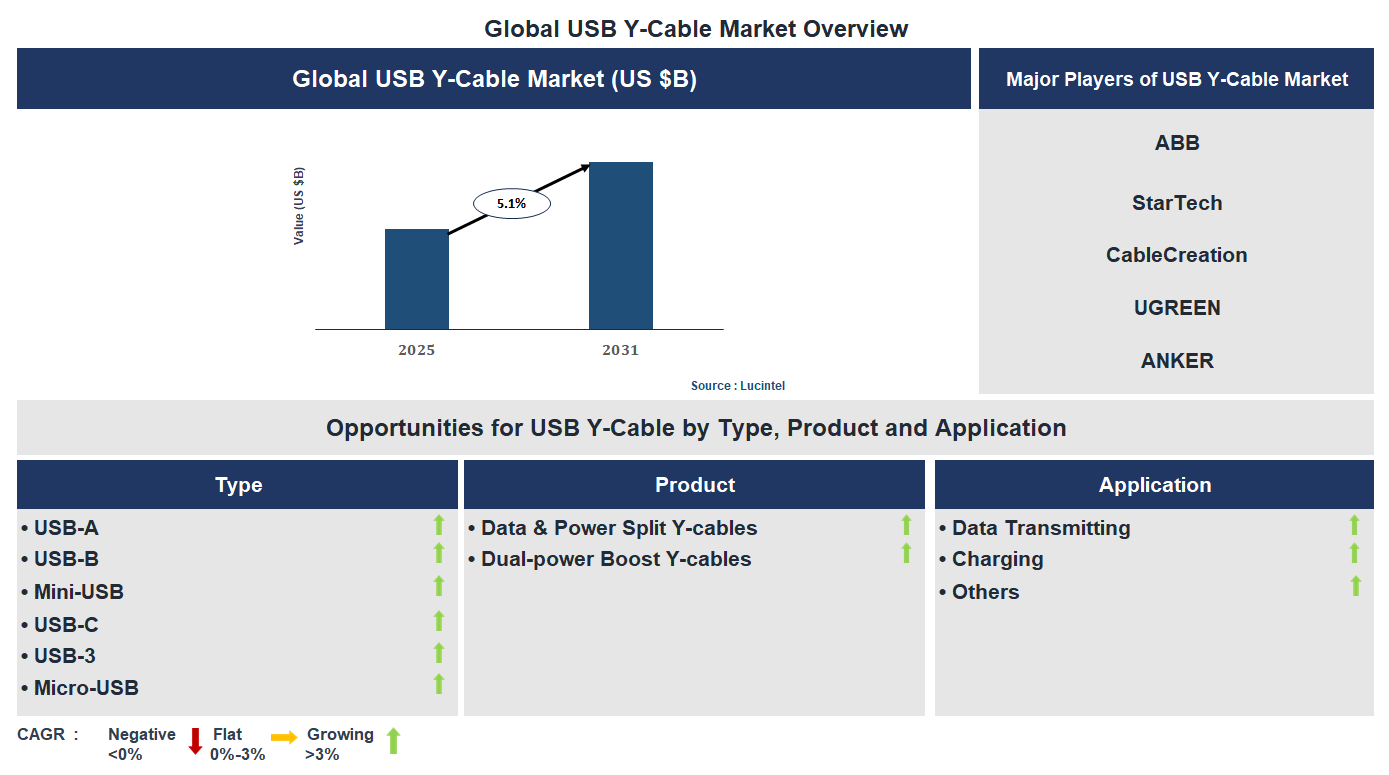
The future of the global USB Y-cable market looks promising with opportunities in the data transmitting and charging markets. The global USB Y-cable market is expected to grow with a CAGR of 5.1% from 2025 to 2031. The major drivers for this market are the increasing use of multi-device connectivity, the rising demand for portable electronic devices, and the growing adoption of fast charging solutions.• Lucintel forecasts that, within the type category, USB-C is expected to witness the highest growth over the forecast period.
• Within the application category, data transmitting is expected to witness higher growth.
• In terms of region, APAC is expected to witness the highest growth over the forecast period. Gain valuable insights for your business decisions with our comprehensive 150+ page report. Sample figures with some insights are shown below.
Emerging Trends in the USB Y-Cable Market
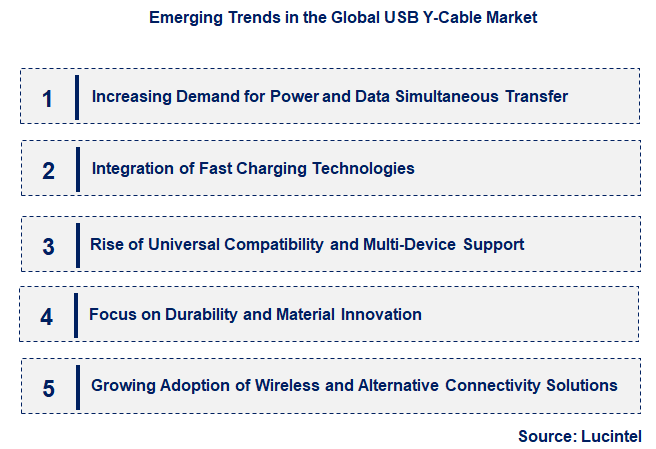
The USB Y-cable market is experiencing rapid evolution driven by technological advancements and changing consumer needs. As devices become more interconnected and demand for efficient power and data transfer increases, manufacturers are innovating to meet these needs. Emerging trends are shaping the market landscape, influencing product design, functionality, and consumer preferences. These developments are not only expanding the market but also redefining how users interact with their devices, emphasizing convenience, speed, and versatility. Understanding these key trends is essential for stakeholders aiming to stay competitive and capitalize on new opportunities in this dynamic industry.• Increasing Demand for Power and Data Simultaneous Transfer: The rise in multi-device usage has led to a higher need for USB Y-Cables that can transfer data and supply power simultaneously. Consumers seek efficient solutions to connect multiple devices without sacrificing speed or power, prompting manufacturers to develop more robust and versatile Y-Cables. This trend enhances user convenience, especially for mobile and portable device users, and supports the growth of connected ecosystems.
• Integration of Fast Charging Technologies: The adoption of fast charging standards like USB Power Delivery (USB PD) is influencing Y-Cable designs. Manufacturers are integrating these technologies to enable quicker charging of devices through Y-Cables, which is crucial for users who need rapid power replenishment on the go. This trend boosts market demand for high-capacity, high-speed cables and aligns with the increasing consumer expectation for quick and efficient charging solutions.
• Rise of Universal Compatibility and Multi-Device Support: Consumers increasingly prefer Y-Cables compatible with various devices and ports, including USB-C, Micro USB, and Lightning. This trend drives the development of universal Y-Cables that can support multiple device types, reducing the need for multiple cables. It enhances user convenience and promotes sustainability by minimizing electronic waste, thereby expanding market reach across different device ecosystems.
• Focus on Durability and Material Innovation: As usage scenarios become more diverse, there is a growing emphasis on the durability of Y-Cables. Manufacturers are investing in high-quality materials, reinforced connectors, and flexible designs to withstand wear and tear. This trend improves product lifespan, reduces returns and replacements, and appeals to professional and heavy-duty users, thereby expanding the market segment for premium, durable Y-Cables.
• Growing Adoption of Wireless and Alternative Connectivity Solutions: While wired Y-Cables remain essential, there is a noticeable shift towards wireless data and power transfer technologies. This trend influences the market by encouraging the development of hybrid solutions that combine traditional Y-Cables with wireless capabilities. It reflects a broader move towards cable-free environments, but also highlights the ongoing need for reliable wired solutions in certain applications, ensuring the market remains adaptable and innovative. In summary, these trends are reshaping the USB Y-cable market by emphasizing versatility, speed, durability, and compatibility. They are driving innovation, expanding application areas, and meeting evolving consumer demands, ultimately fostering a more dynamic and competitive industry landscape.
Recent Development in the USB Y-Cable Market
The USB Y-cable market is experiencing rapid growth driven by increasing demand for versatile connectivity solutions across various industries. Technological advancements and expanding applications in consumer electronics, automotive, and industrial sectors are fueling innovation and market expansion. As devices become more interconnected, the need for reliable, efficient, and multi-functional cables is rising. This evolving landscape presents significant opportunities for manufacturers and stakeholders to capitalize on emerging trends and meet the growing consumer and industrial demands.• Growing Adoption in Consumer Electronics: The increasing use of USB Y-cables in smartphones, tablets, and laptops enhances device connectivity and charging efficiency. Consumers seek multi-purpose cables that support data transfer and power delivery simultaneously, boosting sales. This trend drives market growth by expanding the customer base and encouraging innovation in cable design, durability, and compatibility, ultimately making USB Y-cables a standard accessory in everyday electronic devices.
• Expansion in Automotive Industry: The automotive sector is integrating USB Y-cables for in-car entertainment, charging, and connectivity solutions. As vehicles become smarter and more connected, the demand for reliable, high-speed data transfer cables increases. This development opens new revenue streams for manufacturers and accelerates the adoption of USB Y-cables in automotive applications, improving user experience and supporting the growth of connected vehicle technologies.
• Industrial Automation and IoT Integration: USB Y-cables are increasingly used in industrial automation and IoT devices for seamless data transfer and power supply. The need for robust, durable cables that can withstand harsh environments is driving innovation. This trend enhances operational efficiency, reduces downtime, and supports the deployment of smart manufacturing systems, positioning USB Y-cables as critical components in industrial connectivity infrastructure.
• Technological Advancements in Cable Design: Innovations in materials, shielding, and connector technology are improving the performance and lifespan of USB Y-cables. These advancements enable higher data transfer speeds, better durability, and enhanced safety features. As a result, manufacturers can offer more reliable products, meeting the rising quality expectations of consumers and industrial clients, thereby strengthening market competitiveness and expanding application scope.
• Rising Demand for Customization and Compatibility: Consumers and industries increasingly seek tailored USB Y-cables compatible with various devices and standards. Customization options, such as different lengths, connectors, and power ratings, are becoming popular. This trend allows manufacturers to cater to niche markets, increase customer satisfaction, and differentiate their products, ultimately driving market growth through diversified offerings and improved user experience. These developments collectively are transforming the USB Y-cable market by expanding its application scope, enhancing product quality, and meeting evolving consumer and industrial needs. The market is becoming more dynamic, competitive, and innovative, leading to increased adoption across sectors. As these opportunities continue to grow, stakeholders are positioned to benefit from sustained market expansion and technological progress.
Strategic Growth Opportunities in the USB Y-Cable Market
The USB Y-cable market is experiencing significant growth driven by increasing demand for versatile connectivity solutions across various devices. As technology advances, consumers and industries seek reliable, efficient, and multi-functional cables to enhance device performance and connectivity. Innovations in cable design, expanding applications in consumer electronics, and the rise of IoT devices are creating new opportunities. Market players are focusing on product development, strategic partnerships, and expanding distribution channels to capitalize on these trends and meet evolving customer needs.• Expansion in Consumer Electronics and Mobile Devices: The growing adoption of smartphones, tablets, and wearable devices is fueling demand for USB Y-Cables that enable simultaneous charging and data transfer, enhancing user convenience. As consumers seek streamlined solutions, manufacturers are developing high-quality, durable cables compatible with a wide range of devices. This expansion is further supported by the increasing trend of multi-device usage, prompting brands to innovate and offer versatile connectivity options to capture market share.
• Increasing Adoption in Automotive and Industrial Sectors: The integration of USB Y-Cables in automotive infotainment systems and industrial machinery is creating new growth avenues. Automakers and industrial equipment manufacturers require reliable, high-performance cables for data transfer and device charging. The rising trend of connected vehicles and automation drives demand for specialized USB Y-Cables that withstand harsh environments and ensure seamless connectivity, thereby expanding the market beyond traditional consumer applications.
• Rising Demand for Custom and High-Performance Cables: Consumers and industries are seeking customized USB Y-Cables with specific lengths, connector types, and enhanced durability. High-performance cables with faster data transfer rates and improved shielding are gaining popularity, especially in professional settings like video editing, gaming, and data centers. Manufacturers investing in R&D to develop tailored solutions are likely to gain a competitive advantage, meeting the needs of niche markets and increasing overall market penetration.
• Growth of IoT and Smart Device Connectivity: The proliferation of IoT devices and smart home systems is significantly boosting the need for reliable USB Y-Cables. These cables facilitate multiple device connections, enabling efficient data sharing and power management. As IoT adoption accelerates, demand for robust, multi-functional cables that support various protocols and standards is expected to rise, creating opportunities for manufacturers to innovate and expand their product portfolios to cater to this expanding ecosystem.
• Strategic Partnerships and Distribution Channel Expansion: Companies are forming alliances with electronics retailers, online platforms, and OEMs to enhance product reach and visibility. Expanding distribution channels ensures wider availability of USB Y-Cables, catering to both consumer and industrial markets. Strategic collaborations also enable co-development of innovative products tailored to specific industry needs, fostering market growth. Strengthening supply chains and marketing efforts will be crucial for capturing emerging opportunities and maintaining a competitive advantage. In conclusion, these growth opportunities are poised to significantly influence the USB Y-cable market by driving innovation, expanding application areas, and enhancing consumer and industrial connectivity solutions. Companies that leverage these trends through strategic investments and partnerships will be well-positioned to capitalize on the increasing demand for versatile, high-performance USB Y-Cables, ensuring sustained market expansion and technological advancement.
USB Y-Cable Market Driver and Challenges
The USB Y-cable market is influenced by a variety of technological, economic, and regulatory factors that shape its growth and development. Advances in device connectivity, increasing demand for versatile charging solutions, and the proliferation of electronic devices are key technological drivers. Economic factors such as rising consumer spending on gadgets and the expansion of the electronics industry further propel market growth. Regulatory standards related to safety and compatibility also impact product development and market entry. However, the market faces challenges including rapid technological obsolescence, environmental concerns over electronic waste, and intense competition among manufacturers. These drivers and challenges collectively determine the markets trajectory and prospects. The factors responsible for driving the USB Y-cable market include:• Technological Innovation: The continuous evolution of electronic devices necessitates versatile connectivity solutions. USB Y-Cables enable users to connect multiple devices simultaneously, such as charging a smartphone while transferring data, which enhances user convenience. Innovations in USB standards, like USB 3.0 and USB-C, have increased data transfer speeds and power delivery capabilities, encouraging manufacturers to develop compatible Y-Cables. This technological progression supports market expansion by meeting the growing demand for efficient and multi-functional connectivity accessories.
• Increasing Device Connectivity: The proliferation of smartphones, tablets, laptops, and other portable devices has significantly increased the need for reliable connection accessories. USB Y-Cables facilitate simultaneous charging and data transfer, reducing the need for multiple cables and adapters. As consumers seek streamlined solutions for their expanding device ecosystems, the demand for USB Y-Cables rises. This trend is further driven by the growth of IoT devices and smart home gadgets, which require multiple connections, thereby fueling market growth.
• Growing E-commerce and Retail Presence: The expansion of online retail platforms has made USB Y-Cables more accessible to a global consumer base. E-commerce channels offer a wide variety of options, competitive pricing, and convenient purchasing experiences, which boost sales. Retail outlets and electronic stores also contribute to market growth by providing consumers with immediate access to these accessories. The increased penetration of online shopping and retail distribution channels enhances market reach and accelerates adoption across different regions.
• Rising Consumer Electronics Market: The expanding consumer electronics industry, driven by technological advancements and decreasing device costs, has increased the demand for accessories like USB Y-Cables. Consumers are investing more in gadgets and peripherals, creating a substantial market for connectivity accessories. The trend towards portable and multifunctional devices further amplifies the need for reliable connection solutions, making USB Y-Cables an essential accessory in modern electronic setups.
• Regulatory Standards and Safety Certifications: Compliance with international safety and quality standards influences product development and market entry. Manufacturers are compelled to adhere to regulations such as CE, FCC, and RoHS, ensuring product safety and environmental compliance. These standards foster consumer trust and reduce the risk of product recalls, thereby supporting market stability and growth. Additionally, regulatory frameworks encourage innovation in safer and more efficient USB Y-Cable designs, positively impacting the market. The challenges in the USB Y-cable market are:
• Rapid Technological Obsolescence: The fast-paced evolution of USB standards and device technology leads to frequent product obsolescence. Manufacturers face pressure to continuously innovate and update their offerings to stay relevant, which increases R&D costs and inventory risks. Consumers may also delay purchasing new cables, waiting for the latest standards, which can hinder market growth. This rapid change creates a cycle of short product lifespans and increased waste, complicating inventory management and profitability for manufacturers.
• Environmental Concerns and Electronic Waste: The increasing production and disposal of electronic accessories contribute to environmental issues. USB Y-Cables, often replaced due to technological upgrades or damage, add to electronic waste. The lack of sustainable manufacturing practices and recycling options exacerbates environmental impact, leading to regulatory scrutiny and consumer awareness. Manufacturers are challenged to develop eco-friendly products and implement recycling initiatives, but these efforts can increase costs and complicate supply chains.
• Intense Market Competition: The USB Y-Cable market is highly competitive, with numerous local and international players vying for market share. Price wars, product differentiation, and branding strategies intensify competition, often leading to reduced profit margins. New entrants face barriers such as establishing distribution channels and meeting regulatory standards. This competitive landscape pressures companies to innovate continuously and optimize costs, which can be challenging and may limit market expansion opportunities. In summary, the USB Y-cable market is driven by technological advancements, increasing device connectivity, expanding retail channels, and regulatory compliance, all of which foster growth and innovation. However, rapid technological changes, environmental concerns, and fierce competition pose significant challenges that could hinder market stability and profitability. The overall impact of these drivers and challenges will shape the markets evolution, requiring stakeholders to adapt strategically to sustain growth and meet consumer demands effectively.
List of USB Y-Cable Companies
Companies in the market compete on the basis of product quality offered. Major players in this market focus on expanding their manufacturing facilities, R&D investments, infrastructural development, and leverage integration opportunities across the value chain. With these strategies USB Y-cable companies cater increasing demand, ensure competitive effectiveness, develop innovative products & technologies, reduce production costs, and expand their customer base. Some of the USB Y-cable companies profiled in this report include-• ABB
• StarTech
• CableCreation
• UGREEN
• ANKER
• Mbientlab
• UNITEK
• Mimo Monitors
• HP
• Epson
USB Y-Cable Market by Segment
The study includes a forecast for the global USB Y-cable market by type, product, application, and region.USB Y-Cable Market by Type [Value from 2019 to 2031]:
• USB-A
• USB-B
• Mini-USB
• USB-C
• USB-3
• Micro-USB
USB Y-Cable Market by Product [Value from 2019 to 2031]:
• Data & Power Split Y-cables
• Dual-power Boost Y-cables
USB Y-Cable Market by Application [Value from 2019 to 2031]:
• Data Transmitting
• Charging
• Others
USB Y-Cable Market by Region [Value from 2019 to 2031]:
• North America
• Europe
• Asia Pacific
• The Rest of the World
Country Wise Outlook for the USB Y-Cable Market
The USB Y-cable market has experienced significant growth driven by increasing demand for versatile connectivity solutions across various industries. Technological advancements, expanding applications in consumer electronics, and the rise of IoT devices have contributed to market expansion. Countries are adopting innovative manufacturing techniques and focusing on sustainable materials to meet consumer and industrial needs. The markets evolution reflects broader trends in digital transformation and the need for reliable, high-speed data transfer solutions. As the market continues to develop, key players are investing in R&D to enhance product performance and compatibility, ensuring they stay competitive in a rapidly changing landscape.• United States: The US market has seen a surge in demand for high-quality USB Y-Cables, driven by the growth of consumer electronics and gaming industries. Major manufacturers are focusing on integrating faster data transfer speeds and improved durability. The adoption of USB Type-C standards is accelerating, with many companies developing compatible Y-Cables to support new devices. Additionally, the rise of smart home devices and IoT applications has expanded the market scope. US-based companies are also investing in sustainable and eco-friendly materials to meet environmental regulations and consumer preferences.
• China: China remains a dominant player in the USB Y-Cable market, with rapid manufacturing scale-up and technological innovation. The country’s focus on electronics exports and domestic consumption has led to increased production of affordable yet reliable Y-Cables. Chinese firms are emphasizing miniaturization and enhanced compatibility with various devices, including smartphones and tablets. The government’s support for tech innovation and infrastructure development has further propelled market growth. Moreover, China is investing in R&D to develop advanced cables with higher data transfer rates and better shielding against interference, catering to both local and international markets.
• Germany: Germany’s market is characterized by a focus on high-quality, durable USB Y-Cables tailored for industrial and professional applications. The country’s emphasis on engineering excellence and precision manufacturing has resulted in products with superior performance and longevity. The automotive and manufacturing sectors are increasingly adopting USB Y-Cables for data transfer and device connectivity. German companies are also exploring sustainable materials and energy-efficient production processes. The integration of USB Y-Cables into smart factory setups and automation systems is a notable trend, reflecting Germany’s leadership in Industry 4.0 initiatives.
• India: The Indian market for USB Y-Cables is experiencing rapid growth due to expanding consumer electronics, e-commerce, and digital services sectors. Local manufacturers are offering cost-effective solutions to meet rising demand, with a focus on compatibility with a wide range of devices. The increasing penetration of smartphones and tablets has driven the need for reliable connectivity accessories. Additionally, government initiatives promoting digital infrastructure and Make in India policies are encouraging domestic production and innovation. Market players are also exploring eco-friendly materials and innovative designs to differentiate their products in a competitive landscape.
• Japan: Japan’s market is marked by a focus on high-performance, technologically advanced USB Y-Cables suitable for professional and industrial use. Japanese companies are investing heavily in R&D to develop cables with enhanced shielding, faster data transfer, and durability under harsh conditions. The automotive and electronics sectors are key consumers, utilizing USB Y-Cables for data transfer and device integration. Japan’s emphasis on quality and innovation ensures that products meet strict standards for reliability and safety. The market is also witnessing a trend toward miniaturization and integration with other connectivity solutions, aligning with Japan’s reputation for technological excellence.

Features of the Global USB Y-Cable Market
Market Size Estimates: USB Y-cable market size estimation in terms of value ($B). Trend and Forecast Analysis: Market trends (2019 to 2024) and forecast (2025 to 2031) by various segments and regions. Segmentation Analysis: USB Y-cable market size by type, product, application, and region in terms of value ($B). Regional Analysis: USB Y-cable market breakdown by North America, Europe, Asia Pacific, and Rest of the World. Growth Opportunities: Analysis of growth opportunities in different types, products, applications, and regions for the USB Y-cable market. Strategic Analysis: This includes M&A, new product development, and competitive landscape of the USB Y-cable market. Analysis of competitive intensity of the industry based on Porter’s Five Forces model.
FAQ
Q1. What is the growth forecast for USB Y-cable market? Answer: The global USB Y-cable market is expected to grow with a CAGR of 5.1% from 2025 to 2031. Q2. What are the major drivers influencing the growth of the USB Y-cable market? Answer: The major drivers for this market are the increasing use of multi-device connectivity, the rising demand for portable electronic devices, and the growing adoption of fast charging solutions. Q3. What are the major segments for USB Y-cable market? Answer: The future of the USB Y-cable market looks promising with opportunities in the data transmitting and charging markets. Q4. Who are the key USB Y-cable market companies? Answer: Some of the key USB Y-cable companies are as follows:• ABB
• StarTech
• CableCreation
• UGREEN
• ANKER
• Mbientlab
• UNITEK
• Mimo Monitors
• HP
• Epson Q5. Which USB Y-cable market segment will be the largest in future? Answer: Lucintel forecasts that, within the type category, USB-C is expected to witness the highest growth over the forecast period. Q6. In USB Y-cable market, which region is expected to be the largest in next 5 years? Answer: In terms of region, APAC is expected to witness the highest growth over the forecast period. Q7. Do we receive customization in this report? Answer: Yes, Lucintel provides 10% customization without any additional cost.
Table of Contents
List of Figures
List of Tables
Methodology
- In-depth interviews of the major players in this market
- Detailed secondary research from competitors’ financial statements and published data
- Extensive searches of published works, market, and database information pertaining to industry news, company press releases, and customer intentions
- A compilation of the experiences, judgments, and insights of Lucintel’s professionals, who have analyzed and tracked this market over the years.


Buy Now
Choose a license that fits your team. Instant PDF delivery.
Prices exclude taxes. Instant delivery. Custom licensing available on request.
Key Questions
- • What are some of the most promising, high-growth opportunities for the USB Y-cable market by type (USB-A, USB-B, Mini-USB, USB-C, USB-3, and Micro-USB), product (data & power split Y-cables and dual-power boost Y-cables), application (data transmitting, charging, and others), and region (North America, Europe, Asia Pacific, and the Rest of the World)?
- • Which segments will grow at a faster pace and why?
- • Which region will grow at a faster pace and why?
- • What are the key factors affecting market dynamics? What are the key challenges and business risks in this market?
- • What are the business risks and competitive threats in this market?
- • What are the emerging trends in this market and the reasons behind them?
- • What are some of the changing demands of customers in the market?
- • What are the new developments in the market? Which companies are leading these developments?
- • Who are the major players in this market? What strategic initiatives are key players pursuing for business growth?
- • What are some of the competing products in this market and how big of a threat do they pose for loss of market share by material or product substitution?
- • What M&A activity has occurred in the last 6 years and what has its impact been on the industry? For any questions related to USB Y-Cable Market, USB Y-Cable Market Size, USB Y-Cable Market Growth, USB Y-Cable Market Analysis, USB Y-Cable Market Report, USB Y-Cable Market Share, USB Y-Cable Market Trends, USB Y-Cable Market Forecast, USB Y-Cable Companies, write Lucintel analyst at email: helpdesk@lucintel.com. We will be glad to get back to you soon.


