
Report Feature
Underwater Warfare Market Trends and Forecast
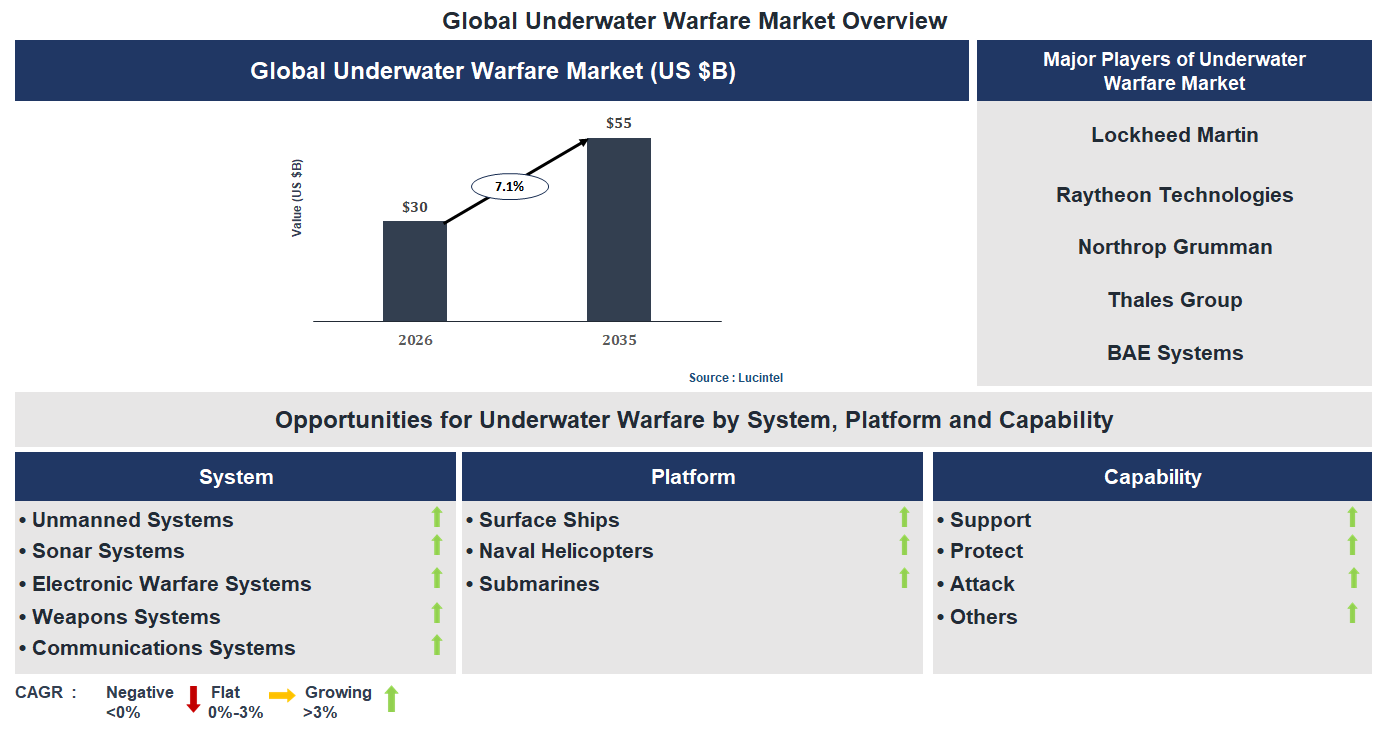
The future of the global underwater warfare market looks promising with opportunities in the surface ship, naval helicopter, and submarine markets. The global underwater warfare market is expected to reach an estimated $55 billion by 2035 with a CAGR of 7.1% from 2026 to 2035. The major drivers for this market are the increasing demand for advanced naval combat capabilities, the rising investment in submarine fleet modernization, and the growing adoption of autonomous underwater systems.• Lucintel forecasts that, within the system category, unmanned system is expected to witness the highest growth over the forecast period.
• Within the platform category, submarine is expected to witness the highest growth.
• In terms of region, North America is expected to witness the highest growth over the forecast period. Gain valuable insights for your business decisions with our comprehensive 150+ page report. Sample figures with some insights are shown below.
Emerging Trends in the Underwater Warfare Market
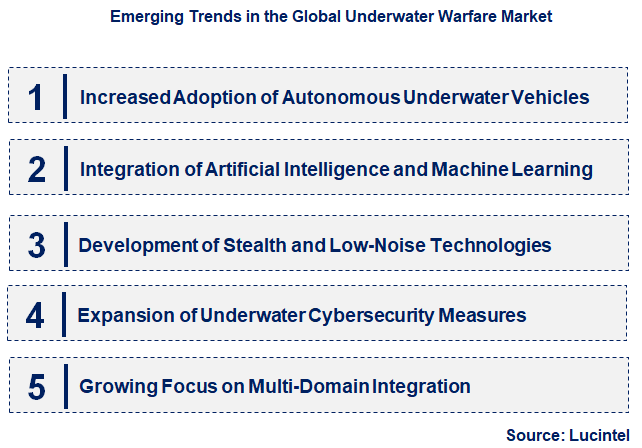
The underwater warfare market is experiencing rapid evolution driven by technological advancements, geopolitical shifts, and increasing security concerns. As nations seek to enhance their maritime defense capabilities, innovative solutions are emerging to address new threats and operational challenges. These developments are reshaping the landscape of underwater warfare, making it more sophisticated, integrated, and responsive. The following key trends highlight the major directions in which this market is heading, reflecting the strategic priorities of global defense agencies and private sector players alike.• Increased Adoption of Autonomous Underwater Vehicles: AUVs are becoming central to underwater surveillance, reconnaissance, and mine countermeasures. Their ability to operate independently reduces risk to human personnel and allows for prolonged missions in complex environments. Advances in AI and sensor technology are enhancing their capabilities, making them more reliable and versatile. This trend is leading to more cost-effective and scalable underwater operations, transforming traditional naval strategies and expanding the scope of underwater missions.
• Integration of Artificial Intelligence and Machine Learning: AI and ML are revolutionizing underwater warfare by enabling smarter decision-making and real-time data analysis. These technologies improve the accuracy of sonar systems, threat detection, and target classification. They also facilitate autonomous decision processes, reducing response times and increasing operational efficiency. The integration of AI-driven systems is creating more adaptive and resilient underwater defense solutions, which are crucial in countering sophisticated adversaries and emerging underwater threats.
• Development of Stealth and Low-Noise Technologies: To evade detection, underwater vehicles and submarines are increasingly equipped with stealth features and low-noise propulsion systems. These innovations minimize acoustic signatures, making them harder to detect by enemy sonar. Enhanced stealth capabilities are vital for covert operations, intelligence gathering, and strategic deterrence. This trend is pushing manufacturers to develop advanced materials and propulsion technologies, significantly impacting the design and deployment of underwater assets.
• Expansion of Underwater Cybersecurity Measures: As underwater systems become more connected and reliant on digital networks, cybersecurity has become a critical concern. Protecting underwater communication links, sensors, and autonomous vehicles from cyber threats is a growing priority. Enhanced cybersecurity measures ensure operational integrity and prevent adversaries from disrupting or hijacking underwater assets. This trend underscores the importance of integrating robust cybersecurity protocols into underwater warfare systems, safeguarding national security interests in an increasingly digital maritime domain.
• Growing Focus on Multi-Domain Integration: Underwater warfare is increasingly integrated with surface and aerial platforms to create comprehensive, multi-domain defense strategies. This approach enhances situational awareness, coordination, and response capabilities across different operational environments. Technologies such as networked sensors, data sharing, and joint command systems facilitate seamless integration. The trend is transforming traditional isolated underwater operations into part of a broader, interconnected maritime security framework, improving overall effectiveness and strategic flexibility. These emerging trends are fundamentally reshaping the underwater warfare market by fostering more autonomous, intelligent, stealthy, secure, and integrated systems. These developments are enabling navies and defense organizations to better detect, deter, and respond to underwater threats, ensuring maritime security in an increasingly complex global landscape.
Recent Development in the Underwater Warfare Market
The underwater warfare market is experiencing rapid advancements driven by technological innovations, geopolitical shifts, and increasing defense budgets worldwide. These developments are shaping the future of naval combat, enhancing strategic capabilities, and addressing emerging threats. As nations invest heavily in underwater defense systems, understanding key growth opportunities becomes essential for stakeholders aiming to capitalize on this evolving landscape. The following highlights five significant recent developments impacting the underwater warfare market.• Growing Investment in Autonomous Underwater Vehicles: Increasing defense budgets and technological progress are fueling the deployment of autonomous underwater vehicles (AUVs). These systems offer enhanced surveillance, mine detection, and reconnaissance capabilities, reducing human risk and operational costs. Countries are prioritizing AUVs to maintain strategic superiority, leading to a surge in research, development, and procurement. This trend is expected to revolutionize underwater operations, making missions more efficient and less hazardous, thereby significantly impacting the market’s growth trajectory.
• Advancements in Submarine Stealth Technologies: Innovations in stealth technology are enabling submarines to operate undetected for longer durations. Developments include noise reduction techniques, improved hull designs, and advanced materials that minimize acoustic signatures. These enhancements provide strategic advantages in intelligence gathering and deterrence. As nations seek to modernize their fleets, the demand for stealth-enabled submarines is rising, driving market growth and fostering competition among defense contractors to develop next-generation stealth systems.
• Expansion of Anti-Submarine Warfare Systems: The increasing threat of hostile submarines has prompted significant investments in ASW systems, including sonar, underwater sensors, and anti-submarine weapons. These systems are becoming more sophisticated, integrating artificial intelligence and real-time data processing for better detection and tracking. The expansion of ASW capabilities enhances maritime security and deterrence, encouraging countries to upgrade existing fleets and develop new platforms. This trend is boosting the market by creating demand for advanced ASW solutions globally.
• Integration of Artificial Intelligence and Data Analytics: AI and data analytics are transforming underwater warfare by enabling real-time decision-making, predictive maintenance, and autonomous operations. These technologies improve the accuracy and efficiency of surveillance, threat detection, and response strategies. Defense agencies are investing heavily in AI-driven systems to gain tactical advantages. The integration of these technologies is expected to accelerate innovation, reduce operational costs, and expand the capabilities of underwater warfare systems, significantly impacting market growth and competitiveness.
• Increasing Focus on Underwater Cybersecurity: As underwater systems become more connected and reliant on digital networks, cybersecurity has become a critical concern. Protecting underwater assets from cyber threats is essential to maintain operational integrity and national security. Recent developments include advanced encryption, intrusion detection systems, and secure communication protocols. Governments and defense organizations are prioritizing cybersecurity investments to safeguard their underwater assets, which is driving growth in this niche but vital segment of the market, ensuring resilience against emerging cyber threats. The overall impact of these developments is a dynamic, technologically advanced underwater warfare market characterized by increased capabilities, strategic advantages, and heightened security measures. These opportunities are fostering innovation, competition, and global defense collaborations, ultimately shaping the future landscape of underwater military operations and defense readiness.
Strategic Growth Opportunities in the Underwater Warfare Market
The underwater warfare market is experiencing rapid evolution driven by technological advancements, increasing geopolitical tensions, and the need for enhanced maritime security. Growing investments in naval defense systems and the development of sophisticated underwater detection and combat solutions are creating significant growth opportunities. As nations prioritize underwater domain awareness and anti-submarine warfare capabilities, the market is poised for substantial expansion across various applications, including military, defense, and security sectors. Strategic innovation and international collaborations will further shape this dynamic landscape.• Increasing Demand for Advanced Submarine and Underwater Vehicles: The rising need for stealthy, efficient submarines and underwater drones to perform surveillance, reconnaissance, and combat missions is fueling market growth. Countries are investing heavily in next-generation underwater vehicles equipped with cutting-edge sensors, AI, and autonomous capabilities. This demand is driven by the necessity to maintain maritime superiority, counter emerging threats, and ensure strategic deterrence, thereby expanding the market for innovative underwater warfare solutions.
• Growing Focus on Underwater Domain Awareness and Surveillance: Enhanced underwater domain awareness is critical for national security, maritime safety, and resource exploration. The development of sophisticated sonar, underwater sensors, and real-time data analytics enables better detection, tracking, and identification of underwater threats. Governments and defense agencies are prioritizing these technologies to prevent unauthorized intrusions, monitor submarine activities, and secure maritime borders, creating a significant opportunity for market players to innovate and expand their product offerings.
• Expansion of Anti-Submarine Warfare Capabilities: As submarine threats become more advanced and prevalent, there is a heightened focus on strengthening anti-submarine warfare capabilities. This includes deploying advanced sonar systems, underwater weapons, and unmanned systems designed to detect and neutralize hostile submarines. The increasing geopolitical tensions and naval conflicts worldwide are driving investments in ASW technology, making it a key growth area within the underwater warfare market.
• Integration of Artificial Intelligence and Autonomous Systems: The incorporation of AI and autonomous technologies into underwater warfare systems is revolutionizing operational efficiency and effectiveness. Autonomous underwater vehicles (AUVs) and AI-powered sensors enable persistent surveillance, rapid threat detection, and autonomous decision-making. This integration reduces human risk, enhances mission success rates, and offers cost-effective solutions, positioning AI and autonomy as pivotal growth drivers in the underwater warfare market.
• Rising Investments in Underwater Defense Infrastructure and International Collaborations: Governments are increasing funding for underwater defense infrastructure, including underwater bases, communication networks, and secure data centers. Additionally, international collaborations and joint military exercises are fostering technology sharing and strategic alliances. These investments and partnerships are accelerating innovation, expanding market reach, and strengthening global underwater defense capabilities, thereby creating a robust growth environment for industry stakeholders. The overall impact of these opportunities is set to significantly enhance technological innovation, operational efficiency, and strategic capabilities within the underwater warfare market. As nations prioritize maritime security and technological superiority, the market will experience sustained growth, fostering competitive advancements and international cooperation. This evolution will shape the future landscape of underwater defense, ensuring preparedness against emerging underwater threats and safeguarding maritime interests worldwide.
Underwater Warfare Market Driver and Challenges
The underwater warfare market is influenced by a complex interplay of technological advancements, economic considerations, and regulatory frameworks. Rapid innovations in stealth technology, sensor systems, and autonomous underwater vehicles are transforming operational capabilities. Economic factors such as defense budgets and geopolitical tensions drive investments in underwater warfare solutions. Additionally, regulatory standards concerning maritime security and environmental concerns shape market dynamics. These drivers and challenges collectively determine the pace of growth, innovation, and adoption within this sector, impacting defense strategies worldwide. Understanding these factors is essential for stakeholders aiming to capitalize on emerging opportunities while navigating potential obstacles. The factors responsible for driving the underwater warfare market include:• Technological Innovation: The continuous development of advanced sonar systems, stealth technologies, and autonomous underwater vehicles enhances operational efficiency and effectiveness. These innovations enable navies to detect, track, and neutralize threats more accurately and at greater depths, thereby increasing the strategic value of underwater warfare capabilities. As technology evolves, the market experiences increased demand for sophisticated equipment, fostering growth and competition among defense contractors.
• Rising Geopolitical Tensions: Increasing maritime disputes and regional conflicts heighten the need for advanced underwater defense systems. Countries seek to secure their maritime borders and protect vital sea lanes from potential threats, prompting significant investments in underwater warfare solutions. This geopolitical landscape drives market expansion as nations prioritize modernizing their naval fleets to maintain strategic superiority.
• Defense Budget Allocations: Governments worldwide are allocating substantial funds toward modernizing their naval forces, including underwater warfare assets. These budgets support procurement of submarines, underwater drones, and sensor systems, fueling market growth. The emphasis on national security and technological superiority ensures sustained demand for innovative underwater warfare equipment.
• Environmental and Regulatory Standards: Stricter regulations concerning marine ecosystems and maritime security influence the development and deployment of underwater warfare systems. Manufacturers must ensure compliance with environmental standards, which can impact design and operational procedures. Regulatory frameworks also promote international cooperation and standardization, shaping market evolution and fostering responsible innovation.
• Strategic Military Alliances: Collaborations among nations and defense alliances enhance the development and deployment of underwater warfare technologies. Joint ventures and shared research initiatives accelerate innovation and expand market reach. These alliances facilitate access to advanced systems and foster interoperability, thereby strengthening collective maritime security capabilities. The challenges facing the underwater warfare market include:
• High Development and Procurement Costs: The advanced nature of underwater warfare systems entails significant research, development, and manufacturing expenses. Budget constraints and cost overruns can delay procurement and limit adoption, especially for smaller nations. These financial barriers hinder rapid market expansion and necessitate strategic investment planning.
• Rapid Technological Obsolescence: The fast-paced evolution of underwater warfare technology risks rendering existing systems obsolete quickly. This creates pressure on defense agencies to continually upgrade and replace equipment, increasing operational costs. Staying ahead of technological advancements is crucial but challenging, impacting long-term planning and market stability.
• Regulatory and Environmental Constraints: Stringent international regulations and environmental concerns can restrict testing, deployment, and operational procedures of underwater systems. Compliance requirements may delay project timelines and increase costs. Navigating these regulatory landscapes is essential but complex, potentially limiting market agility and innovation. The underwater warfare market is shaped by significant technological advancements, geopolitical factors, and regulatory influences that drive growth and innovation. However, high costs, rapid obsolescence, and regulatory constraints pose substantial challenges. These dynamics require stakeholders to balance innovation with strategic planning, ensuring sustainable growth and technological relevance in a competitive global landscape. The overall impact is a market poised for continued evolution, driven by strategic necessity but tempered by financial and regulatory hurdles.
List of Underwater Warfare Companies
Companies in the market compete on the basis of product quality offered. Major players in this market focus on expanding their manufacturing facilities, R&D investments, infrastructural development, and leverage integration opportunities across the value chain. With these strategies underwater warfare companies cater increasing demand, ensure competitive effectiveness, develop innovative products & technologies, reduce production costs, and expand their customer base. Some of the underwater warfare companies profiled in this report include-• Lockheed Martin
• Raytheon Technologies
• Northrop Grumman
• Thales Group
• BAE Systems
• Leonardo
• General Dynamics
• Kongsberg Gruppen
• Saab AB
• L3Harris Technologies, Inc.
Underwater Warfare Market by Segment
The study includes a forecast for the global underwater warfare market by system, platform, capability, and region.Underwater Warfare Market by System [Value from 2019 to 2035]:
• Unmanned Systems
• Sonar Systems
• Electronic Warfare Systems
• Weapons Systems
• Communications Systems
Underwater Warfare Market by Platform [Value from 2019 to 2035]:
• Surface Ships
• Naval Helicopters
• Submarines
Underwater Warfare Market by Capability [Value from 2019 to 2035]:
• Support
• Protect
• Attack
• Others
Underwater Warfare Market by Region [Value from 2019 to 2035]:
• North America
• Europe
• Asia Pacific
• The Rest of the World
Country Wise Outlook for the Underwater Warfare Market
The underwater warfare market has experienced significant technological advancements and strategic shifts driven by geopolitical tensions, technological innovation, and increasing defense budgets worldwide. Countries are investing heavily in modernizing their naval capabilities, developing advanced submarines, unmanned underwater vehicles, and sensor systems to enhance underwater detection, surveillance, and combat effectiveness. The evolving threat landscape, including the rise of near-peer competitors and asymmetric threats, has prompted nations to prioritize underwater warfare capabilities. These developments reflect a broader trend toward technological dominance in maritime security, with countries aiming to secure their maritime interests and maintain strategic superiority in contested waters.• United States: The United States has advanced its underwater warfare capabilities through the development of next-generation submarines, including the Virginia-class and Columbia-class submarines, which feature stealth and missile technology. The U.S. Navy is investing in unmanned underwater vehicles (UUVs) for reconnaissance and mine countermeasures, enhancing operational flexibility. Additionally, the integration of artificial intelligence and sensor networks improves underwater situational awareness. The U.S. is also expanding its underwater drone fleet to support intelligence, surveillance, and reconnaissance missions, maintaining its strategic dominance in global waters.
• China: China has significantly expanded its underwater warfare capabilities, focusing on modernizing its submarine fleet, including the development of nuclear and diesel-electric submarines. The country has launched advanced submarines like the Type 093 and Type 095, emphasizing stealth and missile technology. China is also investing in unmanned underwater vehicles and underwater drone systems to enhance surveillance and anti-submarine warfare. Its strategic focus on the South China Sea and Indo-Pacific region underscores efforts to challenge U.S. naval dominance. The modernization efforts aim to establish a robust underwater force capable of countering regional and global threats.
• Germany: Germany has concentrated on enhancing its underwater warfare technology through the modernization of its submarine fleet, primarily the Type 212 and Type 214 submarines, which feature air-independent propulsion (AIP) systems for extended underwater endurance. The country is also investing in advanced sonar and sensor systems to improve underwater detection and tracking capabilities. Germany collaborates with NATO allies to develop integrated underwater defense systems and participate in joint exercises. The focus remains on maintaining a technologically advanced, stealthy submarine fleet capable of operating in complex maritime environments and supporting NATO’s strategic interests.
• India: India has made substantial progress in underwater warfare by expanding and modernizing its submarine fleet, including the induction of Scorpaena-class submarines and the development of indigenous submarines like the Kalari class. The country is also working on nuclear-powered submarines, such as the INS Arihant, to bolster its strategic deterrence. India is investing in underwater unmanned systems and advanced sonar technology to improve surveillance and anti-submarine warfare capabilities. Its strategic focus on the Indian Ocean region aims to counter regional threats and enhance maritime security, with ongoing efforts to develop indigenous underwater warfare technology.
• Japan: Japan has prioritized strengthening its underwater warfare capabilities amid regional tensions, particularly with China and North Korea. The country has upgraded its submarine fleet, including the Soryu-class submarines, with advanced stealth and sensor systems. Japan is also exploring the development of next-generation submarines with enhanced underwater endurance and combat systems. The nation collaborates with allies like the United States to improve underwater detection and anti-submarine warfare capabilities. Japan’s focus remains on maintaining a technologically advanced submarine fleet to secure its maritime interests and deter regional threats effectively.

Features of the Global Underwater Warfare Market
Market Size Estimates: Underwater warfare market size estimation in terms of value ($B). Trend and Forecast Analysis: Market trends (2019 to 2025) and forecast (2026 to 2035) by various segments and regions. Segmentation Analysis: Underwater warfare market size by system, platform, capability, and region in terms of value ($B). Regional Analysis: Underwater warfare market breakdown by North America, Europe, Asia Pacific, and Rest of the World. Growth Opportunities: Analysis of growth opportunities in different systems, platforms, capabilities, and regions for the underwater warfare market. Strategic Analysis: This includes M&A, new product development, and competitive landscape of the underwater warfare market. Analysis of competitive intensity of the industry based on Porter’s Five Forces model.
FAQ
Q1. What is the underwater warfare market size? Answer: The global underwater warfare market is expected to reach an estimated $55 billion by 2035. Q2. What is the growth forecast for underwater warfare market? Answer: The global underwater warfare market is expected to grow with a CAGR of 7.1% from 2026 to 2035. Q3. What are the major drivers influencing the growth of the underwater warfare market? Answer: The major drivers for this market are the increasing demand for advanced naval combat capabilities, the rising investment in submarine fleet modernization, and the growing adoption of autonomous underwater systems. Q4. What are the major segments for underwater warfare market? Answer: The future of the underwater warfare market looks promising with opportunities in the surface ship, naval helicopter, and submarine markets. Q5. Who are the key underwater warfare market companies? Answer: Some of the key underwater warfare companies are as follows:• Lockheed Martin
• Raytheon Technologies
• Northrop Grumman
• Thales Group
• BAE Systems
• Leonardo
• General Dynamics
• Kongsberg Gruppen
• Saab AB
• L3Harris Technologies, Inc. Q6. Which underwater warfare market segment will be the largest in future? Answer: Lucintel forecasts that, within the system category, unmanned system is expected to witness the highest growth over the forecast period. Q7. In underwater warfare market, which region is expected to be the largest in next 8 years? Answer: In terms of region, North America is expected to witness the highest growth over the forecast period. Q8. Do we receive customization in this report? Answer: Yes, Lucintel provides 10% customization without any additional cost.
Table of Contents
List of Figures
List of Tables
Methodology
- In-depth interviews of the major players in this market
- Detailed secondary research from competitors’ financial statements and published data
- Extensive searches of published works, market, and database information pertaining to industry news, company press releases, and customer intentions
- A compilation of the experiences, judgments, and insights of Lucintel’s professionals, who have analyzed and tracked this market over the years.


Buy Now
Choose a license that fits your team. Instant PDF delivery.
Prices exclude taxes. Instant delivery. Custom licensing available on request.
Key Questions
- • What are some of the most promising, high-growth opportunities for the underwater warfare market by system (unmanned systems, sonar systems, electronic warfare systems, weapons systems, and communications systems), platform (surface ships, naval helicopters, and submarines), capability (support, protect, attack, and others), and region (North America, Europe, Asia Pacific, and the Rest of the World)?
- • Which segments will grow at a faster pace and why?
- • Which region will grow at a faster pace and why?
- • What are the key factors affecting market dynamics? What are the key challenges and business risks in this market?
- • What are the business risks and competitive threats in this market?
- • What are the emerging trends in this market and the reasons behind them?
- • What are some of the changing demands of customers in the market?
- • What are the new developments in the market? Which companies are leading these developments?
- • Who are the major players in this market? What strategic initiatives are key players pursuing for business growth?
- • What are some of the competing products in this market and how big of a threat do they pose for loss of market share by material or product substitution?
- • What M&A activity has occurred in the last 5 years and what has its impact been on the industry? For any questions related to Underwater Warfare Market, Underwater Warfare Market Size, Underwater Warfare Market Growth, Underwater Warfare Market Analysis, Underwater Warfare Market Report, Underwater Warfare Market Share, Underwater Warfare Market Trends, Underwater Warfare Market Forecast, Underwater Warfare Companies, write Lucintel analyst at email: helpdesk@lucintel.com. We will be glad to get back to you soon.


