
Report Feature
Unconventional Oil Market Trends and Forecast
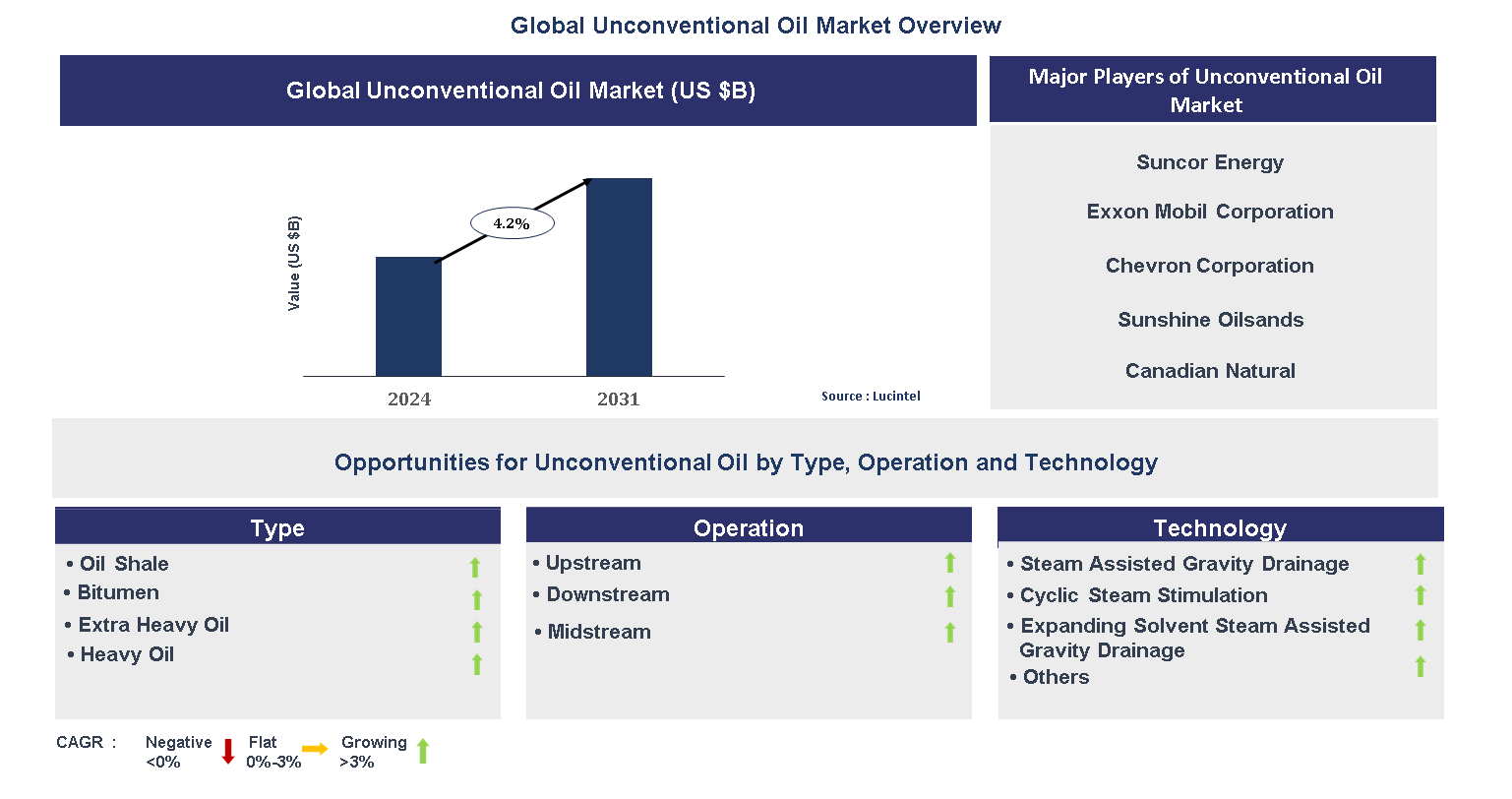
The future of the global unconventional oil market looks promising with opportunities in the steam assisted gravity drainage, cyclic steam stimulation, and expanding solvent steam assisted gravity drainage markets. The global unconventional oil market is expected to grow with a CAGR of 4.2% from 2025 to 2031. The major drivers for this market are the increasing energy demand from developing economies, the rising technological advancements in extraction methods, and the growing focus on energy security.• Lucintel forecasts that, within the type category, heavy oil is expected to witness the highest growth over the forecast period.
• Within the technology category, steam assisted gravity drainage is expected to witness the highest growth.
• In terms of region, APAC is expected to witness the highest growth over the forecast period. Gain valuable insights for your business decisions with our comprehensive 150+ page report. Sample figures with some insights are shown below.
Emerging Trends in the Unconventional Oil Market
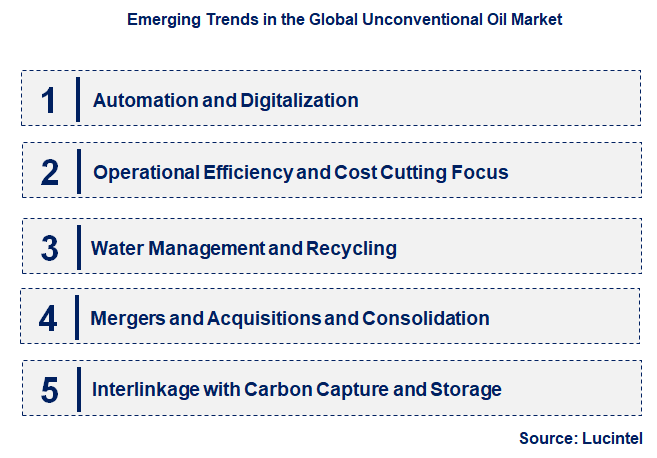
The unconventional oil market is now influenced by a series of emergent trends that are changing production activities, environmental aspects, and strategic alliances. These trends are driving the industry towards higher efficiency, sustainability, and technological convergence. The market is not only meeting the challenge of producing resources from complex rock formations but also responding to an international energy environment that is increasingly climate-focused and operationally resilient.• Automation and Digitalization: This trend sees the utilization of digital technologies like artificial intelligence, machine learning, and automation in order to maximize every step of the unconventional oil production cycle, from exploration to production. The effect is profound: it enables firms to process huge volumes of data in order to determine the most profitable drilling locations, automate drilling operations, and track well performance in real time. This results in greater operational efficiency, lower cost, and a reduced environmental impact through reduced use of on-site staff and waste.
• Operational Efficiency and Cost Cutting Focus: In the wake of a past history of boom and bust environments, the shale oil industry is presently centered on capital restraint and return maximization. The direction is to adopt lean manufacturing concepts, standardize the drilling method, and streamline supply chain logistics. The effect of this transition is a more sustainable and resilient business model that can weather fluctuating oil prices. It has made unconventional oil a more stable and predictable component of the worlds energy supply, a solid source of production, formerly a high-cost, high-risk endeavor.
• Water Management and Recycling: Hydraulic fracturing, a dominant method of extracting unconventional oil, is extremely water-hungry. The practice is increased water management, such as recycling produced water, employing alternative water supplies, and creating closed-loop systems. The effect is a substantial decrease in the environmental impact of unconventional oil production, which aids in lessening public and regulatory opposition to water use and water pollution.
• Mergers and Acquisitions and Consolidation: The US unconventional oil industry is in the middle of a consolidation phase, with larger companies purchasing smaller ones to achieve economies of scale and better optimize their asset base. The effect is the formation of fewer but bigger and stronger companies that have the money and technological know-how to develop large-scale projects. This trend is resulting in more stability and discipline in the market and diminishing the historical oversupply problems and presenting it as a more desirable sector for long-term investment.
• Interlinkage with Carbon Capture and Storage: As the world shifts towards a lower-carbon world, the unconventional oil market is looking to interlink with carbon capture and storage technology. This trend entails sequestering CO2 emissions from production and injecting them into rock formations. The effect is the lowering of the carbon intensity of unconventional oil, which can assist companies in achieving climate goals and attracting investors based on a high emphasis on ESG metrics. All these trends together are remaking the non-traditional oil industry by pushing it toward increased efficiency, sustainability, and techno logicality. The emphasis on digitalization and operating discipline is making the industry more robust to price volatility, and the emphasis on water management and carbon capture is solving environmental issues. The trend of consolidation is making the market more disciplined and stable, such that the industry can remain a dominant player in the global energy mix in the decades to come.
Recent Development in the Unconventional Oil Market
The unconventional oil market has seen some important developments that are essentially transforming its business and strategic landscape. These developments result from technology innovation, changes in corporate strategy, and greater emphasis on environment and social governance. The industry is innovating in response to the call for increased efficiency, cost savings, and environmental stewardship, as well as responding to the fact of a global energy transition.• Multi-Well Pad Drilling Adoption: One of the major developments is the global uptake of multi-well pad drilling, where several horizontal wells are drilled from one surface location. This evolution is influencing the market by dramatically decreasing the physical footprint of drilling operations, reducing land disruption, and environmental impact. It also saves time and cost of moving drilling rigs, thus speeding up production and general project economics.
• Greater Emphasis on Operational Efficiency: Having to deal with fluctuating oil prices, unconventional oil producers now place more emphasis on operational efficiency and capital discipline than fast growth in production. This evolution is affecting the market by shifting it from a "grow at all costs" to a more sustainable return-oriented model. Firms are leveraging sophisticated data analytics and automation to maximize every facet of production, from well design to hydraulic fracturing.
• Strategic M&A and Consolidation: The non-conventional oil space has witnessed a trend of strategic consolidation and mergers, as large energy firms are consolidating their stakes in prime basins. This trend is affecting the market by generating economies of scale, lessening competition for resources, and inducing more financial stability. It is allowing bigger firms to apply best practices and leading-edge technologies in broader areas, improving further efficiency and lowering the total cost of production.
• Evolution of Water Recycling and Reuse Technologies: The water-intensive character of hydraulic fracturing has been one of the principal environmental and public relations concerns. A major development is the evolution of recycling and reuse technologies for produced and flowback water. The effect is a substantial reduction in the water footprint of the industry as well as less dependence on local freshwater resources.
• Carbon Capture, Utilization, and Storage Projects Growth: As there is increasing pressure for unconventional oil producers to cut their carbon footprint, one recent trend is the growing attention on bringing in carbon capture and storage technologies. The outcome is the positioning of unconventional oil as part of the solution for the energy transition and not purely as a problem. By capturing and storing CO2 emissions, firms can reduce their carbon intensity, something that is essential to attract investors and comply with regulations in a world where climate change concerns are rising. These changes are collectively shaping the unconventional oil market towards increased maturity, efficiency, and environmental stewardship. They are making the industry more economically resilient while at the same time also tackling the major environmental and social issues. In taking a more disciplined and technologically superior approach, the market is solidifying its role in serving global energy needs in the near future.
Strategic Growth Opportunities in the Unconventional Oil Market
The unconventional oil sector is full of strategic growth opportunities that are being fueled by changing energy dynamics, advances in technologies, and the quest for energy independence. The opportunities are enabling the players in the market to increase the efficiency of their operations, decrease their carbon footprint, and move into new, high-value segments. By concentrating on these opportunities, businesses are able to increase profitability, increase competitiveness, and establish a long-term foothold in a dynamic and complex global energy environment.• Technological Innovation in Extraction: One of the most important growth opportunities is ongoing development and use of next-generation drilling and completion technologies. This involves deploying AI-based analytics for maximizing well location, employing autonomous drilling rigs for enhanced accuracy, and creating more effective hydraulic fracturing fluids. The strategic effect is a material decrease in the cost per barrel of oil, which makes unconventional resources economically attractive even at depressed oil prices.
• Carbon Capture and Storage Integration: With increasing environmental concerns, one strategic opportunity for growth lies in the integration of unusual oil operations with carbon capture and storage. The plan is to capture CO2 emissions from production and store them in depleted reservoirs or use them for enhanced oil recovery. The effect is a decrease in the carbon footprint of the oil being produced, which will have appeal for green investors and put the company on track with long-term climate objectives.
• Water Recycling Infrastructure Investment: Considering that the production of unconventional oil is water-intensive, one of the growth opportunities with great potential is to construct comprehensive water recycling and reuse infrastructure. It entails establishing centralized facilities to treat and recycle produced water from several wells to minimize freshwater sourcing requirements and wastewater disposal. The strategic benefit is a lowering of operating expenses, improvement in the environmental profile of the industry, and avoidance of a significant regulatory and social risk, which will make operations more sustainable and less unpredictable.
• Utilizing M&A to Enhance Geographic and Asset Optimization: The wave of mergers and acquisitions in the unconventional trend is a strategic growth opportunity. Firms can purchase smaller rivals to access better acreage, reduce costs through economies of scale, and better consolidate operations for efficiency. The strategic effect is a decrease in overhead, more efficient allocation of capital, and the possibility of applying best practices on a larger asset base.
• High-Value Byproduct Development: Many unconventional oil and gas wells yield high-value byproducts in the form of natural gas liquids (NGLs) and ethane. A growth opportunity that is strategic in nature is investing in midstream assets to process and market these high-value products. The effect is diversification of revenues from mere crude oil, which can serve as a buffer against price volatility in crude oil. This enables them to extract more value per well and enhances overall project economics, so that they become more immune to market fluctuations. These opportunities for growth are transforming the unconventional oil industry by creating a more disciplined, efficient, and forward-looking sector. They are allowing companies to enhance their economic and environmental performance and to have a more strategic function in the world energy system. By taking advantage of these opportunities, players in the market are not only securing the long-term sustainability of their operations but are also positioning themselves as pioneers in a changing energy market.
Unconventional Oil Market Driver and Challenges
The unconventional oil market is exposed to an intricate nexus of drivers that power its growth and issues that can impede it. The major drivers are based on technological innovation, the international demand for energy, and geopolitical pressure for energy security. On the other hand, the most major challenges are usually associated with the intrinsic economic instability of the industry, major environmental issues, and supply chain issues. An overall cognizance of these elements is essential to any consideration of the market. The factors responsible for driving the unconventional oil market include: 1. Technological Innovations: The major push behind the unconventional oil market is the ongoing innovation in technologies like hydraulic fracturing and horizontal drilling. The innovations have opened up enormous, previously unknown reservoirs of oil. The result is a huge jump in the oil supply around the world, which has altered the energy game across the globe. These technological advances also increased efficiency in production, lowering the costs at which they break even and economically viable at a larger number of oil prices. 2. World Energy Demand: The continued rise in world energy demand, especially from fast-growing industrializing economies, is a significant one. With the growth of the world population and economies, the demand for an uninterrupted and plenty of energy supply increases. The result is a steady underlying need for oil that forms a long-term basis of the unconventional market. Unconventional resources provide a means of fulfilling this need, complementing conventional sources and maintaining supply shortages from occurring. 3. Quest for Energy Security: Most countries are motivated by a strategic necessity to move away from foreign energy dependence. Unconventional oil and gas reserves, especially in nations such as the US and China, provide a means for increased energy independence. The effect is an overwhelming political and economic motivation for governments to encourage exploration and development of these homegrown resources. This driver offers a steady, long-term policy environment that supports investment in the industry. 4. Enhanced Operational Efficiency: The transition of the industry towards a "factory model" of production and drilling has considerably enhanced operational efficiency. This entails employing multi-well pads, lean processes, and maintaining capital discipline. The result is a more robust and profitable business model that can survive even in a low-price scenario. This productivity has rendered unconventional oil a more stable component of the world energy mix and has served to bring in a new generation of long-term investment. 5. Petrochemical Demand Growth: Petrochemical demand is an expanding source of demand for oil and natural gas liquids (NGLs), which tend to be co-produced with unconventional oil. This stimulus is linked to world demand for plastics and other chemical products. The effect is diversifying the revenue streams of the market away from crude oil. This act hedges against volatility in crude prices and enhances the overall project economics for unconventional wells, as producers are able to extract value from several products. Challenges in the unconventional oil market are: 1. High Price Volatility in Oil: Unconventional oil production is extremely responsive to changes in world oil prices. The economics of such projects are more vulnerable to price fluctuations than conventional oil reservoirs, whose lifetimes may be longer and costs of operation lower. This is a huge source of financial risk and uncertainty and can deter investment, result in boom-and-bust cycles, and make it hard for companies to plan for the long term. 2. Environmental and Regulatory Scrutiny: Unconventional oil production, especially hydraulic fracturing, attracts heavy scrutiny and resistance because of environmental worries regarding water usage, possible contamination, and seismic risks. This threat results in strict regulations, moratoria, and public image problems. The effect is higher operating costs to meet environmental compliance and a risk of delays or total prohibitions of the projects, which can severely constrain the markets growth and profitability. 3. Logistical and Infrastructure Issues: Unconventional oil resources tend to be found in remote or underdeveloped locations, which poses major logistical issues. These are transportation of large quantities of water and sand, the installation of new pipelines, and the handling of produced water. This issue contributes to the total cost of a project and can result in bottlenecks that restrict production. This lack of sufficient infrastructure can also prevent efficiently bringing the produced oil to market. The net effect of the drivers and challenges is a mature but still maturing market. The drivers, particularly technological innovation and the quest for energy security, are robust and are bringing about a more efficient and resilient industry. Nonetheless, challenges that include price volatility and environmental issues call for the industry to be proactive and strategic. The industry is more concerned with a balanced stance that aims at maximizing profitability coupled with avoiding risks as well as solving environmental and social issues.List of Unconventional Oil Companies
Companies in the market compete on the basis of product quality offered. Major players in this market focus on expanding their manufacturing facilities, R&D investments, infrastructural development, and leverage integration opportunities across the value chain. With these strategies unconventional oil companies cater increasing demand, ensure competitive effectiveness, develop innovative products & technologies, reduce production costs, and expand their customer base. Some of the unconventional oil companies profiled in this report include-• Suncor Energy
• Exxon Mobil Corporation
• Chevron Corporation
• Sunshine Oilsands
• Canadian Natural
• Royal Dutch Shell
• Imperial Oil Limited
• ConocoPhillips Company
• Cenovus
• Athabasca Oil Corporation
Unconventional Oil Market by Segment
The study includes a forecast for the global unconventional oil market by type, operation, technology, and region.Unconventional Oil Market by Type [Value from 2019 to 2031]:
• Oil Shale
• Bitumen
• Extra Heavy Oil
• Heavy Oil
Unconventional Oil Market by Operation [Value from 2019 to 2031]:
• Upstream
• Downstream
• Midstream
Unconventional Oil Market by Technology [Value from 2019 to 2031]:
• Steam Assisted Gravity Drainage
• Cyclic Steam Stimulation
• Expanding Solvent Steam Assisted Gravity Drainage
• Others
Unconventional Oil Market by Region [Value from 2019 to 2031]:
• North America
• Europe
• Asia Pacific
• The Rest of the World
Country Wise Outlook for the Unconventional Oil Market
The international unconventional oil market is going through a time of widespread change, supported by advances in technology, changing energy policy, and a realignment of geopolitical forces. This market for resources such as tight oil, oil sands, and shale oil is now no longer a specialty market but a central part of the international energy supply. Current events in major nations reflect a multifaceted dynamic interaction of efforts to achieve energy independence, the implementation of more efficient methods of extraction, and an escalating, if sometimes conflicting, drive towards environmental sustainability.• United States: The US unconventional oil industry remains a world leader, powered by the highly productive tight oil basins such as the Permian. New trends are centered on a "factory concept" of drilling, where multi-well pads and sophisticated horizontal drilling are used to enhance efficiency and save on costs. The industry is also spending on enhanced oil recovery techniques and digitization to maximize production and maximize returns.
• China: Chinas market for unconventional oil is an integral component of its national energy security policy. The nation is steadily developing its enormous shale oil and gas resources, especially in basins such as the Ordos and Song Liao. Recent progress involves a vigorous government drive for research and development to surmount geological difficulties and minimize dependence on overseas technology.
• Germany: Germany has also adopted a conservative pace of unconventional oil and gas development, with current developments marked by tough regulations and resistance to hydraulic fracturing from the public. The nation has some unconventional reserves, but there is an existing moratorium on mass fracking because of the environmental issues caused by water pollution and seismicity. Consequently, Germanys attention has been directed towards energy transition and renewable energy, and it imports to satisfy its oil and gas requirements.
• India: India is in the initial phases of developing and exploring its unconventional oil and gas resources. Current events are characterized by a government drive to bring in foreign investment and technology to tap its shale oil and gas resources, mainly in basins such as Cambay and Krishna-Godavari. The Directorate General of Hydrocarbons (DGH) has issued licenses to state-owned enterprises to carry out pilot projects. Though current production is negligible, these initial policy-making and exploration endeavors are essential to determine the commercial potential of such resources and will contribute to Indias future energy security.
• Japan: With limited domestic fossil fuel reserves, Japan has essentially no unconventional oil production. Current developments in the context of unconventional oil are thus focused on international strategy and energy security. Japan has been a primary investor in overseas unconventional projects, especially in North America, in securing a diversified and stable energy supply. Its policy emphasis is on using diplomatic relations and strategic alliances to secure its access to the global unconventional oil and gas markets that are vital for fueling its industrial economy.

Features of the Global Unconventional Oil Market
Market Size Estimates: Unconventional oil market size estimation in terms of value ($B). Trend and Forecast Analysis: Market trends (2019 to 2024) and forecast (2025 to 2031) by various segments and regions. Segmentation Analysis: Unconventional oil market size by type, operation, technology, and region in terms of value ($B). Regional Analysis: Unconventional oil market breakdown by North America, Europe, Asia Pacific, and Rest of the World. Growth Opportunities: Analysis of growth opportunities in different types, operations, technologies, and regions for the unconventional oil market. Strategic Analysis: This includes M&A, new product development, and competitive landscape of the unconventional oil market. Analysis of competitive intensity of the industry based on Porter’s Five Forces model.
FAQ
Q1. What is the growth forecast for unconventional oil market? Answer: The global unconventional oil market is expected to grow with a CAGR of 4.2% from 2025 to 2031. Q2. What are the major drivers influencing the growth of the unconventional oil market? Answer: The major drivers for this market are the increasing energy demand from developing economies, the rising technological advancements in extraction methods, and the growing focus on energy security. Q3. What are the major segments for unconventional oil market? Answer: The future of the unconventional oil market looks promising with opportunities in the steam assisted gravity drainage, cyclic steam stimulation, and expanding solvent steam assisted gravity drainage markets. Q4. Who are the key unconventional oil market companies? Answer: Some of the key unconventional oil companies are as follows:• Suncor Energy
• Exxon Mobil Corporation
• Chevron Corporation
• Sunshine Oilsands
• Canadian Natural
• Royal Dutch Shell
• Imperial Oil Limited
• ConocoPhillips Company
• Cenovus
• Athabasca Oil Corporation Q5. Which unconventional oil market segment will be the largest in future? Answer: Lucintel forecasts that, within the type category, heavy oil is expected to witness the highest growth over the forecast period. Q6. In unconventional oil market, which region is expected to be the largest in next 5 years? Answer: In terms of region, APAC is expected to witness the highest growth over the forecast period. Q7. Do we receive customization in this report? Answer: Yes, Lucintel provides 10% customization without any additional cost.
Table of Contents
List of Figures
List of Tables
Methodology
- In-depth interviews of the major players in this market
- Detailed secondary research from competitors’ financial statements and published data
- Extensive searches of published works, market, and database information pertaining to industry news, company press releases, and customer intentions
- A compilation of the experiences, judgments, and insights of Lucintel’s professionals, who have analyzed and tracked this market over the years.


Buy Now
Choose a license that fits your team. Instant PDF delivery.
Prices exclude taxes. Instant delivery. Custom licensing available on request.
Key Questions
- • What are some of the most promising, high-growth opportunities for the unconventional oil market by type (oil shale, bitumen, extra heavy oil, and heavy oil), operation (upstream, downstream, and midstream), technology (steam assisted gravity drainage, cyclic steam stimulation, expanding solvent steam assisted gravity drainage, and others), and region (North America, Europe, Asia Pacific, and the Rest of the World)?
- • Which segments will grow at a faster pace and why?
- • Which region will grow at a faster pace and why?
- • What are the key factors affecting market dynamics? What are the key challenges and business risks in this market?
- • What are the business risks and competitive threats in this market?
- • What are the emerging trends in this market and the reasons behind them?
- • What are some of the changing demands of customers in the market?
- • What are the new developments in the market? Which companies are leading these developments?
- • Who are the major players in this market? What strategic initiatives are key players pursuing for business growth?
- • What are some of the competing products in this market and how big of a threat do they pose for loss of market share by material or product substitution?
- • What M&A activity has occurred in the last 5 years and what has its impact been on the industry? For any questions related to Unconventional Oil Market, Unconventional Oil Market Size, Unconventional Oil Market Growth, Unconventional Oil Market Analysis, Unconventional Oil Market Report, Unconventional Oil Market Share, Unconventional Oil Market Trends, Unconventional Oil Market Forecast, Unconventional Oil Companies, write Lucintel analyst at email: helpdesk@lucintel.com. We will be glad to get back to you soon.


