Ultrasonic Inspection System Market Trends and Forecast
The technologies in the ultrasonic inspection system market have undergone significant changes in recent years, with advancements from traditional methods like Time of Flight Diffraction and Immersion Testing to more sophisticated approaches such as phased array and guided-wave testing. These shifts have allowed for higher precision, faster inspection processes, and better defect detection, particularly in complex materials. Phased array ultrasonic testing (PAUT) has emerged as a key technology offering improved imaging and the ability to inspect complex geometries. Additionally, guided-wave testing provides the advantage of inspecting long lengths of pipe with a single probe, increasing the efficiency and coverage area for inspections in industries such as oil & gas and transportation. These technological shifts are enabling more efficient, accurate, and real-time inspections, which are critical for industries that require stringent quality control.
Emerging Trends in the Ultrasonic Inspection System Market
The ultrasonic inspection system market is evolving with several key trends that are driving growth and transforming the industry.
• Phased Array Technology Advancements: Phased array ultrasonic testing (PAUT) continues to develop, enabling more precise defect characterization and offering real-time, 2D, and 3D imaging for complex materials and structures.
• Increased Automation and Integration: Automation in ultrasonic testing systems is gaining traction, with integrated data analysis and reporting tools that enhance testing efficiency and reduce human error.
• Portable and Handheld Ultrasonic Devices: There is a growing demand for portable and handheld ultrasonic inspection devices that offer high performance while being easy to use in field inspections.
• AI and Machine Learning Integration: AI and machine learning algorithms are being incorporated into ultrasonic inspection systems to improve defect detection and enhance decision-making processes through data analytics.
• Non-destructive Testing (NDT) Standardization: As industries demand higher standards of safety, there is increasing emphasis on standardized, non-destructive testing solutions, ensuring consistency and reliability across various sectors.
These technology trends are reshaping the ultrasonic inspection system market by making inspections more efficient, accurate, and accessible, especially in industries that rely heavily on quality control.
Ultrasonic Inspection System Market : Industry Potential, Technological Development, and Compliance Considerations
The ultrasonic inspection system market has seen remarkable advancements in technology, driven by the demand for more efficient, accurate, and non-destructive testing (NDT) solutions. Technologies such as Time of Flight Diffraction (TOFD), Phased Array Ultrasonic Testing (PAUT), Immersion Testing, and Guided-Wave Testing have played pivotal roles in enhancing the capabilities of ultrasonic inspection. These technologies are now widely used in industries like aerospace, automotive, energy, and oil & gas for their ability to detect material flaws, corrosion, and structural weaknesses without compromising integrity.
• Technology Potential:
Ultrasonic inspection systems have substantial potential to revolutionize industries reliant on asset integrity and safety. Phased Array and TOFD, for instance, offer high-resolution imaging and multi-angle scanning, making them ideal for complex inspections, such as welds and pipe joints. Emerging technologies like automated ultrasonic testing (AUT) and integration with AI for automated defect recognition are further enhancing the capability of ultrasonic systems.
• Degree of Disruption:
Ultrasonic inspection technologies are disrupting traditional inspection methods by providing faster, more accurate results with minimal human intervention. With the advent of AI and machine learning, ultrasonic systems can now process large datasets in real time, reducing human error and increasing operational efficiency.
• Technology Maturity Level:
While conventional ultrasonic testing technologies like TOFD and PAUT are well-established, newer developments, such as automated systems and machine learning integration, are still in the growth phase. These innovations hold great promise but require further refinement.
• Regulatory Compliance:
As industries, especially in critical sectors like oil & gas and aerospace, demand higher safety standards, ultrasonic inspection technologies must comply with stringent regulatory frameworks (e.g., ASME, ASTM). Meeting these standards is critical to ensuring the widespread adoption and credibility of advanced ultrasonic systems.
The ultrasonic inspection system market is evolving rapidly, driven by technological advancements that enhance efficiency, accuracy, and compliance. While traditional methods remain reliable, innovations like AI and automated testing hold the potential to further disrupt the industry, paving the way for more advanced, scalable, and cost-effective inspection solutions.
Recent Technological development in Ultrasonic Inspection System Market by Key Players
Key players in the ultrasonic inspection system market are driving innovation and responding to market demands with new products and technologies.
• KARL Deutsch: KARL Deutsch has introduced advanced phased array and TOFD (Time of Flight Diffraction) systems for precise weld inspection, improving detection capabilities for industrial applications such as pipelines and pressure vessels.
• M2M: M2M has focused on automating ultrasonic testing with integrated solutions that combine advanced data analytics and real-time defect detection, particularly in aerospace and automotive industries.
• Olympus: Olympus is enhancing its inspection systems with innovative phased array technology that offers better imaging capabilities and ease of use, catering to industries requiring high-level inspections, such as oil & gas.
• ZETEC: ZETEC has introduced portable ultrasonic systems for on-site inspections that combine PAUT and TOFD, providing detailed analysis and fast results, which is critical for transportation and manufacturing sectors.
• GE Inspection Technologies: GE has made significant strides in ultrasonic flaw detection by integrating automated inspection systems with AI to further improve defect recognition in complex industrial applications.
These developments from leading companies reflect the growing trend toward automation, portability, and integration of advanced technologies like AI, which are pushing the capabilities of ultrasonic inspection systems.
Ultrasonic Inspection System Market Driver and Challenges
The ultrasonic inspection system market is experiencing both growth opportunities and challenges, shaped by technological advancements and industry demands.
The factors responsible for driving the global ultrasonic inspection system market are:
• Demand for Non-destructive Testing (NDT): There is an increasing need for non-destructive testing in industries like aerospace, automotive, and oil & gas to ensure product quality and safety.
• Integration of Advanced Technology: The use of advanced technologies like AI, phased array, and machine learning is enhancing the accuracy and efficiency of ultrasonic inspection systems.
• Regulatory Compliance and Safety: Stricter regulations for safety and quality in critical industries are driving the adoption of reliable and precise ultrasonic testing methods.
• Growth in Infrastructure and Manufacturing: Expanding infrastructure projects, such as pipelines and bridges, are creating a demand for efficient inspection systems to maintain structural integrity.
Challenges facing the global ultrasonic inspection system market are:
• High Initial Investment: The advanced systems and technologies used in ultrasonic testing often come with high upfront costs, which can deter smaller businesses from adopting them.
• Skilled Labor Shortage: There is a shortage of skilled personnel who can operate and interpret complex ultrasonic testing systems, hindering widespread adoption.
• Integration with Existing Systems: Integrating advanced ultrasonic testing systems into existing inspection infrastructure can be complex, requiring high levels of customization and training.
These growth drivers and challenges are impacting the ultrasonic inspection system market by influencing both the technological advancements and the broader industry applications. However, overcoming challenges such as cost and skilled labor will be crucial for realizing the full potential of the market.
List of Ultrasonic Inspection System Companies
Companies in the market compete on the basis of product quality offered. Major players in this market focus on expanding their manufacturing facilities, R&D investments, infrastructural development, and leverage integration opportunities across the value chain. With these strategies ultrasonic inspection system companies cater increasing demand, ensure competitive effectiveness, develop innovative products & technologies, reduce production costs, and expand their customer base. Some of the ultrasonic inspection system companies profiled in this report includes.
• Karl Deutsch
• M2M
• Olympus
• Zetec
• Grecon
• Foerster Instruments
Ultrasonic Inspection System Market by Technology
• Technology Readiness by Technology Type for Ultrasonic Inspection System Market: The readiness of ultrasonic inspection technologies varies by type. Time of flight diffraction (TOFD) and phased array ultrasonic testing (PAUT) are mature technologies widely used in industries like aerospace and oil & gas for high-precision inspections. Immersion testing is a mature method for testing large, complex components like turbine blades or reactor pressure vessels, and it complies with strict regulatory requirements. Guided-wave testing, while newer, is becoming increasingly viable for applications like pipeline monitoring, offering real-time results and minimal operational disruption. These technologies have varying competitive levels, with TOFD and PAUT being highly competitive in critical applications and guided-wave testing gaining traction for its efficiency in large-scale inspections. Regulatory compliance is key for all, as industries such as energy and transportation demand adherence to international standards, including ASME and API. All technologies, particularly PAUT and TOFD, are already proven in their applications, while guided-wave testing is expected to mature further, offering new possibilities for long-distance, cost-effective inspections.
• Competitive Intensity and Regulatory Compliance of Different Technologies: The competitive intensity for ultrasonic inspection technologies is high, as companies strive to improve efficiency, accuracy, and integration with automation. Time of flight diffraction, phased array, and immersion testing technologies are well-established and widely adopted, while newer methods like guided-wave testing are becoming increasingly competitive, particularly for large-scale applications like pipeline monitoring. Regulatory compliance plays a crucial role, as industries like aerospace, automotive, and oil & gas have stringent safety standards for non-destructive testing (NDT). TOFD, PAUT, and immersion testing must adhere to specific standards such as ASME and ASTM, ensuring consistency and reliability. Guided-wave testing, though newer, is rapidly gaining acceptance due to its efficiency and regulatory alignment. Compliance with these regulatory frameworks ensures that technologies remain credible and meet industry-specific requirements, driving their adoption across safety-critical applications.
• Disruption Potential of Different Technologies for Ultrasonic Inspection System Market: The disruption potential of various ultrasonic inspection technologies is significant, as they revolutionize traditional testing methods. Time of flight diffraction (TOFD) enables precise detection of flaws in welds, providing faster and more accurate results. Immersion testing offers enhanced inspection of complex geometries, significantly improving the detection of surface and subsurface flaws. Phased array ultrasonic testing (PAUT) increases inspection capabilities with multi-angle scanning, enhancing both speed and resolution, while guided-wave testing is ideal for inspecting long pipelines with minimal access points, significantly reducing inspection time and costs. These technologies are disrupting the market by providing more detailed, real-time, and cost-effective solutions compared to older techniques. The ability to integrate automation and AI with these technologies increases their potential, further disrupting traditional inspection methods. Their ability to detect flaws with higher accuracy and in less time offers a substantial edge over conventional methods, making them essential for critical industries.
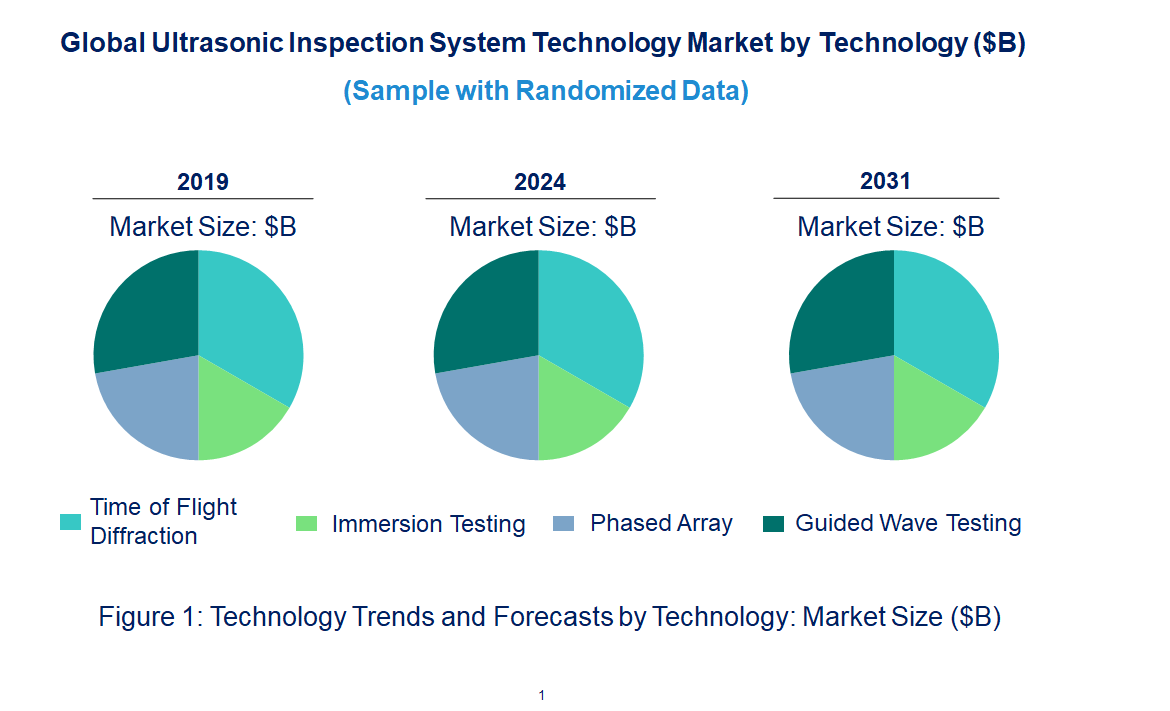
Ultrasonic Inspection System Market Trend and Forecast by Technology [Value from 2019 to 2031]:
• Time of Flight Diffraction
• Immersion Testing
• Phased Array
• Guided-Wave Testing
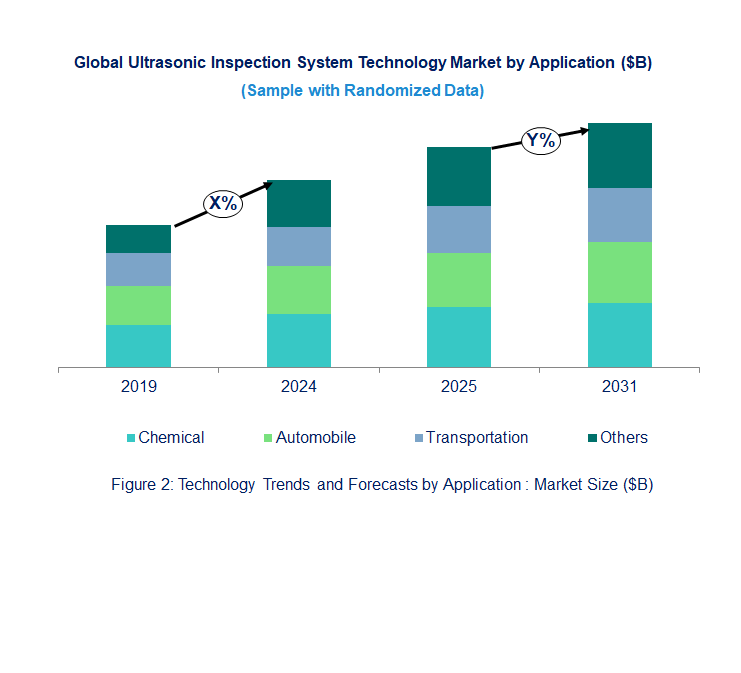
Ultrasonic Inspection System Market Trend and Forecast by Application [Value from 2019 to 2031]:
• Chemical
• Automobile
• Transportation
• Others
Ultrasonic Inspection System Market by Region [Value from 2019 to 2031]:
• North America
• Europe
• Asia Pacific
• The Rest of the World
• Latest Developments and Innovations in the Ultrasonic Inspection System Technologies
• Companies / Ecosystems
• Strategic Opportunities by Technology Type
Features of the Global Ultrasonic Inspection System Market
Market Size Estimates: Ultrasonic inspection system market size estimation in terms of ($B).
Trend and Forecast Analysis: Market trends (2019 to 2024) and forecast (2025 to 2031) by various segments and regions.
Segmentation Analysis: Technology trends in the global ultrasonic inspection system market size by various segments, such as application and technology in terms of value and volume shipments.
Regional Analysis: Technology trends in the global ultrasonic inspection system market breakdown by North America, Europe, Asia Pacific, and the Rest of the World.
Growth Opportunities: Analysis of growth opportunities in different applications, technologies, and regions for technology trends in the global ultrasonic inspection system market.
Strategic Analysis: This includes M&A, new product development, and competitive landscape for technology trends in the global ultrasonic inspection system market.
Analysis of competitive intensity of the industry based on Porter’s Five Forces model.
This report answers following 11 key questions
Q.1. What are some of the most promising potential, high-growth opportunities for the technology trends in the global ultrasonic inspection system market by technology (time of flight diffraction, immersion testing, phased array, and guided-wave testing), application (chemical, automobile, transportation, and others), and region (North America, Europe, Asia Pacific, and the Rest of the World)?
Q.2. Which technology segments will grow at a faster pace and why?
Q.3. Which regions will grow at a faster pace and why?
Q.4. What are the key factors affecting dynamics of different technology? What are the drivers and challenges of these technologies in the global ultrasonic inspection system market?
Q.5. What are the business risks and threats to the technology trends in the global ultrasonic inspection system market?
Q.6. What are the emerging trends in these technologies in the global ultrasonic inspection system market and the reasons behind them?
Q.7. Which technologies have potential of disruption in this market?
Q.8. What are the new developments in the technology trends in the global ultrasonic inspection system market? Which companies are leading these developments?
Q.9. Who are the major players in technology trends in the global ultrasonic inspection system market? What strategic initiatives are being implemented by key players for business growth?
Q.10. What are strategic growth opportunities in this ultrasonic inspection system technology space?
Q.11. What M & A activities did take place in the last five years in technology trends in the global ultrasonic inspection system market?