
Report Feature
UAV Propulsion System Market Trends and Forecast
The future of the global UAV propulsion system market looks promising with opportunities in the civil and military markets. The global UAV propulsion system market is expected to reach an estimated $30 billion by 2035 with a CAGR of 9.9% from 2026 to 2035. The major drivers for this market are the increasing demand for long endurance UAV operations, the rising adoption of electric propulsion technologies, and the growing use in defense surveillance applications.• Lucintel forecasts that, within the fuel type category, gasoline is expected to witness the highest growth over the forecast period.
• Within the application category, military is expected to witness higher growth.
• In terms of region, North America is expected to witness the highest growth over the forecast period.
Gain valuable insights for your business decisions with our comprehensive 150+ page report. Sample figures with some insights are shown below.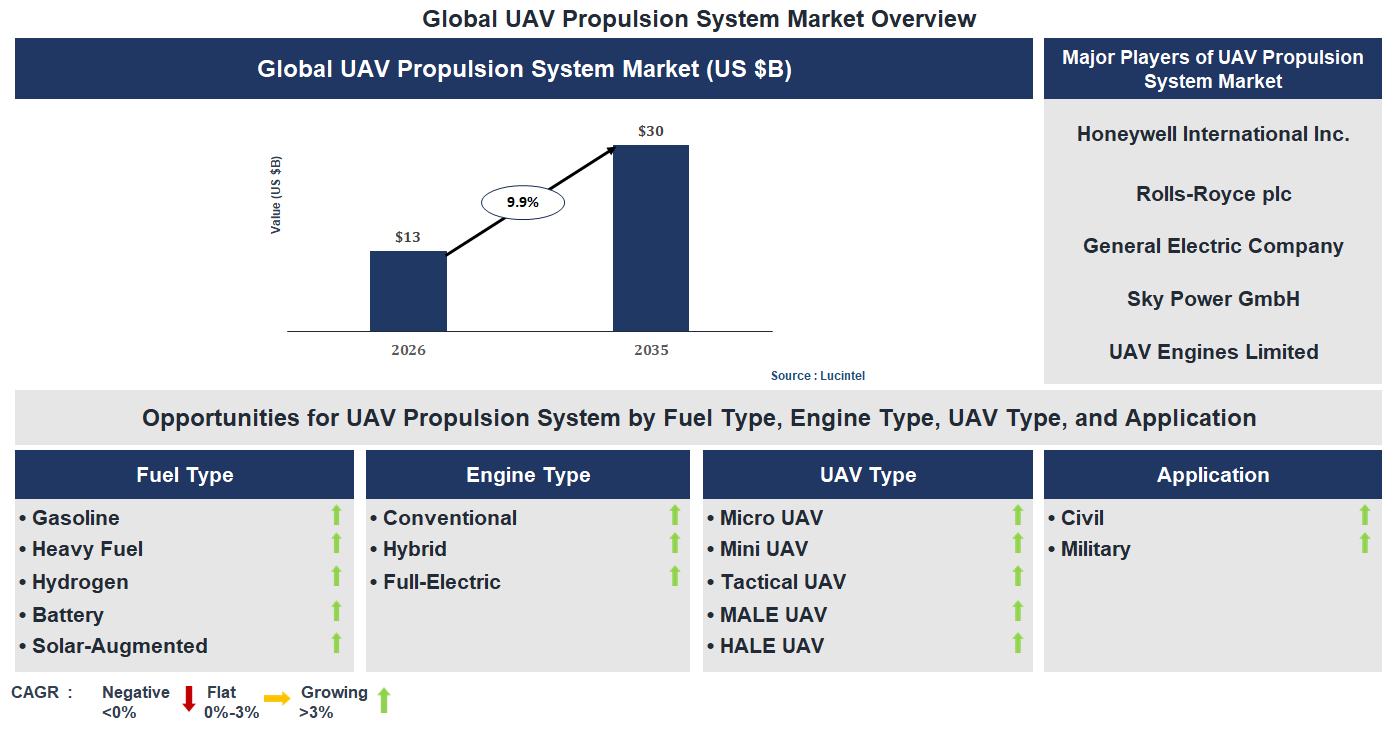
Emerging Trends in the UAV Propulsion System Market
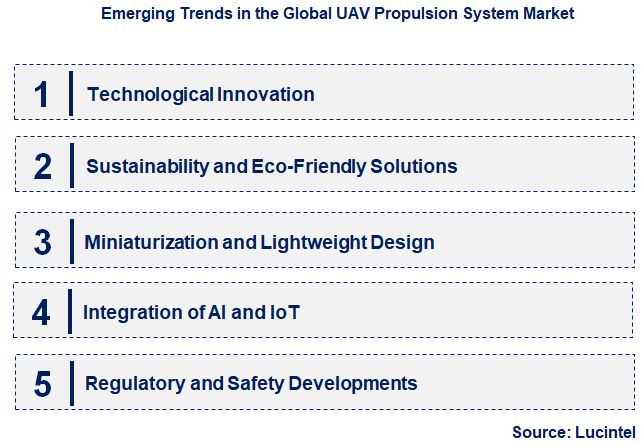
The UAV propulsion system market is experiencing rapid growth driven by technological advancements, increasing demand for commercial and military applications, and evolving regulatory landscapes. As drones become more sophisticated and versatile, the propulsion systems powering them are also advancing to meet new performance, efficiency, and sustainability standards. These developments are transforming the industry, creating new opportunities and challenges for manufacturers, users, and regulators. Understanding the key emerging trends is essential for stakeholders to stay competitive and innovate effectively in this dynamic market environment.• Technological Innovation: Advancements in electric and hybrid propulsion systems are enhancing UAV performance. Innovations such as lightweight batteries, efficient motors, and hybrid engines are enabling longer flight times, higher payload capacities, and improved reliability. These technological improvements are expanding UAV applications across agriculture, surveillance, delivery, and military sectors, making drones more versatile and cost-effective.
• Sustainability and Eco-Friendly Solutions: Growing environmental concerns are pushing the industry toward sustainable propulsion options. The adoption of electric motors powered by renewable energy sources reduces carbon emissions and noise pollution. Companies are investing in green propulsion technologies, such as solar-powered systems and biofuels, to meet regulatory standards and consumer expectations, thereby promoting eco-friendly drone operations.
• Miniaturization and Lightweight Design: The trend toward smaller, lighter UAVs necessitates compact propulsion systems. Innovations in miniaturized motors and lightweight materials are enabling the development of micro and nano drones for specialized tasks like indoor inspection and precision agriculture. This trend enhances maneuverability, reduces energy consumption, and broadens the scope of drone applications in confined or sensitive environments.
• Integration of AI and IoT: The integration of artificial intelligence and Internet of Things (IoT) technologies with propulsion systems is improving drone autonomy and operational efficiency. AI-driven control systems optimize power usage and flight paths, while IoT connectivity allows real-time monitoring and maintenance. These advancements lead to smarter, more reliable UAVs capable of complex missions with minimal human intervention.
• Regulatory and Safety Developments: Evolving regulations are influencing propulsion system design and deployment. Governments are implementing standards for safety, noise levels, and emissions, prompting manufacturers to innovate compliant systems. Enhanced safety features, such as fail-safe mechanisms and redundant propulsion units, are becoming standard, ensuring broader acceptance and integration of UAVs into commercial and public sectors.
These emerging trends are collectively reshaping the UAV propulsion system market by driving innovation, promoting sustainability, enhancing miniaturization, integrating advanced technologies, and aligning with regulatory frameworks. These developments are enabling more efficient, versatile, and environmentally friendly drones, thereby expanding market opportunities and redefining industry standards.
Recent Development in the UAV Propulsion System Market
The UAV propulsion system market is experiencing rapid growth driven by technological advancements, increasing demand for commercial and military applications, and evolving regulatory landscapes. Innovations in electric and hybrid propulsion, along with miniaturization and improved efficiency, are expanding the markets scope. Key players are investing heavily in R&D to develop lightweight, durable, and energy-efficient systems. These developments are transforming UAV capabilities, enabling longer flight times, higher payloads, and broader application areas, thus creating significant opportunities for industry expansion and diversification.• Growing Adoption of Electric Propulsion Systems: The shift towards electric propulsion in UAVs is driven by environmental concerns, lower maintenance costs, and enhanced efficiency. Electric systems offer quieter operation and reduced emissions, making them suitable for surveillance, agriculture, and delivery services. Advances in battery technology and motor design are increasing flight endurance and payload capacity. This trend is expected to dominate the market, encouraging manufacturers to innovate and develop more reliable, lightweight, and cost-effective electric propulsion solutions, thereby expanding UAV applications.
• Increasing Demand for Hybrid Propulsion Technologies: Hybrid propulsion combines traditional fuel engines with electric systems, offering extended flight times and improved fuel efficiency. This technology is gaining traction in military and commercial UAVs requiring longer endurance and operational flexibility. Hybrid systems reduce reliance on fuel, lower operational costs, and enable UAVs to operate in diverse environments. The integration of hybrid propulsion is fostering innovation, leading to more versatile UAV platforms capable of complex missions, thus opening new market segments and increasing competitiveness.
• Advancements in Lightweight Materials and Design: The use of advanced composites and lightweight materials is revolutionizing UAV propulsion systems by reducing weight without compromising strength. These materials enhance flight performance, increase payload capacity, and improve energy efficiency. Innovative design approaches are also optimizing aerodynamics and thermal management. Such developments are enabling UAVs to undertake longer missions, carry heavier payloads, and operate in challenging conditions, thereby broadening their application scope and market reach.
• Rising Focus on Autonomous and Intelligent Propulsion Systems: Integration of AI and sensor technologies into propulsion systems is enabling UAVs to achieve higher levels of autonomy and operational efficiency. Intelligent systems facilitate real-time diagnostics, adaptive control, and predictive maintenance, reducing downtime and operational costs. This technological leap is critical for complex missions such as surveillance, mapping, and delivery. The focus on autonomous propulsion is fostering innovation, attracting investments, and expanding the market for smarter, more reliable UAVs with enhanced capabilities.
• Expansion of Commercial and Civil UAV Applications: The proliferation of UAVs in sectors like agriculture, logistics, filmmaking, and infrastructure inspection is driving demand for advanced propulsion systems. These applications require reliable, efficient, and scalable propulsion solutions to support longer flights and heavier payloads. Regulatory support and decreasing costs are further accelerating adoption. This growth is prompting manufacturers to develop specialized propulsion systems tailored to diverse commercial needs, thereby fueling market expansion and diversification.
These recent developments are significantly transforming the UAV propulsion system market by enhancing performance, efficiency, and application versatility. Electric, hybrid, and intelligent propulsion technologies are enabling longer, more reliable, and autonomous UAV operations. The focus on lightweight materials and expanding commercial applications are broadening market scope. Collectively, these innovations are driving industry growth, attracting investments, and creating new opportunities, positioning the UAV propulsion system market for sustained expansion and technological leadership.
Strategic Growth Opportunities in the UAV Propulsion System Market
The UAV propulsion system market is experiencing rapid expansion driven by technological advancements, increasing drone applications across industries, and rising demand for efficient, lightweight power solutions. As industries such as agriculture, defense, and logistics adopt UAVs, the need for innovative propulsion systems grows. Market players are focusing on developing sustainable, high-performance, and cost-effective propulsion technologies to meet diverse operational requirements, creating significant growth opportunities. Strategic investments and collaborations are expected to further accelerate market development and innovation.• Growing Adoption of Electric Propulsion Systems for Drones: The shift towards electric propulsion systems in UAVs is driven by their environmental benefits, lower maintenance costs, and improved efficiency. Advances in battery technology and lightweight motors are enabling longer flight times and higher payload capacities. This trend is particularly prominent in commercial and recreational drone markets, where electric systems offer safer, quieter, and more reliable operation. The increasing demand for eco-friendly solutions is expected to propel the adoption of electric propulsion across various UAV applications.
• Increasing Demand for Hybrid Propulsion Technologies in UAVs: Hybrid propulsion systems combine traditional fuel engines with electric motors, offering enhanced endurance, reliability, and operational flexibility. These systems are gaining traction in military, surveillance, and industrial applications where extended flight times and rapid deployment are critical. Innovations in hybrid technology aim to optimize fuel efficiency, reduce emissions, and improve overall performance. The integration of hybrid systems is poised to open new avenues for UAV operations in challenging environments and long-duration missions.
• Rising Focus on Lightweight and Compact Propulsion Components: The demand for lightweight, compact propulsion components is driven by the need to maximize payload capacity and flight duration. Material innovations, such as advanced composites and miniaturized motors, are enabling the development of smaller, more efficient propulsion units. This focus is particularly relevant for small and micro UAVs used in reconnaissance, delivery, and agricultural monitoring. Enhanced component design reduces overall drone weight, improves maneuverability, and extends operational capabilities.
• Strategic Collaborations and Partnerships for Technological Innovation: Major market players are forming alliances with technology providers, research institutions, and component manufacturers to accelerate innovation. These collaborations facilitate the development of advanced propulsion systems, integration of AI and automation, and cost-effective manufacturing processes. Such strategic partnerships are crucial for staying competitive, expanding product portfolios, and addressing evolving customer needs. They also enable rapid commercialization of cutting-edge propulsion solutions across diverse UAV segments.
• Growing Emphasis on Sustainable and Eco-Friendly Propulsion Solutions: Environmental concerns and regulatory pressures are driving the development of sustainable UAV propulsion systems. Companies are investing in biofuels, solar-powered systems, and other green technologies to reduce carbon footprints. These eco-friendly solutions are gaining popularity in commercial, agricultural, and environmental monitoring applications. The focus on sustainability not only aligns with global environmental goals but also offers market differentiation and compliance advantages, fostering long-term growth and acceptance of UAVs.
The overall market is poised for substantial growth as these opportunities foster innovation, improve performance, and meet increasing global demand for versatile, efficient, and sustainable UAV propulsion systems.
UAV Propulsion System Market Driver and Challenges
The UAV propulsion system market is influenced by a complex interplay of technological advancements, economic factors, and regulatory frameworks. Rapid innovations in drone technology, increasing demand across commercial and defense sectors, and evolving safety standards are shaping the market landscape. Additionally, economic growth in emerging markets and government initiatives to promote UAV usage further drive growth. However, the market also faces challenges such as regulatory restrictions, technological limitations, and high development costs. Understanding these drivers and challenges is essential for stakeholders to navigate the evolving environment and capitalize on emerging opportunities effectively.The factors responsible for driving the UAV propulsion system market include:
• Technological Innovation: The continuous development of lightweight, efficient, and reliable propulsion systems, such as electric and hybrid engines, enhances UAV performance. Advances in battery technology and motor design improve flight endurance and payload capacity, making UAVs more versatile for various applications. These innovations reduce operational costs and open new market segments, including urban air mobility and autonomous delivery services. As technology progresses, the market is expected to see increased adoption of sophisticated propulsion solutions, fueling overall growth.
• Growing Commercial and Defense Demand: The expanding use of UAVs in agriculture, surveillance, logistics, and military operations significantly propels the market. Governments and private enterprises are investing heavily in UAV technology to improve efficiency and safety. Defense agencies utilize UAVs for reconnaissance and combat missions, while commercial sectors leverage UAVs for aerial photography, mapping, and delivery services. This rising demand creates a robust market for advanced propulsion systems capable of supporting diverse operational needs, thereby driving market expansion.
• Regulatory Support and Policy Frameworks: Governments worldwide are establishing regulations to facilitate safe UAV operations, which encourages market growth. Clear guidelines on airspace management, safety standards, and licensing procedures reduce operational uncertainties. Regulatory support also includes incentives and funding for research and development, fostering innovation in propulsion systems. As regulatory environments become more conducive, manufacturers are motivated to develop compliant and high-performance propulsion solutions, further accelerating market growth.
• Increasing Investment and R&D Activities: Significant investments from private and public sectors in UAV technology and propulsion systems are accelerating innovation. R&D efforts focus on improving efficiency, reducing costs, and developing environmentally friendly propulsion options. These investments enable the development of next-generation UAVs with longer endurance, higher payload capacity, and enhanced safety features. The influx of funding and research activities ensures a competitive market landscape and rapid technological progress, supporting sustained growth.
• Expansion into Emerging Markets: Rapid urbanization and infrastructure development in emerging economies create new opportunities for UAV applications. These markets are adopting UAV technology for agriculture, infrastructure inspection, and delivery services, demanding advanced propulsion systems. The increasing affordability of UAVs and supportive government initiatives further boost market penetration. This expansion into new regions diversifies revenue streams and stimulates innovation in propulsion technologies tailored to diverse operational environments.
The challenges facing the UAV propulsion system market include:
• Regulatory Restrictions and Airspace Management: Stringent regulations and complex airspace management policies pose significant hurdles. Many countries have restrictive rules regarding UAV flight altitudes, no-fly zones, and licensing requirements, limiting operational flexibility. These restrictions can delay deployment and increase compliance costs for manufacturers and operators. As regulations evolve, ensuring compatibility with diverse standards remains a challenge, potentially hindering market growth and innovation.
• Technological Limitations and Safety Concerns: Despite advancements, current propulsion systems face limitations such as limited battery life, thermal management issues, and reliability concerns. Safety risks related to system failures or crashes can impede market acceptance, especially in critical applications like delivery and surveillance. Overcoming these technological barriers requires substantial R&D investment, which can be time-consuming and costly, potentially slowing down market expansion.
• High Development and Production Costs: Developing advanced UAV propulsion systems involves significant capital expenditure on research, testing, and manufacturing. These costs can be prohibitive for smaller companies and startups, restricting market entry and innovation. Additionally, the high costs may translate into expensive UAVs, limiting adoption among price-sensitive customers and hindering widespread market penetration.
The UAV propulsion system market is driven by technological innovation, increasing demand across sectors, supportive regulations, substantial investments, and market expansion into emerging regions. However, regulatory complexities, technological challenges, and high development costs pose significant hurdles. These factors collectively influence the pace and direction of market growth, requiring stakeholders to navigate carefully. Strategic investments, regulatory compliance, and ongoing technological advancements will be crucial for sustained success in this dynamic landscape.
List of UAV Propulsion System Companies
Companies in the market compete on the basis of product quality offered. Major players in this market focus on expanding their manufacturing facilities, R&D investments, infrastructural development, and leverage integration opportunities across the value chain. With these strategies UAV propulsion system companies cater increasing demand, ensure competitive effectiveness, develop innovative products & technologies, reduce production costs, and expand their customer base. Some of the UAV propulsion system companies profiled in this report include-• Honeywell International Inc.
• Rolls-Royce plc
• General Electric Company
• Sky Power GmbH
• UAV Engines Limited
• Hirth Engines GmbH
• Orbital Corporation Ltd
• Intelligent Energy Limited
• H3 Dynamics Holdings Pte. Ltd.
• Verde Go Aero, Inc.
UAV Propulsion System Market by Segment
The study includes a forecast for the global UAV propulsion system market by fuel type, engine type, UAV type, application, and region.UAV Propulsion System Market by Fuel Type [Value from 2019 to 2035]:
• Gasoline
• Heavy Fuel
• Hydrogen
• Battery
• Solar-Augmented
UAV Propulsion System Market by Engine Type [Value from 2019 to 2035]:
• Conventional
• Hybrid
• Full-Electric
UAV Propulsion System Market by UAV Type [Value from 2019 to 2035]:
• Micro UAV
• Mini UAV
• Tactical UAV
• MALE UAV
• HALE UAV
UAV Propulsion System Market by Application [Value from 2019 to 2035]:
• Civil
• Military
UAV Propulsion System Market by Region [Value from 2019 to 2035]:
• North America
• Europe
• Asia Pacific
• The Rest of the World
Country Wise Outlook for the UAV Propulsion System Market
The UAV propulsion system market has experienced significant growth driven by technological advancements, increasing demand for military and commercial applications, and evolving regulatory landscapes. Countries are investing heavily in research and development to enhance UAV capabilities, improve efficiency, and reduce costs. The markets expansion is also fueled by the rising adoption of UAVs in agriculture, surveillance, delivery services, and defense sectors. As the industry matures, key players are focusing on innovation, sustainability, and integration of advanced propulsion technologies to stay competitive. This global trend reflects a strategic shift towards autonomous and efficient aerial systems, with each country contributing uniquely to the markets evolution.• United States: The US leads in UAV propulsion technology, with major companies investing in hybrid and electric propulsion systems. Recent developments include advancements in battery technology, increasing endurance, and payload capacity. The US military has prioritized the integration of more efficient engines for long-endurance missions, while commercial sectors focus on lightweight, eco-friendly solutions. Regulatory support and substantial R&D funding have accelerated innovation, making the US a dominant player in the global UAV propulsion market.
• China: China has rapidly expanded its UAV industry, emphasizing indigenous propulsion systems to reduce reliance on foreign technology. Recent developments include the deployment of high-performance turbojet engines for military drones and improvements in electric propulsion for commercial UAVs. The government’s strategic initiatives aim to boost domestic manufacturing and technological self-sufficiency. Chinese companies are also exploring hybrid propulsion solutions to enhance UAV operational range and efficiency, positioning China as a key competitor in the global market.
• Germany: Germany is known for its advanced engineering and focus on sustainable propulsion solutions. Recent innovations involve the development of lightweight, fuel-efficient engines and hybrid systems for both military and civilian UAVs. German research institutions are collaborating with industry leaders to improve thermal management and energy storage. The country’s emphasis on environmentally friendly propulsion technologies aligns with broader European sustainability goals, making Germany a significant contributor to the evolution of eco-conscious UAV propulsion systems.
• India: India has made notable progress in developing indigenous UAV propulsion systems, driven by military and civilian needs. Recent advancements include the creation of small, efficient electric motors and lightweight combustion engines suitable for surveillance and reconnaissance UAVs. The government’s push for self-reliance has led to increased R&D activities, with startups and public sector units working on hybrid propulsion solutions. These developments aim to enhance UAV endurance, payload capacity, and operational versatility across diverse terrains.
• Japan: Japan focuses on high-precision, reliable propulsion systems for UAVs used in defense and industrial applications. Recent developments include the integration of advanced electric propulsion technologies and hybrid systems that improve efficiency and reduce noise. Japanese firms are also exploring fuel cell technology to extend UAV flight times and operational range. The country’s emphasis on innovation and quality ensures that its UAV propulsion systems remain competitive globally, with ongoing research aimed at achieving greater autonomy and sustainability in aerial systems.

Features of the Global UAV Propulsion System Market
Market Size Estimates: UAV propulsion system market size estimation in terms of value ($B).Trend and Forecast Analysis: Market trends (2019 to 2025) and forecast (2026 to 2035) by various segments and regions.
Segmentation Analysis: UAV propulsion system market size by various segments, such as by fuel type, engine type, UAV type, application, and region in terms of value ($B).
Regional Analysis: UAV propulsion system market breakdown by North America, Europe, Asia Pacific, and Rest of the World.
Growth Opportunities: Analysis of growth opportunities in different fuel types, engine types, UAV types, applications, and regions for the UAV propulsion system market.
Strategic Analysis: This includes M&A, new product development, and competitive landscape of the UAV propulsion system market.
Analysis of competitive intensity of the industry based on Porter’s Five Forces model.

FAQ
Q1. What is the UAV propulsion system market size?Answer: The global UAV propulsion system market is expected to reach an estimated $30 billion by 2035.
Q2. What is the growth forecast for UAV propulsion system market?
Answer: The global UAV propulsion system market is expected to grow with a CAGR of 9.9% from 2026 to 2035.
Q3. What are the major drivers influencing the growth of the UAV propulsion system market?
Answer: The major drivers for this market are the increasing demand for long endurance UAV operations, the rising adoption of electric propulsion technologies, and the growing use in defense surveillance applications.
Q4. What are the major segments for UAV propulsion system market?
Answer: The future of the UAV propulsion system market looks promising with opportunities in the civil and military markets.
Q5. Who are the key UAV propulsion system market companies?
Answer: Some of the key UAV propulsion system companies are as follows:
• Honeywell International Inc.
• Rolls-Royce plc
• General Electric Company
• Sky Power GmbH
• UAV Engines Limited
• Hirth Engines GmbH
• Orbital Corporation Ltd
• Intelligent Energy Limited
• H3 Dynamics Holdings Pte. Ltd.
• Verde Go Aero, Inc.
Q6. Which UAV propulsion system market segment will be the largest in future?Answer: Lucintel forecasts that, within the fuel type category, gasoline is expected to witness the highest growth over the forecast period.
Q7. In UAV propulsion system market, which region is expected to be the largest in next 8 years?
Answer: In terms of region, North America is expected to witness the highest growth over the forecast period.
Q8. Do we receive customization in this report?
Answer: Yes, Lucintel provides 10% customization without any additional cost.
Table of Contents
List of Figures
List of Tables
Methodology
- In-depth interviews of the major players in this market
- Detailed secondary research from competitors’ financial statements and published data
- Extensive searches of published works, market, and database information pertaining to industry news, company press releases, and customer intentions
- A compilation of the experiences, judgments, and insights of Lucintel’s professionals, who have analyzed and tracked this market over the years.


Buy Now
Choose a license that fits your team. Instant PDF delivery.
Prices exclude taxes. Instant delivery. Custom licensing available on request.
Key Questions
- • What are some of the most promising, high-growth opportunities for the UAV propulsion system market by fuel type (gasoline, heavy fuel, hydrogen, battery, and solar-augmented), engine type (conventional, hybrid, and full-electric), UAV type (micro UAV, mini UAV, tactical UAV, MALE UAV, and HALE UAV), application (civil and military), and region (North America, Europe, Asia Pacific, and the Rest of the World)?
- • Which segments will grow at a faster pace and why?
- • Which region will grow at a faster pace and why?
- • What are the key factors affecting market dynamics? What are the key challenges and business risks in this market?
- • What are the business risks and competitive threats in this market?
- • What are the emerging trends in this market and the reasons behind them?
- • What are some of the changing demands of customers in the market?
- • What are the new developments in the market? Which companies are leading these developments?
- • Who are the major players in this market? What strategic initiatives are key players pursuing for business growth?
- • What are some of the competing products in this market and how big of a threat do they pose for loss of market share by material or product substitution?
- • What M&A activity has occurred in the last 5 years and what has its impact been on the industry? For any questions related to UAV Propulsion System Market, UAV Propulsion System Market Size, UAV Propulsion System Market Growth, UAV Propulsion System Market Analysis, UAV Propulsion System Market Report, UAV Propulsion System Market Share, UAV Propulsion System Market Trends, UAV Propulsion System Market Forecast, UAV Propulsion System Companies, write Lucintel analyst at email: helpdesk@lucintel.com. We will be glad to get back to you soon.


