
Report Feature
UAV flight Training and Simulation Market Trends and Forecast
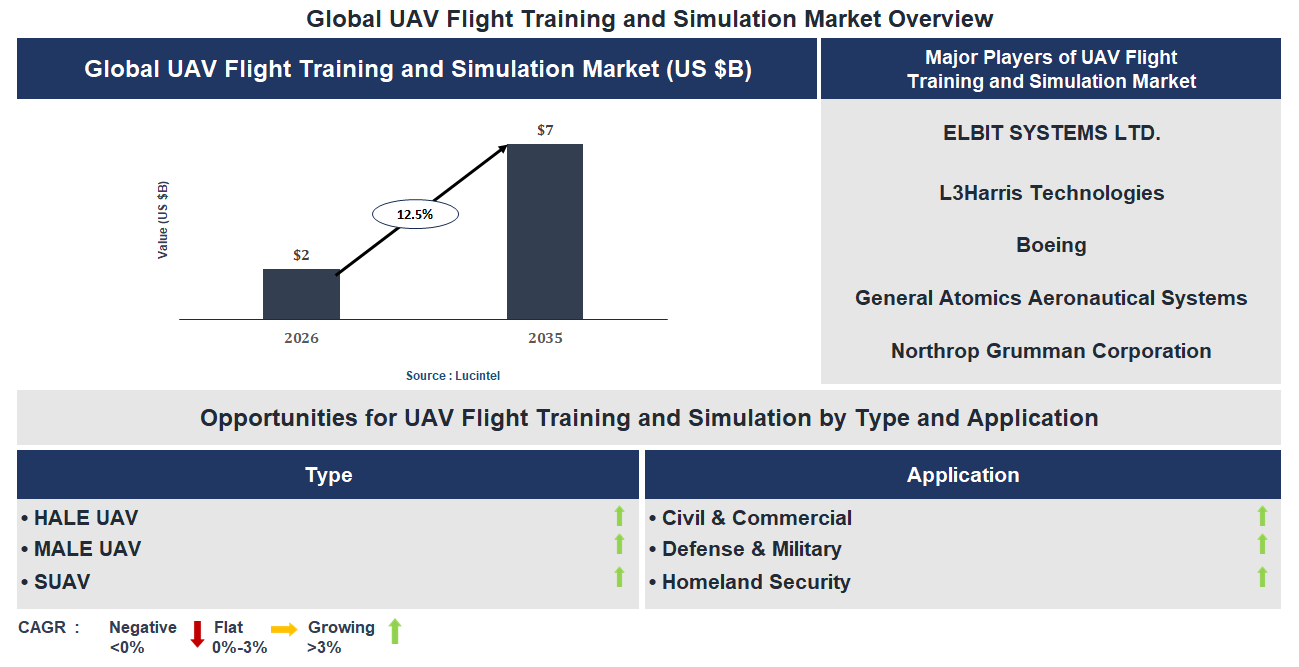
The future of the global UAV flight training and simulation market looks promising with opportunities in the civil & commercial, defense & military, and homeland security markets. The global UAV flight training and simulation market is expected to reach an estimated $7 billion by 2035 with a CAGR of 12.5% from 2026 to 2035. The major drivers for this market are the increasing need for skilled UAV operators, the rising adoption of UAV technology in industries, and the growing demand for realistic flight simulations.• Lucintel forecasts that, within the type category, MALE UAV is expected to witness the highest growth over the forecast period.
• Within the application category, defense & military is expected to witness the highest growth.
• In terms of region, North America is expected to witness the highest growth over the forecast period. Gain valuable insights for your business decisions with our comprehensive 150+ page report. Sample figures with some insights are shown below.
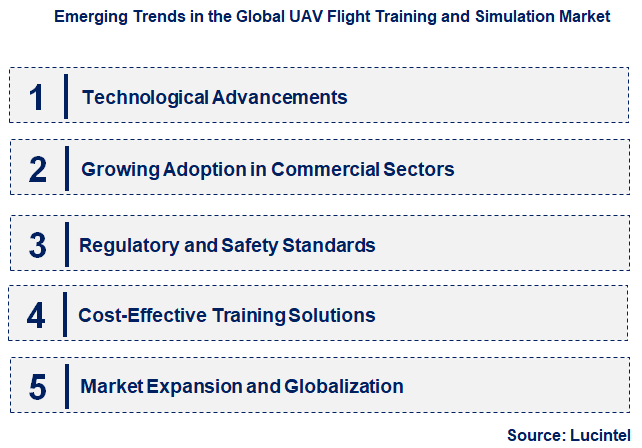
Emerging Trends in the UAV Flight Training and Simulation Market
The UAV flight training and simulation market is experiencing rapid growth driven by technological advancements, increasing drone applications across various industries, and the need for cost-effective, safe, and efficient training solutions. As drones become integral to sectors such as agriculture, defense, surveillance, and delivery services, the demand for sophisticated training and simulation tools is rising. This market evolution is also influenced by regulatory changes and the push for standardized training protocols. These developments are transforming how operators are trained, ensuring safety, enhancing operational efficiency, and expanding the market’s scope globally.• Technological Advancements: The integration of augmented reality (AR), virtual reality (VR), and artificial intelligence (AI) into UAV training simulators is revolutionizing the learning experience. These technologies provide immersive, realistic scenarios that improve skill acquisition and reduce training costs. Enhanced simulation fidelity allows trainees to experience diverse environments and emergency situations without real-world risks. As technology continues to evolve, training becomes more accessible, customizable, and effective, leading to broader adoption across industries and increasing market competitiveness.
• Growing Adoption in Commercial Sectors: The expansion of UAV applications in agriculture, construction, filmmaking, and logistics is fueling demand for specialized training programs. Companies seek to ensure safe, efficient drone operations, prompting the development of tailored simulation modules. This trend not only boosts market growth but also encourages industry-specific certifications and standards. As commercial drone use proliferates, the need for comprehensive training solutions becomes critical, driving innovation and market diversification to meet sector-specific requirements.
• Regulatory and Safety Standards: Governments worldwide are establishing stricter regulations and safety protocols for UAV operations. This regulatory landscape necessitates standardized training and certification processes, which simulation-based training can efficiently support. The market benefits from increased demand for compliant training solutions that help operators meet legal requirements and ensure safety. These standards also promote trust and legitimacy in drone operations, encouraging wider adoption and integration into mainstream industries, thereby expanding the market’s scope and maturity.
• Cost-Effective Training Solutions: Traditional flight training is expensive and resource-intensive. UAV simulation offers a cost-effective alternative by reducing the need for physical drones, fuel, and maintenance. It allows for repeated practice in a controlled environment, accelerating skill development and minimizing risks. As organizations recognize these benefits, investment in simulation technology rises, making training more accessible to a broader audience. This trend democratizes drone operation skills, supports workforce development, and sustains market growth by lowering barriers to entry.
• Market Expansion and Globalization: The increasing adoption of UAVs worldwide, especially in emerging markets, is expanding the training and simulation market. Countries are investing in local training infrastructure to support their growing drone industries. This globalization fosters cross-border collaborations, knowledge sharing, and standardization efforts. As the market extends beyond traditional regions, it creates new opportunities for vendors and accelerates technological innovation. The global expansion ensures a more competitive landscape, with diverse offerings tailored to regional needs, ultimately reshaping the market into a more integrated and dynamic industry. These trends are collectively transforming the UAV flight training and simulation market by enhancing technological capabilities, broadening application areas, ensuring safety compliance, reducing costs, and expanding globally. This evolution is making drone training more effective, accessible, and standardized, thereby supporting the sustainable growth of the drone industry across multiple sectors worldwide.
Recent Development in the UAV Flight Training and Simulation Market
The UAV flight training and simulation market is experiencing rapid growth driven by technological advancements, increasing drone applications across industries, and regulatory changes demanding higher safety standards. As industries adopt UAVs for delivery, surveillance, and agriculture, the need for effective training solutions becomes critical. Innovations in simulation technology are providing more realistic, cost-effective, and accessible training options. This evolving landscape presents significant opportunities for market expansion, driven by both government initiatives and private sector investments aiming to enhance UAV operational safety and efficiency.• Growing Adoption of UAVs in Commercial Sectors: The increasing use of UAVs in agriculture, logistics, and surveillance is fueling demand for specialized training and simulation solutions. As industries recognize the benefits of UAVs, the need for skilled operators rises, prompting investments in advanced training programs. This trend enhances safety, operational efficiency, and regulatory compliance, creating a substantial market for simulation-based training tools. The expansion of commercial UAV applications directly correlates with increased market revenue and technological innovation.
• Technological Advancements in Simulation Software: Innovations in virtual reality (VR), augmented reality (AR), and artificial intelligence (AI) are transforming UAV training. These technologies enable highly realistic, immersive training environments that reduce costs and improve skill acquisition. Enhanced simulation software offers detailed scenario-based training, risk assessment, and real-time feedback, making it more effective than traditional methods. As these technologies become more accessible, they are expected to drive widespread adoption, improve training outcomes, and expand market reach.
• Increasing Regulatory Requirements and Safety Standards: Governments worldwide are implementing stricter regulations for UAV operations, emphasizing safety and pilot competency. These regulations necessitate comprehensive training programs, often relying on simulation to meet certification standards efficiently. The demand for compliant training solutions is rising, encouraging market players to develop specialized simulation platforms. This regulatory push not only ensures safer UAV operations but also accelerates market growth by creating a steady demand for advanced training tools.
• Rising Investments and Strategic Partnerships: Major industry players and startups are investing heavily in UAV training and simulation technology development. Strategic partnerships between technology providers, drone manufacturers, and regulatory bodies are fostering innovation and expanding market capabilities. Funding from government grants and private investors supports research and development, leading to more sophisticated simulation solutions. These investments are crucial for scaling up production, improving software realism, and broadening access to training programs, thus propelling market growth.
• Increasing Focus on Cost-Effective and Remote Training Solutions: The need for scalable, affordable training options is driving the development of remote and online simulation platforms. These solutions enable operators to train from anywhere, reducing costs associated with physical training facilities and flight hours. The COVID-19 pandemic accelerated adoption of remote training, highlighting its importance. As demand for flexible, cost-efficient training grows, market players are innovating in cloud-based and mobile simulation technologies, expanding access and fostering widespread adoption across various sectors. The overall impact of these developments is significantly expanding the UAV flight training and simulation market. Enhanced technological capabilities, regulatory support, and increased industry adoption are driving growth, improving safety standards, and reducing training costs. This evolution is making UAV operations more accessible and reliable, fostering innovation, and positioning the market for sustained expansion in the coming years.
Strategic Growth Opportunities in the UAV Flight Training and Simulation Market
The UAV flight training and simulation market is experiencing rapid expansion driven by technological advancements, increasing drone applications across industries, and regulatory requirements for pilot training. As demand for safer, cost-effective, and efficient training solutions grows, market players are investing in innovative simulation platforms. This creates significant opportunities for growth, partnerships, and technological development, shaping the future landscape of UAV training. Strategic focus on these opportunities will be crucial for stakeholders aiming to capitalize on emerging trends and meet evolving industry needs.• Expanding Use of UAV Simulation for Commercial Pilot Training: The increasing adoption of UAV simulation platforms for commercial pilot training offers a cost-effective, safe, and scalable alternative to traditional methods. These simulators enable realistic scenario-based training, reducing risks and operational costs. As industries like agriculture, construction, and delivery services expand their drone operations, demand for specialized training solutions grows, creating a significant market opportunity for advanced simulation technologies tailored to diverse commercial applications.
• Integration of Artificial Intelligence for Enhanced Training Effectiveness: Incorporating AI into UAV flight simulators enhances training by providing adaptive learning experiences, real-time feedback, and scenario customization. AI-driven analytics help identify pilot weaknesses and optimize training modules, improving skill acquisition and safety. As AI technology matures, its integration into simulation platforms will revolutionize UAV training, making it more efficient, personalized, and accessible, thereby opening new avenues for market growth and innovation.
• Development of Industry-Specific Simulation Modules: Creating tailored simulation modules for specific industries such as agriculture, surveillance, and emergency response addresses unique operational challenges. These customized solutions improve pilot preparedness and operational efficiency, fostering industry-specific expertise. The demand for specialized training content is driven by regulatory standards and safety requirements, offering growth opportunities for developers to expand their product portfolios and establish a competitive edge in niche markets.
• Growing Adoption of Virtual Reality for Immersive Training Experiences: The adoption of VR technology in UAV training provides highly immersive, realistic environments that enhance pilot engagement and skill retention. VR-based simulators allow for complex scenario training without real-world risks, reducing costs and increasing accessibility. As VR hardware becomes more affordable and sophisticated, its integration into UAV training programs will accelerate, creating new market segments and improving overall training quality.
• Increasing Focus on Regulatory Compliance and Certification Training: As drone regulations become more stringent worldwide, there is a rising need for comprehensive training and certification programs. Simulation-based training helps pilots meet regulatory standards efficiently, ensuring safety and legal compliance. This trend drives demand for certification-specific modules and standardized training solutions, presenting opportunities for market players to develop compliant platforms, collaborate with regulatory bodies, and expand their market share in a highly regulated environment. The overall market growth will be significantly influenced by these opportunities, fostering innovation, improving training standards, and expanding the adoption of UAV simulation solutions across various sectors. Stakeholders who strategically leverage these trends will be well-positioned to capitalize on the expanding UAV industry and its evolving training needs.
UAV Flight Training and Simulation Market Driver and Challenges
The UAV flight training and simulation market is influenced by a variety of technological, economic, and regulatory factors. Rapid advancements in drone technology and simulation software are driving innovation and adoption. Economic growth in defense, commercial, and recreational sectors fuels demand for skilled operators and training solutions. Regulatory frameworks are evolving to ensure safety and security, impacting market growth and operational standards. Additionally, increasing investments in research and development, along with the integration of artificial intelligence and automation, are shaping the future landscape of UAV training. However, challenges such as regulatory restrictions, high costs, and technological limitations pose significant hurdles. Understanding these drivers and challenges is essential for stakeholders to navigate this dynamic market effectively. The factors responsible for driving the UAV flight training and simulation market include:• Technological Advancements: Rapid innovations in drone hardware, software, and simulation platforms enhance training realism and effectiveness. The integration of artificial intelligence, virtual reality, and augmented reality creates immersive experiences, reducing training costs and risks. These technological improvements enable more precise skill development, attract new users, and expand applications across defense, commercial, and recreational sectors. As technology continues to evolve, the market is expected to see increased adoption and diversification of training solutions, fostering growth and competitiveness.
• Growing Defense and Commercial Demand: Increasing defense budgets worldwide and rising commercial drone applications, such as agriculture, infrastructure inspection, and logistics, are fueling demand for specialized training. Governments and private companies seek skilled operators to ensure safety, compliance, and operational efficiency. The need for standardized training programs and simulation-based assessments further accelerates market growth. This expanding demand creates opportunities for market players to develop tailored solutions, expand their customer base, and establish strategic partnerships.
• Regulatory and Safety Frameworks: Evolving regulations aimed at ensuring safe UAV operations are driving the adoption of simulation-based training. Governments are implementing licensing, certification, and operational guidelines that require comprehensive training programs. Simulation platforms help meet these regulatory standards efficiently, reducing risks associated with real-world training. As regulatory landscapes become more complex, the demand for compliant training solutions increases, encouraging innovation and standardization within the market.
• Cost-Effective Training Solutions: Simulation-based training offers a cost-effective alternative to traditional flight training by reducing the need for expensive aircraft, fuel, and maintenance. It allows trainees to practice in a safe, controlled environment, minimizing risks and operational costs. This affordability attracts a broader range of users, including educational institutions, small enterprises, and individual hobbyists. As the cost of simulation technology decreases, adoption rates are expected to rise, making training more accessible and scalable across various sectors.
• Increasing Adoption of AI and Automation: The integration of artificial intelligence and automation in UAV training enhances simulation realism and adaptive learning. AI-driven analytics provide personalized feedback, track progress, and optimize training modules. Automation streamlines training workflows, reduces instructor intervention, and accelerates skill acquisition. These technological enhancements improve training efficiency, accuracy, and scalability, making UAV training more effective and appealing. As AI and automation become more sophisticated and affordable, their adoption is expected to significantly transform the training landscape, expanding market opportunities. The challenges facing the UAV flight training and simulation market include:
• Regulatory Restrictions and Compliance: Stringent regulations and evolving legal frameworks pose significant barriers to market growth. Different countries have varying rules regarding UAV operations, licensing, and training requirements, complicating international expansion. Compliance costs and bureaucratic hurdles can delay deployment and increase operational expenses. Additionally, regulatory uncertainty regarding emerging drone applications creates ambiguity, hindering innovation and investment. Navigating these complex legal landscapes requires significant resources and strategic planning, which can limit market penetration and slow down overall growth.
• High Initial Investment and Operational Costs: Developing and implementing advanced simulation platforms require substantial capital expenditure. High costs associated with hardware, software, and ongoing maintenance can deter smaller organizations and educational institutions from adopting these solutions. Additionally, training personnel to operate and maintain sophisticated systems adds to expenses. These financial barriers restrict market accessibility, especially in emerging economies or sectors with limited budgets. Overcoming cost challenges is crucial for expanding adoption and ensuring widespread availability of UAV training solutions.
• Technological Limitations and Cybersecurity Risks: Despite rapid advancements, current simulation technologies may not fully replicate real-world UAV dynamics, leading to potential gaps in training effectiveness. Limitations in hardware capabilities, software realism, and data integration can impact user experience and skill transfer. Furthermore, increasing reliance on digital platforms exposes systems to cybersecurity threats, risking data breaches, system disruptions, and unauthorized access. Addressing these technological and security challenges is vital to maintain trust, ensure safety, and sustain market growth in an increasingly digital and interconnected environment. The UAV flight training and simulation market is driven by technological innovation, expanding demand across defense and commercial sectors, regulatory support, cost efficiencies, and AI integration. However, regulatory complexities, high costs, and technological limitations present notable challenges. These factors collectively shape the market’s trajectory, requiring stakeholders to balance innovation with compliance and affordability. The ongoing evolution of technology and regulation promises growth opportunities, but addressing existing hurdles is essential for sustainable development and widespread adoption in this dynamic industry.
List of UAV flight Training and Simulation Companies
Companies in the market compete on the basis of product quality offered. Major players in this market focus on expanding their manufacturing facilities, R&D investments, infrastructural development, and leverage integration opportunities across the value chain. With these strategies UAV flight training and simulation companies cater increasing demand, ensure competitive effectiveness, develop innovative products & technologies, reduce production costs, and expand their customer base. Some of the UAV flight training and simulation companies profiled in this report include-• ELBIT SYSTEMS LTD.
• L3Harris Technologies
• Boeing
• General Atomics Aeronautical Systems
• Northrop Grumman Corporation
• CAE Inc.
• Kratos Defense & Security Solutions
• Textron Inc.
• Thales Group
• Lockheed Martin Corporation
UAV flight Training and Simulation Market by Segment
The study includes a forecast for the global UAV flight training and simulation market by type, application, and region.UAV flight Training and Simulation Market by Type [Value from 2019 to 2035]:
• HALE UAV
• MALE UAV
• SUAV
UAV flight Training and Simulation Market by Application [Value from 2019 to 2035]:
• Civil & Commercial
• Defense & Military
• Homeland Security
UAV flight Training and Simulation Market by Region [Value from 2019 to 2035]:
• North America
• Europe
• Asia Pacific
• The Rest of the World
Country Wise Outlook for the UAV Flight Training and Simulation Market
The UAV flight training and simulation market has experienced significant growth driven by technological advancements, increasing demand for drone applications across various sectors, and regulatory developments. Countries are investing heavily in developing sophisticated training programs and simulation technologies to enhance safety, efficiency, and operational capabilities. The markets evolution reflects a global shift towards more realistic, cost-effective, and accessible UAV training solutions, with governments and private companies collaborating to meet rising industry needs. This dynamic landscape is shaping the future of drone operations, emphasizing innovation, safety standards, and expanded use cases across different regions.• United States: The US market has seen rapid adoption of advanced UAV simulation platforms, driven by military and commercial sector investments. Regulatory frameworks are evolving to support training programs, with significant government funding for research and development. Major players are developing realistic, scalable simulators to improve pilot proficiency and safety. The integration of AI and virtual reality technologies has enhanced training effectiveness. Additionally, the US is focusing on developing standards for UAV operations, fostering innovation in autonomous drone systems and expanding commercial applications such as delivery and infrastructure inspection.
• China: China is rapidly expanding its UAV training and simulation capabilities, supported by government initiatives aimed at becoming a global leader in drone technology. The country has invested heavily in developing domestically produced simulation software and hardware, emphasizing military and commercial training. Chinese companies are integrating AI and big data analytics into their simulators to improve realism and operational readiness. The government is also promoting the use of UAVs in agriculture, surveillance, and logistics, which drives demand for advanced training solutions. Regulatory reforms are facilitating broader adoption of UAVs, with a focus on safety and standardization.
• Germany: Germanys UAV simulation market is characterized by a focus on high-precision, safety-critical training solutions, especially for industrial and defense applications. The country emphasizes integrating simulation with real-world testing to ensure operational reliability. German firms are investing in hybrid training systems combining virtual and augmented reality to enhance pilot skills. The government supports research collaborations between academia and industry to develop innovative training technologies. Regulatory developments aim to streamline certification processes for UAV pilots, fostering growth in commercial drone services such as infrastructure inspection, environmental monitoring, and security.
• India: India is witnessing rapid growth in UAV training and simulation, driven by government initiatives like the Digital Sky platform and the Make in India campaign. The focus is on developing indigenous simulation technologies to reduce reliance on foreign solutions. The market is expanding in sectors such as agriculture, defense, and disaster management, with increasing adoption of simulation-based training to ensure safety and efficiency. Startups and established firms are collaborating to create cost-effective, scalable simulators tailored to local needs. Regulatory reforms are encouraging drone use, which in turn boosts demand for comprehensive training solutions to support widespread adoption.
• Japan: Japans UAV simulation market is advancing through a focus on safety, precision, and integration with existing industrial systems. The country is investing in high-fidelity simulators for defense and commercial sectors, including infrastructure inspection and disaster response. Japanese companies are leveraging augmented reality and robotics to develop immersive training environments. The government promotes UAV innovation through strategic initiatives and regulatory adjustments aimed at expanding commercial drone applications. Collaboration between academia, industry, and government agencies is fostering the development of next-generation simulation technologies, emphasizing reliability, safety, and operational excellence in UAV training.

Features of the Global UAV flight Training and Simulation Market
Market Size Estimates: UAV flight training and simulation market size estimation in terms of value ($B). Trend and Forecast Analysis: Market trends (2019 to 2025) and forecast (2026 to 2035) by various segments and regions. Segmentation Analysis: UAV flight training and simulation market size by type, application, and region in terms of value ($B). Regional Analysis: UAV flight training and simulation market breakdown by North America, Europe, Asia Pacific, and Rest of the World. Growth Opportunities: Analysis of growth opportunities in different types, applications, and regions for the UAV flight training and simulation market. Strategic Analysis: This includes M&A, new product development, and competitive landscape of the UAV flight training and simulation market. Analysis of competitive intensity of the industry based on Porter’s Five Forces model.
FAQ
Q1. What is the UAV flight training and simulation market size? Answer: The global UAV flight training and simulation market is expected to reach an estimated $7 billion by 2035. Q2. What is the growth forecast for UAV flight training and simulation market? Answer: The global UAV flight training and simulation market is expected to grow with a CAGR of 12.5% from 2026 to 2035. Q3. What are the major drivers influencing the growth of the UAV flight training and simulation market? Answer: The major drivers for this market are the increasing need for skilled uav operators, the rising adoption of uav technology in industries, and the growing demand for realistic flight simulations. Q4. What are the major segments for UAV flight training and simulation market? Answer: The future of the UAV flight training and simulation market looks promising with opportunities in the civil & commercial, defense & military, and homeland security markets. Q5. Who are the key UAV flight training and simulation market companies? Answer: Some of the key UAV flight training and simulation companies are as follows:• ELBIT SYSTEMS LTD.
• L3Harris Technologies
• Boeing
• General Atomics Aeronautical Systems
• Northrop Grumman Corporation
• CAE Inc.
• Kratos Defense & Security Solutions
• Textron Inc.
• Thales Group
• Lockheed Martin Corporation Q6. Which UAV flight training and simulation market segment will be the largest in future? Answer: Lucintel forecasts that, within the type category, MALE UAV is expected to witness the highest growth over the forecast period. Q7. In UAV flight training and simulation market, which region is expected to be the largest in next 8 years? Answer: In terms of region, North America is expected to witness the highest growth over the forecast period. Q8. Do we receive customization in this report? Answer: Yes, Lucintel provides 10% customization without any additional cost.
Table of Contents
List of Figures
List of Tables
Methodology
- In-depth interviews of the major players in this market
- Detailed secondary research from competitors’ financial statements and published data
- Extensive searches of published works, market, and database information pertaining to industry news, company press releases, and customer intentions
- A compilation of the experiences, judgments, and insights of Lucintel’s professionals, who have analyzed and tracked this market over the years.


Buy Now
Choose a license that fits your team. Instant PDF delivery.
Prices exclude taxes. Instant delivery. Custom licensing available on request.
Key Questions
- • What are some of the most promising, high-growth opportunities for the UAV flight training and simulation market by type (HALE UAV, MALE UAV, and SUAV), application (civil & commercial, defense & military, and homeland security), and region (North America, Europe, Asia Pacific, and the Rest of the World)?
- • Which segments will grow at a faster pace and why?
- • Which region will grow at a faster pace and why?
- • What are the key factors affecting market dynamics? What are the key challenges and business risks in this market?
- • What are the business risks and competitive threats in this market?
- • What are the emerging trends in this market and the reasons behind them?
- • What are some of the changing demands of customers in the market?
- • What are the new developments in the market? Which companies are leading these developments?
- • Who are the major players in this market? What strategic initiatives are key players pursuing for business growth?
- • What are some of the competing products in this market and how big of a threat do they pose for loss of market share by material or product substitution?
- • What M&A activity has occurred in the last 7 years and what has its impact been on the industry? For any questions related to UAV flight Training and Simulation Market, UAV flight Training and Simulation Market Size, UAV flight Training and Simulation Market Growth, UAV flight Training and Simulation Market Analysis, UAV flight Training and Simulation Market Report, UAV flight Training and Simulation Market Share, UAV flight Training and Simulation Market Trends, UAV flight Training and Simulation Market Forecast, UAV flight Training and Simulation Companies, write Lucintel analyst at email: helpdesk@lucintel.com. We will be glad to get back to you soon.


