
Report Feature
Travel Accessory Market Trends and Forecast
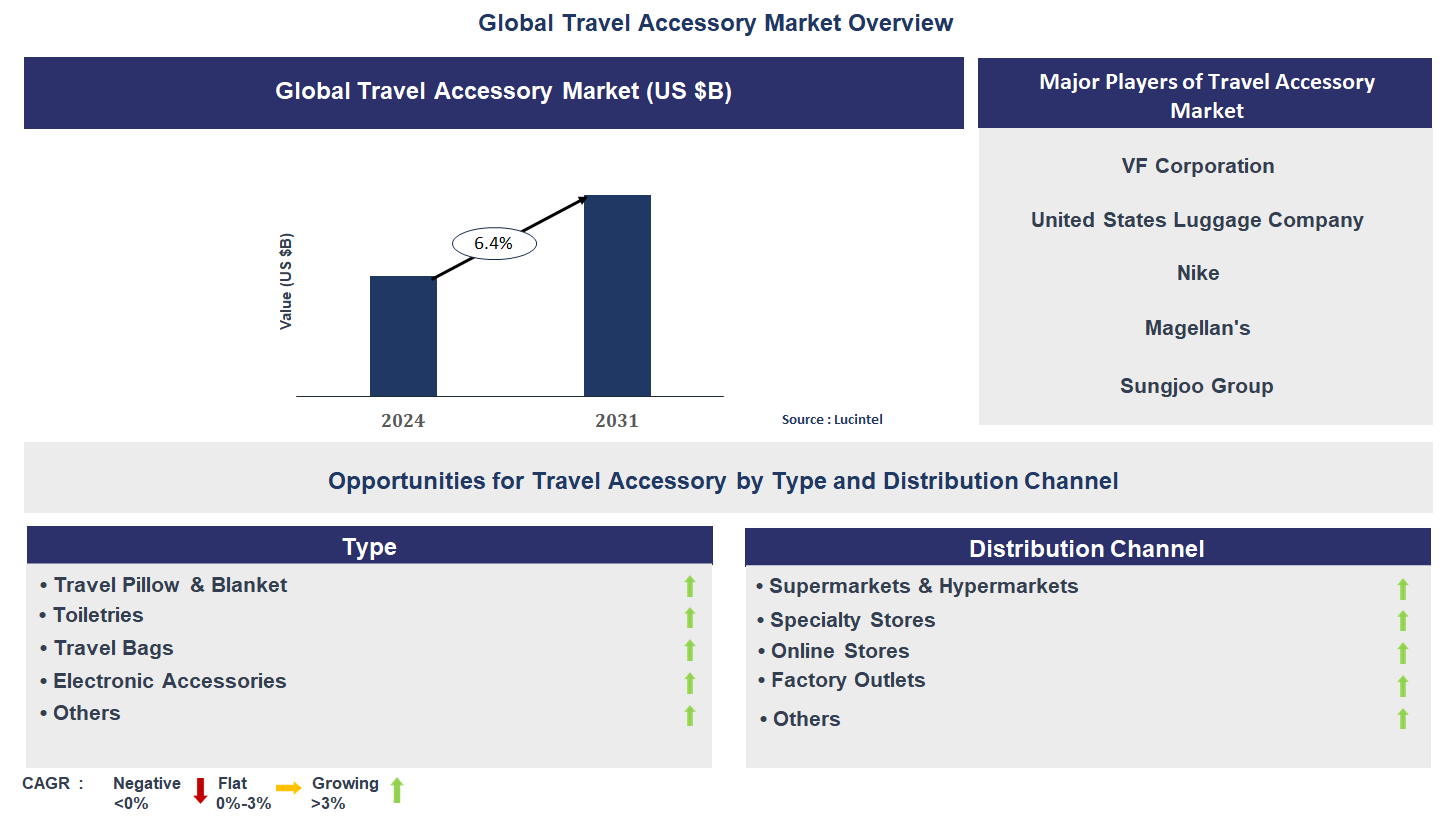
The future of the global travel accessory market looks promising with opportunities in the supermarket & hypermarket, specialty store, factory outlet, and online store markets. The global travel accessory market is expected to grow with a CAGR of 6.4% from 2025 to 2031. The major drivers for this market are the increasing demand for convenience & portability, the rising interest in personalized travel products, and the growing adoption of sustainable travel accessories.• Lucintel forecasts that, within the type category, travel pillow & blanket is expected to witness the highest growth over the forecast period.
• Within the distribution channel category, online store is expected to witness the highest growth.
• In terms of region, APAC is expected to witness the highest growth over the forecast period. Gain valuable insights for your business decisions with our comprehensive 150+ page report. Sample figures with some insights are shown below.
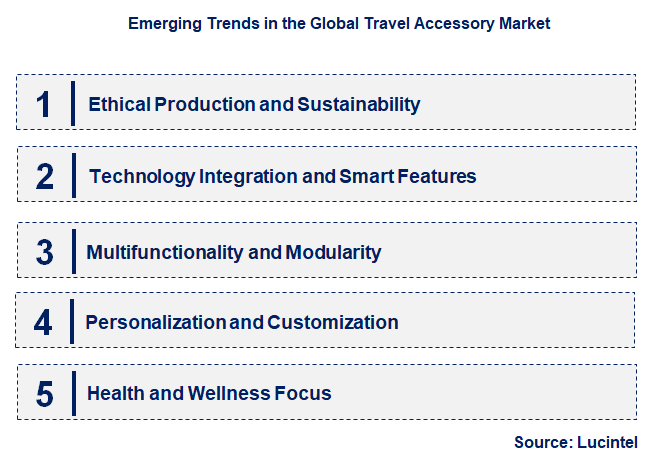
Emerging Trends in the Travel Accessory Market
The travel accessory market is being redefined at its core, as it is influenced by evolving traveler habits and expectations. Todays consumers no longer want plain, generic gear; they are looking for gear that resonates with their values and lifestyle. This is driving a new wave of innovation where personalization, sustainability, and technology take center stage. The sector is shifting from being utilitarian to one that offers solutions for the journey to be seamless, comfortable, and conscious. These are not simply new-product trends but, rather, a reexamination of the total travel experience.• Ethical Production and Sustainability: One of the largest emerging trends is the strong call for sustainable and ethically manufactured travel accessories. Buyers are more conscious of their environmental footprint and want products constructed out of recycled, upcycled, or biodegradable materials. This includes bags constructed from recycled plastic bottles, luggage cubes from abandoned fishing nets, and accessories printed with environmentally friendly dyes. Companies being open about their production and supply chain methods are emerging as leaders. This is part of a larger consumer trend towards conscious and ethical consumption.
• Technology Integration and Smart Features: Technology integration is quickly transforming the travel accessory sector. Items are getting smarter with features that are meant to address contemporary travel issues. Some of these include bags with onboard GPS trackers, USB charging ports, and digital locking systems. Additional smart accessories include Bluetooth-based organizers, RFID-blocking smart wallets, and AI translation devices. This speaks to the technology-adoring traveler who desires ease and safety. It also enables companies to make their products stand out based on more than form and material.
• Multifunctionality and Modularity: Consumers are looking more and more for accessories which do more than one task and are also modular in nature. This is fueled by an interest in a minimalist approach to packing and space saving. Some examples are jackets with built-in neck pillows, backpacks that expand and contract, and modular packing cubes that can be remapped. This emphasis on multifunctionality resonates with a broad spectrum of travelers, from business commuters to adventure backpackers, who need efficiency and versatility in equipment.
• Personalization and Customization: Consumers seek products that mirror their personal style and personality. The travel accessory market is reacting with an emerging trend towards personalization and customization. Brands are providing the option to engrave initials on luggage tags, select custom colors for bags, and include special patches or designs. This trend enables customers to design a product that is personally theirs, increasing brand affinity. It also presents a profitable opportunity for brands to offer premium services and create customer loyalty.
• Health and Wellness Focus: The pandemic has raised consumer consciousness in regard to health and well-being while traveling. This has created a trend towards accessories that ensure comfort and hygiene while on the move. Items such as good-quality neck pillows, compression socks, and eye masks are popular. Portable air purifiers, UV sanitizers, and travel packs of personal care products are also increasing in demand. This trend is an ultimate reaction to a consumer need for a more relaxing and stress-free travel experience. Together, these trends are transforming the travel accessory market by pushing it from a mere category of utilitarian products to a vibrant industry of lifestyle goods. Through their emphasis on sustainability, smart technology, and personal well-being, brands are developing a more engaging value proposition for consumers. This transformation is resulting in a more competitive and innovative marketplace where one needs to have a profound knowledge of the needs and values of the contemporary traveler to succeed.
Recent Development in the Travel Accessory Market
The travel accessory industry is undergoing a major phase of innovation and growth, driven by renewed worldwide enthusiasm for travel and changing consumer attitudes. The sector is departing from a one-size-fits-all strategy to provide goods that are more niche-oriented, technology-driven, and eco-friendly. These innovations are creating an increasingly dynamic and competitive environment, one in which firms are competing to develop solutions that address comfort, convenience, and security for the contemporary traveler.• Emergence of Smart Luggage and Integration of Technology: A significant development is the emergence of smart luggage and technology-integrated accessories. This features suitcases with integrated functionalities like USB charging points, GPS devices, and digital weighing scales. Aside from luggage, other technology accessories such as portable charging banks, worldwide travel adapters, and RFID-blocking wallets have also become essentials for travel. This follows the needs of tech-conscious travelers to remain connected and safe during their travel experience.
• Sustainable and Eco-Friendly Materials: There is an increasing trend of using sustainable and eco-friendly materials in travel accessories. Manufacturers are utilizing recycled plastics from ocean garbage and bottles to produce long-lasting luggage and backpacks. There is also a shift towards natural and biodegradable materials for travel pillows and blankets. This trend is a direct response to customer pressure to produce more sustainable products.
• Multifunctional and Modular Products Development: The industry is experiencing a trend towards products that are both multifunctional and modular, hence more versatile and compact. Some examples include backpacks that are convertible duffel bags, jackets with integrated neck pillows and eye masks, and modular packing cubes that can be rearranged for effective packing. This evolution appeals to an minimalist travel ethic and necessity to pack lightly but still be ready for anything. It reflects an away from one-use products and toward flexible, durable equipment.
• Expansion of the Direct-to-Consumer DTC Model: Expansion of the direct-to-consumer DTC model is a major development in the travel accessory industry. Brands are increasingly selling directly to consumers at their websites without going through traditional retail. This enables them to sell more customized products and strengthen their relationship with the consumer. It also allows them to garner valuable information about what consumers prefer, which can be used in future product development.
• Comfort and Wellness Accessories Innovation: Comfort and wellness accessories have seen a considerable innovation. This ranges from memory foam or microbead ergonomic travel pillows to compression socks to enhance blood circulation on long flights, and noise-canceling headphones to enjoy some personal space. Portable humidifiers and essential oil diffusers are also increasingly trending. This evolution responds to the physical and emotional fatigue of traveling and places accessories as vital equipment in the facilitation of a less stressful and more enjoyable trip. Such evolutions are making a significant impact on the travel accessory industry by becoming increasingly consumer-oriented and value-driven. The emphasis is no longer on simple functionality but on delivering complete solutions that meet the entire travel experience. Through the adoption of technology, sustainability, and individual wellness, the sector is developing products that are not merely functional but also desirable. The trend is increasing the level of competition with brands being compelled to innovate day by day to cater to the changing demands of the contemporary traveler.
Strategic Growth Opportunities in the Travel Accessory Market
The travel accessory industry is filled with strategic opportunities for growth, fueled by a worldwide increase in tourism and a desire for high-quality, innovative products. The market is shifting from an everyday necessity to a lifestyle-oriented model, wherein accessories are viewed as tools to make the travel experience more enjoyable and personalize it. These opportunities stem from profound knowledge of consumers and a desire to adopt emerging technologies and business models. By targeting special applications strategically, businesses can build a compelling competitive edge and open up new market segments.• Tech-Integrated Product Focus: Much growth potential exists in the integration of technology into existing travel accessories. This involves creating intelligent luggage with sophisticated features such as inbuilt GPS tracking, biometric locking, and in-built scales. This goes beyond luggage with the potential to build an entire ecosystem of smart accessories, including smart wallets, charging pods, and mobile biometric scanners. This use case attracts a technophile audience and is worth a premium price tag, making the brand a leader and pioneer in the industry.
• New Venture into Sustainable and Green Lines: With growing environmental awareness, there is a huge opportunity to grow in applying sustainability across the board to all product lines. This entails developing accessories out of recycled or upcycled material, providing plastic-free packaging, and promoting ethical manufacturing practices. New products such as reusable travel-sized containers and biodegradable toiletry bags can also be added. This product not only solves a major consumer issue but also establishes a solid brand reputation and promotes eco-friendly travelers loyalty.
• Diversification into Health and Wellness Accessories: The expanding well-being travel trend is a highly profitable growth prospect for accessories. This entails creating products that respond to the physical and mental fatigue of travel. Examples of these are ergonomic and therapeutic neck pillows, travel air purifiers, essential oil diffusers, and noise-reducing headphones. Through this application, brands are able to access a new consumer segment that is willing to spend money on products that promote comfort, relaxation, and feelings of well-being on the move.
• Creating a Direct-to-Consumer DTC Model: The use of a direct-to-consumer business model presents a vast growth opportunity. By cutting out intermediaries and selling directly to customers via their own online platforms, brands are able to avoid conventional retail markups, resulting in greater profit margins. The model also benefits from a more personalized shopping experience, data gathering to derive market insights, and the possibility of selling exclusive products and bundles. The direct touch with the customer has the potential to create a strong community and generate repeat business.
• Customization and Personalization Services: There is a huge growth potential in providing customization and personalization services. This use can vary from plain monogramming on bags and tags to more intricate customization of luggage parts, including wheels and handles. This enables consumers to design a distinctive product that mirrors their personality and style. It is an effective tool for brand differentiation and can command considerable customer interaction. This product also targets the gifting segment, where customized products are in great demand. These strategic imperatives are driving the travel accessory industry by pushing companies away from a product-centric towards a solutions-centric focus. With tech integration, sustainability, wellness, and personalization at the forefront, companies are breaking away from mere functional needs to develop a richer and more immersive travel experience. This transformation is not merely about retailing accessories; it is about delivering products that enhance travel to be comfortable, secure, and enjoyable. This will fuel innovation and set the direction for the industrys future.
Travel Accessory Market Driver and Challenges
The travel accessory industry is being influenced by a multifaceted relationship between key drivers and challenges, which encompass numerous technological, economic, and regulatory elements. These forces are building a dynamic and competitive landscape in which businesses need to be constantly flexible. On the one hand, an upsurge in global travel and an increased emphasis on convenience and comfort among consumers are driving demand. On the other, the sector needs to deal with supply chain glitches, high competition from a diverse set of players, and having to constantly innovate to remain relevant. The factors responsible for driving the travel accessory market include: 1. Resurgence of Global Tourism: The strongest driver is the global resurgence of leisure and business tourism. The pent-up demand for travel following the pandemic is translating directly into higher sales of travel accessories. The driver is underpinned by the relaxation of travel restrictions and a renewed urge for new experiences. The coming back of international and local tourism has brought much-needed relief to the market, and this is likely to continue as travel becomes more affordable. 2. Smart Technology Rise: Rapid development and implementation of smart technology are top drivers. Customers are now demanding more products with tech-enabled features that make their lives more convenient and secure. Examples include smart luggage with GPS location tracking, portable chargers, and RFID-blocking wallets. The products become convenient and secure for travel, making them attractive to technology-enabled travelers. This driver is also compelling brands to invest in research and development to be ahead of the game. 3. Evolving Lifestyles: With rising disposable incomes and growing aspirations, consumers increasingly value convenience and quality. As consumer lifestyles become more internationalized, they are looking for travel accessories that are not only convenient but also match their travel style. The demand for premium, high-quality, and functional travel accessories is on the rise. It is transforming the market by creating a culture of premiumization, with consumers shifting towards branded and functional products over price-affordable options. It is also creating new market segments in Asia-Pacific. 4. Health and Wellness: The world focus on health and wellness is fueling demand for certain types of travel accessories. Comfort and well-being while traveling are the priorities for todays traveler, and this has resulted in increased popularity of ergonomic travel pillows, noise-canceling headphones, and other hygiene-related products. This driver indicates a change in consumer behavior, with travel presented as a total experience that can be as comfortable and tension-free as possible. 5. Social Media Influence and E-commerce: The rise of e-commerce sites and social media influence are the key drivers. Online platforms facilitate consumers to find and buy products from a vast array of brands. Social media sites such as Instagram and TikTok are also now central marketing tools, with influencers promoting travel accessories, generating desire, and inducing sales. This has opened up the market to smaller, niche brands who can compete with the majors. Challenges in the travel accessory market are: 1. Very High Competition and Price Sensitivity: The industry is extremely competitive and fragmented. It features large, well-established brands alongside a multitude of small, craft, and direct-to-consumer businesses. Such high competition tends to generate price wars and may affect profit margins. Further, a large number of the consumer base continues to be price-sensitive, especially for more commoditized accessories, which tends to hinder brands from sustaining high price points and benefiting from innovation. 2. Supply Chain Volatility: The sector has a strong reliance on international supply chains for production and raw materials. Trade disagreements, geopolitical tensions, and logistical problems can cause supply chain interruptions as well as higher expenses. Fluctuation in the cost of raw materials such as plastics and textiles can also affect production expenditure. These issues call for brands to be responsive and diversify their sourcing so as to reduce risks and maintain a constant product supply. 3. Changing Consumer Preferences: One of the greatest challenges is the constantly changing preference of consumers. Trends may change fast, from minimalism to something with many functions, so brands must be innovative and keep adjusting their products continuously. If they do not stay abreast with these changes, a brand may render itself obsolete. This challenge calls for ongoing expenditure on market research and development to know and predict consumer needs. In sum, the travel accessory industry is driven by powerful drivers including a recovery in travel and demand for smart, comfortable products. But it is also coming under threat from intense competition, highly volatile supply chains, and rapidly shifting consumer trends. The capacity of firms to ride out these challenges by harnessing drivers such as technology and e-commerce will be the key to sustainable growth. The markets future will be established by brands that are able to provide innovative, added-value products that speak to the changing requirements of the contemporary traveler.List of Travel Accessory Companies
Companies in the market compete on the basis of product quality offered. Major players in this market focus on expanding their manufacturing facilities, R&D investments, infrastructural development, and leverage integration opportunities across the value chain. With these strategies travel accessory companies cater increasing demand, ensure competitive effectiveness, develop innovative products & technologies, reduce production costs, and expand their customer base. Some of the travel accessory companies profiled in this report include-• VF Corporation
• United States Luggage Company
• Nike
• Magellans
• Sungjoo Group
• Travel Blue
• LVMH Group
• ACE
• Adidas
• VIP Industries
Travel Accessory Market by Segment
The study includes a forecast for the global travel accessory market by type, distribution channel, and region.Travel Accessory Market by Type [Value from 2019 to 2031]:
• Travel Pillow & Blanket
• Toiletries
• Travel Bags
• Electronic Accessories
• Others
Travel Accessory Market by Distribution Channel [Value from 2019 to 2031]:
• Supermarkets & Hypermarkets
• Specialty Stores
• Factory Outlets
• Online Stores
• Others
Travel Accessory Market by Region [Value from 2019 to 2031]:
• North America
• Europe
• Asia Pacific
• The Rest of the World
Country Wise Outlook for the Travel Accessory Market
The world travel accessory industry is presently witnessing a dramatic transformation, fueled by a post-pandemic revival in travel and a deep-seated paradigm shift in consumer needs. Tourists are no longer merely looking for functional convenience; they now expect products to be intelligent, eco-friendly, and versatile. This has triggered a torrent of innovation, as producers incorporate technology, adopt green materials, and concentrate on modular architecture. The sector is also witnessing growth in direct-to-consumer DTC brands that use e-commerce to provide niche products.• United States: The United States market is a pioneering market for technology integration and customization. The latest trends include the mass adoption of smart luggage with advanced features such as GPS tracking, USB charging points, and biometric locks. Additionally, consumers are showing a strong preference for products that can be customized, such as luggage where parts are interchangeable and labels can be personalized. The market is seeing direct-to-consumer models where brands eliminate traditional retail in favor of more curated and technology-enhanced shopping.
• China: Chinas travel accessories industry is a growth powerhouse, driven by an enormous domestic tourism market and increased disposable incomes. Recent trends focus on technology-integrated equipment and a heavy emphasis on convenience and comfort. Demand is rising for products such as memory foam travel neck pillows and portable, collapsible backpacks. Also, Chinese consumers are also very much affected by social media, and this has seen companies focus on products that are good-looking and "Instagram able."
• Germany: German travel accessory industry is led by a high emphasis on engineering, toughness, and sustainability. Recent trends involve a high demand for green products from recycled or upcycled materials. German consumers are environmentally aware and look for products that align with their values. There is also a drive towards highly functional and organized travel equipment, with a focus on multipurpose and module-based designs that work both for business and vacation travel. E-commerce is a growth driver, with brands using online platforms to present a wider array of customizable products.
• India: The Indian travel accessories market is going upward, supported by a youthful population, rising urbanization, and a transition towards short trips. Some recent trends include a heightened demand for intelligent and technology-based accessories such as smart luggage with power banks and anti-theft properties. Customers are also seeking products which are fashionable as well as functional. The emergence of direct-to-consumer companies and rapid-commerce websites is a key trend, with last-minute purchases and greater personalization offered. The market is dominated by both value-for-money and premium products.
• Japan: Japans travel accessories market is typified by a mix of tradition, quality, and high-tech. Emerging trends are a high demand for products that have not only functionality but a minimalist and stylish design. Japanese consumers value much their durability and craftsmanship. The market is also witnessing a big trend towards tech-infused accessories and products that add to comfort, e.g., high-end sleep masks and noise-canceling headsets. There is an increasing demand for brands providing distinct, high-quality, and exclusive products.

Features of the Global Travel Accessory Market
Market Size Estimates: Travel accessory market size estimation in terms of value ($B). Trend and Forecast Analysis: Market trends (2019 to 2024) and forecast (2025 to 2031) by various segments and regions. Segmentation Analysis: Travel accessory market size by type, distribution channel, and region in terms of value ($B). Regional Analysis: Travel accessory market breakdown by North America, Europe, Asia Pacific, and Rest of the World. Growth Opportunities: Analysis of growth opportunities in different types, distribution channels, and regions for the travel accessory market. Strategic Analysis: This includes M&A, new product development, and competitive landscape of the travel accessory market. Analysis of competitive intensity of the industry based on Porter’s Five Forces model.
FAQ
Q1. What is the growth forecast for travel accessory market? Answer: The global travel accessory market is expected to grow with a CAGR of 6.4% from 2025 to 2031. Q2. What are the major drivers influencing the growth of the travel accessory market? Answer: The major drivers for this market are the increasing demand for convenience & portability, the rising interest in personalized travel products, and the growing adoption of sustainable travel accessories. Q3. What are the major segments for travel accessory market? Answer: The future of the travel accessory market looks promising with opportunities in the supermarket & hypermarket, specialty store, factory outlet, and online store markets. Q4. Who are the key travel accessory market companies? Answer: Some of the key travel accessory companies are as follows:• VF Corporation
• United States Luggage Company
• Nike
• Magellans
• Sungjoo Group
• Travel Blue
• LVMH Group
• ACE
• Adidas
• VIP Industries Q5. Which travel accessory market segment will be the largest in future? Answer: Lucintel forecasts that, within the type category, travel pillow & blanket is expected to witness the highest growth over the forecast period. Q6. In travel accessory market, which region is expected to be the largest in next 5 years? Answer: In terms of region, APAC is expected to witness the highest growth over the forecast period. Q7. Do we receive customization in this report? Answer: Yes, Lucintel provides 10% customization without any additional cost.
Table of Contents
List of Figures
List of Tables
Methodology
- In-depth interviews of the major players in this market
- Detailed secondary research from competitors’ financial statements and published data
- Extensive searches of published works, market, and database information pertaining to industry news, company press releases, and customer intentions
- A compilation of the experiences, judgments, and insights of Lucintel’s professionals, who have analyzed and tracked this market over the years.


Buy Now
Choose a license that fits your team. Instant PDF delivery.
Prices exclude taxes. Instant delivery. Custom licensing available on request.
Key Questions
- • What are some of the most promising, high-growth opportunities for the travel accessory market by type (travel pillow & blanket, toiletries, travel bags, electronic accessories, and others), distribution channel (supermarkets & hypermarkets, specialty stores, factory outlets, online stores, and others), and region (North America, Europe, Asia Pacific, and the Rest of the World)?
- • Which segments will grow at a faster pace and why?
- • Which region will grow at a faster pace and why?
- • What are the key factors affecting market dynamics? What are the key challenges and business risks in this market?
- • What are the business risks and competitive threats in this market?
- • What are the emerging trends in this market and the reasons behind them?
- • What are some of the changing demands of customers in the market?
- • What are the new developments in the market? Which companies are leading these developments?
- • Who are the major players in this market? What strategic initiatives are key players pursuing for business growth?
- • What are some of the competing products in this market and how big of a threat do they pose for loss of market share by material or product substitution?
- • What M&A activity has occurred in the last 5 years and what has its impact been on the industry? For any questions related to Travel Accessory Market, Travel Accessory Market Size, Travel Accessory Market Growth, Travel Accessory Market Analysis, Travel Accessory Market Report, Travel Accessory Market Share, Travel Accessory Market Trends, Travel Accessory Market Forecast, Travel Accessory Companies, write Lucintel analyst at email: helpdesk@lucintel.com. We will be glad to get back to you soon.


