
Close Lucintel Chat
Didn't Find What You're Looking for?
Call us at +1972 636 5056 or write at helpdesk@Lucintel.com
Ask an Expert Provide Custom Requirements Download Sample Report Search Available Reports
  • helpdesk@Lucintel.com
  • |
  • Call Lucintel +1 972 636 5056
  • |
  • Login
  • |
  • Register
  • |
  • Search
  • |
'
...

The Impact of COVID-19 is included in Transplant Market Report. Buy it today to get an advantage.

Request the impact of COVID-19 on your product or industry


Transplant Market Trends and Forecast

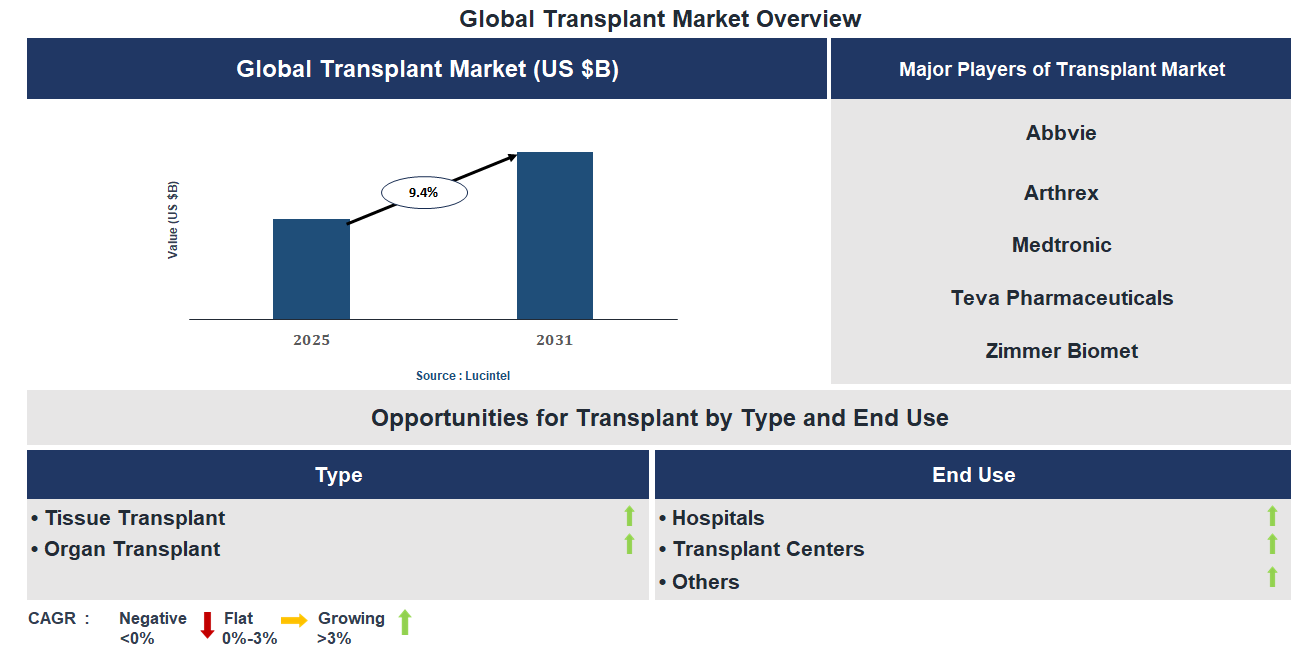
The future of the global transplant market looks promising with opportunities in the hospital and transplant center markets. The global transplant market is expected to grow with a CAGR of 9.4% from 2025 to 2031. The major drivers for this market are the increasing prevalence of organ failure cases, the rising demand for tissue transplantation, and the growing advancements in surgical techniques.

• Lucintel forecasts that, within the type category, tissue transplant is expected to witness higher growth over the forecast period.
• Within the end use category, transplant center is expected to witness higher growth.
• In terms of region, North America is expected to witness the highest growth over the forecast period.
Gain valuable insights for your business decisions with our comprehensive 150+ page report. Sample figures with some insights are shown below.
Transplant Market Trends and Forecast

Emerging Trends in the Transplant Market

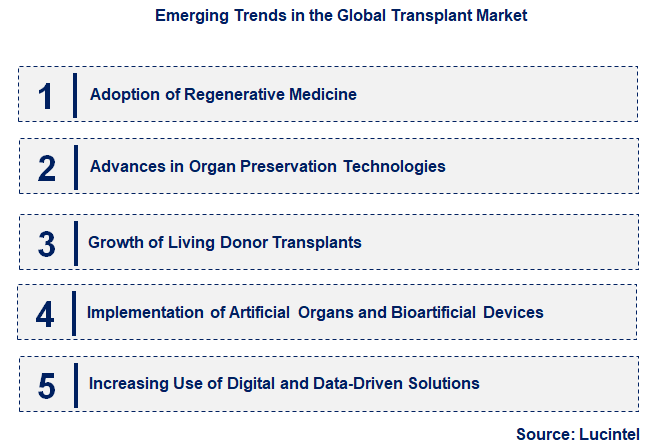
The transplant market is experiencing rapid evolution driven by technological advancements, changing regulations, and increasing demand for organ transplants worldwide. These developments are reshaping how organs are sourced, preserved, and transplanted, ultimately improving patient outcomes and expanding access. As the market adapts to these innovations, stakeholders must navigate new opportunities and challenges. The following key trends highlight the major shifts currently influencing the transplant landscape, reflecting a move toward more efficient, ethical, and innovative practices that are set to redefine the future of organ transplantation.

• Adoption of Regenerative Medicine: This trend involves using stem cell therapy and tissue engineering to create lab-grown organs and tissues, reducing reliance on donor organs. It promises to address organ shortages and improve compatibility, leading to more personalized treatments. As research progresses, regenerative medicine could revolutionize transplant procedures, making them safer and more accessible, especially for patients with rare or complex conditions.
• Advances in Organ Preservation Technologies: Innovations such as hypothermic machine perfusion and cryopreservation are enhancing organ viability during transport. These technologies extend the window for transplantation, reduce organ wastage, and improve success rates. Improved preservation methods enable better matching and planning, ultimately increasing the number of successful transplants and optimizing resource utilization across the market.
• Growth of Living Donor Transplants: There is an increasing trend toward living donor transplants, driven by improved surgical techniques and better donor-recipient matching. This approach reduces dependence on deceased donors and shortens waiting times. It also raises ethical considerations and necessitates comprehensive donor care protocols, but overall, it expands the transplant pool and offers more timely treatment options for patients.
• Implementation of Artificial Organs and Bioartificial Devices: The development of artificial organs, such as bioartificial kidneys and hearts, is gaining momentum. These devices can temporarily or permanently replace organ functions, reducing the need for donor organs and providing solutions for patients with organ failure. This trend is poised to significantly impact the market by offering alternative treatment options and improving quality of life for patients.
• Increasing Use of Digital and Data-Driven Solutions: The integration of AI, big data, and telemedicine is transforming transplant diagnostics, matching, and post-operative care. These tools enhance precision, reduce errors, and facilitate remote monitoring, leading to better patient outcomes. Digital solutions also streamline workflows and improve transparency, making the transplant process more efficient and accessible globally.

In summary, these emerging trends are collectively reshaping the transplant market by improving organ availability, enhancing patient outcomes, and fostering innovative treatment modalities. They are driving a shift toward more sustainable, ethical, and technologically advanced practices, ultimately expanding access and improving the quality of life for transplant patients worldwide.
Emerging Trends in the Transplant Market

Recent Development in the Transplant Market

The transplant market has experienced significant evolution driven by technological advancements, increasing demand for organ transplants, and improvements in medical procedures. These developments are reshaping the landscape, making transplants more accessible, efficient, and successful. The market’s growth is also influenced by rising awareness, regulatory changes, and innovations in organ preservation. As the global healthcare infrastructure adapts to these changes, stakeholders are focusing on improving patient outcomes and expanding transplant options. The following key developments highlight the current trajectory of this dynamic market, reflecting its ongoing transformation and future potential.

• Technological Innovations in Organ Preservation: New preservation techniques, such as hypothermic machine perfusion, have extended organ viability, increasing transplant success rates and expanding donor pools. This advancement reduces organ wastage and allows for better matching, ultimately saving more lives and improving patient outcomes.
• Growth of Organ Donation Registries: Enhanced awareness campaigns and digital registries have led to increased donor registrations worldwide. This growth addresses the organ shortage crisis, facilitating more transplants and reducing waiting times for patients in need.
• Advances in Immunosuppressive Therapies: Development of targeted immunosuppressants has minimized organ rejection and side effects, improving long-term transplant success. These therapies have increased patient survival rates and reduced post-transplant complications.
• Rise of Regenerative Medicine and Bioartificial Organs: Innovations in stem cell research and bioengineering are paving the way for lab-grown organs and bioartificial transplants. This emerging field promises to alleviate organ shortages and reduce dependency on donor organs in the future.
• Regulatory and Policy Changes: Governments and health authorities are implementing policies to streamline organ donation processes, improve ethical standards, and promote cross-border organ sharing. These changes enhance transparency, efficiency, and global collaboration in the transplant market.

In summary, these developments are collectively transforming the Transplant Market by improving organ preservation, increasing donor availability, enhancing patient outcomes, and fostering innovative solutions. The market is becoming more efficient and accessible, with technological and policy advancements driving sustained growth and better healthcare delivery worldwide.

Strategic Growth Opportunities in the Transplant Market

The transplant market is experiencing significant growth driven by advancements in medical technology, increasing organ donation rates, and expanding applications across various medical fields. As healthcare systems evolve, there are numerous opportunities to enhance patient outcomes and optimize transplant procedures. Key growth areas include innovations in organ preservation, development of bioartificial organs, expansion of minimally invasive techniques, improvements in immunosuppressive therapies, and increased focus on regenerative medicine. These opportunities are transforming the landscape of transplantation, making procedures safer, more effective, and accessible to a broader patient population. The following highlights five key growth opportunities across different applications within this market.

• Organ Preservation Technologies: Improving preservation solutions and techniques extend the viability of organs outside the body, increasing transplant success rates and expanding the donor pool. Enhanced preservation methods reduce organ damage during transportation, enabling longer distances between donors and recipients, which is crucial for organ matching and timely transplantation.
• Bioartificial Organs: The development of bioartificial organs combines biological tissues with synthetic components, offering solutions for patients with organ failure. These innovations can potentially eliminate the need for donor organs, reduce rejection risks, and improve long-term outcomes, revolutionizing treatment options for end-stage organ failure.
• Minimally Invasive Transplant Procedures: Advancements in surgical techniques and robotic-assisted surgeries enable less invasive transplant procedures. These methods reduce patient recovery time, minimize complications, and improve overall patient experience, thereby broadening the applicability of transplants to more patients.
• Immunosuppressive Therapy Innovations: New immunosuppressive drugs and personalized regimens are enhancing graft survival and reducing adverse effects. These developments improve long-term transplant success, decrease rejection rates, and allow for better management of post-transplant care.
• Regenerative Medicine and Stem Cell Therapy: The integration of regenerative medicine offers potential to repair or replace damaged tissues and organs, reducing the dependence on donor organs. Stem cell therapies can promote tissue regeneration, improve transplant outcomes, and open new avenues for treating chronic organ diseases.

In summary, these growth opportunities are significantly impacting the transplant market by increasing success rates, expanding patient access, and reducing complications. They are driving innovation, improving patient outcomes, and shaping the future landscape of transplantation medicine.

Transplant Market Driver and Challenges

The transplant market is influenced by a complex interplay of technological advancements, economic factors, and regulatory frameworks. Innovations in surgical techniques and immunosuppressive therapies have expanded the possibilities for organ transplantation, while economic conditions affect accessibility and funding. Regulatory policies govern organ donation and transplantation procedures, impacting market growth and ethical standards. Additionally, demographic shifts, such as aging populations and increasing chronic diseases, drive demand. However, challenges such as organ shortages, high costs, and ethical concerns pose significant hurdles. Understanding these drivers and challenges is essential for stakeholders aiming to optimize transplantation outcomes and expand market reach.

The factors responsible for driving the transplant market include:
• Technological Innovations: The development of advanced surgical techniques, such as minimally invasive procedures and 3D organ printing, has significantly improved transplant success rates. Innovations in immunosuppressive drugs have reduced rejection rates, making transplants more viable and increasing patient survival. These technological advancements have broadened the scope of transplant procedures, attracting more patients and healthcare providers to adopt these solutions. As research continues, further improvements are expected, fueling market growth and expanding access to transplantation services worldwide.
• Rising Prevalence of Chronic Diseases: The increasing incidence of chronic conditions like kidney failure, liver cirrhosis, and heart diseases has led to a higher demand for organ transplants. Aging populations and lifestyle-related health issues contribute to this trend, creating a sustained need for transplant procedures. This demographic shift ensures a steady growth trajectory for the market, prompting investments in infrastructure, organ preservation, and donor management systems to meet the rising demand.
• Regulatory and Policy Frameworks: Governments and health authorities have implemented policies to promote organ donation and streamline transplantation processes. Initiatives such as opt-in and opt-out organ donation systems, along with international guidelines, aim to increase organ availability and ensure ethical practices. These regulations influence market dynamics by facilitating organ procurement, standardizing procedures, and ensuring patient safety, thereby encouraging market expansion and fostering trust among stakeholders.
• Increasing Investment in Transplant Research: Significant funding from public and private sectors has accelerated research in transplant medicine. Focus areas include organ preservation techniques, bioartificial organs, and regenerative medicine. These investments lead to improved transplant outcomes, reduced rejection rates, and the development of novel therapies. Enhanced research efforts attract collaborations and innovations, further propelling market growth and expanding treatment options for patients.
• Growing Awareness and Acceptance: Public awareness campaigns and advocacy efforts have improved understanding of organ donation benefits, leading to increased donor registrations. Cultural shifts and education initiatives have reduced stigma and misconceptions surrounding transplantation. As acceptance grows, more individuals are willing to donate organs, alleviating shortages and expanding the donor pool. This societal change directly impacts market growth by increasing the availability of organs for transplantation.

The challenges facing the transplant market include:
• Organ Shortage: Despite technological and policy efforts, the supply of donor organs remains insufficient to meet demand. Limited donor pools, driven by cultural, religious, and logistical barriers, result in long waiting times and increased mortality rates among patients. This shortage hampers market growth and necessitates the development of alternative solutions such as xenotransplantation and bioengineered organs, which are still in experimental stages.
• High Costs and Reimbursement Issues: Transplant procedures involve significant expenses, including surgery, immunosuppressive drugs, and post-operative care. These costs can be prohibitive for many patients, especially in low- and middle-income countries. Reimbursement policies vary, often limiting access for uninsured or underinsured populations. The financial burden restricts market expansion and underscores the need for cost-effective solutions and supportive healthcare policies.
• Ethical and Legal Concerns: Organ allocation, consent processes, and transplantation ethics pose ongoing challenges. Issues such as organ trafficking, black markets, and disparities in organ distribution raise ethical questions and threaten public trust. Regulatory frameworks must balance ethical considerations with the need to increase organ availability, but inconsistencies and legal ambiguities can hinder progress and create market uncertainties.

In summary, the transplant market is driven by technological progress, demographic trends, supportive policies, research investments, and societal acceptance. However, it faces significant challenges including organ shortages, high costs, and ethical dilemmas. These factors collectively shape the market landscape, influencing growth prospects and the development of innovative solutions. Addressing these challenges while leveraging technological and policy advancements will be crucial for sustainable growth and improved patient outcomes in the transplantation field.

List of Transplant Companies

Companies in the market compete on the basis of product quality offered. Major players in this market focus on expanding their manufacturing facilities, R&D investments, infrastructural development, and leverage integration opportunities across the value chain. With these strategies transplant companies cater increasing demand, ensure competitive effectiveness, develop innovative products & technologies, reduce production costs, and expand their customer base. Some of the transplant companies profiled in this report include-
• Abbvie
• Arthrex
• Medtronic
• Teva Pharmaceuticals
• Zimmer Biomet
• Strykers
• Novartis
• Veloxis Pharmaceuticals
• 21st Century Medicin
• BiolifeSolutions

Transplant Market by Segment

The study includes a forecast for the global transplant market by type, end use, and region.

Transplant Market by Type [Value from 2019 to 2031]:


• Tissue Transplant
• Organ Transplant

Transplant Market by End Use [Value from 2019 to 2031]:


• Hospitals
• Transplant Centers
• Others

Transplant Market by Region [Value from 2019 to 2031]:


• North America
• Europe
• Asia Pacific
• The Rest of the World

Country Wise Outlook for the Transplant Market

The transplant market has experienced significant evolution driven by technological advancements, regulatory changes, and increasing demand for organ transplants worldwide. Countries are investing in innovative procedures, improving organ preservation techniques, and expanding donor pools to meet rising patient needs. These developments are shaping the future landscape of transplantation, with a focus on enhancing success rates and reducing waiting times. The United States, China, Germany, India, and Japan are key players, each contributing uniquely to this dynamic sector through policy reforms, research breakthroughs, and infrastructure improvements.

• United States: The US transplant market has seen increased adoption of bioengineered organs and advanced preservation methods. Policy reforms have expanded donor eligibility, including the use of donor chains and opt-out systems, boosting organ availability. Investment in research for xenotransplantation and regenerative medicine is growing, aiming to reduce organ shortages. The FDA has approved new immunosuppressive drugs, improving post-transplant outcomes. Telehealth initiatives are enhancing patient management and follow-up care, making transplantation more accessible and efficient.
• China: China has rapidly expanded its transplant infrastructure, with a focus on increasing donor rates through public awareness campaigns and legal reforms. The country has invested heavily in developing organ preservation and transportation technologies. Recent advancements include the use of 3D printing for organ scaffolds and research into xenotransplantation using genetically modified pigs. Regulatory frameworks are being strengthened to ensure ethical practices, and collaborations with international organizations are improving standards. The government’s support has led to a significant rise in transplant procedures, especially kidney and liver transplants.
• Germany: Germany’s transplant market is characterized by stringent regulations and high standards for organ donation and transplantation. The country has implemented innovative donor management protocols and enhanced organ allocation systems to optimize outcomes. Advances in minimally invasive surgical techniques and immunosuppressive therapies have improved success rates. Germany is also investing in research on bioartificial organs and regenerative medicine. Public awareness campaigns and donor registration drives have increased donor numbers, and cross-border collaborations within Europe are expanding access to organs and expertise.
• India: India’s transplant market is experiencing rapid growth due to increasing awareness, improved healthcare infrastructure, and government initiatives. The country has seen a rise in live donor transplants, especially kidney and liver procedures, supported by the establishment of specialized transplant centers. Innovations include the use of telemedicine for pre- and post-operative care and the development of low-cost immunosuppressive drugs. Efforts are underway to establish ethical guidelines and streamline organ donation processes. The market is also witnessing growth in research on tissue engineering and regenerative therapies to address organ shortages.
• Japan: Japan’s transplant market is focused on overcoming cultural and ethical challenges related to organ donation. Recent developments include the implementation of advanced organ preservation techniques and the use of ex vivo perfusion systems to extend organ viability. The country is investing in regenerative medicine and stem cell research to develop bioartificial organs. Japan has also enhanced its legal framework to facilitate organ donation and improve public acceptance. Collaborative research with international institutions is fostering innovation, and efforts are ongoing to increase donor registration through public education campaigns, aiming to reduce waiting times for transplants.

Lucintel Analytics Dashboard

Features of the Global Transplant Market

Market Size Estimates: Transplant market size estimation in terms of value ($B).
Trend and Forecast Analysis: Market trends (2019 to 2024) and forecast (2025 to 2031) by various segments and regions.
Segmentation Analysis: Transplant market size by type, end use, and region in terms of value ($B).
Regional Analysis: Transplant market breakdown by North America, Europe, Asia Pacific, and Rest of the World.
Growth Opportunities: Analysis of growth opportunities in different types, end uses, and regions for the transplant market.
Strategic Analysis: This includes M&A, new product development, and competitive landscape of the transplant market.
Analysis of competitive intensity of the industry based on Porter’s Five Forces model.

Lucintel Consulting Services

FAQ

Q1. What is the growth forecast for transplant market?
Answer: The global transplant market is expected to grow with a CAGR of 9.4% from 2025 to 2031.
Q2. What are the major drivers influencing the growth of the transplant market?
Answer: The major drivers for this market are the increasing prevalence of organ failure cases, the rising demand for tissue transplantation, and the growing advancements in surgical techniques.
Q3. What are the major segments for transplant market?
Answer: The future of the transplant market looks promising with opportunities in the hospital and transplant center markets.
Q4. Who are the key transplant market companies?
Answer: Some of the key transplant companies are as follows:
• Abbvie
• Arthrex
• Medtronic
• Teva Pharmaceuticals
• Zimmer Biomet
• Strykers
• Novartis
• Veloxis Pharmaceuticals
• 21st Century Medicin
• BiolifeSolutions
Q5. Which transplant market segment will be the largest in future?
Answer: Lucintel forecasts that, within the type category, tissue transplant is expected to witness higher growth over the forecast period.
Q6. In transplant market, which region is expected to be the largest in next 5 years?
Answer: In terms of region, North America is expected to witness the highest growth over the forecast period.
Q7. Do we receive customization in this report?
Answer: Yes, Lucintel provides 10% customization without any additional cost.

This report answers following 11 key questions:

Q.1. What are some of the most promising, high-growth opportunities for the transplant market by type (tissue transplant and organ transplant), end use (hospitals, transplant centers, and others), and region (North America, Europe, Asia Pacific, and the Rest of the World)?
Q.2. Which segments will grow at a faster pace and why?
Q.3. Which region will grow at a faster pace and why?
Q.4. What are the key factors affecting market dynamics? What are the key challenges and business risks in this market?
Q.5. What are the business risks and competitive threats in this market?
Q.6. What are the emerging trends in this market and the reasons behind them?
Q.7. What are some of the changing demands of customers in the market?
Q.8. What are the new developments in the market? Which companies are leading these developments?
Q.9. Who are the major players in this market? What strategic initiatives are key players pursuing for business growth?
Q.10. What are some of the competing products in this market and how big of a threat do they pose for loss of market share by material or product substitution?
Q.11. What M&A activity has occurred in the last 5 years and what has its impact been on the industry?

For any questions related to Transplant Market, Transplant Market Size, Transplant Market Growth, Transplant Market Analysis, Transplant Market Report, Transplant Market Share, Transplant Market Trends, Transplant Market Forecast, Transplant Companies, write Lucintel analyst at email: helpdesk@lucintel.com. We will be glad to get back to you soon.
                                           Table of Contents

            1. Executive Summary

            2. Market Overview

                        2.1 Background and Classifications
                        2.2 Supply Chain

            3. Market Trends & Forecast Analysis

                        3.1 Macroeconomic Trends and Forecasts
                        3.2 Industry Drivers and Challenges
                        3.3 PESTLE Analysis
                        3.4 Patent Analysis
                        3.5 Regulatory Environment
                        3.6 Global Transplant Market Trends and Forecast

            4. Global Transplant Market by Type

                        4.1 Overview
                        4.2 Attractiveness Analysis by Type
                        4.3 Tissue Transplant : Trends and Forecast 2025 to 2031
                        4.4 Organ Transplant : Trends and Forecast 2025 to 2031

            5. Global Transplant Market by End Use

                        5.1 Overview
                        5.2 Attractiveness Analysis by End Use
                        5.3 Hospitals : Trends and Forecast 2025 to 2031
                        5.4 Transplant Centers : Trends and Forecast 2025 to 2031
                        5.5 Others : Trends and Forecast 2025 to 2031

            6. Regional Analysis

                        6.1 Overview
                        6.2 Global Transplant Market by Region

            7. North American Transplant Market

                        7.1 Overview
                        7.2 North American Transplant Market by Type
                        7.3 North American Transplant Market by End Use
                        7.4 The United States Transplant Market
                        7.5 Canadian Transplant Market
                        7.6 Mexican Transplant Market

            8. European Transplant Market

                        8.1 Overview
                        8.2 European Transplant Market by Type
                        8.3 European Transplant Market by End Use
                        8.4 German Transplant Market
                        8.5 French Transplant Market
                        8.6 Italian Transplant Market
                        8.7 Spanish Transplant Market
                        8.8 The United Kingdom Transplant Market

            9. APAC Transplant Market

                        9.1 Overview
                        9.2 APAC Transplant Market by Type
                        9.3 APAC Transplant Market by End Use
                        9.4 Chinese Transplant Market
                        9.5 Indian Transplant Market
                        9.6 Japanese Transplant Market
                        9.7 South Korean Transplant Market
                        9.8 Indonesian Transplant Market

            10. ROW Transplant Market

                        10.1 Overview
                        10.2 ROW Transplant Market by Type
                        10.3 ROW Transplant Market by End Use
                        10.4 Middle Eastern Transplant Market
                        10.5 South American Transplant Market
                        10.6 African Transplant Market

            11. Competitor Analysis

                        11.1 Product Portfolio Analysis
                        11.2 Operational Integration
                        11.3 Porter’s Five Forces Analysis
                                    • Competitive Rivalry
                                    • Bargaining Power of Buyers
                                    • Bargaining Power of Suppliers
                                    • Threat of Substitutes
                                    • Threat of New Entrants
                        11.4 Market Share Analysis

            12. Opportunities & Strategic Analysis

                        12.1 Value Chain Analysis
                        12.2 Growth Opportunity Analysis
                                    12.2.1 Growth Opportunity by Type
                                    12.2.2 Growth Opportunity by End Use
                        12.3 Emerging Trends in the Global Transplant Market
                        12.4 Strategic Analysis
                                    12.4.1 New Product Development
                                    12.4.2 Certification and Licensing
                                    12.4.3 Mergers, Acquisitions, Agreements, Collaborations, and Joint Ventures

            13. Company Profiles of the Leading Players Across the Value Chain

                        13.1 Competitive Analysis Overview
                        13.2 Abbvie
                                    • Company Overview
                                    • Transplant Market Business Overview
                                    • New Product Development
                                    • Merger, Acquisition, and Collaboration
                                    • Certification and Licensing
                        13.3 Arthrex
                                    • Company Overview
                                    • Transplant Market Business Overview
                                    • New Product Development
                                    • Merger, Acquisition, and Collaboration
                                    • Certification and Licensing
                        13.4 Medtronic
                                    • Company Overview
                                    • Transplant Market Business Overview
                                    • New Product Development
                                    • Merger, Acquisition, and Collaboration
                                    • Certification and Licensing
                        13.5 Teva Pharmaceuticals
                                    • Company Overview
                                    • Transplant Market Business Overview
                                    • New Product Development
                                    • Merger, Acquisition, and Collaboration
                                    • Certification and Licensing
                        13.6 Zimmer Biomet
                                    • Company Overview
                                    • Transplant Market Business Overview
                                    • New Product Development
                                    • Merger, Acquisition, and Collaboration
                                    • Certification and Licensing
                        13.7 Strykers
                                    • Company Overview
                                    • Transplant Market Business Overview
                                    • New Product Development
                                    • Merger, Acquisition, and Collaboration
                                    • Certification and Licensing
                        13.8 Novartis
                                    • Company Overview
                                    • Transplant Market Business Overview
                                    • New Product Development
                                    • Merger, Acquisition, and Collaboration
                                    • Certification and Licensing
                        13.9 Veloxis Pharmaceuticals
                                    • Company Overview
                                    • Transplant Market Business Overview
                                    • New Product Development
                                    • Merger, Acquisition, and Collaboration
                                    • Certification and Licensing
                        13.10 21st Century Medicin
                                    • Company Overview
                                    • Transplant Market Business Overview
                                    • New Product Development
                                    • Merger, Acquisition, and Collaboration
                                    • Certification and Licensing
                        13.11 BiolifeSolutions
                                    • Company Overview
                                    • Transplant Market Business Overview
                                    • New Product Development
                                    • Merger, Acquisition, and Collaboration
                                    • Certification and Licensing

            14. Appendix

                        14.1 List of Figures
                        14.2 List of Tables
                        14.3 Research Methodology
                        14.4 Disclaimer
                        14.5 Copyright
                        14.6 Abbreviations and Technical Units
                        14.7 About Us
                        14.8 Contact Us

                                               List of Figures


            Chapter 1

                        Figure 1.1: Trends and Forecast for the Global Transplant Market

            Chapter 2

                        Figure 2.1: Usage of Transplant Market
                        Figure 2.2: Classification of the Global Transplant Market
                        Figure 2.3: Supply Chain of the Global Transplant Market

            Chapter 3

                        Figure 3.1: Trends of the Global GDP Growth Rate
                        Figure 3.2: Trends of the Global Population Growth Rate
                        Figure 3.3: Trends of the Global Inflation Rate
                        Figure 3.4: Trends of the Global Unemployment Rate
                        Figure 3.5: Trends of the Regional GDP Growth Rate
                        Figure 3.6: Trends of the Regional Population Growth Rate
                        Figure 3.7: Trends of the Regional Inflation Rate
                        Figure 3.8: Trends of the Regional Unemployment Rate
                        Figure 3.9: Trends of Regional Per Capita Income
                        Figure 3.10: Forecast for the Global GDP Growth Rate
                        Figure 3.11: Forecast for the Global Population Growth Rate
                        Figure 3.12: Forecast for the Global Inflation Rate
                        Figure 3.13: Forecast for the Global Unemployment Rate
                        Figure 3.14: Forecast for the Regional GDP Growth Rate
                        Figure 3.15: Forecast for the Regional Population Growth Rate
                        Figure 3.16: Forecast for the Regional Inflation Rate
                        Figure 3.17: Forecast for the Regional Unemployment Rate
                        Figure 3.18: Forecast for Regional Per Capita Income
                        Figure 3.19: Driver and Challenges of the Transplant Market

            Chapter 4

                        Figure 4.1: Global Transplant Market by Type in 2019, 2024, and 2031
                        Figure 4.2: Trends of the Global Transplant Market ($B) by Type
                        Figure 4.3: Forecast for the Global Transplant Market ($B) by Type
                        Figure 4.4: Trends and Forecast for Tissue Transplant in the Global Transplant Market (2019-2031)
                        Figure 4.5: Trends and Forecast for Organ Transplant in the Global Transplant Market (2019-2031)

            Chapter 5

                        Figure 5.1: Global Transplant Market by End Use in 2019, 2024, and 2031
                        Figure 5.2: Trends of the Global Transplant Market ($B) by End Use
                        Figure 5.3: Forecast for the Global Transplant Market ($B) by End Use
                        Figure 5.4: Trends and Forecast for Hospitals in the Global Transplant Market (2019-2031)
                        Figure 5.5: Trends and Forecast for Transplant Centers in the Global Transplant Market (2019-2031)
                        Figure 5.6: Trends and Forecast for Others in the Global Transplant Market (2019-2031)

            Chapter 6

                        Figure 6.1: Trends of the Global Transplant Market ($B) by Region (2019-2024)
                        Figure 6.2: Forecast for the Global Transplant Market ($B) by Region (2025-2031)

            Chapter 7

                        Figure 7.1: Trends and Forecast for the North American Transplant Market (2019-2031)
                        Figure 7.2: North American Transplant Market by Type in 2019, 2024, and 2031
                        Figure 7.3: Trends of the North American Transplant Market ($B) by Type (2019-2024)
                        Figure 7.4: Forecast for the North American Transplant Market ($B) by Type (2025-2031)
                        Figure 7.5: North American Transplant Market by End Use in 2019, 2024, and 2031
                        Figure 7.6: Trends of the North American Transplant Market ($B) by End Use (2019-2024)
                        Figure 7.7: Forecast for the North American Transplant Market ($B) by End Use (2025-2031)
                        Figure 7.8: Trends and Forecast for the United States Transplant Market ($B) (2019-2031)
                        Figure 7.9: Trends and Forecast for the Mexican Transplant Market ($B) (2019-2031)
                        Figure 7.10: Trends and Forecast for the Canadian Transplant Market ($B) (2019-2031)

            Chapter 8

                        Figure 8.1: Trends and Forecast for the European Transplant Market (2019-2031)
                        Figure 8.2: European Transplant Market by Type in 2019, 2024, and 2031
                        Figure 8.3: Trends of the European Transplant Market ($B) by Type (2019-2024)
                        Figure 8.4: Forecast for the European Transplant Market ($B) by Type (2025-2031)
                        Figure 8.5: European Transplant Market by End Use in 2019, 2024, and 2031
                        Figure 8.6: Trends of the European Transplant Market ($B) by End Use (2019-2024)
                        Figure 8.7: Forecast for the European Transplant Market ($B) by End Use (2025-2031)
                        Figure 8.8: Trends and Forecast for the German Transplant Market ($B) (2019-2031)
                        Figure 8.9: Trends and Forecast for the French Transplant Market ($B) (2019-2031)
                        Figure 8.10: Trends and Forecast for the Spanish Transplant Market ($B) (2019-2031)
                        Figure 8.11: Trends and Forecast for the Italian Transplant Market ($B) (2019-2031)
                        Figure 8.12: Trends and Forecast for the United Kingdom Transplant Market ($B) (2019-2031)

            Chapter 9

                        Figure 9.1: Trends and Forecast for the APAC Transplant Market (2019-2031)
                        Figure 9.2: APAC Transplant Market by Type in 2019, 2024, and 2031
                        Figure 9.3: Trends of the APAC Transplant Market ($B) by Type (2019-2024)
                        Figure 9.4: Forecast for the APAC Transplant Market ($B) by Type (2025-2031)
                        Figure 9.5: APAC Transplant Market by End Use in 2019, 2024, and 2031
                        Figure 9.6: Trends of the APAC Transplant Market ($B) by End Use (2019-2024)
                        Figure 9.7: Forecast for the APAC Transplant Market ($B) by End Use (2025-2031)
                        Figure 9.8: Trends and Forecast for the Japanese Transplant Market ($B) (2019-2031)
                        Figure 9.9: Trends and Forecast for the Indian Transplant Market ($B) (2019-2031)
                        Figure 9.10: Trends and Forecast for the Chinese Transplant Market ($B) (2019-2031)
                        Figure 9.11: Trends and Forecast for the South Korean Transplant Market ($B) (2019-2031)
                        Figure 9.12: Trends and Forecast for the Indonesian Transplant Market ($B) (2019-2031)

            Chapter 10

                        Figure 10.1: Trends and Forecast for the ROW Transplant Market (2019-2031)
                        Figure 10.2: ROW Transplant Market by Type in 2019, 2024, and 2031
                        Figure 10.3: Trends of the ROW Transplant Market ($B) by Type (2019-2024)
                        Figure 10.4: Forecast for the ROW Transplant Market ($B) by Type (2025-2031)
                        Figure 10.5: ROW Transplant Market by End Use in 2019, 2024, and 2031
                        Figure 10.6: Trends of the ROW Transplant Market ($B) by End Use (2019-2024)
                        Figure 10.7: Forecast for the ROW Transplant Market ($B) by End Use (2025-2031)
                        Figure 10.8: Trends and Forecast for the Middle Eastern Transplant Market ($B) (2019-2031)
                        Figure 10.9: Trends and Forecast for the South American Transplant Market ($B) (2019-2031)
                        Figure 10.10: Trends and Forecast for the African Transplant Market ($B) (2019-2031)

            Chapter 11

                        Figure 11.1: Porter’s Five Forces Analysis of the Global Transplant Market
                        Figure 11.2: Market Share (%) of Top Players in the Global Transplant Market (2024)

            Chapter 12

                        Figure 12.1: Growth Opportunities for the Global Transplant Market by Type
                        Figure 12.2: Growth Opportunities for the Global Transplant Market by End Use
                        Figure 12.3: Growth Opportunities for the Global Transplant Market by Region
                        Figure 12.4: Emerging Trends in the Global Transplant Market

                                               List of Tables


            Chapter 1

                        Table 1.1: Growth Rate (%, 2023-2024) and CAGR (%, 2025-2031) of the Transplant Market by Type and End Use
                        Table 1.2: Attractiveness Analysis for the Transplant Market by Region
                        Table 1.3: Global Transplant Market Parameters and Attributes

            Chapter 3

                        Table 3.1: Trends of the Global Transplant Market (2019-2024)
                        Table 3.2: Forecast for the Global Transplant Market (2025-2031)

            Chapter 4

                        Table 4.1: Attractiveness Analysis for the Global Transplant Market by Type
                        Table 4.2: Market Size and CAGR of Various Type in the Global Transplant Market (2019-2024)
                        Table 4.3: Market Size and CAGR of Various Type in the Global Transplant Market (2025-2031)
                        Table 4.4: Trends of Tissue Transplant in the Global Transplant Market (2019-2024)
                        Table 4.5: Forecast for Tissue Transplant in the Global Transplant Market (2025-2031)
                        Table 4.6: Trends of Organ Transplant in the Global Transplant Market (2019-2024)
                        Table 4.7: Forecast for Organ Transplant in the Global Transplant Market (2025-2031)

            Chapter 5

                        Table 5.1: Attractiveness Analysis for the Global Transplant Market by End Use
                        Table 5.2: Market Size and CAGR of Various End Use in the Global Transplant Market (2019-2024)
                        Table 5.3: Market Size and CAGR of Various End Use in the Global Transplant Market (2025-2031)
                        Table 5.4: Trends of Hospitals in the Global Transplant Market (2019-2024)
                        Table 5.5: Forecast for Hospitals in the Global Transplant Market (2025-2031)
                        Table 5.6: Trends of Transplant Centers in the Global Transplant Market (2019-2024)
                        Table 5.7: Forecast for Transplant Centers in the Global Transplant Market (2025-2031)
                        Table 5.8: Trends of Others in the Global Transplant Market (2019-2024)
                        Table 5.9: Forecast for Others in the Global Transplant Market (2025-2031)

            Chapter 6

                        Table 6.1: Market Size and CAGR of Various Regions in the Global Transplant Market (2019-2024)
                        Table 6.2: Market Size and CAGR of Various Regions in the Global Transplant Market (2025-2031)

            Chapter 7

                        Table 7.1: Trends of the North American Transplant Market (2019-2024)
                        Table 7.2: Forecast for the North American Transplant Market (2025-2031)
                        Table 7.3: Market Size and CAGR of Various Type in the North American Transplant Market (2019-2024)
                        Table 7.4: Market Size and CAGR of Various Type in the North American Transplant Market (2025-2031)
                        Table 7.5: Market Size and CAGR of Various End Use in the North American Transplant Market (2019-2024)
                        Table 7.6: Market Size and CAGR of Various End Use in the North American Transplant Market (2025-2031)
                        Table 7.7: Trends and Forecast for the United States Transplant Market (2019-2031)
                        Table 7.8: Trends and Forecast for the Mexican Transplant Market (2019-2031)
                        Table 7.9: Trends and Forecast for the Canadian Transplant Market (2019-2031)

            Chapter 8

                        Table 8.1: Trends of the European Transplant Market (2019-2024)
                        Table 8.2: Forecast for the European Transplant Market (2025-2031)
                        Table 8.3: Market Size and CAGR of Various Type in the European Transplant Market (2019-2024)
                        Table 8.4: Market Size and CAGR of Various Type in the European Transplant Market (2025-2031)
                        Table 8.5: Market Size and CAGR of Various End Use in the European Transplant Market (2019-2024)
                        Table 8.6: Market Size and CAGR of Various End Use in the European Transplant Market (2025-2031)
                        Table 8.7: Trends and Forecast for the German Transplant Market (2019-2031)
                        Table 8.8: Trends and Forecast for the French Transplant Market (2019-2031)
                        Table 8.9: Trends and Forecast for the Spanish Transplant Market (2019-2031)
                        Table 8.10: Trends and Forecast for the Italian Transplant Market (2019-2031)
                        Table 8.11: Trends and Forecast for the United Kingdom Transplant Market (2019-2031)

            Chapter 9

                        Table 9.1: Trends of the APAC Transplant Market (2019-2024)
                        Table 9.2: Forecast for the APAC Transplant Market (2025-2031)
                        Table 9.3: Market Size and CAGR of Various Type in the APAC Transplant Market (2019-2024)
                        Table 9.4: Market Size and CAGR of Various Type in the APAC Transplant Market (2025-2031)
                        Table 9.5: Market Size and CAGR of Various End Use in the APAC Transplant Market (2019-2024)
                        Table 9.6: Market Size and CAGR of Various End Use in the APAC Transplant Market (2025-2031)
                        Table 9.7: Trends and Forecast for the Japanese Transplant Market (2019-2031)
                        Table 9.8: Trends and Forecast for the Indian Transplant Market (2019-2031)
                        Table 9.9: Trends and Forecast for the Chinese Transplant Market (2019-2031)
                        Table 9.10: Trends and Forecast for the South Korean Transplant Market (2019-2031)
                        Table 9.11: Trends and Forecast for the Indonesian Transplant Market (2019-2031)

            Chapter 10

                        Table 10.1: Trends of the ROW Transplant Market (2019-2024)
                        Table 10.2: Forecast for the ROW Transplant Market (2025-2031)
                        Table 10.3: Market Size and CAGR of Various Type in the ROW Transplant Market (2019-2024)
                        Table 10.4: Market Size and CAGR of Various Type in the ROW Transplant Market (2025-2031)
                        Table 10.5: Market Size and CAGR of Various End Use in the ROW Transplant Market (2019-2024)
                        Table 10.6: Market Size and CAGR of Various End Use in the ROW Transplant Market (2025-2031)
                        Table 10.7: Trends and Forecast for the Middle Eastern Transplant Market (2019-2031)
                        Table 10.8: Trends and Forecast for the South American Transplant Market (2019-2031)
                        Table 10.9: Trends and Forecast for the African Transplant Market (2019-2031)

            Chapter 11

                        Table 11.1: Product Mapping of Transplant Suppliers Based on Segments
                        Table 11.2: Operational Integration of Transplant Manufacturers
                        Table 11.3: Rankings of Suppliers Based on Transplant Revenue

            Chapter 12

                        Table 12.1: New Product Launches by Major Transplant Producers (2019-2024)
                        Table 12.2: Certification Acquired by Major Competitor in the Global Transplant Market

.

Buy full report or by chapter as follows

Limited Time Offer

Price by License Type:
[-] Hide Chapter Details
[Chapter Number] [Chapter Name] [Chapter Number Of Pages] [Chapter Price]
Title/Chapter Name Pages Price
Full Report: Transplant Market Report: Trends, Forecast and Competitive Analysis to 2031 Full Report $ 2,990
A 150 Page Report
Lucintel has been in the business of market research and management consulting since 2000 and has published over 1000 market intelligence reports in various markets / applications and served over 1,000 clients worldwide. This study is a culmination of four months of full-time effort performed by Lucintel's analyst team. The analysts used the following sources for the creation and completion of this valuable report:
  • In-depth interviews of the major players in this market
  • Detailed secondary research from competitors’ financial statements and published data 
  • Extensive searches of published works, market, and database information pertaining to industry news, company press releases, and customer intentions
  • A compilation of the experiences, judgments, and insights of Lucintel’s professionals, who have analyzed and tracked this market over the years.
Extensive research and interviews are conducted across the supply chain of this market to estimate market share, market size, trends, drivers, challenges, and forecasts. Below is a brief summary of the primary interviews that were conducted by job function for this report.
 
Thus, Lucintel compiles vast amounts of data from numerous sources, validates the integrity of that data, and performs a comprehensive analysis. Lucintel then organizes the data, its findings, and insights into a concise report designed to support the strategic decision-making process. The figure below is a graphical representation of Lucintel’s research process. 
 

Please sign in below to get report brochure - Transplant Market Report.

At Lucintel, we respect your privacy and maintain the confidentiality of information / data provided by you
(Please enter your corporate email. * These fields are mandatory )

Follow us on

