
Market Report · July 31, 2026

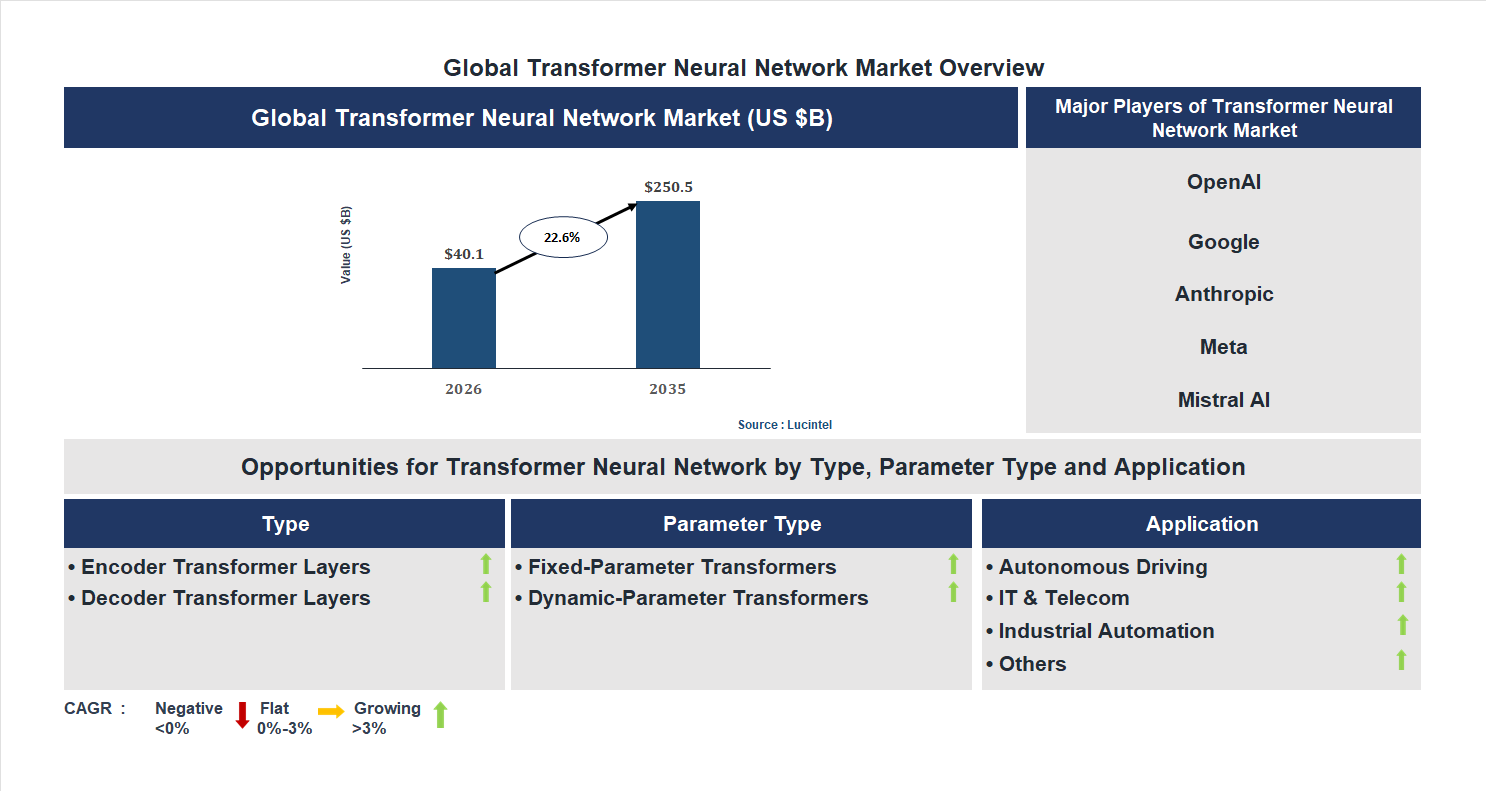
Key data points: The market size in 2035 = $250.5 billion, growth forecast = 22.6% annually for the next 8 years. Scroll below to get more insights. This market report covers trends, opportunities and forecasts in transformer neural network market to 2035 by type (encoder transformer layers and decoder transformer layers), parameter type (fixed-parameter transformers and dynamic-parameter transformers), application (autonomous driving, IT & telecom, industrial automation, and others), and region (North America, Europe, Asia Pacific, and the Rest of the World)
We'll send your sample report shortly.
• Lucintel forecasts that, within the type category, encoder transformer layer is expected to witness higher growth over the forecast period.
• Within the application category, autonomous driving is expected to witness the highest growth.
• In terms of region, APAC is expected to witness the highest growth over the forecast period. Gain valuable insights for your business decisions with our comprehensive 150+ page report. Sample figures with some insights are shown below.
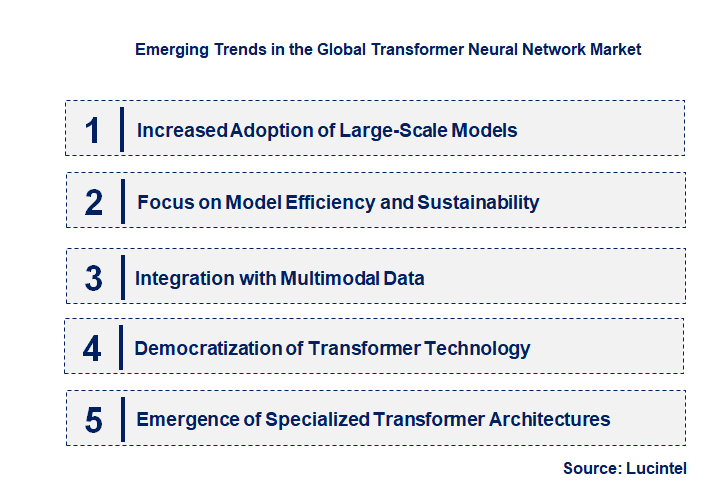
• Increased Adoption of Large-Scale Models: The trend toward deploying larger transformer models is driven by the need for higher accuracy and more complex task handling. These models, such as GPT-4 and BERT, demonstrate superior performance in natural language understanding and generation. Their ability to process vast amounts of data enables more nuanced and context-aware outputs, which are critical for applications like chatbots, translation, and content creation. However, the increased size demands significant computational resources, prompting innovations in model efficiency and hardware acceleration. This trend is expanding the capabilities of AI systems and setting new benchmarks for performance.
• Focus on Model Efficiency and Sustainability: As transformer models grow larger, concerns about their computational cost and environmental impact have intensified. The industry is prioritizing research into more efficient architectures, such as sparse transformers and distillation techniques, to reduce energy consumption without sacrificing performance. This shift aims to make AI more accessible and sustainable, especially for organizations with limited resources. Innovations in hardware, like specialized AI chips, further support this trend. Improving efficiency not only lowers costs but also aligns with global sustainability goals, ensuring the long-term viability of transformer-based AI solutions.
• Integration with Multimodal Data: The market is witnessing a significant push toward multimodal transformers capable of processing and integrating different types of data, such as text, images, and audio. This development enables a more comprehensive understanding and interaction with complex environments, facilitating applications like autonomous vehicles, medical diagnostics, and multimedia content analysis. Multimodal models improve contextual awareness and decision-making accuracy, making AI systems more versatile. The ability to seamlessly combine diverse data sources is transforming user experiences and expanding the scope of AI applications across industries.
• Democratization of Transformer Technology: Open-source initiatives, pre-trained models, and cloud-based platforms are making transformer technology more accessible to a broader audience. This democratization accelerates innovation by enabling startups, researchers, and smaller companies to leverage advanced AI without extensive infrastructure investments. It fosters a collaborative ecosystem that drives rapid development and customization of transformer models for specific needs. As accessibility increases, the market is likely to see a surge in innovative applications and solutions, further fueling growth and diversification within the industry.
• Emergence of Specialized Transformer Architectures: The development of domain-specific transformer models tailored for fields like healthcare, finance, and legal services is gaining momentum. These specialized architectures incorporate domain knowledge to improve accuracy and relevance in their respective areas. For example, medical transformers are optimized for diagnostic tasks, while financial models focus on market predictions. This trend enhances the effectiveness of AI in niche markets, providing more precise and reliable outputs. It also encourages industry-specific research and investment, leading to a more segmented and mature market landscape. In summary, these trends are collectively transforming the transformer neural network market by enhancing model performance, efficiency, accessibility, and application scope. They are driving innovation, reducing barriers to entry, and enabling AI solutions to address increasingly complex and diverse challenges across industries. This evolution is positioning transformer-based AI as a cornerstone of future technological advancements.
• Growing Adoption of Transformer Models in Natural Language Processing: The increasing use of transformer models in NLP tasks such as translation, sentiment analysis, and chatbots is expanding market reach. These models offer superior accuracy and contextual understanding, leading to improved user experiences and automation capabilities. As organizations seek more efficient and scalable solutions, the demand for transformer-based NLP applications is expected to rise significantly, driving market growth and innovation.
• Advancements in Model Efficiency and Scalability: Recent developments focus on optimizing transformer architectures for better efficiency and scalability. Techniques like model pruning, quantization, and distributed training reduce computational costs and enable deployment on resource-constrained devices. These improvements make transformer models more accessible for real-time applications and edge computing, broadening their adoption across industries and increasing market penetration.
• Integration of Transformers in Computer Vision and Multimodal Applications: Transformers are increasingly being integrated into computer vision tasks such as image classification, object detection, and video analysis. Their ability to handle multimodal data enhances applications like autonomous vehicles, surveillance, and medical imaging. This cross-domain versatility is expanding the market beyond NLP, fostering new growth avenues and technological convergence.
• Development of Specialized Transformer Architectures: The emergence of domain-specific transformer models tailored for healthcare, finance, and scientific research is a key trend. These specialized architectures improve performance in niche applications, enabling more accurate diagnostics, financial predictions, and scientific simulations. Such targeted solutions are attracting investments and partnerships, further accelerating market expansion and technological innovation.
• Rising Investment and Strategic Collaborations: Increased funding from venture capital, tech giants, and research institutions is fueling market development. Strategic collaborations aim to accelerate the deployment of transformer models in commercial products and services. This influx of capital and partnerships is fostering innovation, expanding application areas, and strengthening the overall market ecosystem. The recent developments in the transformer neural network market are significantly enhancing its scope, efficiency, and application diversity. These advancements are driving increased adoption across multiple sectors, fostering innovation, and attracting investments. As a result, the market is poised for sustained growth, with transformative impacts on AI-driven solutions and industry competitiveness.
• Expanding Natural Language Processing Capabilities in Customer Service: Transformer neural networks are revolutionizing customer service by enabling more accurate and context-aware chatbots and virtual assistants. These models improve understanding of complex queries, leading to enhanced user experience and reduced operational costs. As businesses seek to automate and personalize interactions, the demand for sophisticated NLP solutions will surge, creating significant growth opportunities for companies developing transformer-based customer engagement tools.
• Advancing Healthcare Diagnostics with Transformer Models: In healthcare, transformer neural networks are being utilized to analyze medical images, patient records, and genomic data with high precision. These models facilitate early diagnosis, personalized treatment plans, and drug discovery processes. The integration of transformer technology into healthcare diagnostics promises to improve accuracy and efficiency, attracting investments and fostering innovation in medical research, ultimately expanding the market significantly.
• Enhancing Financial Analysis and Algorithmic Trading: Financial institutions leverage transformer neural networks for predictive analytics, fraud detection, and algorithmic trading. These models excel at processing vast amounts of unstructured data, such as news feeds and social media, to inform investment decisions. The ability to generate real-time insights and mitigate risks positions transformer technology as a critical tool in finance, opening avenues for growth through improved decision-making and automation.
• Enabling Autonomous Systems and Robotics: Transformer neural networks are increasingly applied in autonomous vehicles, drones, and robotics for perception, decision-making, and navigation. Their capacity to interpret complex sensor data and adapt to dynamic environments enhances safety and efficiency. As autonomous systems become more prevalent across industries, transformer models will play a vital role in advancing these technologies, presenting substantial opportunities for innovation and market expansion.
• Improving Content Generation and Personalization in Media: The ability of transformer neural networks to generate human-like text, images, and videos is transforming content creation and personalization. Media companies utilize these models for automated news writing, creative arts, and targeted advertising, enhancing engagement and reducing production costs. The growing demand for personalized content experiences will drive further development of transformer-based solutions, fueling market growth in the digital media and entertainment sectors. The overall impact of these growth opportunities will significantly accelerate innovation, adoption, and market size in the transformer neural network market, fostering competitive advantages and technological breakthroughs across multiple industries.
• Technological Advancements: Rapid innovations in deep learning architectures, especially the development of transformer models, have revolutionized natural language processing and computer vision. These models offer superior performance in tasks like translation, summarization, and image recognition, fueling demand across industries. Continuous improvements in model efficiency, scalability, and training techniques enable deployment in real-world applications, attracting investments from tech giants and startups alike. As research progresses, transformer-based models are expected to become more accessible and versatile, further expanding their market reach and application scope.
• Increasing Data Availability: The exponential growth of digital data generated through social media, IoT devices, and enterprise systems provides a rich resource for training transformer models. This abundance of data enhances model accuracy and robustness, making them more effective in real-world scenarios. Organizations are leveraging big data to fine-tune models for specific applications, driving market growth. Additionally, advancements in data collection and preprocessing techniques facilitate the development of more sophisticated transformer architectures, enabling better handling of complex, unstructured data.
• Rising Adoption in Industry Verticals: Sectors such as healthcare, finance, retail, and automotive are increasingly adopting transformer neural networks to improve operational efficiency and customer experience. In healthcare, transformers assist in medical imaging and diagnostics; in finance, they enhance fraud detection and algorithmic trading; in retail, they optimize recommendation systems. This cross-industry adoption is driven by the models ability to process large volumes of unstructured data and generate actionable insights. As industries recognize the competitive advantages offered by transformers, market demand continues to grow, encouraging further innovation and deployment.
• Investment and Funding: The transformer neural network market benefits from substantial investments from venture capitalists, technology firms, and government agencies. Funding supports research and development, infrastructure expansion, and talent acquisition, accelerating technological breakthroughs. Major tech companies are establishing dedicated AI research labs focused on transformer models, fostering innovation. Increased funding also facilitates the commercialization of transformer-based solutions, enabling startups and established players to scale their offerings. This financial backing ensures continuous improvement and wider adoption, reinforcing the market’s growth potential.
• Growing Cloud Computing Infrastructure: The expansion of cloud services from providers like AWS, Google Cloud, and Microsoft Azure offers scalable, cost-effective resources for training and deploying transformer models. Cloud infrastructure reduces the barriers to entry for organizations lacking extensive in-house computational capabilities. It enables rapid experimentation, model iteration, and deployment at scale, which is crucial for the development of advanced transformer architectures. The availability of cloud-based AI platforms also democratizes access to powerful models, fostering innovation across small and large enterprises, and propelling the market forward. The challenges facing this transformer neural network market include:
• High Computational Costs: Training transformer neural networks requires immense computational power, often involving thousands of GPUs or TPUs over extended periods. This results in significant energy consumption and high operational costs, limiting accessibility for smaller organizations. The environmental impact of energy-intensive training processes also raises sustainability concerns. As models grow larger and more complex, managing these costs becomes increasingly difficult, potentially hindering widespread adoption and innovation, especially in resource-constrained settings.
• Data Privacy and Security Concerns: The reliance on vast amounts of data for training transformer models raises issues related to data privacy, security, and compliance with regulations such as GDPR and CCPA. Organizations must navigate complex legal frameworks to ensure data protection, which can slow down development and deployment. Additionally, risks of data breaches and misuse pose threats to user trust and brand reputation. Balancing the need for large datasets with privacy considerations remains a critical challenge for market participants.
• Ethical and Bias Issues: Transformer models can inadvertently learn and perpetuate biases present in training data, leading to ethical concerns and potential societal harm. These biases can affect decision-making processes in sensitive applications like hiring, lending, and law enforcement. Addressing these issues requires developing techniques for bias mitigation, transparency, and explainability, which are still evolving. Failure to manage ethical risks can result in regulatory backlash, reduced user trust, and limitations on deployment, impacting market growth. In summary, the transformer neural network market is driven by rapid technological innovations, increasing data availability, industry adoption, substantial investments, and expanding cloud infrastructure. However, high computational costs, privacy concerns, and ethical issues pose significant hurdles. These factors collectively influence the market’s growth trajectory, requiring stakeholders to innovate responsibly and sustainably. Navigating these drivers and challenges will determine the pace of adoption and the future landscape of transformer-based AI solutions.
• OpenAI
• Anthropic
• Meta
• Mistral AI
• xAI
• Cohere
• Stability AI
• AI21 Labs
• Microsoft
• Encoder Transformer Layers
• Decoder Transformer Layers
• Fixed-Parameter Transformers
• Dynamic-Parameter Transformers
• Autonomous Driving
• IT & Telecom
• Industrial Automation
• Others
• North America
• Europe
• Asia Pacific
• The Rest of the World
• United States: The US market has seen substantial investments from tech giants like Google, OpenAI, and Microsoft, focusing on developing more efficient and scalable transformer models. There has been a surge in research collaborations and startups innovating in natural language understanding and computer vision. The government has also increased funding for AI research, emphasizing ethical AI deployment and industry standards. Major breakthroughs include the release of advanced models like GPT-4, which have set new benchmarks in language processing capabilities.
• China: China is rapidly advancing in transformer neural network technology, with significant government backing and private sector investments. Companies like Baidu, Alibaba, and Tencent are developing proprietary models tailored for domestic applications such as e-commerce, social media, and smart city initiatives. Chinese research institutions are publishing influential papers, and there is a focus on multilingual and low-resource language models to serve diverse markets. The country aims to become a global leader in AI by integrating transformer models into various sectors, including healthcare and finance.
• Germany: Germany’s market emphasizes industrial applications of transformer neural networks, particularly in manufacturing, automotive, and automation sectors. Leading automotive companies are integrating transformer-based models for autonomous driving and predictive maintenance. Research institutions are collaborating with industry to develop explainable AI systems, ensuring transparency and compliance with European regulations. Germany is also investing in AI talent development and infrastructure to support innovation, positioning itself as a hub for industrial AI solutions.
• India: India is witnessing a growing adoption of transformer models in sectors like banking, healthcare, and e-commerce. Startups and tech firms are leveraging these models to improve customer service, automate processes, and enhance language translation for regional languages. The government’s Digital India initiative promotes AI research and deployment, with a focus on affordable and accessible AI solutions. Indian universities and research centers are actively contributing to transformer model development, aiming to address local language and data challenges.
• Japan: Japan’s focus is on integrating transformer neural networks into robotics, manufacturing, and consumer electronics. Companies like Sony and Toyota are exploring transformer-based models for intelligent automation and human-robot interaction. Japan emphasizes the development of energy-efficient models to suit its aging population and energy policies. The government supports AI innovation through strategic initiatives, fostering collaborations between academia and industry to maintain its competitive edge in AI-driven robotics and automation sectors.


• OpenAI
• Anthropic
• Meta
• Mistral AI
• xAI
• Cohere
• Stability AI
• AI21 Labs
• Microsoft Q5. Which transformer neural network market segment will be the largest in future? Answer: Lucintel forecasts that, within the type category, encoder transformer layer is expected to witness higher growth over the forecast period. Q6. In transformer neural network market, which region is expected to be the largest in next 5 years? Answer: In terms of region, APAC is expected to witness the highest growth over the forecast period. Q7. Do we receive customization in this report? Answer: Yes, Lucintel provides 10% customization without any additional cost.


Choose a license that fits your team. Instant PDF delivery.
Prices exclude taxes. Instant delivery. Custom licensing available on request.
Market Report · July 31, 2026
Market Report · July 31, 2026
Market Report · July 31, 2026
Trusted partner for strategic intelligence and business growth


Receive a complimentary market analysis tailored to your industry. Our analysts will identify key growth opportunities and competitive dynamics specific to your business.

Market size, growth rate, and key trend analysis for your specific sector.

Top competitor positioning and market share analysis.

Strategic recommendations backed by data-driven insights.
Get curated market intelligence and competitive moves straight to your inbox.
By subscribing, you agree to receive our monthly insights. Unsubscribe anytime.
Receive a complimentary market analysis tailored to your industry. Our analysts will identify key growth opportunities and competitive dynamics specific to your business.
Market size, growth rate, and key trend analysis for your specific sector.
Top competitor positioning and market share analysis.
Strategic recommendations backed by data-driven insights.
Get curated market intelligence, emerging trends, and competitive moves straight to your inbox each month.
By subscribing, you agree to receive our monthly insights. Unsubscribe anytime.
We'll send your sample report shortly.