
Report Feature
Transcatheter Heart Valve Replacement and Repair Market Trends and Forecast
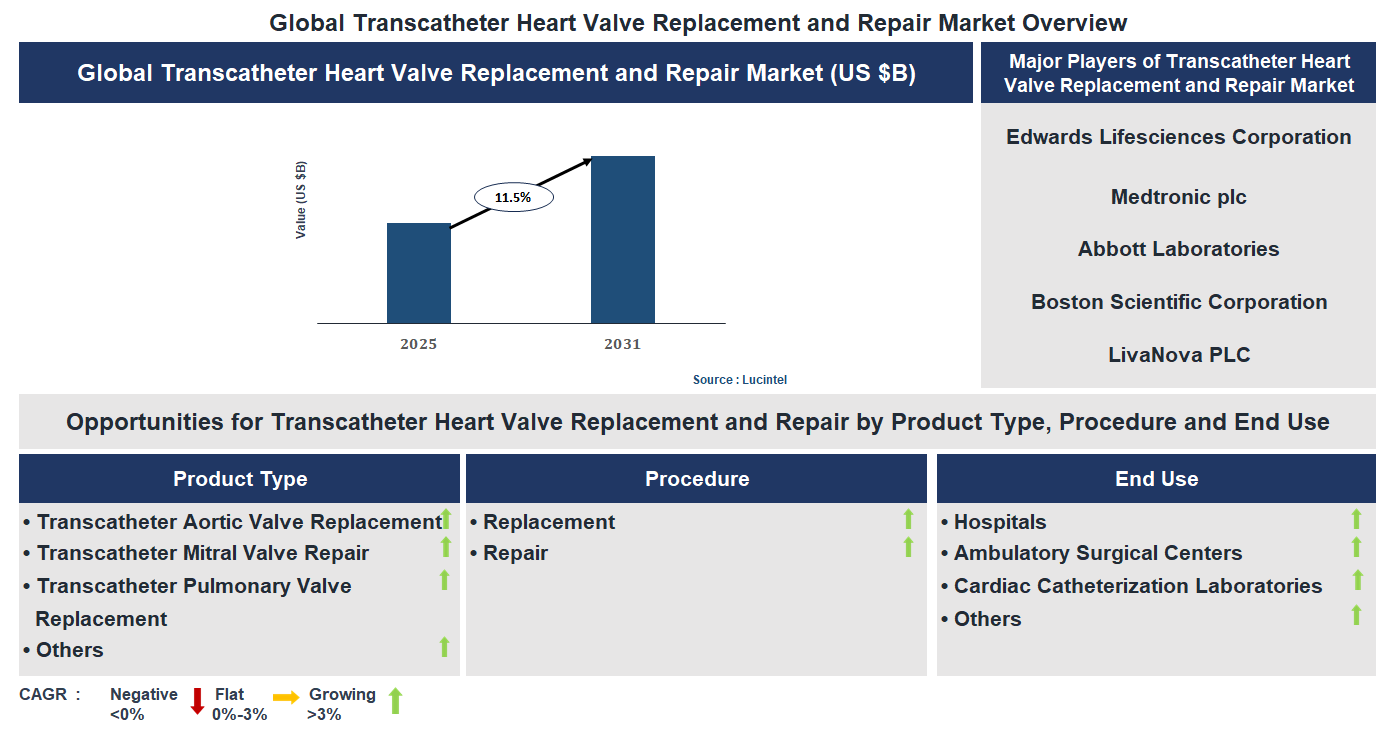
The future of the global transcatheter heart valve replacement and repair market looks promising with opportunities in the hospital, ambulatory surgical center, and cardiac catheterization laboratory markets. The global transcatheter heart valve replacement and repair market is expected to grow with a CAGR of 11.5% from 2025 to 2031. The major drivers for this market are the increasing prevalence of cardiovascular diseases, the rising adoption of minimally invasive procedures, and the growing demand for advanced heart valve treatments.• Lucintel forecasts that, within the product type category, transcatheter aortic valve replacement is expected to witness the highest growth over the forecast period.
• Within the end use category, hospital is expected to witness the highest growth.
• In terms of region, North America is expected to witness the highest growth over the forecast period. Gain valuable insights for your business decisions with our comprehensive 150+ page report. Sample figures with some insights are shown below.
Emerging Trends in the Transcatheter Heart Valve Replacement and Repair Market
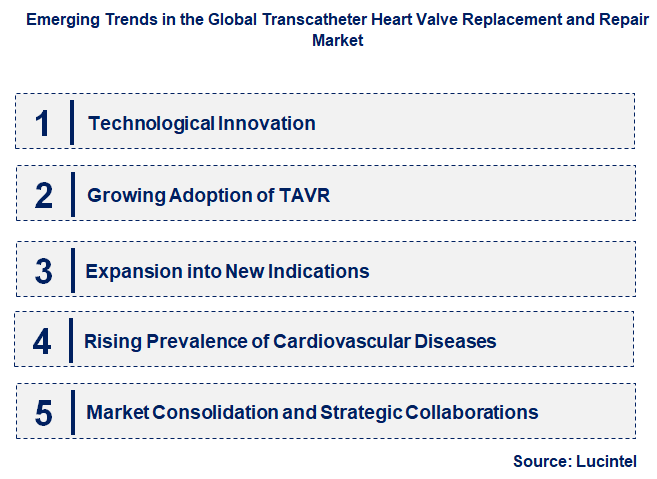
The transcatheter heart valve replacement and repair market is experiencing rapid growth driven by technological advancements, increasing prevalence of cardiovascular diseases, and a shift towards minimally invasive procedures. As healthcare providers seek more effective and less invasive treatment options, the market is evolving with innovative devices and expanding applications. These developments are not only improving patient outcomes but also transforming the landscape of cardiac care. The following key trends highlight the major shifts shaping this dynamic market, reflecting a move towards personalized, efficient, and accessible cardiac interventions.• Technological Innovation: Advancements in device design and materials are enhancing the safety and efficacy of transcatheter valves. Newer devices feature improved durability, better hemodynamic performance, and easier deployment techniques, reducing procedural risks. Innovations such as repositionable and retrievable valves allow for greater precision during implantation. These technological improvements are expanding the patient pool, including those with complex anatomies, and are setting new standards for minimally invasive cardiac interventions.
• Growing Adoption of TAVR: Transcatheter Aortic Valve Replacement (TAVR) is increasingly replacing surgical valve replacement, especially among high-risk and elderly patients. The procedure offers a less invasive alternative with shorter recovery times and fewer complications. As clinical evidence supports its safety and effectiveness, TAVR adoption is expanding across various healthcare settings globally. This trend is driven by improved device technology, increased physician familiarity, and favorable reimbursement policies, making TAVR a mainstream treatment option for a broader patient demographic.
• Expansion into New Indications: Originally developed for aortic stenosis, transcatheter valves are now being adapted for other conditions such as mitral regurgitation, tricuspid valve disease, and structural heart defects. This expansion is facilitated by device modifications and innovative repair techniques. The ability to treat a wider range of cardiac conditions minimally invasively is broadening market opportunities and addressing unmet clinical needs, ultimately improving quality of life for patients with complex valvular and structural heart diseases.
• Rising Prevalence of Cardiovascular Diseases: The increasing incidence of conditions like aortic stenosis, mitral regurgitation, and other valvular disorders due to aging populations and lifestyle factors is fueling market growth. The demand for less invasive, durable, and effective treatment options is rising correspondingly. This demographic shift is prompting healthcare systems to adopt transcatheter solutions more widely, driving market expansion and encouraging ongoing research and development in device technology and procedural techniques.
• Market Consolidation and Strategic Collaborations: The market is witnessing increased mergers, acquisitions, and collaborations among key players to enhance product portfolios and expand geographic reach. Strategic partnerships facilitate the development of innovative devices, clinical trials, and regulatory approvals. These collaborations also help companies address regional market disparities and accelerate commercialization. Market consolidation is creating a competitive landscape focused on innovation, cost-effectiveness, and comprehensive patient care solutions, ultimately benefiting healthcare providers and patients through improved device options and service delivery. In summary, these emerging trends are fundamentally reshaping the transcatheter heart valve replacement and repair market by fostering innovation, expanding indications, and improving patient access. The shift towards minimally invasive procedures, driven by technological advancements and demographic changes, is making cardiac care more effective and accessible. As the market continues to evolve, it is poised for sustained growth, with ongoing innovations and strategic collaborations playing pivotal roles in delivering better outcomes for patients worldwide.
Recent Development in the Transcatheter Heart Valve Replacement and Repair Market
The transcatheter heart valve replacement and repair market has experienced significant growth driven by technological advancements, increasing prevalence of cardiovascular diseases, and a shift towards minimally invasive procedures. As healthcare providers seek more effective and less invasive treatment options, this market is rapidly evolving. Recent developments reflect innovations in device design, expanding indications, and improved procedural techniques. These changes are shaping the future landscape of cardiac care, offering better patient outcomes and broader access to treatment. The following are five key recent developments that are influencing this dynamic market.• Technological Innovations: Development of next-generation transcatheter valves with enhanced durability and biocompatibility has improved procedural success rates and patient safety. These innovations enable more complex cases to be treated and extend the lifespan of implants, reducing the need for repeat procedures. The impact is a broader patient demographic benefiting from minimally invasive options and increased market growth.
• Expanded Indications: Regulatory approvals for transcatheter procedures in treating a wider range of valve diseases, including off-label uses, have increased market penetration. This expansion allows more patients, including those with complex anatomies or high surgical risk, to access minimally invasive treatments. Consequently, the market is witnessing increased adoption and revenue growth.
• Advancements in Imaging and Navigation: Integration of advanced imaging techniques such as 3D echocardiography and real-time fluoroscopy has improved procedural precision. Enhanced visualization reduces complications and shortens procedure times, leading to better patient outcomes. These technological improvements are fostering confidence among clinicians and expanding the procedures applicability.
• Growing Adoption in Emerging Markets: Increased awareness, healthcare infrastructure development, and favorable reimbursement policies are driving the adoption of transcatheter heart valve procedures in emerging economies. This expansion opens new revenue streams for manufacturers and diversifies the market landscape, contributing to overall industry growth.
• Focus on Valve-in-Valve Procedures: The rising popularity of valve-in-valve techniques for treating failed bioprosthetic valves has become a significant trend. These procedures offer a minimally invasive solution for patients with degenerative valve disease, reducing hospital stays and recovery times. The trend is expected to boost demand for compatible transcatheter valves and stimulate market expansion. In summary, recent developments in technological innovation, expanded indications, advanced imaging, emerging market adoption, and valve-in-valve procedures are collectively transforming the transcatheter heart valve replacement and repair market. These advancements are enhancing procedural success, broadening patient access, and driving sustained market growth, ultimately improving patient outcomes worldwide.
Strategic Growth Opportunities in the Transcatheter Heart Valve Replacement and Repair Market
The transcatheter heart valve replacement and repair market is experiencing rapid growth driven by technological advancements, increasing prevalence of cardiovascular diseases, and a shift towards minimally invasive procedures. As healthcare providers seek more effective and less invasive treatment options, key applications are expanding, creating significant opportunities for market players. These developments are transforming patient care, reducing recovery times, and improving outcomes. The following are five key growth opportunities across different applications that are shaping the future of this market and driving innovation.• Aortic Valve Replacement: Expanding minimally invasive procedures for aortic stenosis are increasing patient access and reducing hospital stays, leading to higher adoption rates and market growth.
• Mitral Valve Repair: Innovations in transcatheter mitral valve repair techniques are enabling treatment of previously inoperable patients, broadening the patient base and boosting demand.
• Tricuspid Valve Interventions: Growing recognition of tricuspid regurgitations impact is driving the development of specialized transcatheter devices, opening new revenue streams.
• Valve-in-Valve Procedures: Increasing cases of bioprosthetic valve failure are fueling the adoption of valve-in-valve procedures, offering less invasive solutions for reintervention.
• Congenital Heart Disease Repairs: Advancements in transcatheter techniques are facilitating treatment of congenital heart defects, expanding market reach into pediatric and adult populations. In summary, these growth opportunities are significantly impacting the transcatheter heart valve replacement and repair market by broadening application scope, enhancing device innovation, and improving patient outcomes. This evolution is fostering increased market competition, driving technological advancements, and ultimately expanding access to life-saving treatments worldwide.
Transcatheter Heart Valve Replacement and Repair Market Driver and Challenges
The transcatheter heart valve replacement and repair market is influenced by a variety of technological, economic, and regulatory factors. Advances in minimally invasive procedures, increasing prevalence of cardiovascular diseases, and supportive government policies are key drivers. However, challenges such as high procedural costs, regulatory hurdles, and limited awareness in certain regions pose significant barriers. The interplay of these factors shapes the markets growth trajectory, requiring stakeholders to adapt to rapid technological innovations while navigating complex regulatory landscapes. Understanding these drivers and challenges is essential for strategic planning and sustainable growth in this evolving sector. The factors responsible for driving the transcatheter heart valve replacement and repair market include:-• Technological Advancements: The development of innovative transcatheter valves and delivery systems has revolutionized treatment options for patients with valvular heart diseases. These advancements enable minimally invasive procedures, reducing recovery times and improving patient outcomes. Continuous R&D efforts are leading to more durable, biocompatible, and easier-to-implant devices, which expand the market by making procedures accessible to a broader patient base. The integration of imaging and navigation technologies further enhances procedural precision, fostering confidence among clinicians and patients alike.
• Rising Prevalence of Cardiovascular Diseases: The increasing incidence of conditions such as aortic stenosis and mitral regurgitation, especially among aging populations, is a significant market driver. As the global population ages, the demand for less invasive, effective treatment options grows. This trend is compounded by lifestyle factors like obesity and hypertension, which contribute to cardiovascular disease prevalence. Consequently, healthcare providers are increasingly adopting transcatheter procedures as first-line treatments, fueling market expansion and encouraging manufacturers to innovate.
• Favorable Regulatory Environment: Supportive policies and regulatory approvals from agencies like the FDA and EMA facilitate market growth. Streamlined approval processes for new devices and ongoing clinical trials bolster confidence among investors and manufacturers. Regulatory bodies are also emphasizing patient safety and device efficacy, leading to rigorous testing and validation, which ultimately enhances product credibility. These regulatory frameworks encourage innovation while ensuring that new devices meet safety standards, thereby accelerating market penetration and adoption.
• Growing Awareness and Adoption: Increased awareness among healthcare professionals and patients about the benefits of transcatheter procedures is driving market growth. Educational initiatives, clinical guidelines, and positive patient outcomes are encouraging clinicians to prefer minimally invasive options over traditional surgery. Additionally, expanding healthcare infrastructure in emerging economies is improving access to advanced treatments. As awareness spreads, demand for transcatheter heart valves is expected to rise, further stimulating market development and encouraging manufacturers to expand their product portfolios.
• Strategic Collaborations and Mergers: Partnerships between device manufacturers, healthcare providers, and research institutions are fostering innovation and expanding market reach. Collaborations facilitate the sharing of expertise, resources, and technology, leading to the development of next-generation devices. Mergers and acquisitions enable companies to strengthen their market position, diversify product offerings, and accelerate commercialization. These strategic alliances are crucial for navigating complex regulatory pathways and for entering new geographical markets, ultimately supporting sustained growth in the transcatheter heart valve market. The challenges facing this transcatheter heart valve replacement and repair market include:-
• High Procedural Costs: The cost of transcatheter heart valve procedures remains a significant barrier, especially in developing regions. Expenses associated with device procurement, specialized training, and hospital infrastructure contribute to overall costs. These high costs limit patient access and reimbursement options, restricting market growth. Additionally, insurance coverage disparities and economic constraints in certain countries hinder widespread adoption. Overcoming these financial barriers requires innovative pricing strategies, government support, and increased awareness of long-term cost savings associated with minimally invasive procedures.
• Regulatory Hurdles: Despite supportive policies, navigating complex regulatory pathways remains challenging. The approval process for new devices involves extensive clinical trials, documentation, and compliance with evolving standards, which can delay market entry. Variability in regulatory requirements across regions complicates global commercialization efforts. Additionally, post-market surveillance and ongoing safety monitoring demand significant resources. These hurdles can increase time-to-market and development costs, discouraging innovation and limiting the availability of advanced devices in certain markets.
• Limited Awareness and Training: A lack of awareness among healthcare providers and patients about transcatheter procedures hampers market growth. In many regions, traditional surgical options remain the standard, and clinicians may lack experience or confidence in adopting new technologies. Insufficient training programs and limited access to specialized centers further restrict procedure adoption. Addressing this challenge requires comprehensive education, training initiatives, and the development of specialized centers to build expertise and promote acceptance of transcatheter heart valve therapies. In summary, the transcatheter heart valve replacement and repair market is driven by technological innovations, increasing disease prevalence, supportive regulations, rising awareness, and strategic collaborations. However, high costs, regulatory complexities, and limited awareness pose significant challenges. These factors collectively influence market dynamics, requiring stakeholders to focus on cost reduction, regulatory navigation, and education to sustain growth. Overcoming these barriers will be crucial for expanding access, improving patient outcomes, and maintaining competitive advantage in this rapidly evolving sector.
List of Transcatheter Heart Valve Replacement and Repair Companies
Companies in the market compete on the basis of product quality offered. Major players in this market focus on expanding their manufacturing facilities, R&D investments, infrastructural development, and leverage integration opportunities across the value chain. With these strategies transcatheter heart valve replacement and repair companies cater increasing demand, ensure competitive effectiveness, develop innovative products & technologies, reduce production costs, and expand their customer base. Some of the transcatheter heart valve replacement and repair companies profiled in this report include-• Edwards Lifesciences Corporation
• Medtronic plc
• Abbott Laboratories
• Boston Scientific Corporation
• LivaNova PLC
• JenaValve Technology, Inc.
• CryoLife, Inc.
• Braile Biomédica
• Micro Interventional Devices, Inc.
• Tendyne Holdings, Inc.
Transcatheter Heart Valve Replacement and Repair Market by Segment
The study includes a forecast for the global transcatheter heart valve replacement and repair market by product type, procedure, end use, and region.Transcatheter Heart Valve Replacement and Repair Market by Product Type [Value from 2019 to 2031]:
• Transcatheter Aortic Valve Replacement
• Transcatheter Mitral Valve Repair
• Transcatheter Pulmonary Valve Replacement
• Others
Transcatheter Heart Valve Replacement and Repair Market by Procedure [Value from 2019 to 2031]:
• Replacement
• Repair
Transcatheter Heart Valve Replacement and Repair Market by End Use [Value from 2019 to 2031]:
• Hospitals
• Ambulatory Surgical Centers
• Cardiac Catheterization Laboratories
• Others
Transcatheter Heart Valve Replacement and Repair Market by Region [Value from 2019 to 2031]:
• North America
• Europe
• Asia Pacific
• The Rest of the World
Country Wise Outlook for the Transcatheter Heart Valve Replacement and Repair Market
The transcatheter heart valve replacement and repair market has experienced significant growth driven by technological advancements, increasing prevalence of cardiovascular diseases, and expanding healthcare infrastructure worldwide. Countries are investing in innovative procedures to improve patient outcomes and reduce recovery times. Regulatory approvals and clinical trials are further shaping the market landscape, fostering competition among key players. The adoption of minimally invasive techniques is rising, supported by government initiatives and rising awareness. As the market evolves, regional differences in adoption rates and technological adoption are becoming more apparent, reflecting varying healthcare priorities and economic capabilities.• United States: The US market has seen rapid adoption of transcatheter heart valve procedures, driven by technological innovations and favorable reimbursement policies. Leading companies are expanding their product portfolios, and new clinical trials are demonstrating improved patient outcomes. The FDA has approved several devices, boosting market growth. Increasing awareness and the presence of specialized cardiac centers contribute to high procedure volumes. Additionally, the aging population and rising cardiovascular disease prevalence are fueling demand for minimally invasive solutions. Telemedicine and digital health integration are also emerging trends enhancing patient management.
• China: China’s market is experiencing rapid growth due to increasing cardiovascular disease prevalence and expanding healthcare infrastructure. Government initiatives aim to improve access to advanced cardiac procedures, supported by rising healthcare expenditure. Local manufacturers are gaining prominence through cost-effective devices, while international companies are establishing partnerships to penetrate the market. Clinical adoption is increasing, driven by rising awareness and training programs. The government’s focus on innovation and modernization of healthcare facilities is expected to further accelerate market development. Challenges include regulatory hurdles and the need for skilled healthcare professionals.
• Germany: Germany remains a mature market with high adoption rates of transcatheter heart valve procedures, supported by advanced healthcare infrastructure and high healthcare expenditure. The country benefits from a well-established network of cardiac centers and experienced clinicians. Innovations in device technology and procedural techniques continue to improve outcomes. Reimbursement policies are favorable, encouraging widespread adoption. The aging population and increasing prevalence of valvular heart diseases sustain demand. Germany also emphasizes research and development, with several clinical trials underway to refine existing devices and develop new solutions. Market growth is steady, driven by technological advancements and healthcare policy support.
• India: India’s market is witnessing rapid expansion due to increasing cardiovascular disease burden and rising healthcare awareness. The government’s focus on improving healthcare access and affordability is facilitating market growth. Local manufacturers are emerging, offering cost-effective devices to cater to a large patient base. The adoption of transcatheter procedures is gradually increasing, supported by training programs and expanding healthcare infrastructure. Challenges include regulatory delays and a shortage of trained specialists. However, ongoing initiatives to improve healthcare delivery and the growing number of cardiac centers are expected to boost market penetration. The market is poised for significant growth in the coming years.
• Japan: Japan’s market is characterized by high procedural volumes driven by an aging population and a high prevalence of valvular heart diseases. The country has a mature healthcare system with advanced technology adoption. Innovations in device design and procedural techniques continue to enhance outcomes. Reimbursement policies are supportive, encouraging widespread use of transcatheter procedures. Japan emphasizes clinical research, with numerous trials focusing on device efficacy and safety. The aging demographic sustains demand, and the government’s focus on healthcare innovation further propels market growth. Challenges include regulatory processes and the need for ongoing training of healthcare professionals to keep pace with technological advancements.

Features of the Global Transcatheter Heart Valve Replacement and Repair Market
Market Size Estimates: Transcatheter heart valve replacement and repair market size estimation in terms of value ($B). Trend and Forecast Analysis: Market trends (2019 to 2024) and forecast (2025 to 2031) by various segments and regions. Segmentation Analysis: Transcatheter heart valve replacement and repair market size by product type, procedure, end use, and region in terms of value ($B). Regional Analysis: Transcatheter heart valve replacement and repair market breakdown by North America, Europe, Asia Pacific, and Rest of the World. Growth Opportunities: Analysis of growth opportunities in different product types, procedures, end uses, and regions for the transcatheter heart valve replacement and repair market. Strategic Analysis: This includes M&A, new product development, and competitive landscape of the transcatheter heart valve replacement and repair market. Analysis of competitive intensity of the industry based on Porter’s Five Forces model.
FAQ
Q1. What is the growth forecast for transcatheter heart valve replacement and repair market? Answer: The global transcatheter heart valve replacement and repair market is expected to grow with a CAGR of 11.5% from 2025 to 2031. Q2. What are the major drivers influencing the growth of the transcatheter heart valve replacement and repair market? Answer: The major drivers for this market are the increasing prevalence of cardiovascular diseases, the rising adoption of minimally invasive procedures, and the growing demand for advanced heart valve treatments. Q3. What are the major segments for transcatheter heart valve replacement and repair market? Answer: The future of the transcatheter heart valve replacement and repair market looks promising with opportunities in the hospital, ambulatory surgical center, and cardiac catheterization laboratory markets. Q4. Who are the key transcatheter heart valve replacement and repair market companies? Answer: Some of the key transcatheter heart valve replacement and repair companies are as follows:• Edwards Lifesciences Corporation
• Medtronic plc
• Abbott Laboratories
• Boston Scientific Corporation
• LivaNova PLC
• JenaValve Technology, Inc.
• CryoLife, Inc.
• Braile Biomédica
• Micro Interventional Devices, Inc.
• Tendyne Holdings, Inc. Q5. Which transcatheter heart valve replacement and repair market segment will be the largest in future? Answer: Lucintel forecasts that, within the product type category, transcatheter aortic valve replacement is expected to witness the highest growth over the forecast period. Q6. In transcatheter heart valve replacement and repair market, which region is expected to be the largest in next 5 years? Answer: In terms of region, North America is expected to witness the highest growth over the forecast period. Q7. Do we receive customization in this report? Answer: Yes, Lucintel provides 10% customization without any additional cost.
Table of Contents
List of Figures
List of Tables
Methodology
- In-depth interviews of the major players in this market
- Detailed secondary research from competitors’ financial statements and published data
- Extensive searches of published works, market, and database information pertaining to industry news, company press releases, and customer intentions
- A compilation of the experiences, judgments, and insights of Lucintel’s professionals, who have analyzed and tracked this market over the years.


Buy Now
Choose a license that fits your team. Instant PDF delivery.
Prices exclude taxes. Instant delivery. Custom licensing available on request.
Key Questions
- • What are some of the most promising, high-growth opportunities for the transcatheter heart valve replacement and repair market by product type (transcatheter aortic valve replacement, transcatheter mitral valve repair, transcatheter pulmonary valve replacement, and others), procedure (replacement and repair), end use (hospitals, ambulatory surgical centers, cardiac catheterization laboratories, and others), and region (North America, Europe, Asia Pacific, and the Rest of the World)?
- • Which segments will grow at a faster pace and why?
- • Which region will grow at a faster pace and why?
- • What are the key factors affecting market dynamics? What are the key challenges and business risks in this market?
- • What are the business risks and competitive threats in this market?
- • What are the emerging trends in this market and the reasons behind them?
- • What are some of the changing demands of customers in the market?
- • What are the new developments in the market? Which companies are leading these developments?
- • Who are the major players in this market? What strategic initiatives are key players pursuing for business growth?
- • What are some of the competing products in this market and how big of a threat do they pose for loss of market share by material or product substitution?
- • What M&A activity has occurred in the last 5 years and what has its impact been on the industry? For any questions related to Transcatheter Heart Valve Replacement and Repair Market, Transcatheter Heart Valve Replacement and Repair Market Size, Transcatheter Heart Valve Replacement and Repair Market Growth, Transcatheter Heart Valve Replacement and Repair Market Analysis, Transcatheter Heart Valve Replacement and Repair Market Report, Transcatheter Heart Valve Replacement and Repair Market Share, Transcatheter Heart Valve Replacement and Repair Market Trends, Transcatheter Heart Valve Replacement and Repair Market Forecast, Transcatheter Heart Valve Replacement and Repair Companies, write Lucintel analyst at email: helpdesk@lucintel.com. We will be glad to get back to you soon.


