
Report Feature
Toy and Game Market Trends and Forecast
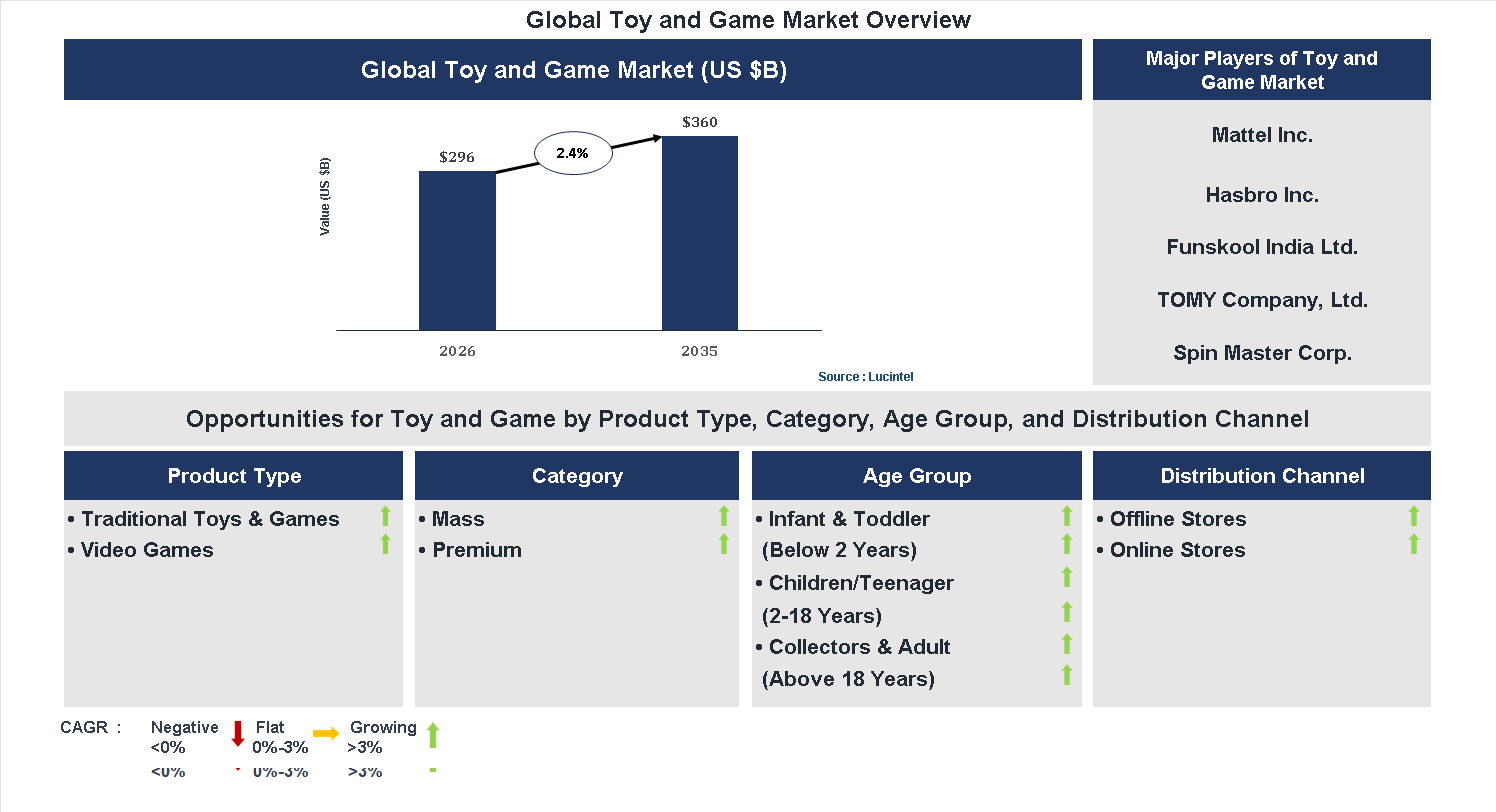
The future of the global toy and game market looks promising with opportunities in the offline store and online store markets. The global toy and game market is expected to reach an estimated $360 billion by 2035 with a CAGR of 2.4% from 2026 to 2035. The major drivers for this market are the increasing demand for educational toys, the rising popularity of interactive games, and the growing interest in licensed character toys.• Lucintel forecasts that, within the product type category, video game is expected to witness higher growth over the forecast period.
• Within the distribution channel category, online store is expected to witness the highest growth.
• In terms of region, APAC is expected to witness the highest growth over the forecast period. Gain valuable insights for your business decisions with our comprehensive 150+ page report. Sample figures with some insights are shown below.
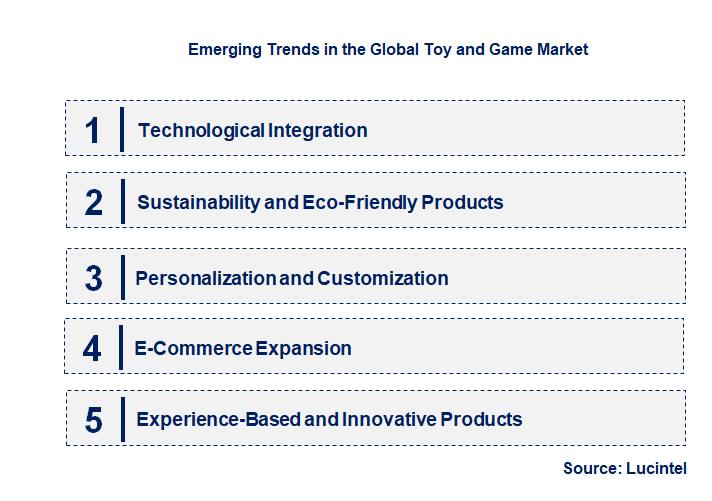
Emerging Trends in the Toy and Game Market
The toy and game market is experiencing rapid transformation driven by technological advancements, changing consumer preferences, and global economic shifts. As digital integration becomes more prevalent, traditional toys are evolving to incorporate smart features, while sustainability concerns are prompting eco-friendly innovations. Additionally, the rise of experiential and personalized products is reshaping consumer engagement. Market players are also expanding their reach through e-commerce platforms, making toys more accessible worldwide. These developments are not only redefining product offerings but also influencing marketing strategies and supply chain dynamics. Overall, these trends are creating a more dynamic, innovative, and competitive landscape in the toy and game industry.• Technological Integration: The incorporation of digital technology into toys and games is revolutionizing the market. Smart toys, augmented reality (AR), and virtual reality (VR) experiences are engaging consumers in new ways, especially children and tech-savvy users. This trend enhances interactivity, personalization, and educational value, making traditional toys more appealing. Companies investing in tech-driven products are gaining competitive advantages, and the market is witnessing a surge in innovative, connected toys that blend physical and digital play. This shift is expanding the scope of what toys can offer, fostering a more immersive and engaging user experience.
• Sustainability and Eco-Friendly Products: Growing environmental awareness is prompting manufacturers to develop sustainable toys. This includes using biodegradable materials, recycled plastics, and eco-friendly packaging. Consumers, especially parents, are increasingly prioritizing environmentally responsible products, influencing purchasing decisions. Companies adopting sustainable practices are enhancing brand loyalty and meeting regulatory standards. The market is witnessing a rise in eco-conscious product lines, which appeal to a broader demographic and contribute to environmental conservation efforts. This trend is pushing the industry toward greener manufacturing processes and more sustainable supply chains.
• Personalization and Customization: Consumers are seeking unique, personalized toys that reflect individual preferences and identities. Advances in manufacturing, such as 3D printing, enable companies to offer customized products at scale. Personalization enhances emotional connection and customer satisfaction, driving brand loyalty. The trend also includes customizable game experiences and toys that can be tailored in terms of design, features, and content. This shift is encouraging brands to adopt flexible production methods and digital platforms that facilitate customization, ultimately creating a more engaging and satisfying consumer experience.
• E-Commerce Expansion: The growth of online retail channels is significantly impacting the toy and game market. E-commerce platforms provide wider reach, convenience, and access to a global customer base. Digital marketing strategies and online reviews influence purchasing decisions, making online presence crucial for brands. The pandemic accelerated this trend, leading to increased online sales and direct-to-consumer models. Companies are investing in robust digital infrastructure, virtual showrooms, and seamless logistics to capitalize on this shift. E-commerce is enabling brands to gather valuable consumer data, personalize marketing efforts, and respond swiftly to market trends.
• Experience-Based and Innovative Products: The market is shifting toward experiential toys and games that promote social interaction, creativity, and learning. This includes escape room kits, STEM-focused toys, and immersive gaming experiences. Such products cater to the growing demand for meaningful, educational, and entertaining activities. Companies are also developing hybrid products that combine physical and digital elements to enhance engagement. This trend reflects a desire for more enriching play experiences that foster skills development and social bonding. It is driving innovation and diversification in product portfolios, appealing to a broader age range and interest groups. These trends are fundamentally reshaping the toy and game market by fostering innovation, sustainability, personalization, and digital integration. They are enabling companies to meet evolving consumer demands, expand their reach, and create more engaging, responsible, and technologically advanced products. As a result, the industry is becoming more competitive, dynamic, and aligned with modern lifestyles and values.
Recent Development in the Toy and Game Market
The toy and game market is experiencing rapid evolution driven by technological advancements, changing consumer preferences, and innovative product development. These developments are shaping the future landscape, creating new opportunities for manufacturers and retailers. As digital integration and sustainability become central themes, companies are adapting strategies to meet emerging demands. This dynamic environment offers significant growth potential, influencing market competitiveness and consumer engagement worldwide.• Digital Gaming Expansion: The rise of digital gaming platforms is transforming entertainment options, offering immersive experiences that attract diverse age groups. This growth is driven by increased internet access, smartphone penetration, and consumer demand for interactive content. As a result, traditional toy sales are complemented by digital products, expanding revenue streams and market reach. Companies investing in app development and online gaming are gaining competitive advantages, fostering innovation and customer loyalty.
• Sustainability and Eco-Friendly Toys: Consumers are increasingly prioritizing environmentally sustainable products, prompting manufacturers to develop eco-friendly toys using biodegradable materials and sustainable packaging. This shift reduces environmental impact and appeals to eco-conscious buyers, especially parents. The market for sustainable toys is expanding rapidly, encouraging innovation in materials and design. Companies adopting green practices are enhancing brand reputation and capturing a growing segment of environmentally aware consumers.
• Augmented Reality (AR) and Virtual Reality (VR) Integration: AR and VR technologies are revolutionizing play experiences by creating interactive, immersive environments. These innovations enable children to engage with toys in new ways, blending physical and digital worlds. The integration of AR/VR enhances product appeal, drives sales, and opens new avenues for educational and entertainment applications. Companies investing in AR/VR are positioning themselves at the forefront of technological advancement, fostering engagement and differentiation in a competitive market.
• Licensing and Brand Collaborations: Strategic partnerships with popular entertainment franchises and brands are boosting toy sales and market visibility. Licensing agreements allow companies to leverage existing fan bases, creating highly desirable products. These collaborations often lead to limited editions and exclusive releases, increasing consumer interest. The trend enhances brand recognition, drives revenue, and encourages innovation through themed product lines, making licensing a key growth driver in the toy and game industry.
• E-commerce and Direct-to-Consumer Sales: The shift toward online shopping has accelerated, with brands establishing direct-to-consumer channels to reach customers more effectively. E-commerce platforms offer convenience, wider selection, and personalized experiences, boosting sales and market penetration. This development reduces reliance on traditional retail outlets, allowing brands to gather valuable consumer data and tailor offerings. The growth of online sales channels is reshaping distribution strategies and increasing market accessibility for manufacturers and consumers alike. The overall impact of these developments is a more dynamic, innovative, and consumer-centric toy and game market. Companies are leveraging technology, sustainability, and strategic partnerships to enhance product offerings and expand their reach. This evolution is fostering increased competition, driving growth, and creating new opportunities for market players worldwide.
Strategic Growth Opportunities in the Toy and Game Market
The toy and game market is experiencing rapid growth driven by technological advancements, changing consumer preferences, and expanding demographics. Innovations in digital and interactive toys, along with increased focus on educational and sustainable products, are creating new opportunities for manufacturers and retailers. Market players are exploring diverse applications across age groups and regions, aiming to enhance engagement and safety standards. Strategic investments and product diversification are essential to capitalize on emerging trends and maintain competitive advantage in this dynamic industry.• Digital and Interactive Toys: The rise of digital and interactive toys offers significant growth potential by integrating augmented reality, virtual reality, and AI technologies. These innovations enhance user engagement, provide immersive experiences, and appeal to tech-savvy consumers. Manufacturers are investing in smart toys that connect to apps or online platforms, creating personalized and educational experiences. This trend caters to children’s evolving entertainment preferences and opens avenues for new revenue streams, making digital toys a key growth driver in the market.
• Expansion of Educational and STEM Toys: Increasing emphasis on STEM education and skill development is fueling demand for educational toys. Parents and educators seek products that promote learning, creativity, and problem-solving skills. Companies are developing innovative STEM kits, coding toys, and science-based games to meet this demand. These products not only support cognitive development but also align with educational curricula, making them attractive to schools and parents. The focus on educational value is expected to sustain growth in this segment.
• Growing Popularity of Sustainable and Eco-Friendly Toys: Consumers are increasingly prioritizing sustainability, prompting manufacturers to develop eco-friendly toys made from biodegradable, recycled, or non-toxic materials. This shift addresses environmental concerns and appeals to eco-conscious families. Companies adopting sustainable practices are gaining competitive advantage and brand loyalty. The demand for sustainable toys is expanding across regions, encouraging innovation in packaging, manufacturing processes, and product design to meet eco-friendly standards.
• Market Penetration in Emerging Economies: Rapid urbanization, rising disposable incomes, and increasing awareness are expanding the toy and game market in emerging economies. Companies are tailoring products to local preferences and investing in distribution channels to reach new consumers. Strategic partnerships and localized marketing are crucial for market entry and growth. This expansion offers substantial opportunities for revenue growth, diversification, and establishing brand presence in regions with untapped potential.
• Integration of Augmented Reality and Virtual Reality in Gaming: The incorporation of AR and VR technologies into gaming products is transforming entertainment experiences. These immersive environments attract a broad age range, from children to adults, and enhance social interaction and skill development. Companies investing in AR/VR gaming are creating innovative products that stand out in a competitive landscape. The technology’s potential to deliver engaging, realistic experiences is expected to drive significant growth and reshape the future of gaming within the toy industry. These growth opportunities are poised to significantly influence the toy and game market by fostering innovation, expanding consumer bases, and emphasizing sustainability. Companies that strategically leverage these trends can enhance their market share, meet evolving customer demands, and sustain long-term growth in this competitive industry.
Toy and Game Market Driver and Challenges
The toy and game market is influenced by a variety of technological, economic, and regulatory factors that shape its growth and development. Innovations in digital technology, changing consumer preferences, economic fluctuations, and evolving safety standards all play crucial roles. These elements create opportunities for market expansion while simultaneously presenting challenges that companies must navigate. Understanding these drivers and challenges is essential for stakeholders aiming to capitalize on emerging trends and mitigate risks. As the market continues to evolve, staying attuned to these factors will determine the success and sustainability of businesses within this dynamic industry. The factors responsible for driving the toy and game market include:-• Technological Innovation: The integration of digital technology, augmented reality, and smart toys has revolutionized the industry. These innovations enhance user engagement, offer interactive experiences, and open new revenue streams. As consumers seek more immersive and technologically advanced products, manufacturers are investing heavily in R&D to develop innovative toys and games. This technological shift not only attracts younger audiences but also broadens the market scope, encouraging cross-industry collaborations and expanding global reach.
• Rising Disposable Income: Increased disposable income, especially in emerging markets, boosts consumer spending on toys and games. Families are willing to invest more in high-quality, branded, and innovative products, driving sales growth. Economic growth in regions like Asia-Pacific and Latin America has led to a surge in demand for premium toys, fostering market expansion. This trend also encourages manufacturers to diversify their product portfolios to cater to different income segments, further fueling industry growth.
• E-commerce Expansion: The growth of online retail platforms has significantly impacted the toy and game market. E-commerce offers consumers convenience, a wider product selection, and competitive pricing, which boosts sales. Digital marketing and social media influence purchasing decisions, enabling brands to reach a global audience efficiently. The rise of direct-to-consumer channels also allows manufacturers to gather valuable consumer data, tailor offerings, and improve customer engagement, thereby accelerating market penetration and sales.
• Changing Consumer Preferences: Modern consumers, especially Millennials and Gen Z, prefer innovative, eco-friendly, and educational toys. There is a growing demand for sustainable products and those that promote learning and development. This shift encourages manufacturers to adopt eco-conscious materials and design toys that align with educational trends. Additionally, experiential and collectible toys are gaining popularity, influencing product development strategies and marketing approaches, which in turn drive market growth.
• Globalization and Market Penetration: Increased globalization has facilitated the entry of international brands into new markets. Strategic partnerships, licensing agreements, and regional adaptations have expanded the market footprint. This globalization trend enables companies to leverage diverse consumer bases, adapt products to local preferences, and benefit from economies of scale. As a result, the market experiences accelerated growth, increased competition, and innovation driven by diverse cultural influences. The challenges facing the toy and game market include:-
• Regulatory and Safety Standards: Stringent safety regulations and standards across different regions pose significant challenges. Compliance requires substantial investment in testing, certification, and quality assurance processes, which can increase costs and delay product launches. Variations in regulations between countries complicate international expansion and necessitate tailored product modifications, impacting profitability and operational efficiency.
• Market Saturation and Intense Competition: The toy and game market is highly saturated, with numerous established brands and new entrants vying for consumer attention. This intense competition leads to price wars, reduced profit margins, and the constant need for innovation. Companies must continuously invest in marketing, product development, and branding to maintain market share, which can strain resources and hinder sustainable growth.
• Rapid Technological Changes: The fast pace of technological advancements demands continuous innovation and adaptation. Companies face the challenge of keeping up with emerging trends such as augmented reality, virtual reality, and smart toys. Failure to innovate or adopt new technologies can result in obsolescence, loss of market relevance, and decreased consumer interest, making it essential for firms to invest heavily in R&D and stay ahead of technological curves. The toy and game market is shaped by dynamic technological advancements, economic growth, and evolving consumer preferences, which create substantial growth opportunities. However, regulatory complexities, intense competition, and rapid technological changes pose significant challenges. Navigating these drivers and challenges requires strategic agility, innovation, and compliance. Overall, the market's future depends on how effectively companies can leverage technological trends while managing regulatory and competitive pressures, ensuring sustainable growth and consumer engagement in a rapidly evolving landscape.
List of Toy and Game Companies
Companies in the market compete on the basis of product quality offered. Major players in this market focus on expanding their manufacturing facilities, R&D investments, infrastructural development, and leverage integration opportunities across the value chain. With these strategies toy and game companies cater increasing demand, ensure competitive effectiveness, develop innovative products & technologies, reduce production costs, and expand their customer base. Some of the toy and game companies profiled in this report include-• Mattel Inc.
• Hasbro Inc.
• Funskool India Ltd.
• TOMY Company, Ltd.
• Spin Master Corp.
• Bandai Namco Holdings Inc.
• MGA Entertainment Inc.
• Funko Inc.
• VTech Holdings Ltd.
• Ravensburger AG
Toy and Game Market by Segment
The study includes a forecast for the global toy and game market by product type, category, age group, distribution channel, and region.Toy and Game Market by Product Type [Value from 2019 to 2035]:
• Traditional Toys & Games
• Video Games
Toy and Game Market by Category [Value from 2019 to 2035]:
• Mass
• Premium
Toy and Game Market by Age Group [Value from 2019 to 2035]:
• Infant & Toddler (Below 2 Years)
• Children/Teenager (2-18 Years)
• Collectors & Adult (Above 18 Years)
Toy and Game Market by Distribution Channel [Value from 2019 to 2035]:
• Offline Stores
• Online Stores
Toy and Game Market by Region [Value from 2019 to 2035]:
• North America
• Europe
• Asia Pacific
• The Rest of the World
Country Wise Outlook for the Toy and Game Market
The global toy and game market has experienced significant shifts driven by technological innovation, changing consumer preferences, and the impact of the COVID-19 pandemic. As digital entertainment gains popularity, traditional toys are evolving to incorporate smart features, while e-commerce continues to expand. Countries are adopting new regulations and sustainability practices to meet environmental concerns. Market players are focusing on product safety, diversity, and inclusivity to attract a broader audience. These developments reflect a dynamic landscape where innovation and consumer engagement are key to growth. The following summarizes recent trends and advancements in the toy and game market across the United States, China, Germany, India, and Japan.• United States: The US market has seen a surge in digital and STEM-focused toys, with increased investment in augmented reality (AR) and virtual reality (VR) gaming. E-commerce sales have grown rapidly, especially during the pandemic, and there is a rising demand for eco-friendly and inclusive toys. Major brands are expanding their product lines to include diverse characters and sustainable materials. Regulatory efforts emphasize safety standards and data privacy, especially for online platforms. The US also witnesses a trend toward nostalgic and retro toys, appealing to adult consumers.
• China: China’s toy and game market is expanding rapidly, driven by a booming middle class and increased disposable income. There is a strong focus on innovative, tech-enabled toys such as smart robots and interactive learning devices. E-commerce giants like Alibaba and JD.com dominate distribution channels, facilitating quick market penetration. The government promotes domestic manufacturing and innovation, leading to a rise in locally designed products. Additionally, Chinese consumers show a preference for culturally relevant toys, blending traditional elements with modern technology. Sustainability practices are gradually gaining importance among manufacturers.
• Germany: The German market emphasizes high-quality, durable, and eco-friendly toys, aligning with European sustainability standards. There is a growing interest in educational and developmental toys that promote creativity and problem-solving skills. Digital integration is increasing, with many companies developing hybrid toys combining physical and digital elements. The market is regulated to ensure safety and environmental compliance, with strict standards for chemical content and recyclability. German consumers value craftsmanship and innovation, leading to a focus on premium products. The industry also benefits from a strong retail network and online sales channels.
• India: The Indian toy and game market is experiencing rapid growth, fueled by a young population and rising disposable incomes. Traditional toys like clay, wooden, and handmade items coexist with modern electronic and digital toys. There is a rising trend of localized content and culturally relevant toys that reflect Indian heritage. E-commerce platforms are expanding reach, especially in Tier 2 and Tier 3 cities. The government promotes toy manufacturing through initiatives like Make in India, encouraging domestic production. Safety standards are evolving, with increasing awareness among consumers about quality and safety. The market is also witnessing a surge in educational and STEM toys.
• Japan: Japan’s toy and game market is characterized by innovation and technological integration, with a focus on robotics, plush toys, and video games. The country is a leader in the development of advanced electronic toys and gaming consoles. Nostalgia plays a significant role, with retro toys and characters remaining popular. The market emphasizes safety, quality, and sustainability, with many companies adopting eco-friendly materials. Digital and interactive toys are increasingly prevalent, often linked to popular media franchises. The industry benefits from a strong retail infrastructure and a culture that values creativity and craftsmanship, fostering continuous innovation.

Features of the Global Toy and Game Market
Market Size Estimates: Toy and game market size estimation in terms of value ($B). Trend and Forecast Analysis: Market trends (2019 to 2025) and forecast (2026 to 2035) by various segments and regions. Segmentation Analysis: Toy and game market size by various segments, such as by product type, category, age group, distribution channel, and region in terms of value ($B). Regional Analysis: Toy and game market breakdown by North America, Europe, Asia Pacific, and Rest of the World. Growth Opportunities: Analysis of growth opportunities in different product types, category, age groups, distribution channels, and regions for the toy and game market. Strategic Analysis: This includes M&A, new product development, and competitive landscape of the toy and game market. Analysis of competitive intensity of the industry based on Porter’s Five Forces model.
FAQ
Q1. What is the toy and game market size? Answer: The global toy and game market is expected to reach an estimated $360 billion by 2035. Q2. What is the growth forecast for toy and game market? Answer: The global toy and game market is expected to grow with a CAGR of 2.4% from 2026 to 2035. Q3. What are the major drivers influencing the growth of the toy and game market? Answer: The major drivers for this market are the increasing demand for educational toys, the rising popularity of interactive games, and the growing interest in licensed character toys. Q4. What are the major segments for toy and game market? Answer: The future of the toy and game market looks promising with opportunities in the offline store and online store markets. Q5. Who are the key toy and game market companies? Answer: Some of the key toy and game companies are as follows:• Mattel Inc.
• Hasbro Inc.
• Funskool India Ltd.
• TOMY Company, Ltd.
• Spin Master Corp.
• Bandai Namco Holdings Inc.
• MGA Entertainment Inc.
• Funko Inc.
• VTech Holdings Ltd.
• Ravensburger AG Q6. Which toy and game market segment will be the largest in future? Answer: Lucintel forecasts that, within the product type category, video game is expected to witness higher growth over the forecast period. Q7. In toy and game market, which region is expected to be the largest in next 5 years? Answer: In terms of region, APAC is expected to witness the highest growth over the forecast period. Q8. Do we receive customization in this report? Answer: Yes, Lucintel provides 10% customization without any additional cost.
Table of Contents
List of Figures
List of Tables
Methodology
- In-depth interviews of the major players in this market
- Detailed secondary research from competitors’ financial statements and published data
- Extensive searches of published works, market, and database information pertaining to industry news, company press releases, and customer intentions
- A compilation of the experiences, judgments, and insights of Lucintel’s professionals, who have analyzed and tracked this market over the years.


Buy Now
Choose a license that fits your team. Instant PDF delivery.
Prices exclude taxes. Instant delivery. Custom licensing available on request.
Key Questions
- • What are some of the most promising, high-growth opportunities for the toy and game market by product type (traditional toys & games and video games), category (mass and premium), age group (infant & toddler (below 2 years), children/teenager (2-18 years), and collectors & adult (above 18 years)), distribution channel (offline stores and online stores), and region (North America, Europe, Asia Pacific, and the Rest of the World)?
- • Which segments will grow at a faster pace and why?
- • Which region will grow at a faster pace and why?
- • What are the key factors affecting market dynamics? What are the key challenges and business risks in this market?
- • What are the business risks and competitive threats in this market?
- • What are the emerging trends in this market and the reasons behind them?
- • What are some of the changing demands of customers in the market?
- • What are the new developments in the market? Which companies are leading these developments?
- • Who are the major players in this market? What strategic initiatives are key players pursuing for business growth?
- • What are some of the competing products in this market and how big of a threat do they pose for loss of market share by material or product substitution?
- • What M&A activity has occurred in the last 7 years and what has its impact been on the industry? For any questions related to Toy and Game Market, Toy and Game Market Size, Toy and Game Market Growth, Toy and Game Market Analysis, Toy and Game Market Report, Toy and Game Market Share, Toy and Game Market Trends, Toy and Game Market Forecast, Toy and Game Companies, write Lucintel analyst at email: helpdesk@lucintel.com. We will be glad to get back to you soon.


