
Report Feature
Toast Maker Market Trends and Forecast
The future of the global toast maker market looks promising with opportunities in the residential and commercial markets. The global toast maker market is expected to grow with a CAGR of 4.2% from 2025 to 2031. The major drivers for this market are the growing demand for quick, convenient breakfast options, the rising adoption of modern kitchen appliances in urban households, and the increasing consumer interest in healthy, customizable food preparation appliances.• Lucintel forecasts that, within the product type category, pop-up toaster is expected to witness the highest growth over the forecast period.
• Within the application category, residential is expected to witness higher growth.
• In terms of region, North America is expected to witness the highest growth over the forecast period. Gain valuable insights for your business decisions with our comprehensive 150+ page report. Sample figures with some insights are shown below.

Emerging Trends in the Toast Maker Market
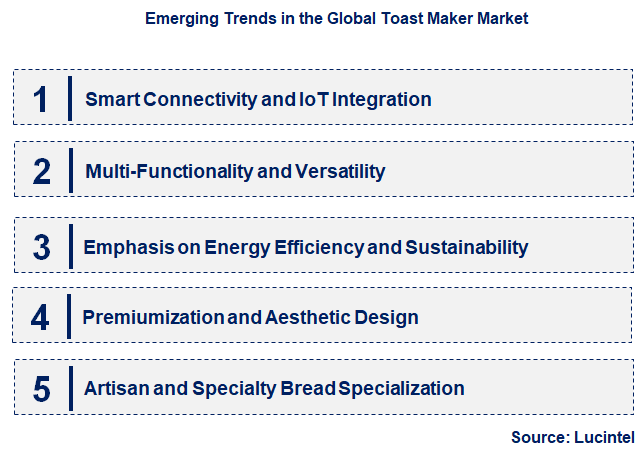
The market for toast maker is undergoing deep transformation, evolving away from a standalone appliance to an advanced, integrated kitchen aid. This transformation is trend-led by worldwide phenomena such as the smart home revolution, the increased emphasis on health and wellness, and the growing demand for swift, convenient, and multifunctional kitchen appliances because of hectic urban lifestyles. These new trends are not incremental refinements; they are essentially redefining consumer expectations, design principles, and the markets competitive dynamic, requiring manufacturers to innovate in order to stay relevant. The market is successfully turning the humble process of toasting into a technology-aided, customizable food experience.• Smart Connectivity and IoT Integration: The trend here is to provide toast makers with Wi-Fi or Bluetooth-enabled features, allowing for smartphone app, voice assistant, and other smart home device control. Users can pre-set toasting settings remotely, monitor progress, or even get reminders to perform maintenance. Its impact is substantial: it increases user convenience, provides a very personalized toasting experience, and enables manufacturers to gain user data for future product enhancement. This innovation propels the toast maker as a high-technology appliance, appealing to the technology-engaged, digitally connected consumer market.
• Multi-Functionality and Versatility: The latest toast makers are now more and more made with changeable plates and multi-cooking capabilities, going way beyond toasting. Such appliances usually come with additional functions that include grilling, waffle making, or panini pressing. This trend is a direct response to the limitation of the small counter space available in city homes and the demand for convenient, one-device kitchen solutions from consumers. Its influence is the broadening of the application of the toast maker, its enhanced value proposition, and the displacement of traditional single-function appliances as it becomes a multi-function breakfast or snack-making hub.
• Emphasis on Energy Efficiency and Sustainability: In response to increased consumer environmental awareness and more stringent energy laws, companies are designing lower-power toasters. These include aspects such as clever sensors that control heating cycles, power-saver modes that operate automatically, and the employment of sustainable or recyclable materials in building. This has an effect on the market by establishing an important buying factor—environmental palatableness—and stimulates innovation in heating element technology and insulation.
• Premiumization and Aesthetic Design: There is increasingly widespread consumer willingness to pay a premium for toasters that provide superior performance, built-to-last build quality, and high-end design aesthetics. The trend entails leveraging high-quality materials (e.g., stainless steel), providing upscale color palettes, and creating slim, designer models that become a visual centerpiece in the kitchen. The effect is a market segmentation with the top-end segment expanding more rapidly than the bottom-end. They are able to extract higher margins, and the appliance becomes a lifestyle and taste statement, similar to home furnishings.
• Artisan and Specialty Bread Specialization: As the consumption of various bread categories such as sourdough, gluten-free, and artisan bread rises, there has been a trend towards toasters designed specifically to accommodate various thicknesses and densities. Examples of this include additional-wide slots, specific bagel/defrost controls, and features such as steam injection or smart sensors that compute the ideal cycle for a given bread type. The effect is enhanced consumer satisfaction with specialty products, minimizing uneven results from toasting. In short, these five major trends—Smart Connectivity, Multi-Functionality, Sustainability, Premiumization, and Specialization—are indeed changing the toast maker market at its core. The machine is no longer merely a heating coil and timer; its turning into an intelligent, multitasking, green, and design-driven kitchen appliance. This evolution is broadening its range of application, raising its position in the home, and propelling the market to grow considerably, especially in the premium and high-tech categories.
Recent Development in the Toast Maker Market
The global toast maker market has seen a chain of dynamic developments, going beyond incremental product upgrades to include digital integration and sustainability. These developments are underpinned by changing consumer expectations around convenience, performance, and ethical sourcing, especially in the expanding working and urban population worldwide. The context for the developments is a small kitchen appliance sector that grows more integrated with the wider smart home environment and fueled by an absolute demand for rapid, quality food preparation.• Emergence of Steam and Gourmet Toasters: One recent trend has been the launch of steam and gourmet toasters, led by firms such as Bermuda. These devices use controlled temperature and a few drops of water to produce an ideal toast slice that is crispy on the outside and soft on the inside. This solves for consumers a need for a superior-quality, café-standard breakfast at home. The effect has been the establishment of a new, high-margin, premium category in the marketplace, proving that consumers are willing to pay considerably more for better, specialized toasting capability and distinctive culinary outcome.
• Convergence of Digital Displays and Touch Interfaces: Firms are more and more switching from conventional mechanical levers and dials to slim, digital LED displays and capacitive touch interfaces. These interfaces provide greater control over toasting colors, exhibit countdown clocks, and include dedicated settings for different breads and operations. This innovation enhances the user experience by providing more accuracy and a clean, modern appearance.
• Emergence of Direct-to-Consumer Brands: The industry has experienced the rise and expansion of many smaller, digitally native, direct-to-consumer brands with a concentration on niche characteristics, minimalism, and an emphasis on using e-commerce as a sales channel. These brands tend to go around traditional retailer channels to promote highly edited items at affordable costs while developing strong communities via social media. This growth makes markets more competitive, pressures mature brands to innovate faster, and increases market access, especially on online retailing platforms.
• Energy-Saving Technology Adoption: One common development is the incorporation of power-saving functionalities, like clever sensors that warm only those coils required for the size of the bread or built-in low-power sleep modes after a time of inactivity. This is a direct reaction to rising worldwide energy costs and customer demand for environmentally friendly appliances. The effect is double: it enhances the energy efficiency ratings of products, which are more attractive to the environmentally friendly and price-sensitive consumer, and it puts manufacturers ahead of imminent stricter energy usage regulations, especially in North America and Europe.
• Safety and Cleaning Features Enhanced: Current designs incorporate substantial gains in safety and convenience of maintenance, such as more spacious, removeable, and completely enclosed crumb trays, exterior casings that are heat-resistant, and automatic shut-off devices. These are solutions to long-time consumer irritants of cleaning and kitchen safety issues. The benefits are increased consumer satisfaction, fewer warranty claims for maintenance and overheating, and a generally more convenient product experience overall. In total, these five innovations—Steam Toasters, Digital Interfaces, DTC Brands, Energy-Saving Tech, and Enhanced Safety—are compelling the toast maker market forward into a new era. Theyre a marriage of kitchen innovation, digital complexity, and sensible consumer-centric design. This effect is the segmentation of the market between high-end premium and value-based tech segments, speeding product replacement, and solidly cementing the toast maker as a must-have, smart, and efficient part of the contemporary connected kitchen.
Strategic Growth Opportunities in the Toast Maker Market
The world market for toast maker is dominated by a powerful undercurrent of innovation that offers manufacturers and retailers strategic growth prospects across a range of significant key applications. The underlying context for the opportunities is the continued worldwide trends of rapid urbanization, shrinking household size, and hence the need for highly efficient and space-conserving kitchen solutions that are responsive to quick meal preparation. By targeting strategically certain application segments—residential, commercial, and specialty use—firms can unlock new sources of revenue and become market leaders. User-driven innovation and localized product strategy will be critical in capturing these growth opportunities in a growingly competitive environment.• Smart Residential Kitchens: The opportunity is in integrating sophisticated toast makers into the growing smart home network. This entails creating appliances that incorporate AI for tailored toasting profiles, reordering favorite bread automatically through connected grocery services, and interacting with other kitchen devices. The effect of this growth opportunity is the capacity to lock up a high-value customer base that is prepared to pay a premium for convenience and connectivity.
• Quick-Service Restaurants and Cafes: The opportunity for growth here is to design and promote high-volume, heavy-duty conveyor toasters and dedicated bun/bagel grillers that can satisfy the demanding specifications of the commercial foodservice market. The emphasis must be on speed, reliability, energy efficiency for constant use, and low maintenance. The effect is grabbing the high-volume commercial market, which demands dependable equipment for commercial use.
• Small/Urban Households: The strategic expansion is servicing the space needs of city living and small household sizes. This involves creating ultra-compact, multifunction products—like 2-slice toasters that also function as panini presses or compact toaster ovens—that enhance functionality without taking up much counter space. The payoff is capturing an important, fast-growing consumer segment in high-density markets, notably in Asia-Pacific. This approach targets the consumer demand for multifunctional, do-it-all products, translating into added sales volume as consumers value appliances that reward them for their limited space.
• Health and Wellness Emphasis: This opportunity entails producing toasters and toaster ovens that are specifically designed for specialty dietary requirements, including gluten-free, low-carb, or whole-grain breads. This necessitates precise controls, deeper/wider slots, and allergen-safe materials certified for that purpose. Marketing will focus on the health-conscious advantages and tailored outcomes. The effect is leveraging the growing important market of health-conscious and dietary-limited consumers.
• Hospitality and Catering Services: The chance is offering multifunctional, large capacity toaster ovens and pop-up toasters for institutional applications in hotels (breakfast buffets), hospitals, and mass catering. Products need to trade off high capacity with ease of operation for staff and a priority on durability in commercial wear and tear. The effect is reaching the institutional market, which buys in bulk and values long product lifecycles and reliability. This solution offers a stable, commercial source of revenue that is linked to the worlds expansion and recovery in the travel, hospitality, and foodservice institutions markets. In short, these five growth opportunities—Smart Kitchens, QSR Efficiency, Compact Design, Health-Focused Specialization, and Bulk Versatility—emphasize the rich avenues for market growth. They divert attention from a one-product marketplace to a multiple-application ecosystem. To effectively target these segments, particularly with digital and multifunctional innovations, will enable companies to broaden their revenue streams and collectively drive the world market for toast makers to a higher value by capturing both the high-volume commercial and high-value premium residential markets.
Toast Maker Market Driver and Challenges
The world market for toast maker is influenced by the dominant interplay of key drivers and issues that constitute a sophisticated and dynamic operating landscape. The key drivers are several technological improvements enhancing the functionality of the product, economic pressures like growing disposable incomes, and a global movement towards convenience in food preparation. In contrast, the key challenges arise from market saturation in mature markets, stiff competition from multi-functional replacement appliances, and the volatility of raw material prices. The factors responsible for driving the toast maker market include: 1. Technological Innovation and Smart Integration: The fast-evolving nature of IoT and smart home technology is a leading driver. Manufacturers are including features such as app control, voice activation, touchscreens, and precision sensors that determine ideal toasting time. These innovations increase user convenience and personalization. The inference is a change of the toast maker into an advanced appliance, which fuels customer demand for upgrades and sustains premium prices. 2. Increased Demand for Convenience and Quick Meals: Urban lifestyles and increasingly hectic consumer live, especially among the working class worldwide, are driving demand for convenient breakfast solutions. The toast maker presents a quick, easy food preparation method, which is in complete harmony with the on-the-go meal trend. The implication is that this convenience aspect generates high and consistent demand for the appliance among residential and commercial clients. 3. Expansion of the Commercial Food Service Market: The international growth of Quick-Service Restaurants (QSRs), cafes, hotels, and catering operations provides a strong market for commercial-grade, heavy-duty toasters. These establishments need high-volume, consistent, and dependable toasting machines. The implication is a consistent B2B revenue stream for producers of conveyor and specialty toasting units. This driver requires emphasis on high production, durability, and specialty features (such as bun grilling) to support the demanding needs of professional kitchens, all to ensure stability and bulk sales. 4. Rise in Global Disposable Income: The growing middle-class consumer base, especially in emerging economies such as China and India, is more affluent and inclined to invest in appliances for the modern kitchen for convenience and lifestyle upgrade. Such an economic influence directly leads to increased volume of sales and a larger market for mid-range to high-end offerings. The consequence is an increase in the overall addressable market worldwide, compelling manufacturers to localize offerings and increase distribution, especially through expanding e-commerce channels in emerging economies. 5. Emphasis on Health and Specialty Diets: A worldwide shift in emphasis from health and wellness has pushed consumption of diverse breads such as gluten-free, whole-grain, and artisanal loaves that necessitate specialized toasting. This has necessitated innovation into products with wider slots and specialty settings (e.g., defrost, bagel) to achieve optimal results. The implication is the introduction of niche, specialty product offerings that are premium-priced. Challenges in the toast maker market are: 1. Competition from Multi-functional Kitchen Appliances: The most formidable challenge is intense competition from multi-functional alternatives such as air fryers, multi-cooker toaster ovens, and microwaves that can also do toasting in addition to other cooking functions. This saturation of rival appliances in the market pressures the toast maker to explain its sole purpose counter space. The implication is a downward price pressure for simple models and a strategic imperative for manufacturers to introduce multi-function capabilities to their products in order to remain relevant and competitive. 2. Raw Material Cost Fluctuations: Toast maker manufacturing is dependent on primary raw materials like stainless steel, plastic, and electronic parts, whose prices are influenced by global supply chain instability and geopolitics. The prices of these materials have a direct impact on the manufacturers margins and the end consumer price. The result is pricing instability, which can undermine sales in price-sensitive markets. 3. Market Saturation in Developed Economies: In the regions of North America and Western Europe, the toast maker is a standard household item, so the market growth rate will rest heavily on replacement sales instead of first purchases. This saturation caps the overall market growth rate in these prime geographies. The implication is that makers will have to heavily invest in product innovation (e.g., smart functionality, design) to encourage consumers to replace working units that may be years old. The combined effect of these drivers and challenges is a market bifurcation: the low-margin, high-volume segment continues to be held back by cost uncertainty and competition from alternatives, and the high-margin, innovation-led segment—driven by clever technology, premium design, and niched features—is growing very strongly. The drivers, particularly technology and convenience, are delivering a very strong upward force, particularly in emerging markets and the commercial sector. But the challenges call for ongoing investment in cost advantage and differentiation.List of Toast Maker Companies
Companies in the market compete on the basis of product quality offered. Major players in this market focus on expanding their manufacturing facilities, R&D investments, infrastructural development, and leverage integration opportunities across the value chain. With these strategies toast maker companies cater increasing demand, ensure competitive effectiveness, develop innovative products & technologies, reduce production costs, and expand their customer base. Some of the toast maker companies profiled in this report include-• Breville Corporation
• Cuisinart
• DeLonghi
• Hamilton Beach Brands Holding Company
• Kenwood Limited
• Krups
• Morphy Richards
• Panasonic Corporation
• Philips Electronics
• Russell Hobbs
Toast Maker Market by Segment
The study includes a forecast for the global toast maker market by product type, power rating, distribution channel, application, and region.Toast Maker Market by Product Type [Value from 2019 to 2031]:
• Pop-Up Toasters
• Conveyor Toasters
• Commercial Toasters
Toast Maker Market by Power Rating [Value from 2019 to 2031]:
• Low
• Medium
• High
Toast Maker Market by Distribution Channel [Value from 2019 to 2031]:
• Online Stores
• Supermarkets/Hypermarkets
• Specialty Stores
• Others
Toast Maker Market by Application [Value from 2019 to 2031]:
• Residential
• Commercial
Toast Maker Market by Region [Value from 2019 to 2031]:
• North America
• Europe
• Asia Pacific
• The Rest of the World
Country Wise Outlook for the Toast Maker Market
The world market for toast maker is experiencing a dramatic evolution, spurred by innovative technologies and changing lifestyles globally. This kitchen essential appliance is going beyond mere toasting, with more manufacturers incorporating intelligent technology, energy efficiency, and stylish designs to attract contemporary homes. Accelerating urbanization, increasing convenience breakfast culture, and growing middle-class disposable incomes in Asia-Pacific are the main drivers propelling market growth. The convenience and customizability focus of the industry, wherein the toast maker becomes a versatile, multi-purpose device in both household and commercial applications across various international markets, drives its popularity.• United States: The US market demonstrates high demand for innovative and premium-featured toasters. Highlights are the growth of smart toasters with app connectivity, personalized toasting presets, and integration into smart home systems. Consumers are becoming more willing to spend more on high-end, multi-featured models that promise consistent performance for specialty breads such as bagels and artisanal loaves.
• China: China is a vibrant growth market for toast makers, driven by accelerating urbanization, a growing middle class, and shifting eating patterns that include more Western-style breakfasts. Innovation is focused on inexpensive, multi-functional devices with versatility, including models that integrate toasting, grilling, and baking functions. Domestic players such as Midea and Sopor are competitive, with solid e-commerce distribution channels. The market is also experiencing an increase in demand for minimal, space-efficient designs that would be perfect for the small urban apartment.
• Germany: The German market is mature but quality, durability, and energy efficiency-oriented. The latest trends feature precision engineering, with customers demanding toasters with extremely consistent, adjustable browning levels. There is high demand for rugged, well-thought-out appliances, usually minimalist or retro-modern in design, matching European-style kitchen decor. Pressure from regulations to make household appliances energy efficient is the driving force behind developments, with lower-wattage, power-saving models being introduced.
• India: Indias toast maker market is growing vigorously, spurred mostly by growing disposable incomes, changing food habits, and greater usage of convenient electric domestic appliances in urban India. Trends are characterized by huge demand for efficient, pocket-friendly, and energy-saving models, mainly pop-up toasters. Companies are emphasizing widening distribution channels, particularly online retailing, to reach the young working class that is more concerned with easy and quick breakfast options rather than conventional cooking.
• Japan: The Japanese market is extremely innovative, with an emphasis on careful design and advanced toasting technology in order to obtain an enhanced flavor and texture. A development worth mentioning is the emergence of gourmet toasters, including Bermuda’s steam toaster, which incorporates precise temperature control and steam in order to simulate the quality of freshly baked bread. Customers emphasize high-quality, small, and good-looking appliances.

Features of the Global Toast Maker Market
Market Size Estimates: Toast maker market size estimation in terms of value ($B). Trend and Forecast Analysis: Market trends (2019 to 2024) and forecast (2025 to 2031) by various segments and regions. Segmentation Analysis: Toast maker market size by various segments, such as by product type, power rating, distribution channel, application, and region in terms of value ($B). Regional Analysis: Toast maker market breakdown by North America, Europe, Asia Pacific, and Rest of the World. Growth Opportunities: Analysis of growth opportunities in different product type, power rating, distribution channel, application, and regions for the toast maker market. Strategic Analysis: This includes M&A, new product development, and competitive landscape of the toast maker market. Analysis of competitive intensity of the industry based on Porter’s Five Forces model.
FAQ
Q1. What is the growth forecast for toast maker market? Answer: The global toast maker market is expected to grow with a CAGR of 4.2% from 2025 to 2031. Q2. What are the major drivers influencing the growth of the toast maker market? Answer: The major drivers for this market are the growing demand for quick, convenient breakfast options, the rising adoption of modern kitchen appliances in urban households, and the increasing consumer interest in healthy, customizable food preparation appliances. Q3. What are the major segments for toast maker market? Answer: The future of the toast maker market looks promising with opportunities in the residential and commercial markets. Q4. Who are the key toast maker market companies? Answer: Some of the key toast maker companies are as follows:• Breville Corporation
• Cuisinart
• DeLonghi
• Hamilton Beach Brands Holding Company
• Kenwood Limited
• Krups
• Morphy Richards
• Panasonic Corporation
• Philips Electronics
• Russell Hobbs Q5. Which toast maker market segment will be the largest in future? Answer: Lucintel forecasts that, within the product type category, pop-up toaster is expected to witness the highest growth over the forecast period. Q6. In toast maker market, which region is expected to be the largest in next 5 years? Answer: In terms of region, North America is expected to witness the highest growth over the forecast period. Q7. Do we receive customization in this report? Answer: Yes, Lucintel provides 10% customization without any additional cost.
Table of Contents
List of Figures
List of Tables
Methodology
- In-depth interviews of the major players in this market
- Detailed secondary research from competitors’ financial statements and published data
- Extensive searches of published works, market, and database information pertaining to industry news, company press releases, and customer intentions
- A compilation of the experiences, judgments, and insights of Lucintel’s professionals, who have analyzed and tracked this market over the years.


Buy Now
Choose a license that fits your team. Instant PDF delivery.
Prices exclude taxes. Instant delivery. Custom licensing available on request.
Key Questions
- • What are some of the most promising, high-growth opportunities for the toast maker market by product type (pop-up toasters, conveyor toasters, and commercial toasters), power rating (low, medium, and high), distribution channel (online stores, supermarkets/hypermarkets, specialty stores, and others), application (residential and commercial), and region (North America, Europe, Asia Pacific, and the Rest of the World)?
- • Which segments will grow at a faster pace and why?
- • Which region will grow at a faster pace and why?
- • What are the key factors affecting market dynamics? What are the key challenges and business risks in this market?
- • What are the business risks and competitive threats in this market?
- • What are the emerging trends in this market and the reasons behind them?
- • What are some of the changing demands of customers in the market?
- • What are the new developments in the market? Which companies are leading these developments?
- • Who are the major players in this market? What strategic initiatives are key players pursuing for business growth?
- • What are some of the competing products in this market and how big of a threat do they pose for loss of market share by material or product substitution?
- • What M&A activity has occurred in the last 5 years and what has its impact been on the industry? For any questions related to Toast Maker Market, Toast Maker Market Size, Toast Maker Market Growth, Toast Maker Market Analysis, Toast Maker Market Report, Toast Maker Market Share, Toast Maker Market Trends, Toast Maker Market Forecast, Toast Maker Companies, write Lucintel analyst at email: helpdesk@lucintel.com. We will be glad to get back to you soon.


