
'
...

The Impact of COVID-19 is included in Titanium Dioxide Market Report. Buy it today to get an advantage.

Request the impact of COVID-19 on your product or industry


Titanium Dioxide Market Trends and Forecast

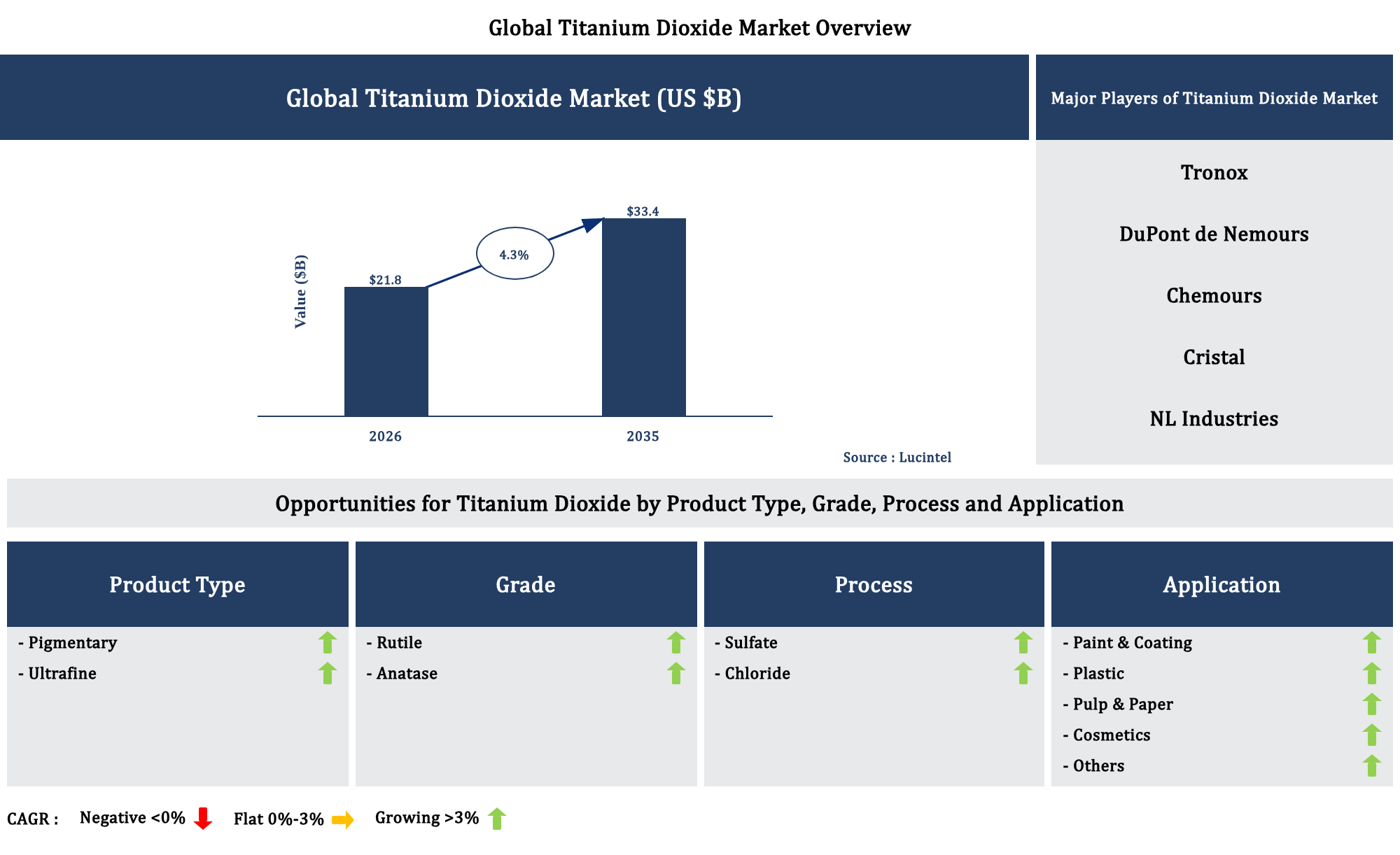
The future of the global titanium dioxide market looks promising with opportunities in the paint & coating, plastic, pulp & paper, and cosmetic markets. The global titanium dioxide market is expected to reach an estimated $33,427 million by 2035 with a CAGR of 4.3% from 2026 to 2035. The major drivers for this market are the rising use in plastics for whitening & strength, the growing need for construction & infrastructure development activities, and the increasing demand from automotive manufacturing sector.

• Lucintel forecasts that, within the product type category, pigmentary is expected to witness higher growth over the forecast period.
• Within the application category, paint & coating is expected to witness the highest growth.
• In terms of region, APAC is expected to witness the highest growth over the forecast period.
Gain valuable insights for your business decisions with our comprehensive 150+ page report. Sample figures with some insights are shown below.
Titanium Dioxide Market Trends and Forecast

Emerging Trends in the Titanium Dioxide Market

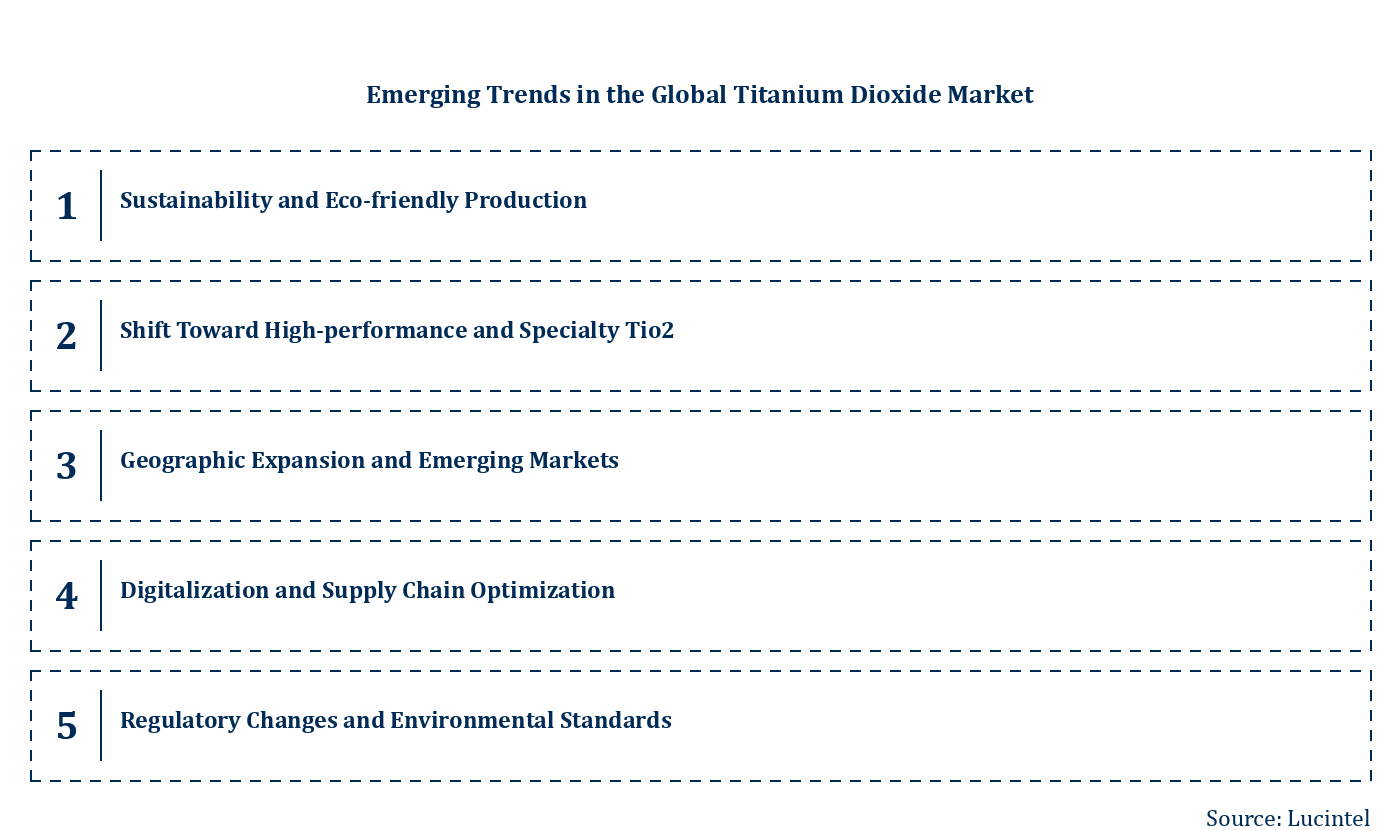
The titanium dioxide market is experiencing significant transformation driven by technological advancements, environmental concerns, and shifting global demand patterns. As industries such as paints, plastics, and cosmetics evolve, the market adapts to new regulations, sustainability goals, and innovative applications. These developments are shaping the competitive landscape, influencing supply chains, and prompting companies to invest in eco-friendly production methods. Understanding these emerging trends is crucial for stakeholders aiming to capitalize on growth opportunities and navigate challenges effectively. The following five key trends highlight the current and future directions of the titanium dioxide market.

• Sustainability and Eco-Friendly Production: The industry is increasingly focused on reducing environmental impact by adopting greener manufacturing processes. Companies are investing in alternative raw materials, such as recycled TiO2, and implementing energy-efficient technologies to lower carbon emissions. Regulatory pressures and consumer demand for sustainable products are driving innovation in eco-friendly TiO2 production. This trend not only helps companies comply with stricter environmental standards but also enhances brand reputation and market competitiveness, ultimately shaping a more sustainable industry landscape.
• Shift Toward High-Performance and Specialty TiO2: There is a growing demand for high-purity and specialty TiO2 grades tailored for specific applications like electronics, cosmetics, and high-end paints. These advanced grades offer superior brightness, opacity, and durability, enabling manufacturers to meet the evolving needs of end-users. The focus on high-performance TiO2 is expanding market opportunities in niche sectors, encouraging R&D investments, and fostering product differentiation. This trend is elevating the overall quality standards and expanding the scope of TiO2 applications.
• Geographic Expansion and Emerging Markets: Rapid industrialization and urbanization in regions such as Asia-Pacific, Latin America, and Africa are fueling demand for TiO2. Countries like China, India, and Brazil are witnessing increased construction activities, automotive production, and consumer goods manufacturing, all of which require TiO2. Market players are expanding their production capacities and establishing local supply chains to capitalize on these opportunities. This geographic shift is diversifying the market base, reducing dependency on traditional regions, and fostering global growth.
• Digitalization and Supply Chain Optimization: The integration of digital technologies such as AI, IoT, and data analytics is transforming supply chain management in the TiO2 industry. These tools enable real-time tracking, predictive maintenance, and demand forecasting, leading to increased efficiency and reduced costs. Digitalization also facilitates better inventory management and enhances transparency across the supply chain. As a result, companies can respond more swiftly to market fluctuations, improve customer service, and strengthen competitive positioning in a rapidly evolving market.
• Regulatory Changes and Environmental Standards: Stricter regulations concerning the environmental and health impacts of TiO2 production are prompting industry-wide changes. Governments are imposing limits on emissions, waste disposal, and the use of certain chemicals, compelling manufacturers to adopt cleaner technologies. Compliance with these standards often involves significant investment but ultimately leads to safer, more sustainable products. Navigating these regulatory landscapes is crucial for market players to avoid penalties and maintain market access, influencing production methods and product formulations.

These emerging trends are collectively reshaping the titanium dioxide market by emphasizing sustainability, innovation, geographic diversification, technological integration, and regulatory compliance. They are driving industry evolution toward more sustainable, high-quality, and globally accessible solutions, positioning the market for continued growth and adaptation in a dynamic global economy.
Emerging Trends in the Titanium Dioxide Market

Recent Developments in the Titanium Dioxide Market

The titanium dioxide market is experiencing rapid growth driven by increasing demand across various industries such as paints, plastics, and cosmetics. Technological advancements and environmental regulations are shaping the market landscape, creating new opportunities for innovation and expansion. Companies are investing heavily in sustainable production methods to meet stricter standards. The market‘s evolution is also influenced by regional developments and shifting consumer preferences, making it a dynamic sector with significant growth potential in the coming years.

• Growing Demand in The Paints and Coatings Industry: The expansion of construction and automotive sectors worldwide is boosting the need for high-quality paints and coatings. Titanium dioxide, known for its excellent whiteness and opacity, is essential in these applications. This increased demand is driving manufacturers to enhance production capacities and develop innovative formulations, ultimately strengthening market position and expanding global reach.
• Rising use in Plastics and Polymers: The plastics industry is increasingly utilizing titanium dioxide for its UV resistance, brightness, and durability. As the demand for lightweight, durable, and aesthetically appealing plastics grows, so does the need for titanium dioxide. This trend is encouraging research into more efficient and eco-friendly production methods, which could lead to cost reductions and broader application scopes, further fueling market growth.
• Expansion in the Cosmetics and Personal Care Sector: Titanium dioxide is a key ingredient in sunscreens, skincare, and makeup products due to its UV-blocking properties and safety profile. The rising consumer awareness about skin protection and the demand for natural, safe ingredients are propelling this sector. Companies are innovating with formulations that enhance product efficacy, which is expanding market opportunities and increasing global sales.
• Adoption of Sustainable and Eco-Friendly Production Processes: Stricter environmental regulations are compelling manufacturers to adopt greener methods, such as chloride process alternatives and recycling techniques. These innovations reduce environmental impact and improve sustainability credentials. As consumers and regulators prioritize eco-friendly products, companies investing in sustainable production are gaining competitive advantages, leading to increased market acceptance and growth.
• Technological Advancements and Product Innovations: Ongoing research is leading to the development of high-performance titanium dioxide variants with improved brightness, dispersibility, and environmental profiles. These innovations enable new applications and improve existing product performance. Enhanced manufacturing technologies also reduce costs and environmental footprint, making titanium dioxide more accessible and versatile, thus expanding its market reach and application diversity.

The overall impact of these developments is a robust, expanding market characterized by increased demand, innovation, and sustainability. Companies that adapt to technological and environmental trends are positioned for growth, while regional developments open new opportunities. These factors collectively are driving the market toward a more sustainable, innovative, and competitive future.

Strategic Growth Opportunities in the Titanium Dioxide Market

The titanium dioxide market is experiencing significant growth driven by increasing demand across various industries such as paints, plastics, and paper. Innovations in production processes and environmental regulations are shaping market dynamics, creating new opportunities for manufacturers. Expanding applications in emerging sectors and geographic regions further contribute to the market‘s potential. Strategic investments and technological advancements are essential for capturing market share and sustaining growth in this competitive landscape.

• Expansion into the Paints and Coatings Industry: The rising demand for high-quality, durable, and environmentally friendly paints and coatings is a key growth driver for titanium dioxide. Its excellent whiteness, opacity, and UV resistance make it indispensable in architectural, automotive, and industrial applications. As construction activities increase globally and eco-friendly standards tighten, manufacturers can capitalize on developing specialty grades tailored for specific coatings, boosting market share and revenue.
• Growth in Plastics and Polymer Applications: Titanium dioxide is increasingly used as a white pigment in plastics and polymers due to its brightness and stability. The surge in demand for lightweight, durable, and aesthetically appealing plastic products in packaging, automotive parts, and consumer goods presents significant opportunities. Innovations in nanotechnology and surface treatments enhance its performance, enabling manufacturers to meet evolving industry standards and expand into new markets.
• Rising Demand in Paper and Printing Industries: The paper industry relies heavily on titanium dioxide for brightness, opacity, and printability. Growing consumption of high-quality paper products, including packaging and specialty papers, drives demand. Additionally, advancements in coating formulations improve paper surface properties. As e-commerce and packaging needs expand globally, opportunities arise for suppliers to develop tailored grades that enhance paper quality and meet environmental regulations.
• Adoption of Eco-Friendly and Sustainable Production Methods: Environmental concerns and stricter regulations are pushing the industry toward sustainable manufacturing practices. Innovations such as chloride-free processes and recycling of titanium-bearing raw materials reduce environmental impact. Companies investing in eco-friendly production methods can differentiate themselves, meet regulatory compliance, and appeal to environmentally conscious consumers, thereby expanding their market presence and fostering long-term growth.
• Expansion into Emerging Markets with Growing Infrastructure: Rapid urbanization and infrastructure development in regions like Asia-Pacific and Africa create substantial demand for construction materials, including paints and coatings containing titanium dioxide. Local manufacturers and international players investing in these markets can capitalize on increasing construction activities. Tailoring products to regional specifications and establishing local supply chains will be crucial for capturing market share and supporting sustained growth.

The overall impact of these opportunities is poised to significantly enhance market growth, diversify application sectors, and promote innovation. Companies that strategically leverage these opportunities will strengthen their market positions, meet evolving customer needs, and contribute to the sustainable development of the titanium dioxide industry.

Titanium Dioxide Market Driver and Challenges

The titanium dioxide market is influenced by a complex interplay of technological advancements, economic conditions, and regulatory frameworks. As a vital pigment in paints, coatings, plastics, and paper, its growth is driven by industrial development and consumer demand for high-quality products. However, the market also faces challenges such as environmental concerns, regulatory restrictions, and fluctuating raw material prices. These factors collectively shape the market dynamics, creating opportunities for innovation while posing significant hurdles. Understanding these drivers and challenges is essential for stakeholders to navigate the evolving landscape and capitalize on emerging trends effectively.

The factors responsible for driving the titanium dioxide market include:-
• Technological Innovation: The development of more efficient manufacturing processes, such as the chloride process, has enhanced production efficiency and product quality. Innovations in coating formulations and pigment dispersions have expanded application scopes, boosting demand. Advanced surface treatments and eco-friendly production methods are also gaining traction, aligning with sustainability goals. These technological improvements reduce costs, improve product performance, and open new markets, thereby fueling market growth.
• Growing Construction and Automotive Industries: Rapid urbanization and infrastructure development worldwide have increased demand for paints and coatings, where titanium dioxide is a key component. The automotive sector’s need for durable, high-quality paints also drives demand. As these industries expand, the need for high-performance, environmentally friendly pigments rises, directly impacting the titanium dioxide market positively. This growth is further supported by increasing investments in infrastructure and vehicle manufacturing globally.
• Rising Demand from Paper and Packaging Sectors: The paper industry utilizes titanium dioxide for brightness, opacity, and whiteness enhancement. The surge in packaging demand driven by e-commerce and retail sectors has amplified the need for high-quality paper products. As consumers and businesses seek sustainable and visually appealing packaging, the demand for titanium dioxide in these applications continues to grow, providing a significant market boost.
• Environmental Regulations and Sustainability Initiatives: Stricter environmental standards and the push for sustainable production practices are influencing market dynamics. Manufacturers are adopting eco-friendly processes, such as the chloride process, which reduces hazardous waste. Additionally, the demand for non-toxic, eco-friendly pigments is increasing, prompting innovation in production methods. These regulatory pressures encourage market players to develop greener products, which can lead to increased costs but also open opportunities for sustainable growth.

The challenges facing this Market include:-
• Environmental Concerns and Regulatory Restrictions: Titanium dioxide production has been associated with environmental issues, including waste management and emissions. Regulatory agencies in various regions are imposing restrictions or bans on its use, especially in food and cosmetic applications, due to health concerns. These regulations can limit market growth, increase compliance costs, and necessitate the development of alternative materials, thereby creating uncertainty and operational challenges for manufacturers.
• Fluctuating Raw Material Prices: The market relies heavily on raw materials like titanium ore and chlorine, whose prices are subject to volatility due to geopolitical tensions, supply chain disruptions, and environmental policies. Price fluctuations can impact profit margins and lead to increased costs for end-users. Manufacturers may face difficulties in forecasting and planning, which can hinder investment and expansion strategies within the market.
• Competition and Market Saturation: The titanium dioxide industry is highly competitive, with major players dominating the market. Market saturation in developed regions limits growth opportunities, forcing companies to seek new markets or innovate product offerings. Price wars and consolidation further intensify competition, potentially reducing profit margins. This environment challenges new entrants and compels existing players to continuously innovate and differentiate their products to maintain market share.

The titanium dioxide market is shaped by technological advancements, expanding industrial applications, and sustainability initiatives, which collectively drive growth. However, environmental regulations, raw material price volatility, and intense competition pose significant challenges. These factors require market participants to innovate, adapt, and strategize effectively. While opportunities for growth remain robust, navigating regulatory landscapes and market dynamics will be crucial for sustained success. Overall, the market‘s future hinges on balancing technological progress with environmental and economic considerations to foster sustainable development.

List of Titanium Dioxide Companies

Companies in the market compete on the basis of product quality offered. Major players in this market focus on expanding their manufacturing facilities, R&D investments, infrastructural development, and leverage integration opportunities across the value chain. With these strategies titanium dioxide companies cater increasing demand, ensure competitive effectiveness, develop innovative products & technologies, reduce production costs, and expand their customer base. Some of the titanium dioxide companies profiled in this report include-
• Tronox
• DuPont de Nemours
• Chemours
• Cristal
• NL Industries
• Huntsman
• Artex Titanium
• Tayca
• Evonik
• Lanka Mineral Sands

Titanium Dioxide Market by Segment

The study includes a forecast for the global titanium dioxide market by product type, grade, process, application, and region.

Titanium Dioxide Market by Product Type [Value from 2019 to 2035]:


• Pigmentary
• Ultrafine

Titanium Dioxide Market by Grade [Value from 2019 to 2035]:


• Rutile
• Anatase

Titanium Dioxide Market by Process [Value from 2019 to 2035]:


• Sulfate
• Chloride

Titanium Dioxide Market by Application [Value from 2019 to 2035]:


• Paint & Coating
• Plastic
• Pulp & Paper
• Cosmetics
• Others

Titanium Dioxide Market by Region [Value from 2019 to 2035]:


• North America
• Europe
• Asia Pacific
• The Rest of the World

Country Wise Outlook for the Titanium Dioxide Market

The titanium dioxide market has experienced significant shifts globally, driven by technological innovations, environmental regulations, and changing demand patterns. Countries are focusing on sustainable production methods, expanding applications in industries such as paints, plastics, and cosmetics, and addressing supply chain challenges. These developments reflect a broader trend toward eco-friendly practices and increased market competitiveness. As the market evolves, key players are investing in research and development to enhance product quality and reduce environmental impact, shaping the future landscape of the TiO2 industry across major economies.

• United States: The US market has seen increased adoption of eco-friendly TiO2 products due to stricter environmental regulations. Major companies are investing in sustainable manufacturing processes, including chlorine-free production methods. Demand from the paints and coatings sector remains strong, driven by construction and automotive industries. Innovations in nanotechnology are expanding applications in cosmetics and plastics. The US government’s focus on reducing carbon emissions is encouraging industry players to adopt greener practices, fostering growth in the domestic market.
• China: China continues to dominate global TiO2 production, with significant capacity expansions and technological upgrades. The country is shifting toward environmentally friendly production methods amid tightening regulations. Domestic demand is rising sharply, fueled by growth in construction, automotive, and packaging industries. Chinese companies are investing in research to improve product quality and reduce environmental impact. Export activities are also increasing, making China a key player in the global supply chain. Government policies favor sustainable development, which is influencing market dynamics positively.
• Germany: Germany’s TiO2 market is characterized by a focus on high-quality, specialty products for niche applications such as electronics and high-performance coatings. The country emphasizes sustainable production practices, including waste reduction and energy efficiency. Innovations in coating technologies are expanding the use of TiO2 in automotive and industrial sectors. Regulatory pressures are prompting companies to adopt greener manufacturing processes. Germany’s strong research infrastructure supports advancements in nanomaterials and eco-friendly alternatives, positioning it as a leader in sustainable TiO2 solutions within Europe.
• India: India’s TiO2 market is experiencing rapid growth driven by expanding construction, automotive, and packaging sectors. The country is investing in capacity expansion and modernizing production facilities to meet rising domestic demand. Environmental regulations are becoming more stringent, encouraging manufacturers to adopt cleaner technologies. The government’s focus on infrastructure development and urbanization is boosting market prospects. Additionally, local players are exploring innovative applications in textiles and cosmetics. The market’s growth is also supported by increasing exports to neighboring countries, making India a significant emerging player in the global TiO2 industry.
• Japan: Japan’s TiO2 market is characterized by high-quality standards and a focus on specialty applications such as electronics, cosmetics, and high-performance coatings. The country emphasizes sustainable manufacturing practices, including energy-efficient processes and waste minimization. Technological advancements in nanotechnology are enhancing product performance and expanding application areas. Japan’s strict environmental regulations are driving innovation toward eco-friendly TiO2 production. The industry benefits from strong R&D capabilities and collaborations with academic institutions, positioning Japan as a leader in developing advanced, sustainable TiO2 solutions for global markets.
Lucintel Analytics Dashboard

Features of the Global Titanium Dioxide Market

Market Size Estimates: Titanium dioxide market size estimation in terms of value ($M).
Trend and Forecast Analysis: Market trends (2019 to 2025) and forecast (2026 to 2035) by various segments and regions.
Segmentation Analysis: Titanium dioxide market size by various segments, such as by product type, grade, process, application, and region in terms of value ($M).
Regional Analysis: Titanium dioxide market breakdown by North America, Europe, Asia Pacific, and Rest of the World.
Growth Opportunities: Analysis of growth opportunities in different product type, grade, process, application, and regions for the titanium dioxide market.
Strategic Analysis: This includes M&A, new product development, and competitive landscape of the titanium dioxide market.
Analysis of competitive intensity of the industry based on Porter’s Five Forces model.

Lucintel Consulting Services

FAQ

Q1. What is the titanium dioxide market size?
Answer: The global titanium dioxide market is expected to reach an estimated $33,427 million by 2035.
Q2. What is the growth forecast for titanium dioxide market?
Answer: The global titanium dioxide market is expected to grow with a CAGR of 4.3% from 2026 to 2035.
Q3. What are the major drivers influencing the growth of the titanium dioxide market?
Answer: The major drivers for this market are the rising use in plastics for whitening & strength, the growing need for construction & infrastructure development activities, and the increasing demand from automotive manufacturing sector.
Q4. What are the major segments for titanium dioxide market?
Answer: The future of the titanium dioxide market looks promising with opportunities in the paint & coating, plastic, pulp & paper, and cosmetic markets.
Q5. Who are the key titanium dioxide market companies?
Answer: Some of the key titanium dioxide companies are as follows:
• Tronox
• DuPont de Nemours
• Chemours
• Cristal
• NL Industries
• Huntsman
• Artex Titanium
• Tayca
• Evonik
• Lanka Mineral Sands
Q6. Which titanium dioxide market segment will be the largest in future?
Answer: Lucintel forecasts that, within the product type category, pigmentary is expected to witness higher growth over the forecast period.
Q7. In titanium dioxide market, which region is expected to be the largest in next 8 years?
Answer: In terms of region, APAC is expected to witness the highest growth over the forecast period.
Q8. Do we receive customization in this report?
Answer: Yes, Lucintel provides 10% customization without any additional cost.

This report answers following 11 key questions:

Q.1. What are some of the most promising, high-growth opportunities for the titanium dioxide market by product type (pigmentary and ultrafine), grade (rutile and anatase), process (sulfate and chloride), application (paint & coating, plastic, pulp & paper, cosmetics, and others), and region (North America, Europe, Asia Pacific, and the Rest of the World)?
Q.2. Which segments will grow at a faster pace and why?
Q.3. Which region will grow at a faster pace and why?
Q.4. What are the key factors affecting market dynamics? What are the key challenges and business risks in this market?
Q.5. What are the business risks and competitive threats in this market?
Q.6. What are the emerging trends in this market and the reasons behind them?
Q.7. What are some of the changing demands of customers in the market?
Q.8. What are the new developments in the market? Which companies are leading these developments?
Q.9. Who are the major players in this market? What strategic initiatives are key players pursuing for business growth?
Q.10. What are some of the competing products in this market and how big of a threat do they pose for loss of market share by material or product substitution?
Q.11. What M&A activity has occurred in the last 5 years and what has its impact been on the industry?

For any questions related to Titanium Dioxide Market, Titanium Dioxide Market Size, Titanium Dioxide Market Growth, Titanium Dioxide Market Analysis, Titanium Dioxide Market Report, Titanium Dioxide Market Share, Titanium Dioxide Market Trends, Titanium Dioxide Market Forecast, Titanium Dioxide Companies, write Lucintel analyst at email: helpdesk@lucintel.com. We will be glad to get back to you soon.
                                           Table of Contents

            1. Executive Summary

            2. Market Overview

                        2.1 Background and Classifications
                        2.2 Supply Chain

            3. Market Trends & Forecast Analysis

                        3.1 Macroeconomic Trends and Forecasts
                        3.2 Industry Drivers and Challenges
                        3.3 PESTLE Analysis
                        3.4 Patent Analysis
                        3.5 Regulatory Environment
                        3.6 Global Titanium Dioxide Market Trends and Forecast

            4. Global Titanium Dioxide Market by Product Type

                        4.1 Overview
                        4.2 Attractiveness Analysis by Product Type
                        4.3 Pigmentary : Trends and Forecast (2019 to 2035)
                        4.4 Ultrafine : Trends and Forecast (2019 to 2035)

            5. Global Titanium Dioxide Market by Grade

                        5.1 Overview
                        5.2 Attractiveness Analysis by Grade
                        5.3 Rutile : Trends and Forecast (2019 to 2035)
                        5.4 Anatase : Trends and Forecast (2019 to 2035)

            6. Global Titanium Dioxide Market by Process

                        6.1 Overview
                        6.2 Attractiveness Analysis by Process
                        6.3 Sulfate : Trends and Forecast (2019 to 2035)
                        6.4 Chloride : Trends and Forecast (2019 to 2035)

            7. Global Titanium Dioxide Market by Application

                        7.1 Overview
                        7.2 Attractiveness Analysis by Application
                        7.3 Paint & Coating : Trends and Forecast (2019 to 2035)
                        7.4 Plastic : Trends and Forecast (2019 to 2035)
                        7.5 Pulp & Paper : Trends and Forecast (2019 to 2035)
                        7.6 Cosmetics : Trends and Forecast (2019 to 2035)
                        7.7 Others : Trends and Forecast (2019 to 2035)

            8. Regional Analysis

                        8.1 Overview
                        8.2 Global Titanium Dioxide Market by Region

            9. North American Titanium Dioxide Market

                        9.1 Overview
                        9.2 North American Titanium Dioxide Market by Product Type
                        9.3 North American Titanium Dioxide Market by Application
                        9.4 The United States Titanium Dioxide Market
                        9.5 Canadian Titanium Dioxide Market
                        9.6 Mexican Titanium Dioxide Market

            10. European Titanium Dioxide Market

                        10.1 Overview
                        10.2 European Titanium Dioxide Market by Product Type
                        10.3 European Titanium Dioxide Market by Application
                        10.4 German Titanium Dioxide Market
                        10.5 French Titanium Dioxide Market
                        10.6 Italian Titanium Dioxide Market
                        10.7 Spanish Titanium Dioxide Market
                        10.8 The United Kingdom Titanium Dioxide Market

            11. APAC Titanium Dioxide Market

                        11.1 Overview
                        11.2 APAC Titanium Dioxide Market by Product Type
                        11.3 APAC Titanium Dioxide Market by Application
                        11.4 Chinese Titanium Dioxide Market
                        11.5 Indian Titanium Dioxide Market
                        11.6 Japanese Titanium Dioxide Market
                        11.7 South Korean Titanium Dioxide Market
                        11.8 Indonesian Titanium Dioxide Market

            12. ROW Titanium Dioxide Market

                        12.1 Overview
                        12.2 ROW Titanium Dioxide Market by Product Type
                        12.3 ROW Titanium Dioxide Market by Application
                        12.4 Middle Eastern Titanium Dioxide Market
                        12.5 South American Titanium Dioxide Market
                        12.6 African Titanium Dioxide Market

            13. Competitor Analysis

                        13.1 Product Portfolio Analysis
                        13.2 Operational Integration
                        13.3 Porter’s Five Forces Analysis
                                    • Competitive Rivalry
                                    • Bargaining Power of Buyers
                                    • Bargaining Power of Suppliers
                                    • Threat of Substitutes
                                    • Threat of New Entrants
                        13.4 Market Share Analysis

            14. Opportunities & Strategic Analysis

                        14.1 Value Chain Analysis
                        14.2 Growth Opportunity Analysis
                                    14.2.1 Growth Opportunity by Product Type
                                    14.2.2 Growth Opportunity by Grade
                                    14.2.3 Growth Opportunity by Process
                                    14.2.4 Growth Opportunity by Application
                                    14.2.5 Growth Opportunity by Region
                        14.3 Emerging Trends in the Global Titanium Dioxide Market
                        14.4 Strategic Analysis
                                    14.4.1 New Product Development
                                    14.4.2 Certification and Licensing
                                    14.4.3 Mergers, Acquisitions, Agreements, Collaborations, and Joint Ventures

            15. Company Profiles of the Leading Players Across the Value Chain

                        15.1 Competitive Analysis Overview
                        15.2 Tronox
                                    • Company Overview
                                    • Titanium Dioxide Market Business Overview
                                    • New Product Development
                                    • Merger, Acquisition, and Collaboration
                                    • Certification and Licensing
                        15.3 DuPont de Nemours
                                    • Company Overview
                                    • Titanium Dioxide Market Business Overview
                                    • New Product Development
                                    • Merger, Acquisition, and Collaboration
                                    • Certification and Licensing
                        15.4 Chemours
                                    • Company Overview
                                    • Titanium Dioxide Market Business Overview
                                    • New Product Development
                                    • Merger, Acquisition, and Collaboration
                                    • Certification and Licensing
                        15.5 Cristal
                                    • Company Overview
                                    • Titanium Dioxide Market Business Overview
                                    • New Product Development
                                    • Merger, Acquisition, and Collaboration
                                    • Certification and Licensing
                        15.6 NL Industries
                                    • Company Overview
                                    • Titanium Dioxide Market Business Overview
                                    • New Product Development
                                    • Merger, Acquisition, and Collaboration
                                    • Certification and Licensing
                        15.7 Huntsman
                                    • Company Overview
                                    • Titanium Dioxide Market Business Overview
                                    • New Product Development
                                    • Merger, Acquisition, and Collaboration
                                    • Certification and Licensing
                        15.8 Artex Titanium
                                    • Company Overview
                                    • Titanium Dioxide Market Business Overview
                                    • New Product Development
                                    • Merger, Acquisition, and Collaboration
                                    • Certification and Licensing
                        15.9 Tayca
                                    • Company Overview
                                    • Titanium Dioxide Market Business Overview
                                    • New Product Development
                                    • Merger, Acquisition, and Collaboration
                                    • Certification and Licensing
                        15.10 Evonik
                                    • Company Overview
                                    • Titanium Dioxide Market Business Overview
                                    • New Product Development
                                    • Merger, Acquisition, and Collaboration
                                    • Certification and Licensing
                        15.11 Lanka Mineral Sands
                                    • Company Overview
                                    • Titanium Dioxide Market Business Overview
                                    • New Product Development
                                    • Merger, Acquisition, and Collaboration
                                    • Certification and Licensing

            16. Appendix

                        16.1 List of Figures
                        16.2 List of Tables
                        16.3 Research Methodology
                        16.4 Disclaimer
                        16.5 Copyright
                        16.6 Abbreviations and Technical Units
                        16.7 About Us
                        16.8 Contact Us

                                               List of Figures


            Chapter 1

                        Figure 1.1: Trends and Forecast for the Global Titanium Dioxide Market

            Chapter 2

                        Figure 2.1: Usage of Titanium Dioxide Market
                        Figure 2.2: Classification of the Global Titanium Dioxide Market
                        Figure 2.3: Supply Chain of the Global Titanium Dioxide Market

            Chapter 3

                        Figure 3.1: Trends of the Global GDP Growth Rate
                        Figure 3.2: Trends of the Global Population Growth Rate
                        Figure 3.3: Trends of the Global Inflation Rate
                        Figure 3.4: Trends of the Global Unemployment Rate
                        Figure 3.5: Trends of the Regional GDP Growth Rate
                        Figure 3.6: Trends of the Regional Population Growth Rate
                        Figure 3.7: Trends of the Regional Inflation Rate
                        Figure 3.8: Trends of the Regional Unemployment Rate
                        Figure 3.9: Trends of Regional Per Capita Income
                        Figure 3.10: Forecast for the Global GDP Growth Rate
                        Figure 3.11: Forecast for the Global Population Growth Rate
                        Figure 3.12: Forecast for the Global Inflation Rate
                        Figure 3.13: Forecast for the Global Unemployment Rate
                        Figure 3.14: Forecast for the Regional GDP Growth Rate
                        Figure 3.15: Forecast for the Regional Population Growth Rate
                        Figure 3.16: Forecast for the Regional Inflation Rate
                        Figure 3.17: Forecast for the Regional Unemployment Rate
                        Figure 3.18: Forecast for Regional Per Capita Income
                        Figure 3.19: Driver and Challenges of the Titanium Dioxide Market

            Chapter 4

                        Figure 4.1: Global Titanium Dioxide Market by Product Type in 2019, 2025, and 2035
                        Figure 4.2: Trends of the Global Titanium Dioxide Market ($M) by Product Type
                        Figure 4.3: Forecast for the Global Titanium Dioxide Market ($M) by Product Type
                        Figure 4.4: Trends and Forecast for Pigmentary in the Global Titanium Dioxide Market (2019-2035)
                        Figure 4.5: Trends and Forecast for Ultrafine in the Global Titanium Dioxide Market (2019-2035)

            Chapter 5

                        Figure 5.1: Global Titanium Dioxide Market by Grade in 2019, 2025, and 2035
                        Figure 5.2: Trends of the Global Titanium Dioxide Market ($M) by Grade
                        Figure 5.3: Forecast for the Global Titanium Dioxide Market ($M) by Grade
                        Figure 5.4: Trends and Forecast for Rutile in the Global Titanium Dioxide Market (2019-2035)
                        Figure 5.5: Trends and Forecast for Anatase in the Global Titanium Dioxide Market (2019-2035)

            Chapter 6

                        Figure 6.1: Global Titanium Dioxide Market by Process in 2019, 2025, and 2035
                        Figure 6.2: Trends of the Global Titanium Dioxide Market ($M) by Process
                        Figure 6.3: Forecast for the Global Titanium Dioxide Market ($M) by Process
                        Figure 6.4: Trends and Forecast for Sulfate in the Global Titanium Dioxide Market (2019-2035)
                        Figure 6.5: Trends and Forecast for Chloride in the Global Titanium Dioxide Market (2019-2035)

            Chapter 7

                        Figure 7.1: Global Titanium Dioxide Market by Application in 2019, 2025, and 2035
                        Figure 7.2: Trends of the Global Titanium Dioxide Market ($M) by Application
                        Figure 7.3: Forecast for the Global Titanium Dioxide Market ($M) by Application
                        Figure 7.4: Trends and Forecast for Paint & Coating in the Global Titanium Dioxide Market (2019-2035)
                        Figure 7.5: Trends and Forecast for Plastic in the Global Titanium Dioxide Market (2019-2035)
                        Figure 7.6: Trends and Forecast for Pulp & Paper in the Global Titanium Dioxide Market (2019-2035)
                        Figure 7.7: Trends and Forecast for Cosmetics in the Global Titanium Dioxide Market (2019-2035)
                        Figure 7.8: Trends and Forecast for Others in the Global Titanium Dioxide Market (2019-2035)

            Chapter 8

                        Figure 8.1: Trends of the Global Titanium Dioxide Market ($M) by Region (2019-2025)
                        Figure 8.2: Forecast for the Global Titanium Dioxide Market ($M) by Region (2026-2035)

            Chapter 9

                        Figure 9.1: Trends and Forecast for the North American Titanium Dioxide Market (2019-2035)
                        Figure 9.2: North American Titanium Dioxide Market by Product Type in 2019, 2025, and 2035
                        Figure 9.3: Trends of the North American Titanium Dioxide Market ($M) by Product Type (2019-2025)
                        Figure 9.4: Forecast for the North American Titanium Dioxide Market ($M) by Product Type (2026-2035)
                        Figure 9.5: North American Titanium Dioxide Market by Grade in 2019, 2025, and 2035
                        Figure 9.6: Trends of the North American Titanium Dioxide Market ($M) by Grade (2019-2025)
                        Figure 9.7: Forecast for the North American Titanium Dioxide Market ($M) by Grade (2026-2035)
                        Figure 9.8: Trends and Forecast for the United States Titanium Dioxide Market ($M) (2019-2035)
                        Figure 9.9: Trends and Forecast for the Mexican Titanium Dioxide Market ($M) (2019-2035)
                        Figure 9.10: Trends and Forecast for the Canadian Titanium Dioxide Market ($M) (2019-2035)

            Chapter 10

                        Figure 10.1: Trends and Forecast for the European Titanium Dioxide Market (2019-2035)
                        Figure 10.2: European Titanium Dioxide Market by Product Type in 2019, 2025, and 2035
                        Figure 10.3: Trends of the European Titanium Dioxide Market ($M) by Product Type (2019-2025)
                        Figure 10.4: Forecast for the European Titanium Dioxide Market ($M) by Product Type (2026-2035)
                        Figure 10.5: European Titanium Dioxide Market by Grade in 2019, 2025, and 2035
                        Figure 10.6: Trends of the European Titanium Dioxide Market ($M) by Grade (2019-2025)
                        Figure 10.7: Forecast for the European Titanium Dioxide Market ($M) by Grade (2026-2035)
                        Figure 10.8: Trends and Forecast for the German Titanium Dioxide Market ($M) (2019-2035)
                        Figure 10.9: Trends and Forecast for the French Titanium Dioxide Market ($M) (2019-2035)
                        Figure 10.10: Trends and Forecast for the Spanish Titanium Dioxide Market ($M) (2019-2035)
                        Figure 10.11: Trends and Forecast for the Italian Titanium Dioxide Market ($M) (2019-2035)
                        Figure 10.12: Trends and Forecast for the United Kingdom Titanium Dioxide Market ($M) (2019-2035)

            Chapter 11

                        Figure 11.1: Trends and Forecast for the APAC Titanium Dioxide Market (2019-2035)
                        Figure 11.2: APAC Titanium Dioxide Market by Product Type in 2019, 2025, and 2035
                        Figure 11.3: Trends of the APAC Titanium Dioxide Market ($M) by Product Type (2019-2025)
                        Figure 11.4: Forecast for the APAC Titanium Dioxide Market ($M) by Product Type (2026-2035)
                        Figure 11.5: APAC Titanium Dioxide Market by Grade in 2019, 2025, and 2035
                        Figure 11.6: Trends of the APAC Titanium Dioxide Market ($M) by Grade (2019-2025)
                        Figure 11.7: Forecast for the APAC Titanium Dioxide Market ($M) by Grade (2026-2035)
                        Figure 11.8: Trends and Forecast for the Japanese Titanium Dioxide Market ($M) (2019-2035)
                        Figure 11.9: Trends and Forecast for the Indian Titanium Dioxide Market ($M) (2019-2035)
                        Figure 11.10: Trends and Forecast for the Chinese Titanium Dioxide Market ($M) (2019-2035)
                        Figure 11.11: Trends and Forecast for the South Korean Titanium Dioxide Market ($M) (2019-2035)
                        Figure 11.12: Trends and Forecast for the Indonesian Titanium Dioxide Market ($M) (2019-2035)

            Chapter 12

                        Figure 12.1: Trends and Forecast for the ROW Titanium Dioxide Market (2019-2035)
                        Figure 12.2: ROW Titanium Dioxide Market by Product Type in 2019, 2025, and 2035
                        Figure 12.3: Trends of the ROW Titanium Dioxide Market ($M) by Product Type (2019-2025)
                        Figure 12.4: Forecast for the ROW Titanium Dioxide Market ($M) by Product Type (2026-2035)
                        Figure 12.5: ROW Titanium Dioxide Market by Grade in 2019, 2025, and 2035
                        Figure 12.6: Trends of the ROW Titanium Dioxide Market ($M) by Grade (2019-2025)
                        Figure 12.7: Forecast for the ROW Titanium Dioxide Market ($M) by Grade (2026-2035)
                        Figure 12.8: Trends and Forecast for the Middle Eastern Titanium Dioxide Market ($M) (2019-2035)
                        Figure 12.9: Trends and Forecast for the South American Titanium Dioxide Market ($M) (2019-2035)
                        Figure 12.10: Trends and Forecast for the African Titanium Dioxide Market ($M) (2019-2035)

            Chapter 13

                        Figure 13.1: Porter’s Five Forces Analysis of the Global Titanium Dioxide Market
                        Figure 13.2: Market Share (%) of Top Players in the Global Titanium Dioxide Market (2025)

            Chapter 14

                        Figure 14.1: Growth Opportunities for the Global Titanium Dioxide Market by Product Type
                        Figure 14.2: Growth Opportunities for the Global Titanium Dioxide Market by Grade
                        Figure 14.3: Growth Opportunities for the Global Titanium Dioxide Market by Process
                        Figure 14.4: Growth Opportunities for the Global Titanium Dioxide Market by Application
                        Figure 14.5: Growth Opportunities for the Global Titanium Dioxide Market by Region
                        Figure 14.6: Emerging Trends in the Global Titanium Dioxide Market

                                               List of Tables


            Chapter 1

                        Table 1.1: Growth Rate (%, 2024-2025) and CAGR (%, 2026-2035) of the Titanium Dioxide Market by Product Type, Grade, Process, and Application
                        Table 1.2: Attractiveness Analysis for the Titanium Dioxide Market by Region
                        Table 1.3: Global Titanium Dioxide Market Parameters and Attributes

            Chapter 3

                        Table 3.1: Trends of the Global Titanium Dioxide Market (2019-2025)
                        Table 3.2: Forecast for the Global Titanium Dioxide Market (2026-2035)

            Chapter 4

                        Table 4.1: Attractiveness Analysis for the Global Titanium Dioxide Market by Product Type
                        Table 4.2: Market Size and CAGR of Various Product Type in the Global Titanium Dioxide Market (2019-2025)
                        Table 4.3: Market Size and CAGR of Various Product Type in the Global Titanium Dioxide Market (2026-2035)
                        Table 4.4: Trends of Pigmentary in the Global Titanium Dioxide Market (2019-2025)
                        Table 4.5: Forecast for Pigmentary in the Global Titanium Dioxide Market (2026-2035)
                        Table 4.6: Trends of Ultrafine in the Global Titanium Dioxide Market (2019-2025)
                        Table 4.7: Forecast for Ultrafine in the Global Titanium Dioxide Market (2026-2035)

            Chapter 5

                        Table 5.1: Attractiveness Analysis for the Global Titanium Dioxide Market by Grade
                        Table 5.2: Market Size and CAGR of Various Grade in the Global Titanium Dioxide Market (2019-2025)
                        Table 5.3: Market Size and CAGR of Various Grade in the Global Titanium Dioxide Market (2026-2035)
                        Table 5.4: Trends of Rutile in the Global Titanium Dioxide Market (2019-2025)
                        Table 5.5: Forecast for Rutile in the Global Titanium Dioxide Market (2026-2035)
                        Table 5.6: Trends of Anatase in the Global Titanium Dioxide Market (2019-2025)
                        Table 5.7: Forecast for Anatase in the Global Titanium Dioxide Market (2026-2035)

            Chapter 6

                        Table 6.1: Attractiveness Analysis for the Global Titanium Dioxide Market by Process
                        Table 6.2: Market Size and CAGR of Various Process in the Global Titanium Dioxide Market (2019-2025)
                        Table 6.3: Market Size and CAGR of Various Process in the Global Titanium Dioxide Market (2026-2035)
                        Table 6.4: Trends of Sulfate in the Global Titanium Dioxide Market (2019-2025)
                        Table 6.5: Forecast for Sulfate in the Global Titanium Dioxide Market (2026-2035)
                        Table 6.6: Trends of Chloride in the Global Titanium Dioxide Market (2019-2025)
                        Table 6.7: Forecast for Chloride in the Global Titanium Dioxide Market (2026-2035)

            Chapter 7

                        Table 7.1: Attractiveness Analysis for the Global Titanium Dioxide Market by Application
                        Table 7.2: Market Size and CAGR of Various Application in the Global Titanium Dioxide Market (2019-2025)
                        Table 7.3: Market Size and CAGR of Various Application in the Global Titanium Dioxide Market (2026-2035)
                        Table 7.4: Trends of Paint & Coating in the Global Titanium Dioxide Market (2019-2025)
                        Table 7.5: Forecast for Paint & Coating in the Global Titanium Dioxide Market (2026-2035)
                        Table 7.6: Trends of Plastic in the Global Titanium Dioxide Market (2019-2025)
                        Table 7.7: Forecast for Plastic in the Global Titanium Dioxide Market (2026-2035)
                        Table 7.8: Trends of Pulp & Paper in the Global Titanium Dioxide Market (2019-2025)
                        Table 7.9: Forecast for Pulp & Paper in the Global Titanium Dioxide Market (2026-2035)
                        Table 7.10: Trends of Cosmetics in the Global Titanium Dioxide Market (2019-2025)
                        Table 7.11: Forecast for Cosmetics in the Global Titanium Dioxide Market (2026-2035)
                        Table 7.12: Trends of Others in the Global Titanium Dioxide Market (2019-2025)
                        Table 7.13: Forecast for Others in the Global Titanium Dioxide Market (2026-2035)

            Chapter 8

                        Table 8.1: Market Size and CAGR of Various Regions in the Global Titanium Dioxide Market (2019-2025)
                        Table 8.2: Market Size and CAGR of Various Regions in the Global Titanium Dioxide Market (2026-2035)

            Chapter 9

                        Table 9.1: Trends of the North American Titanium Dioxide Market (2019-2025)
                        Table 9.2: Forecast for the North American Titanium Dioxide Market (2026-2035)
                        Table 9.3: Market Size and CAGR of Various Product Type in the North American Titanium Dioxide Market (2019-2025)
                        Table 9.4: Market Size and CAGR of Various Product Type in the North American Titanium Dioxide Market (2026-2035)
                        Table 9.5: Market Size and CAGR of Various Grade in the North American Titanium Dioxide Market (2019-2025)
                        Table 9.6: Market Size and CAGR of Various Grade in the North American Titanium Dioxide Market (2026-2035)
                        Table 9.7: Trends and Forecast for the United States Titanium Dioxide Market (2019-2035)
                        Table 9.8: Trends and Forecast for the Mexican Titanium Dioxide Market (2019-2035)
                        Table 9.9: Trends and Forecast for the Canadian Titanium Dioxide Market (2019-2035)

            Chapter 10

                        Table 10.1: Trends of the European Titanium Dioxide Market (2019-2025)
                        Table 10.2: Forecast for the European Titanium Dioxide Market (2026-2035)
                        Table 10.3: Market Size and CAGR of Various Product Type in the European Titanium Dioxide Market (2019-2025)
                        Table 10.4: Market Size and CAGR of Various Product Type in the European Titanium Dioxide Market (2026-2035)
                        Table 10.5: Market Size and CAGR of Various Grade in the European Titanium Dioxide Market (2019-2025)
                        Table 10.6: Market Size and CAGR of Various Grade in the European Titanium Dioxide Market (2026-2035)
                        Table 10.7: Trends and Forecast for the German Titanium Dioxide Market (2019-2035)
                        Table 10.8: Trends and Forecast for the French Titanium Dioxide Market (2019-2035)
                        Table 10.9: Trends and Forecast for the Spanish Titanium Dioxide Market (2019-2035)
                        Table 10.10: Trends and Forecast for the Italian Titanium Dioxide Market (2019-2035)
                        Table 10.11: Trends and Forecast for the United Kingdom Titanium Dioxide Market (2019-2035)

            Chapter 11

                        Table 11.1: Trends of the APAC Titanium Dioxide Market (2019-2025)
                        Table 11.2: Forecast for the APAC Titanium Dioxide Market (2026-2035)
                        Table 11.3: Market Size and CAGR of Various Product Type in the APAC Titanium Dioxide Market (2019-2025)
                        Table 11.4: Market Size and CAGR of Various Product Type in the APAC Titanium Dioxide Market (2026-2035)
                        Table 11.5: Market Size and CAGR of Various Grade in the APAC Titanium Dioxide Market (2019-2025)
                        Table 11.6: Market Size and CAGR of Various Grade in the APAC Titanium Dioxide Market (2026-2035)
                        Table 11.7: Trends and Forecast for the Japanese Titanium Dioxide Market (2019-2035)
                        Table 11.8: Trends and Forecast for the Indian Titanium Dioxide Market (2019-2035)
                        Table 11.9: Trends and Forecast for the Chinese Titanium Dioxide Market (2019-2035)
                        Table 11.10: Trends and Forecast for the South Korean Titanium Dioxide Market (2019-2035)
                        Table 11.11: Trends and Forecast for the Indonesian Titanium Dioxide Market (2019-2035)

            Chapter 12

                        Table 12.1: Trends of the ROW Titanium Dioxide Market (2019-2025)
                        Table 12.2: Forecast for the ROW Titanium Dioxide Market (2026-2035)
                        Table 12.3: Market Size and CAGR of Various Product Type in the ROW Titanium Dioxide Market (2019-2025)
                        Table 12.4: Market Size and CAGR of Various Product Type in the ROW Titanium Dioxide Market (2026-2035)
                        Table 12.5: Market Size and CAGR of Various Grade in the ROW Titanium Dioxide Market (2019-2025)
                        Table 12.6: Market Size and CAGR of Various Grade in the ROW Titanium Dioxide Market (2026-2035)
                        Table 12.7: Trends and Forecast for the Middle Eastern Titanium Dioxide Market (2019-2035)
                        Table 12.8: Trends and Forecast for the South American Titanium Dioxide Market (2019-2035)
                        Table 12.9: Trends and Forecast for the African Titanium Dioxide Market (2019-2035)

            Chapter 13

                        Table 13.1: Product Mapping of Titanium Dioxide Suppliers Based on Segments
                        Table 13.2: Operational Integration of Titanium Dioxide Manufacturers
                        Table 13.3: Rankings of Suppliers Based on Titanium Dioxide Revenue

            Chapter 14

                        Table 14.1: New Product Launches by Major Titanium Dioxide Producers (2019-2025)
                        Table 14.2: Certification Acquired by Major Competitor in the Global Titanium Dioxide Market
 
.

Buy full report or by chapter as follows

Price by License Type:
[-] Hide Chapter Details
[Chapter Number] [Chapter Name] [Chapter Number Of Pages] [Chapter Price]
Title/Chapter Name Pages Price
Full Report: Titanium Dioxide Market Report: Trends, Forecast and Competitive Analysis to 2035 Full Report $ 4,850
A 150 Page Report
Lucintel has been in the business of market research and management consulting since 2000 and has published over 1000 market intelligence reports in various markets / applications and served over 1,000 clients worldwide. This study is a culmination of four months of full-time effort performed by Lucintel's analyst team. The analysts used the following sources for the creation and completion of this valuable report:
  • In-depth interviews of the major players in this market
  • Detailed secondary research from competitors’ financial statements and published data 
  • Extensive searches of published works, market, and database information pertaining to industry news, company press releases, and customer intentions
  • A compilation of the experiences, judgments, and insights of Lucintel’s professionals, who have analyzed and tracked this market over the years.
Extensive research and interviews are conducted across the supply chain of this market to estimate market share, market size, trends, drivers, challenges, and forecasts. Below is a brief summary of the primary interviews that were conducted by job function for this report.
 
Thus, Lucintel compiles vast amounts of data from numerous sources, validates the integrity of that data, and performs a comprehensive analysis. Lucintel then organizes the data, its findings, and insights into a concise report designed to support the strategic decision-making process. The figure below is a graphical representation of Lucintel’s research process. 
 

Please sign in below to get report brochure - Titanium Dioxide Market Report.

At Lucintel, we respect your privacy and maintain the confidentiality of information / data provided by you
(Please enter your corporate email. * These fields are mandatory )

Follow us on