
'
...

The Impact of COVID-19 is included in Tinned Fish Market Report. Buy it today to get an advantage.

Request the impact of COVID-19 on your product or industry


Tinned Fish Market Trends and Forecast

The future of the global tinned fish market looks promising with opportunities in the tuna, sardine, mackerel, and anchovy markets. The global tinned fish market is expected to reach an estimated $24 billion by 2035 with a CAGR of 5.1% from 2026 to 2035. The major drivers for this market are the increasing demand for convenient protein rich foods, the rising preference for long shelf life seafood products, and the growing consumption of ready to eat fish products.

• Lucintel forecasts that, within the distribution channel category, online retail store is expected to witness the highest growth over the forecast period.
• Within the product type category, tuna is expected to witness the highest growth.
• In terms of region, APAC is expected to witness the highest growth over the forecast period.
Gain valuable insights for your business decisions with our comprehensive 150+ page report. Sample figures with some insights are shown below.
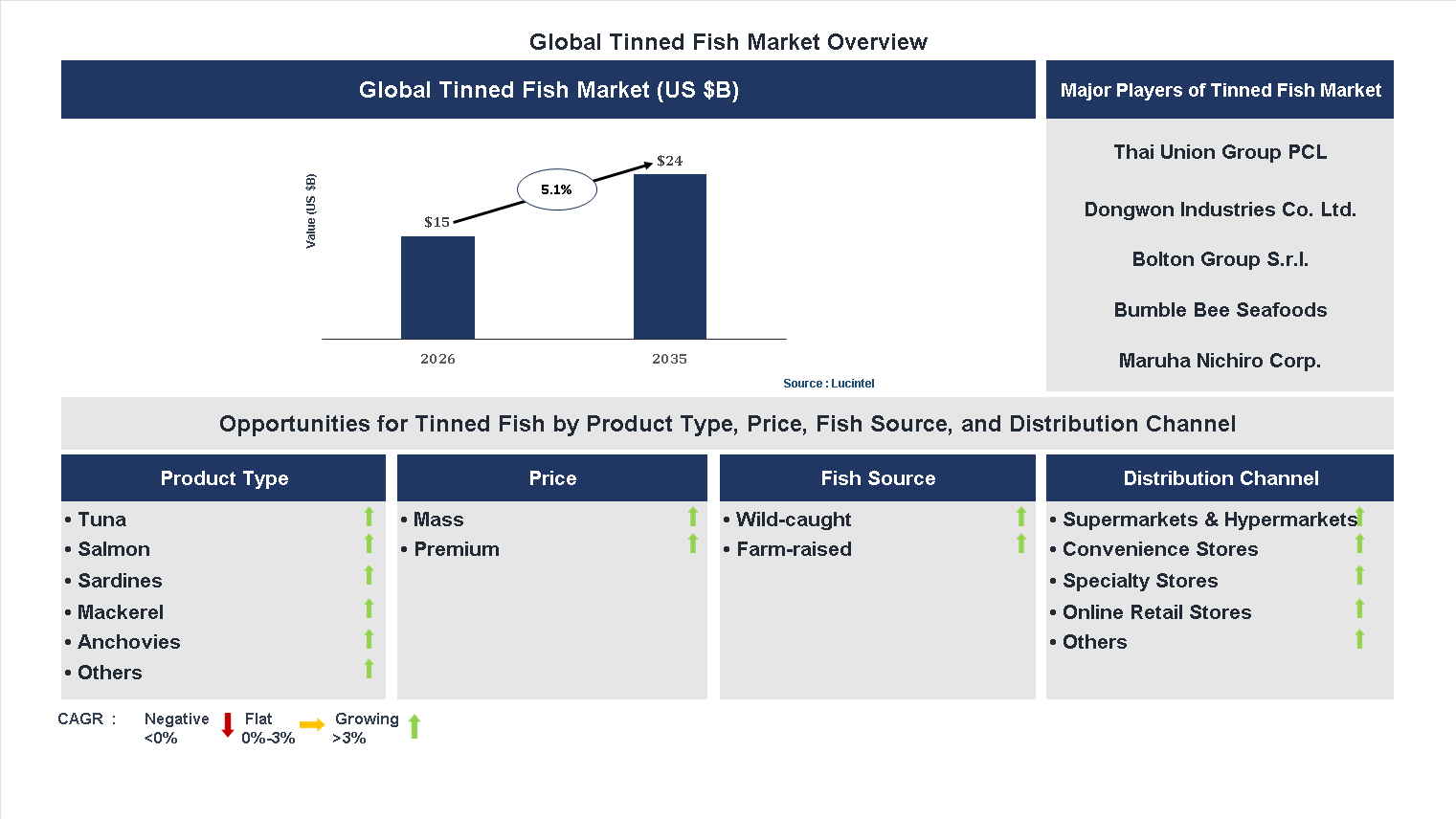
Tinned Fish Market Trends and Forecast

Emerging Trends in the Tinned Fish Market

Tinned fish demand is being reshaped by changing consumer tastes, sustainability expectations, and evolving retail and distribution models. As people seek convenient, protein-rich meals, manufacturers are upgrading formulations, diversifying species and formats, and emphasizing transparency about sourcing, processing, and nutrition. At the same time, regulatory pressure on labeling, food safety, and sustainable fisheries is pushing companies toward traceability systems and responsible sourcing practices. The market is also responding to premiumization, regional flavor preferences, and shifting household budgets. Digital discovery, subscription shopping, and stronger e-commerce presence are influencing how brands communicate value and win loyalty. These forces are creating distinct growth pockets within the broader tinned fish category.

• Sustainable Sourcing And Traceability: Consumers and regulators increasingly demand proof of responsible fishing and processing. Brands are investing in traceability tools, supplier audits, and certifications that track origin, species, and catch methods across the value chain. This helps reduce reputational risk and supports compliance with stricter rules on labeling, fisheries management, and anti-IUU (illegal, unreported, and unregulated) fishing expectations. Impact appears in stronger shelf trust, improved retailer acceptance, and better brand equity with environmentally conscious shoppers. Strong sub segments include MSC or equivalent certified products, tuna and sardines with chain-of-custody messaging, and line extensions that highlight local or region-specific fish origins.
• Premiumization Of Taste, Ingredients, And Formats: The category is moving beyond basic staples toward “better-for-you” and “restaurant-like” positioning. Companies are expanding marinades, sauces, herbs, olive oil blends, spicy variants, and smoked profiles to match modern flavor trends. At the same time, they are tailoring products for specific dietary needs, such as lower-sodium options, omega-3 emphasis, and higher-protein recipes. Packaging is also evolving with pull-tabs, easy-open lids, and recyclable or lighter materials to improve convenience. Impact includes higher average selling prices, stronger brand differentiation, and reduced price sensitivity. Key sub segments include gourmet tuna steaks in oil, spicy mackerel, and ready-to-eat Mediterranean-style preparations.
• Health-Focused Positioning And Nutrition Transparency: Consumers want clear nutrition information and practical health benefits from everyday products. Brands are reformulating to reduce salt, adjust oil types, and improve perceived “clean label” qualities by lowering additives where possible. Many are highlighting omega-3 content, vitamin D, and portion-based nutrition to support heart and brain health narratives. Transparent labeling helps shoppers compare brands quickly, especially in online listings where shoppers rely heavily on thumbnails and nutrition panels. Impact is visible in increased repeat purchase among health-oriented households and younger buyers entering the category. Strong sub segments include low-sodium sardines, no-added-salt tuna, high-protein “meal mix” formats, and products marketed for weight management or sports nutrition.
• Growth In Convenience, Meal Kits, And Culinary Use Cases: Tinned fish is shifting from “pantry backup” to an ingredient for quick meals. Brands are expanding single-serve cups, multi-packs, and formats designed for meal assembly, such as fish plus salad components, rice pairing suggestions, and sauce-forward offerings. Cooking-time messaging and recipe QR codes are increasingly used to guide consumers toward predictable results. This also supports brand growth among busy professionals, students, and households that seek budget-friendly lunches. Retailers benefit from higher basket sizes due to cross-selling with pasta, crackers, vegetables, and sauces. Key sub segments include grab-and-go kits, snackable portions, and gourmet salad-topper tuna or salmon blends.
• Retail Evolution Through E-Commerce, Targeted Marketing, And Private Label: Digital channels are changing discovery and purchase behavior. E-commerce marketplaces enable niche brands and regional specialties to reach wider audiences, while subscriptions and repeat-order features encourage consistent buying. Brands are optimizing product pages with clearer dietary claims, ingredient details, and cooking guidance to reduce uncertainty online. Meanwhile, private label continues to expand in many markets as retailers seek value while maintaining quality. This creates competitive pressure on pricing and drives innovation to defend margins. Impact includes faster trend adoption, more SKU proliferation in flavors and species, and sharper segmentation by price tier. Notable sub segments include e-commerce multipacks, retailer exclusive flavors, and budget-friendly entry lines with improved taste claims.

These trends are collectively transforming tinned fish from a commodity pantry item into a modern, trust-driven, and taste-led product category. Sustainable sourcing and traceability strengthen credibility, while premiumization and health positioning elevate value. Convenience-focused formats expand everyday usage, and e-commerce plus targeted retail strategies accelerate discovery and repeat purchase. Together, they drive growth across both mainstream and niche segments, reshaping assortment strategies, branding, and margins. Companies that align sourcing practices, nutrition transparency, and consumer-friendly formats are likely to outperform as shoppers increasingly expect both sustainability and a satisfying culinary experience.
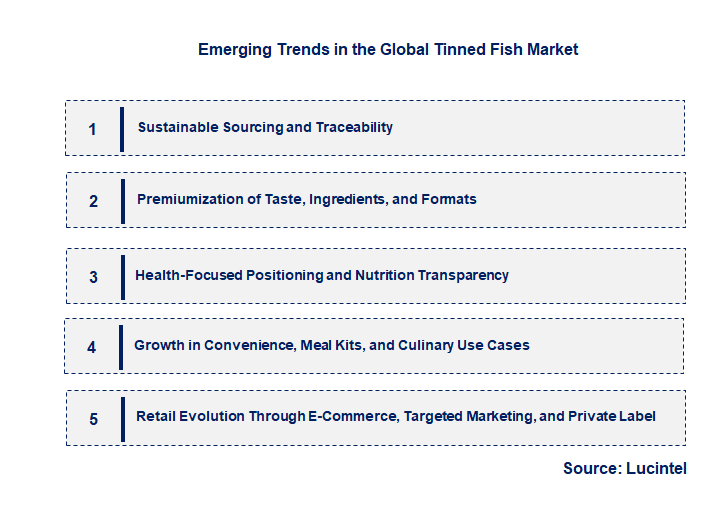
Emerging Trends in the Tinned Fish Market

Recent Development in the Tinned Fish Market

Recent shifts in fishing regulations, consumer health priorities, and logistics costs are reshaping the tinned fish market. Manufacturers are upgrading sourcing, improving shelf life and taste, and expanding into new channels where convenience matters. Meanwhile, retailers and foodservice buyers seek reliable volumes and transparent origin data. Over the last few years, several developments have accelerated demand for premium and value packs alike. Together, they influence pricing, distribution, product formats, and sustainability credentials across regions especially in Europe, Asia, and Americas.

• Sustainable Sourcing With Full Traceability Enhances Trust: Companies are moving toward MSC- or equivalent-certified fisheries, publishing catch locations, gear type, and labor standards. Digital lot tracking and third-party audits reduce reputation risk and help brands justify premium pricing. This is especially effective for anchovies, sardines, and mackerel sold as giftable or “everyday gourmet” tins. Retailers increasingly demand documented sustainability to meet due-diligence rules. As more suppliers meet traceability requirements, production planning stabilizes, enabling consistent supply and lower discounting for both supermarkets and independent stores that compete locally.
• Health And Better-For-You Recipes Drive Demand For Low-Sodium Protein: Consumers continue shifting to high-protein, heart-health, and lower-sodium diets, prompting reformulation of brines, sauces, and portion sizes. Brands are launching natural juices, olive-oil packs, and skinless fillets to reduce preparation steps while preserving taste. Clear nutrition panels, fewer additives, and omega-3 messaging support both home use and workplace meals. Foodservice operators favor predictable flavor profiles for salads, pastas, and rice bowls. Together, these changes expand the target segment beyond traditional canned-fish loyalists particularly among younger consumers seeking convenient everyday nutrition.
• Flavor Innovation And Premiumization Create Differentiated Tinned Choices: Producers are investing in new flavor systems—smoked, roasted garlic, lemon-pepper, chili, and Mediterranean herb blends—while improving texture through better fish cuts and refined packing processes. This premiumization appears in smaller “meals for one,” multipack samplers, and upscale brand collaborations with chefs. Better filling consistency and can coatings also reduce off-notes, extending perceived freshness after opening. As shoppers trade up, retailers allocate more shelf space to distinctive variants and seasonal editions. Growth also comes from value-tier lines that match trends closely.
• Expansion In Emerging Retail And Foodservice Channels Broadens Volume: Distribution is widening through modern grocery chains, discount retailers, and convenience stores in Asia, Latin America, and parts of Africa. Many entrants localize packaging languages, create regional flavors, and optimize case sizes for high-turn shelving. Partnerships with wholesalers help navigate import rules, cold-chain alternatives, and changing tariffs. In foodservice, tinned fish is increasingly used for quick protein in school lunches, and ready-to-eat salads. As category awareness rises, repeat purchases follow through bundle promotions and loyalty programs tied to multipack consumption.
• E-Commerce And Smarter Supply Chains Improve Availability And Margin: Online grocery and D2C subscriptions are boosting demand for shelf-stable protein, especially during peak cooking seasons. Retailers enhance searchability with dietary tags, variety packs, and recipe content that converts browsers into repeat buyers. Meanwhile, manufacturers use demand forecasting, automated canning-line scheduling, and optimized freight planning to reduce lead times and stockouts. Better inventory visibility also helps manage raw fish price volatility through longer purchasing windows and flexible sourcing. These logistics upgrades lower total cost-to-serve, protecting margins while maintaining delivery performance.

Across the tinned fish market, sustainability traceability, health-focused reformulation, and flavor premiumization are raising consumer confidence and willingness to pay. Channel expansion in retail and foodservice is widening household reach and improving repeat purchase behavior, while e-commerce and supply-chain analytics are stabilizing availability and protecting margins. Together, these developments shift the category from commodity tins to differentiated meal solutions. For suppliers, it means more investment opportunities, stronger brand building, and resilience against input-cost volatility, ultimately supporting competition and demand growth.

Strategic Growth Opportunities in the Tinned Fish Market

The tinned fish market can expand as consumers seek affordable, shelf-stable protein with consistent quality and better taste. Urbanization, female workforce growth, and climate-related supply uncertainty increase demand for reliable pantry items. Meanwhile, retailers want differentiated SKUs, private-label opportunities, and traceability credentials to meet safety regulations. New product formats, regional flavors, and value packs can strengthen repeat purchase. Strategic partnerships with distributors, e-commerce channels, and foodservice buyers can convert seasonal demand into steady volume across households, retailers, and institutional menus.

• Position Healthier Variants With Clear Nutrition And Convenience Segments: Develop lower-sodium, reduced-oil, and omega-3-rich recipes, using transparent labels for calories, salt, and bones. Target segments such as weight management seekers, fitness consumers, and seniors who need soft-texture options. Introduce ready-to-eat bowls, pull-tab snack packs, and single-serve cups to reduce meal friction. Use allergen and histamine controls to enhance trust. Offer cooking guidance and pairing suggestions for ethnic cuisines, turning tins into everyday protein rather than emergency food. Promote subscription multi-packs through retailers and D2C to drive repeat purchase cycles.
• Embed Sustainability And Traceability Into Every Brand Promise: Secure long-term sourcing via certified fisheries and responsible aquaculture, then communicate outcomes through QR-enabled traceability, including catch dates, vessel details, and CO2 estimates. Implement sustainable packaging such as recyclable cans and paper-based sleeves, and publish improvement milestones. Create eco-claims governance to avoid greenwashing risk. Target procurement buyers for supermarkets and exporters who require documentation for compliance. Partner with NGOs and independent auditors to validate impacts, strengthening premium pricing potential and loyalty while reassuring shoppers about quality and responsible harvesting practices.
• Launch Localized Flavors And Culinary Formats To Win Lapsed Buyers: Expand beyond classic varieties by launching regional Mediterranean, Asian, and Latin-seasoned lines with sauces like chili-lime, smoked paprika, and garlic-herb. Offer diversified textures—chunked, flaked, and pâté-style—plus deboned options for kids and older consumers. Co-create recipes with chefs and community influencers, then feature pairings for tacos, salads, and pasta. Run limited-time promotions tied to cultural calendars to build trial, then convert to core listings through consistent supply planning and shelf-test learning. Track repeat rates via programs and optimize pack sizes accordingly.
• Scale Distribution Through E-Commerce, Retail Multipacks, And Foodservice: Build omnichannel reach by partnering with grocery platforms, online marketplaces, and subscription meal services, ensuring fast delivery and clear nutrition images. Package for retail velocity using multipacks by household size and cooking occasion, such as lunchboxes or quick dinners. Target foodservice operators—cafeterias, airlines, disaster relief—where shelf stability reduces inventory risk. Provide bulk pricing, spec sheets, and logistical support for tendering. Adapt labeling to local language and compliance, then monitor sell-through to adjust assortments seasonally with localized marketing creatives and funding.
• Optimize Pricing With Smarter Cans, Portions, And Value Bundles: Introduce cost-effective formats such as smaller 60–120g tins, twin packs, and refillable pouch systems where regulations allow, reducing per-serving price barriers. Use advanced can coatings to maintain flavor and color, extending shelf life beyond typical expectations. Design easy-open ergonomics and portion markings for faster consumer use. Offer mix-and-match variety bundles to reduce purchase risk, and align promotion cadence with inflation cycles. Strengthen supply planning and procurement hedging to stabilize raw fish costs, protecting margins while improving satisfaction and repeat buying.

Collectively, these growth opportunities can lift category penetration and margin by meeting evolving dietary, convenience, and trust needs. Health-forward reformulation and portioned formats broaden appeal beyond traditional buyers, while sustainability and traceability strengthen brand credibility. Geographic expansion and retail/foodservice channel strategies convert awareness into recurring purchases. Product innovation and localized flavors improve differentiation against substitutes like pasta, legumes, and refrigeration-based seafood. If executed with strong procurement, compliance, and marketing discipline, the tinned fish market can achieve volume growth and profitability.

Tinned Fish Market Driver and Challenges

The tinned fish market growth is shaped by intertwined technological, economic, and regulatory forces. On the technology side, advances in canning processes, shelf life extension, quality control, and packaging materials improve consistency, safety, and product appeal. Economically, shifts in consumer demand, income levels, inflation, and seafood price volatility influence purchasing patterns and retailer stocking strategies. Regulatory factors including food safety standards, labeling rules, sustainability requirements, and import export compliance determine market access and operating costs. Together, these drivers and challenges affect availability, pricing, brand trust, and long term demand across domestic and international channels, making the market highly sensitive to both operational and policy changes.

The factors responsible for driving the tinned fish market include
• Product innovation and improved shelf life: Enhanced sterilization and retort technologies, combined with better thermal processing controls, reduce variability in texture and flavor while extending shelf life. New product formats such as pull-tab cans, easy open ends, and resealable variants support convenience and modern consumption habits. Flavor diversification and healthier formulations also help broaden target groups, including health focused consumers seeking lower sodium or added omega 3 convenience. These improvements reduce spoilage and returns for retailers, enabling wider distribution and more reliable inventory planning. As households prioritize quick meals, consistent quality at room temperature strengthens repeat purchases. Over time, better product engineering can raise customer loyalty and support premium pricing where consumers trust the safety and taste of canned offerings.
• Rising demand for affordable protein and convenience: Economic pressures and changing meal patterns encourage consumers to choose shelf stable protein that is easy to store and prepare. Tinned fish offers a fast alternative to fresh seafood, especially for busy consumers, smaller households, and areas with limited access to consistent cold chain logistics. When grocery budgets tighten, canned fish often competes favorably versus fresh fish, supporting volume sales during periods of higher seafood prices. The convenience factor also aligns with the growth of home cooking, workday snacking, and travel needs, where low preparation time matters. This driver expands demand across mainstream and value channels, including discount retailers and online grocery baskets. Increased pantry stocking further boosts sales stability throughout the year.
• Expansion of retail channels and e commerce distribution: Wider availability through supermarkets, convenience stores, club stores, and online platforms improves reach and visibility for tinned fish brands. Better logistics and supply chain planning reduce stock outs and improve product availability in local markets. Retailers increasingly use data driven assortment strategies, promoting core SKUs and seasonal varieties to match regional preferences. E commerce accelerates discovery through reviews, subscription style bundles, and targeted promotions, especially for niche products such as smoked, flavored, or low sodium fish. Subscription programs and multipack offerings can smooth demand and reduce customer acquisition costs. Strong channel execution supports brand building and allows manufacturers to test new flavors with lower risk via limited runs.
• Sustainability and responsible sourcing initiatives: Increasing scrutiny of fishing practices and environmental impact pushes companies to adopt sourcing standards, traceability, and certification programs. Responsible sourcing reduces reputational risk and supports access to retail buyers that require documented sustainability metrics. Improved traceability systems using lot level tracking and supplier audits help assure compliance with evolving sustainability expectations. Consumers also show growing interest in ethical consumption, which can translate into higher acceptance of premium canned products when credible sourcing claims are verified. These initiatives may help stabilize raw material supply by strengthening relationships with fisheries and aquaculture partners. In turn, procurement planning becomes more resilient to disruptions, helping maintain production continuity and market supply.

The challenges facing the tinned fish market include:
• Fluctuating raw material costs and supply disruptions: Prices for fish and fishmeal can swing due to overfishing constraints, shifting quotas, climate related impacts, and changes in global demand. These fluctuations directly affect manufacturing costs, which can pressure margins if companies cannot pass costs to retailers and consumers. Supply disruptions also occur from regulatory enforcement against illegal fishing and from extreme weather affecting harvesting and transportation. Manufacturers may respond with longer contracts, alternative sourcing, and recipe adjustments, but these actions can affect product consistency and customer perception. Volatile costs can also lead to promotional intensity, which may weaken brand equity over time. Effective procurement, hedging strategies, and flexible production planning become essential to maintain stable pricing and avoid shortages that harm retailer confidence.
• Strict food safety, labeling, and compliance requirements: The market operates under rigorous standards for sterilization efficacy, contaminant limits, and process verification. Compliance failures can lead to product recalls, fines, and long term brand damage, which are particularly costly for packaged seafood. Labeling rules covering ingredients, nutritional information, allergen statements, and claims such as “low sodium” or “sustainably sourced” vary by region and must be carefully validated. Additionally, import and export documentation requirements increase administrative burden, slowing market entry or expansion. Changing regulatory frameworks around mercury levels, histamine controls, and packaging migration testing further increase technical workload. To manage these pressures, firms must invest in quality management systems, audit readiness, and supplier controls, raising overhead and influencing smaller players’ ability to compete.
• Consumer health concerns and shift toward fresh or alternative proteins: While tinned fish is convenient, consumers may worry about sodium content, added oils, packaging chemicals, and long term health effects associated with frequent consumption of processed foods. Skepticism can intensify when marketing claims are not substantiated or when taste and texture are perceived as inferior to fresh fish. Competing against fresh seafood and alternative proteins such as plant based seafood or cultured options can cap growth in certain segments. Regulatory attention on nutrition labeling and health claims may force reformulations that raise production complexity. Companies must manage brand trust by improving nutritional profiles, clarifying sourcing and processing details, and refining sensory quality. Balancing health positioning with affordability is critical during periods of intense consumer scrutiny.


The tinned fish market is propelled by technological improvements that enhance safety, shelf life, and product consistency, alongside strong demand for affordable, convenient protein. Retail expansion and e commerce further broaden access and improve purchase frequency, while sustainability and responsible sourcing initiatives support buyer requirements and strengthen brand credibility. However, the market faces significant constraints from volatile raw material costs and supply disruptions, strict food safety and labeling compliance burdens, and evolving consumer preferences influenced by health concerns and competing protein formats. Overall, the ability to maintain consistent quality, manage regulatory risk, and deliver value in a fluctuating cost environment will determine how growth opportunities are realized across regions and channels.

List of Tinned Fish Companies

Companies in the market compete on the basis of product quality offered. Major players in this market focus on expanding their manufacturing facilities, R&D investments, infrastructural development, and leverage integration opportunities across the value chain. With these strategies tinned fish companies cater increasing demand, ensure competitive effectiveness, develop innovative products & technologies, reduce production costs, and expand their customer base. Some of the tinned fish companies profiled in this report include-
• Thai Union Group PCL
• Dongwon Industries Co. Ltd.
• Bolton Group S.r.l.
• Bumble Bee Seafoods
• Maruha Nichiro Corp.
• Century Pacific Food Inc.
• Grupo Calvo
• Nissui Corporation
• Trident Seafoods Corporation
• Alimentos Prosalud

Tinned Fish Market by Segment

The study includes a forecast for the global tinned fish market by product type, price, fish source, distribution channel, and region.

Tinned Fish Market by Product Type [Value from 2019 to 2035]:


• Tuna
• Salmon
• Sardines
• Mackerel
• Anchovies
• Others

Tinned Fish Market by Price [Value from 2019 to 2035]:


• Mass
• Premium

Tinned Fish Market by Fish Source [Value from 2019 to 2035]:


• Wild-caught
• Farm-raised

Tinned Fish Market by Distribution Channel [Value from 2019 to 2035]:


• Supermarkets & Hypermarkets
• Convenience Stores
• Specialty Stores
• Online Retail Stores
• Others

Tinned Fish Market by Region [Value from 2019 to 2035]:


• North America
• Europe
• Asia Pacific
• The Rest of the World

Country Wise Outlook for the Tinned Fish Market

The tinned fish remains a steady, value-driven category as consumers look for convenient protein, longer shelf life, and pandemic-era cooking habits that have persisted. Recent developments have been shaped by seafood supply variability, shifting shipping and input costs, and evolving consumer preferences for cleaner labels and sustainability. Across the United States, China, Germany, India, and Japan, manufacturers and retailers are responding with new product formats, expanded flavor and ingredient options, tighter sourcing and traceability, and targeted distribution through grocery, e-commerce, and foodservice channels. Regulatory pressure on labeling and sustainability claims is also increasing, pushing companies toward stronger documentation and responsible sourcing while managing price volatility.

• United States: Demand has stayed resilient due to affordability and convenience, with growth supported by meals-at-home trends and higher interest in protein-dense pantry items. Product innovation is focusing on “ready-to-eat” positioning, microwaveable or pull-tab formats, and bolder flavor profiles such as smoky, spicy, and Mediterranean-style preparations. Retailers are also emphasizing transparency around sourcing, including better specification of species, catch regions, and packing dates. Sustainability messaging is becoming more prominent as consumers scrutinize environmental credentials. Meanwhile, supply-side pressure from volatile wild catches and freight costs continues to affect pricing, prompting suppliers to adjust pack sizes and promotional strategies to protect volume.
• China: The market is being influenced by modernization of processing capacity, improving quality control, and greater brand visibility in urban retail and e-commerce. Growth is supported by demand for shelf-stable seafood that fits fast, convenient home cooking and instant meal trends. Manufacturers are expanding variety beyond traditional staples, including higher-end tuna and sardine lines, diversified seasonings, and more health-oriented options such as lower-salt variants where feasible. Traceability and compliance are also strengthening, driven by tighter inspection regimes and increasing consumer expectations. Geopolitical and ocean-sourcing constraints can cause shifts in species availability and raw material costs, so firms are leaning on flexible sourcing strategies and optimized production scheduling to stabilize supply.
• Germany: German consumers continue to favor quality, origin clarity, and environmentally responsible seafood, which is pushing packers toward stronger documentation and more consistent labeling. Recent activity includes broader assortments from mainstream grocery to premium specialty counters, with particular attention to tuna, mackerel, and herring in recognizable European taste profiles. Many brands are responding to salt and additive concerns by reformulating for “clean label” positioning and clearer ingredient lists. Sustainability scrutiny remains intense, encouraging use of certified sources where possible and improved communication of fishing methods and certifications. Logistics and energy costs have also influenced pricing, leading retailers to favor promotions, smaller pack sizes, and occasional lineup refreshes to maintain shopper affordability.
• India: Tinned fish demand is supported by a large population relying on affordable, shelf-stable protein, along with rising urbanization and improved retail penetration. Recent developments include increased focus on hygiene, packaging improvements, and better consistency in taste and texture, which help expand repeat purchases. Producers are introducing more flavor variants aligned with local preferences, including spicier gravies and regional seasoning blends, while also increasing availability in mainstream supermarkets and convenience stores. Some companies are strengthening traceability to support export opportunities and compliance expectations. Price volatility from fish inputs and currency-linked costs can quickly affect shelf pricing, so manufacturers often manage margins through formulation adjustments, optimized sourcing, and varied pack sizes.
• Japan: In Japan, tinned fish continues to benefit from its role in everyday “pantry cooking,” bento culture, and quick meal preparation. Recent shifts emphasize higher quality ingredients, refined seasonings, and more convenient consumption formats that fit modern lifestyles. Consumers are showing continued interest in premium tuna and mackerel offerings, as well as season-specific or region-specific flavors. Sustainability and legality of sourcing remain critical, with companies investing in traceability systems and documentation to maintain trust. Packaging and branding are also evolving, including clearer cooking guidance and improved usability for home preparation. Supply conditions, including changes in catch availability and import costs, influence product lineup and pricing, prompting retailers to balance affordability with consistent quality.

Lucintel Analytics Dashboard

Features of the Global Tinned Fish Market

Market Size Estimates: Tinned fish market size estimation in terms of value ($B).
Trend and Forecast Analysis: Market trends (2019 to 2025) and forecast (2026 to 2035) by various segments and regions.
Segmentation Analysis: Tinned fish market size by various segments, such as by product type, price, fish source, distribution channel, and region in terms of value ($B).
Regional Analysis: Tinned fish market breakdown by North America, Europe, Asia Pacific, and Rest of the World.
Growth Opportunities: Analysis of growth opportunities in different product types, prices, fish sources, distribution channels, and regions for the tinned fish market.
Strategic Analysis: This includes M&A, new product development, and competitive landscape of the tinned fish market.
Analysis of competitive intensity of the industry based on Porter’s Five Forces model.

Lucintel Consulting Services

FAQ

Q1. What is the tinned fish market size?
Answer: The global tinned fish market is expected to reach an estimated $24 billion by 2035.
Q2. What is the growth forecast for tinned fish market?
Answer: The global tinned fish market is expected to grow with a CAGR of 5.1% from 2026 to 2035.
Q3. What are the major drivers influencing the growth of the tinned fish market?
Answer: The major drivers for this market are the increasing demand for convenient protein rich foods, the rising preference for long shelf life seafood products, and the growing consumption of ready to eat fish products.
Q4. What are the major segments for tinned fish market?
Answer: The future of the tinned fish market looks promising with opportunities in the tuna, sardine, mackerel, and anchovy markets.
Q5. Who are the key tinned fish market companies?
Answer: Some of the key tinned fish companies are as follows:
• Thai Union Group PCL
• Dongwon Industries Co. Ltd.
• Bolton Group S.r.l.
• Bumble Bee Seafoods
• Maruha Nichiro Corp.
• Century Pacific Food Inc.
• Grupo Calvo
• Nissui Corporation
• Trident Seafoods Corporation
• Alimentos Prosalud
Q6. Which tinned fish market segment will be the largest in future?
Answer: Lucintel forecasts that, within the distribution channel category, online retail store is expected to witness the highest growth over the forecast period.
Q7. In tinned fish market, which region is expected to be the largest in next 8 years?
Answer: In terms of region, APAC is expected to witness the highest growth over the forecast period.
Q8. Do we receive customization in this report?
Answer: Yes, Lucintel provides 10% customization without any additional cost.

This report answers following 11 key questions:

Q.1. What are some of the most promising, high-growth opportunities for the tinned fish market by product type (tuna, salmon, sardines, mackerel, anchovies, and others), price (mass and premium), fish source (wild-caught and farm-raised), distribution channel (supermarkets & hypermarkets, convenience stores, specialty stores, online retail stores, and others), and region (North America, Europe, Asia Pacific, and the Rest of the World)?
Q.2. Which segments will grow at a faster pace and why?
Q.3. Which region will grow at a faster pace and why?
Q.4. What are the key factors affecting market dynamics? What are the key challenges and business risks in this market?
Q.5. What are the business risks and competitive threats in this market?
Q.6. What are the emerging trends in this market and the reasons behind them?
Q.7. What are some of the changing demands of customers in the market?
Q.8. What are the new developments in the market? Which companies are leading these developments?
Q.9. Who are the major players in this market? What strategic initiatives are key players pursuing for business growth?
Q.10. What are some of the competing products in this market and how big of a threat do they pose for loss of market share by material or product substitution?
Q.11. What M&A activity has occurred in the last 7 years and what has its impact been on the industry?

For any questions related to Tinned Fish Market, Tinned Fish Market Size, Tinned Fish Market Growth, Tinned Fish Market Analysis, Tinned Fish Market Report, Tinned Fish Market Share, Tinned Fish Market Trends, Tinned Fish Market Forecast, Tinned Fish Companies, write Lucintel analyst at email: helpdesk@lucintel.com. We will be glad to get back to you soon.
                                           Table of Contents

            1. Executive Summary

            2. Market Overview

                        2.1 Background and Classifications
                        2.2 Supply Chain

            3. Market Trends & Forecast Analysis

                        3.1 Macroeconomic Trends and Forecasts
                        3.2 Industry Drivers and Challenges
                        3.3 PESTLE Analysis
                        3.4 Patent Analysis
                        3.5 Regulatory Environment
                        3.6 Global Tinned Fish Market Trends and Forecast

            4. Global Tinned Fish Market by Product Type

                        4.1 Overview
                        4.2 Attractiveness Analysis by Product Type
                        4.3 Tuna : Trends and Forecast (2019 to 2035)
                        4.4 Salmon : Trends and Forecast (2019 to 2035)
                        4.5 Sardines : Trends and Forecast (2019 to 2035)
                        4.6 Mackerel : Trends and Forecast (2019 to 2035)
                        4.7 Anchovies : Trends and Forecast (2019 to 2035)
                        4.8 Others : Trends and Forecast (2019 to 2035)

            5. Global Tinned Fish Market by Price

                        5.1 Overview
                        5.2 Attractiveness Analysis by Price
                        5.3 Mass : Trends and Forecast (2019 to 2035)
                        5.4 Premium : Trends and Forecast (2019 to 2035)

            6. Global Tinned Fish Market by Fish Source

                        6.1 Overview
                        6.2 Attractiveness Analysis by Fish Source
                        6.3 Wild-caught : Trends and Forecast (2019 to 2035)
                        6.4 Farm-raised : Trends and Forecast (2019 to 2035)

            7. Global Tinned Fish Market by Distribution Channel

                        7.1 Overview
                        7.2 Attractiveness Analysis by Distribution Channel
                        7.3 Supermarkets & Hypermarkets : Trends and Forecast (2019 to 2035)
                        7.4 Convenience Stores : Trends and Forecast (2019 to 2035)
                        7.5 Specialty Stores : Trends and Forecast (2019 to 2035)
                        7.6 Online Retail Stores : Trends and Forecast (2019 to 2035)
                        7.7 Others : Trends and Forecast (2019 to 2035)

            8. Regional Analysis

                        8.1 Overview
                        8.2 Global Tinned Fish Market by Region

            9. North American Tinned Fish Market

                        9.1 Overview
                        9.2 North American Tinned Fish Market by Product Type
                        9.3 North American Tinned Fish Market by Fish Source
                        9.4 The United States Tinned Fish Market
                        9.5 Canadian Tinned Fish Market
                        9.6 Mexican Tinned Fish Market

            10. European Tinned Fish Market

                        10.1 Overview
                        10.2 European Tinned Fish Market by Product Type
                        10.3 European Tinned Fish Market by Fish Source
                        10.4 German Tinned Fish Market
                        10.5 French Tinned Fish Market
                        10.6 Italian Tinned Fish Market
                        10.7 Spanish Tinned Fish Market
                        10.8 The United Kingdom Tinned Fish Market

            11. APAC Tinned Fish Market

                        11.1 Overview
                        11.2 APAC Tinned Fish Market by Product Type
                        11.3 APAC Tinned Fish Market by Fish Source
                        11.4 Chinese Tinned Fish Market
                        11.5 Indian Tinned Fish Market
                        11.6 Japanese Tinned Fish Market
                        11.7 South Korean Tinned Fish Market
                        11.8 Indonesian Tinned Fish Market

            12. ROW Tinned Fish Market

                        12.1 Overview
                        12.2 ROW Tinned Fish Market by Product Type
                        12.3 ROW Tinned Fish Market by Fish Source
                        12.4 Middle Eastern Tinned Fish Market
                        12.5 South American Tinned Fish Market
                        12.6 African Tinned Fish Market

            13. Competitor Analysis

                        13.1 Product Portfolio Analysis
                        13.2 Operational Integration
                        13.3 Porter’s Five Forces Analysis
                                    • Competitive Rivalry
                                    • Bargaining Power of Buyers
                                    • Bargaining Power of Suppliers
                                    • Threat of Substitutes
                                    • Threat of New Entrants
                        13.4 Market Share Analysis

            14. Opportunities & Strategic Analysis

                        14.1 Value Chain Analysis
                        14.2 Growth Opportunity Analysis
                                    14.2.1 Growth Opportunity by Product Type
                                    14.2.2 Growth Opportunity by Price
                                    14.2.3 Growth Opportunity by Fish Source
                                    14.2.4 Growth Opportunity by Distribution Channel
                                    14.2.5 Growth Opportunity by Region
                        14.3 Emerging Trends in the Global Tinned Fish Market
                        14.4 Strategic Analysis
                                    14.4.1 New Product Development
                                    14.4.2 Certification and Licensing
                                    14.4.3 Mergers, Acquisitions, Agreements, Collaborations, and Joint Ventures

            15. Company Profiles of the Leading Players Across the Value Chain

                        15.1 Competitive Analysis Overview
                        15.2 Thai Union Group PCL
                                    • Company Overview
                                    • Tinned Fish Market Business Overview
                                    • New Product Development
                                    • Merger, Acquisition, and Collaboration
                                    • Certification and Licensing
                        15.3 Dongwon Industries Co. Ltd.
                                    • Company Overview
                                    • Tinned Fish Market Business Overview
                                    • New Product Development
                                    • Merger, Acquisition, and Collaboration
                                    • Certification and Licensing
                        15.4 Bolton Group S.r.l.
                                    • Company Overview
                                    • Tinned Fish Market Business Overview
                                    • New Product Development
                                    • Merger, Acquisition, and Collaboration
                                    • Certification and Licensing
                        15.5 Bumble Bee Seafoods
                                    • Company Overview
                                    • Tinned Fish Market Business Overview
                                    • New Product Development
                                    • Merger, Acquisition, and Collaboration
                                    • Certification and Licensing
                        15.6 Maruha Nichiro Corp.
                                    • Company Overview
                                    • Tinned Fish Market Business Overview
                                    • New Product Development
                                    • Merger, Acquisition, and Collaboration
                                    • Certification and Licensing
                        15.7 Century Pacific Food Inc.
                                    • Company Overview
                                    • Tinned Fish Market Business Overview
                                    • New Product Development
                                    • Merger, Acquisition, and Collaboration
                                    • Certification and Licensing
                        15.8 Grupo Calvo
                                    • Company Overview
                                    • Tinned Fish Market Business Overview
                                    • New Product Development
                                    • Merger, Acquisition, and Collaboration
                                    • Certification and Licensing
                        15.9 Nissui Corporation
                                    • Company Overview
                                    • Tinned Fish Market Business Overview
                                    • New Product Development
                                    • Merger, Acquisition, and Collaboration
                                    • Certification and Licensing
                        15.10 Trident Seafoods Corporation
                                    • Company Overview
                                    • Tinned Fish Market Business Overview
                                    • New Product Development
                                    • Merger, Acquisition, and Collaboration
                                    • Certification and Licensing
                        15.11 Alimentos Prosalud
                                    • Company Overview
                                    • Tinned Fish Market Business Overview
                                    • New Product Development
                                    • Merger, Acquisition, and Collaboration
                                    • Certification and Licensing

            16. Appendix

                        16.1 List of Figures
                        16.2 List of Tables
                        16.3 Research Methodology
                        16.4 Disclaimer
                        16.5 Copyright
                        16.6 Abbreviations and Technical Units
                        16.7 About Us
                        16.8 Contact Us

                                               List of Figures


            Chapter 1

                        Figure 1.1: Trends and Forecast for the Global Tinned Fish Market

            Chapter 2

                        Figure 2.1: Usage of Tinned Fish Market
                        Figure 2.2: Classification of the Global Tinned Fish Market
                        Figure 2.3: Supply Chain of the Global Tinned Fish Market

            Chapter 3

                        Figure 3.1: Trends of the Global GDP Growth Rate
                        Figure 3.2: Trends of the Global Population Growth Rate
                        Figure 3.3: Trends of the Global Inflation Rate
                        Figure 3.4: Trends of the Global Unemployment Rate
                        Figure 3.5: Trends of the Regional GDP Growth Rate
                        Figure 3.6: Trends of the Regional Population Growth Rate
                        Figure 3.7: Trends of the Regional Inflation Rate
                        Figure 3.8: Trends of the Regional Unemployment Rate
                        Figure 3.9: Trends of Regional Per Capita Income
                        Figure 3.10: Forecast for the Global GDP Growth Rate
                        Figure 3.11: Forecast for the Global Population Growth Rate
                        Figure 3.12: Forecast for the Global Inflation Rate
                        Figure 3.13: Forecast for the Global Unemployment Rate
                        Figure 3.14: Forecast for the Regional GDP Growth Rate
                        Figure 3.15: Forecast for the Regional Population Growth Rate
                        Figure 3.16: Forecast for the Regional Inflation Rate
                        Figure 3.17: Forecast for the Regional Unemployment Rate
                        Figure 3.18: Forecast for Regional Per Capita Income
                        Figure 3.19: Driver and Challenges of the Tinned Fish Market

            Chapter 4

                        Figure 4.1: Global Tinned Fish Market by Product Type in 2019, 2025, and 2035
                        Figure 4.2: Trends of the Global Tinned Fish Market ($B) by Product Type
                        Figure 4.3: Forecast for the Global Tinned Fish Market ($B) by Product Type
                        Figure 4.4: Trends and Forecast for Tuna in the Global Tinned Fish Market (2019-2035)
                        Figure 4.5: Trends and Forecast for Salmon in the Global Tinned Fish Market (2019-2035)
                        Figure 4.6: Trends and Forecast for Sardines in the Global Tinned Fish Market (2019-2035)
                        Figure 4.7: Trends and Forecast for Mackerel in the Global Tinned Fish Market (2019-2035)
                        Figure 4.8: Trends and Forecast for Anchovies in the Global Tinned Fish Market (2019-2035)
                        Figure 4.9: Trends and Forecast for Others in the Global Tinned Fish Market (2019-2035)

            Chapter 5

                        Figure 5.1: Global Tinned Fish Market by Price in 2019, 2025, and 2035
                        Figure 5.2: Trends of the Global Tinned Fish Market ($B) by Price
                        Figure 5.3: Forecast for the Global Tinned Fish Market ($B) by Price
                        Figure 5.4: Trends and Forecast for Mass in the Global Tinned Fish Market (2019-2035)
                        Figure 5.5: Trends and Forecast for Premium in the Global Tinned Fish Market (2019-2035)

            Chapter 6

                        Figure 6.1: Global Tinned Fish Market by Fish Source in 2019, 2025, and 2035
                        Figure 6.2: Trends of the Global Tinned Fish Market ($B) by Fish Source
                        Figure 6.3: Forecast for the Global Tinned Fish Market ($B) by Fish Source
                        Figure 6.4: Trends and Forecast for Wild-caught in the Global Tinned Fish Market (2019-2035)
                        Figure 6.5: Trends and Forecast for Farm-raised in the Global Tinned Fish Market (2019-2035)

            Chapter 7

                        Figure 7.1: Global Tinned Fish Market by Distribution Channel in 2019, 2025, and 2035
                        Figure 7.2: Trends of the Global Tinned Fish Market ($B) by Distribution Channel
                        Figure 7.3: Forecast for the Global Tinned Fish Market ($B) by Distribution Channel
                        Figure 7.4: Trends and Forecast for Supermarkets & Hypermarkets in the Global Tinned Fish Market (2019-2035)
                        Figure 7.5: Trends and Forecast for Convenience Stores in the Global Tinned Fish Market (2019-2035)
                        Figure 7.6: Trends and Forecast for Specialty Stores in the Global Tinned Fish Market (2019-2035)
                        Figure 7.7: Trends and Forecast for Online Retail Stores in the Global Tinned Fish Market (2019-2035)
                        Figure 7.8: Trends and Forecast for Others in the Global Tinned Fish Market (2019-2035)

            Chapter 8

                        Figure 8.1: Trends of the Global Tinned Fish Market ($B) by Region (2019-2025)
                        Figure 8.2: Forecast for the Global Tinned Fish Market ($B) by Region (2026-2035)

            Chapter 9

                        Figure 9.1: Trends and Forecast for the North American Tinned Fish Market (2019-2035)
                        Figure 9.2: North American Tinned Fish Market by Product Type in 2019, 2025, and 2035
                        Figure 9.3: Trends of the North American Tinned Fish Market ($B) by Product Type (2019-2025)
                        Figure 9.4: Forecast for the North American Tinned Fish Market ($B) by Product Type (2026-2035)
                        Figure 9.5: North American Tinned Fish Market by Price in 2019, 2025, and 2035
                        Figure 9.6: Trends of the North American Tinned Fish Market ($B) by Price (2019-2025)
                        Figure 9.7: Forecast for the North American Tinned Fish Market ($B) by Price (2026-2035)
                        Figure 9.8: Trends and Forecast for the United States Tinned Fish Market ($B) (2019-2035)
                        Figure 9.9: Trends and Forecast for the Mexican Tinned Fish Market ($B) (2019-2035)
                        Figure 9.10: Trends and Forecast for the Canadian Tinned Fish Market ($B) (2019-2035)

            Chapter 10

                        Figure 10.1: Trends and Forecast for the European Tinned Fish Market (2019-2035)
                        Figure 10.2: European Tinned Fish Market by Product Type in 2019, 2025, and 2035
                        Figure 10.3: Trends of the European Tinned Fish Market ($B) by Product Type (2019-2025)
                        Figure 10.4: Forecast for the European Tinned Fish Market ($B) by Product Type (2026-2035)
                        Figure 10.5: European Tinned Fish Market by Price in 2019, 2025, and 2035
                        Figure 10.6: Trends of the European Tinned Fish Market ($B) by Price (2019-2025)
                        Figure 10.7: Forecast for the European Tinned Fish Market ($B) by Price (2026-2035)
                        Figure 10.8: Trends and Forecast for the German Tinned Fish Market ($B) (2019-2035)
                        Figure 10.9: Trends and Forecast for the French Tinned Fish Market ($B) (2019-2035)
                        Figure 10.10: Trends and Forecast for the Spanish Tinned Fish Market ($B) (2019-2035)
                        Figure 10.11: Trends and Forecast for the Italian Tinned Fish Market ($B) (2019-2035)
                        Figure 10.12: Trends and Forecast for the United Kingdom Tinned Fish Market ($B) (2019-2035)

            Chapter 11

                        Figure 11.1: Trends and Forecast for the APAC Tinned Fish Market (2019-2035)
                        Figure 11.2: APAC Tinned Fish Market by Product Type in 2019, 2025, and 2035
                        Figure 11.3: Trends of the APAC Tinned Fish Market ($B) by Product Type (2019-2025)
                        Figure 11.4: Forecast for the APAC Tinned Fish Market ($B) by Product Type (2026-2035)
                        Figure 11.5: APAC Tinned Fish Market by Price in 2019, 2025, and 2035
                        Figure 11.6: Trends of the APAC Tinned Fish Market ($B) by Price (2019-2025)
                        Figure 11.7: Forecast for the APAC Tinned Fish Market ($B) by Price (2026-2035)
                        Figure 11.8: Trends and Forecast for the Japanese Tinned Fish Market ($B) (2019-2035)
                        Figure 11.9: Trends and Forecast for the Indian Tinned Fish Market ($B) (2019-2035)
                        Figure 11.10: Trends and Forecast for the Chinese Tinned Fish Market ($B) (2019-2035)
                        Figure 11.11: Trends and Forecast for the South Korean Tinned Fish Market ($B) (2019-2035)
                        Figure 11.12: Trends and Forecast for the Indonesian Tinned Fish Market ($B) (2019-2035)

            Chapter 12

                        Figure 12.1: Trends and Forecast for the ROW Tinned Fish Market (2019-2035)
                        Figure 12.2: ROW Tinned Fish Market by Product Type in 2019, 2025, and 2035
                        Figure 12.3: Trends of the ROW Tinned Fish Market ($B) by Product Type (2019-2025)
                        Figure 12.4: Forecast for the ROW Tinned Fish Market ($B) by Product Type (2026-2035)
                        Figure 12.5: ROW Tinned Fish Market by Price in 2019, 2025, and 2035
                        Figure 12.6: Trends of the ROW Tinned Fish Market ($B) by Price (2019-2025)
                        Figure 12.7: Forecast for the ROW Tinned Fish Market ($B) by Price (2026-2035)
                        Figure 12.8: Trends and Forecast for the Middle Eastern Tinned Fish Market ($B) (2019-2035)
                        Figure 12.9: Trends and Forecast for the South American Tinned Fish Market ($B) (2019-2035)
                        Figure 12.10: Trends and Forecast for the African Tinned Fish Market ($B) (2019-2035)

            Chapter 13

                        Figure 13.1: Porter’s Five Forces Analysis of the Global Tinned Fish Market
                        Figure 13.2: Market Share (%) of Top Players in the Global Tinned Fish Market (2025)

            Chapter 14

                        Figure 14.1: Growth Opportunities for the Global Tinned Fish Market by Product Type
                        Figure 14.2: Growth Opportunities for the Global Tinned Fish Market by Price
                        Figure 14.3: Growth Opportunities for the Global Tinned Fish Market by Fish Source
                        Figure 14.4: Growth Opportunities for the Global Tinned Fish Market by Distribution Channel
                        Figure 14.5: Growth Opportunities for the Global Tinned Fish Market by Region
                        Figure 14.6: Emerging Trends in the Global Tinned Fish Market

                                               List of Tables


            Chapter 1

                        Table 1.1: Growth Rate (%, 2024-2025) and CAGR (%, 2026-2035) of the Tinned Fish Market by Product Type, Price, Fish Source, and Distribution Channel
                        Table 1.2: Attractiveness Analysis for the Tinned Fish Market by Region
                        Table 1.3: Global Tinned Fish Market Parameters and Attributes

            Chapter 3

                        Table 3.1: Trends of the Global Tinned Fish Market (2019-2025)
                        Table 3.2: Forecast for the Global Tinned Fish Market (2026-2035)

            Chapter 4

                        Table 4.1: Attractiveness Analysis for the Global Tinned Fish Market by Product Type
                        Table 4.2: Market Size and CAGR of Various Product Type in the Global Tinned Fish Market (2019-2025)
                        Table 4.3: Market Size and CAGR of Various Product Type in the Global Tinned Fish Market (2026-2035)
                        Table 4.4: Trends of Tuna in the Global Tinned Fish Market (2019-2025)
                        Table 4.5: Forecast for Tuna in the Global Tinned Fish Market (2026-2035)
                        Table 4.6: Trends of Salmon in the Global Tinned Fish Market (2019-2025)
                        Table 4.7: Forecast for Salmon in the Global Tinned Fish Market (2026-2035)
                        Table 4.8: Trends of Sardines in the Global Tinned Fish Market (2019-2025)
                        Table 4.9: Forecast for Sardines in the Global Tinned Fish Market (2026-2035)
                        Table 4.10: Trends of Mackerel in the Global Tinned Fish Market (2019-2025)
                        Table 4.11: Forecast for Mackerel in the Global Tinned Fish Market (2026-2035)
                        Table 4.12: Trends of Anchovies in the Global Tinned Fish Market (2019-2025)
                        Table 4.13: Forecast for Anchovies in the Global Tinned Fish Market (2026-2035)
                        Table 4.14: Trends of Others in the Global Tinned Fish Market (2019-2025)
                        Table 4.15: Forecast for Others in the Global Tinned Fish Market (2026-2035)

            Chapter 5

                        Table 5.1: Attractiveness Analysis for the Global Tinned Fish Market by Price
                        Table 5.2: Market Size and CAGR of Various Price in the Global Tinned Fish Market (2019-2025)
                        Table 5.3: Market Size and CAGR of Various Price in the Global Tinned Fish Market (2026-2035)
                        Table 5.4: Trends of Mass in the Global Tinned Fish Market (2019-2025)
                        Table 5.5: Forecast for Mass in the Global Tinned Fish Market (2026-2035)
                        Table 5.6: Trends of Premium in the Global Tinned Fish Market (2019-2025)
                        Table 5.7: Forecast for Premium in the Global Tinned Fish Market (2026-2035)

            Chapter 6

                        Table 6.1: Attractiveness Analysis for the Global Tinned Fish Market by Fish Source
                        Table 6.2: Market Size and CAGR of Various Fish Source in the Global Tinned Fish Market (2019-2025)
                        Table 6.3: Market Size and CAGR of Various Fish Source in the Global Tinned Fish Market (2026-2035)
                        Table 6.4: Trends of Wild-caught in the Global Tinned Fish Market (2019-2025)
                        Table 6.5: Forecast for Wild-caught in the Global Tinned Fish Market (2026-2035)
                        Table 6.6: Trends of Farm-raised in the Global Tinned Fish Market (2019-2025)
                        Table 6.7: Forecast for Farm-raised in the Global Tinned Fish Market (2026-2035)

            Chapter 7

                        Table 7.1: Attractiveness Analysis for the Global Tinned Fish Market by Distribution Channel
                        Table 7.2: Market Size and CAGR of Various Distribution Channel in the Global Tinned Fish Market (2019-2025)
                        Table 7.3: Market Size and CAGR of Various Distribution Channel in the Global Tinned Fish Market (2026-2035)
                        Table 7.4: Trends of Supermarkets & Hypermarkets in the Global Tinned Fish Market (2019-2025)
                        Table 7.5: Forecast for Supermarkets & Hypermarkets in the Global Tinned Fish Market (2026-2035)
                        Table 7.6: Trends of Convenience Stores in the Global Tinned Fish Market (2019-2025)
                        Table 7.7: Forecast for Convenience Stores in the Global Tinned Fish Market (2026-2035)
                        Table 7.8: Trends of Specialty Stores in the Global Tinned Fish Market (2019-2025)
                        Table 7.9: Forecast for Specialty Stores in the Global Tinned Fish Market (2026-2035)
                        Table 7.10: Trends of Online Retail Stores in the Global Tinned Fish Market (2019-2025)
                        Table 7.11: Forecast for Online Retail Stores in the Global Tinned Fish Market (2026-2035)
                        Table 7.12: Trends of Others in the Global Tinned Fish Market (2019-2025)
                        Table 7.13: Forecast for Others in the Global Tinned Fish Market (2026-2035)

            Chapter 8

                        Table 8.1: Market Size and CAGR of Various Regions in the Global Tinned Fish Market (2019-2025)
                        Table 8.2: Market Size and CAGR of Various Regions in the Global Tinned Fish Market (2026-2035)

            Chapter 9

                        Table 9.1: Trends of the North American Tinned Fish Market (2019-2025)
                        Table 9.2: Forecast for the North American Tinned Fish Market (2026-2035)
                        Table 9.3: Market Size and CAGR of Various Product Type in the North American Tinned Fish Market (2019-2025)
                        Table 9.4: Market Size and CAGR of Various Product Type in the North American Tinned Fish Market (2026-2035)
                        Table 9.5: Market Size and CAGR of Various Price in the North American Tinned Fish Market (2019-2025)
                        Table 9.6: Market Size and CAGR of Various Price in the North American Tinned Fish Market (2026-2035)
                        Table 9.7: Trends and Forecast for the United States Tinned Fish Market (2019-2035)
                        Table 9.8: Trends and Forecast for the Mexican Tinned Fish Market (2019-2035)
                        Table 9.9: Trends and Forecast for the Canadian Tinned Fish Market (2019-2035)

            Chapter 10

                        Table 10.1: Trends of the European Tinned Fish Market (2019-2025)
                        Table 10.2: Forecast for the European Tinned Fish Market (2026-2035)
                        Table 10.3: Market Size and CAGR of Various Product Type in the European Tinned Fish Market (2019-2025)
                        Table 10.4: Market Size and CAGR of Various Product Type in the European Tinned Fish Market (2026-2035)
                        Table 10.5: Market Size and CAGR of Various Price in the European Tinned Fish Market (2019-2025)
                        Table 10.6: Market Size and CAGR of Various Price in the European Tinned Fish Market (2026-2035)
                        Table 10.7: Trends and Forecast for the German Tinned Fish Market (2019-2035)
                        Table 10.8: Trends and Forecast for the French Tinned Fish Market (2019-2035)
                        Table 10.9: Trends and Forecast for the Spanish Tinned Fish Market (2019-2035)
                        Table 10.10: Trends and Forecast for the Italian Tinned Fish Market (2019-2035)
                        Table 10.11: Trends and Forecast for the United Kingdom Tinned Fish Market (2019-2035)

            Chapter 11

                        Table 11.1: Trends of the APAC Tinned Fish Market (2019-2025)
                        Table 11.2: Forecast for the APAC Tinned Fish Market (2026-2035)
                        Table 11.3: Market Size and CAGR of Various Product Type in the APAC Tinned Fish Market (2019-2025)
                        Table 11.4: Market Size and CAGR of Various Product Type in the APAC Tinned Fish Market (2026-2035)
                        Table 11.5: Market Size and CAGR of Various Price in the APAC Tinned Fish Market (2019-2025)
                        Table 11.6: Market Size and CAGR of Various Price in the APAC Tinned Fish Market (2026-2035)
                        Table 11.7: Trends and Forecast for the Japanese Tinned Fish Market (2019-2035)
                        Table 11.8: Trends and Forecast for the Indian Tinned Fish Market (2019-2035)
                        Table 11.9: Trends and Forecast for the Chinese Tinned Fish Market (2019-2035)
                        Table 11.10: Trends and Forecast for the South Korean Tinned Fish Market (2019-2035)
                        Table 11.11: Trends and Forecast for the Indonesian Tinned Fish Market (2019-2035)

            Chapter 12

                        Table 12.1: Trends of the ROW Tinned Fish Market (2019-2025)
                        Table 12.2: Forecast for the ROW Tinned Fish Market (2026-2035)
                        Table 12.3: Market Size and CAGR of Various Product Type in the ROW Tinned Fish Market (2019-2025)
                        Table 12.4: Market Size and CAGR of Various Product Type in the ROW Tinned Fish Market (2026-2035)
                        Table 12.5: Market Size and CAGR of Various Price in the ROW Tinned Fish Market (2019-2025)
                        Table 12.6: Market Size and CAGR of Various Price in the ROW Tinned Fish Market (2026-2035)
                        Table 12.7: Trends and Forecast for the Middle Eastern Tinned Fish Market (2019-2035)
                        Table 12.8: Trends and Forecast for the South American Tinned Fish Market (2019-2035)
                        Table 12.9: Trends and Forecast for the African Tinned Fish Market (2019-2035)

            Chapter 13

                        Table 13.1: Product Mapping of Tinned Fish Suppliers Based on Segments
                        Table 13.2: Operational Integration of Tinned Fish Manufacturers
                        Table 13.3: Rankings of Suppliers Based on Tinned Fish Revenue

            Chapter 14

                        Table 14.1: New Product Launches by Major Tinned Fish Producers (2019-2025)
                        Table 14.2: Certification Acquired by Major Competitor in the Global Tinned Fish Market

.

Buy full report or by chapter as follows

Price by License Type:
[-] Hide Chapter Details
[Chapter Number] [Chapter Name] [Chapter Number Of Pages] [Chapter Price]
Title/Chapter Name Pages Price
Full Report: Tinned Fish Market Report: Trends, Forecast and Competitive Analysis to 2035 Full Report $ 4,850
A 150 Page Report
Lucintel has been in the business of market research and management consulting since 2000 and has published over 1000 market intelligence reports in various markets / applications and served over 1,000 clients worldwide. This study is a culmination of four months of full-time effort performed by Lucintel's analyst team. The analysts used the following sources for the creation and completion of this valuable report:
  • In-depth interviews of the major players in this market
  • Detailed secondary research from competitors’ financial statements and published data 
  • Extensive searches of published works, market, and database information pertaining to industry news, company press releases, and customer intentions
  • A compilation of the experiences, judgments, and insights of Lucintel’s professionals, who have analyzed and tracked this market over the years.
Extensive research and interviews are conducted across the supply chain of this market to estimate market share, market size, trends, drivers, challenges, and forecasts. Below is a brief summary of the primary interviews that were conducted by job function for this report.
 
Thus, Lucintel compiles vast amounts of data from numerous sources, validates the integrity of that data, and performs a comprehensive analysis. Lucintel then organizes the data, its findings, and insights into a concise report designed to support the strategic decision-making process. The figure below is a graphical representation of Lucintel’s research process. 
 

Please sign in below to get report brochure - Tinned Fish Market Report.

At Lucintel, we respect your privacy and maintain the confidentiality of information / data provided by you
(Please enter your corporate email. * These fields are mandatory )

Follow us on

