
Report Feature
THz Spectrometer Market Trends and Forecast
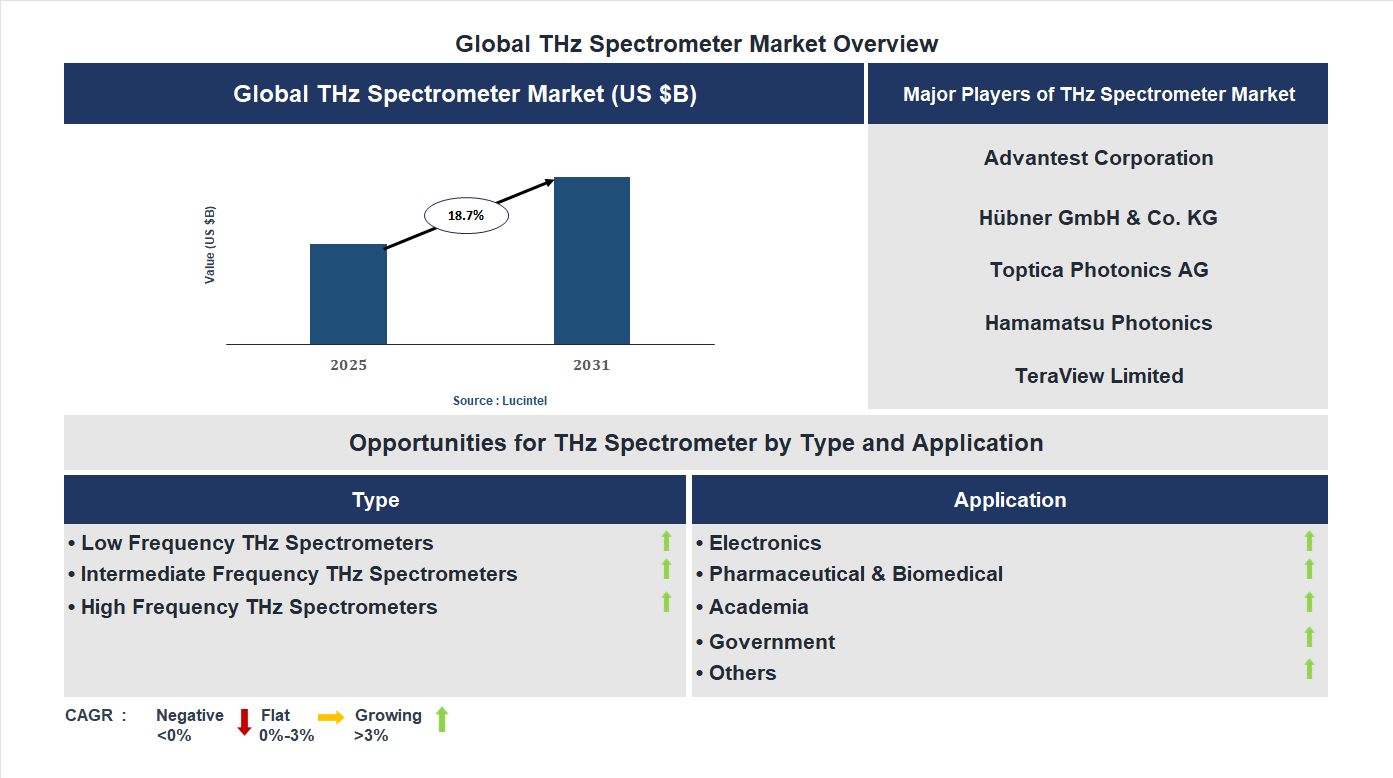
The future of the global THz spectrometer market looks promising with opportunities in the electronics, pharmaceutical & biomedical, academia, and government markets. The global THz spectrometer market is expected to grow with a CAGR of 18.7% from 2025 to 2031. The major drivers for this market are the increasing demand for precise spectroscopic analysis, the rising use in pharmaceutical quality inspection, and the growing adoption in semiconductor material research.• Lucintel forecasts that, within the type category, high frequency THz spectrometer is expected to witness the highest growth over the forecast period.
• Within the application category, pharmaceutical & biomedical is expected to witness the highest growth.
• In terms of region, APAC is expected to witness the highest growth over the forecast period. Gain valuable insights for your business decisions with our comprehensive 150+ page report. Sample figures with some insights are shown below.
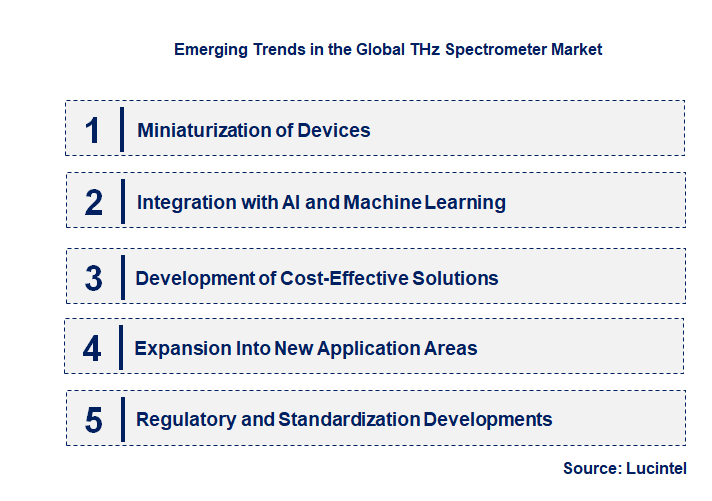
Emerging Trends in the THz Spectrometer Market
The THz spectrometer market is experiencing rapid growth driven by technological advancements and expanding applications across various industries. As the demand for precise, non-destructive testing and imaging increases, key trends are emerging that are shaping the future of this market. These developments are not only enhancing the capabilities of THz spectrometers but also broadening their adoption in sectors such as healthcare, security, and materials science. Understanding these trends is crucial for stakeholders aiming to capitalize on the markets potential and stay ahead in this innovative landscape.• Miniaturization of Devices: The trend towards smaller, portable THz spectrometers is driven by advancements in semiconductor technology and integrated circuits. This miniaturization allows for easier deployment in field settings, on-site inspections, and portable diagnostic tools. It enhances user convenience and broadens application possibilities, especially in security screening, quality control, and biomedical diagnostics. As devices become more compact without compromising performance, market penetration is expected to increase significantly, making THz technology more accessible and versatile.
• Integration with AI and Machine Learning: Incorporating artificial intelligence and machine learning algorithms into THz spectrometry enhances data analysis, pattern recognition, and predictive capabilities. This integration enables faster, more accurate interpretation of complex spectral data, facilitating real-time decision-making. It is particularly impactful in quality assurance, defect detection, and medical diagnostics, where rapid and precise results are critical. The synergy between THz technology and AI is expected to revolutionize data processing, improve automation, and expand the scope of applications.
• Development of Cost-Effective Solutions: The market is witnessing a push towards more affordable THz spectrometers through innovative manufacturing techniques and material improvements. Cost reduction makes the technology accessible to a broader range of industries and research institutions, fostering widespread adoption. This trend is crucial for scaling applications in security, pharmaceuticals, and industrial testing, where budget constraints previously limited usage. As affordability improves, the market is poised for accelerated growth and increased competition among manufacturers.
• Expansion into New Application Areas: Emerging applications such as biomedical imaging, pharmaceutical analysis, and advanced material characterization are expanding the market scope. THz spectrometers offer non-invasive, high-resolution insights, making them ideal for sensitive environments. The ability to detect chemical compositions, structural properties, and biological tissues without damaging samples opens new avenues for research and industrial processes. This diversification is driving innovation and increasing demand across sectors, positioning THz spectrometry as a versatile tool for future technological advancements.
• Regulatory and Standardization Developments: As the technology matures, efforts to establish industry standards and regulatory frameworks are gaining momentum. Standardization ensures compatibility, safety, and reliability, which are essential for widespread commercial adoption. Regulatory clarity also encourages investment and collaboration among industry players, academia, and government agencies. These developments are vital for building trust, facilitating international trade, and accelerating market growth, ultimately making THz spectrometers more mainstream and integrated into various industrial and scientific workflows. In summary, these trends are collectively transforming the THz spectrometer market by making devices more accessible, intelligent, versatile, and reliable. The ongoing innovations and expanding applications are positioning THz technology as a critical tool across multiple industries, promising significant growth and new opportunities in the near future.
Recent Development in the THz Spectrometer Market
The THz spectrometer market has experienced significant growth driven by technological advancements, increasing applications across various industries, and rising demand for precise spectroscopic analysis. As industries such as healthcare, security, and telecommunications expand their use of terahertz technology, the market landscape continues to evolve rapidly. Recent developments reflect a focus on innovation, cost reduction, and expanding application areas, which are shaping the future of this market. These advancements are enabling more efficient, portable, and affordable spectrometers, thereby broadening their adoption and enhancing overall market growth.• Technological Innovation: Development of high-resolution, portable THz spectrometers has improved measurement accuracy and usability, enabling broader application in research and industry. This innovation enhances data quality and operational convenience, fostering increased adoption in fields like material analysis and biomedical imaging.
• Cost Reduction Strategies: Manufacturers are focusing on reducing production costs through new materials and manufacturing techniques, making THz spectrometers more affordable. Lower costs are expanding market reach, especially among small and medium enterprises, and accelerating deployment across various sectors.
• Expansion into Healthcare: The application of THz spectroscopy in medical diagnostics, such as skin cancer detection and tissue imaging, is gaining momentum. This development offers non-invasive, rapid diagnostic tools, significantly impacting healthcare by improving early detection and treatment outcomes.
• Security and Defense Applications: The integration of THz spectrometers into security screening systems for detecting concealed weapons and explosives is increasing. This development enhances security measures at airports and public venues, driving demand and market growth in security sectors.
• Regulatory and Standardization Efforts: The establishment of industry standards and regulatory frameworks for THz technology is progressing, facilitating market acceptance and international trade. These efforts ensure product reliability and safety, boosting consumer confidence and market expansion. In summary, these recent developments are collectively propelling the THz spectrometer market forward by improving device performance, reducing costs, and expanding application areas. The market is becoming more accessible and versatile, which is expected to lead to increased adoption across healthcare, security, and industrial sectors, ultimately fostering sustained growth and innovation.
Strategic Growth Opportunities in the THz Spectrometer Market
The THz spectrometer market is experiencing rapid growth driven by technological advancements and expanding applications across various industries. As the demand for precise, non-invasive, and high-resolution analysis increases, key sectors such as healthcare, security, telecommunications, research, and manufacturing are adopting THz technology. These applications are unlocking new possibilities for material characterization, security screening, and communication systems. The markets evolution is fueled by innovations in device miniaturization, cost reduction, and enhanced sensitivity, creating significant opportunities for industry players. Understanding these growth avenues is essential for stakeholders aiming to capitalize on the expanding potential of THz spectrometers in diverse applications.• Healthcare: Early disease detection and imaging : THz spectrometers enable non-invasive, high-resolution imaging for medical diagnostics, improving early detection of skin cancers, dental issues, and burns, thereby enhancing patient outcomes and reducing healthcare costs.
• Security and Defense: Enhanced screening capabilities : These devices are crucial for security screening at airports and borders, detecting concealed weapons and explosives with high accuracy, which strengthens safety measures and reduces false alarms.
• Telecommunications: High-speed wireless communication : THz technology offers the potential for ultra-fast data transmission, supporting the development of next-generation wireless networks and significantly increasing bandwidth for data-intensive applications.
• Material Research: Advanced material characterization : THz spectrometers facilitate detailed analysis of materials properties, aiding in the development of new composites, polymers, and nanomaterials, thus accelerating innovation in manufacturing and research sectors.
• Industrial Quality Control: Non-destructive testing : They are used for real-time, non-destructive inspection of products and components, ensuring quality assurance in manufacturing processes, reducing waste, and improving efficiency. In summary, these growth opportunities are significantly impacting the THz spectrometer market by broadening its application scope, driving technological innovation, and fostering industry adoption. This expansion is leading to increased market size, competitive advancements, and the creation of new revenue streams across multiple sectors.
THz Spectrometer Market Driver and Challenges
The THz spectrometer market is influenced by a variety of technological, economic, and regulatory factors that shape its growth trajectory. Advances in terahertz technology, increasing demand across diverse industries, and evolving regulatory standards are key drivers. Simultaneously, challenges such as high costs, technical limitations, and regulatory hurdles pose significant obstacles. Understanding these drivers and challenges is essential for stakeholders aiming to capitalize on emerging opportunities and navigate potential risks within this dynamic market landscape. The factors responsible for driving the THz spectrometer market include:-• Technological Advancements: The rapid development of terahertz sources, detectors, and imaging techniques has significantly enhanced the capabilities of THz spectrometers. These innovations enable higher resolution, faster data acquisition, and broader application scopes, making the technology more accessible and appealing across industries such as healthcare, security, and materials science. As research continues, the improved performance and reduced costs of components are expected to further accelerate market adoption, fostering innovation and expanding market reach.
• Increasing Industrial Applications: The expanding use of THz spectrometers in diverse sectors such as pharmaceuticals, aerospace, defense, and food safety is a major growth driver. In healthcare, they facilitate non-invasive diagnostics; in security, they improve threat detection; and in manufacturing, they assist in quality control. The versatility and non-destructive nature of THz technology make it highly attractive, leading to increased investments and collaborations, which propel market growth.
• Rising Government Funding and R&D Initiatives: Governments worldwide are investing heavily in terahertz research to develop advanced spectroscopic tools. Funding programs and collaborative projects aim to improve the technology’s efficiency and reduce costs. These initiatives foster innovation, support commercialization, and expand application areas, thereby boosting market growth. Additionally, regulatory support and standardization efforts are creating a conducive environment for industry expansion.
• Growing Awareness and Adoption: Increased awareness of the benefits of THz spectroscopy among end-users and industry stakeholders is driving adoption. Educational campaigns, industry conferences, and demonstration projects showcase the technology’s potential, encouraging organizations to integrate THz spectrometers into their workflows. As familiarity grows, so does demand, leading to a broader customer base and market expansion. The challenges in the THz spectrometer market are:
• High Cost of Equipment: The advanced components required for THz spectrometers, such as terahertz sources and detectors, are expensive. This high cost limits accessibility for small and medium-sized enterprises and hampers widespread adoption. Additionally, the need for specialized maintenance and calibration adds to operational expenses, making the technology less attractive for cost-sensitive applications.
• Technical Limitations: Despite significant progress, THz technology still faces challenges such as limited power output, low signal-to-noise ratio, and difficulties in miniaturization. These technical constraints restrict the performance and reliability of spectrometers, especially in demanding environments. Overcoming these limitations requires ongoing research and development, which can be time-consuming and costly.
• Regulatory and Standardization Barriers: The lack of comprehensive regulatory frameworks and standardized protocols for THz applications hampers market growth. Concerns over privacy, safety, and security regulations can delay product approvals and commercialization. Additionally, inconsistent standards across regions create barriers to international trade and collaboration, impeding the global expansion of THz spectrometer applications. In summary, the THz spectrometer market is driven by technological innovations, expanding applications, government support, and increasing awareness. However, high costs, technical challenges, and regulatory hurdles pose significant obstacles. The interplay of these factors will shape the market’s future growth, requiring strategic investments and collaborative efforts to overcome barriers and harness emerging opportunities. Overall, the market holds substantial potential for growth, provided stakeholders effectively address these challenges.
List of THz Spectrometer Companies
Companies in the market compete on the basis of product quality offered. Major players in this market focus on expanding their manufacturing facilities, R&D investments, infrastructural development, and leverage integration opportunities across the value chain. With these strategies THz spectrometer companies cater increasing demand, ensure competitive effectiveness, develop innovative products & technologies, reduce production costs, and expand their customer base. Some of the THz spectrometer companies profiled in this report include-• Advantest Corporation
• Hübner GmbH & Co. KG
• Toptica Photonics AG
• Hamamatsu Photonics
• TeraView Limited
• Menlo Systems GmbH
• Bruker
• EKSPLA
• Microtech Instruments
• BATOP GmbH
THz Spectrometer Market by Segment
The study includes a forecast for the global THz spectrometer market by type, application, and region.THz Spectrometer Market by Type [Value from 2019 to 2031]:
• Low Frequency THz Spectrometers
• Intermediate Frequency THz Spectrometers
• High Frequency THz Spectrometers
THz Spectrometer Market by Application [Value from 2019 to 2031]:
• Electronics
• Pharmaceutical & Biomedical
• Academia
• Government
• Others
THz Spectrometer Market by Region [Value from 2019 to 2031]:
• North America
• Europe
• Asia Pacific
• The Rest of the World
Country Wise Outlook for the THz Spectrometer Market
The THz spectrometer market has experienced significant growth driven by technological advancements and increasing applications across various industries such as healthcare, security, and telecommunications. As the demand for precise, non-invasive, and rapid analysis tools rises, countries are investing heavily in research and development to enhance spectrometer capabilities. The markets evolution is also influenced by government initiatives, industry collaborations, and the integration of artificial intelligence for better data analysis. These developments reflect a global push towards more sophisticated THz spectrometry solutions, with each country contributing uniquely based on its technological landscape and strategic priorities.• United States: The US leads in THz spectrometer innovation, with major investments from government agencies like DARPA and NIH. Recent advancements include portable, high-resolution devices for security screening and biomedical imaging. US companies are also integrating AI to improve data processing and analysis, expanding applications in research and industry. The market is driven by strong academic-industry collaborations and increasing commercialization efforts, positioning the US as a key player in global development.
• China: China has rapidly expanded its THz spectrometer capabilities, focusing on military, security, and industrial applications. Recent developments include the launch of state-funded projects to develop cost-effective, high-performance spectrometers. Chinese firms are also investing in miniaturization and portable solutions to meet domestic demand. The government’s strategic focus on technological self-sufficiency has accelerated innovation, making China a significant emerging market for THz spectrometry.
• Germany: Germany remains a leader in precision instrumentation and scientific research, with recent innovations in high-accuracy THz spectrometers for material characterization and quality control. German companies are collaborating with universities to develop advanced spectrometers with enhanced sensitivity and speed. The focus on industrial applications, especially in automotive and manufacturing sectors, has driven the adoption of these technologies. Germany’s emphasis on sustainable and efficient solutions continues to shape its market growth.
• India: India is witnessing growing interest in THz spectrometry for security, healthcare, and research purposes. Recent developments include government initiatives to promote indigenous manufacturing and R&D. Indian startups and research institutions are working on developing affordable, portable spectrometers to address local needs. The market is also benefiting from increased funding and collaborations with international firms, aiming to establish India as a competitive player in the global THz spectrometer landscape.
• Japan: Japan has advanced in the development of high-frequency, high-resolution THz spectrometers, primarily for scientific research and industrial applications. Recent innovations include integration with quantum technologies and improvements in spectral resolution. Japanese firms are focusing on miniaturization and enhancing device stability for practical deployment. The country’s strong emphasis on innovation and technology transfer continues to propel its market growth, especially in sectors like electronics, aerospace, and healthcare.

Features of the Global THz Spectrometer Market
Market Size Estimates: THz spectrometer market size estimation in terms of value ($B). Trend and Forecast Analysis: Market trends (2019 to 2024) and forecast (2025 to 2031) by various segments and regions. Segmentation Analysis: THz spectrometer market size by type, application, and region in terms of value ($B). Regional Analysis: THz spectrometer market breakdown by North America, Europe, Asia Pacific, and Rest of the World. Growth Opportunities: Analysis of growth opportunities in different types, applications, and regions for the THz spectrometer market. Strategic Analysis: This includes M&A, new product development, and competitive landscape of the THz spectrometer market. Analysis of competitive intensity of the industry based on Porter’s Five Forces model.
FAQ
Q1. What is the growth forecast for THz spectrometer market? Answer: The global THz spectrometer market is expected to grow with a CAGR of 18.7% from 2025 to 2031. Q2. What are the major drivers influencing the growth of the THz spectrometer market? Answer: The major drivers for this market are the increasing demand for precise spectroscopic analysis, the rising use in pharmaceutical quality inspection, and the growing adoption in semiconductor material research. Q3. What are the major segments for THz spectrometer market? Answer: The future of the THz spectrometer market looks promising with opportunities in the electronics, pharmaceutical & biomedical, academia, and government markets. Q4. Who are the key THz spectrometer market companies? Answer: Some of the key THz spectrometer companies are as follows:• Advantest Corporation
• Hübner GmbH & Co. KG
• Toptica Photonics AG
• Hamamatsu Photonics
• TeraView Limited
• Menlo Systems GmbH
• Bruker
• EKSPLA
• Microtech Instruments
• BATOP GmbH Q5. Which THz spectrometer market segment will be the largest in future? Answer: Lucintel forecasts that, within the type category, high frequency THz spectrometer is expected to witness the highest growth over the forecast period. Q6. In THz spectrometer market, which region is expected to be the largest in next 5 years? Answer: In terms of region, APAC is expected to witness the highest growth over the forecast period. Q7. Do we receive customization in this report? Answer: Yes, Lucintel provides 10% customization without any additional cost.
Table of Contents
List of Figures
List of Tables
Methodology
- In-depth interviews of the major players in this market
- Detailed secondary research from competitors’ financial statements and published data
- Extensive searches of published works, market, and database information pertaining to industry news, company press releases, and customer intentions
- A compilation of the experiences, judgments, and insights of Lucintel’s professionals, who have analyzed and tracked this market over the years.


Buy Now
Choose a license that fits your team. Instant PDF delivery.
Prices exclude taxes. Instant delivery. Custom licensing available on request.
Key Questions
- • What are some of the most promising, high-growth opportunities for the THz spectrometer market by type (low frequency THz spectrometers, intermediate frequency THz spectrometers, and high frequency THz spectrometers), application (electronics, pharmaceutical & biomedical, academia, government, and others), and region (North America, Europe, Asia Pacific, and the Rest of the World)?
- • Which segments will grow at a faster pace and why?
- • Which region will grow at a faster pace and why?
- • What are the key factors affecting market dynamics? What are the key challenges and business risks in this market?
- • What are the business risks and competitive threats in this market?
- • What are the emerging trends in this market and the reasons behind them?
- • What are some of the changing demands of customers in the market?
- • What are the new developments in the market? Which companies are leading these developments?
- • Who are the major players in this market? What strategic initiatives are key players pursuing for business growth?
- • What are some of the competing products in this market and how big of a threat do they pose for loss of market share by material or product substitution?
- • What M&A activity has occurred in the last 5 years and what has its impact been on the industry? For any questions related to THz Spectrometer Market, THz Spectrometer Market Size, THz Spectrometer Market Growth, THz Spectrometer Market Analysis, THz Spectrometer Market Report, THz Spectrometer Market Share, THz Spectrometer Market Trends, THz Spectrometer Market Forecast, THz Spectrometer Companies, write Lucintel analyst at email: helpdesk@lucintel.com. We will be glad to get back to you soon.


