
Report Feature
Thrust Vector Control Market Trends and Forecast
The future of the global thrust vector control market looks promising with opportunities in the aviation and defense markets. The global thrust vector control market is expected to reach an estimated $21 billion by 2035 with a CAGR of 8% from 2026 to 2035. The major drivers for this market are the increasing demand for advanced missile control systems, the rising investments in space exploration programs, and the growing adoption of precision guided defense technologies.
• Lucintel forecasts that, within the type category, thrust vector actuation system is expected to witness the highest growth over the forecast period.
• Within the application category, defense is expected to witness higher growth.
• In terms of region, APAC is expected to witness the highest growth over the forecast period.
Gain valuable insights for your business decisions with our comprehensive 150+ page report. Sample figures with some insights are shown below.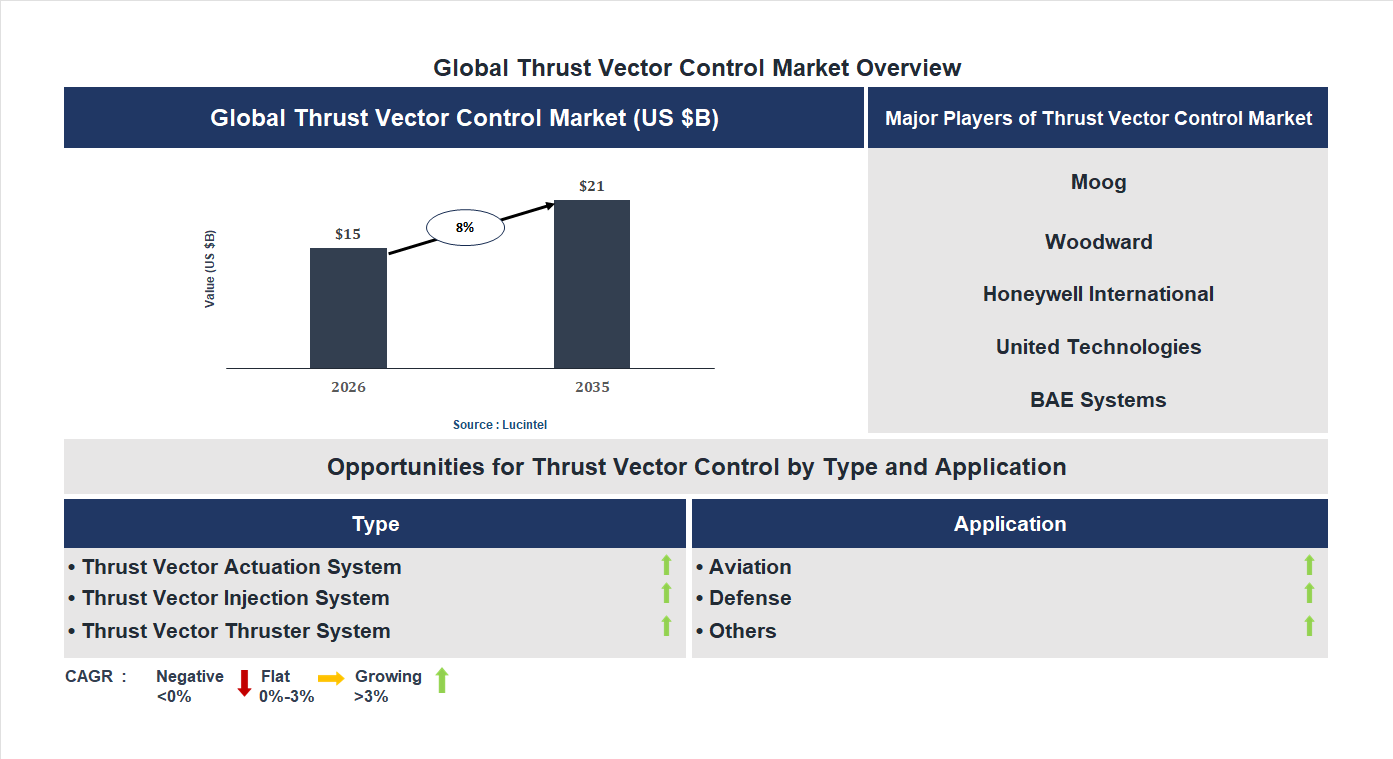
Emerging Trends in the Thrust Vector Control Market
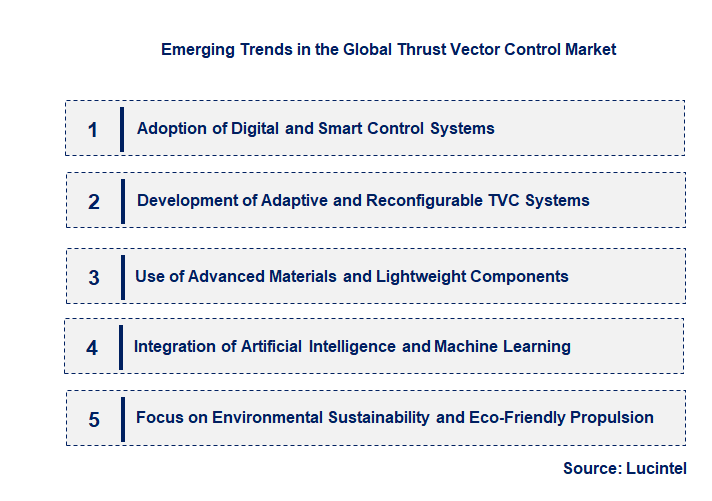
The thrust vector control market is experiencing rapid evolution driven by advancements in aerospace technology, increasing demand for precision in missile and spacecraft navigation, and the integration of innovative control systems. As space exploration and defense applications expand, the need for more reliable, efficient, and adaptable thrust vector control solutions becomes critical. Emerging trends are shaping the future landscape of this market, influencing product development, operational capabilities, and strategic investments. These developments are not only enhancing performance but also opening new opportunities across military, commercial, and scientific sectors, ultimately transforming how vehicles are guided and controlled in complex environments.
• Adoption of Digital and Smart Control Systems: The integration of digital technology and smart control algorithms is revolutionizing TVC systems. These systems enable real-time data processing, predictive maintenance, and adaptive control, leading to higher precision and reliability. Enhanced sensors and actuators facilitate more accurate thrust vector adjustments, improving missile and spacecraft performance. This trend reduces operational risks and maintenance costs while increasing system lifespan. The shift towards digital control also allows for easier integration with other onboard systems, fostering innovation in autonomous navigation and complex mission execution.
• Development of Adaptive and Reconfigurable TVC Systems: Adaptive TVC systems are designed to modify their control strategies dynamically based on flight conditions and mission requirements. Reconfigurable systems can switch between different control modes, offering versatility across various platforms. This trend enhances mission flexibility, allowing vehicles to operate efficiently in diverse environments, from atmospheric to deep space. It also improves resilience against system failures by enabling fallback modes. The ability to adapt in real-time significantly boosts mission success rates and broadens application scopes, especially in unpredictable or hostile environments.
• Use of Advanced Materials and Lightweight Components: The push for lighter, more durable TVC components is driven by the need to improve fuel efficiency and payload capacity. Advanced composites, ceramics, and lightweight alloys are increasingly used to manufacture actuators, nozzles, and control surfaces. These materials reduce overall system weight without compromising strength or thermal stability, leading to better performance and longer operational life. The trend supports the development of smaller, more agile vehicles and enhances the payload capacity of rockets and missiles, making space missions more cost-effective and expanding the potential for commercial and scientific applications.
• Integration of Artificial Intelligence and Machine Learning: AI and ML are being incorporated into TVC systems to optimize control algorithms, predict system failures, and enhance decision-making processes. These technologies enable autonomous adjustments to thrust vectors, improving accuracy and responsiveness in dynamic conditions. AI-driven diagnostics facilitate predictive maintenance, reducing downtime and operational costs. The ability to learn from operational data allows systems to improve over time, increasing reliability and safety. This trend is particularly impactful in complex missions where human intervention is limited or impossible, such as deep space exploration and high-speed missile guidance.
• Focus on Environmental Sustainability and Eco-Friendly Propulsion: The market is witnessing a shift towards environmentally sustainable TVC solutions, including the development of eco-friendly propellants and energy-efficient control mechanisms. Innovations aim to reduce emissions, thermal signatures, and environmental impact during launches and operations. This trend aligns with global efforts to promote green aerospace technologies and meet regulatory standards. Eco-friendly TVC systems also contribute to operational cost savings and enhance the sustainability profile of space and defense programs. As environmental concerns grow, this trend is expected to drive research and development in cleaner, more sustainable propulsion and control technologies.
These emerging trends are fundamentally reshaping the thrust vector control market by enhancing system precision, flexibility, sustainability, and intelligence. They enable more complex, reliable, and environmentally conscious space and defense missions, fostering innovation and expanding market opportunities across various sectors. As these developments continue, the market is poised for significant growth, driven by technological advancements and evolving operational demands.
Recent Developments in the Thrust Vector Control Market
The thrust vector control market is experiencing rapid advancements driven by technological innovations and increasing demand for precision in aerospace and defense applications. These developments are shaping the future of missile guidance, satellite positioning, and space exploration. As governments and private sectors invest heavily in space technology, the market is poised for significant growth. Emerging trends include enhanced control mechanisms, integration with AI, and miniaturization, which are expanding the scope and capabilities of TVC systems worldwide.
• Technological Innovations in Control Mechanisms: Advancements in actuators and sensors are enabling more precise and reliable thrust vector control. These innovations improve missile accuracy, reduce response times, and enhance safety features. The integration of smart materials and digital control systems is further optimizing performance. As a result, defense agencies and aerospace companies are adopting these cutting-edge solutions to meet evolving operational requirements, leading to increased market demand and new application opportunities.
• Integration of Artificial Intelligence and Automation: AI-driven control systems are revolutionizing TVC technology by enabling real-time data analysis and adaptive control. These systems improve system responsiveness, fault detection, and predictive maintenance, reducing downtime and operational costs. The automation of thrust vector adjustments enhances missile and satellite performance, especially in complex environments. This integration is attracting investments from defense and commercial sectors, fostering innovation and expanding the market’s scope for intelligent, autonomous control solutions.
• Miniaturization and Lightweight Design: The development of compact, lightweight TVC systems is crucial for small satellites, drones, and space exploration missions. Advances in materials and manufacturing techniques allow for smaller, more efficient components without compromising performance. These miniaturized systems enable deployment in a broader range of platforms, reducing launch costs and increasing mission flexibility. The trend is opening new markets for small-scale aerospace applications and fostering innovation in portable, high-performance thrust control solutions.
• Growing Demand in Space Exploration and Satellite Launches: The increasing number of satellite launches and space exploration missions is driving demand for reliable TVC systems. These systems are essential for precise orbit adjustments, attitude control, and mission success. Governments and private companies are investing heavily in space infrastructure, creating a surge in market opportunities. Enhanced TVC systems improve mission safety and efficiency, supporting the expansion of space activities and fostering technological advancements in the industry.
• Development of Hybrid and Multi-Mode Control Systems: Hybrid TVC systems combining different control technologies are emerging to offer greater flexibility and robustness. Multi-mode systems can switch between control strategies based on operational needs, improving reliability and performance in diverse conditions. These innovations are particularly valuable for complex missile systems and space vehicles requiring adaptable control solutions. The market is witnessing increased R&D investments, leading to more versatile, resilient thrust vector control options that meet the demands of modern aerospace applications.
These recent developments in the thrust vector control market are significantly enhancing system capabilities, reliability, and application scope. Innovations like AI integration, miniaturization, and hybrid controls are expanding market opportunities across defense, space exploration, and commercial sectors. As technological advancements continue, the market is expected to grow rapidly, driven by increasing demand for precision, efficiency, and autonomous control solutions. These trends are shaping a more advanced, competitive, and dynamic industry landscape.
Strategic Growth Opportunities in the Thrust Vector Control Market
The thrust vector control market is experiencing significant growth driven by advancements in aerospace, defense, and space exploration sectors. Increasing demand for precise missile guidance, satellite positioning, and launch vehicle stability is fueling innovation and expansion. Emerging technologies and increasing defense budgets worldwide are creating new opportunities for market players. As applications diversify, the market is poised for substantial development, driven by technological improvements and strategic investments. This analysis explores key growth opportunities shaping the future of the Thrust Vector Control market.
• Expansion in Military Missile Systems: The increasing deployment of advanced missile systems with enhanced guidance capabilities is a major growth driver. Countries are investing heavily in missile technology to improve defense capabilities, leading to higher demand for reliable TVC systems. Innovations in control mechanisms, such as gimbaled and jet vane systems, are enabling more precise targeting and maneuverability, expanding the market for military applications across regions.
• Growth in Commercial Space Launch Services: The rise of private space companies and government space agencies ambitious missions are boosting demand for efficient TVC systems. These systems are critical for satellite deployment, orbital adjustments, and launch vehicle stability. As commercial launches become more frequent and cost-effective, the need for advanced, lightweight, and reliable TVC solutions is increasing, opening new revenue streams for manufacturers.
• Technological Advancements in Aerospace Propulsion: Innovations in aerospace propulsion systems, including hybrid and electric thrusters, are creating new opportunities for TVC integration. These advancements require sophisticated control mechanisms to ensure stability and precision. The development of miniaturized, high-performance TVC components supports next-generation aircraft, drones, and space vehicles, fostering market growth through improved performance and reduced costs.
• Increasing Adoption in Space Exploration Missions: Growing investments in space exploration by government agencies and private entities are driving demand for advanced TVC systems. These systems are essential for spacecraft attitude control, trajectory adjustments, and landing maneuvers. As missions become more complex, the need for highly reliable and adaptable TVC solutions increases, encouraging innovation and expanding the market scope in deep space and planetary exploration.
• Rising Demand for Satellite Stabilization and Orientation: The proliferation of communication, weather, and Earth observation satellites necessitates precise stabilization and orientation control. TVC systems play a vital role in maintaining satellite positioning and maneuvering in orbit. The expanding satellite market, coupled with miniaturization trends and enhanced control accuracy, is expected to significantly boost the demand for innovative TVC technologies across various satellite segments.
The Thrust Vector Control market is poised for substantial growth driven by technological innovations, expanding military and commercial applications, and increasing investments in space exploration. These opportunities will enhance system capabilities, improve operational efficiency, and open new markets. As industries evolve, the integration of advanced TVC solutions will be crucial for achieving precision, reliability, and cost-effectiveness, ultimately shaping the future landscape of aerospace and defense technology.
Thrust Vector Control Market Driver and Challenges
The thrust vector control market is influenced by a variety of technological, economic, and regulatory factors that shape its growth and development. Advances in aerospace technology, increasing defense budgets, and the need for precise missile and spacecraft control are primary drivers. Additionally, regulatory standards for safety and environmental concerns impact market dynamics. Economic factors such as government investments and international collaborations further influence market expansion. However, the industry also faces challenges including high development costs, technological complexities, and regulatory hurdles that can impede progress. Understanding these drivers and challenges is essential for stakeholders aiming to capitalize on market opportunities and navigate potential risks effectively.
The factors responsible for driving the thrust vector control market include:-
• Technological Advancements: The continuous development of innovative thrust vector control systems, such as gimbaled nozzles and jet vanes, enhances missile and spacecraft maneuverability. These advancements enable more precise control, increased safety, and better performance in various aerospace applications. As technology evolves, manufacturers can offer more efficient, reliable, and lightweight solutions, fueling market growth. The integration of digital control systems and automation further boosts operational efficiency, making thrust vector control systems indispensable in modern aerospace engineering.
• Growing Defense Spending: Increasing defense budgets worldwide, especially in countries like the U.S., China, and Russia, are significant drivers. Governments are investing heavily in missile technology, space exploration, and military aircraft, which require advanced thrust vector control systems. This surge in defense expenditure supports research, development, and procurement activities, expanding market opportunities. The rising geopolitical tensions and the need for strategic superiority further propel investments in missile defense systems, directly impacting the growth of the thrust vector control industry.
• Space Exploration and Commercialization: The surge in space exploration initiatives by government agencies and private companies is a key driver. The demand for reliable propulsion and control systems for satellites, space probes, and launch vehicles is increasing. Commercial entities like SpaceX and Blue Origin are pushing the boundaries of space travel, necessitating sophisticated thrust vector control solutions. This trend not only boosts demand but also encourages innovation, leading to the development of more efficient and cost-effective systems suitable for commercial and scientific missions.
• Regulatory and Safety Standards: Stringent safety and environmental regulations influence the market by mandating the adoption of advanced, reliable, and environmentally friendly thrust vector control systems. Compliance with international standards ensures operational safety and reduces liability risks. Regulatory frameworks also drive innovation, as manufacturers develop systems that meet evolving standards. While these regulations can increase development costs, they ultimately promote safer and more sustainable aerospace technologies, fostering long-term market stability and growth.
The challenges in the thrust vector control market are:
• High Development and Manufacturing Costs: Developing advanced thrust vector control systems involves significant investment in research, testing, and manufacturing facilities. The complexity of these systems requires specialized materials and precision engineering, which escalate costs. These high expenses can limit market entry for smaller players and slow down innovation. Additionally, the need for rigorous testing and certification adds to the financial burden, potentially delaying product launches and increasing overall project costs, thereby impacting market growth and competitiveness.
• Technological Complexities: The design and integration of thrust vector control systems involve complex engineering challenges, including thermal management, material durability, and precise control algorithms. Ensuring system reliability under extreme conditions such as high velocities and temperatures is difficult. Technological hurdles can lead to delays in development, increased costs, and potential system failures, which can compromise mission success. Overcoming these complexities requires continuous innovation and expertise, posing a significant challenge for manufacturers aiming to stay ahead in the market.
• Regulatory and Environmental Challenges: Navigating the evolving regulatory landscape presents a significant obstacle. Stringent safety, environmental, and export control regulations can restrict technology transfer and increase compliance costs. Environmental concerns related to missile emissions and space debris also influence system design and deployment. These regulatory hurdles can slow down product development, limit market access, and increase operational costs. Companies must invest in compliance and sustainable practices, which can strain resources and impact overall profitability.
The thrust vector control market is driven by technological innovation, increased defense and space exploration investments, and regulatory standards that promote safety and sustainability. However, high development costs, technological complexities, and regulatory challenges pose significant hurdles. These factors collectively influence market dynamics, requiring stakeholders to balance innovation with compliance and cost management. The overall impact is a market that is poised for growth but must navigate substantial technical and regulatory obstacles to realize its full potential.
List of Thrust Vector Control Companies
Companies in the market compete on the basis of product quality offered. Major players in this market focus on expanding their manufacturing facilities, R&D investments, infrastructural development, and leverage integration opportunities across the value chain. With these strategies thrust vector control companies cater increasing demand, ensure competitive effectiveness, develop innovative products & technologies, reduce production costs, and expand their customer base. Some of the thrust vector control companies profiled in this report include-
• Moog
• Woodward
• Honeywell International
• United Technologies
• BAE Systems
• Northrop Grumman
• Parker-Hannifin
• S.A.B.C.A.
• Dynetics
• Sierra Nevada
Thrust Vector Control Market by Segment
The study includes a forecast for the global thrust vector control market by type, application, and region.
Thrust Vector Control Market by Type [Value from 2019 to 2035]:
• Thrust Vector Actuation System
• Thrust Vector Injection System
• Thrust Vector Thruster System
Thrust Vector Control Market by Application [Value from 2019 to 2035]:
• Aviation
• Defense
• Others
Thrust Vector Control Market by Region [Value from 2019 to 2035]:
• North America
• Europe
• Asia Pacific
• The Rest of the World
Country Wise Outlook for the Thrust Vector Control Market
The thrust vector control market has experienced significant advancements driven by technological innovation, increased defense spending, and the growing demand for space exploration and missile systems. Countries are investing heavily to enhance their missile accuracy, maneuverability, and overall defense capabilities. The markets evolution is marked by the development of more precise, reliable, and cost-effective TVC systems, with a focus on integrating advanced materials and control technologies. These developments reflect the strategic priorities of nations aiming to strengthen their military and space exploration programs amid geopolitical tensions and technological competition.
• United States: The US has made substantial progress in TVC technology, focusing on integrating digital control systems and lightweight materials to improve missile performance. Major defense contractors are developing next-generation systems for both military and space applications, emphasizing precision and reliability. The US government continues to invest in research to enhance the maneuverability of ballistic missiles and space launch vehicles, ensuring technological superiority.
• China: China has rapidly advanced its TVC capabilities, emphasizing indigenous development to reduce reliance on foreign technology. The country has successfully tested new missile systems with improved thrust vectoring for enhanced accuracy and maneuverability. China’s focus on missile modernization aligns with its strategic military expansion, aiming to strengthen its regional and global influence through advanced missile technology.
• Germany: Germany is primarily involved in the development and supply of advanced TVC components and systems for European missile and space programs. The country emphasizes innovation in control mechanisms and materials to improve system efficiency and safety. German firms are also collaborating with international partners to develop cutting-edge solutions for both military and civilian space missions.
• India: India has made notable strides in developing indigenous TVC systems, particularly for its missile and space programs. The Indian Space Research Organisation (ISRO) has integrated advanced thrust vectoring techniques into its launch vehicles, enhancing their precision and payload capacity. India’s focus remains on self-reliance and expanding its capabilities in missile technology and space exploration.
• Japan: Japan continues to innovate in TVC technology, primarily for its missile defense systems and space launch vehicles. The country emphasizes the development of highly reliable and precise control systems, incorporating advanced sensors and materials. Japan’s efforts are driven by its strategic need to bolster national security and maintain technological leadership in space and missile technology.

Features of the Global Thrust Vector Control Market
Market Size Estimates: Thrust vector control market size estimation in terms of value ($B).
Trend and Forecast Analysis: Market trends (2019 to 2025) and forecast (2026 to 2035) by various segments and regions.Segmentation Analysis: Thrust vector control market size by type, application, and region in terms of value ($B).
Regional Analysis: Thrust vector control market breakdown by North America, Europe, Asia Pacific, and Rest of the World.
Growth Opportunities: Analysis of growth opportunities in different types, applications, and regions for the thrust vector control market.
Strategic Analysis: This includes M&A, new product development, and competitive landscape of the thrust vector control market.
Analysis of competitive intensity of the industry based on Porter’s Five Forces model.

FAQ
Q1. What is the thrust vector control market size?
Answer: The global thrust vector control market is expected to reach an estimated $21 billion by 2035.
Q2. What is the growth forecast for thrust vector control market?
Answer: The global thrust vector control market is expected to grow with a CAGR of 8% from 2026 to 2035.
Q3. What are the major drivers influencing the growth of the thrust vector control market?
Answer: The major drivers for this market are the increasing demand for advanced missile control systems, the rising investments in space exploration programs, and the growing adoption of precision guided defense technologies.
Q4. What are the major segments for thrust vector control market?
Answer: The future of the thrust vector control market looks promising with opportunities in the aviation and defense markets.
Q5. Who are the key thrust vector control market companies?
Answer: Some of the key thrust vector control companies are as follows:
• Moog
• Woodward
• Honeywell International
• United Technologies
• BAE Systems
• Northrop Grumman
• Parker-Hannifin
• S.A.B.C.A.
• Dynetics
• Sierra Nevada
Q6. Which thrust vector control market segment will be the largest in future?Answer: Lucintel forecasts that, within the type category, thrust vector actuation system is expected to witness the highest growth over the forecast period.
Q7. In thrust vector control market, which region is expected to be the largest in next 8 years?
Answer: In terms of region, APAC is expected to witness the highest growth over the forecast period.
Q8. Do we receive customization in this report?
Answer: Yes, Lucintel provides 10% customization without any additional cost.
Table of Contents
List of Figures
List of Tables
Methodology
- In-depth interviews of the major players in this market
- Detailed secondary research from competitors’ financial statements and published data
- Extensive searches of published works, market, and database information pertaining to industry news, company press releases, and customer intentions
- A compilation of the experiences, judgments, and insights of Lucintel’s professionals, who have analyzed and tracked this market over the years.


Buy Now
Choose a license that fits your team. Instant PDF delivery.
Prices exclude taxes. Instant delivery. Custom licensing available on request.
Key Questions
- • What are some of the most promising, high-growth opportunities for the thrust vector control market by type (thrust vector actuation system, thrust vector injection system, and thrust vector thruster system), application (aviation, defense, and others), and region (North America, Europe, Asia Pacific, and the Rest of the World)?
- • Which segments will grow at a faster pace and why?
- • Which region will grow at a faster pace and why?
- • What are the key factors affecting market dynamics? What are the key challenges and business risks in this market?
- • What are the business risks and competitive threats in this market?
- • What are the emerging trends in this market and the reasons behind them?
- • What are some of the changing demands of customers in the market?
- • What are the new developments in the market? Which companies are leading these developments?
- • Who are the major players in this market? What strategic initiatives are key players pursuing for business growth?
- • What are some of the competing products in this market and how big of a threat do they pose for loss of market share by material or product substitution?
- • What M&A activity has occurred in the last 5 years and what has its impact been on the industry? For any questions related to Thrust Vector Control Market, Thrust Vector Control Market Size, Thrust Vector Control Market Growth, Thrust Vector Control Market Analysis, Thrust Vector Control Market Report, Thrust Vector Control Market Share, Thrust Vector Control Market Trends, Thrust Vector Control Market Forecast, Thrust Vector Control Companies, write Lucintel analyst at email: helpdesk@lucintel.com. We will be glad to get back to you soon.


