
Market Report · July 31, 2026

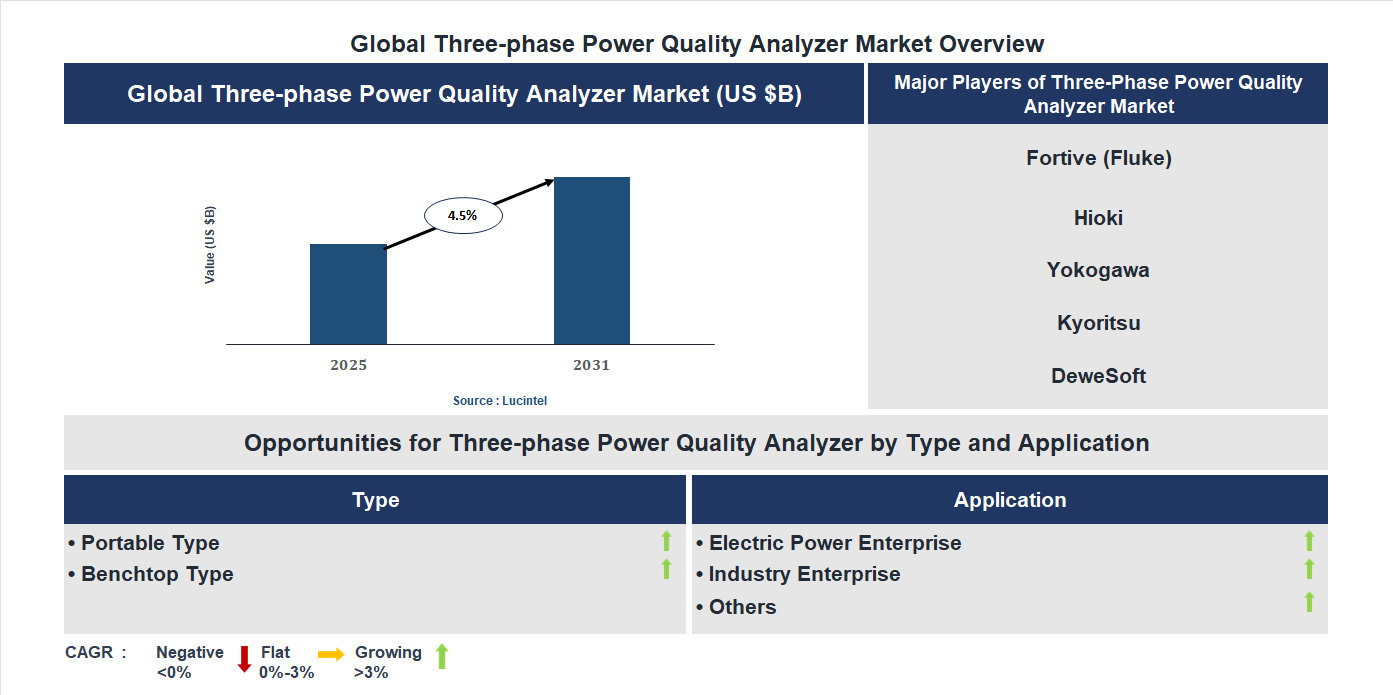
Key data points: The growth forecast = 4.5% annually for the next 7 years. Scroll below to get more insights. This market report covers trends, opportunities and forecasts in three-phase power quality analyzer market to 2031 by type (portable type and benchtop type), application (electric power enterprise, industry enterprise, and others), and region (North America, Europe, Asia Pacific, and the Rest of the World)
We'll send your sample report shortly.
• Lucintel forecasts that, within the type category, portable type is expected to witness higher growth over the forecast period.
• Within the application category, industry enterprise is expected to witness higher growth.
• In terms of region, APAC is expected to witness the highest growth over the forecast period. Gain valuable insights for your business decisions with our comprehensive 150+ page report. Sample figures with some insights are shown below.
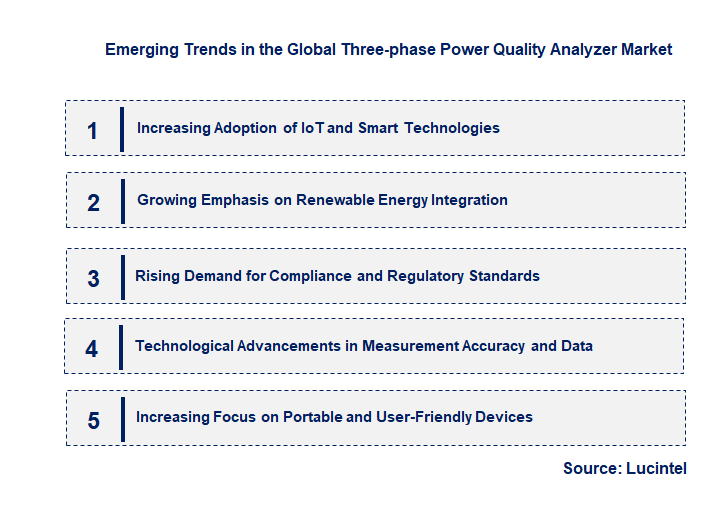
• Increasing adoption of IoT and smart technologies: The integration of IoT-enabled devices with power quality analyzers allows real-time data collection and remote monitoring. This connectivity enhances diagnostic accuracy, facilitates predictive maintenance, and reduces operational costs. Smart analyzers can automatically detect anomalies, alert operators, and even initiate corrective actions, leading to improved system reliability and efficiency. As industries move toward digital transformation, IoT integration is becoming a standard feature, significantly expanding the market scope and capabilities of power quality analyzers.
• Growing emphasis on renewable energy integration: The shift toward renewable energy sources such as solar and wind introduces new power quality challenges, including voltage fluctuations and harmonics. Power quality analyzers are increasingly equipped to handle these complexities, providing detailed insights into grid stability and power fluctuations. This trend drives demand for advanced analyzers capable of monitoring diverse energy inputs, ensuring grid reliability, and complying with evolving regulatory standards. The market is thus expanding to support the integration of cleaner energy sources while maintaining power quality.
• Rising demand for compliance and regulatory standards: Governments and industry bodies are implementing stricter regulations related to power quality, safety, and environmental impact. Power quality analyzers are essential tools for ensuring compliance, conducting audits, and avoiding penalties. The market is witnessing the development of analyzers with enhanced features such as detailed reporting, data logging, and compliance certification. This trend underscores the importance of accurate, reliable measurement tools in meeting regulatory requirements and maintaining operational standards across various sectors.
• Technological advancements in measurement accuracy and data analytics: Innovations in sensor technology and data processing algorithms are improving the precision of power quality measurements. Advanced analyzers now offer comprehensive analytics, trend analysis, and predictive insights, enabling proactive maintenance and system optimization. These technological improvements reduce false alarms and improve diagnostic confidence. As data analytics become more sophisticated, the market is moving toward integrated solutions that combine measurement, analysis, and reporting, empowering users with actionable insights for better decision-making.
• Increasing focus on portable and user-friendly devices: The demand for portable, easy-to-use power quality analyzers is rising, especially for field inspections and troubleshooting. Compact designs, intuitive interfaces, and wireless connectivity make these devices accessible to a broader range of users, including technicians and engineers. This trend enhances operational flexibility, reduces downtime, and lowers training requirements. The market is responding with innovative portable solutions that do not compromise on measurement accuracy, thus expanding the reach of power quality analysis to diverse environments and applications. In summary, these emerging trends are transforming the three-phase power quality analyzer market by making devices smarter, more adaptable, and aligned with modern energy needs. The integration of IoT, focus on renewable energy, regulatory compliance, technological innovations, and portability are collectively driving market growth and redefining how power quality is monitored and managed in an increasingly complex energy landscape.
• Technological Advancements in Measurement Accuracy: The development of more precise and sensitive analyzers has improved fault detection and power quality monitoring, leading to enhanced system reliability and reduced maintenance costs for industries and utilities.
• Integration of IoT and Smart Grid Technologies: Incorporating IoT-enabled devices allows real-time data collection and remote monitoring, facilitating proactive maintenance and faster response to power quality issues, which boosts operational efficiency.
• Portable and User-Friendly Devices: The launch of compact, easy-to-use analyzers has expanded market reach, enabling field technicians to perform on-site diagnostics quickly, thus reducing downtime and operational costs.
• Regulatory Standards and Compliance: Stricter government regulations and industry standards have increased demand for advanced analyzers capable of detailed reporting and compliance verification, driving market growth.
• Growing Adoption in Renewable Energy Sector: The rising integration of renewable energy sources like solar and wind into power grids necessitates sophisticated power quality analysis to manage variability and ensure grid stability, expanding market opportunities. These developments are collectively enhancing the market by improving device performance, expanding application areas, and ensuring compliance, which in turn is accelerating market growth and technological innovation.
• Industrial Manufacturing: Enhanced Monitoring and Maintenance : The adoption of power quality analyzers in manufacturing facilities allows for real-time monitoring of electrical systems, reducing equipment failures and maintenance costs. This leads to increased operational efficiency and minimized downtime, supporting continuous production processes and improving overall productivity.
• Commercial Buildings: Energy Management and Optimization : In commercial sectors, power quality analyzers facilitate energy consumption analysis, enabling better management and optimization of electrical loads. This results in reduced energy costs, improved system reliability, and compliance with sustainability standards, making buildings more energy-efficient.
• Data Centers: Ensuring Power Reliability and Uptime : Data centers require uninterrupted power supply for optimal operation. Power quality analyzers help identify and mitigate power disturbances, ensuring high availability and preventing costly outages. This enhances data security and operational continuity, critical for digital infrastructure.
• Renewable Energy Integration: Grid Compatibility and Stability : As renewable energy sources like solar and wind are integrated into power grids, power quality analyzers assist in maintaining grid stability and compatibility. They help detect power fluctuations and harmonics, ensuring smooth integration and reliable energy supply.
• Utilities and Grid Management: Fault Detection and System Optimization : Utility companies utilize power quality analyzers for fault detection, system diagnostics, and grid optimization. This improves grid reliability, reduces transmission losses, and enhances overall system performance, supporting sustainable energy distribution. In summary, these growth opportunities are significantly impacting the three-phase power quality analyzer market by driving technological advancements and expanding application scopes. They enable industries to achieve higher efficiency, reliability, and sustainability, fostering market growth and innovation across multiple sectors.
• Technological Advancements: The continuous development of sophisticated power quality analysis tools enhances measurement accuracy and operational efficiency. Innovations such as real-time monitoring, IoT integration, and advanced data analytics enable utilities and industries to detect and mitigate power issues proactively. These technological improvements reduce downtime, improve energy efficiency, and ensure compliance with standards, thereby increasing demand for advanced analyzers. As technology evolves, the market is expected to see increased adoption driven by the need for smarter, more reliable power systems.
• Growing Infrastructure Development: Rapid urbanization and industrialization, especially in emerging economies, are fueling infrastructure projects that require robust power management solutions. Power quality analyzers are essential for maintaining stable electrical systems in large-scale projects, including smart grids, renewable energy integration, and industrial facilities. Governments and private sectors are investing heavily in infrastructure, which directly boosts the demand for power quality analyzers to ensure efficient and reliable power distribution.
• Increasing Focus on Power Quality and Reliability: The rising awareness of power quality issues such as voltage fluctuations, harmonics, and transients is prompting industries and utilities to invest in advanced diagnostic tools. Power quality analyzers help identify and rectify issues that can cause equipment failure, energy losses, and operational disruptions. As industries become more sensitive to power disturbances, the demand for precise and comprehensive power quality analysis grows, driving market expansion.
• Regulatory and Standards Compliance: Governments and regulatory bodies worldwide are implementing stricter standards for power quality to ensure safety, efficiency, and environmental sustainability. Compliance with standards such as IEEE, IEC, and local regulations necessitates the use of sophisticated power quality analyzers. This regulatory environment compels utilities and industries to adopt advanced measurement tools, thereby propelling market growth. The challenges in the three-phase power quality analyzer market are:
• High Cost of Deployment: The installation and maintenance of advanced power quality analyzers involve significant capital expenditure. Small and medium-sized enterprises may find these costs prohibitive, limiting market penetration in certain segments. Additionally, ongoing calibration, training, and software updates add to operational expenses, which can hinder widespread adoption, especially in price-sensitive markets.
• Technological Complexity and Integration Issues: The sophisticated nature of modern power quality analyzers requires specialized knowledge for operation and interpretation of data. Integrating these devices into existing power systems can be complex, requiring compatibility with various hardware and software platforms. This complexity can lead to implementation delays, increased costs, and a reluctance among some users to upgrade existing systems.
• Evolving Regulatory Landscape: While regulations drive market growth, frequent changes and varying standards across regions pose challenges for manufacturers and users. Keeping up with evolving compliance requirements demands continuous updates and adaptations, which can be resource-intensive. Non-compliance risks penalties and operational disruptions, making regulatory navigation a significant challenge for market participants. In summary, the three-phase power quality analyzer market is shaped by technological innovations, infrastructure development, and regulatory pressures that promote growth. However, high costs, technological complexities, and regulatory uncertainties present notable hurdles. These drivers and challenges collectively influence market dynamics, requiring stakeholders to adopt strategic approaches to leverage opportunities while mitigating risks. Overall, the markets future depends on balancing technological progress with cost-effective solutions and regulatory compliance, ensuring sustainable growth and enhanced power system reliability.
• Fortive (Fluke)
• Hioki
• Yokogawa
• Kyoritsu
• DeweSoft
• A. Eberle
• Janitza Electronics
• Elspec
• HT Instruments
• Chauvin Arnoux
• Portable Type
• Benchtop Type
• Electric Power Enterprise
• Industry Enterprise
• Others
• North America
• Europe
• Asia Pacific
• The Rest of the World
• United States: The U.S. market has seen rapid adoption of advanced power quality analyzers with integrated IoT capabilities, enabling real-time monitoring and data analytics. Regulatory agencies are emphasizing grid reliability, prompting utilities to upgrade infrastructure. Major players are focusing on developing portable, user-friendly devices that support predictive maintenance and fault detection, aligning with smart grid initiatives.
• China: China is experiencing robust growth driven by rapid industrialization and renewable energy projects. The market is characterized by increased investments in digital power quality analyzers that support large-scale grid management. Domestic manufacturers are expanding their product portfolios, emphasizing cost-effective solutions and integration with smart grid systems to meet the countrys ambitious energy targets.
• Germany: Germanys market is marked by a focus on high-precision analyzers to support its energy transition (Energiewende). There is a strong emphasis on compliance with European standards and integration of analyzers into renewable energy plants and industrial facilities. Innovations include enhanced data accuracy, remote monitoring, and automation features to optimize energy efficiency and grid stability.
• India: The Indian market is witnessing rapid growth due to expanding industrial sectors and government initiatives promoting smart grids and renewable energy. Local manufacturers are developing affordable, rugged analyzers suitable for diverse environmental conditions. The focus is on scalable solutions that facilitate grid monitoring, fault analysis, and energy management in rural and urban areas.
• Japan: Japans market is characterized by the adoption of highly sophisticated analyzers with advanced diagnostic features to ensure grid stability amid increasing renewable energy integration. The emphasis is on miniaturization, high accuracy, and seamless integration with existing infrastructure. Japan is also investing in research to develop analyzers capable of handling complex power quality issues associated with modern smart grids.


• Fortive (Fluke)
• Hioki
• Yokogawa
• Kyoritsu
• DeweSoft
• A. Eberle
• Janitza Electronics
• Elspec
• HT Instruments
• Chauvin Arnoux Q5. Which three-phase power quality analyzer market segment will be the largest in future? Answer: Lucintel forecasts that, within the type category, portable type is expected to witness higher growth over the forecast period. Q6. In three-phase power quality analyzer market, which region is expected to be the largest in next 5 years? Answer: In terms of region, APAC is expected to witness the highest growth over the forecast period. Q7. Do we receive customization in this report? Answer: Yes, Lucintel provides 10% customization without any additional cost.


Choose a license that fits your team. Instant PDF delivery.
Prices exclude taxes. Instant delivery. Custom licensing available on request.
Market Report · July 31, 2026
Market Report · July 22, 2026
Market Report · July 20, 2026
Trusted partner for strategic intelligence and business growth


Receive a complimentary market analysis tailored to your industry. Our analysts will identify key growth opportunities and competitive dynamics specific to your business.

Market size, growth rate, and key trend analysis for your specific sector.

Top competitor positioning and market share analysis.

Strategic recommendations backed by data-driven insights.
Get curated market intelligence and competitive moves straight to your inbox.
By subscribing, you agree to receive our monthly insights. Unsubscribe anytime.
Receive a complimentary market analysis tailored to your industry. Our analysts will identify key growth opportunities and competitive dynamics specific to your business.
Market size, growth rate, and key trend analysis for your specific sector.
Top competitor positioning and market share analysis.
Strategic recommendations backed by data-driven insights.
Get curated market intelligence, emerging trends, and competitive moves straight to your inbox each month.
By subscribing, you agree to receive our monthly insights. Unsubscribe anytime.
We'll send your sample report shortly.