
Report Feature
Thin-Film Lithium Niobate Device Market Trends and Forecast
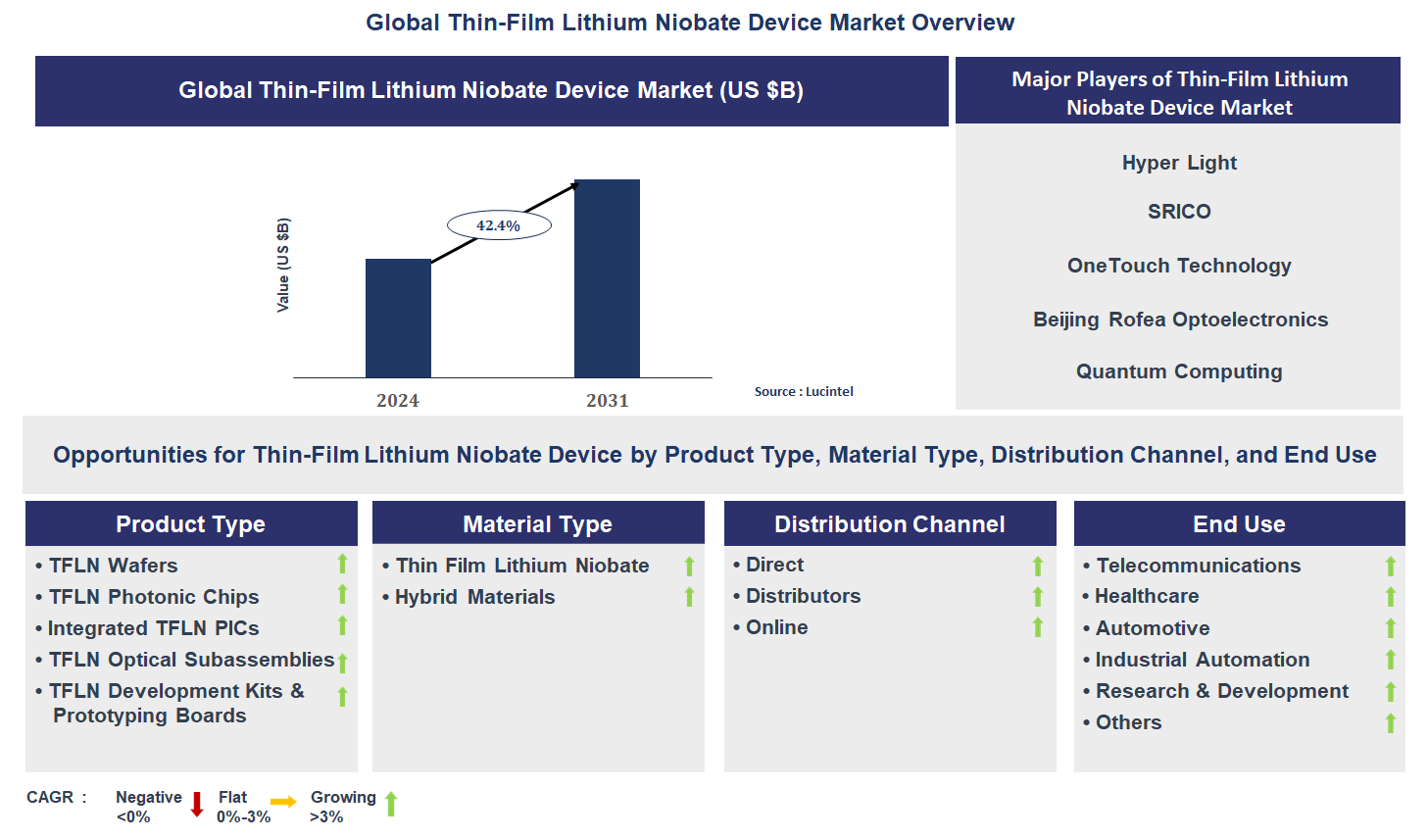
The future of the global thin-film lithium niobate device market looks promising with opportunities in the telecommunication, healthcare, automotive, industrial automation, and research & development markets. The global thin-film lithium niobate device market is expected to grow with a CAGR of 42.4% from 2025 to 2031. The major drivers for this market are the increasing demand for high-speed communication devices, the rising adoption of advanced photonic technologies, and the growing need for energy-efficient electronic solutions.• Lucintel forecasts that, within the product type category, TFLN photonic chip is expected to witness the highest growth over the forecast period.
• Within the end use category, telecommunication is expected to witness the highest growth.
• In terms of region, APAC is expected to witness the highest growth over the forecast period. Gain valuable insights for your business decisions with our comprehensive 150+ page report. Sample figures with some insights are shown below.
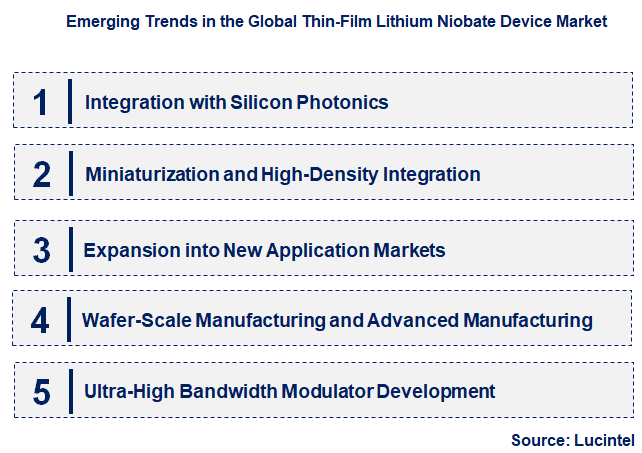
Emerging Trends in the Thin-Film Lithium Niobate Device Market
The new trends in the thin-film lithium niobate device industry are actually reshaping the industry from a niche, research-based sector to a commercially profitable, high-growth industry. These trends indicate an imperative shift toward the technical and economic obstacles that have previously constrained TFLN’s widespread adoption. The combination of leading-edge manufacturing methods, the broadening of applications outside telecommunications, and an emerging emphasis on cost reduction are all together making a new paradigm for photonic and electronic devices.• Integration with Silicon Photonics: The integration trend of the TFLN devices with the mature silicon photonics platform is taking off big time. It merges the strengths of both worlds: the high-speed modulation’s best electro-optic properties of TFLN and silicon’s low-cost, scalable fabrication. This hybrid integration allows for the compactness of highly energy-efficient photonic integrated circuits (PICs). Through the integration of these technologies, producers can produce a new class of high-speed devices for telecommunication and data center applications that overcome the shortcomings of each material individually.
• Miniaturization and High-Density Integration: The fact that TFLN can contain light within a reduced footprint is fueling the move toward more miniaturization and higher-density integration. Researchers and makers are creating nano-scale TFLN waveguides and resonators that enable denser packing of more components onto one chip. This trend is important to applications requiring numerous components in a confined space, like future LiDAR systems, quantum computing, and sophisticated sensors.
• Expansion into New Application Markets: Though telecommunication is a core application, TFLN is experiencing a significant trend of expansion into new and profitable markets. These include quantum computing, for which TFLN’s properties are particularly suited to making high-performance quantum photonics devices. Also, TFLN is finding use in automotive LiDAR for autonomous cars and biomedical sensing. This diversification eliminates the market’s dependence on one sector and develops new sources of revenue, highlighting TFLN as a diversified material for use in many different emerging technologies.
• Wafer-Scale Manufacturing and Advanced Manufacturing: There is a strong trend towards developing manufacturing processes to facilitate wafer-scale manufacturing of TFLN devices. These new methods such as ion slicing and epitaxial growth enable the production of high-quality, large-area TFLN wafers. This is important for cost reduction and the competitiveness of TFLN devices with respect to other technologies. Scaling from small-scale, laboratory-based fabrication to commercial fabrication is an important facilitator for broad-based adoption and a main driver of growth in the market.
• Ultra-High Bandwidth Modulator Development: The need for greater data rates is fueling a push in the creation of TFLN modulators with extremely high bandwidths. Industry and research organizations are experimenting with the frontiers of possibility, with demonstrations of modulators with speeds as high as 100 GHz and above. High-performance modulators are crucial to addressing the escalating needs of 5G, 6G, and hyperscale data centers. It is at the core of TFLN’s contribution to the future communication networks, establishing it as a reference material for ultra-fast data transfer. The trends are essentially remodeling the thin-film lithium niobate device market in terms of accelerating its maturity and commercialization. The shift towards hybrid integration and wafer-scale production is overcoming critical manufacturing roadblocks, making TFLN a more affordable and scalable option. At the same time, the growth into new markets such as quantum computing and LiDAR is opening up new growth opportunities and demonstrating the material’s versatility.
Recent Development in the Thin-Film Lithium Niobate Device Market
Recent advancements in the thin-film lithium niobate device industry are a reflection of the growing worldwide need for compact, high-speed, and energy-efficient photonic devices. The market is moving swiftly beyond the early research stage into a time of commercialization and large-scale production. These advancements, fueled by both technological innovations and strategic investment, are all contributing to a more diversified and penetrable market. The five major developments discussed below point out the most significant changes that are driving the TFLN market forward.• Commercialization of High-Quality TFLN Wafers: One key development has been the commercial production of high-quality TFLN wafers by industry leaders such as Sumitomo and NGK. These wafers, with their uniform thickness and low defect density, form the basis of high-performance devices. Availability of these wafers in larger sizes (e.g., 6-inch) has facilitated more advanced, wafer-scale fabrication processes. This advancement has reduced the barrier to entry for device manufacturers considerably, speeding up the design and manufacturing of a new line of TFLN-based components for diverse applications.
• Advances in Hybrid Integration with Silicon: There have been significant advances in methods of integrating TFLN with silicon photonics platforms. This requires the creation of advanced wafer bonding and patterning techniques that enable the two materials to be blended together seamlessly. This is important as it brings together the better optical characteristics of TFLN and silicon’s low-cost and scalable fabrication.
• Dedicated Fabrication Foundries: One key development is the creation of dedicated TFLN fabrication foundries and pilot lines. An example is the development of a new pilot line in China for 6-inch TFLN wafers, which represents an important step towards industrialization. These foundries are meant to accommodate the special TFLN processing challenges and facilitate fast prototyping and high-volume manufacturing. This transition from laboratory-scale fabrication to commercial-scale production is a driving force behind the markets growth and represents a vital infrastructure for businesses to make their designs commercially available.
• Ultra-High-Speed Modulator Demonstrations: Recent developments and R&D activities have resulted in demonstrations of ultra-high-speed TFLN modulators with bandwidths in excess of 100 GHz. This is a landmark development that demonstrates TFLNs ability to address future communication system requirements. These modulators provide better performance, reduced power usage, and more compactness than traditional technologies.
• Strategic Funding and Corporate Investment: Strategic funding and corporate investment have increased significantly in the TFLN market. Startups in TFLN are raising notable venture capital, whereas incumbent companies are committing large amounts of R&D investment. The injection of capital is an indication of market confidence and offering the resources that enable firms to ramp up their operations, speed up research, and bring new products to market. This is creating a vibrant and innovative ecosystem, hiring best talent and creating a new wave of innovations. These advancements are transforming the thin-film lithium niobate device market from a theoretical possibility to a real, commercial one. Access to high-quality wafers and the setup of special foundries are resolving critical manufacturing bottlenecks. Advances in hybrid integration and ultra-high-speed device demonstrations are establishing TFLN’s superior performance. The momentum in strategic investment is delivering the capital required to grow these innovations. Collectively, these advancements are paving the way for TFLN to become a core technology in high-speed optical communications and next-generation photonics.
Strategic Growth Opportunities in the Thin-Film Lithium Niobate Device Market
Strategic growth prospects in the thin-film lithium niobate device market lie mainly in major application spaces that require high performance, miniaturization, and energy efficiency. These opportunities are fueled by the materials unique properties and its capacity to address severe challenges in next-generation technologies. Focusing on these precise applications, companies can apply their expertise to gain considerable market share and stimulate innovation.• High-Speed Optical Communication: This is the best-established and biggest growth market for TFLN devices. With the worldwide deployment of 5G and the growing requirement for data center bandwidth, there is a bottomless appetite for low-power, high-speed modulators and switches. TFLN devices, with their excellent electro-optic performance and compact size, are ideal for this use. The potential is in creating and producing in large volumes TFLN-based optical transceivers for data centers and long-haul telecommunication networks, replacing older, less efficient technologies.
• Quantum Computing and Quantum Photonics: TFLN is a enabler for future quantum computing and quantum photonics. The material’s high nonlinear properties and low optical loss properties make it suitable for producing entangled photons, frequency conversion, and designing high-performance quantum gates. The growth potential lies in the supply of specialized TFLN chips and components for commercial quantum systems and quantum research.
• Industrial and Automotive LiDAR: The soon-to-be Booming market for LiDAR systems for autonomous vehicles and industrial robots is a high-growth opportunity. TFLN devices are suitable for the production of compact, high-performance optical beam steering and modulation devices for solid-state LiDAR. Such devices must be reliable, energy-efficient, and capable of operating in harsh conditions. The opportunity is in producing and designing TFLN chips that will support a new generation of low-cost, high-performance LiDAR systems, which are a prerequisite for autonomous technology adoption on a mass scale.
• Microwave Photonics: TFLN devices are increasingly being used in microwave photonics, an emerging technology that integrates microwave and optical technology for signal processing. The material’s high electro-optic efficiency enables the development of ultra-broadband microwave filters, oscillators, and signal processors. The potential here is in the availability of TFLN-based components for defense, aerospace, and telecommunication uses where high-level signal manipulation is needed.
• Medical and Sensing Devices: Advanced sensing and medical diagnostics markets are a promising, albeit less-exploited, growth prospect. Piezoelectric and optical properties of TFLN are being utilized to create extremely sensitive sensors for chemical sensing, environmental monitoring, and medical imaging. The opportunity lies in the development of a new generation of small, high-performance sensors that can be incorporated within mobile devices. The application area entails a multidisciplinary approach and provides the means to diversify revenue streams from conventional communication markets. These high-growth opportunities are having a revolutionary effect on the thin-film lithium niobate device market by propelling its development from a specialty technology into a foundation for a broad array of industries. With their focus on such high-growth applications, businesses are not merely broadening their base of customers but are also spurring ongoing research and development. This strategic concentration keeps TFLN at the cutting edge of innovation, establishing it as an essential enabler for the next generation of technological breakthroughs in communications, computing, and sensing.
Thin-Film Lithium Niobate Device Market Driver and Challenges
The market for thin-film lithium niobate device is driven by a vibrant combination of potent drivers and important challenges. The principal drivers, encompassing different technology, economics, and policy drivers, are driving the market. The rising demand for high-speed data, mature process manufacturing, and increasing investments are fueling a strong ecosystem. Yet this growth is challenged by high production costs, fierce competition from substitute materials, and the technological intricacies of fabrication. Understanding the dynamics of these forces deepens our insight into the landscape. The factors responsible for driving the thin-film lithium niobate device market include: 1. Accelerated Expansion of Data Centers and 5G Networks: The surging demand for data in data centers and worldwide deployment of 5G and upcoming 6G networks are the key drivers. TFLN modulators provide greater bandwidth and reduced power consumption than available technologies and are best suited for these high-speed applications. With data traffic continuing to expand exponentially, demand for TFLN devices will continue to grow, providing a steady and firm market demand. 2. Advances in Manufacturing Technology: Technological advances in fabrication methods, including ion slicing and epitaxial growth, have enabled fabrication at the wafer scale of TFLN devices. Such advances have minimized production expenses and maximized yield, bringing TFLN as a more cost-effective option compared to other materials. The driver is responsible for bringing TFLN from being a lab-based, niche technology to a commercially scalable option. 3. Integration with Silicon Photonics: The capability to integrate TFLN and silicon photonics seamlessly is one of the main drivers. This compound technology enables the creation of high-performance devices that take advantage of the optimal properties of each material. Through the provision of an existing silicon fabrication infrastructure, this integration minimizes costs and maximizes the rate of innovation, creating new possibilities for complicated photonic integrated circuits. 4. New Applications Emergence: Growth of TFLN to new and high-value applications like quantum computing, LiDAR, and microwave photonics is a key market growth driver. These new markets are strongly dependent on TFLN’s special characteristics, opening up new, high-margin market segments. This diversification minimizes the dependence of the market on telecommunications and guarantees long-term viability. 5. Strategic Investment and R&D Growth: The industry is witnessing growth in strategic investments from big companies and venture capitalists. This money is driving research and development activities, resulting in swift innovation. This driver forms a self-reinforcing cycle of innovation, as new innovations attract further investment that contributes to even greater technological improvements and market growth. Challenges in the thin-film lithium niobate device market are: 1. High Cost of TFLN Wafers: Even with improvements in production, high-quality TFLN wafers still come at a very high cost. The raw materials and the specialized, intricate processes involved in producing wafers drive up the cost compared to silicon wafers. The high cost can be a hindrance for some low-margin applications and is a more costly option, which dampers its extensive adoption. 2. Alternative Materials Competition: TFLN has strong competition from long-standing technologies and competing materials such as silicon photonics and indium phosphide. Although TFLN provides better performance in numerous fronts, these competing platforms are more developed, possess long-standing supply chains, and tend to be less expensive. The market needs to continue showing TFLN’s performance benefits in order to price its technology higher and compete fairly. 3. Fabrication Technical Complexity: The production of TFLN devices is technically complex and involves the use of sophisticated equipment and technical expertise. Techniques such as wafer bonding, high-precision etching, and polishing are difficult to master and scale. This technical complexity can compromise manufacturing yields and increase production costs, creating a major entry barrier for new firms as well as for existing firms that want to expand their operations to meet growing demand in the market. In summary, the market for thin-film lithium niobate devices is motivated by strong forces including high-speed data demand, manufacturing technological advancements, and new markets. These drivers are setting the stage for growth and commercialization. Nonetheless, the market has to surmount major challenges in the form of high costs of production, intense competition, and technical intricacies in fabrication. The long-term success of TFLN devices will depend on the industry being able to keep innovating and discover ways to cut costs and simplify production so that these high-performance devices become more affordable and competitive.List of Thin-Film Lithium Niobate Device Companies
Companies in the market compete on the basis of product quality offered. Major players in this market focus on expanding their manufacturing facilities, R&D investments, infrastructural development, and leverage integration opportunities across the value chain. With these strategies thin-film lithium niobate device companies cater increasing demand, ensure competitive effectiveness, develop innovative products & technologies, reduce production costs, and expand their customer base. Some of the thin-film lithium niobate device companies profiled in this report include-• Hyper Light
• SRICO
• OneTouch Technology
• Beijing Rofea Optoelectronics
• Quantum Computing
• Ori-Chip
• AFR
• Agiltron
• Thorlab
• Fujitsu
Thin-Film Lithium Niobate Device Market by Segment
The study includes a forecast for the global thin-film lithium niobate device market by product type, material type, distribution channel, end use, and region.Thin-Film Lithium Niobate Device Market by Product Type [Value from 2019 to 2031]:
• TFLN Wafers
• TFLN Photonic Chips
• Integrated TFLN PICs
• TFLN Optical Subassemblies
• TFLN Development Kits & Prototyping Boards
Thin-Film Lithium Niobate Device Market by Material Type [Value from 2019 to 2031]:
• Thin Film Lithium Niobate
• Hybrid Materials
Thin-Film Lithium Niobate Device Market by Distribution Channel [Value from 2019 to 2031]:
• Direct
• Distributors
• Online
Thin-Film Lithium Niobate Device Market by End Use [Value from 2019 to 2031]:
• Telecommunications
• Healthcare
• Automotive
• Industrial Automation
• Research & Development
• Others
Thin-Film Lithium Niobate Device Market by Region [Value from 2019 to 2031]:
• North America
• Europe
• Asia Pacific
• The Rest of the World
Country Wise Outlook for the Thin-Film Lithium Niobate Device Market
The thin-film lithium niobate device market is growing rapidly and innovating as a result of the material’s excellent electro-optic, piezoelectric, and nonlinear characteristics. The TFLN devices are vital for high-speed data transmission, 5G and beyond-5G networks, and next-generation photonics. Recent trends in the world’s major markets, such as the United States, China, Germany, India, and Japan, are marked by a heavy emphasis on manufacturing scalability, research and development partnerships, and the growth of applications in new areas such as quantum computing and artificial intelligence.• United States : The US market is the forefront of TFLN research and commercialization, led by strong focuses on combining TFLN with current silicon photonics platforms. The latest developments center on enhancing device performance and processing technologies, especially in high-speed modulators for data centers and telecommunications. Principal companies and startups are raising sizeable funding, reflecting investor confidence. There is a strong trend towards a fabless model, where the chips are designed by companies and sourced from foundries, which enables it to have more agile innovation cycles.
• China: China’s TFLN market is also quickly evolving, fueled by a countrywide strategy of getting technologically self-sufficient in key components. One such critical development is the creation of the nation’s first 6-inch TFLN photonic chip pilot line by such organizations as Shanghai Jiao Tong University. This will facilitate defeating manufacturing difficulties and mass production of high-performance modulators for 5G and 6G networks. Chinese scientists are making tremendous performance breakthroughs, including 110GHz bandwidth modulators, which are essential to stay competitive.
• Germany: Germany is a major force in the European TFLN market, with a strong materials science base and focused manufacturing. Recent advancements have been driven by cooperation between research centers and industry to optimize fabrication methods and explore new uses. There is specific emphasis on enhancing the quality and yield of single-crystal TFLN films. German industry and research institutions are applying their knowledge in precision engineering to further TFLN for high-frequency use, such as microwave photonics and next-generation sensors.
• India: The Indian TFLN market is in its infancy but is developing fast, driven by the initiative of India to develop digital infrastructure and deploy 5G. Although mass production is not yet in the limelight, recent advancements are focused on research and development, especially in institutions. The emphasis lies in exhibiting proof-of-concept devices and investigating low-cost fabrication techniques. The main driver for growth is the local demand for high-speed communication components.
• Japan: Japan’s background in advanced materials and electronics is extensive, and its TFLN market is a reflection of the same. Recent advances are dominated by key players such as Sumitomo Metal Mining and NGK Insulators, who are paying close attention to enhancing the manufacturing of high-quality TFLN wafers. Quality control and manufacturing scalability are given major priority. Japanese firms are also leading the charge in investigating TFLN application in next-generation applications, such as quantum computing and high-end optical components for data centers. The market is driven by a top-down, strategic approach with the big firms investing in R&D to preserve their position at the top of the global supply chain.

Features of the Global Thin-Film Lithium Niobate Device Market
Market Size Estimates: Thin-film lithium niobate device market size estimation in terms of value ($B). Trend and Forecast Analysis: Market trends (2019 to 2024) and forecast (2025 to 2031) by various segments and regions. Segmentation Analysis: Thin-film lithium niobate device market size by various segments, such as by product type, material type, distribution channel, end use, and region in terms of value ($B). Regional Analysis: Thin-film lithium niobate device market breakdown by North America, Europe, Asia Pacific, and Rest of the World. Growth Opportunities: Analysis of growth opportunities in different product types, material types, distribution channels, end uses, and regions for the thin-film lithium niobate device market. Strategic Analysis: This includes M&A, new product development, and competitive landscape of the thin-film lithium niobate device market. Analysis of competitive intensity of the industry based on Porter’s Five Forces model.
FAQ
Q1. What is the growth forecast for thin-film lithium niobate device market? Answer: The global thin-film lithium niobate device market is expected to grow with a CAGR of 42.4% from 2025 to 2031. Q2. What are the major drivers influencing the growth of the thin-film lithium niobate device market? Answer: The major drivers for this market are the increasing demand for high-speed communication devices, the rising adoption of advanced photonic technologies, and the growing need for energy-efficient electronic solutions. Q3. What are the major segments for thin-film lithium niobate device market? Answer: The future of the thin-film lithium niobate device market looks promising with opportunities in the telecommunication, healthcare, automotive, industrial automation, and research & development markets. Q4. Who are the key thin-film lithium niobate device market companies? Answer: Some of the key thin-film lithium niobate device companies are as follows:• Hyper Light
• SRICO
• OneTouch Technology
• Beijing Rofea Optoelectronics
• Quantum Computing
• Ori-Chip
• AFR
• Agiltron
• Thorlab
• Fujitsu Q5. Which thin-film lithium niobate device market segment will be the largest in future? Answer: Lucintel forecasts that, within the product type category, TFLN photonic chip is expected to witness the highest growth over the forecast period. Q6. In thin-film lithium niobate device market, which region is expected to be the largest in next 5 years? Answer: In terms of region, APAC is expected to witness the highest growth over the forecast period. Q7. Do we receive customization in this report? Answer: Yes, Lucintel provides 10% customization without any additional cost.
Table of Contents
List of Figures
List of Tables
Methodology
- In-depth interviews of the major players in this market
- Detailed secondary research from competitors’ financial statements and published data
- Extensive searches of published works, market, and database information pertaining to industry news, company press releases, and customer intentions
- A compilation of the experiences, judgments, and insights of Lucintel’s professionals, who have analyzed and tracked this market over the years.


Buy Now
Choose a license that fits your team. Instant PDF delivery.
Prices exclude taxes. Instant delivery. Custom licensing available on request.
Key Questions
- • What are some of the most promising, high-growth opportunities for the thin-film lithium niobate device market by product type (TFLN wafers, TFLN photonic chips, integrated TFLN PICs, TFLN optical subassemblies, and TFLN development kits & prototyping boards), material type (thin film lithium niobate and hybrid materials), distribution channel (direct, distributors, and online), end use (telecommunications, healthcare, automotive, industrial automation, research & development, and others), and region (North America, Europe, Asia Pacific, and the Rest of the World)?
- • Which segments will grow at a faster pace and why?
- • Which region will grow at a faster pace and why?
- • What are the key factors affecting market dynamics? What are the key challenges and business risks in this market?
- • What are the business risks and competitive threats in this market?
- • What are the emerging trends in this market and the reasons behind them?
- • What are some of the changing demands of customers in the market?
- • What are the new developments in the market? Which companies are leading these developments?
- • Who are the major players in this market? What strategic initiatives are key players pursuing for business growth?
- • What are some of the competing products in this market and how big of a threat do they pose for loss of market share by material or product substitution?
- • What M&A activity has occurred in the last 5 years and what has its impact been on the industry? For any questions related to Thin-Film Lithium Niobate Device Market, Thin-Film Lithium Niobate Device Market Size, Thin-Film Lithium Niobate Device Market Growth, Thin-Film Lithium Niobate Device Market Analysis, Thin-Film Lithium Niobate Device Market Report, Thin-Film Lithium Niobate Device Market Share, Thin-Film Lithium Niobate Device Market Trends, Thin-Film Lithium Niobate Device Market Forecast, Thin-Film Lithium Niobate Device Companies, write Lucintel analyst at email: helpdesk@lucintel.com. We will be glad to get back to you soon.


