
Market Report · July 31, 2026

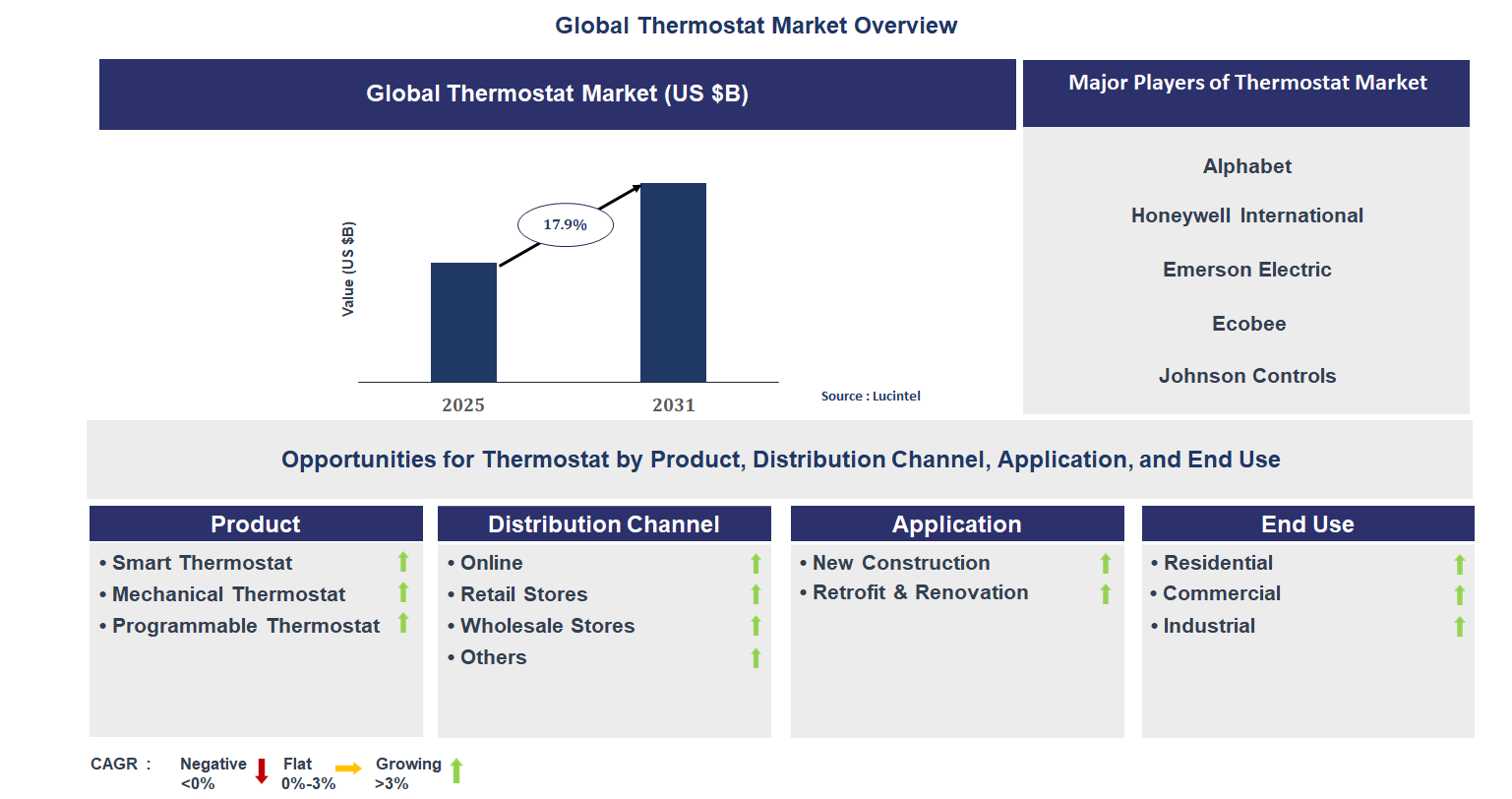
Key data points: The growth forecast = 17.9% annually for the next 7 years. Scroll below to get more insights. This market report covers trends, opportunities and forecasts in thermostat market to 2031 by product (smart thermostat, mechanical thermostat, and programmable thermostat), distribution channel (online, retail stores, wholesale stores, and others), application (new construction and retrofit & renovation), end use (residential, commercial, and industrial), and region (North America, Europe, Asia Pacific, and the Rest of the World)
We'll send your sample report shortly.
• Lucintel forecasts that, within the product category, smart thermostat is expected to witness the highest growth over the forecast period.
• Within the end use category, commercial is expected to witness the highest growth.
• In terms of region, APAC is expected to witness the highest growth over the forecast period. Gain valuable insights for your business decisions with our comprehensive 150+ page report. Sample figures with some insights are shown below.
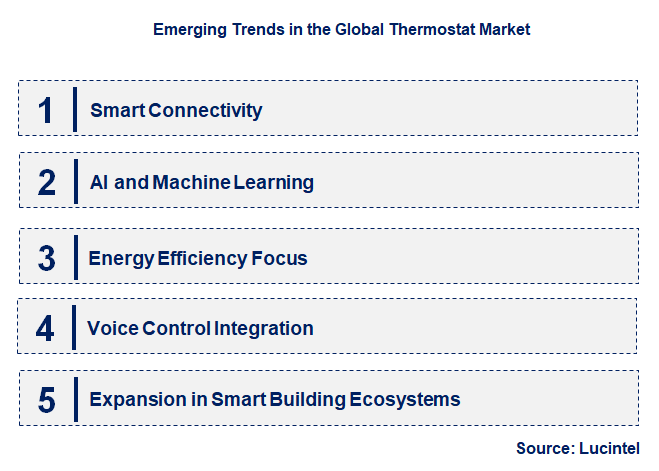
• Smart Connectivity: Wi-Fi and Bluetooth-enabled thermostats enable seamless remote access, integration with smart home systems, and multi-device control, elevating consumer convenience.
• AI and Machine Learning: Adaptive learning thermostats analyze user behavior and environmental data to optimize temperature settings, improving comfort and energy efficiency.
• Energy Efficiency Focus: Thermostats with advanced sensors and algorithms reduce waste by precise control, supporting environmental goals and reducing utility costs.
• Voice Control Integration: Compatibility with voice assistants like Alexa, Google Assistant, and Siri simplifies operation and encourages hands-free control.
• Expansion in Smart Building Ecosystems: Thermostats integrate with building management systems for centralized control, contributing to large-scale energy management and automation. These trends collectively transform thermostats from simple temperature regulators into intelligent, connected devices critical for modern energy management and user-centric comfort solutions.
• Advancements in AI Algorithms: New thermostats leverage AI for predictive climate control, adapting dynamically to changing environments.
• Enhanced User Interfaces: Touchscreen and app-controlled thermostats improve accessibility and customization.
• Integration with Renewable Energy Systems: Thermostats optimize heating/cooling in homes with solar panels and smart grids.
• Expansion of Voice-Activated Devices: Increased consumer demand drives broader inclusion of voice assistant compatibility.
• Growth of Retrofit and Replacement Markets: Rising focus on upgrading existing HVAC systems fuels demand for modern, programmable thermostats. These developments drive thermostat market expansion by improving functionality, user engagement, and enabling seamless integration with broader smart home and energy systems.
• Residential Smart Home Market: Penetration of IoT-enabled smart thermostats in homes boosts energy savings and comfort control.
• Commercial HVAC Systems: Large-scale installations benefit from networked thermostats for efficient space management and operational savings.
• Industrial Automation: Precision thermostats aid in process control, ensuring quality and reducing energy consumption in manufacturing.
• Retrofit and Replacement: Upgrading old thermostat systems offers significant market potential with growing environmental regulations.
• Renewable Energy Integration: Thermostats aligned with solar and other renewable sources enhance system efficiency and adoption. Leveraging these application areas accelerates thermostat adoption, fuels innovation, and supports market growth aligned with global energy and digital transformation trends.
• Alphabet
• Honeywell International
• Emerson Electric
• Ecobee
• Johnson Controls
• Siemens
• Trane Technologies
• Carrier Corporation
• Resideo Technologies
• Bosch Thermotechnology
• Smart Thermostat
• Mechanical Thermostat
• Programmable Thermostat
• Online
• Retail Stores
• Wholesale Stores
• Others
• New Construction
• Retrofit & Renovation
• Residential
• Commercial
• Industrial
• North America
• Europe
• Asia Pacific
• The Rest of the World
• United States: The US thermostat market is marked by strong growth driven by widespread smart home integration and energy efficiency regulations. Key advancements include AI-powered learning thermostats, voice control capabilities, and broad adoption of IoT-connected devices. Investments in commercial and residential upgrades further enhance demand, solidifying the US as the largest regional market with aggressive innovation leadership.
• China: China’s market is expanding rapidly with increasing urbanization and government programs promoting smart cities and green buildings. Major developments involve cost-effective smart thermostats adapted for mass-market adoption, integration with multi-functional home automation systems, and a growing base of HVAC manufacturers incorporating connected devices to support energy management and environmentally conscious solutions.
• Germany: Germany is advancing through stringent environmental policies and a focus on Industry 4.0 automation. Thermostats tailored for smart building integration, energy-saving functions, and compatibility with European energy standards lead growth. German manufacturers emphasize sustainability and digital control ecosystems, supporting consumer demand for precision climate control in both new constructions and retrofits.
• India: India’s thermostat market is growing steadily, driven by increasing middle-class housing construction and rising awareness of energy conservation. Efforts focus on affordable, programmable thermostats and smart devices suitable for local infrastructure. Growing investments in commercial infrastructure and smart cities initiatives promote adoption in both residential and institutional sectors, supported by government incentives.
• Japan: Japan pioneers with highly sophisticated, compact thermostats integrating AI and IoT for precise comfort and energy savings. Innovations include voice-enabled interfaces and integration with smart grids to optimize power use. Strong automotive, healthcare, and industrial sectors demand advanced temperature control solutions, and Japanese companies focus on continuous product refinement and user experience enhancement.


• Alphabet
• Honeywell International
• Emerson Electric
• Ecobee
• Johnson Controls
• Siemens
• Trane Technologies
• Carrier Corporation
• Resideo Technologies
• Bosch Thermotechnology Q5. Which thermostat market segment will be the largest in future? Answer: Lucintel forecasts that, within the product category, smart thermostat is expected to witness the highest growth over the forecast period. Q6. In thermostat market, which region is expected to be the largest in next 5 years? Answer: In terms of region, APAC is expected to witness the highest growth over the forecast period. Q7. Do we receive customization in this report? Answer: Yes, Lucintel provides 10% customization without any additional cost.


Choose a license that fits your team. Instant PDF delivery.
Prices exclude taxes. Instant delivery. Custom licensing available on request.
Market Report · July 31, 2026
Market Report · July 31, 2026
Market Report · July 31, 2026
Trusted partner for strategic intelligence and business growth


Receive a complimentary market analysis tailored to your industry. Our analysts will identify key growth opportunities and competitive dynamics specific to your business.

Market size, growth rate, and key trend analysis for your specific sector.

Top competitor positioning and market share analysis.

Strategic recommendations backed by data-driven insights.
Get curated market intelligence and competitive moves straight to your inbox.
By subscribing, you agree to receive our monthly insights. Unsubscribe anytime.
Receive a complimentary market analysis tailored to your industry. Our analysts will identify key growth opportunities and competitive dynamics specific to your business.
Market size, growth rate, and key trend analysis for your specific sector.
Top competitor positioning and market share analysis.
Strategic recommendations backed by data-driven insights.
Get curated market intelligence, emerging trends, and competitive moves straight to your inbox each month.
By subscribing, you agree to receive our monthly insights. Unsubscribe anytime.
We'll send your sample report shortly.