
Report Feature
Textile Fluorine Free Water Repellent Market Trends and Forecast
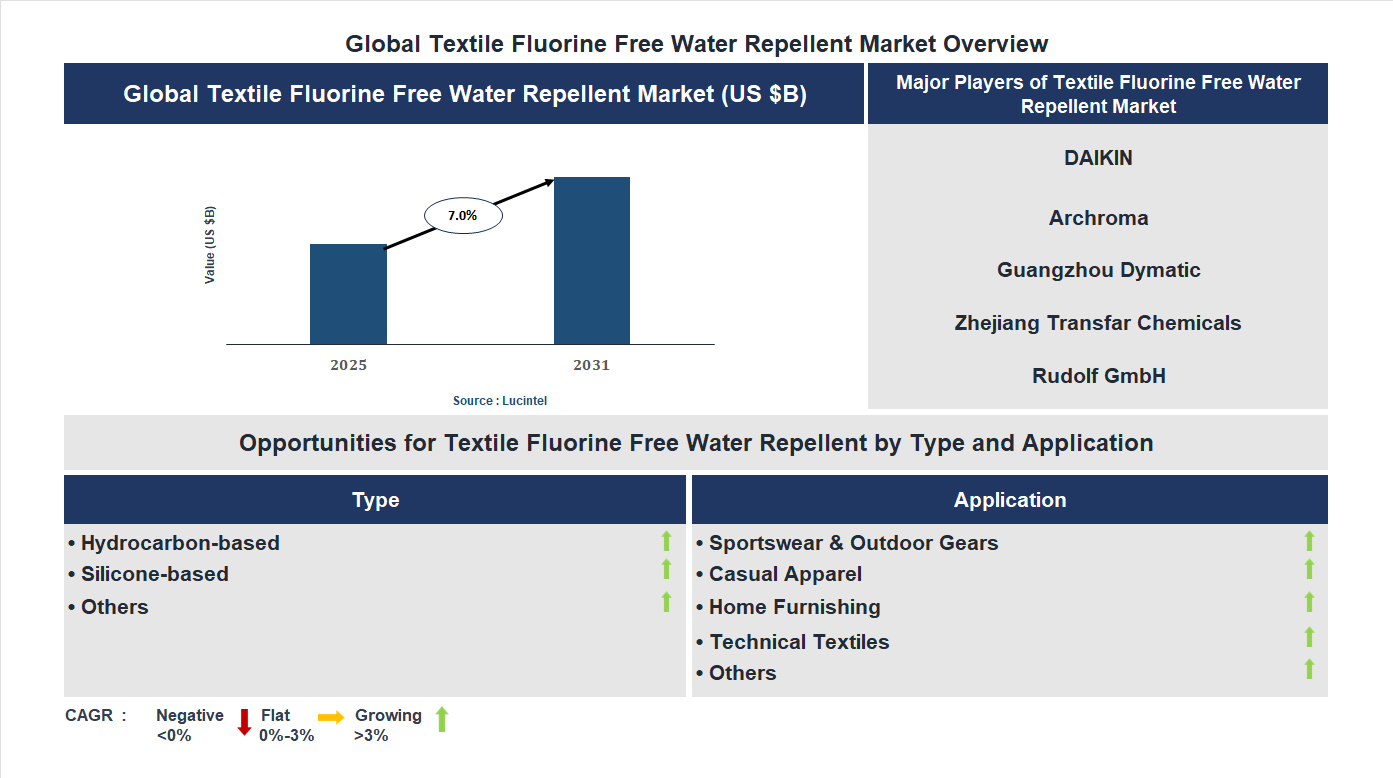
The future of the global textile fluorine free water repellent market looks promising with opportunities in the sportswear & outdoor gear, casual apparel, home furnishing, and technical textile markets. The global textile fluorine free water repellent market is expected to grow with a CAGR of 7% from 2025 to 2031. The major drivers for this market are the increasing preference for eco-friendly textile finishes, the rising demand for durable water-repellent fabrics, and the growing use of sustainable performance coatings.• Lucintel forecasts that, within the type category, silicone-based is expected to witness higher growth over the forecast period.
• Within the application category, technical textile is expected to witness the highest growth.
• In terms of region, APAC is expected to witness the highest growth over the forecast period. Gain valuable insights for your business decisions with our comprehensive 150+ page report. Sample figures with some insights are shown below.
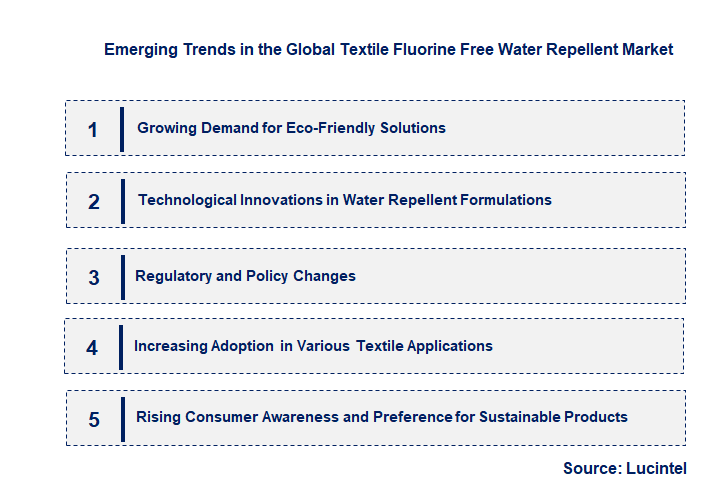
Emerging Trends in the Textile Fluorine Free Water Repellent Market
The textile fluorine free water repellent market is experiencing rapid evolution driven by increasing environmental awareness, regulatory changes, and technological advancements. Consumers and manufacturers are shifting towards sustainable solutions that offer effective water repellency without harmful chemicals. This shift is fostering innovation and redefining industry standards, leading to new opportunities and challenges. As the market adapts to these changes, understanding emerging trends is crucial for stakeholders aiming to stay competitive and environmentally responsible. The following five key trends highlight the significant developments shaping the future of this market.• Growing Demand for Eco-Friendly Solutions: Increasing environmental concerns and stricter regulations are driving demand for fluorine-free water repellents. Consumers prefer sustainable products that do not contain harmful chemicals, prompting manufacturers to develop innovative, eco-friendly formulations. This trend enhances brand reputation and aligns with global sustainability goals, ultimately expanding market reach and consumer trust.
• Technological Innovations in Water Repellent Formulations: Advances in nanotechnology and polymer science are enabling the creation of more effective and durable fluorine-free water repellents. These innovations improve performance, longevity, and ease of application, making eco-friendly options more competitive with traditional fluorinated products. Such technological progress is crucial for meeting industry standards and consumer expectations.
• Regulatory and Policy Changes: Governments worldwide are implementing stricter regulations on the use of fluorinated chemicals in textiles. These policies are encouraging manufacturers to adopt safer alternatives and phase out harmful substances. Compliance with these regulations not only avoids penalties but also positions companies as environmentally responsible leaders in the market.
• Increasing Adoption in Various Textile Applications: The demand for fluorine-free water repellents is expanding across diverse textile sectors, including outdoor apparel, upholstery, and technical textiles. The versatility and safety of these solutions make them suitable for sensitive applications, boosting market penetration and driving growth in new segments.
• Rising Consumer Awareness and Preference for Sustainable Products: Consumers are becoming more conscious of the environmental and health impacts of their purchases. This awareness influences buying decisions, favoring products with eco-friendly water repellents. Manufacturers are responding by marketing sustainable textiles, which enhances brand loyalty and accelerates market expansion. In summary, these emerging trends are fundamentally reshaping the textile fluorine free water repellent market by fostering sustainable innovation, influencing regulatory landscapes, and aligning product offerings with consumer values. This evolution is leading to a more environmentally responsible industry that balances performance with safety, ultimately driving long-term growth and market resilience.
Recent Development in the Textile Fluorine Free Water Repellent Market
The textile fluorine free water repellent market has experienced significant growth driven by increasing environmental awareness, regulatory pressures, and technological advancements. As consumers and manufacturers seek sustainable solutions, the demand for eco-friendly water repellents has surged. Innovations in chemical formulations and expanding applications across various textile segments are shaping the market landscape. Additionally, regulatory bans on fluorinated compounds are accelerating the shift toward fluorine-free alternatives. Market players are investing in research and development to enhance product performance while maintaining eco-credentials. These developments collectively influence market dynamics, creating new opportunities and challenges for stakeholders in the textile industry.• Rising Environmental Regulations: Governments worldwide are imposing stricter regulations on fluorinated chemicals, prompting manufacturers to develop and adopt fluorine-free water repellents, which boosts market growth and encourages innovation.
• Technological Advancements: New chemical formulations and application techniques have improved the efficacy and durability of fluorine-free water repellents, making them more competitive with traditional fluorinated options and expanding their use across various textiles.
• Increasing Consumer Demand for Eco-Friendly Products: Consumers are increasingly prioritizing sustainable and non-toxic textiles, driving brands to incorporate fluorine-free water repellents, thereby expanding market adoption and product offerings.
• Expansion in End-Use Industries: The textile water repellent market is witnessing growth in sectors such as outdoor apparel, upholstery, and technical textiles, which require high-performance, eco-friendly water-repellent solutions, broadening market scope.
• Strategic Partnerships and Investments: Market players are forming alliances and investing in R&D to develop innovative fluorine-free solutions, enhancing product portfolios and gaining competitive advantages in the evolving market landscape. In summary, these developments are significantly impacting the textile fluorine free water repellent market by fostering sustainable practices, encouraging innovation, and expanding application areas. The shift towards eco-friendly solutions is driving market growth, while regulatory pressures and consumer preferences are shaping future trends. Companies that adapt to these changes through technological advancements and strategic collaborations are poised to capitalize on emerging opportunities in this evolving landscape.
Strategic Growth Opportunities in the Textile Fluorine Free Water Repellent Market
The textile fluorine free water repellent market is experiencing rapid growth driven by increasing environmental concerns, regulatory pressures, and consumer demand for sustainable products. As industries shift towards eco-friendly solutions, innovative water-repellent technologies are gaining prominence across various applications. This evolution presents significant opportunities for market players to expand their offerings, improve product performance, and meet evolving regulatory standards. The following key growth opportunities across different applications highlight the potential for market expansion and technological advancement, shaping the future landscape of textile water repellents.• Outdoor Apparel: Enhanced durability and eco-friendliness drive adoption : Growing consumer preference for sustainable outdoor clothing fuels demand for fluorine-free water repellents that offer long-lasting protection without environmental harm. This boosts sales in premium outdoor gear segments and encourages brands to innovate with eco-conscious materials.
• Automotive Textiles: Increased focus on sustainability and safety : The automotive industry seeks water-repellent textiles that are environmentally safe and meet stringent safety standards. Fluorine-free solutions improve vehicle interior longevity and safety, opening new avenues for suppliers and manufacturers.
• Home Furnishings: Rising demand for eco-friendly fabrics : Consumers increasingly prefer sustainable home textiles such as curtains, upholstery, and bedding that resist water and stains. This trend encourages manufacturers to develop fluorine-free water repellents that align with eco-conscious lifestyles.
• Industrial Textiles: Adoption in protective clothing and technical fabrics : Industrial applications require durable, eco-friendly water-repellent textiles for protective gear and technical fabrics. The shift towards sustainable solutions enhances product safety and environmental compliance, expanding market opportunities.
• Sportswear and Activewear: Growing emphasis on performance and sustainability : Athleisure and sportswear brands prioritize eco-friendly, water-resistant fabrics that support active lifestyles. Fluorine-free water repellents improve product appeal and meet regulatory standards, boosting market growth. In summary, these growth opportunities across key applications are significantly impacting the textile fluorine free water repellent market by fostering innovation, enhancing sustainability, and expanding market reach. As demand for eco-friendly textiles increases, industry players are poised to capitalize on these trends, driving overall market expansion and technological progress.
Textile Fluorine Free Water Repellent Market Driver and Challenges
The textile fluorine free water repellent market is influenced by a variety of technological, economic, and regulatory factors. As environmental concerns grow, there is increasing demand for sustainable and eco-friendly textile treatments. Technological advancements are enabling the development of innovative water-repellent solutions that are free from harmful chemicals. Economic factors such as rising disposable incomes and expanding textile industries in emerging markets further propel market growth. Additionally, stricter regulations on fluorinated compounds are pushing manufacturers to adopt safer alternatives. These drivers collectively shape the market landscape, creating opportunities for innovation and expansion while also presenting challenges related to compliance and technological adaptation. The factors responsible for driving the textile fluorine free water repellent market include:• Increasing Environmental Regulations: Governments worldwide are imposing stricter regulations on the use of fluorinated chemicals due to their environmental and health impacts. This regulatory pressure encourages manufacturers to develop and adopt fluorine-free water repellents, fostering market growth. Companies are investing in research to meet compliance standards, which also enhances their brand reputation. The shift towards eco-friendly products aligns with consumer preferences for sustainable textiles, further boosting demand. However, navigating diverse regulatory landscapes can be complex, requiring continuous adaptation and innovation.
• Growing Demand for Sustainable Textiles: Consumers are increasingly prioritizing eco-friendly and sustainable products, prompting textile manufacturers to seek environmentally safe water-repellent solutions. Fluorine-free water repellents offer a safer alternative that appeals to eco-conscious buyers. This trend is particularly prominent in fashion, outdoor apparel, and technical textiles, where water resistance is essential. The demand is also driven by corporate social responsibility initiatives and certifications that favor sustainable practices. As awareness grows, the market for fluorine-free water repellents is expected to expand significantly, encouraging innovation and investment in greener technologies.
• Technological Innovations in Water-Repellent Coatings: Advances in nanotechnology and polymer chemistry are enabling the development of highly effective fluorine-free water-repellent coatings. These innovations improve the durability, breathability, and water resistance of textiles without compromising comfort or environmental safety. Companies investing in R&D are creating products that outperform traditional fluorinated treatments, opening new application avenues. The integration of smart and multifunctional coatings further enhances textile performance. However, developing cost-effective and scalable solutions remains a challenge, requiring ongoing research and technological refinement to meet industry standards.
• Rising Adoption in Technical and Outdoor Textiles: The demand for high-performance textiles in outdoor, sports, and technical applications is fueling the adoption of fluorine-free water repellents. These textiles require durable, long-lasting water resistance to withstand harsh conditions. Fluorine-free solutions are increasingly preferred due to their environmental benefits and compliance with regulations. Manufacturers are incorporating these treatments into a wide range of products, from outdoor jackets to industrial fabrics. The challenge lies in ensuring that these eco-friendly coatings match or surpass the performance of traditional fluorinated options, which requires continuous innovation and testing.
• Expansion in Emerging Markets: Rapid industrialization and urbanization in emerging economies such as India, China, and Southeast Asia are driving textile production and consumption. The growing middle class and increased awareness of sustainable products are boosting demand for fluorine-free water-repellent textiles. Local manufacturers are adopting eco-friendly treatments to meet global standards and consumer preferences. This expansion offers significant growth opportunities but also requires overcoming infrastructural and technological barriers. Ensuring quality, affordability, and compliance with international regulations remains critical for capturing market share in these regions. The challenges facing this textile fluorine free water repellent market include:
• Stringent Regulatory Environment: While regulations promote eco-friendly solutions, they also pose compliance challenges for manufacturers. Different countries have varying standards and approval processes for fluorine-free water repellents, complicating product development and market entry. Companies must invest heavily in R&D to meet diverse regulatory requirements, which can increase costs and time-to-market. Non-compliance risks legal penalties and damage to brand reputation. Navigating this complex regulatory landscape requires strategic planning and continuous monitoring of policy changes, which can hinder rapid innovation and expansion.
• Performance and Durability Concerns: Achieving water repellency comparable to fluorinated treatments remains a significant challenge. Fluorine-free coatings often struggle with durability, especially after multiple washes or exposure to harsh conditions. This limits their application in demanding environments like outdoor gear and technical textiles. Manufacturers must balance environmental safety with performance, which requires advanced formulations and testing. Overcoming these hurdles is essential to gain consumer trust and expand market adoption, but it involves substantial investment in research and development.
• Cost and Scalability Issues: Developing effective fluorine-free water repellents that are also cost-competitive is challenging. Advanced formulations and nanotechnology-based coatings can be expensive to produce at scale, impacting pricing strategies. Small and medium-sized manufacturers may find it difficult to adopt these technologies due to high initial investments. Scaling production while maintaining quality and consistency adds complexity. Addressing these cost and scalability issues is crucial for widespread adoption, especially in price-sensitive markets, but it requires technological breakthroughs and supply chain optimization. In summary, the textile fluorine free water repellent market is driven by environmental regulations, consumer demand for sustainability, technological innovations, application in high-performance textiles, and growth in emerging markets. However, challenges such as regulatory compliance, performance limitations, and cost barriers must be addressed to realize its full potential. The markets future depends on continuous innovation, strategic adaptation, and balancing environmental benefits with performance and affordability. Overall, these drivers and challenges will shape the evolution of eco-friendly textile treatments, influencing industry standards and consumer choices globally.
List of Textile Fluorine Free Water Repellent Companies
Companies in the market compete on the basis of product quality offered. Major players in this market focus on expanding their manufacturing facilities, R&D investments, infrastructural development, and leverage integration opportunities across the value chain. With these strategies textile fluorine free water repellent companies cater increasing demand, ensure competitive effectiveness, develop innovative products & technologies, reduce production costs, and expand their customer base. Some of the textile fluorine free water repellent companies profiled in this report include-• DAIKIN
• Archroma
• Guangzhou Dymatic
• Zhejiang Transfar Chemicals
• Rudolf GmbH
• NICCA
• Tanatex Chemicals
• Zschimmer & Schwarz
• Fibrochem Advanced Materials Co
• HeiQ Materials AG
Textile Fluorine Free Water Repellent Market by Segment
The study includes a forecast for the global textile fluorine free water repellent market by type, application, and region.Textile Fluorine Free Water Repellent Market by Type [Value from 2019 to 2031]:
• Hydrocarbon-based
• Silicone-based
• Others
Textile Fluorine Free Water Repellent Market by Application [Value from 2019 to 2031]:
• Sportswear & Outdoor Gears
• Casual Apparel
• Home Furnishing
• Technical Textiles
• Others
Textile Fluorine Free Water Repellent Market by Region [Value from 2019 to 2031]:
• North America
• Europe
• Asia Pacific
• The Rest of the World
Country Wise Outlook for the Textile Fluorine Free Water Repellent Market
The textile fluorine free water repellent market has experienced significant growth driven by increasing environmental awareness, regulatory pressures, and technological advancements. Countries worldwide are shifting towards sustainable solutions, prompting innovations in water-repellent textiles that avoid harmful fluorinated chemicals. This trend is particularly prominent in major markets such as the United States, China, Germany, India, and Japan, where consumer demand and regulatory frameworks are shaping industry directions. These nations are investing in research and development to enhance product performance while ensuring environmental safety, leading to a dynamic and evolving market landscape.• United States: The US market has seen a surge in demand for eco-friendly textile treatments, driven by stringent regulations and consumer preferences for sustainable products. Major brands are adopting fluorine-free water repellents, focusing on performance and environmental safety. Innovations in nanotechnology and bio-based solutions are gaining traction, with increased investments in R&D. The government’s emphasis on environmental standards and eco-labeling is further accelerating market growth, making the US a leader in adopting fluorine-free textile solutions.
• China: China remains the largest producer and consumer of textiles, with a growing shift towards sustainable practices. The government’s policies promoting environmental protection are encouraging manufacturers to adopt fluorine-free water repellents. Technological advancements in eco-friendly textile finishing are being rapidly integrated into production lines. Domestic companies are investing heavily in research to develop high-performance, fluorine-free water-repellent textiles that meet international standards, positioning China as a key player in the global market.
• Germany: Germany’s market is characterized by a strong focus on sustainability and innovation. The country’s textile industry is adopting advanced fluorine-free water-repellent technologies to comply with strict EU regulations. German companies are leading in developing durable, eco-friendly textile finishes that do not compromise on quality. The emphasis on circular economy principles and eco-labeling is driving the adoption of fluorine-free solutions, making Germany a significant hub for sustainable textile innovations in Europe.
• India: India’s textile sector is rapidly adopting fluorine-free water repellents due to increasing environmental concerns and regulatory pressures. The market is witnessing a rise in local manufacturing of eco-friendly textile chemicals, supported by government initiatives promoting sustainable practices. Innovations in natural and bio-based water-repellent solutions are gaining popularity among Indian manufacturers. The expanding domestic market and export opportunities are further fueling investments in fluorine-free textile technologies, positioning India as a growing market for sustainable textile solutions.
• Japan: Japan’s textile industry is focused on integrating advanced, environmentally friendly water-repellent technologies. The country emphasizes research and development to create high-performance fluorine-free solutions that align with strict environmental standards. Japanese companies are pioneering in nanotechnology and bio-based treatments to enhance textile durability and water resistance. The government’s commitment to sustainability and eco-friendly innovations is fostering a competitive environment, making Japan a key player in the global shift towards fluorine-free water-repellent textiles.

Features of the Global Textile Fluorine Free Water Repellent Market
Market Size Estimates: Textile fluorine free water repellent market size estimation in terms of value ($B). Trend and Forecast Analysis: Market trends (2019 to 2024) and forecast (2025 to 2031) by various segments and regions. Segmentation Analysis: Textile fluorine free water repellent market size by type, application, and region in terms of value ($B). Regional Analysis: Textile fluorine free water repellent market breakdown by North America, Europe, Asia Pacific, and Rest of the World. Growth Opportunities: Analysis of growth opportunities in different types, applications, and regions for the textile fluorine free water repellent market. Strategic Analysis: This includes M&A, new product development, and competitive landscape of the textile fluorine free water repellent market. Analysis of competitive intensity of the industry based on Porter’s Five Forces model.
FAQ
Q1. What is the growth forecast for textile fluorine free water repellent market? Answer: The global textile fluorine free water repellent market is expected to grow with a CAGR of 7% from 2025 to 2031. Q2. What are the major drivers influencing the growth of the textile fluorine free water repellent market? Answer: The major drivers for this market are the increasing preference for eco-friendly textile finishes, the rising demand for durable water-repellent fabrics, and the growing use of sustainable performance coatings. Q3. What are the major segments for textile fluorine free water repellent market? Answer: The future of the textile fluorine free water repellent market looks promising with opportunities in the sportswear & outdoor gear, casual apparel, home furnishing, and technical textile markets. Q4. Who are the key textile fluorine free water repellent market companies? Answer: Some of the key textile fluorine free water repellent companies are as follows:• DAIKIN
• Archroma
• Guangzhou Dymatic
• Zhejiang Transfar Chemicals
• Rudolf GmbH
• NICCA
• Tanatex Chemicals
• Zschimmer & Schwarz
• Fibrochem Advanced Materials Co
• HeiQ Materials AG Q5. Which textile fluorine free water repellent market segment will be the largest in future? Answer: Lucintel forecasts that, within the type category, silicone-based is expected to witness higher growth over the forecast period. Q6. In textile fluorine free water repellent market, which region is expected to be the largest in next 5 years? Answer: In terms of region, APAC is expected to witness the highest growth over the forecast period. Q7. Do we receive customization in this report? Answer: Yes, Lucintel provides 10% customization without any additional cost.
Table of Contents
List of Figures
List of Tables
Methodology
- In-depth interviews of the major players in this market
- Detailed secondary research from competitors’ financial statements and published data
- Extensive searches of published works, market, and database information pertaining to industry news, company press releases, and customer intentions
- A compilation of the experiences, judgments, and insights of Lucintel’s professionals, who have analyzed and tracked this market over the years.


Buy Now
Choose a license that fits your team. Instant PDF delivery.
Prices exclude taxes. Instant delivery. Custom licensing available on request.
Key Questions
- • What are some of the most promising, high-growth opportunities for the textile fluorine free water repellent market by type (hydrocarbon-based, silicone-based, and others), application (sportswear & outdoor gears, casual apparel, home furnishing, technical textiles, and others), and region (North America, Europe, Asia Pacific, and the Rest of the World)?
- • Which segments will grow at a faster pace and why?
- • Which region will grow at a faster pace and why?
- • What are the key factors affecting market dynamics? What are the key challenges and business risks in this market?
- • What are the business risks and competitive threats in this market?
- • What are the emerging trends in this market and the reasons behind them?
- • What are some of the changing demands of customers in the market?
- • What are the new developments in the market? Which companies are leading these developments?
- • Who are the major players in this market? What strategic initiatives are key players pursuing for business growth?
- • What are some of the competing products in this market and how big of a threat do they pose for loss of market share by material or product substitution?
- • What M&A activity has occurred in the last 5 years and what has its impact been on the industry? For any questions related to Textile Fluorine Free Water Repellent Market, Textile Fluorine Free Water Repellent Market Size, Textile Fluorine Free Water Repellent Market Growth, Textile Fluorine Free Water Repellent Market Analysis, Textile Fluorine Free Water Repellent Market Report, Textile Fluorine Free Water Repellent Market Share, Textile Fluorine Free Water Repellent Market Trends, Textile Fluorine Free Water Repellent Market Forecast, Textile Fluorine Free Water Repellent Companies, write Lucintel analyst at email: helpdesk@lucintel.com. We will be glad to get back to you soon.


