
Market Report · May 18, 2026

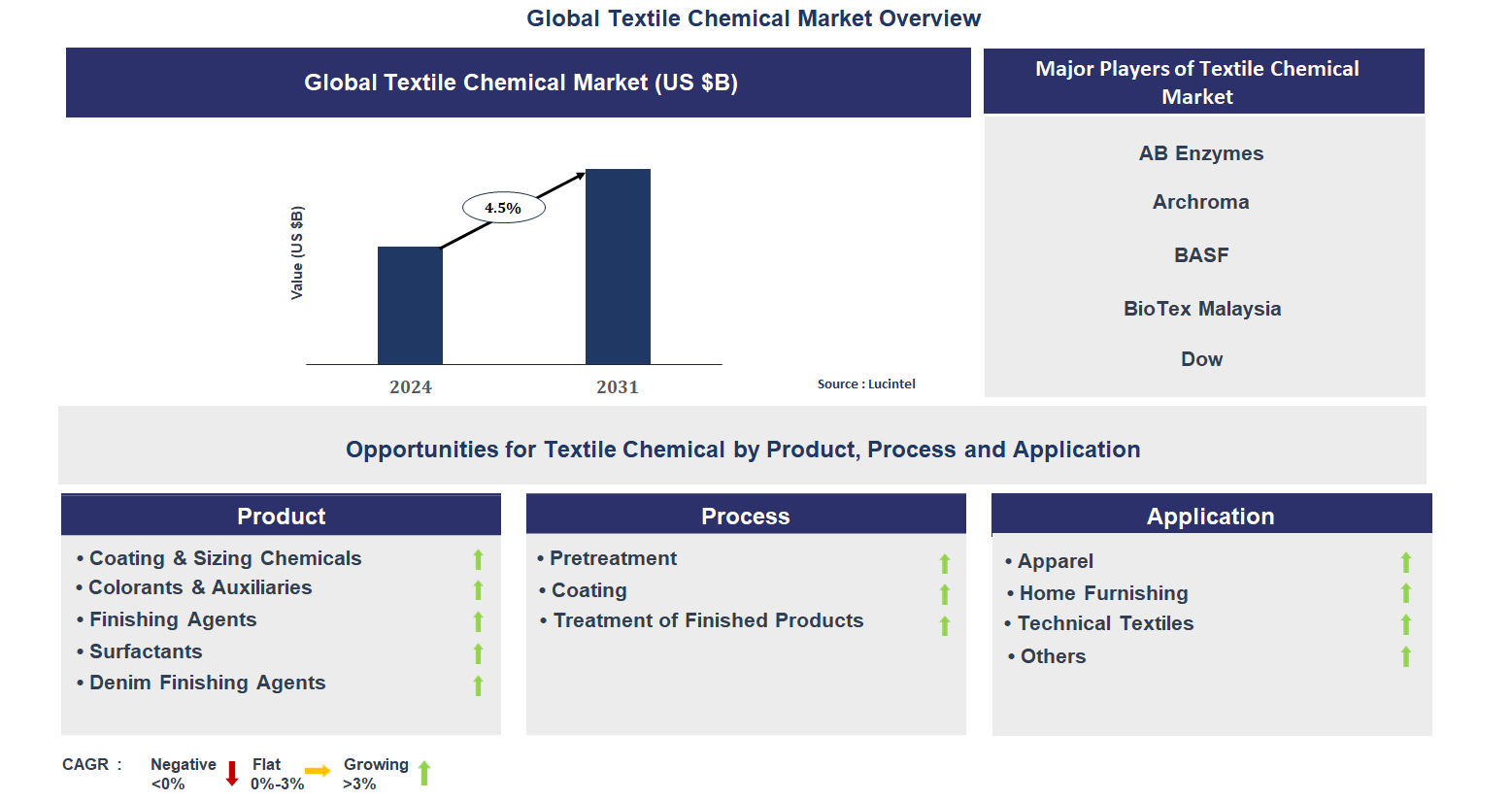
Key data points: The growth forecast = 4.5% annually for the next 7 years. Scroll below to get more insights. This market report covers trends, opportunities and forecasts in textile chemical market to 2031 by product (coating & sizing chemicals, colorants & auxiliaries, finishing agents, surfactants, and denim finishing agents), process (pretreatment, coating, and treatment of finished products), application (apparel, home furnishing, technical textiles, and others), and region (North America, Europe, Asia Pacific, and the Rest of the World)
We'll send your sample report shortly.
• Lucintel forecasts that, within the product category, coating & sizing chemical is expected to witness the highest growth over the forecast period.
• Within the application category, apparel is expected to witness the highest growth.
• In terms of region, APAC is expected to witness the highest growth over the forecast period. Gain valuable insights for your business decisions with our comprehensive 150+ page report. Sample figures with some insights are shown below.
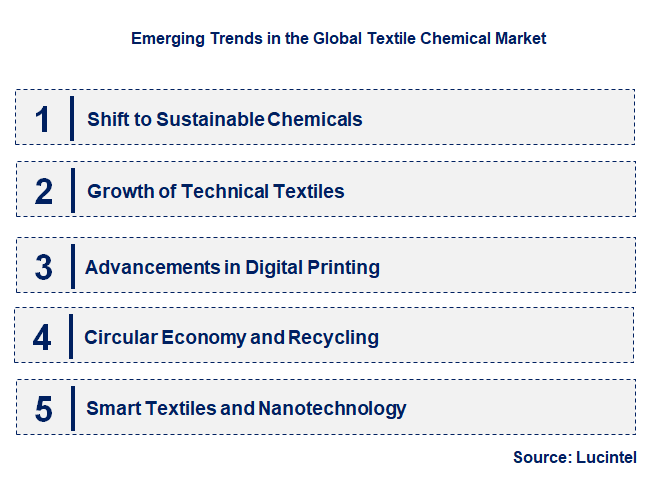
• Shift to Sustainable Chemicals: A primary trend is the push for bio-based and eco-friendly textile chemicals. This is a direct response to rising environmental concerns and strict regulations on the use of harmful substances like formaldehyde. The impact is a more sustainable market, which is attracting new investments and appealing to eco-conscious brands and consumers.
• Growth of Technical Textiles: A significant trend is the increasing demand for technical textiles, which require specialized chemicals for properties like flame retardance, water resistance, and UV protection. This is driven by their growing use in sectors such as automotive, medical, and construction. The impact is a new, high-growth application segment that is diversifying the market.
• Advancements in Digital Printing: The market is seeing a major trend towards the adoption of digital textile printing technologies. These new technologies require specialized inks and chemicals that offer superior color vibrancy and stability. The impact is a new, high-value application segment that is creating stable demand and premium pricing for specialized chemicals.
• Circular Economy and Recycling: An emerging trend is the increasing focus on the circular economy and textile recycling. This involves the development of new chemical processes to deconstruct and recycle textile waste. The impact is a more circular and sustainable model for the industry, which reduces the need for new production and minimizes waste.
• Smart Textiles and Nanotechnology: There is an emerging trend toward the use of textile chemicals in smart textiles and nanotechnology. These advanced materials require specialized coatings and finishes to impart new functionalities. The impact is a new, high-tech application segment that is positioning the market for long-term growth and innovation. These trends are fundamentally reshaping the textile chemical market by pushing it towards sustainability, high-tech applications, and greater specialization. The focus on bio-based chemicals and digital printing highlights the industry’s ability to adapt to new demands, while the expansion into technical textiles is creating new growth opportunities. This evolution is positioning the market as a crucial enabler of a greener and more technologically advanced textile industry.
• Growth of Eco-Friendly Products: The use of eco-friendly and sustainable chemicals continues to be the most significant development. Companies are developing new products that are free from harmful substances and have a lower environmental footprint. The impact is a shift in the entire industry towards green chemistry, driven by regulatory pressure and consumer demand.
• Increased Demand for Technical Textiles: A recent development is the growing adoption of textile chemicals in the technical textiles sector. The demand for textiles with specialized properties for industries like medical and automotive is booming. The impact is a stable and expanding market segment driven by global industrialization.
• Advancements in Digital Printing Inks: There have been advancements in the production of specialized inks for digital printing. These new inks offer superior color fastness and vibrancy, which is a key driver for market growth. The impact is a move toward a more specialized, high-performance product that commands premium pricing.
• Strategic Consolidation of Players: The textile chemical market has seen recent developments in the form of strategic mergers and acquisitions among major players. This consolidation is aimed at securing market share and integrating supply chains. The impact is a more concentrated market with fewer but more powerful companies controlling the supply and pricing.
• Demand for Water-Saving Technologies: A key development is the growing demand for water-saving technologies and chemicals. New formulations that reduce water consumption in dyeing and finishing processes are gaining traction. The impact is a new, high-growth application that is diversifying the market. These developments are having a profound impact on the textile chemical market. The continued dominance in traditional applications is assured, while the push for sustainability and diversification into new applications ensures a stable and greener supply. This evolution is positioning the market to meet the growing demand for a versatile chemical while also addressing critical environmental and economic challenges.
• Technical Textiles: The largest growth opportunity remains in the technical textiles sector. The global demand for textiles used in automotive, medical, and construction is a powerful driver. Companies can focus on developing specialized chemicals that impart properties like durability, flame retardance, and antimicrobial qualities to these high-performance fabrics.
• Eco-Friendly Dyes and Auxiliaries: The eco-friendly dyes and auxiliaries sector is a significant growth opportunity. The global push for sustainability is driving demand for bio-based and non-toxic dyes and auxiliaries. The opportunity is in providing a high-purity, environmentally friendly product that meets the stringent quality and safety standards for dyeing and finishing.
• Digital Printing: The digital printing market presents a key growth opportunity. New digital printing technologies require specialized inks and chemicals. The opportunity is in providing a reliable and high-performance product that can be used in a wide range of textile digital printing and finishing applications.
• Functional Finishes: The functional finishes sector offers a promising growth opportunity. There is a growing demand for textiles with specialized finishes, such as wrinkle-free, stain-resistant, and odor-resistant properties. The opportunity is in providing a high-performance product that can be used to impart these functionalities.
• Water Treatment: The water treatment sector offers a significant growth opportunity. Textile mills are a major source of water pollution, and there is a growing demand for chemicals that can be used for wastewater treatment and effluent control. The opportunity is in providing a safe and effective chemical for environmental management and compliance with increasingly strict regulations. These strategic growth opportunities are impacting the textile chemical market by driving it toward diversification and higher value-added applications. By focusing on high-growth sectors like technical textiles and digital printing, companies can reduce their reliance on commodity sales and command higher prices. This shift is transforming the industry into a more sophisticated and dynamic one, capable of meeting a wide range of industrial needs.
• AB Enzymes
• Archroma
• BASF
• BioTex Malaysia
• Dow
• Ethox Chemicals
• Evonik Industries
• Fibro Chem
• German Chemicals
• Govi
• Coating & Sizing Chemicals
• Colorants & Auxiliaries
• Finishing Agents
• Surfactants
• Denim Finishing Agents
• Pretreatment
• Coating
• Treatment of Finished Products
• Apparel
• Home Furnishing
• Technical Textiles
• Others
• North America
• Europe
• Asia Pacific
• The Rest of the World
• United States: The U.S. market is maturing, with recent developments focusing on high-performance and technical textiles. The demand for specialized chemicals that impart properties like durability, UV resistance, and antimicrobial qualities is growing. This is driven by strong demand from the defense, automotive, and home furnishing sectors, pushing the market toward higher-value products.
• China: China’s market remains the world’s largest producer and consumer. Recent developments include massive production capacity expansion, primarily to support its vast textile and apparel industries. China is increasingly focused on developing domestic production to reduce reliance on imports and secure its position as a dominant global player. The shift to intelligent manufacturing is also a key development.
• Germany: Germany’s textile chemical market is highly specialized, with recent developments focusing on eco-friendly and bio-based products. German companies are at the forefront of developing new, high-efficiency production processes and low-emission technologies. The market is driven by a strong emphasis on high-end, value-added products that meet stringent EU environmental regulations.
• India: India’s market is a high-growth area, with recent developments focusing on a surge in domestic production to support its booming apparel and textile sectors. The government’s push for sustainable practices and investments in new plants are key drivers. The market is seeing a focus on enhancing product portfolios through partnerships and R&D to meet evolving needs.
• Japan: Japan’s market is technology-driven and mature. Recent developments include the use of textile chemicals in specialized, high-purity applications for digital printing and advanced finishing. Japanese manufacturers are at the forefront of research into new, more efficient production processes that minimize environmental impact.


• AB Enzymes
• Archroma
• BASF
• BioTex Malaysia
• Dow
• Ethox Chemicals
• Evonik Industries
• Fibro Chem
• German Chemicals
• Govi Q5. Which textile chemical market segment will be the largest in future? Answer: Lucintel forecasts that, within the product category, coating & sizing chemical is expected to witness the highest growth over the forecast period. Q6. In textile chemical market, which region is expected to be the largest in next 5 years? Answer: In terms of region, APAC is expected to witness the highest growth over the forecast period. Q7. Do we receive customization in this report? Answer: Yes, Lucintel provides 10% customization without any additional cost.


Choose a license that fits your team. Instant PDF delivery.
Prices exclude taxes. Instant delivery. Custom licensing available on request.
Market Report · May 18, 2026
Market Report · May 18, 2026
Market Report · May 18, 2026
Trusted partner for strategic intelligence and business growth


Receive a complimentary market analysis tailored to your industry. Our analysts will identify key growth opportunities and competitive dynamics specific to your business.

Market size, growth rate, and key trend analysis for your specific sector.

Top competitor positioning and market share analysis.

Strategic recommendations backed by data-driven insights.
Get curated market intelligence and competitive moves straight to your inbox.
By subscribing, you agree to receive our monthly insights. Unsubscribe anytime.
Receive a complimentary market analysis tailored to your industry. Our analysts will identify key growth opportunities and competitive dynamics specific to your business.
Market size, growth rate, and key trend analysis for your specific sector.
Top competitor positioning and market share analysis.
Strategic recommendations backed by data-driven insights.
Get curated market intelligence, emerging trends, and competitive moves straight to your inbox each month.
By subscribing, you agree to receive our monthly insights. Unsubscribe anytime.
We'll send your sample report shortly.