
Television Market Report: Trends, Forecast and Competitive Analysis to 2035

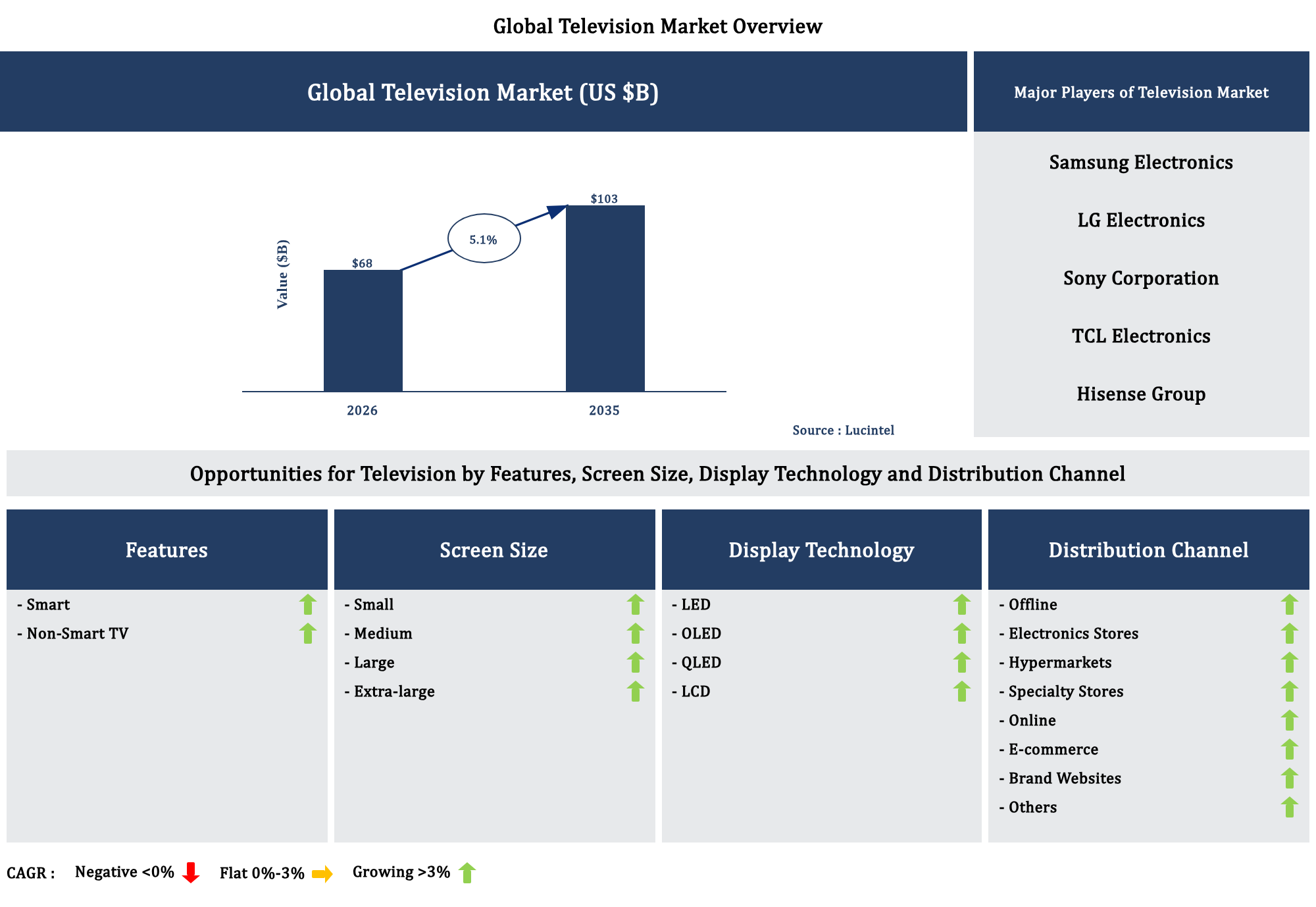
Key data points: The market size in 2035 = $103 billion, growth forecast = 5.1% annually for the next 8 years. Scroll below to get more insights. This market report covers trends, opportunities and forecasts in television market to 2035 by features (smart and non-smart tv), screen size (small, medium, large, and extra-large), display technology (LED, OLED, QLED, and LCD), distribution channel (offline, electronics stores, hypermarkets, specialty stores, online, E-commerce, brand websites, and others), and region (North America, Europe, Asia Pacific, and the Rest of the World)

Publisher: Lucintel Last Updated: July 2026
See Pricing

Download Sample Report

| ✨ New Download Sample report — Get instant insights! | ✨ New Download Sample report — Get instant insights!

Television Market Report: Trends, Forecast and Competitive Analysis to 2035

Television Market

The future of the global television market looks promising with opportunities in the LED, OLED, QLED, and LCD markets. The global television market is expected to reach an estimated $103 billion by 2035 with a CAGR of 5.1% from 2026 to 2035. The major drivers for this market are the increasing demand for smart high definition, the rising adoption of oled qled displays, and the growing preference for home entertainment solutions.

  • Lucintel forecasts that, within the distribution channel category, offline is expected to witness the highest growth over the forecast period due to strong retail engagement and wider physical product availability.
  • Within the display technology category, LED is expected to witness the highest growth due to energy efficiency, better brightness, and longer display lifespan.
  • In terms of regions, APAC is expected to witness the highest growth over the forecast period due to rising disposable income and growing demand for digital entertainment.

Gain valuable insights for your business decisions with our comprehensive 150+ page report. Sample figures with some insights are shown below.
Television Market

Emerging Trends in the Television Market

The television market is experiencing rapid transformation driven by technological advancements, changing consumer preferences, and innovative content delivery methods. As traditional TV viewing shifts towards digital platforms, manufacturers and content providers are adapting to meet new demands. The integration of smart technology, increased focus on high-quality visuals, and the rise of streaming services are reshaping the landscape. These developments are not only influencing consumer behavior but also redefining industry standards and competition. Understanding these emerging trends is crucial for stakeholders aiming to stay ahead in this dynamic environment. The following key trends highlight the major shifts currently shaping the television market.

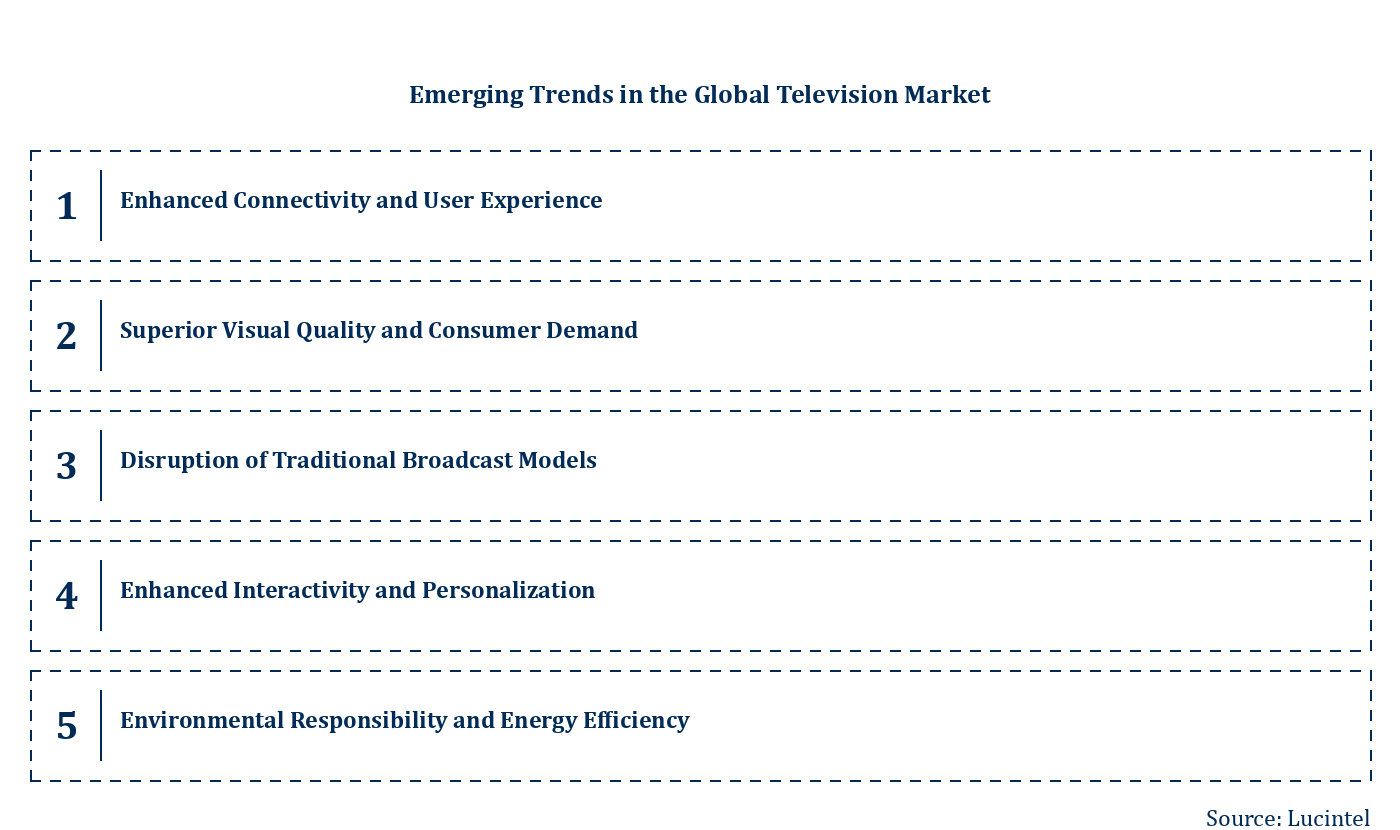
  • Enhanced Connectivity and User Experience: Smart TVs are becoming the norm, offering internet connectivity, app integration, and voice control. This trend allows consumers to access streaming services, social media, and other online content directly on their television screens. Manufacturers are focusing on intuitive interfaces and seamless integration with smart home devices, creating a more personalized and interactive viewing experience. The proliferation of smart TVs is driving sales and shifting revenue models from hardware sales to content and service subscriptions.
  • Superior Visual Quality and Consumer Demand: The demand for higher resolution TVs is increasing, with 4K becoming standard and 8K models entering the market. These ultra-high-definition displays provide sharper images, richer colors, and more immersive viewing experiences. Content providers are also producing more 4K and 8K content, encouraging consumers to upgrade. This trend is pushing manufacturers to innovate in display technology and invest in higher-quality panels, ultimately elevating the overall quality and appeal of television products.
  • Disruption of Traditional Broadcast Models: Streaming platforms like Netflix, Amazon Prime, and Disney+ are transforming how viewers access content. The shift from cable and satellite TV to OTT services offers on-demand, ad-free, and personalized viewing options. This trend is reducing reliance on traditional broadcasters and prompting TV manufacturers to optimize their devices for streaming. As a result, there is increased competition, diversification of content, and a move towards subscription-based revenue models, fundamentally changing the television consumption landscape.
  • Enhanced Interactivity and Personalization: AI-powered features are becoming integral to modern televisions, enabling voice commands, content recommendations, and smart home integration. These capabilities improve user convenience and engagement by providing tailored content suggestions and hands-free operation. AI also helps in optimizing picture and sound quality based on viewing conditions. This trend enhances the overall user experience, making televisions more intuitive and responsive, and is expected to drive further innovation in user interface design and content curation.
  • Environmental Responsibility and Energy Efficiency: Consumers and regulators are increasingly prioritizing sustainability, prompting manufacturers to develop eco-friendly TVs. This includes energy-efficient displays, recyclable materials, and reduced packaging waste. Innovations such as OLED and LED technologies are designed to consume less power while maintaining high performance. The push for sustainability is influencing product design, manufacturing processes, and corporate strategies, aligning the market with global environmental goals. This trend not only appeals to eco-conscious consumers but also helps companies meet regulatory standards and reduce operational costs.

These emerging trends are collectively reshaping the television market by enhancing technological capabilities, improving consumer experiences, and emphasizing sustainability. They are driving innovation, altering revenue models, and expanding the scope of content delivery, ultimately creating a more dynamic and competitive industry landscape.
Television Market by country

Recent Developments in the Television Market

The television market is experiencing rapid transformation driven by technological advancements, changing consumer preferences, and innovative content delivery methods. These developments are reshaping how viewers access and enjoy entertainment, creating new opportunities for manufacturers, content providers, and advertisers. As the industry adapts to these shifts, understanding the key growth areas becomes essential for stakeholders aiming to capitalize on emerging trends and maintain competitive advantage in a dynamic landscape.

  • Growing Demand for 8K and 4K Televisions: The market is witnessing increased consumer interest in ultra-high-definition TVs, driven by advancements in display technology and declining prices. This trend enhances viewing experiences with sharper images and richer colors, encouraging manufacturers to develop more 8K and 4K models. The demand boosts sales, stimulates innovation, and pushes the industry toward higher resolution standards, ultimately expanding market size and offering new revenue streams for producers and retailers.
  • Integration of Smart TV Features: Smart TVs with internet connectivity, voice control, and app integration are becoming standard. This development transforms traditional television into an interactive entertainment hub, increasing consumer engagement and convenience. It fosters the growth of app ecosystems and streaming services, reducing reliance on cable subscriptions. The integration drives sales, enhances user experience, and creates new monetization opportunities for content providers and device manufacturers, significantly impacting market dynamics.
  • Rise of OLED and QLED Technologies: OLED and QLED display technologies are gaining popularity due to their superior picture quality, contrast ratios, and energy efficiency. These innovations attract premium consumers seeking high-end viewing experiences. The adoption of these technologies encourages manufacturers to invest in R&D, leading to more advanced, affordable options. This trend elevates product differentiation, boosts sales of premium models, and influences market segmentation, ultimately expanding the high-end segment and increasing overall market value.
  • Expansion of Content Streaming Services: The proliferation of streaming platforms like Netflix, Amazon Prime, and Disney+ is revolutionizing content consumption. Consumers prefer on-demand, personalized viewing experiences, prompting TV manufacturers to optimize devices for seamless streaming. This shift reduces traditional broadcast reliance and fosters partnerships between device makers and content providers. The growth of streaming services drives market expansion, influences hardware specifications, and creates new revenue opportunities, significantly impacting the television industry's evolution.
  • Adoption of 5G and Cloud Technologies: The rollout of 5G networks and cloud-based solutions enhances remote access, real-time streaming, and interactive content delivery. These technologies enable smarter, more connected televisions with faster data speeds and improved reliability. They facilitate innovative features like cloud gaming and virtual reality integration. This development accelerates the transition toward more versatile, connected entertainment ecosystems, boosts consumer adoption, and opens new avenues for service providers, profoundly shaping the future landscape of the television market.

The overall impact of these developments is a more dynamic, innovative, and consumer-centric television market. Enhanced technology, content options, and connectivity are driving growth, expanding market segments, and creating new revenue streams. As these trends continue, the industry is poised for sustained evolution, offering richer experiences and greater opportunities for all stakeholders involved.

Strategic Growth Opportunities in the Television Market

The television market is experiencing rapid transformation driven by technological advancements, changing consumer preferences, and increasing demand for high-quality content. Innovations in display technology, smart features, and connectivity are creating new growth avenues. Additionally, the integration of streaming services and the rise of 4K and 8K resolutions are reshaping consumer expectations. Market players are focusing on product differentiation and expanding into emerging markets to capitalize on these opportunities, ensuring sustained growth and competitive advantage in a dynamic environment.

  • Growing Adoption of Smart Televisions: The increasing popularity of smart TVs, equipped with internet connectivity and app integration, is expanding market reach. Consumers seek seamless access to streaming platforms, social media, and interactive content, driving demand. Manufacturers are investing in advanced operating systems and user-friendly interfaces to enhance user experience. This trend is particularly prominent in developed regions but is rapidly expanding into emerging markets, creating significant growth opportunities for brands that innovate and localize content.
  • Rising Demand for 4K and 8K Resolution Televisions: Consumers are increasingly opting for higher-resolution displays for superior picture quality. The shift towards 4K and 8K TVs is driven by content availability, falling prices, and enhanced viewing experiences. Content providers are producing more 4K/8K content, encouraging consumers to upgrade. Manufacturers are focusing on developing larger screens with advanced display technologies, which boosts sales. This trend is expected to continue as technology becomes more affordable and content ecosystems expand, fueling market growth.
  • Expansion of Streaming Services and Content Ecosystems: The proliferation of streaming platforms like Netflix, Amazon Prime, and Disney+ is transforming how consumers access entertainment. Televisions integrated with these services offer a more immersive experience, increasing demand for compatible devices. Market players are partnering with content providers and investing in native app development. This integration enhances consumer engagement, drives sales of connected TVs, and opens new revenue streams, making streaming a key growth driver in the television industry.
  • Innovation in Display Technologies and Design: Advancements in OLED, QLED, and Micro LED technologies are delivering better contrast, color accuracy, and energy efficiency. Sleek, ultra-thin designs and bezel-less displays appeal to modern aesthetics. Manufacturers are investing heavily in R&D to develop innovative display solutions that differentiate their products. These technological improvements attract tech-savvy consumers and premium buyers, expanding market segments. As display technology evolves, it will continue to influence consumer preferences and stimulate sales across various price points.
  • Increasing Focus on Emerging Markets and Rural Areas: As internet penetration and disposable incomes grow, emerging markets present substantial growth potential. Manufacturers are tailoring products to local preferences, offering affordable models with essential features. Distribution channels are expanding into rural areas, and marketing strategies are adapting to regional needs. This expansion helps tap into a large, underserved customer base, driving overall market growth. The focus on emerging markets is crucial for sustaining long-term industry expansion amid saturation in developed regions.

The overall impact of these opportunities is a dynamic, expanding television market characterized by technological innovation, diverse consumer preferences, and global outreach. Companies that leverage these growth avenues can enhance their market share, improve profitability, and shape future industry standards. As technology and content ecosystems evolve, the market is poised for continued growth and increased consumer engagement worldwide.

Television Market Drivers and Challenges

The television market is influenced by a complex interplay of technological advancements, economic shifts, and regulatory changes. Rapid innovations in display technology, content delivery, and smart features continuously reshape consumer preferences and industry standards. Economic factors such as disposable income levels and global market trends impact consumer purchasing power and investment in new television models. Regulatory policies concerning content licensing, broadcasting standards, and digital rights also significantly influence market dynamics. These drivers and challenges collectively determine the growth trajectory, competitive landscape, and innovation pace within the television market, requiring stakeholders to adapt swiftly to maintain relevance and capitalize on emerging opportunities.

The factors responsible for driving the television market include:

  • Technological Innovation: The advent of 4K, 8K, OLED, and QLED display technologies has revolutionized visual quality, attracting consumers seeking immersive viewing experiences. Smart TV integration with internet connectivity and voice control features enhances user convenience and engagement. These technological advancements enable manufacturers to differentiate their products, increase sales, and expand market share. As consumers demand higher quality and smarter features, companies invest heavily in R&D to stay competitive, fueling continuous innovation and market growth.
  • Content Streaming and Digital Platforms: The rise of OTT (Over-the-Top) streaming services like Netflix, Amazon Prime, and Disney+ has shifted consumer viewing habits from traditional cable to digital platforms. This trend drives demand for internet-enabled smart TVs capable of seamless streaming. The proliferation of content-rich platforms encourages consumers to upgrade their televisions for better connectivity and app integration, boosting sales. Additionally, content providers partner with TV manufacturers to optimize their apps, further fueling the markets expansion driven by changing entertainment consumption patterns.
  • Economic Growth and Disposable Income: Increasing disposable incomes in emerging markets and stable economic conditions in developed regions have led to higher consumer spending on premium electronics, including televisions. As consumers prioritize home entertainment, demand for larger screens, advanced features, and high-resolution displays rises. Economic stability also encourages investments by manufacturers in marketing and distribution channels, expanding market reach. This economic momentum supports sustained growth, especially in developing countries where television ownership is still expanding.
  • Regulatory Environment and Standards: Governments and industry bodies establish standards for broadcasting, digital rights, and content licensing, shaping the television market landscape. Regulations promoting digital transition, spectrum allocation, and content censorship influence product features and distribution channels. Compliance with safety, energy efficiency, and environmental standards also impacts manufacturing costs and product design. Favorable regulatory policies can facilitate market entry and innovation, while restrictive policies may pose barriers, affecting overall market growth and competitiveness.
  • Consumer Preferences and Lifestyle Changes: Evolving consumer preferences towards larger screens, 4K resolution, and smart features are driving market demand. The increasing popularity of home entertainment setups, gaming, and multi-purpose TVs aligns with lifestyle shifts towards more integrated and immersive experiences. Additionally, the trend of cord-cutting and preference for personalized content influences product offerings. Manufacturers adapt by developing versatile, feature-rich televisions to meet these changing demands, thereby expanding their customer base and market penetration.

The challenges facing the television market include:

  • Rapid Technological Obsolescence: The fast pace of technological innovation leads to frequent product obsolescence, pressuring manufacturers to continuously invest in R&D. Consumers may delay purchases, waiting for the latest features, which can slow sales cycles. Additionally, high R&D costs and the need for rapid product updates can strain financial resources, especially for smaller players. This rapid evolution also creates a challenge in managing inventory and supply chains, impacting profitability and market stability.
  • Intense Competition and Price Pressures: The market is highly competitive, with numerous global and local players vying for market share. Price wars often ensue, reducing profit margins and forcing companies to find innovative ways to differentiate their products. Competition from low-cost manufacturers, especially from emerging markets, further exacerbates pricing pressures. This environment necessitates strategic marketing, product differentiation, and cost management to sustain profitability amid aggressive pricing strategies.
  • Regulatory and Content Licensing Challenges: Navigating complex regulatory landscapes across different regions can hinder market expansion. Content licensing restrictions, censorship laws, and digital rights management complicate content availability and distribution. Compliance costs increase, and restrictions may limit consumer access to certain content, affecting user experience and sales. Additionally, evolving regulations around data privacy and digital security require ongoing adjustments, adding to operational complexities and costs for manufacturers and service providers.

The television market is shaped by rapid technological advancements, shifting consumer preferences, and evolving regulatory frameworks. While these drivers foster innovation and growth, challenges such as technological obsolescence, intense competition, and regulatory complexities pose significant hurdles. The overall impact is a dynamic, competitive landscape that demands agility, strategic investment, and continuous innovation from industry players. Success in this market hinges on balancing technological progress with regulatory compliance and consumer engagement, ensuring sustainable growth amid evolving trends.

List of Television Market Companies

Companies in the market compete on the basis of product quality offered. Major players in this market focus on expanding their manufacturing facilities, R&D investments, infrastructural development, and leverage integration opportunities across the value chain. Through these strategies television market companies cater increasing demand, ensure competitive effectiveness, develop innovative products & technologies, reduce production costs, and expand their customer base. Some of the television market companies profiled in this report include-

  • Samsung Electronics
  • LG Electronics
  • Sony Corporation
  • TCL Electronics
  • Hisense Group
  • Xiaomi Corporation
  • Panasonic Corporation
  • Vizio Holding Corp
  • Skyworth Group
  • Sharp Corporation

Television Market by Segment

The study includes a forecast for the global television market by features, screen size, display technology, distribution channel, and region.

  • Television Market by Features [Value from 2019 to 2035]:
    • Smart
    • Non-Smart TV
  • Television Market by Screen Size [Value from 2019 to 2035]:
    • Small
    • Medium
    • Large
    • Extra-large
  • Television Market by Display Technology [Value from 2019 to 2035]:
    • LED
    • OLED
    • QLED
    • LCD
  • Television Market by Distribution Channel [Value from 2019 to 2035]:
    • Offline
    • Electronics Stores
    • Hypermarkets
    • Specialty Stores
    • Online
    • E-commerce
    • Brand Websites
    • Others
  • Television Market by Region [Value from 2019 to 2035]:
    • North America
    • Europe
    • Asia Pacific
    • The Rest of the World

Country Wise Outlook for the Television Market

The television market has experienced rapid evolution driven by technological innovations, changing consumer preferences, and increasing competition among manufacturers. Advances in display technology, smart TV features, and content streaming services have significantly influenced market dynamics. Additionally, regional economic factors and regulatory policies shape the development trajectory in different countries. As consumers demand higher quality and more interactive viewing experiences, manufacturers are investing heavily in research and development. The following summaries highlight recent developments in the television market across the United States, China, Germany, India, and Japan, reflecting their unique market trends and innovations.

  • United States: The U.S. market has seen a surge in 8K TV adoption and the integration of AI-powered features for personalized viewing experiences. Streaming services like Netflix and Disney+ are influencing consumer preferences, leading to increased demand for smart TVs with advanced connectivity. Major brands are focusing on OLED and QLED display technologies to enhance picture quality. The adoption of voice control and smart home integration is also expanding, making televisions more interactive and user-friendly. Regulatory efforts are aimed at reducing e-waste and promoting sustainable manufacturing practices.
  • China: China remains the largest producer and consumer of televisions, with a focus on affordable 4K and smart TV models. Local brands like TCL and Hisense are expanding globally, leveraging innovative display technologies and competitive pricing. The market is witnessing rapid growth in internet-enabled TVs, driven by the popularity of streaming platforms and smart home integration. 5G connectivity is being incorporated into new models to support seamless content streaming and IoT applications. Government policies encourage technological innovation and export growth, positioning China as a key player in the global TV industry.
  • Germany: The German television market emphasizes high-quality, energy-efficient displays, with a strong preference for OLED and LED technologies. Consumers are increasingly interested in eco-friendly products, prompting manufacturers to adopt sustainable practices. The market is also witnessing a shift towards larger screen sizes and ultra-high-definition content. German consumers value privacy and data security, influencing the integration of secure smart TV platforms. The adoption of hybrid broadcast broadband TV (Hobbit) is growing, enabling interactive services and enhanced content delivery. Regulatory standards focus on energy efficiency and consumer protection.
  • India: The Indian television market is experiencing rapid growth, driven by increasing internet penetration and affordability of smart TVs. Brands like Xiaomi, Samsung, and LG are expanding their presence with budget-friendly 4K and HD models. The adoption of OTT streaming services like Hotstar and Amazon Prime Video is fueling demand for internet-enabled TVs. The market is also witnessing a shift towards larger screens and smart features, with a focus on regional content. Government initiatives promoting digital connectivity and affordable internet are further boosting TV sales. Local manufacturing and supply chain improvements are supporting market expansion.
  • Japan: Japan's television market is characterized by a focus on high-end, innovative display technologies such as OLED and 4K/8K resolution. Consumers prioritize picture quality, design, and advanced features like HDR and smart home integration. The market is witnessing a decline in traditional TV sales but growth in premium and niche segments. Japanese manufacturers are investing in cutting-edge technology, including micro LED displays. Eco-friendly and energy-efficient models are gaining popularity, aligning with national sustainability goals. The integration of AI and IoT features is enhancing user experiences, while regulatory standards emphasize environmental impact and consumer safety.

Features of the Television Market

  • Market Size Estimates: Television market size estimation in terms of value ($B).
  • Trend and Forecast Analysis: Market trends (2019 to 2025) and forecast (2026 to 2035) by various segments and regions.
  • Segmentation Analysis: Television market size by various segments, such as by features, screen size, display technology, distribution channel, and region in terms of value ($B).
  • Regional Analysis: Television market breakdown by North America, Europe, Asia Pacific, and Rest of the World.
  • Growth Opportunities: Analysis of growth opportunities in different features, screen sizes, display technologies, distribution channels, and regions for the television market.
  • Strategic Analysis: This includes M&A, new product development, and competitive landscape of the television market.
  • Analysis of competitive intensity of the industry based on Porter’s Five Forces model.

Top 5 Companies

  • Samsung Electronics
  • LG Electronics
  • Sony Corporation
  • TCL Electronics
  • Hisense Group

Table of Contents

1. Executive Summary
15.1 Competitive Analysis Overview

List of Figures

List of Tables

Table 7.1: Attractiveness Analysis for the Global Television Market by Distribution Channel Table 7.2: Market Size and CAGR of Various Distribution Channel in the Global Television Market (2019-2025) Table 7.3: Market Size and CAGR of Various Distribution Channel in the Global Television Market (2026-2035) Table 7.4: Trends of Offline in the Global Television Market (2019-2025) Table 7.5: Forecast for Offline in the Global Television Market (2026-2035) Table 7.6: Trends of Electronics Stores in the Global Television Market (2019-2025) Table 7.7: Forecast for Electronics Stores in the Global Television Market (2026-2035) Table 7.8: Trends of Hypermarkets in the Global Television Market (2019-2025) Table 7.9: Forecast for Hypermarkets in the Global Television Market (2026-2035) Table 7.10: Trends of Specialty Stores in the Global Television Market (2019-2025) Table 7.11: Forecast for Specialty Stores in the Global Television Market (2026-2035) Table 7.12: Trends of Online in the Global Television Market (2019-2025) Table 7.13: Forecast for Online in the Global Television Market (2026-2035) Table 7.14: Trends of E-commerce in the Global Television Market (2019-2025) Table 7.15: Forecast for E-commerce in the Global Television Market (2026-2035) Table 7.16: Trends of Brand Websites in the Global Television Market (2019-2025) Table 7.17: Forecast for Brand Websites in the Global Television Market (2026-2035) Table 7.18: Trends of Others in the Global Television Market (2019-2025) Table 7.19: Forecast for Others in the Global Television Market (2026-2035)

Methodology

Lucintel has been in the business of market research and management consulting since 2000 and has published over 1000 market intelligence reports in various markets / applications and served over 1,000 clients worldwide. This study is a culmination of four months of full-time effort performed by Lucintel's analyst team. The analysts used the following sources for the creation and completion of this valuable report:

  • In-depth interviews of the major players in this market
  • Detailed secondary research from competitors' financial statements and published data
  • Extensive searches of published works, market, and database information pertaining to industry news, company press releases, and customer intentions
  • A compilation of the experiences, judgments, and insights of Lucintel's professionals, who have analyzed and tracked this market over the years.

Extensive research and interviews are conducted across the supply chain of this market to estimate market share, market size, trends, drivers, challenges, and forecasts. Below is a brief summary of the primary interviews that were conducted by job function for this report.

Lucintel's methodology for market research

Thus, Lucintel compiles vast amounts of data from numerous sources, validates the integrity of that data, and performs a comprehensive analysis. Lucintel then organizes the data, its findings, and insights into a concise report designed to support the strategic decision-making process. The figure below is a graphical representation of Lucintel's research process.

Primary interviews by job function

Buy Now

Choose a license that fits your team. Instant PDF delivery.

Market Report

1 User PDF

$4,850
Buy Now

Market Report

2-5 Users PDF

$6,700
Buy Now

Market Report

Corporate PDF

$8,850
Buy Now

Market Report

Global PDF

$10,000
Buy Now

Prices exclude taxes. Instant delivery. Custom licensing available on request.

Frequently Asked Questions

What is the television market size?
The global television market is expected to reach an estimated $103 billion by 2035.
What is the growth forecast for television market?
The global television market is expected to grow with a CAGR of 5.1% from 2026 to 2035.
What are the major drivers influencing the growth of the television market?
The major drivers for this market are the increasing demand for smart high definition, the rising adoption of oled qled displays, and the growing preference for home entertainment solutions.
What are the major segments for television market?
The future of the television market looks promising with opportunities in the LED, OLED, QLED, and LCD markets.
Who are the key television market companies?

Some of the key television companies are as follows:

  • Samsung Electronics
  • LG Electronics
  • Sony Corporation
  • TCL Electronics
  • Hisense Group
  • Xiaomi Corporation
  • Panasonic Corporation
  • Vizio Holding Corp
  • Skyworth Group
  • Sharp Corporation
Which television market segment will be the largest in future?
Lucintel forecasts that, within the distribution channel category, offline is expected to witness the highest growth over the forecast period.
In television market, which region is expected to be the largest in next 8 years?
In terms of region, APAC is expected to witness the highest growth over the forecast period.
Do we receive customization in this report?
Yes, Lucintel provides 10% customization without any additional cost.

Key Questions

  • What are some of the most promising, high-growth opportunities for the television market by features (smart and non-smart tv), screen size (small, medium, large, and extra-large), display technology (LED, OLED, QLED, and LCD), distribution channel (offline, electronics stores, hypermarkets, specialty stores, online, E-commerce, brand websites, and others), and region (North America, Europe, Asia Pacific, and the Rest of the World)?
  • Which segments will grow at a faster pace and why?
  • Which region will grow at a faster pace and why?
  • What are the key factors affecting market dynamics? What are the key challenges and business risks in this market?
  • What are the business risks and competitive threats in this market?
  • What are the emerging trends in this market and the reasons behind them?
  • What are some of the changing demands of customers in the market?
  • What are the new developments in the market? Which companies are leading these developments?
  • Who are the major players in this market? What strategic initiatives are key players pursuing for business growth?
  • What are some of the competing products in this market and how big of a threat do they pose for loss of market share by material or product substitution?
  • What M&A activity has occurred in the last 5 years and what has its impact been on the industry?
Why Choose Us

The Lucintel Advantage

Trusted partner for strategic intelligence and business growth

25+ Years Excellence

25+ Years Excellence

Quarter century of proven expertise in management consulting and market research across global markets.
Game-Changer Ideas

Game-Changer Ideas

Innovative strategies and actionable insights that help clients become the smartest in their industry.
Global Reach

Global Reach

Extensive coverage across 50+ industries and markets worldwide with localized expertise.
Start Your Growth Journey

Get Your Free
Market Intelligence
Briefing

Receive a complimentary market analysis tailored to your industry. Our analysts will identify key growth opportunities and competitive dynamics specific to your business.

Custom Market Snapshot

Market size, growth rate, and key trend analysis for your specific sector.

Competitive Landscape Overview

Top competitor positioning and market share analysis.

Growth Opportunity Identification

Strategic recommendations backed by data-driven insights.

Subscribe

Subscribe to our Newsletter

Get curated market intelligence and competitive moves straight to your inbox.

By subscribing, you agree to receive our monthly insights. Unsubscribe anytime.

Industry Trends Market Signals Opportunities Competitor Moves
