Smart Mobility Market Trends and Forecast
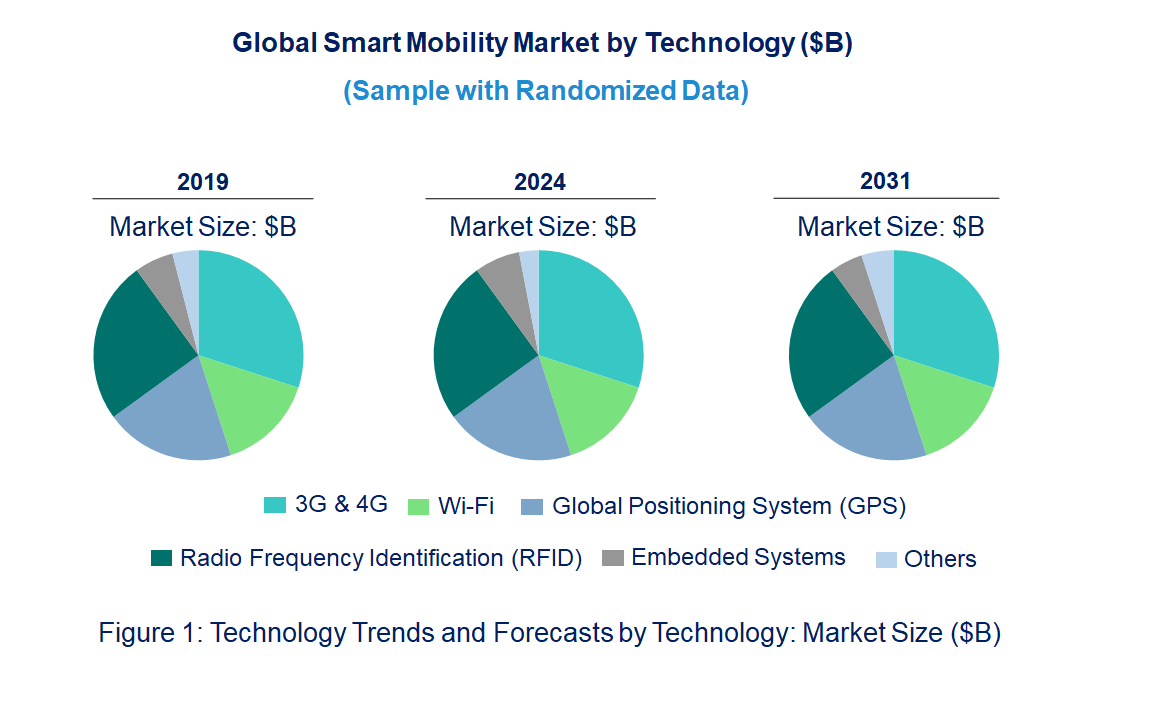
The technologies of the smart mobility market have witnessed many changes in recent times. For example, the earlier use of 3G and 4G technologies is gradually being replaced by 5G technology, which offers faster and more reliable communication networks for smart transportation systems. Wi-Fi and GPS technologies are still used but in more advanced forms, with more developed positioning systems and vehicle-to-everything (V2X) communication that improve real-time navigation and safety. RFID technology is being integrated with IoT devices to better manage and track traffic and logistics more intelligently. Once primarily dedicated to basic vehicle controls, today’s embedded systems are evolving toward supporting autonomous driving and ADAS to promote safer and more efficient transport networks. The evolution of new technologies is fueling a transformation in smart mobility solutions, enhancing the potential for more connected, automated, and sustainable transportation.
Emerging Trends in the Smart Mobility Market
The smart mobility market is evolving rapidly, driven by advancements in connectivity, automation, and sustainability. As urbanization increases and transportation demands grow, new technologies are changing the way people and goods move. Emerging trends are reshaping the transportation landscape, making mobility smarter, more efficient, and more sustainable. Here are five key trends that are shaping the smart mobility market today.
• 5G Integration for Enhanced Connectivity: The transportation system is enabled with faster and more reliable communication through 5G technology. Ultra-low latency and high-speed data transfer in 5G allow for real-time communication between vehicles, infrastructure, and cloud systems. This connectivity is essential for Vehicle-to-Everything (V2X) communication, which enables autonomous vehicles to share information about traffic conditions, road hazards, and vehicle performance. The adoption of 5G will improve the safety, efficiency, and overall experience of smart mobility solutions.
• Autonomous Vehicles (AVs) and ADAS (Advanced Driver-Assistance Systems): Autonomous vehicles and ADAS are at the forefront of transforming mobility. AVs rely on AI, machine learning, and sensors to drive without human intervention, while ADAS offers features like lane-keeping, adaptive cruise control, and automatic emergency braking. These technologies are making transportation safer by reducing human error and enhancing the driving experience. These technologies will mature over time, reducing accidents, optimizing traffic flow, and increasing access for people who require mobility support, such as the elderly and disabled.
• Electric Vehicles (EVs) and Charging Infrastructure Expansion: As concerns for sustainable, low-emission transport continue to grow, there is a tremendous push toward electric mobility. EV adoption is increasing due to improvements in battery technology, reducing prices, and offering longer ranges. This makes electric vehicles more accessible and affordable to consumers, especially with the expanding charging infrastructure. Governments are supporting the shift with incentives and regulations that help promote reduced carbon footprints. In addition to sustainability improvements, the move toward electrified mobility has promoted innovation in battery storage, charging infrastructure, and energy system integration.
• Mobility-as-a-Service (MaaS) and Shared Mobility Solutions: MaaS (Mobility-as-a-Service) is revolutionizing how people use transportation. It integrates different transport modes, including ride-hailing, public transport, and bike-sharing, into one accessible service. Users can plan, book, and pay for various transportation modes via their mobile devices. This integration increases convenience and flexibility. It also reduces the number of personal vehicles needed, lowering traffic congestion, reducing emissions, and improving mobility for urban residents.
• Smart Traffic Management Systems and IoT Integration: Smart traffic management systems use IoT for better optimization of traffic flow, reduction of congestion, and improvement in urban mobility. These systems rely on sensors, cameras, and data analytics to monitor and manage real-time traffic patterns. IoT-enabled infrastructure allows cities to collect data on traffic volumes, air quality, and road conditions. This information can be used to dynamically adjust traffic signals, reducing congestion and improving safety. Smart traffic systems make cities more efficient and livable for their residents.
These emerging trends are transforming the smart mobility market, making it more connected, efficient, and sustainable. The integration of 5G, autonomous vehicles, electric mobility, MaaS, and smart traffic management is not only improving transportation but also contributing to the development of smarter cities and more livable urban environments. As technologies continue to advance, they will redefine how people move and interact with their surroundings, ultimately transforming the global transportation landscape.
Smart Mobility Market : Industry Potential, Technological Development, and Compliance Considerations
Technological innovations in connectivity, automation, and sustainability are rapidly revolutionizing the transportation system within the smart mobility market. These changes are improving performance with greater efficiency, safety, and user experience in transportation systems.
• Technology Potential: The smart mobility technology space is vast, and breakthroughs such as 5G, autonomous vehicles (AVs), electric vehicles (EVs), and intelligent traffic management systems are expected to bring about transformative benefits. These technologies can enhance passenger transportation efficiency, reduce carbon emissions, and improve safety by enabling real-time data exchange and more responsive infrastructure.
• Degree of Disruption: The degree of disruption is significant. Autonomous vehicles and EVs are fundamentally changing the transportation landscape and challenging traditional mobility modes. They have the potential to disrupt industries like automotive, logistics, and public transport, driving the shift towards shared and electric mobility solutions.
• Level of Current Technology Maturity: Smart mobility technologies vary in maturity. While electric vehicles and traffic management systems are relatively mature and being rolled out in large numbers, autonomous vehicles and 5G networks are still in development or early adoption phases. These technologies will require considerable testing and regulatory work before widespread deployment.
• Regulatory Compliance: Regulatory compliance is of major importance, especially for autonomous vehicles, EVs, and data-driven systems. Governments are developing new frameworks for safety, privacy, and environmental standards, which will guide the development and deployment of smart mobility technologies.
Recent Technological development in Smart Mobility Market by Key Players
The smart mobility market is rapidly evolving with large technological advancements that make transportation smarter, safer, and more sustainable. Key players in the market are driving innovation in the areas of connectivity, autonomous driving, vehicle electrification, traffic management, and data analytics. These developments shape the future of mobility in terms of user experience, improving efficiency, and supporting more sustainable and connected transportation systems. Below are major recent developments in smart mobility by various market players.
• QUALIX INFORMATION SYSTEM: QUALIX Information System has advanced mobility-as-a-service (MaaS) platforms by integrating various transport modes. QUALIX’s software solutions enable users to plan, book, and pay for multiple transport services on a single platform. By improving accessibility and convenience, QUALIX helps cities optimize public transportation systems and reduce traffic congestion.
• MaaS Global: MaaS Global is leading the MaaS revolution by expanding its Whim platform. The Whim app offers users an easy, seamless travel experience by combining public transport, ride-hailing, and car-sharing services. Whim provides access to all transport options under one app, encouraging the use of environmentally friendly transportation modes. MaaS Global aims to promote a shift from private car ownership to flexible, shared mobility solutions, reducing urban congestion and emissions.
• Toyota Motor Corporation: Toyota Motor Corporation is focusing on the development of autonomous and hydrogen-powered vehicles. The company has been heavily investing in autonomous driving technologies and collaborating with tech companies to enhance its self-driving capabilities. Toyota’s electric and hydrogen-powered vehicle initiatives are also advancing its sustainability goals by reducing carbon emissions and increasing energy efficiency in the transportation sector.
• TOMTOM INTERNATIONAL: TomTom International continues to perfect its smart mobility solutions with advanced mapping and navigation technologies. Using real-time traffic data, TomTom’s solutions enable more efficient route planning, helping reduce traffic congestion. The company is also contributing to autonomous vehicle navigation with high-definition maps and real-time data services designed for self-driving cars.
• Excelfore: Excelfore is advancing connected solutions for smart mobility by improving in-vehicle networks and communication technologies. Its platform facilitates the integration of different systems within connected vehicles, such as ADAS and infotainment. Excelfore’s innovations in V2X communication and 5G integration enable real-time data exchange between vehicles, infrastructure, and traffic management systems, enhancing safety and efficiency on the roads.
• Siemens: Siemens is a leader in intelligent traffic management and urban mobility solutions. The company has implemented intelligent transportation systems that use sensors, data analytics, and automation to optimize traffic, reduce congestion, and ensure safety. Siemens is also leading the integration of renewable energy sources with electric vehicle charging infrastructure in urban areas, supporting the shift towards electric mobility.
• Robert Bosch: Robert Bosch is focusing on autonomous driving and ADAS technologies. The company has introduced sensor systems, including radar and camera solutions, that enable vehicles to navigate safely and efficiently in complex environments. Bosch is also advancing electric vehicle components, particularly batteries and powertrains, solidifying its position as a key player in the transition to sustainable mobility.
• Cisco Systems: Cisco Systems is a leader in the digital transformation of smart cities and connected mobility solutions. The company’s technology enables seamless connectivity between vehicles, infrastructure, and urban environments, improving transportation system safety, efficiency, and reliability. Cisco focuses on developing IoT solutions for traffic management, smart parking, and public transportation networks, which contribute to creating smarter, more sustainable urban mobility ecosystems.
• FORD MOTOR: Ford Motor has accelerated its development of electric and autonomous vehicles. The company’s investments in electric mobility are aimed at producing eco-friendly transportation solutions. Ford is also exploring autonomous driving technology and strengthening its partnerships with technology companies to bring self-driving cars to consumers. These efforts align with Ford’s commitment to reducing emissions and developing innovative mobility solutions for the future.
• Innoviz Technologies: Innoviz Technologies specializes in LiDAR technology, which plays a crucial role in the development of autonomous vehicles. The company’s high-resolution LiDAR sensors enable vehicles to perceive their surroundings, making self-driving cars safer and more reliable. Innoviz’s LiDAR solutions are being integrated into various vehicle platforms, advancing the deployment of self-driving cars and contributing to the overall growth of the smart mobility market.
Smart Mobility Market Driver and Challenges
The smart mobility market is being shaped by technological advancements in connectivity, automation, and sustainability, which are transforming the way people and goods move in urban environments. Key drivers include electric vehicle adoption, autonomous driving, and integrated transportation systems, all of which are highly promising. However, several challenges, such as infrastructure limitations and regulatory hurdles, persist. Below are the key drivers and challenges affecting the market.
Major Drivers:
• Adoption of Electric Vehicles and Sustainability: The increased focus on electric mobility due to sustainability and carbon emission concerns from governments and consumers worldwide is driving rapid growth in the EV sector. This trend is also leading to significant growth in the smart mobility market by promoting greener alternatives to transportation and reducing pollution in cities.
• Autonomous Vehicles (AVs) and Connected Technology: AVs are revolutionizing mobility by removing human errors, resulting in safer, faster, and smoother traffic operations. Through AI, machine learning, and sensors, the transportation infrastructure is transforming. Additionally, V2X communication systems enable real-time data exchange between devices, making transportation more efficient and safer.
• Mobility-as-a-Service (MaaS): MaaS integrates various transportation modes, allowing users to plan, book, and pay for different services using a single platform. This model increases travel flexibility, efficiency, and convenience while encouraging people to rely less on personal cars and use shared mobility services. MaaS promotes sustainability and reduces urban congestion.
• 5G Connectivity for Real-Time Communication: The rollout of 5G technology enhances connectivity and near-real-time communication, especially for autonomous vehicles and traffic management systems. 5G enables faster data transfer, ultra-low latency, and improved reliability, which are crucial for Vehicle-to-Everything (V2X) communication, enhancing the safety and efficiency of smart mobility applications.
• Government Regulations and Incentives: Governments are enacting regulations and providing incentives to support smart mobility growth, such as subsidies for EVs, infrastructure development, and emission reduction standards. These policies encourage investments in sustainable mobility solutions and the adoption of smart transportation technologies.
Critical Challenges:
• Infrastructure Limitations: Many cities currently lack the infrastructure necessary to support the large-scale adoption of smart mobility solutions. Key limitations include insufficient charging stations for electric vehicles, outdated road systems for self-driving cars, and limited 5G connectivity. Upgrading infrastructure is crucial to supporting the growth of smart mobility technologies.
• Regulatory and Safety Concerns: The deployment of autonomous vehicles and connected systems faces challenges related to safety standards, data privacy, and regulatory compliance. Governments are still working on creating unified regulations, which delays the adoption of these new technologies. Safety concerns, such as system failures or accidents with AVs, remain significant obstacles.
• Cost of Technology Development: Smart mobility technologies like autonomous driving systems, EVs, and V2X communication infrastructure require significant investments in research, development, and market deployment. High R&D costs, along with the need for advanced testing and validation, create barriers to the rapid commercialization of these technologies, limiting market growth.
• Public Acceptance and Trust: Public acceptance of new technologies, especially autonomous vehicles, is still a challenge. Many people have limited confidence in the safety and reliability of AVs, and concerns about job displacement due to automation persist. To gain public trust, these systems need to be demonstrated as safe and reliable, and people must be educated on their benefits for greater adoption.
• Data Privacy and Cybersecurity Risks: The integration of connected vehicles and smart infrastructure increases the risk of cyberattacks and data breaches. Protecting user data and ensuring the security of vehicle systems is crucial to prevent unauthorized access or malicious interference. Strengthening cybersecurity measures is vital for the continued growth and success of smart mobility solutions.
The smart mobility market is rapidly growing, with significant opportunities driven by trends such as electric vehicle adoption, autonomous driving, and the expansion of 5G connectivity. However, challenges like infrastructure limitations, regulatory hurdles, and cybersecurity risks need to be addressed. Overcoming these obstacles will pave the way for more efficient, sustainable, and safer transportation systems, fundamentally transforming urban mobility in the years to come.
List of Smart Mobility Companies
Companies in the market compete based on product quality offered. Major players in this market focus on expanding their manufacturing facilities, R&D investments, infrastructural development, and leverage integration opportunities across the value chain. With these strategies smart mobility companies cater to increasing demand, ensure competitive effectiveness, develop innovative products & technologies, reduce production costs, and expand their customer base. Some of the smart mobility companies profiled in this report include.
• QUALIX INFORMATION SYSTEM
• MaaS Global
• TOYOTA MOTOR CORPORATION
• TOMTOM INTERNATIONAL
• Excelfore
• Siemens
Smart Mobility Market by Technology
• Technology Readiness by Technology Type for Smart Mobility Market: Technology readiness is a critical aspect, and while 3G and 4G networks are widely deployed, they have limitations in enabling future applications, especially in autonomous driving. Wi-Fi is established but lacks the low-latency and high-speed characteristics needed for next-generation smart mobility solutions, making 5G a better choice. GPS is highly mature and extensively utilized in navigation, but its continuous advancements in precision positioning ensure reliability for autonomous vehicles. RFID is ready for use in tracking and asset management, but has not yet been more integrated into higher-order functions like autonomous vehicle communication. Embedded systems are highly advanced and play a crucial role in ADAS and autonomous driving technology, but further innovation is needed to achieve full autonomy. Other technologies, such as V2X communication and blockchain, are emerging but not yet fully integrated into mainstream smart mobility solutions. Regulatory compliance is a major factor in technology adoption, with strict safety standards governing autonomous driving and data privacy concerns in connected systems. The competitive levels in these technologies range from high for communication systems to moderate for sensors and tracking, which are essential components for building a smarter, safer mobility system.
• Competitive Intensity and Regulatory Compliance of Different Technologies for Smart Mobility Market: The competitive intensity across smart mobility technologies varies significantly. 3G and 4G face low competitive pressure due to their foundational role, but 5G has much higher competitive pressure because of its greater application support. Wi-Fi, in general, faces moderate competition, particularly from 5G, especially in urban mobility applications. GPS technology is highly mature, but newer advancements in positioning systems offer competition. RFID faces moderate competition from alternative tracking technologies but remains the leader in asset and vehicle tracking. Embedded systems are highly competitive as they support key technologies such as ADAS and autonomous driving, leading to rapid innovation. Regulatory compliance is an ongoing challenge for all of these technologies, especially for autonomous vehicles, where safety and data privacy are paramount. Governments are implementing stricter regulations on connectivity, data sharing, and cybersecurity, particularly for V2X communication and autonomous driving. The smart mobility ecosystem needs to adapt to various regulations to ensure compliance and reduce risks for all stakeholders.
• Disruption Potential of Different Technologies for Smart Mobility Market: The disruption potential of technologies like 3 G and 4G in the smart mobility market is limited to basic connectivity, whereas 5G will dramatically transform mobility by providing faster and lower-latency communication for autonomous vehicles and IoT systems. The advancement of Wi-Fi continues with increases in speed and coverage; however, its impact in urban environments is overshadowed by the impact of 5G. GPS remains the core technology for location-based services, though newer positioning systems will enhance accuracy. RFID is already revolutionizing tracking and logistics within smart mobility, providing real-time data for vehicle management, but its disruptive potential is mostly in supporting roles. Embedded systems are highly disruptive as they enable real-time data processing and autonomy in vehicles. Other emerging technologies, including V2X communication and blockchain for data security, are becoming increasingly important in transforming mobility but face challenges with scalability and integration.
Smart Mobility Market Trend and Forecast by Technology [Value from 2019 to 2031]:
• 3G & 4G
• Wi-Fi
• Global Positioning System (GPS)
• Radio Frequency Identification (RFID)
• Embedded Systems
• Others
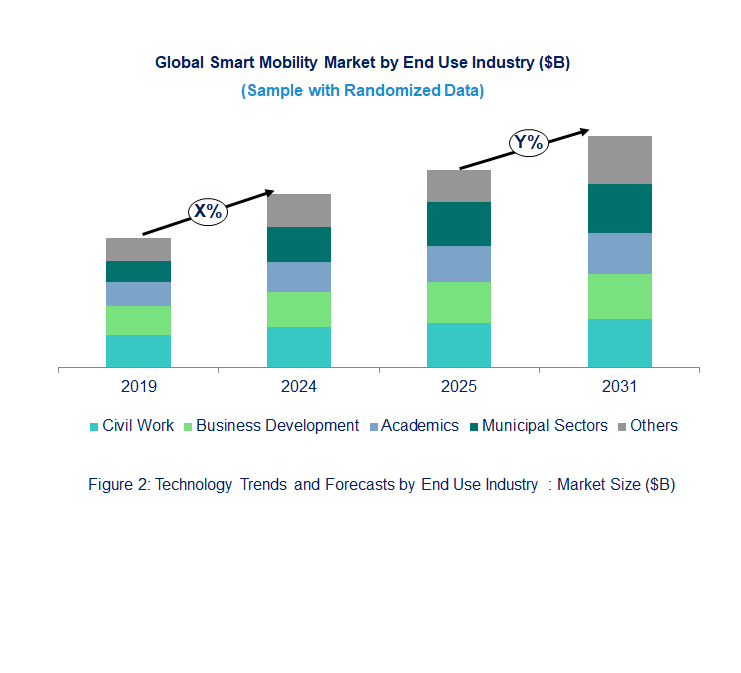
Smart Mobility Market Trend and Forecast by End Use Industry [Value from 2019 to 2031]:
• Civil Work
• Business Development
• Academics
• Municipal Sectors
• Others
Smart Mobility Market by Region [Value from 2019 to 2031]:
• North America
• Europe
• Asia Pacific
• The Rest of the World
• Latest Developments and Innovations in the Smart Mobility Technologies
• Companies / Ecosystems
• Strategic Opportunities by Technology Type
Features of the Global Smart Mobility Market
Market Size Estimates: Smart mobility market size estimation in terms of ($B).
Trend and Forecast Analysis: Market trends (2019 to 2024) and forecast (2025 to 2031) by various segments and regions.
Segmentation Analysis: Technology trends in the global smart mobility market size by various segments, such as end use industry and technology in terms of value and volume shipments.
Regional Analysis: Technology trends in the global smart mobility market breakdown by North America, Europe, Asia Pacific, and the Rest of the World.
Growth Opportunities: Analysis of growth opportunities in different end use industries, technologies, and regions for technology trends in the global smart mobility market.
Strategic Analysis: This includes M&A, new product development, and competitive landscape for technology trends in the global smart mobility market.
Analysis of competitive intensity of the industry based on Porter’s Five Forces model.
This report answers following 11 key questions
Q.1. What are some of the most promising potential, high-growth opportunities for the technology trends in the global smart mobility market by technology (3g & 4g, wi-fi, global positioning system (gps), radio frequency identification (rfid), embedded systems, and others), end use industry (civil work, business development, academics, municipal sectors, and others), and region (North America, Europe, Asia Pacific, and the Rest of the World)?
Q.2. Which technology segments will grow at a faster pace and why?
Q.3. Which regions will grow at a faster pace and why?
Q.4. What are the key factors affecting dynamics of different technology? What are the drivers and challenges of these technologies in the global smart mobility market?
Q.5. What are the business risks and threats to the technology trends in the global smart mobility market?
Q.6. What are the emerging trends in these technologies in the global smart mobility market and the reasons behind them?
Q.7. Which technologies have potential of disruption in this market?
Q.8. What are the new developments in the technology trends in the global smart mobility market? Which companies are leading these developments?
Q.9. Who are the major players in technology trends in the global smart mobility market? What strategic initiatives are being implemented by key players for business growth?
Q.10. What are strategic growth opportunities in this smart mobility technology space?
Q.11. What M & A activities did take place in the last five years in technology trends in the global smart mobility market?