
'
...

The Impact of COVID-19 is included in Tea Tree Oil Market Report. Buy it today to get an advantage.

Request the impact of COVID-19 on your product or industry


Tea Tree Oil Market Trends and Forecast

The future of the global tea tree oil market looks promising with opportunities in the FMCG manufacturer, cosmetic company, and pharmaceutical company markets. The global tea tree oil market is expected to reach an estimated $189.5 million by 2035 with a CAGR of 5.7% from 2026 to 2035. The major drivers for this market are the increasing demand for natural skincare, the rising use in pharmaceutical formulations, and the growing preference for plant based remedies.

• Lucintel forecasts that, within the grade category, therapeutic grade is expected to witness higher growth over the forecast period.
• Within the end use category, FMCG manufacturer is expected to witness the highest growth.
• In terms of region, APAC is expected to witness the highest growth over the forecast period.
Gain valuable insights for your business decisions with our comprehensive 150+ page report. Sample figures with some insights are shown below.
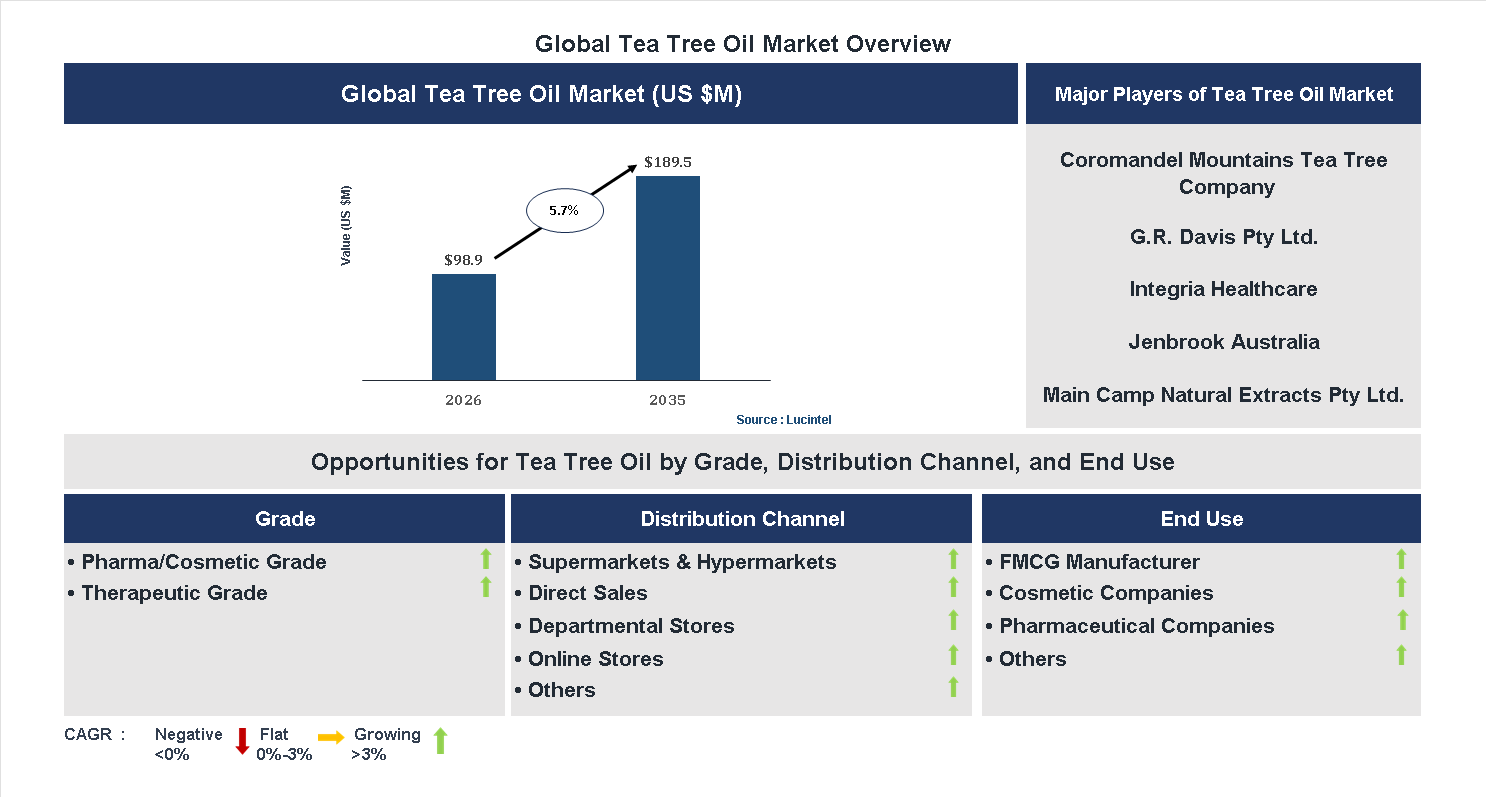
Tea Tree Oil Market Trends and Forecast

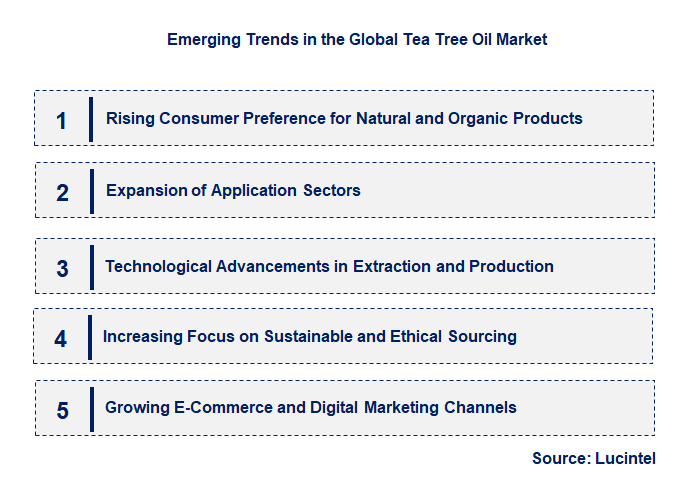
Emerging Trends in the Tea Tree Oil Market

The tea tree oil market is experiencing rapid growth driven by increasing consumer awareness of natural and organic products, expanding applications in health and beauty sectors, and technological advancements in extraction methods. As consumers seek sustainable and chemical-free options, the market is evolving with innovative product offerings and strategic collaborations. These developments are not only expanding market size but also enhancing product quality and safety standards. The following key trends highlight the major shifts shaping the future of the tea tree oil market, reflecting its dynamic nature and promising growth potential.

• Rising Consumer Preference for Natural and Organic Products: Consumers are increasingly prioritizing natural, organic, and chemical-free products for health and skincare. This shift is driven by growing awareness of the adverse effects of synthetic chemicals and a desire for sustainable living. As a result, demand for pure, high-quality tea tree oil is surging, encouraging producers to adopt organic certification and transparent sourcing practices. This trend is expanding market reach, especially among health-conscious and environmentally aware consumers, and is prompting brands to innovate with eco-friendly packaging and marketing strategies.
• Expansion of Application Sectors: The versatility of tea tree oil is fueling its adoption across various sectors such as personal care, cosmetics, aromatherapy, and medicinal products. In skincare, it is used for acne treatment and anti-inflammatory purposes; in hair care, for dandruff control; and in medicinal applications, for antimicrobial and antifungal properties. This diversification is broadening the market scope and creating new revenue streams. Companies are investing in research to develop specialized formulations, which further enhance product efficacy and consumer trust, thereby driving overall market growth.
• Technological Advancements in Extraction and Production: Innovations in extraction techniques, such as steam distillation and supercritical CO2 extraction, are improving the yield, purity, and quality of tea tree oil. These advancements reduce production costs and environmental impact while ensuring compliance with safety standards. Enhanced extraction methods also enable the preservation of bioactive compounds, increasing the oil’s effectiveness. As a result, manufacturers can offer higher-quality products, meet regulatory requirements, and cater to premium market segments. This technological progress is crucial for maintaining a competitive advantage and supporting sustainable growth in the market.
• Increasing Focus on Sustainable and Ethical Sourcing: Consumers and regulatory bodies are emphasizing sustainability and ethical sourcing practices. Companies are adopting fair trade practices, supporting local communities, and ensuring environmentally friendly cultivation methods. Certification programs like organic and cruelty-free labels are gaining importance, influencing purchasing decisions. This focus on sustainability not only enhances brand reputation but also aligns with global environmental goals. Ethical sourcing practices are becoming a key differentiator, encouraging transparency and accountability within the supply chain, which ultimately boosts consumer confidence and market stability.
• Growing E-commerce and Digital Marketing Channels: The rise of online retail platforms and digital marketing is significantly impacting the market landscape. E-commerce enables brands to reach a broader audience, including international markets, with ease. Digital marketing strategies such as social media campaigns, influencer collaborations, and targeted advertising are increasing product visibility and consumer engagement. This trend facilitates direct consumer feedback, rapid product launches, and personalized marketing approaches. As a result, companies can adapt quickly to market demands, foster brand loyalty, and accelerate sales growth, making digital channels a vital component of market expansion strategies.

These trends are collectively transforming the tea tree oil market by fostering innovation, enhancing product quality, and expanding market reach. The shift towards natural and sustainable products, coupled with technological advancements and digital engagement, is creating a more competitive and consumer-centric industry. These developments are not only driving growth but also ensuring the markets resilience and long-term sustainability in a rapidly evolving landscape.
Emerging Trends in the Tea Tree Oil Market

Recent Development in the Tea Tree Oil Market

The tea tree oil market has experienced significant growth driven by increasing consumer awareness of natural and organic products, expanding applications in health and beauty sectors, and rising demand for sustainable and eco-friendly solutions. Innovations in extraction techniques and product formulations have further boosted market potential. As consumers seek effective, chemical-free alternatives, the industry is poised for continued expansion. This report highlights five key developments shaping the future of the tea tree oil market, emphasizing their implications for stakeholders and market dynamics.

• Growing Consumer Preference for Natural Products: The shift towards organic and natural products has propelled demand for tea tree oil, recognized for its antimicrobial and therapeutic properties. Consumers increasingly prefer chemical-free skincare, haircare, and wellness products, boosting market sales. This trend encourages manufacturers to innovate with high-quality, sustainably sourced tea tree oil, fostering brand loyalty and expanding market reach. The rising preference for natural remedies also opens new avenues in alternative medicine and holistic health sectors.
• Expansion in Personal Care and Cosmetic Applications: The personal care industry is integrating tea tree oil into a wide range of products, including cleansers, shampoos, and creams. Its antimicrobial and anti-inflammatory benefits make it ideal for acne treatment and skin soothing solutions. This expansion enhances product efficacy and appeals to health-conscious consumers. As brands innovate with tea tree oil-infused formulations, market penetration deepens, leading to increased sales and diversification of product portfolios across global markets.
• Innovations in Extraction and Production Techniques: Advances in sustainable extraction methods, such as steam distillation and supercritical CO2 extraction, have improved the yield quality and purity of tea tree oil. These innovations reduce environmental impact and production costs, making high-grade oil more accessible. Enhanced extraction processes also ensure consistency and potency, which are critical for pharmaceutical and cosmetic applications. This technological progress supports market growth by meeting stringent quality standards and increasing consumer trust.
• Rising Demand in the Pharmaceutical Sector: The antimicrobial and anti-inflammatory properties of tea tree oil have attracted attention from pharmaceutical companies for developing topical treatments and medicinal formulations. Its potential in combating skin infections, fungal issues, and minor wounds positions it as a natural alternative to synthetic drugs. Increased R&D investments and regulatory approvals are further propelling this segment. The pharmaceutical sectors adoption significantly boosts overall market value and encourages innovation in therapeutic applications.
• Focus on Sustainable and Ethical Sourcing: Consumers and companies are emphasizing sustainability and ethical sourcing practices for tea tree oil. Certification standards like Fair Trade and Organic are gaining importance, ensuring environmentally friendly cultivation and fair labor practices. This focus enhances brand credibility and appeals to socially conscious buyers. Sustainable sourcing also supports biodiversity conservation and community development in producing regions, fostering long-term industry stability and aligning market growth with environmental and social responsibility.

These developments collectively are transforming the tea tree oil market by enhancing product quality, expanding application areas, and aligning with consumer values of sustainability and health. Increased innovation, demand in pharmaceuticals, and ethical sourcing practices are driving market expansion and competitiveness. As these trends continue, the industry is poised for sustained growth, offering new opportunities for stakeholders and reinforcing tea tree oil’s position as a versatile, natural solution in global markets.

Strategic Growth Opportunities in the Tea Tree Oil Market

The tea tree oil market is experiencing significant growth driven by increasing consumer awareness of natural and organic products, expanding applications in personal care, healthcare, and household sectors, and rising demand for sustainable and eco-friendly solutions. Innovations in extraction and formulation techniques are enhancing product efficacy, while regional markets show varied growth patterns influenced by cultural preferences and regulatory environments. Strategic investments and product diversification are expected to further accelerate market expansion, creating new opportunities for manufacturers and stakeholders to capitalize on the rising global demand for natural essential oils.

• Growing Demand for Natural and Organic Personal Care Products: The increasing consumer shift towards natural, chemical-free skincare and haircare products is boosting tea tree oil sales. Its antimicrobial, antifungal, and anti-inflammatory properties make it a preferred ingredient in cosmetics, lotions, and shampoos. Rising awareness about the adverse effects of synthetic chemicals encourages brands to incorporate tea tree oil into their formulations, expanding market reach. This trend is particularly prominent in North America and Europe, where organic product consumption is on the rise.
• Expansion of Tea Tree Oil in Healthcare and Medicinal Applications: The rising prevalence of skin infections, acne, and fungal conditions is driving the adoption of tea tree oil in medicinal products. Its proven antimicrobial and antiseptic properties make it suitable for topical treatments, wound care, and oral hygiene products. Increasing research and clinical validation are supporting its use in pharmaceutical formulations. The growing preference for natural remedies over synthetic drugs further fuels this opportunity, especially in emerging markets with traditional medicine practices.
• Innovation in Product Formulations and Delivery Systems: Advances in extraction, encapsulation, and delivery technologies are enhancing tea tree oil’s stability, potency, and ease of use. Innovations such as ready-to-use sprays, wipes, and roll-ons improve consumer convenience and product efficacy. These developments enable manufacturers to target specific applications like acne treatment, dandruff control, and household disinfectants more effectively. The focus on sustainable packaging and eco-friendly formulations also aligns with consumer preferences, fostering market growth through product differentiation.
• Rising Adoption in Household and Industrial Cleaning Products: The antimicrobial and antifungal properties of tea tree oil make it an attractive ingredient in natural cleaning solutions. Consumers seek eco-friendly, chemical-free disinfectants for household use, boosting demand for tea tree oil-based products. Additionally, industries are incorporating tea tree oil into industrial cleaning agents to meet regulatory standards and consumer expectations for sustainable practices. This expanding application segment offers significant growth potential, especially in regions emphasizing green and non-toxic cleaning solutions.
• Increasing Regional Market Penetration and Consumer Awareness: Market expansion into Asia-Pacific, Latin America, and the Middle East regions presents substantial growth opportunities due to rising disposable incomes and growing awareness of natural health products. Localized marketing strategies and product customization are driving adoption in these markets. Additionally, regulatory support and increasing import/export activities facilitate market penetration. As consumer knowledge about tea tree oil’s benefits spreads globally, demand is expected to surge, further strengthening the market’s overall growth trajectory.

The overall impact of these opportunities is set to significantly enhance the global tea tree oil market, fostering innovation, expanding application areas, and increasing consumer adoption. Strategic focus on product development, regional expansion, and sustainable practices will be crucial for stakeholders aiming to capitalize on the rising demand for natural essential oils. This growth will likely lead to increased competition, diversification, and market maturity in the coming years.

Tea Tree Oil Market Driver and Challenges

The tea tree oil market is influenced by a variety of technological, economic, and regulatory factors that shape its growth trajectory. Advances in extraction and formulation technologies have improved product quality and efficiency, while increasing consumer awareness about natural and organic products has expanded market demand. Economic factors such as rising disposable incomes and the growing popularity of herbal remedies further propel market expansion. However, regulatory standards concerning product safety and labeling pose challenges for manufacturers. Additionally, supply chain complexities and environmental concerns related to sustainable sourcing impact the market dynamics. Understanding these drivers and challenges is essential for stakeholders aiming to capitalize on emerging opportunities and navigate potential risks within this competitive landscape.

The factors responsible for driving the tea tree oil market include:-
• Increasing Consumer Preference for Natural and Organic Products: Consumers are shifting towards natural remedies and organic skincare, boosting demand for tea tree oil. This trend is driven by rising awareness of health and wellness, concerns over synthetic chemicals, and a desire for eco-friendly products. As a result, manufacturers are expanding their product lines to include organic and sustainably sourced tea tree oil, which commands premium pricing and enhances market growth. The growing popularity of herbal and holistic health practices further amplifies this demand, making it a significant driver for the industry.
• Technological Advancements in Extraction and Formulation: Innovations in extraction techniques, such as steam distillation and supercritical CO2 extraction, have improved the purity and yield of tea tree oil. These advancements reduce production costs and enhance product quality, making it more appealing to consumers and manufacturers alike. Additionally, new formulation technologies enable the development of diverse product formats like serums, creams, and essential oil blends, broadening application areas in skincare, haircare, and aromatherapy. These technological improvements facilitate scalability and meet stringent quality standards, thereby fueling market expansion.
• Growing Applications Across Multiple Industries: Tea tree oils antimicrobial, antifungal, and anti-inflammatory properties have led to its increased adoption across various sectors. In cosmetics and personal care, it is used in skincare, haircare, and oral hygiene products. The healthcare industry employs it in topical treatments and natural remedies. The agricultural sector utilizes it as a natural pesticide, and the household segment incorporates it into cleaning products. This diversification of applications broadens the market scope, creating new revenue streams and encouraging innovation, which collectively drive overall market growth.
• Rising Awareness of Health Benefits and Self-Care: Consumers are increasingly seeking natural solutions for health and wellness, driven by a desire for holistic self-care routines. Educational campaigns, social media influence, and the proliferation of herbal medicine practices have heightened awareness of tea tree oils benefits. This trend encourages consumers to incorporate tea tree oil into daily routines for skin health, immune support, and relaxation. The emphasis on preventive health and natural remedies sustains demand, prompting brands to develop targeted products and marketing strategies that capitalize on this health-conscious consumer base.
• Expansion of Distribution Channels and Global Markets: The proliferation of online retail platforms, specialty stores, and health and wellness outlets has enhanced accessibility to tea tree oil products worldwide. E-commerce enables brands to reach a broader audience, including emerging markets with growing middle-class populations. Strategic partnerships and distribution agreements facilitate entry into new regions, boosting sales volume. Additionally, increasing awareness and acceptance of natural products in developing countries contribute to market expansion. This global outreach not only increases sales but also encourages product innovation tailored to diverse consumer preferences.

The challenges facing this tea tree oil market include:-
• Stringent Regulatory Standards and Quality Control Issues: Regulatory agencies impose strict guidelines concerning the safety, labeling, and sourcing of natural products like tea tree oil. Compliance requires significant investment in quality assurance, testing, and certification processes, which can increase production costs. Variability in quality standards across regions complicates international trade and may lead to market entry barriers. Non-compliance risks product recalls, legal penalties, and damage to brand reputation. Ensuring consistent quality and transparency remains a critical challenge for manufacturers aiming to maintain consumer trust and meet evolving regulatory requirements.
• Supply Chain Complexities and Sustainability Concerns: Tea tree oil production depends heavily on sustainable cultivation and harvesting practices. Environmental issues such as deforestation, overharvesting, and climate change threaten raw material availability and quality. Supply chain disruptions, geopolitical tensions, and logistical challenges can hinder consistent supply and increase costs. Moreover, consumers are increasingly demanding ethically sourced and environmentally friendly products, compelling companies to adopt sustainable sourcing practices. Balancing supply chain efficiency with sustainability commitments is complex but essential for long-term market stability.
• Market Saturation and Intense Competition: As the market expands, numerous players—from large multinational corporations to small local producers—enter the space, leading to heightened competition. Price wars, product differentiation challenges, and marketing battles can erode profit margins. Additionally, counterfeit and adulterated products pose risks to brand integrity and consumer safety. Companies must invest in branding, quality assurance, and innovation to stand out. Navigating this competitive landscape requires strategic positioning and continuous product development to sustain growth and market share.

The tea tree oil market is driven by increasing consumer demand for natural products, technological innovations, expanding applications, health awareness, and global distribution. However, regulatory hurdles, supply chain sustainability issues, and intense competition present significant challenges. These factors collectively influence market dynamics, requiring stakeholders to adopt adaptive strategies. While growth prospects remain promising, success hinges on maintaining quality standards, sustainable sourcing, and differentiation in a competitive environment. Overall, the markets future will depend on how effectively companies can leverage opportunities while mitigating risks associated with these drivers and challenges.

List of Tea Tree Oil Companies

Companies in the market compete on the basis of product quality offered. Major players in this market focus on expanding their manufacturing facilities, R&D investments, infrastructural development, and leverage integration opportunities across the value chain. With these strategies tea tree oil companies cater increasing demand, ensure competitive effectiveness, develop innovative products & technologies, reduce production costs, and expand their customer base. Some of the tea tree oil companies profiled in this report include-
• Coromandel Mountains Tea Tree Oil Company
• G.R. Davis Pty Ltd.
• Integria Healthcare
• Jenbrook Australia
• Main Camp Natural Extracts Pty Ltd.
• Maria River Plantation
• Naturally Australian Tea Tree Oil Pty Ltd
• NOW Foods
• T.G.Cassegrain & Co
• The

Tea Tree Oil Market by Segment

The study includes a forecast for the global tea tree oil market by grade, distribution channel, end use, and region.

Tea Tree Oil Market by Grade [Value from 2019 to 2035]:


• Pharma/Cosmetic Grade
• Therapeutic Grade

Tea Tree Oil Market by Distribution Channel [Value from 2019 to 2035]:


• Supermarkets & Hypermarkets
• Direct Sales
• Departmental Stores
• Online Stores
• Others

Tea Tree Oil Market by End Use [Value from 2019 to 2035]:


• FMCG Manufacturer
• Cosmetic Companies
• Pharmaceutical Companies
• Others

Tea Tree Oil Market by Region [Value from 2019 to 2035]:


• North America
• Europe
• Asia Pacific
• The Rest of the World

Country Wise Outlook for the Tea Tree Oil Market

The global tea tree oil market has experienced significant growth driven by increasing consumer awareness of natural and organic products, rising demand for alternative medicine, and expanding applications in cosmetics, personal care, and health industries. Technological advancements and sustainable sourcing practices have also contributed to market expansion. Countries are adopting innovative extraction techniques and emphasizing quality standards to meet global demand. Regulatory frameworks and consumer preferences continue to shape market dynamics, fostering competition and diversification. As the market evolves, key players are investing in research and development to introduce new products and improve supply chain efficiency, ensuring sustained growth across major regions.

• United States: The U.S. market has seen a surge in organic and natural product demand, with increased consumer interest in wellness and holistic health. Major brands are expanding their product lines to include Tea Tree Oil for skincare, haircare, and aromatherapy. E-commerce sales have grown substantially, driven by online health and beauty platforms. Regulatory standards are tightening to ensure product safety and quality, encouraging companies to adopt sustainable sourcing practices. Additionally, innovative formulations and blends with other essential oils are gaining popularity, boosting market growth.
• China: China’s Tea Tree Oil market is expanding rapidly due to rising awareness of natural remedies and traditional medicine practices. Domestic production is increasing, supported by government initiatives promoting herbal and botanical products. The market benefits from a growing middle class with higher disposable incomes and a preference for organic health products. Local companies are investing in advanced extraction technologies to improve yield and quality. Export opportunities are also emerging as international demand for high-quality Tea Tree Oil rises. E-commerce platforms and retail chains are key distribution channels fueling market growth.
• Germany: Germany remains a significant market for Tea Tree Oil within Europe, driven by a strong preference for organic and eco-friendly products. The country’s stringent quality standards and certifications ensure high product safety, fostering consumer trust. The market is characterized by innovative product applications in cosmetics, personal care, and natural remedies. Sustainability and ethical sourcing are critical factors influencing purchasing decisions. German companies are investing in research to develop new formulations and improve extraction methods. The growing trend of natural skincare and holistic health practices continues to propel market expansion.
• India: India’s Tea Tree Oil market is witnessing rapid growth due to increasing awareness of herbal and natural health solutions. The rising popularity of Ayurveda and traditional medicine practices supports demand. Local producers are focusing on sustainable cultivation and organic certification to meet international standards. The market is also benefiting from the expanding beauty and personal care sectors, with Tea Tree Oil used in skincare, haircare, and aromatherapy products. E-commerce platforms are playing a vital role in reaching rural and urban consumers. Government initiatives promoting herbal products further bolster market development.
• Japan: Japan’s market for Tea Tree Oil is characterized by a focus on high-quality, pure products suitable for sensitive skin. Consumers prefer products with natural ingredients and minimal chemical additives. The market is driven by a strong skincare culture and increasing interest in natural remedies. Japanese companies are investing in research to develop innovative formulations and improve extraction techniques. The demand for organic and sustainably sourced Tea Tree Oil is rising, aligning with environmental consciousness. Retail and online channels are expanding, with a focus on premium and niche products catering to health-conscious consumers.

Lucintel Analytics Dashboard

Features of the Global Tea Tree Oil Market

Market Size Estimates: Tea tree oil market size estimation in terms of value ($M).
Trend and Forecast Analysis: Market trends (2019 to 2025) and forecast (2026 to 2035) by various segments and regions.
Segmentation Analysis: Tea tree oil market size by grade, distribution channel, end use, and region in terms of value ($M).
Regional Analysis: Tea tree oil market breakdown by North America, Europe, Asia Pacific, and Rest of the World.
Growth Opportunities: Analysis of growth opportunities in different grades, distribution channels, end uses, and regions for the tea tree oil market.
Strategic Analysis: This includes M&A, new product development, and competitive landscape of the tea tree oil market.
Analysis of competitive intensity of the industry based on Porter’s Five Forces model.

Lucintel Consulting Services

FAQ

Q1. What is the tea tree oil market size?
Answer: The global tea tree oil market is expected to reach an estimated $189.5 million by 2035.
Q2. What is the growth forecast for tea tree oil market?
Answer: The global tea tree oil market is expected to grow with a CAGR of 5.7% from 2026 to 2035.
Q3. What are the major drivers influencing the growth of the tea tree oil market?
Answer: The major drivers for this market are the increasing demand for natural skincare, the rising use in pharmaceutical formulations, and the growing preference for plant based remedies.
Q4. What are the major segments for tea tree oil market?
Answer: The future of the tea tree oil market looks promising with opportunities in the FMCG manufacturer, cosmetic company, and pharmaceutical company markets.
Q5. Who are the key tea tree oil market companies?
Answer: Some of the key tea tree oil companies are as follows:
• Coromandel Mountains Tea Tree Oil Company
• G.R. Davis Pty Ltd.
• Integria Healthcare
• Jenbrook Australia
• Main Camp Natural Extracts Pty Ltd.
• Maria River Plantation
• Naturally Australian Tea Tree Oil Pty Ltd
• NOW Foods
• T.G.Cassegrain & Co
• The Lebermuth Co
Q6. Which tea tree oil market segment will be the largest in future?
Answer: Lucintel forecasts that, within the grade category, therapeutic grade is expected to witness higher growth over the forecast period.
Q7. In tea tree oil market, which region is expected to be the largest in next 5 years?
Answer: In terms of region, APAC is expected to witness the highest growth over the forecast period.
Q8. Do we receive customization in this report?
Answer: Yes, Lucintel provides 10% customization without any additional cost.

This report answers following 11 key questions:

Q.1. What are some of the most promising, high-growth opportunities for the tea tree oil market by grade (pharma/cosmetic grade and therapeutic grade), distribution channel (supermarkets & hypermarkets, direct sales, departmental stores, online stores, and others), end use (FMCG manufacturer, cosmetic companies, pharmaceutical companies, and others), and region (North America, Europe, Asia Pacific, and the Rest of the World)?
Q.2. Which segments will grow at a faster pace and why?
Q.3. Which region will grow at a faster pace and why?
Q.4. What are the key factors affecting market dynamics? What are the key challenges and business risks in this market?
Q.5. What are the business risks and competitive threats in this market?
Q.6. What are the emerging trends in this market and the reasons behind them?
Q.7. What are some of the changing demands of customers in the market?
Q.8. What are the new developments in the market? Which companies are leading these developments?
Q.9. Who are the major players in this market? What strategic initiatives are key players pursuing for business growth?
Q.10. What are some of the competing products in this market and how big of a threat do they pose for loss of market share by material or product substitution?
Q.11. What M&A activity has occurred in the last 7 years and what has its impact been on the industry?

For any questions related to Tea Tree Oil Market, Tea Tree Oil Market Size, Tea Tree Oil Market Growth, Tea Tree Oil Market Analysis, Tea Tree Oil Market Report, Tea Tree Oil Market Share, Tea Tree Oil Market Trends, Tea Tree Oil Market Forecast, Tea Tree Oil Companies, write Lucintel analyst at email: helpdesk@lucintel.com. We will be glad to get back to you soon.
                                           Table of Contents

            1. Executive Summary

            2. Market Overview

                        2.1 Background and Classifications
                        2.2 Supply Chain

            3. Market Trends & Forecast Analysis

                        3.1 Macroeconomic Trends and Forecasts
                        3.2 Industry Drivers and Challenges
                        3.3 PESTLE Analysis
                        3.4 Patent Analysis
                        3.5 Regulatory Environment
                        3.6 Global Tea Tree Oil Market Trends and Forecast

            4. Global Tea Tree Oil Market by Grade

                        4.1 Overview
                        4.2 Attractiveness Analysis by Grade
                        4.3 Pharma/Cosmetic Grade : Trends and Forecast 2019 to 2035
                        4.4 Therapeutic Grade : Trends and Forecast 2019 to 2035

            5. Global Tea Tree Oil Market by Distribution Channel

                        5.1 Overview
                        5.2 Attractiveness Analysis by Distribution Channel
                        5.3 Supermarkets & Hypermarkets : Trends and Forecast 2019 to 2035
                        5.4 Direct Sales : Trends and Forecast 2019 to 2035
                        5.5 Departmental Stores : Trends and Forecast 2019 to 2035
                        5.6 Online Stores : Trends and Forecast 2019 to 2035
                        5.7 Others : Trends and Forecast 2019 to 2035

            6. Global Tea Tree Oil Market by End Use

                        6.1 Overview
                        6.2 Attractiveness Analysis by End Use
                        6.3 FMCG Manufacturer : Trends and Forecast 2019 to 2035
                        6.4 Cosmetic Companies : Trends and Forecast 2019 to 2035
                        6.5 Pharmaceutical Companies : Trends and Forecast 2019 to 2035
                        6.6 Others : Trends and Forecast 2019 to 2035

            7. Regional Analysis

                        7.1 Overview
                        7.2 Global Tea Tree Oil Market by Region

            8. North American Tea Tree Oil Market

                        8.1 Overview
                        8.2 North American Tea Tree Oil Market by Grade
                        8.3 North American Tea Tree Oil Market by End Use
                        8.4 The United States Tea Tree Oil Market
                        8.5 Canadian Tea Tree Oil Market
                        8.6 Mexican Tea Tree Oil Market

            9. European Tea Tree Oil Market

                        9.1 Overview
                        9.2 European Tea Tree Oil Market by Grade
                        9.3 European Tea Tree Oil Market by End Use
                        9.4 German Tea Tree Oil Market
                        9.5 French Tea Tree Oil Market
                        9.6 Italian Tea Tree Oil Market
                        9.7 Spanish Tea Tree Oil Market
                        9.8 The United Kingdom Tea Tree Oil Market

            10. APAC Tea Tree Oil Market

                        10.1 Overview
                        10.2 APAC Tea Tree Oil Market by Grade
                        10.3 APAC Tea Tree Oil Market by End Use
                        10.4 Chinese Tea Tree Oil Market
                        10.5 Indian Tea Tree Oil Market
                        10.6 Japanese Tea Tree Oil Market
                        10.7 South Korean Tea Tree Oil Market
                        10.8 Indonesian Tea Tree Oil Market

            11. ROW Tea Tree Oil Market

                        11.1 Overview
                        11.2 ROW Tea Tree Oil Market by Grade
                        11.3 ROW Tea Tree Oil Market by End Use
                        11.4 Middle Eastern Tea Tree Oil Market
                        11.5 South American Tea Tree Oil Market
                        11.6 African Tea Tree Oil Market

            12. Competitor Analysis

                        12.1 Product Portfolio Analysis
                        12.2 Operational Integration
                        12.3 Porter’s Five Forces Analysis
                                    • Competitive Rivalry
                                    • Bargaining Power of Buyers
                                    • Bargaining Power of Suppliers
                                    • Threat of Substitutes
                                    • Threat of New Entrants
                        12.4 Market Share Analysis

            13. Opportunities & Strategic Analysis

                        13.1 Value Chain Analysis
                        13.2 Growth Opportunity Analysis
                                    13.2.1 Growth Opportunity by Grade
                                    13.2.2 Growth Opportunity by Distribution Channel
                                    13.2.3 Growth Opportunity by End Use
                                    13.2.4 Growth Opportunity by Region
                        13.3 Emerging Trends in the Global Tea Tree Oil Market
                        13.4 Strategic Analysis
                                    13.4.1 New Product Development
                                    13.4.2 Certification and Licensing
                                    13.4.3 Mergers, Acquisitions, Agreements, Collaborations, and Joint Ventures

            14. Company Profiles of the Leading Players Across the Value Chain

                        14.1 Competitive Analysis Overview
                        14.2 Coromandel Mountains Tea Tree Oil Company
                                    • Company Overview
                                    • Tea Tree Oil Market Business Overview
                                    • New Product Development
                                    • Merger, Acquisition, and Collaboration
                                    • Certification and Licensing
                        14.3 G.R. Davis Pty Ltd.
                                    • Company Overview
                                    • Tea Tree Oil Market Business Overview
                                    • New Product Development
                                    • Merger, Acquisition, and Collaboration
                                    • Certification and Licensing
                        14.4 Integria Healthcare
                                    • Company Overview
                                    • Tea Tree Oil Market Business Overview
                                    • New Product Development
                                    • Merger, Acquisition, and Collaboration
                                    • Certification and Licensing
                        14.5 Jenbrook Australia
                                    • Company Overview
                                    • Tea Tree Oil Market Business Overview
                                    • New Product Development
                                    • Merger, Acquisition, and Collaboration
                                    • Certification and Licensing
                        14.6 Main Camp Natural Extracts Pty Ltd.
                                    • Company Overview
                                    • Tea Tree Oil Market Business Overview
                                    • New Product Development
                                    • Merger, Acquisition, and Collaboration
                                    • Certification and Licensing
                        14.7 Maria River Plantation
                                    • Company Overview
                                    • Tea Tree Oil Market Business Overview
                                    • New Product Development
                                    • Merger, Acquisition, and Collaboration
                                    • Certification and Licensing
                        14.8 Naturally Australian Tea Tree Oil Pty Ltd
                                    • Company Overview
                                    • Tea Tree Oil Market Business Overview
                                    • New Product Development
                                    • Merger, Acquisition, and Collaboration
                                    • Certification and Licensing
                        14.9 NOW Foods
                                    • Company Overview
                                    • Tea Tree Oil Market Business Overview
                                    • New Product Development
                                    • Merger, Acquisition, and Collaboration
                                    • Certification and Licensing
                        14.10 T.G.Cassegrain & Co
                                    • Company Overview
                                    • Tea Tree Oil Market Business Overview
                                    • New Product Development
                                    • Merger, Acquisition, and Collaboration
                                    • Certification and Licensing
                        14.11 The Lebermuth Co
                                    • Company Overview
                                    • Tea Tree Oil Market Business Overview
                                    • New Product Development
                                    • Merger, Acquisition, and Collaboration
                                    • Certification and Licensing

            15. Appendix

                        15.1 List of Figures
                        15.2 List of Tables
                        15.3 Research Methodology
                        15.4 Disclaimer
                        15.5 Copyright
                        15.6 Abbreviations and Technical Units
                        15.7 About Us
                        15.8 Contact Us

                                               List of Figures


            Chapter 1

                        Figure 1.1: Trends and Forecast for the Global Tea Tree Oil Market

            Chapter 2

                        Figure 2.1: Usage of Tea Tree Oil Market
                        Figure 2.2: Classification of the Global Tea Tree Oil Market
                        Figure 2.3: Supply Chain of the Global Tea Tree Oil Market

            Chapter 3

                        Figure 3.1: Trends of the Global GDP Growth Rate
                        Figure 3.2: Trends of the Global Population Growth Rate
                        Figure 3.3: Trends of the Global Inflation Rate
                        Figure 3.4: Trends of the Global Unemployment Rate
                        Figure 3.5: Trends of the Regional GDP Growth Rate
                        Figure 3.6: Trends of the Regional Population Growth Rate
                        Figure 3.7: Trends of the Regional Inflation Rate
                        Figure 3.8: Trends of the Regional Unemployment Rate
                        Figure 3.9: Trends of Regional Per Capita Income
                        Figure 3.10: Forecast for the Global GDP Growth Rate
                        Figure 3.11: Forecast for the Global Population Growth Rate
                        Figure 3.12: Forecast for the Global Inflation Rate
                        Figure 3.13: Forecast for the Global Unemployment Rate
                        Figure 3.14: Forecast for the Regional GDP Growth Rate
                        Figure 3.15: Forecast for the Regional Population Growth Rate
                        Figure 3.16: Forecast for the Regional Inflation Rate
                        Figure 3.17: Forecast for the Regional Unemployment Rate
                        Figure 3.18: Forecast for Regional Per Capita Income
                        Figure 3.19: Driver and Challenges of the Tea Tree Oil Market

            Chapter 4

                        Figure 4.1: Global Tea Tree Oil Market by Grade in 2019, 2025, and 2035
                        Figure 4.2: Trends of the Global Tea Tree Oil Market ($B) by Grade
                        Figure 4.3: Forecast for the Global Tea Tree Oil Market ($B) by Grade
                        Figure 4.4: Trends and Forecast for Pharma/Cosmetic Grade in the Global Tea Tree Oil Market (2019-2035)
                        Figure 4.5: Trends and Forecast for Therapeutic Grade in the Global Tea Tree Oil Market (2019-2035)

            Chapter 5

                        Figure 5.1: Global Tea Tree Oil Market by Distribution Channel in 2019, 2025, and 2035
                        Figure 5.2: Trends of the Global Tea Tree Oil Market ($B) by Distribution Channel
                        Figure 5.3: Forecast for the Global Tea Tree Oil Market ($B) by Distribution Channel
                        Figure 5.4: Trends and Forecast for Supermarkets & Hypermarkets in the Global Tea Tree Oil Market (2019-2035)
                        Figure 5.5: Trends and Forecast for Direct Sales in the Global Tea Tree Oil Market (2019-2035)
                        Figure 5.6: Trends and Forecast for Departmental Stores in the Global Tea Tree Oil Market (2019-2035)
                        Figure 5.7: Trends and Forecast for Online Stores in the Global Tea Tree Oil Market (2019-2035)
                        Figure 5.8: Trends and Forecast for Others in the Global Tea Tree Oil Market (2019-2035)

            Chapter 6

                        Figure 6.1: Global Tea Tree Oil Market by End Use in 2019, 2025, and 2035
                        Figure 6.2: Trends of the Global Tea Tree Oil Market ($B) by End Use
                        Figure 6.3: Forecast for the Global Tea Tree Oil Market ($B) by End Use
                        Figure 6.4: Trends and Forecast for FMCG Manufacturer in the Global Tea Tree Oil Market (2019-2035)
                        Figure 6.5: Trends and Forecast for Cosmetic Companies in the Global Tea Tree Oil Market (2019-2035)
                        Figure 6.6: Trends and Forecast for Pharmaceutical Companies in the Global Tea Tree Oil Market (2019-2035)
                        Figure 6.7: Trends and Forecast for Others in the Global Tea Tree Oil Market (2019-2035)

            Chapter 7

                        Figure 7.1: Trends of the Global Tea Tree Oil Market ($B) by Region (2019-2025)
                        Figure 7.2: Forecast for the Global Tea Tree Oil Market ($B) by Region (2026-2035)

            Chapter 8

                        Figure 8.1: Trends and Forecast for the North American Tea Tree Oil Market (2019-2035)
                        Figure 8.2: North American Tea Tree Oil Market by Grade in 2019, 2025, and 2035
                        Figure 8.3: Trends of the North American Tea Tree Oil Market ($B) by Grade (2019-2025)
                        Figure 8.4: Forecast for the North American Tea Tree Oil Market ($B) by Grade (2026-2035)
                        Figure 8.5: North American Tea Tree Oil Market by Distribution Channel in 2019, 2025, and 2035
                        Figure 8.6: Trends of the North American Tea Tree Oil Market ($B) by Distribution Channel (2019-2025)
                        Figure 8.7: Forecast for the North American Tea Tree Oil Market ($B) by Distribution Channel (2026-2035)
                        Figure 8.8: North American Tea Tree Oil Market by End Use in 2019, 2025, and 2035
                        Figure 8.9: Trends of the North American Tea Tree Oil Market ($B) by End Use (2019-2025)
                        Figure 8.10: Forecast for the North American Tea Tree Oil Market ($B) by End Use (2026-2035)
                        Figure 8.11: Trends and Forecast for the United States Tea Tree Oil Market ($B) (2019-2035)
                        Figure 8.12: Trends and Forecast for the Mexican Tea Tree Oil Market ($B) (2019-2035)
                        Figure 8.13: Trends and Forecast for the Canadian Tea Tree Oil Market ($B) (2019-2035)

            Chapter 9

                        Figure 9.1: Trends and Forecast for the European Tea Tree Oil Market (2019-2035)
                        Figure 9.2: European Tea Tree Oil Market by Grade in 2019, 2025, and 2035
                        Figure 9.3: Trends of the European Tea Tree Oil Market ($B) by Grade (2019-2025)
                        Figure 9.4: Forecast for the European Tea Tree Oil Market ($B) by Grade (2026-2035)
                        Figure 9.5: European Tea Tree Oil Market by Distribution Channel in 2019, 2025, and 2035
                        Figure 9.6: Trends of the European Tea Tree Oil Market ($B) by Distribution Channel (2019-2025)
                        Figure 9.7: Forecast for the European Tea Tree Oil Market ($B) by Distribution Channel (2026-2035)
                        Figure 9.8: European Tea Tree Oil Market by End Use in 2019, 2025, and 2035
                        Figure 9.9: Trends of the European Tea Tree Oil Market ($B) by End Use (2019-2025)
                        Figure 9.10: Forecast for the European Tea Tree Oil Market ($B) by End Use (2026-2035)
                        Figure 9.11: Trends and Forecast for the German Tea Tree Oil Market ($B) (2019-2035)
                        Figure 9.12: Trends and Forecast for the French Tea Tree Oil Market ($B) (2019-2035)
                        Figure 9.13: Trends and Forecast for the Spanish Tea Tree Oil Market ($B) (2019-2035)
                        Figure 9.14: Trends and Forecast for the Italian Tea Tree Oil Market ($B) (2019-2035)
                        Figure 9.15: Trends and Forecast for the United Kingdom Tea Tree Oil Market ($B) (2019-2035)

            Chapter 10

                        Figure 10.1: Trends and Forecast for the APAC Tea Tree Oil Market (2019-2035)
                        Figure 10.2: APAC Tea Tree Oil Market by Grade in 2019, 2025, and 2035
                        Figure 10.3: Trends of the APAC Tea Tree Oil Market ($B) by Grade (2019-2025)
                        Figure 10.4: Forecast for the APAC Tea Tree Oil Market ($B) by Grade (2026-2035)
                        Figure 10.5: APAC Tea Tree Oil Market by Distribution Channel in 2019, 2025, and 2035
                        Figure 10.6: Trends of the APAC Tea Tree Oil Market ($B) by Distribution Channel (2019-2025)
                        Figure 10.7: Forecast for the APAC Tea Tree Oil Market ($B) by Distribution Channel (2026-2035)
                        Figure 10.8: APAC Tea Tree Oil Market by End Use in 2019, 2025, and 2035
                        Figure 10.9: Trends of the APAC Tea Tree Oil Market ($B) by End Use (2019-2025)
                        Figure 10.10: Forecast for the APAC Tea Tree Oil Market ($B) by End Use (2026-2035)
                        Figure 10.11: Trends and Forecast for the Japanese Tea Tree Oil Market ($B) (2019-2035)
                        Figure 10.12: Trends and Forecast for the Indian Tea Tree Oil Market ($B) (2019-2035)
                        Figure 10.13: Trends and Forecast for the Chinese Tea Tree Oil Market ($B) (2019-2035)
                        Figure 10.14: Trends and Forecast for the South Korean Tea Tree Oil Market ($B) (2019-2035)
                        Figure 10.15: Trends and Forecast for the Indonesian Tea Tree Oil Market ($B) (2019-2035)

            Chapter 11

                        Figure 11.1: Trends and Forecast for the ROW Tea Tree Oil Market (2019-2035)
                        Figure 11.2: ROW Tea Tree Oil Market by Grade in 2019, 2025, and 2035
                        Figure 11.3: Trends of the ROW Tea Tree Oil Market ($B) by Grade (2019-2025)
                        Figure 11.4: Forecast for the ROW Tea Tree Oil Market ($B) by Grade (2026-2035)
                        Figure 11.5: ROW Tea Tree Oil Market by Distribution Channel in 2019, 2025, and 2035
                        Figure 11.6: Trends of the ROW Tea Tree Oil Market ($B) by Distribution Channel (2019-2025)
                        Figure 11.7: Forecast for the ROW Tea Tree Oil Market ($B) by Distribution Channel (2026-2035)
                        Figure 11.8: ROW Tea Tree Oil Market by End Use in 2019, 2025, and 2035
                        Figure 11.9: Trends of the ROW Tea Tree Oil Market ($B) by End Use (2019-2025)
                        Figure 11.10: Forecast for the ROW Tea Tree Oil Market ($B) by End Use (2026-2035)
                        Figure 11.11: Trends and Forecast for the Middle Eastern Tea Tree Oil Market ($B) (2019-2035)
                        Figure 11.12: Trends and Forecast for the South American Tea Tree Oil Market ($B) (2019-2035)
                        Figure 11.13: Trends and Forecast for the African Tea Tree Oil Market ($B) (2019-2035)

            Chapter 12

                        Figure 12.1: Porter’s Five Forces Analysis of the Global Tea Tree Oil Market
                        Figure 12.2: Market Share (%) of Top Players in the Global Tea Tree Oil Market (2025)

            Chapter 13

                        Figure 13.1: Growth Opportunities for the Global Tea Tree Oil Market by Grade
                        Figure 13.2: Growth Opportunities for the Global Tea Tree Oil Market by Distribution Channel
                        Figure 13.3: Growth Opportunities for the Global Tea Tree Oil Market by End Use
                        Figure 13.4: Growth Opportunities for the Global Tea Tree Oil Market by Region
                        Figure 13.5: Emerging Trends in the Global Tea Tree Oil Market

                                               List of Tables


            Chapter 1

                        Table 1.1: Growth Rate (%, 2024-2025) and CAGR (%, 2026-2035) of the Tea Tree Oil Market by Grade, Distribution Channel, and End Use
                        Table 1.2: Attractiveness Analysis for the Tea Tree Oil Market by Region
                        Table 1.3: Global Tea Tree Oil Market Parameters and Attributes

            Chapter 3

                        Table 3.1: Trends of the Global Tea Tree Oil Market (2019-2025)
                        Table 3.2: Forecast for the Global Tea Tree Oil Market (2026-2035)

            Chapter 4

                        Table 4.1: Attractiveness Analysis for the Global Tea Tree Oil Market by Grade
                        Table 4.2: Market Size and CAGR of Various Grade in the Global Tea Tree Oil Market (2019-2025)
                        Table 4.3: Market Size and CAGR of Various Grade in the Global Tea Tree Oil Market (2026-2035)
                        Table 4.4: Trends of Pharma/Cosmetic Grade in the Global Tea Tree Oil Market (2019-2025)
                        Table 4.5: Forecast for Pharma/Cosmetic Grade in the Global Tea Tree Oil Market (2026-2035)
                        Table 4.6: Trends of Therapeutic Grade in the Global Tea Tree Oil Market (2019-2025)
                        Table 4.7: Forecast for Therapeutic Grade in the Global Tea Tree Oil Market (2026-2035)

            Chapter 5

                        Table 5.1: Attractiveness Analysis for the Global Tea Tree Oil Market by Distribution Channel
                        Table 5.2: Market Size and CAGR of Various Distribution Channel in the Global Tea Tree Oil Market (2019-2025)
                        Table 5.3: Market Size and CAGR of Various Distribution Channel in the Global Tea Tree Oil Market (2026-2035)
                        Table 5.4: Trends of Supermarkets & Hypermarkets in the Global Tea Tree Oil Market (2019-2025)
                        Table 5.5: Forecast for Supermarkets & Hypermarkets in the Global Tea Tree Oil Market (2026-2035)
                        Table 5.6: Trends of Direct Sales in the Global Tea Tree Oil Market (2019-2025)
                        Table 5.7: Forecast for Direct Sales in the Global Tea Tree Oil Market (2026-2035)
                        Table 5.8: Trends of Departmental Stores in the Global Tea Tree Oil Market (2019-2025)
                        Table 5.9: Forecast for Departmental Stores in the Global Tea Tree Oil Market (2026-2035)
                        Table 5.10: Trends of Online Stores in the Global Tea Tree Oil Market (2019-2025)
                        Table 5.11: Forecast for Online Stores in the Global Tea Tree Oil Market (2026-2035)
                        Table 5.12: Trends of Others in the Global Tea Tree Oil Market (2019-2025)
                        Table 5.13: Forecast for Others in the Global Tea Tree Oil Market (2026-2035)

            Chapter 6

                        Table 6.1: Attractiveness Analysis for the Global Tea Tree Oil Market by End Use
                        Table 6.2: Market Size and CAGR of Various End Use in the Global Tea Tree Oil Market (2019-2025)
                        Table 6.3: Market Size and CAGR of Various End Use in the Global Tea Tree Oil Market (2026-2035)
                        Table 6.4: Trends of FMCG Manufacturer in the Global Tea Tree Oil Market (2019-2025)
                        Table 6.5: Forecast for FMCG Manufacturer in the Global Tea Tree Oil Market (2026-2035)
                        Table 6.6: Trends of Cosmetic Companies in the Global Tea Tree Oil Market (2019-2025)
                        Table 6.7: Forecast for Cosmetic Companies in the Global Tea Tree Oil Market (2026-2035)
                        Table 6.8: Trends of Pharmaceutical Companies in the Global Tea Tree Oil Market (2019-2025)
                        Table 6.9: Forecast for Pharmaceutical Companies in the Global Tea Tree Oil Market (2026-2035)
                        Table 6.10: Trends of Others in the Global Tea Tree Oil Market (2019-2025)
                        Table 6.11: Forecast for Others in the Global Tea Tree Oil Market (2026-2035)

            Chapter 7

                        Table 7.1: Market Size and CAGR of Various Regions in the Global Tea Tree Oil Market (2019-2025)
                        Table 7.2: Market Size and CAGR of Various Regions in the Global Tea Tree Oil Market (2026-2035)

            Chapter 8

                        Table 8.1: Trends of the North American Tea Tree Oil Market (2019-2025)
                        Table 8.2: Forecast for the North American Tea Tree Oil Market (2026-2035)
                        Table 8.3: Market Size and CAGR of Various Grade in the North American Tea Tree Oil Market (2019-2025)
                        Table 8.4: Market Size and CAGR of Various Grade in the North American Tea Tree Oil Market (2026-2035)
                        Table 8.5: Market Size and CAGR of Various Distribution Channel in the North American Tea Tree Oil Market (2019-2025)
                        Table 8.6: Market Size and CAGR of Various Distribution Channel in the North American Tea Tree Oil Market (2026-2035)
                        Table 8.7: Market Size and CAGR of Various End Use in the North American Tea Tree Oil Market (2019-2025)
                        Table 8.8: Market Size and CAGR of Various End Use in the North American Tea Tree Oil Market (2026-2035)
                        Table 8.9: Trends and Forecast for the United States Tea Tree Oil Market (2019-2035)
                        Table 8.10: Trends and Forecast for the Mexican Tea Tree Oil Market (2019-2035)
                        Table 8.11: Trends and Forecast for the Canadian Tea Tree Oil Market (2019-2035)

            Chapter 9

                        Table 9.1: Trends of the European Tea Tree Oil Market (2019-2025)
                        Table 9.2: Forecast for the European Tea Tree Oil Market (2026-2035)
                        Table 9.3: Market Size and CAGR of Various Grade in the European Tea Tree Oil Market (2019-2025)
                        Table 9.4: Market Size and CAGR of Various Grade in the European Tea Tree Oil Market (2026-2035)
                        Table 9.5: Market Size and CAGR of Various Distribution Channel in the European Tea Tree Oil Market (2019-2025)
                        Table 9.6: Market Size and CAGR of Various Distribution Channel in the European Tea Tree Oil Market (2026-2035)
                        Table 9.7: Market Size and CAGR of Various End Use in the European Tea Tree Oil Market (2019-2025)
                        Table 9.8: Market Size and CAGR of Various End Use in the European Tea Tree Oil Market (2026-2035)
                        Table 9.9: Trends and Forecast for the German Tea Tree Oil Market (2019-2035)
                        Table 9.10: Trends and Forecast for the French Tea Tree Oil Market (2019-2035)
                        Table 9.11: Trends and Forecast for the Spanish Tea Tree Oil Market (2019-2035)
                        Table 9.12: Trends and Forecast for the Italian Tea Tree Oil Market (2019-2035)
                        Table 9.13: Trends and Forecast for the United Kingdom Tea Tree Oil Market (2019-2035)

            Chapter 10

                        Table 10.1: Trends of the APAC Tea Tree Oil Market (2019-2025)
                        Table 10.2: Forecast for the APAC Tea Tree Oil Market (2026-2035)
                        Table 10.3: Market Size and CAGR of Various Grade in the APAC Tea Tree Oil Market (2019-2025)
                        Table 10.4: Market Size and CAGR of Various Grade in the APAC Tea Tree Oil Market (2026-2035)
                        Table 10.5: Market Size and CAGR of Various Distribution Channel in the APAC Tea Tree Oil Market (2019-2025)
                        Table 10.6: Market Size and CAGR of Various Distribution Channel in the APAC Tea Tree Oil Market (2026-2035)
                        Table 10.7: Market Size and CAGR of Various End Use in the APAC Tea Tree Oil Market (2019-2025)
                        Table 10.8: Market Size and CAGR of Various End Use in the APAC Tea Tree Oil Market (2026-2035)
                        Table 10.9: Trends and Forecast for the Japanese Tea Tree Oil Market (2019-2035)
                        Table 10.10: Trends and Forecast for the Indian Tea Tree Oil Market (2019-2035)
                        Table 10.11: Trends and Forecast for the Chinese Tea Tree Oil Market (2019-2035)
                        Table 10.12: Trends and Forecast for the South Korean Tea Tree Oil Market (2019-2035)
                        Table 10.13: Trends and Forecast for the Indonesian Tea Tree Oil Market (2019-2035)

            Chapter 11

                        Table 11.1: Trends of the ROW Tea Tree Oil Market (2019-2025)
                        Table 11.2: Forecast for the ROW Tea Tree Oil Market (2026-2035)
                        Table 11.3: Market Size and CAGR of Various Grade in the ROW Tea Tree Oil Market (2019-2025)
                        Table 11.4: Market Size and CAGR of Various Grade in the ROW Tea Tree Oil Market (2026-2035)
                        Table 11.5: Market Size and CAGR of Various Distribution Channel in the ROW Tea Tree Oil Market (2019-2025)
                        Table 11.6: Market Size and CAGR of Various Distribution Channel in the ROW Tea Tree Oil Market (2026-2035)
                        Table 11.7: Market Size and CAGR of Various End Use in the ROW Tea Tree Oil Market (2019-2025)
                        Table 11.8: Market Size and CAGR of Various End Use in the ROW Tea Tree Oil Market (2026-2035)
                        Table 11.9: Trends and Forecast for the Middle Eastern Tea Tree Oil Market (2019-2035)
                        Table 11.10: Trends and Forecast for the South American Tea Tree Oil Market (2019-2035)
                        Table 11.11: Trends and Forecast for the African Tea Tree Oil Market (2019-2035)

            Chapter 12

                        Table 12.1: Product Mapping of Tea Tree Oil Suppliers Based on Segments
                        Table 12.2: Operational Integration of Tea Tree Oil Manufacturers
                        Table 12.3: Rankings of Suppliers Based on Tea Tree Oil Revenue

            Chapter 13

                        Table 13.1: New Product Launches by Major Tea Tree Oil Producers (2019-2025)
                        Table 13.2: Certification Acquired by Major Competitor in the Global Tea Tree Oil Market

.

Buy full report or by chapter as follows

Price by License Type:
[-] Hide Chapter Details
[Chapter Number] [Chapter Name] [Chapter Number Of Pages] [Chapter Price]
Title/Chapter Name Pages Price
Full Report: Tea Tree Oil Market Report: Trends, Forecast and Competitive Analysis to 2035 Full Report $ 4,850
A 150 Page Report
Lucintel has been in the business of market research and management consulting since 2000 and has published over 1000 market intelligence reports in various markets / applications and served over 1,000 clients worldwide. This study is a culmination of four months of full-time effort performed by Lucintel's analyst team. The analysts used the following sources for the creation and completion of this valuable report:
  • In-depth interviews of the major players in this market
  • Detailed secondary research from competitors’ financial statements and published data 
  • Extensive searches of published works, market, and database information pertaining to industry news, company press releases, and customer intentions
  • A compilation of the experiences, judgments, and insights of Lucintel’s professionals, who have analyzed and tracked this market over the years.
Extensive research and interviews are conducted across the supply chain of this market to estimate market share, market size, trends, drivers, challenges, and forecasts. Below is a brief summary of the primary interviews that were conducted by job function for this report.
 
Thus, Lucintel compiles vast amounts of data from numerous sources, validates the integrity of that data, and performs a comprehensive analysis. Lucintel then organizes the data, its findings, and insights into a concise report designed to support the strategic decision-making process. The figure below is a graphical representation of Lucintel’s research process. 
 

Please sign in below to get report brochure - Tea Tree Oil Market Report.

At Lucintel, we respect your privacy and maintain the confidentiality of information / data provided by you
(Please enter your corporate email. * These fields are mandatory )

Follow us on