
Tablet Coating Market Trends and Forecast
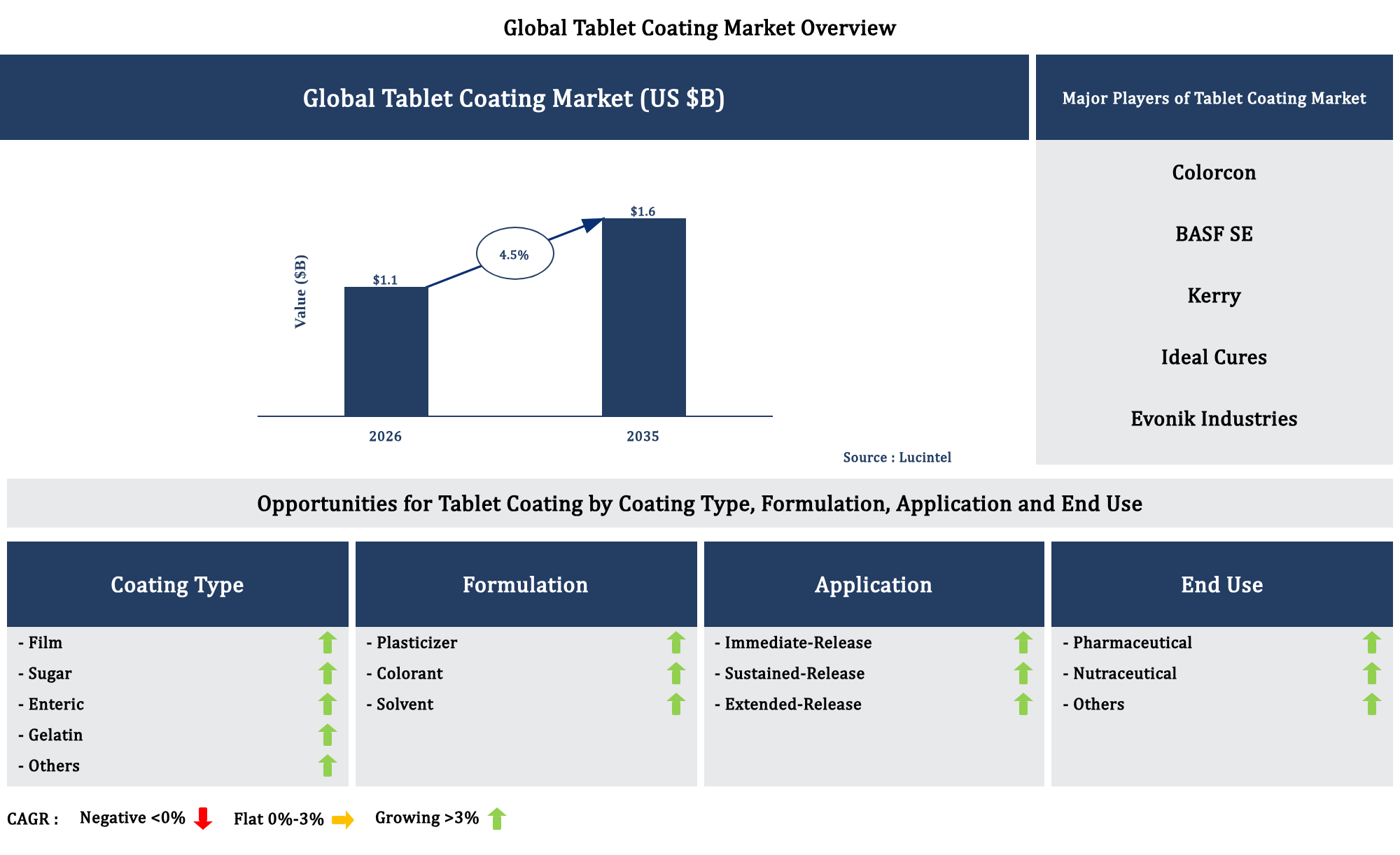
The future of the global tablet coating market looks promising with opportunities in the pharmaceutical and nutraceutical markets. The global tablet coating market is expected to reach an estimated $1692 million by 2035 with a CAGR of 4.5% from 2026 to 2035. The major drivers for this market are the rising demand for patient-friendly dosage forms, the growing demand for investments in pharmaceutical manufacturing, and the increasing demand for coated tablets for better taste & stability.
• Lucintel forecasts that, within the coating type category, film is expected to witness the highest growth over the forecast period.
• Within the end use category, pharmaceutical is expected to witness the highest growth.
• In terms of region, APAC is expected to witness the highest growth over the forecast period.
Gain valuable insights for your business decisions with our comprehensive 150+ page report. Sample figures with some insights are shown below.
Emerging Trends in the Tablet Coating Market
The tablet coating market is experiencing rapid evolution driven by technological advancements, changing consumer preferences, and regulatory shifts. As pharmaceutical companies seek more efficient, cost-effective, and innovative solutions, the market is adapting to meet these demands. Emerging trends are shaping the future landscape, influencing product development, manufacturing processes, and market dynamics. These developments are not only enhancing the quality and functionality of coated tablets but also expanding the scope of applications across various therapeutic areas. Understanding these key trends is essential for stakeholders aiming to stay competitive and leverage new opportunities in this dynamic industry.
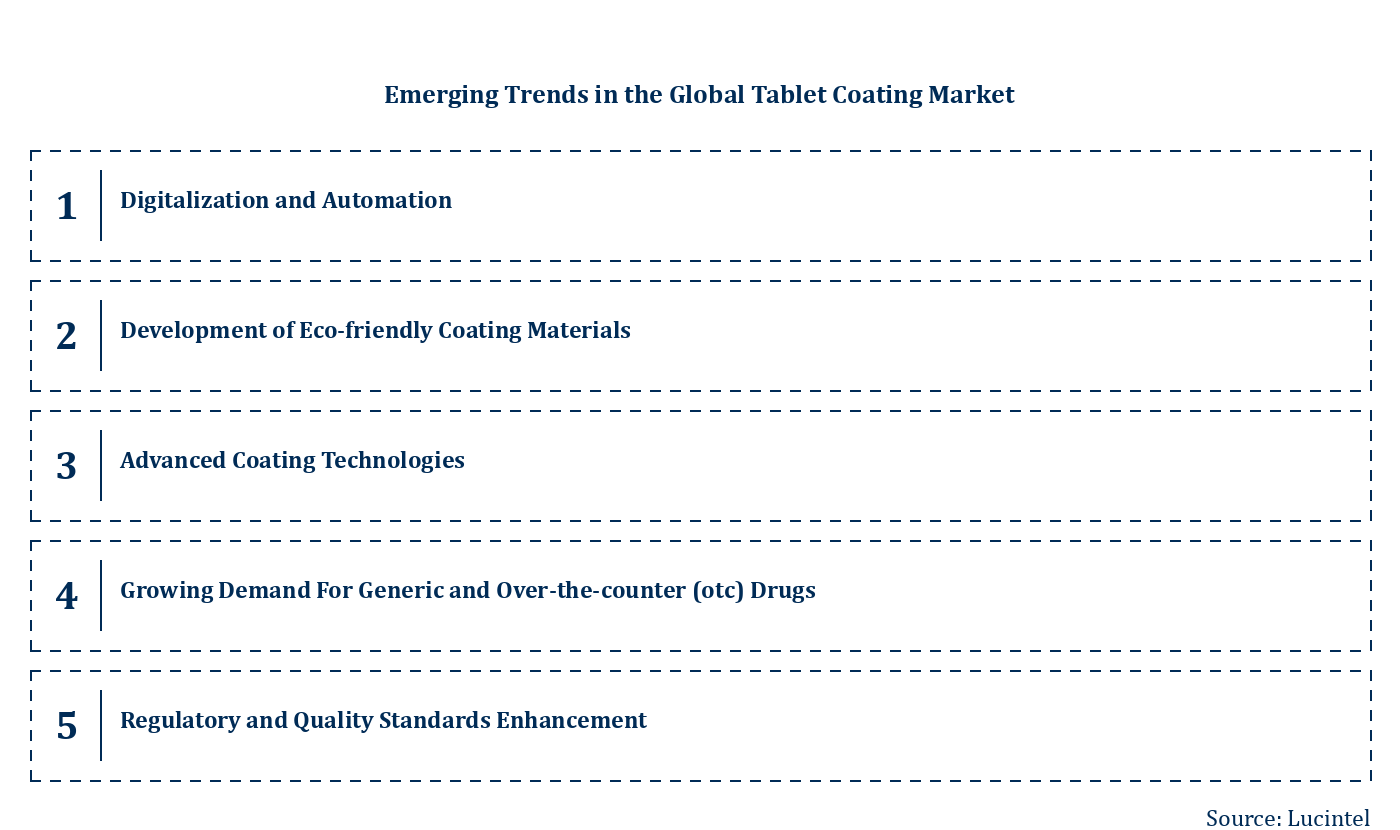
• Digitalization and Automation: The integration of digital technologies and automation in tablet coating processes is transforming manufacturing efficiency. Automated systems improve precision, reduce human error, and increase throughput, leading to cost savings and higher product consistency. Digital tools enable real-time monitoring and data collection, facilitating better quality control and regulatory compliance. This trend supports scalable production and rapid customization, meeting the growing demand for personalized medicines. As a result, companies adopting digital solutions are gaining a competitive edge by streamlining operations and enhancing product quality.
• Development of Eco-Friendly Coating Materials: There is a significant shift toward sustainable and environmentally friendly coating solutions. Manufacturers are exploring biodegradable, water-based, and solvent-free coatings to reduce environmental impact and comply with stricter regulations. These eco-friendly materials also minimize health hazards for workers and consumers. The adoption of green coatings aligns with corporate social responsibility goals and appeals to environmentally conscious consumers. This trend is driving innovation in formulation science and expanding market opportunities for sustainable products, ultimately contributing to a greener pharmaceutical industry.
• Advanced Coating Technologies: Innovations such as controlled-release, taste-masking, and functional coatings are gaining prominence. These technologies enhance drug efficacy, patient compliance, and product stability. Controlled-release coatings enable targeted delivery and reduced dosing frequency, improving therapeutic outcomes. Taste-masking coatings improve patient experience, especially for pediatric and geriatric populations. Functional coatings provide additional benefits like moisture protection or UV shielding. The development of these advanced coatings is expanding the scope of tablet applications and enabling personalized medicine, thereby creating new market segments and growth opportunities.
• Growing Demand for Generic and Over-the-Counter (OTC) Drugs: The increasing prevalence of chronic diseases and aging populations are fueling demand for affordable medications, boosting the generic and OTC segments. Coating technologies are crucial for differentiating generic products through improved stability, appearance, and patient acceptability. Cost-effective coating solutions are essential for manufacturers to meet regulatory standards while maintaining profitability. This trend is driving innovation in scalable, efficient coating processes that can be rapidly adapted for various formulations. As a result, the market is witnessing a surge in coated generic and OTC products, expanding market size and competition.
• Regulatory and Quality Standards Enhancement: Stricter regulatory requirements and quality standards are prompting manufacturers to adopt more rigorous coating processes. Enhanced validation protocols, quality control measures, and documentation are becoming standard practice. This trend ensures product safety, efficacy, and compliance with global regulations, reducing the risk of recalls and legal issues. It also encourages the adoption of advanced coating technologies that meet these standards. As regulatory landscapes evolve, companies investing in compliance are better positioned to access new markets and maintain consumer trust, fostering overall market stability and growth.
These emerging trends are reshaping the tablet coating market by fostering innovation, sustainability, and regulatory compliance. They are enabling manufacturers to produce higher-quality, more effective, and environmentally friendly products while expanding market opportunities. As these trends continue to evolve, they will drive further technological advancements and competitive dynamics, ultimately transforming the landscape of tablet coating solutions worldwide.
Recent Development in the Tablet Coating Market
The tablet coating market is experiencing rapid innovation driven by technological advancements, increasing demand for personalized medication, and stricter regulatory standards. These developments are transforming manufacturing processes, improving drug efficacy, and enhancing patient compliance. As the pharmaceutical industry evolves, stakeholders are focusing on sustainable solutions, digital integration, and novel coating materials to meet global health needs. The following key developments highlight the current trajectory and future potential of this dynamic market.
• Growing Adoption of Eco-Friendly Coating Materials: The shift towards sustainable practices is leading to increased use of biodegradable and water-based coatings, reducing environmental impact and aligning with regulatory requirements. This trend enhances market competitiveness by offering safer, cost-effective options that appeal to environmentally conscious consumers and pharmaceutical companies committed to green initiatives.
• Integration of Digital Technologies in Coating Processes: Automation, AI, and IoT are revolutionizing tablet coating by improving precision, reducing waste, and increasing efficiency. Digital tools enable real-time monitoring and quality control, leading to consistent product quality and faster production cycles. This technological integration is attracting investments and fostering innovation within the industry.
• Development of Advanced Coating Formulations for Controlled Release: New formulations allow for targeted drug delivery and sustained release, improving therapeutic outcomes and patient compliance. These innovations cater to complex treatment regimens, reduce dosing frequency, and minimize side effects, thereby expanding the market for specialized coatings and opening new revenue streams for manufacturers.
• Rising Demand for Personalized Medicine and Customized Coatings: The trend towards individualized treatments is driving demand for tailored coating solutions that accommodate specific drug properties and patient needs. This customization enhances drug stability, bioavailability, and patient adherence, positioning the market for growth as healthcare shifts towards precision medicine.
• Implementation of Stricter Regulatory Standards and Quality Assurance: Enhanced regulations are pushing manufacturers to adopt higher standards for coating quality, safety, and efficacy. Compliance drives innovation in formulation and process control, ensuring market access and consumer trust. This focus on quality assurance is shaping industry practices and fostering competitive differentiation.
The overall impact of these developments is a more innovative, sustainable, and efficient tablet coating market. Enhanced technological integration, regulatory compliance, and personalized solutions are driving growth, improving product quality, and meeting evolving healthcare demands. These trends are positioning the market for sustained expansion and increased global competitiveness.
Strategic Growth Opportunities in the Tablet Coating Market
The tablet coating market is experiencing significant growth driven by advancements in pharmaceutical formulations, increasing demand for controlled-release medications, and rising focus on patient compliance. Innovations in coating materials and techniques are expanding application possibilities across healthcare sectors. Market players are investing in R&D to develop eco-friendly, cost-effective solutions. The integration of digital technologies and regulatory support further accelerates growth. These opportunities collectively enhance product efficacy, safety, and patient experience, positioning the market for sustained expansion in the coming years.
• Growing Demand for Controlled-Release and Targeted Drug Delivery: The increasing need for precise medication release profiles is driving innovation in tablet coating technologies. Coatings that enable controlled, sustained, or targeted release improve therapeutic outcomes and reduce side effects. This trend is particularly prominent in chronic disease management, oncology, and pediatrics. As pharmaceutical companies seek to differentiate their products, advanced coating solutions that enhance drug stability and bioavailability are gaining prominence, creating substantial growth opportunities in the market.
• Rising Adoption of Eco-Friendly and Sustainable Coating Materials: Environmental concerns and regulatory pressures are prompting manufacturers to develop biodegradable, non-toxic, and sustainable coating options. Water-based and solvent-free coatings are gaining popularity due to their lower environmental impact. The shift towards green chemistry not only aligns with regulatory standards but also appeals to environmentally conscious consumers. This trend encourages innovation in raw materials and manufacturing processes, opening new avenues for market expansion and competitive differentiation.
• Technological Advancements in Coating Processes and Equipment: Innovations such as fluidized bed coating, spray coating, and digital control systems are enhancing efficiency, precision, and scalability. These technological improvements reduce production time, minimize waste, and improve coating uniformity. Automation and real-time monitoring enable better quality control, meeting stringent regulatory requirements. As companies adopt advanced equipment, the market benefits from increased productivity and product consistency, fostering growth in both developed and emerging markets.
• Increasing Focus on Patient-Centric and Aesthetic Coatings: The demand for visually appealing, taste-masked, and patient-friendly coatings is rising, especially in pediatric and geriatric populations. Coatings that improve swallowability, mask unpleasant tastes, and provide branding opportunities are gaining importance. Innovations in film and sugar coatings enhance patient compliance and brand recognition. This focus on aesthetics and functionality drives product differentiation and market expansion, particularly in over-the-counter and prescription medications.
• Expansion of Tablet Coating Applications Beyond Pharmaceuticals: The use of coating technologies is broadening into nutraceuticals, functional foods, and dietary supplements. Coatings are now employed to protect sensitive ingredients, improve stability, and deliver functional benefits such as controlled release or flavor masking. The growing consumer preference for health supplements and functional foods creates new market segments. This diversification offers manufacturers opportunities to innovate and capture additional revenue streams across various health-related industries.
The overall impact of these growth opportunities is a dynamic, innovative market poised for continued expansion. Advancements in technology, sustainability, and application diversity are shaping a competitive landscape that benefits manufacturers, healthcare providers, and consumers alike. As these opportunities evolve, they will drive product innovation, improve patient outcomes, and foster sustainable growth within the tablet coating industry.
Tablet Coating Market Driver and Challenges
The tablet coating market is influenced by a variety of technological, economic, and regulatory factors that shape its growth and development. Advances in coating technologies, such as film and sugar coating, have improved drug stability, taste masking, and controlled release, driving demand. Economic factors like increasing healthcare expenditure and the rising prevalence of chronic diseases further propel market expansion. Regulatory standards for pharmaceutical safety and quality control also influence market dynamics, ensuring compliance and innovation. Additionally, the demand for personalized medicine and the need for efficient manufacturing processes are key drivers. However, the market faces challenges related to high R&D costs, stringent regulatory requirements, and technological complexities, which could hinder growth.
The factors responsible for driving the tablet coating market include:
• Technological Innovation: The development of advanced coating materials and techniques, such as controlled-release coatings and eco-friendly processes, enhances drug efficacy and patient compliance. Innovations like hot-melt extrusion and spray coating improve efficiency and reduce manufacturing time, making products more competitive. These technological advancements enable manufacturers to meet diverse pharmaceutical needs, expanding market opportunities and fostering product differentiation.
• Rising Prevalence of Chronic Diseases: The increasing incidence of chronic conditions such as cardiovascular diseases, diabetes, and neurological disorders boosts demand for effective medication delivery systems. Coated tablets offer benefits like improved stability, taste masking, and controlled release, which are crucial for patient adherence. As healthcare awareness grows, the need for innovative coating solutions to enhance drug performance becomes more prominent, fueling market growth.
• Regulatory Compliance and Quality Standards: Stringent regulations imposed by agencies like the FDA and EMA require pharmaceutical companies to adhere to high-quality manufacturing practices. Coating processes must meet safety, efficacy, and environmental standards, prompting investments in advanced coating technologies. Compliance ensures market access and consumer trust, driving innovation and quality improvements within the industry.
• Growing Pharmaceutical R&D Investment: Increased funding in pharmaceutical research accelerates the development of new drugs and formulations, including specialized coatings. R&D efforts focus on improving drug stability, taste, and controlled release, which directly impact market growth. Collaborations between academia and industry further foster innovation, expanding the scope of coating applications and market size.
• Expansion in Emerging Markets: Rapid economic growth and healthcare infrastructure development in emerging economies like India and China create new opportunities for tablet coating manufacturers. Rising disposable incomes and increased healthcare awareness lead to higher demand for quality medications. Local manufacturing and technological adoption are expected to boost regional market growth, making emerging markets key growth drivers.
The challenges facing the tablet coating market include:
• High R&D and Manufacturing Costs: Developing innovative coating technologies requires significant investment in research, equipment, and skilled personnel. These costs can be prohibitive for smaller companies and may slow down innovation. Additionally, maintaining quality standards involves ongoing expenses, which can impact profit margins and market competitiveness.
• Stringent Regulatory Environment: Navigating complex regulatory frameworks across different regions poses a significant challenge. Compliance with safety, environmental, and quality standards often involves lengthy approval processes and substantial documentation. This can delay product launches and increase costs, hindering market agility and innovation.
• Technological Complexities and Compatibility Issues: Developing coatings that are compatible with various active pharmaceutical ingredients (APIs) and delivery mechanisms is complex. Variability in raw materials and process parameters can affect coating quality and performance. Overcoming these technical challenges requires continuous research and development, which can be resource-intensive and time-consuming.
The tablet coating market is driven by technological advancements, increasing disease prevalence, regulatory standards, R&D investments, and emerging market growth. However, high costs, regulatory hurdles, and technical complexities pose significant challenges. These factors collectively influence the market‘s trajectory, requiring stakeholders to innovate and adapt to sustain growth. The overall impact suggests a dynamic landscape with substantial opportunities tempered by notable obstacles, emphasizing the need for strategic planning and technological innovation to capitalize on emerging trends.
List of Tablet Coating Companies
Companies in the market compete on the basis of product quality offered. Major players in this market focus on expanding their manufacturing facilities, R&D investments, infrastructural development, and leverage integration opportunities across the value chain. With these strategies tablet coating companies cater increasing demand, ensure competitive effectiveness, develop innovative products & technologies, reduce production costs, and expand their customer base. Some of the tablet coating companies profiled in this report include-
• Colorcon
• BASF SE
• Kerry
• Ideal Cures
• Evonik Industries
Tablet Coating Market by Segment
The study includes a forecast for the global tablet coating market by coating type, formulation, application, end use, and region.
Tablet Coating Market by Coating Type [Value from 2019 to 2035]:
• Film
• Sugar
• Enteric
• Gelatin
• Others
Tablet Coating Market by Formulation [Value from 2019 to 2035]:
• Plasticizer
• Colorant
• Solvent
Tablet Coating Market by Application [Value from 2019 to 2035]:
• Immediate-Release
• Sustained-Release
• Extended-Release
Tablet Coating Market by End Use [Value from 2019 to 2035]:
• Pharmaceutical
• Nutraceutical
• Others
Tablet Coating Market by Region [Value from 2019 to 2035]:
• North America
• Europe
• Asia Pacific
• The Rest of the World
Country Wise Outlook for the Tablet Coating Market
The tablet coating market has experienced significant advancements driven by technological innovations, regulatory changes, and evolving consumer preferences. As the pharmaceutical industry seeks improved drug delivery systems, the demand for advanced coating solutions has increased globally. Countries like the United States, China, Germany, India, and Japan are at the forefront of these developments, each contributing unique innovations and market dynamics. These countries‘ regulatory environments, technological capabilities, and manufacturing capacities influence the global trajectory of the tablet coating industry. Understanding these regional developments provides insight into future trends and opportunities within this vital segment of pharmaceutical manufacturing.
• United States: The US market has seen a surge in the adoption of eco-friendly and sustainable coating materials, driven by stringent environmental regulations. Innovations in controlled-release coatings and the integration of digital printing technologies for customized tablet designs are prominent. The presence of major pharmaceutical companies and research institutions fosters rapid development and adoption of new coating technologies, enhancing drug efficacy and patient compliance.
• China: China is experiencing rapid growth in the tablet coating sector, supported by expanding pharmaceutical manufacturing capabilities and government initiatives promoting innovation. The focus is on cost-effective, high-quality coating solutions, with increasing investments in R&D for advanced coating materials. Local manufacturers are adopting automation and digitalization to improve efficiency and meet international standards, positioning China as a key player in the global market.
• Germany: Germany‘s market is characterized by high-quality standards and a focus on innovative, biocompatible coating materials. The country emphasizes research and development in functional coatings that improve drug stability and controlled release. German companies are also investing in sustainable manufacturing practices and digital technologies to optimize coating processes, maintaining their reputation for precision and reliability.
• India: India is witnessing significant growth driven by a burgeoning pharmaceutical industry and increasing export demands. The focus is on affordable, scalable coating solutions that meet international quality standards. Advances in spray coating technologies and the adoption of automation are helping Indian manufacturers improve efficiency and product quality, making India a competitive player in the global tablet coating market.
• Japan: Japan‘s market emphasizes technological innovation and high-quality standards, with a focus on functional coatings that enhance drug stability and controlled release. The country invests heavily in R&D for advanced coating materials and processes, including nanotechnology-based coatings. Japanese firms are also exploring environmentally friendly coatings and sustainable manufacturing practices to align with global eco-conscious trends.
Features of the Global Tablet Coating Market
Market Size Estimates: Tablet coating market size estimation in terms of value ($M).
Trend and Forecast Analysis: Market trends (2019 to 2025) and forecast (2026 to 2035) by various segments and regions.
Segmentation Analysis: Tablet coating market size by various segments, such as by coating type, formulation, application, end use, and region in terms of value ($M).
Regional Analysis: Tablet coating market breakdown by North America, Europe, Asia Pacific, and Rest of the World.
Growth Opportunities: Analysis of growth opportunities in different coating type, formulation, application, end use, and regions for the tablet coating market.
Strategic Analysis: This includes M&A, new product development, and competitive landscape of the tablet coating market.
Analysis of competitive intensity of the industry based on Porter’s Five Forces model.
FAQ
Q1. What is the tablet coating market size?
Answer: The global tablet coating market is expected to reach an estimated $1692 million by 2035.
Q2. What is the growth forecast for tablet coating market?
Answer: The global tablet coating market is expected to grow with a CAGR of 4.5% from 2026 to 2035.
Q3. What are the major drivers influencing the growth of the tablet coating market?
Answer: The major drivers for this market are the rising demand for patient-friendly dosage forms, the growing demand for investments in pharmaceutical manufacturing, and the increasing demand for coated tablets for better taste & stability.
Q4. What are the major segments for tablet coating market?
Answer: The future of the tablet coating market looks promising with opportunities in the pharmaceutical and nutraceutical markets.
Q5. Who are the key tablet coating market companies?
Answer: Some of the key tablet coating companies are as follows:
• Colorcon
• BASF SE
• Kerry
• Ideal Cures
• Evonik Industries
Q6. Which tablet coating market segment will be the largest in future?
Answer: Lucintel forecasts that, within the coating type category, film is expected to witness the highest growth over the forecast period.
Q7. In tablet coating market, which region is expected to be the largest in next 8 years?
Answer: In terms of region, APAC is expected to witness the highest growth over the forecast period.
Q8. Do we receive customization in this report?
Answer: Yes, Lucintel provides 10% customization without any additional cost.
This report answers following 11 key questions:
Q.1. What are some of the most promising, high-growth opportunities for the tablet coating market by coating type (film, sugar, enteric, gelatin, and others), formulation (plasticizer, colorant, and solvent), application (immediate-release, sustained-release, and extended-release), end use (pharmaceutical, nutraceutical, and others), and region (North America, Europe, Asia Pacific, and the Rest of the World)?
Q.2. Which segments will grow at a faster pace and why?
Q.3. Which region will grow at a faster pace and why?
Q.4. What are the key factors affecting market dynamics? What are the key challenges and business risks in this market?
Q.5. What are the business risks and competitive threats in this market?
Q.6. What are the emerging trends in this market and the reasons behind them?
Q.7. What are some of the changing demands of customers in the market?
Q.8. What are the new developments in the market? Which companies are leading these developments?
Q.9. Who are the major players in this market? What strategic initiatives are key players pursuing for business growth?
Q.10. What are some of the competing products in this market and how big of a threat do they pose for loss of market share by material or product substitution?
Q.11. What M&A activity has occurred in the last 7 years and what has its impact been on the industry?
For any questions related to Tablet Coating Market, Tablet Coating Market Size, Tablet Coating Market Growth, Tablet Coating Market Analysis, Tablet Coating Market Report, Tablet Coating Market Share, Tablet Coating Market Trends, Tablet Coating Market Forecast, Tablet Coating Companies, write Lucintel analyst at email: helpdesk@lucintel.com. We will be glad to get back to you soon.
