
Report Feature
Table Tennis Ball Market Trends and Forecast
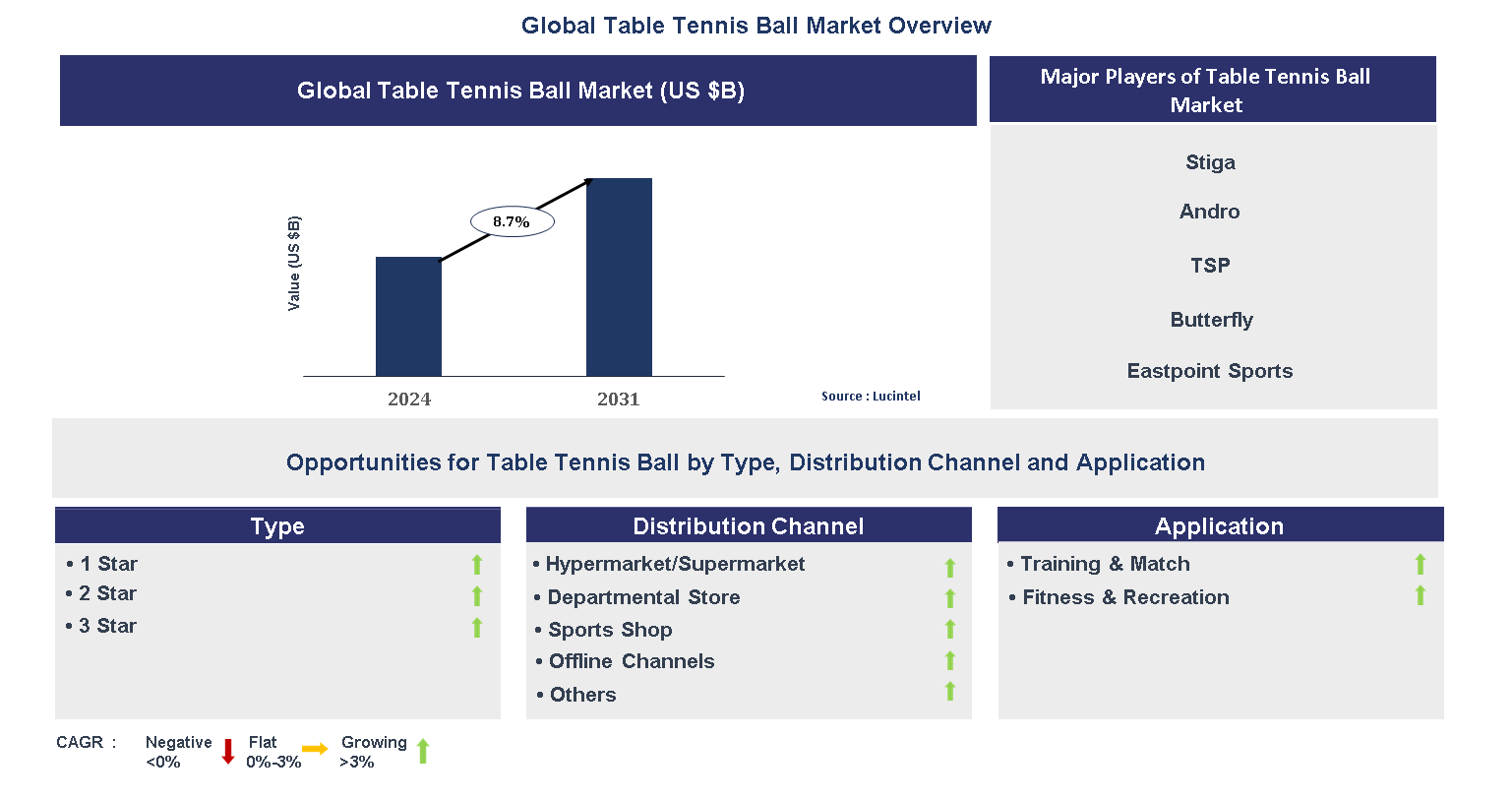
The future of the global table tennis ball market looks promising with opportunities in the hypermarket/supermarket, departmental store, sports shop, and offline channel markets. The global table tennis ball market is expected to grow with a CAGR of 8.7% from 2025 to 2031. The major drivers for this market are the increasing popularity of table tennis, the rising demand for high-quality equipment, and the growing participation in competitive sports events.• Lucintel forecasts that, within the type category, 3 star is expected to witness the highest growth over the forecast period.
• Within the distribution channel category, sports shop is expected to witness the highest growth.
• In terms of region, APAC is expected to witness the highest growth over the forecast period. Gain valuable insights for your business decisions with our comprehensive 150+ page report. Sample figures with some insights are shown below.
Emerging Trends in the Table Tennis Ball Market
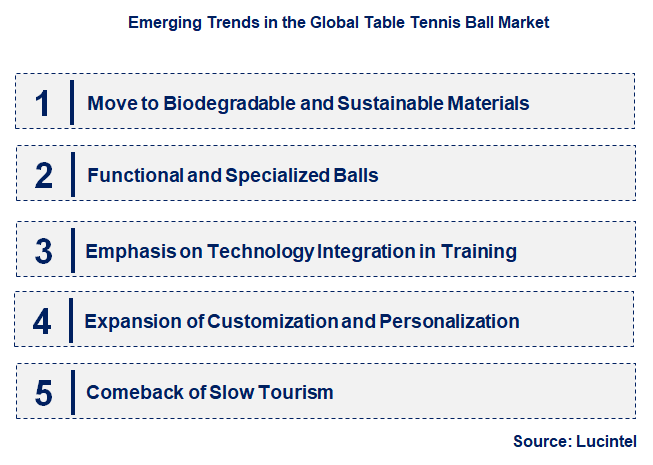
The market for table tennis ball is being transformed by some new trends that represent a growing appreciation for aesthetics, sustainability, and contemporary values of consumers. The era of simple, mass-market products is gone. Consumers are now looking for specialized, science-based solutions that are also in line with larger issues of environmental footprint and self-expression. These tendencies are affecting everything from product design to advertising, making it a more specialist and consumer-focused industry that is concerned with performance as well as environmental concerns.• Move to Biodegradable and Sustainable Materials: One of the major tendencies is the increasing need for balls that are produced from environmentally friendly and biodegradable material, away from conventional celluloid. This is fueled by greater consumer concern over environmental issues and a fear over the long-term effects of plastic waste. The effect is a change in the marketplace in which brands are promoting sustainability credentials as a prime selling point. This is developing a new category of ecologically aware consumers and is forcing the entire industry to develop more responsible manufacturing methods without losing ball performance.
• Functional and Specialized Balls: One of the principal trends is the industry shift from general products towards specialized balls that benefit in more than one way. People are increasingly looking for balls that are both long-lasting and benefit from additional features such as increased grip, spin, or anti-ageing. This is driven by advances in digital printing and manufacturing technology. This trend is giving rise to a new niche of highly customized home decor. It enables brands to focus on specific consumer needs and provide better, problem-solving solutions for numerous interior design problems.
• Emphasis on Technology Integration in Training: An interesting trend is the increasing popularity of smart balls with technology integration. They feature sensors to offer real-time feedback on critical performance indicators like spin rate, speed, and trajectory. The effect is a marketplace where technology and functionality are becoming major differentiators. The trend appeals to technologically advanced players and coaches seeking products that help them analyze and enhance their game. It is also opening up new avenues for interactive training and online competitions.
• Expansion of Customization and Personalization: A trend that is fueled by the growth in e-commerce is the application of direct-to-consumer (D2C) models. Brands are now relying more and more on social media and the internet to promote their products and to engage directly with consumers. This enables them to go over conventional retail channels and to manage their brand message. The result is a more accessible and competitive marketplace.
• Comeback of Slow Tourism: One of the trends fueled by a need for authenticity is the comeback of classic and handmade designs. People are increasingly appreciating the art of hand-knotted and hand-woven rugs and their cultural value. This trend is generating a new category that appreciates both art and cultural value. The effect is a marketplace where brands are concentrating on providing a smooth and enjoyable user experience. This serves to minimize product wastage and keeps the rugs fresh and functional for an extended amount of time. These new trends are simply revolutionizing the market for table tennis balls by consumer zing, specializing, and making it ethically aware. The emphasis on sustainability and the multi-functional aspect is increasing the benchmark for product effectiveness and worth. Concurrently, the move to a more multi-use and direct-consumer model is positioning the industry in line with the principles of contemporary consumers. Ultimately, these trends are taking the market toward a future in which wipes for personal care are a more considerate, holistic, and accountable component of a personal care regimen.
Recent Development in the Table Tennis Ball Market
The market for table tennis ball is presently affected by a series of fundamental recent events, which are shaping its growth and competitive dynamics. These are not discrete incidents but are interrelated, marking a general change in consumerism and technology. The market is becoming more evolved, catalyzed by scientific development, emphasis on performance and safety, and innovative means of accessing consumers.• Plastic Poly Balls Introduction: One major innovation is the universal use of plastic poly balls in place of the conventional celluloid balls. The introduction was forced by the International Table Tennis Federation (ITTF) due to concerns over safety and the environment. The effect is a more diverse market that serves more environmentally aware consumers, thus boosting customer satisfaction and loyalty. It also enables brands to be seen as leaders in the sustainability arena.
• Expanded Market for Multi-functional Products: One of the big trends is the widespread use of multi-functional personal care wipes. Fueled by consumer demand for convenience and effectiveness, they are created to do more than simply clean. They may have moisturizers, makeup removers, or even antibacterial ingredients. The effect is a wide growth of the markets "premium" segment. This evolution is compelling legacy brands to reimagine their offerings in order to stay in the game and is creating a new market for high-value, multi-functional products.
• Direct-to-Consumer and E-commerce Revolution: The move towards e-retail and direct-to-consumer (D2C) models is a noteworthy trend. Brands are now using e-commerce platforms and own websites to directly connect with customers without the intermediation of traditional retail. The effect is a very competitive environment with more choices for the consumer. This trend also enables companies to manage their brand message, interact with the customer directly, and receive rich feedback to drive future product development.
• Expansion of the Mens Grooming Segment: One of the newer trends is the increased popularity of wipes in the mens grooming category. This is fueled by a heightened level of awareness among men regarding individual cleanliness and a penchant for easily accessible, on-the-move products. The effect is enormous growth in market reach and a new customer base. This also enables brands to get first-time buyers who seek a cheaper point of entry into the personal care market.
• Formulation and Ingredient Transparency Innovations: The industry is experiencing a significant trend within formulation and ingredient transparency. Companies are launching products that provide transparent, simple-to-read ingredient panels and increased focus on natural and organic ingredients. This trend is in direct reaction to consumer demand for safety and trust. The effect is a more convenient and low-risk experience. It also gives a significant consumer selling point for consumers who have issues with the chemicals found in personal care products. These recent trends are collectively transforming the table tennis ball market towards a more specialized, ethical, and consumer-oriented model. The emphasis on sustainability and multifunctional traits is increasing the effectiveness and value of products. At the same time, e-commerce and the emergence of niche segments are updating the markets distribution and reach standards, paving the way for the sectors sustained growth and applicability to a new generation of consumers.
Strategic Growth Opportunities in the Table Tennis Ball Market
The table tennis ball industry offers some strategic opportunities for growth in its major applications. With changing consumer taste and an increased emphasis on health and well-being, these opportunities can be used by companies to innovate and gain new market share. These opportunities are not limited to conventional product formulations but also involve innovation in marketing, distribution, and product specialization. Understanding and leveraging these growth opportunities will be the key for the companies to achieve sustainable success in this emerging market.• Baby and Infant Care Segment: A high growth opportunity lies in the baby and infant care product category. With increasing parental awareness of skin sensitivities and the environment, there is a growing need for high-quality, hypoallergenic, and biodegradable baby wipes. Businesses have the opportunity to take advantage of this by creating specialized, certified, and mild products for babies use. This enables brands to be premium-priced, gain a reputation for quality, and win the loyalty of a demographic that values the health and wellbeing of its children.
• Facial and Skincare Segment Opportunity: The facial and skincare segment is an opportunity of great magnitude. With increasingly consumers embracing multi-step skincare regimens, there is increased demand for expert wipes capable of cleansing, toning, and moisturizing. Brands can stand out by concentrating on products that suit specific skin kinds and complaints, e.g., sensitive or acne-prone skin. This strategy not only addresses a surging market segment of health-oriented consumers but also creates a positive brand image and encourages customer loyalty in the long term by associating with their values.
• E-commerce and Direct-to-Consumer Channel Opportunity: Growth in e-commerce presents a huge growth opportunity. With a solid online presence and an associated use of direct-to-consumer (D2C) models, brands can eliminate traditional retail hurdles and access a broader consumer base. This approach enables businesses to own their brand story, connect with customers in real-time via social media and content marketing, and provide individually tailored product recommendations. It also enables a data-based strategy, offering rich insights into consumer preference and behavior to inform future product innovation.
• Travel and On-the-Go Market: One significant growth opportunity is to create products that are especially promoted for travel and on-the-go consumption. As individuals return to commuting and traveling, there is increased need for convenient, small, and multi-use wipes that are safe for use on hands, face, and surfaces. Businesses can develop formulations and marketing initiatives specifically for the distinct requirements of consumers looking for a hassle-free and effective solution. This approach caters to an under-served market and opens up a new path of development.
• Eco-Friendly and Sustainable Industry: The industry offers an opportunity for growth in sustainability. Businesses can create products that not only are biodegradable but also have sustainable production processes and environment-friendly packaging. It can include forming a subscription service for plant-based wipes or associating with environmental associations to encourage proper disposal. This approach gives a differentiated selling proposition and creates a firm connection with the consumer. It takes the market from being purely transactional to something more value-oriented and purpose-focused. These growth opportunities are set to propel the table tennis ball market. By targeting niche markets and going direct-to-consumer, businesses will be able to reach more people and establish new sources of revenue. Specialized and sustainable product development further meets the values of contemporary consumers, while the availability of travel-oriented models points towards a future where the market is not just bigger but also more innovative and customized to the specific requirements of each user.
Table Tennis Ball Market Driver and Challenges
The market for table tennis ball is shaped by a dynamic mix of the largest drivers and challenges that are directing its path. The major drivers are mainly focused on evolving consumer lifestyles, an increased emphasis on hygiene, and a growing demand for green products. Nonetheless, the market also encounters major obstacles, which include environmental factors, intense rivalry, and a lack of specified regulatory norms. Recognizing these considerations is vital for any organization or business intent on thriving in this changing market. The factors responsible for driving the table tennis ball market include: 1. Growing Hygiene and Cleanliness Awareness: One of the main drivers is growing consumer awareness of hygiene and cleanliness. This has created more demand for easy and effective cleaning solutions. This driver is driven by the universal availability of information via the internet and social media, which is revolutionizing the way consumers think and making wipes a necessity of a healthy lifestyle. 2. Urbanization and Changing Lifestyles: One of the biggest drivers is the international trend towards urbanization and hectic lifestyles. With a larger population in urban centers and less time for conventional cleansing procedures, there is a snowball effect for easy and go-anywhere personal care products. Wipes are perceived as a convenient and take-anywhere substitute for soap and water, which is fueling their application in an array of uses. 3. Consumer Spending and Increasing Disposable Incomes: The industry is fueled by growing disposable incomes, especially among emerging markets. With the improvement in peoples financial status, they are more interested in spending on personal care and hygiene products. This has been helping companies spread their presence across new markets and develop high-value products that appeal to a wealthier class of consumers, hence propelling the growth of the market as well as profitability. 4. Technological Development in Formulation and Production: The market for table tennis balls is spurred by ongoing technological development. Advances in new materials, including plant fibers and biodegradable substrates, have enhanced the effectiveness and sustainability of wipes. Such technologies have not only enhanced the consumer experience but also sought to alleviate age-old issues with disposal and sustainability. 5. Role of Digital Marketing and E-commerce: Another driver is the rise of e-commerce platforms. Online shopping has exposed personal care wipe products to a global market. This driver has reduced the entry barriers for new brands and has increased consumer choices. Ease of convenience in shopping online and the facility to compare products and know reviews are significant drivers of purchasing behavior. Challenges in the table tennis ball market are: 1. Environmental Issues and Waste Disposal: One of the principal challenges is the increasing issue of the environmental effect of non-biodegradable wipes. Most conventional products have plastic fibers that are not biodegradable in landfills or sewage systems. This can contribute to pollution and clog up infrastructure. This challenge is pushing brands to spend more on more sustainable materials to meet consumer and regulatory pressure. 2. High Competition and Market Saturation: The market is extremely competitive and, in certain markets, its saturated with numerous brands from multinational companies to regional players. This high level of competition complicates entry for newcomers and sustains for dominant brands. The challenge necessitates a lot of investment in marketing, product development, and brand development to differentiate oneself. 3. Lack of Clear Regulatory Standards: The industry is confronted with challenges of a lack of clear regulatory standards, especially in terms of the definition "flushable." This risks confusing consumers and undermining the industry’s reputation. This issue requires the creation of precise, industry-standard definitions and consumer campaigns promoting education to establish trust and make consumers aware of how products are used and disposed. The market for table tennis balls is driven by powerful drivers such as increasing incomes, emphasis on hygiene, and technological advancements. These drivers are building a conducive atmosphere for development and expansion. Still, the future of the market also hangs on how it faces up to some of the main challenges. The sustainability of the products, high competition, and a lack of regulatory simplicity are major barriers that need to be addressed.List of Table Tennis Ball Companies
Companies in the market compete on the basis of product quality offered. Major players in this market focus on expanding their manufacturing facilities, R&D investments, infrastructural development, and leverage integration opportunities across the value chain. With these strategies table tennis ball companies cater increasing demand, ensure competitive effectiveness, develop innovative products & technologies, reduce production costs, and expand their customer base. Some of the table tennis ball companies profiled in this report include-• Stiga
• Andro
• TSP
• Butterfly
• Eastpoint Sports
• Xushaofa
• DHS
• Joola
• Doublefish
• Yinhe
Table Tennis Ball Market by Segment
The study includes a forecast for the global table tennis ball market by type, distribution channel, application, and region.Table Tennis Ball Market by Type [Value from 2019 to 2031]:
• 1 Star
• 2 Star
• 3 Star
Table Tennis Ball Market by Distribution Channel [Value from 2019 to 2031]:
• Hypermarket/Supermarket
• Departmental Store
• Sports Shop
• Offline Channels
• Others
Table Tennis Ball Market by Application [Value from 2019 to 2031]:
• Training & Match
• Fitness & Recreation
Table Tennis Ball Market by Region [Value from 2019 to 2031]:
• North America
• Europe
• Asia Pacific
• The Rest of the World
Country Wise Outlook for the Table Tennis Ball Market
The market for table tennis ball is currently undergoing evolution, spurred by a combination of technological innovation, changing consumer tastes, and the increasing popularity of the sport worldwide. This was once a plain, unadorned product, but it has now evolved into an advanced piece of equipment, whose uses have gone beyond professional competition to domestic leisure. This change in the market is also influenced by emerging materials, sustainability emphasis, and the added convenience of web shopping.• United States: In the US, the market for table tennis balls is seeing a huge boost driven by the sports popularity as a recreational activity. Recent trends include rising demand for low-cost, long-lasting balls for domestic consumption and clubs play. The market is also transforming towards online distribution channels, which provide a greater number of products and competitive prices, making equipment more popular among a mass consumer base.
• China: China is still the hub of the worldwide table tennis ball market with an enormous player population from professional players to casual players. Recent trends involve emphasis on high-performance, ITTF-approved balls for competitive use, along with a high domestic manufacturing base. Global brands such as DHS, Double Fish, and Mushaira are well-known and command a high market share. Strong government support and grassroots programs of the country continue to drive market growth.
• Germany: The German market for table tennis balls is one that strongly focuses on product quality, accuracy, and performance. New trends involve an increased need for high-quality, premium balls that either match or surpass international standards. German customers, as with the majority of Europeans, are high-level players who appreciate uniform bounce, spin, and longevity. The market also clearly favors brands that are longstanding and known for their innovation and dependability in the professional table tennis sector.
• India: The Indian table tennis ball market is in a stage of fast growth, fueled by an emerging middle class and increasing interest in the sport as a competitive and recreational pursuit. One major development is the entry of local brands providing more affordable products to make table tennis more accessible across a broader population. Concurrently, international brands are spreading out, frequently through online platforms, to fulfill the increasing demand for premium, high-quality balls. The market is also experiencing a movement towards a more discerning consumer population that is prepared to make an investment in products that will provide some kind of specific benefit over and above mere functionality.
• Japan: The Japanese market for table tennis balls is highly advanced and fueled by a culture of fussiness and a desire for high-quality, soft products. Some recent trends involve emphasizing minimalist designs and lightweight materials that provide the greatest convenience without compromising efficacy. Products that contain gentle, natural fragrances and sophisticated, minimalist packaging are also in demand. Brands are doing everything they can to develop products that not only work but also offer a good sensory experience.

Features of the Global Table Tennis Ball Market
Market Size Estimates: Table tennis ball market size estimation in terms of value ($B). Trend and Forecast Analysis: Market trends (2019 to 2024) and forecast (2025 to 2031) by various segments and regions. Segmentation Analysis: Table tennis ball market size by type, distribution channel, application, and region in terms of value ($B). Regional Analysis: Table tennis ball market breakdown by North America, Europe, Asia Pacific, and Rest of the World. Growth Opportunities: Analysis of growth opportunities in different types, distribution channels, applications, and regions for the table tennis ball market. Strategic Analysis: This includes M&A, new product development, and competitive landscape of the table tennis ball market. Analysis of competitive intensity of the industry based on Porter’s Five Forces model.
FAQ
Q1. What is the growth forecast for table tennis ball market? Answer: The global table tennis ball market is expected to grow with a CAGR of 8.7% from 2025 to 2031. Q2. What are the major drivers influencing the growth of the table tennis ball market? Answer: The major drivers for this market are the increasing popularity of table tennis, the rising demand for high-quality equipment, and the growing participation in competitive sports events. Q3. What are the major segments for table tennis ball market? Answer: The future of the table tennis ball market looks promising with opportunities in the hypermarket/supermarket, departmental store, sports shop, and offline channel markets. Q4. Who are the key table tennis ball market companies? Answer: Some of the key table tennis ball companies are as follows:• Stiga
• Andro
• TSP
• Butterfly
• Eastpoint Sports
• Xushaofa
• DHS
• Joola
• Doublefish
• Yinhe Q5. Which table tennis ball market segment will be the largest in future? Answer: Lucintel forecasts that, within the type category, 3 star is expected to witness the highest growth over the forecast period. Q6. In table tennis ball market, which region is expected to be the largest in next 5 years? Answer: In terms of region, APAC is expected to witness the highest growth over the forecast period. Q7. Do we receive customization in this report? Answer: Yes, Lucintel provides 10% customization without any additional cost.
Table of Contents
List of Figures
List of Tables
Methodology
- In-depth interviews of the major players in this market
- Detailed secondary research from competitors’ financial statements and published data
- Extensive searches of published works, market, and database information pertaining to industry news, company press releases, and customer intentions
- A compilation of the experiences, judgments, and insights of Lucintel’s professionals, who have analyzed and tracked this market over the years.


Buy Now
Choose a license that fits your team. Instant PDF delivery.
Prices exclude taxes. Instant delivery. Custom licensing available on request.
Key Questions
- • What are some of the most promising, high-growth opportunities for the table tennis ball market by type (1 star, 2 star, and 3 star), distribution channel (hypermarket/supermarket, departmental store, sports shop, offline channels, and others), application (training & match and fitness & recreation), and region (North America, Europe, Asia Pacific, and the Rest of the World)?
- • Which segments will grow at a faster pace and why?
- • Which region will grow at a faster pace and why?
- • What are the key factors affecting market dynamics? What are the key challenges and business risks in this market?
- • What are the business risks and competitive threats in this market?
- • What are the emerging trends in this market and the reasons behind them?
- • What are some of the changing demands of customers in the market?
- • What are the new developments in the market? Which companies are leading these developments?
- • Who are the major players in this market? What strategic initiatives are key players pursuing for business growth?
- • What are some of the competing products in this market and how big of a threat do they pose for loss of market share by material or product substitution?
- • What M&A activity has occurred in the last 5 years and what has its impact been on the industry? For any questions related to Table Tennis Ball Market, Table Tennis Ball Market Size, Table Tennis Ball Market Growth, Table Tennis Ball Market Analysis, Table Tennis Ball Market Report, Table Tennis Ball Market Share, Table Tennis Ball Market Trends, Table Tennis Ball Market Forecast, Table Tennis Ball Companies, write Lucintel analyst at email: helpdesk@lucintel.com. We will be glad to get back to you soon.


