
Market Report · July 22, 2026

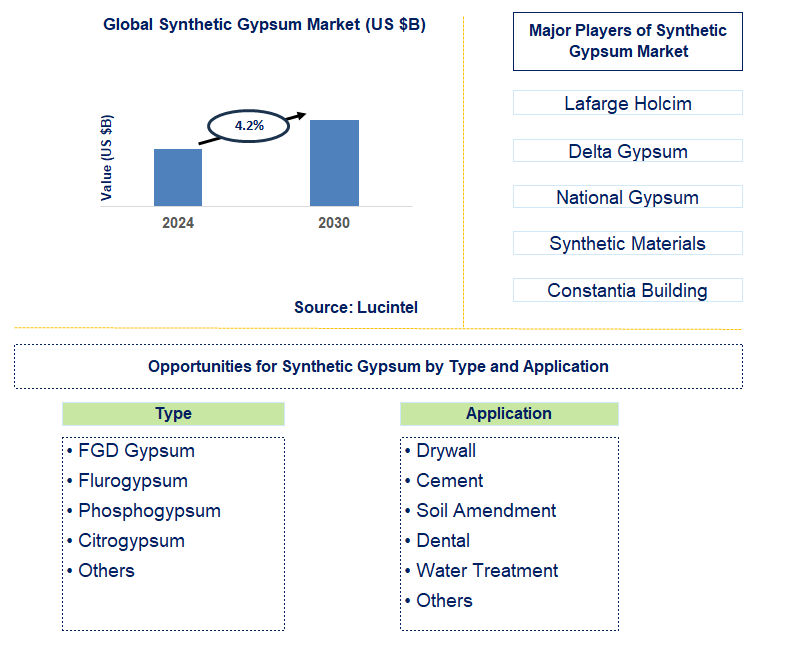
Key data points: The growth forecast = 4.2% annually for the next 6 years. Scroll below to get more insights. This market report covers trends, opportunities, and forecasts in the global synthetic gypsum market to 2030 by type (FGD gypsum, flurogypsum, phosphogypsum, citrogypsum, and others), application (drywall, cement, soil amendment, dental, water treatment, and others), and region (North America, Europe, Asia Pacific, and the Rest of the World)
We'll send your sample report shortly.
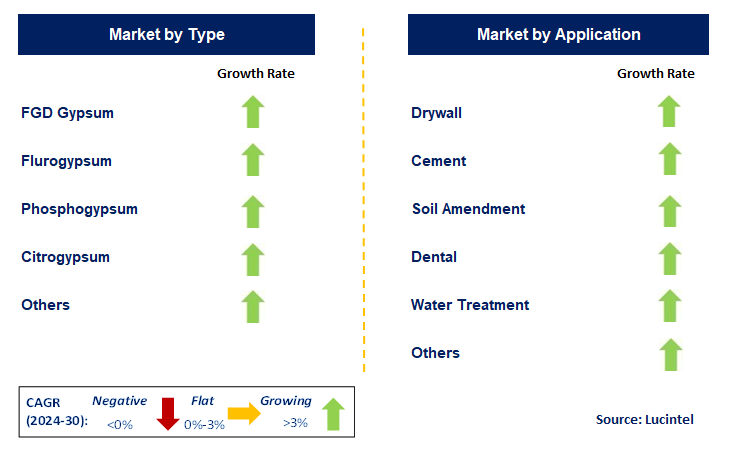
• Lucintel forecasts that, within the type category, phosphogypsum is expected to witness the highest growth over the forecast period due to its increasing application in the agricultural sector for soil amendment.
• Within the application category, drywall will remain the largest segment.
• In terms of regions, APAC is expected to witness the highest growth over the forecast period due to the increasing number of infrastructural activities along with the large population in China and India. Gain valuable insight for your business decisions with our comprehensive 150+ page report.
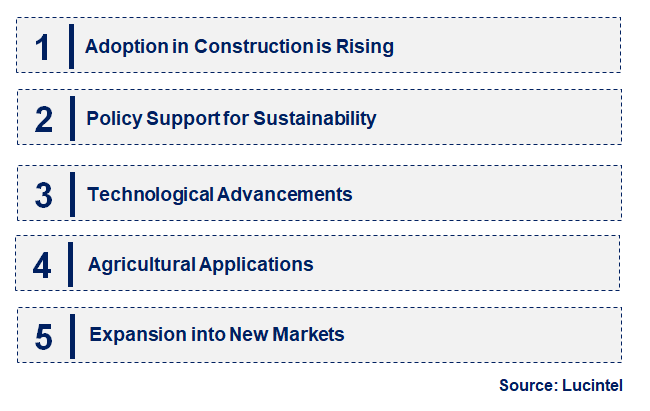
• Adoption in Construction is Rising: Synthetic gypsum is increasingly used in the construction sector due to its environmentally benign properties and low cost. It is used for drywall, plaster, and cement products as demand grows for sustainable building materials. Synthetic gypsum improves material performance while reducing the environmental impact of construction.
• Policy Support for Sustainability: Strict environmental regulations are promoting synthetic gypsum as an environmentally friendly alternative to natural gypsum. Governments reward the recycling of industrial by-products and encourage manufacturers to use synthetic gypsum products. These steps help reduce waste and carbon emissions across economies, driving the demand for synthetic gypsum and accelerating market growth.
• Technological Advancements: Technological advances in the manufacturing of synthetic gypsum are continually improving its quality and efficiency. Improvements in FGD processes and processing technology allow manufacturers to produce higher quality, purer synthetic gypsum. Growing competition between synthetic and natural gypsum opens new potential markets.
• Agricultural Applications: Synthetic gypsum is widely adopted as a soil amendment to enhance soil structure and nutrient availability. It is promoted for its ability to reduce soil compaction and help retain water. This trend is creating demand in the agricultural sector, offering new opportunities for synthetic gypsum manufacturers.
• Expansion into New Markets: The synthetic gypsum market is growing in developing economies, where rapid industrialization and urbanization are creating opportunities for building materials. The construction and agriculture sectors in India and China are increasingly using synthetic gypsum. Producers are expanding their operations in these markets to capture growth opportunities driven by rising demand. The following novel trends are transforming the synthetic gypsum industry for good: focusing on sustainability, promoting innovation, and diversifying applications. Companies that embrace these trends will accelerate their competitiveness and drive the growth of the synthetic gypsum market.
• Improved Production Techniques: Synthetic gypsum is now produced more efficiently due to the latest improvements in FGD processes. New technologies have improved gypsum purity without increasing energy consumption or waste generation. These innovations enhance profitability and support the industry's sustainability efforts.
• Increased Consumption of Green Products: Synthetic gypsum is now a component of eco-friendly building materials, such as low-carbon cement and green drywall. Manufacturers have responded to growing consumer demand for environmentally conscious materials by incorporating synthetic gypsum's sustainable properties into new product innovations.
• Increasing Agricultural Applications: The use of synthetic gypsum to amend soil is growing, with its efficacy in improving crop yields and soil health. New studies recommend it as a means to reduce soil salinity and enhance drainage, further encouraging its adoption in agricultural industries.
• Regulatory Support and Incentives: Governments worldwide are implementing policies and providing incentives for the use of synthetic gypsum. These policies promote the recycling of materials, creating high demand for synthetic gypsum in construction and agriculture.
• Global Market Expansion: The synthetic gypsum market is expanding globally as more investments flow into emerging economies. Companies are setting up production facilities and forming partnerships in the Asia-Pacific region to capitalize on growing demand. This expansion enhances the supply chain and broadens market access for synthetic gypsum products. All these changes are now part of the synthetic gypsum landscape. With evolving technology and regulatory environments, companies are well-positioned to seize new opportunities, drive growth, and thrive in the market.
• Construction materials: Synthetic gypsum is one of the high-growth areas in the construction industry today. This is attributed to the high demand for sustainable building materials like drywall, plaster, and cement products due to their rapidly increasing demand. High-performance construction material innovators or developers can easily take a significant share of this budding market.
• Crop improvements: There is high potential for the growth of synthetic gypsum as a soil amendment in agriculture because it enhances soil health and offers compelling incentives for increased crop yields. Manufacturers can collaborate with agricultural firms to promote the use of synthetic gypsum products and develop solutions specifically for individual crops.
• Waste management solutions: Synthetic gypsum can be marketed as an alternative for the recycling of industrial by-products as regulations surrounding waste management continue to tighten. Companies can devise ways to work with power plants and industrial facilities to collect FGD waste and convert it into useful synthetic gypsum products while reducing landfill waste.
• Green technology development: Another investment area is in green technologies, where synthetic gypsum producers have growth potential. With industries trying to reduce carbon footprints, eco-friendly materials are in high demand. Companies can invest in research and development to create advanced synthetic gypsum products that meet sustainability standards and establish their presence as leaders in green construction.
• Emerging market penetration: Growth potential for synthetic gypsum lies in emerging markets, where demand is rising significantly, mainly in the Asia-Pacific and African regions. Gains in this area are substantial because both regions are rapidly building cities and are heavily industrialized. This drives demand for construction materials and agricultural inputs. Companies can establish production facilities and distribution networks here to capitalize on growth opportunities. These strategic growth opportunities in the synthetic gypsum market demonstrate potential innovation and diversification across applications. By following these strategies, companies can enhance their market presence and respond to emerging demands or industry trends among consumers.
• Lafarge Holcim
• Delta Gypsum
• National Gypsum
• Synthetic Materials
• Constantia Building Products
• American Gypsum
• PABCO Gypsum
• FGD Gypsum
• Flurogypsum
• Phosphogypsum
• Citrogypsum
• Others
• Drywall
• Cement
• Soil Amendment
• Dental
• Water Treatment
• Others
• North America
• Europe
• Asia Pacific
• The Rest of the World
• United States: The synthetic gypsum market in the U.S. is increasing due to improvements in the construction sector and a rise in the use of eco-friendly products. Synthetic gypsum continues to gain favor in wallboard production as governmental environmental regulations increasingly enforce recycling in production processes. Leading companies in this market are investing resources in higher technologies to increase the quality and uniformity of synthetic gypsum. Through cooperation between power plants and construction companies, supply chains are strengthening, and synthetic gypsum products maintain consistent demand across the country.
• China: China is the largest market for synthetic gypsum, mainly due to the large number of coal-fired power plants producing massive amounts of synthetic gypsum as a byproduct of FGD processes. In recent years, synthetic gypsum has been used in cement production. Its improved product strength and sustainability ensure it remains a stable material for concrete and asphalt applications. The use of synthetic gypsum will increase with the government's commitment to reducing pollution and carbon emissions. Investments in R&D to optimize gypsum processing will likely continue to improve quality and reduce costs, enhancing the overall market.
• Germany: Sustainability and innovation are strongly featured in the German market, with synthetic gypsum having a significant impact. Notable improvements include the increased use of chemical gypsum in eco-friendly building materials and construction. German firms continue to apply advanced technologies to manufacture high-quality gypsum with minimal environmental impact. Additionally, the government's open policy regarding regulations, especially those facilitating the recycling of industrial by-products, further integrates synthetic gypsum into the framework of a circular economy. This aligns with the country's bold sustainability goals and positions German companies at the forefront of the synthetic gypsum market.
• India: The synthetic gypsum market in India is growing rapidly due to rapid urbanization and the subsequent growth in construction activities. Recent breakthroughs include the local production of synthetic gypsum, which reduces reliance on imports, mainly from the Middle East. The agricultural sector is also discovering the utility of synthetic gypsum as a soil amendment, improving crop yields and soil health. Government policies supporting sustainable building practices and the reuse of materials are driving increased demand for synthetic gypsum in the country, helping India emerge as one of the top players in the global synthetic gypsum market.
• Japan: Advances in production technologies and a growing focus on environmental sustainability are driving growth in the synthetic gypsum market in Japan. Synthetic gypsum is increasingly used in various construction materials such as drywall and cement. Recent developments in the country include collaborations between energy companies and construction firms to better utilize FGD by-products. Japan's commitment to reducing greenhouse gas emissions in alignment with national sustainability targets is further promoting investments in cleaner technologies for producing synthetic gypsum. These efforts help maintain Japan's competitive advantage in the global synthetic gypsum market.


• Lafarge Holcim
• Delta Gypsum
• National Gypsum
• Synthetic Materials
• Constantia Building Products
• American Gypsum
• PABCO Gypsum Q5. Which synthetic gypsum market segment will be the largest in future? Answer: Lucintel forecasts that phosphogypsum is expected to witness the highest growth over the forecast period due to its increasing application in the agricultural sector for soil amendment. Q6. In synthetic gypsum market, which region is expected to be the largest in next 6 years? Answer: APAC is expected to witness highest growth over the forecast period due to increasing number of infrastructural activities along with the large population in China and India. Q.7 Do we receive customization in this report? Answer: Yes, Lucintel provides 10% customization without any additional cost.


Choose a license that fits your team. Instant PDF delivery.
Prices exclude taxes. Instant delivery. Custom licensing available on request.
Market Report · July 22, 2026
Market Report · July 17, 2026
Market Report · July 17, 2026
Trusted partner for strategic intelligence and business growth


Receive a complimentary market analysis tailored to your industry. Our analysts will identify key growth opportunities and competitive dynamics specific to your business.

Market size, growth rate, and key trend analysis for your specific sector.

Top competitor positioning and market share analysis.

Strategic recommendations backed by data-driven insights.
Get curated market intelligence and competitive moves straight to your inbox.
By subscribing, you agree to receive our monthly insights. Unsubscribe anytime.
Receive a complimentary market analysis tailored to your industry. Our analysts will identify key growth opportunities and competitive dynamics specific to your business.
Market size, growth rate, and key trend analysis for your specific sector.
Top competitor positioning and market share analysis.
Strategic recommendations backed by data-driven insights.
Get curated market intelligence, emerging trends, and competitive moves straight to your inbox each month.
By subscribing, you agree to receive our monthly insights. Unsubscribe anytime.
We'll send your sample report shortly.