
Water Storage Tank Market Trends and Forecast
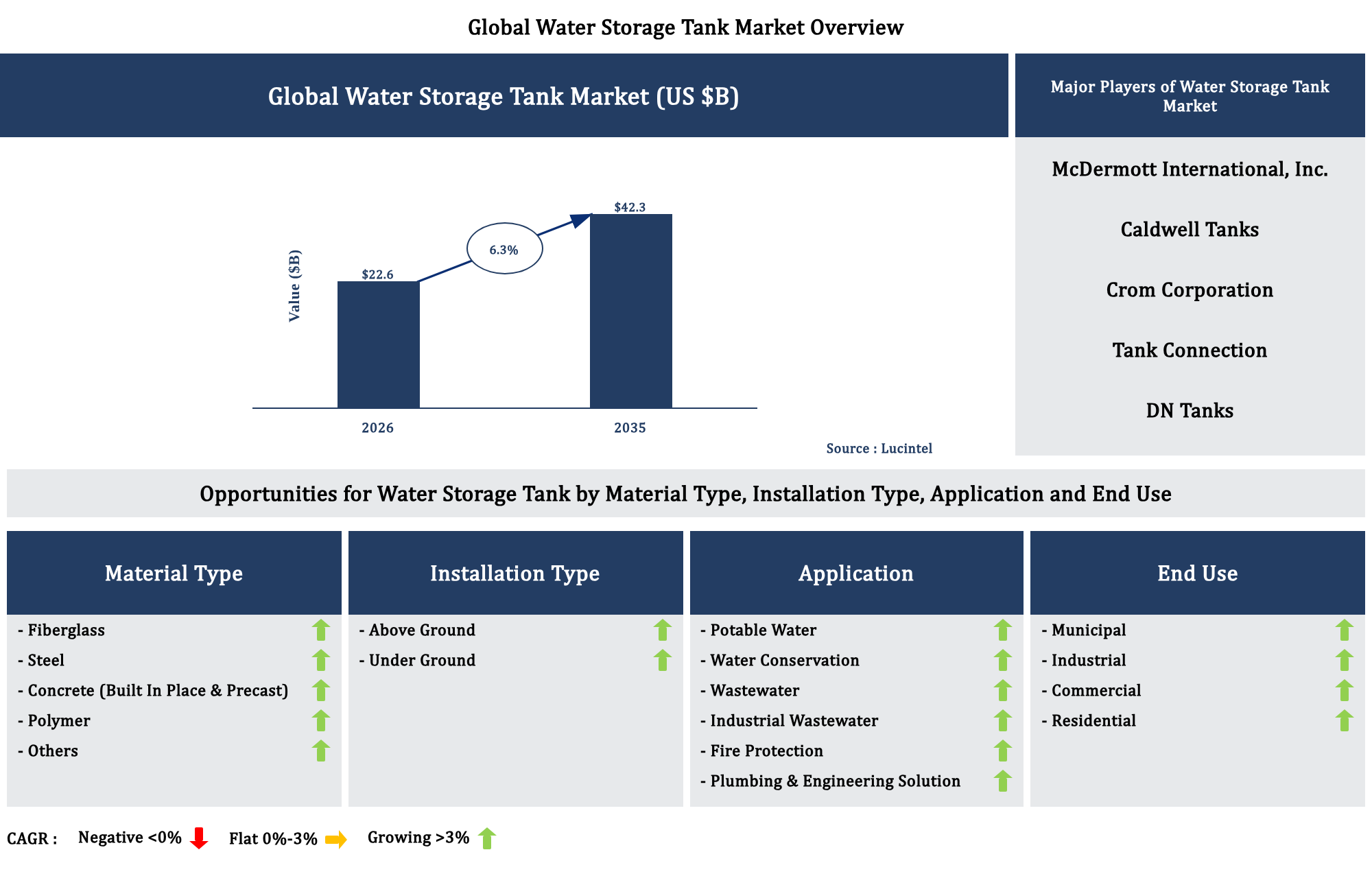
The future of the global water storage tank market looks promising with opportunities in the municipal, industrial, commercial, and residential markets. The global water storage tank market is expected to reach an estimated $42,338 million by 2035 with a CAGR of 6.3% from 2026 to 2035. The major drivers for this market are the growing use of plastic & durable materials boosting water tank adoption, the increasing frequency of water shortages driving storage solutions, and the rising demand for clean & safe drinking water storage.
• Lucintel forecasts that, within the material type category, polymer is expected to witness the highest growth over the forecast period.
• Within the end use category, residential is expected to witness the highest growth.
• In terms of region, APAC is expected to witness the highest growth over the forecast period.
Gain valuable insights for your business decisions with our comprehensive 150+ page report. Sample figures with some insights are shown below.
Emerging Trends in the Water Storage Tank Market
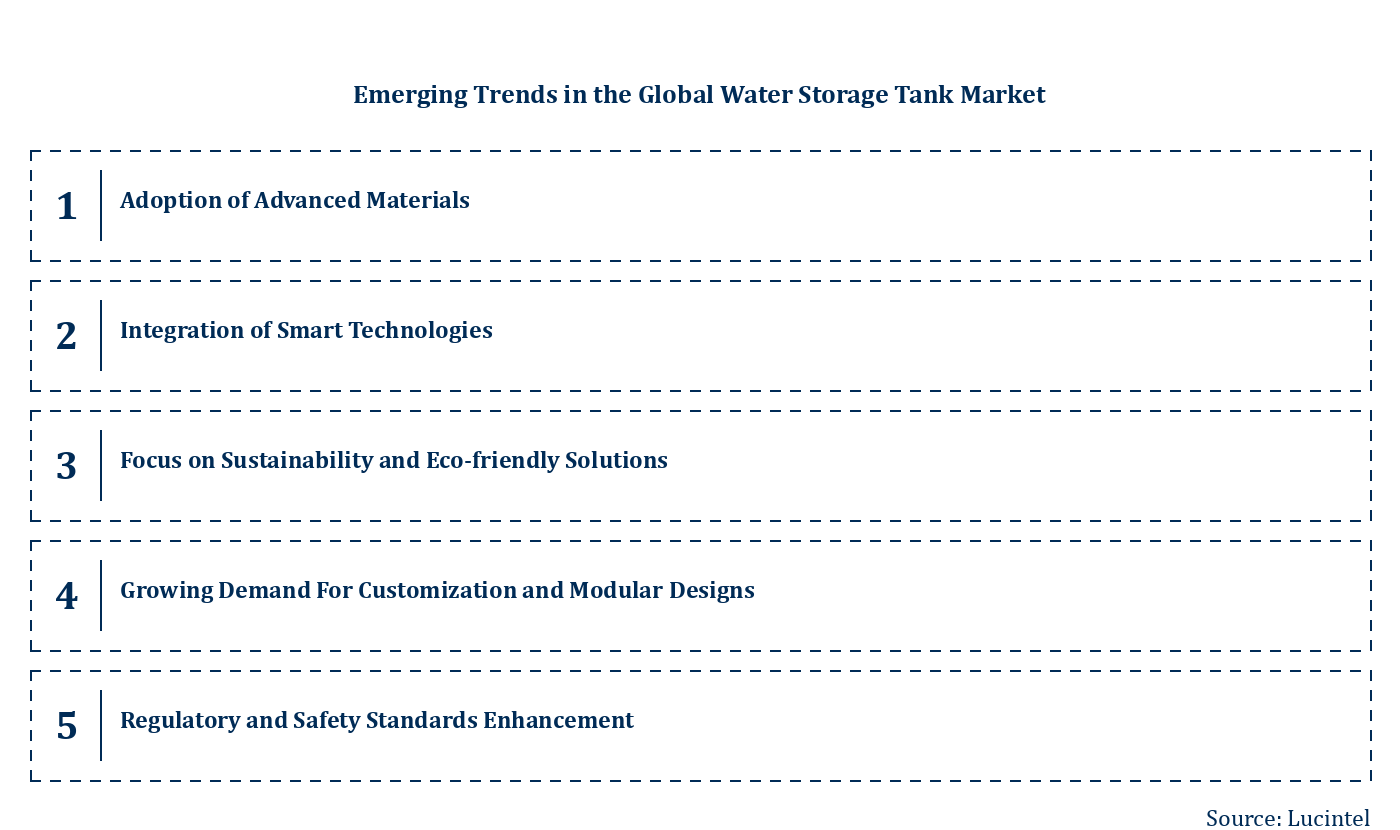
The water storage tank market is experiencing significant transformation driven by technological advancements, environmental concerns, and changing consumer preferences. As urbanization accelerates and water management becomes increasingly critical, innovative solutions are emerging to address efficiency, sustainability, and safety. Market players are adopting new materials, smart technologies, and eco-friendly practices to meet rising demand and regulatory standards. These developments are not only expanding the market‘s scope but also redefining industry standards, creating new opportunities and challenges. Understanding these key trends is essential for stakeholders aiming to stay competitive and leverage emerging innovations effectively.
• Adoption of Advanced Materials: Use of durable, lightweight, and corrosion-resistant materials such as polyethylene, fiberglass, and composite plastics. These materials enhance tank longevity, reduce maintenance costs, and improve safety. The shift towards eco-friendly and recyclable materials also aligns with sustainability goals, attracting environmentally conscious consumers. This trend is driving innovation in tank design and manufacturing, leading to more efficient and resilient water storage solutions that cater to diverse applications, from residential to industrial sectors.
• Integration of Smart Technologies: Implementation of IoT-enabled sensors and automation systems for real-time monitoring of water levels, pressure, and quality. Smart tanks facilitate predictive maintenance, reduce water wastage, and improve operational efficiency. These technologies enable users to remotely manage and optimize water storage, ensuring safety and compliance with health standards. The integration of smart systems is transforming traditional water tanks into intelligent infrastructure components, fostering a more connected and efficient water management ecosystem.
• Focus on Sustainability and Eco-Friendly Solutions: Emphasis on reducing environmental impact through the use of recyclable materials, energy-efficient manufacturing processes, and rainwater harvesting systems. Sustainable water tanks help conserve resources, lower carbon footprints, and meet regulatory standards for environmental protection. This trend is driven by increasing awareness of water scarcity issues and government incentives for green infrastructure, encouraging market players to develop innovative, eco-conscious products that appeal to eco-aware consumers and organizations.
• Growing Demand for Customization and Modular Designs: Increasing preference for tailored water storage solutions that fit specific space constraints and capacity requirements. Modular tanks offer flexibility, ease of installation, and scalability, making them suitable for diverse settings such as urban rooftops, industrial sites, and rural areas. Customization options include various sizes, shapes, and features like insulation or integrated filtration. This trend enhances customer satisfaction and opens new market segments by providing versatile solutions that adapt to unique needs.
• Regulatory and Safety Standards Enhancement: Stricter government regulations and industry standards for water quality, tank safety, and environmental impact. Compliance with these standards ensures product reliability and consumer safety, prompting manufacturers to innovate and improve quality control processes. Enhanced standards also drive market growth by fostering trust and encouraging investment in high-quality, certified water storage solutions. This trend underscores the importance of innovation in meeting evolving legal requirements and safeguarding public health.
These trends are reshaping the water storage tank market by fostering innovation, promoting sustainability, and enhancing safety and efficiency. They are enabling market players to develop smarter, more durable, and environmentally friendly solutions, thereby expanding market opportunities and setting new industry benchmarks. As these developments continue, the market is poised for sustained growth driven by technological progress and increasing demand for reliable water management infrastructure.
Recent Developments in the Water Storage Tank Market
The water storage tank market has experienced significant recent developments driven by increasing urbanization, water scarcity concerns, and technological advancements. These changes are shaping the industry landscape, creating new opportunities for manufacturers and stakeholders. Innovations in materials, design, and sustainability practices are enhancing product efficiency and environmental compatibility. Market players are also focusing on expanding their geographic reach and adopting smart technology integrations. These developments collectively influence market growth, competitiveness, and consumer preferences, setting the stage for a dynamic future in water storage solutions.
• Growing Demand for Sustainable and Eco-Friendly Tanks: The market is witnessing a shift towards environmentally sustainable water storage solutions, driven by regulatory pressures and consumer awareness. Manufacturers are adopting recyclable materials and energy-efficient production processes. This trend enhances brand reputation and aligns with global sustainability goals. The demand for eco-friendly tanks is expanding across residential, commercial, and industrial sectors, fostering innovation and competitive differentiation. As environmental concerns intensify, this development is expected to significantly influence market growth and product development strategies.
• Advancements in Material Technology for Durability and Safety: Innovations in materials such as high-density polyethylene (HDPE), fiberglass, and composite materials are improving tank durability, chemical resistance, and safety standards. These advancements reduce maintenance costs and extend product lifespan, appealing to a broader customer base. Enhanced safety features, including anti-corrosion and UV-resistant properties, are also gaining importance. This development ensures reliable water storage solutions, minimizes environmental impact, and boosts consumer confidence, thereby driving market expansion and technological progress.
• Integration of Smart Technology for Monitoring and Control: The incorporation of IoT and sensor-based systems into water tanks allows real-time monitoring of water levels, quality, and system performance. This technological integration improves operational efficiency, reduces wastage, and facilitates predictive maintenance. Smart tanks are increasingly popular in smart cities, industrial facilities, and large-scale residential complexes. This development enhances user convenience, optimizes resource management, and opens new revenue streams for manufacturers, significantly impacting the market’s evolution towards intelligent water storage solutions.
• Expansion into Emerging Markets with Infrastructure Development: Rapid urbanization and infrastructure projects in developing regions are creating substantial growth opportunities. Companies are expanding their presence in Asia-Pacific, Africa, and Latin America, where water scarcity and demand for reliable storage are rising. Strategic partnerships and localized manufacturing are facilitating market penetration. This expansion supports economic growth, improves water security, and diversifies market sources. The development of emerging markets is expected to be a key driver of global market growth, fostering innovation tailored to regional needs.
• Focus on Modular and Customizable Tank Solutions: The demand for flexible, space-efficient, and customizable water storage options is increasing across various sectors. Modular tanks offer scalability, ease of installation, and adaptability to different environments. Customization options cater to specific client requirements, enhancing customer satisfaction. This trend supports efficient land use and simplifies maintenance. The rise of modular and tailored solutions is influencing product design, encouraging innovation, and expanding market reach, especially in urban and industrial applications, thereby shaping future industry directions.
The overall impact of these developments is a more sustainable, technologically advanced, and geographically expansive water storage tank market. These opportunities are driving innovation, improving product performance, and meeting diverse consumer needs. As a result, the market is poised for robust growth, increased competitiveness, and enhanced environmental responsibility, shaping a resilient and forward-looking industry landscape.
Strategic Growth Opportunities in the Water Storage Tank Market
The water storage tank market is experiencing significant growth driven by increasing urbanization, industrial expansion, and the need for reliable water management solutions. Rising demand for potable water, government regulations on water conservation, and technological advancements in tank materials are further fueling market expansion. Key applications across residential, commercial, industrial, agricultural, and firefighting sectors present substantial opportunities for manufacturers and stakeholders to innovate and capture market share in this evolving landscape.
• Expansion of Residential Water Storage Solutions to Meet Urban Water Demand: As urban populations grow, the need for efficient water storage in residential settings increases. This drives demand for durable, space-efficient tanks that ensure reliable water supply, especially in areas with inconsistent municipal water services. Innovations in materials and design are making tanks more affordable and easier to install, creating opportunities for manufacturers to cater to new housing developments and retrofitting projects.
• Adoption of Advanced Materials for Corrosion-Eesistant Water Tanks: The shift towards corrosion-resistant materials like polyethylene, fiberglass, and composite plastics enhances tank longevity and reduces maintenance costs. This opportunity is driven by the need for tanks that withstand harsh environmental conditions and chemical exposure, especially in industrial and agricultural applications. Manufacturers investing in R&D to develop lightweight, eco-friendly, and durable materials can gain a competitive edge in the market.
• Growing Demand for Large-Scale Industrial Water Storage Solutions: Industries such as chemicals, power generation, and manufacturing require large-capacity tanks for process water, cooling, and waste management. The increasing industrialization in emerging economies presents a significant growth avenue. Customization, compliance with safety standards, and integration with automation systems are key factors that can help suppliers meet the complex needs of industrial clients.
• Rising Ise of Water Tanks in Agricultural Irrigation and Water Conservation: Agriculture accounts for a substantial portion of water consumption, prompting the adoption of storage tanks for irrigation and rainwater harvesting. The focus on sustainable farming practices and water conservation initiatives creates opportunities for innovative, cost-effective tank solutions. These include modular tanks and systems that facilitate efficient water use, helping farmers reduce dependency on unreliable water sources.
• Increasing Deployment of Water Tanks for Firefighting and Emergency Preparedness: Governments and organizations are investing in fire safety infrastructure, including large-capacity tanks for firefighting. The rising frequency of wildfires and urban fires necessitates reliable water storage solutions in vulnerable areas. Manufacturers can capitalize on this by offering tanks that are easy to install, maintain, and comply with safety standards, thereby supporting emergency response efforts and infrastructure resilience.
These growth opportunities are poised to significantly influence the water storage tank market by fostering innovation, expanding application scopes, and addressing evolving regulatory and environmental demands. Stakeholders who strategically invest in these areas can enhance their market position and contribute to sustainable water management solutions worldwide.
Water Storage Tank Market Driver and Challenges
The water storage tank market is influenced by a variety of technological, economic, and regulatory factors that shape its growth and development. Advances in materials and manufacturing processes have improved tank durability and efficiency, while economic trends such as urbanization and infrastructure development drive demand. Regulatory standards concerning safety, environmental impact, and water conservation also play a crucial role in shaping market dynamics. Additionally, technological innovations like smart water management systems are transforming the industry. However, the market faces challenges related to environmental concerns, fluctuating raw material costs, and regulatory compliance complexities. Understanding these drivers and challenges is essential for stakeholders to navigate the evolving landscape effectively.
The factors responsible for driving the water storage tank market include:
• Increasing Urbanization and Infrastructure Development: Urban growth worldwide necessitates extensive water storage solutions to meet rising demand. Governments and private sectors are investing heavily in infrastructure projects, including water supply systems, which significantly boost the demand for water storage tanks. This trend is particularly prominent in developing countries where urban expansion is rapid. The need for reliable water storage to ensure uninterrupted supply and support sanitation infrastructure further propels market growth. As urban populations continue to grow, the demand for durable, efficient, and large-capacity water tanks is expected to rise, creating substantial opportunities for manufacturers and suppliers.
• Technological Innovations in Materials and Design: The adoption of advanced materials such as high-density polyethylene (HDPE), fiberglass, and composite materials has revolutionized water tank manufacturing. These materials offer benefits like corrosion resistance, lightweight construction, and longer lifespan, making tanks more reliable and easier to install. Innovations in design, including modular and smart tanks with integrated monitoring systems, enhance operational efficiency and maintenance. These technological advancements not only improve product performance but also expand application possibilities across residential, commercial, and industrial sectors. As technology continues to evolve, the market is poised for increased adoption of innovative, cost-effective, and sustainable water storage solutions.
• Growing Focus on Water Conservation and Sustainability: Increasing awareness about water scarcity and the importance of sustainable water management practices is driving demand for efficient storage solutions. Governments and organizations are implementing policies to promote water conservation, encouraging the use of tanks that minimize water wastage and support rainwater harvesting. Eco-friendly materials and energy-efficient designs are gaining popularity, aligning with global sustainability goals. This focus on environmental responsibility influences product development and market strategies, fostering growth in segments that prioritize eco-conscious solutions. As water conservation becomes a global priority, the market for sustainable water storage tanks is expected to expand significantly.
• Regulatory Standards and Government Initiatives: Stringent regulations concerning water safety, quality, and environmental impact are shaping the market landscape. Governments worldwide are establishing standards for tank manufacturing, installation, and maintenance to ensure safety and compliance. Initiatives promoting clean water access and infrastructure upgrades further stimulate market growth. Compliance with these regulations often requires advanced, certified products, encouraging manufacturers to innovate and adhere to high standards. Additionally, subsidies and incentives for water conservation projects support market expansion. Navigating regulatory frameworks is crucial for market players aiming to capitalize on emerging opportunities and ensure long-term sustainability.
• Rising Adoption of Smart Water Management Systems: The integration of IoT and automation technologies into water storage solutions is transforming the industry. Smart tanks equipped with sensors and remote monitoring capabilities enable real-time data collection on water levels, quality, and usage patterns. This technological integration improves operational efficiency, reduces wastage, and facilitates predictive maintenance. The adoption of smart systems is driven by the need for efficient water management in urban and industrial settings. As digital transformation accelerates, the market is witnessing increased demand for intelligent water storage solutions that support sustainable and efficient water resource management.
The challenges facing the water storage tank market include:
• Environmental Concerns and Disposal Issues: The environmental impact of water storage tanks, particularly those made from non-biodegradable materials, poses significant challenges. Disposal and recycling of old or damaged tanks can lead to environmental pollution if not managed properly. Additionally, the manufacturing process may involve the use of chemicals and energy, contributing to ecological concerns. Growing environmental awareness demands sustainable practices, but the lack of standardized recycling protocols for certain materials hampers progress. Addressing these issues requires innovation in eco-friendly materials and effective waste management strategies, which can increase costs and complicate market operations.
• Fluctuating Raw Material Costs: The market heavily depends on raw materials like polyethylene, fiberglass, and steel, whose prices are subject to volatility due to global supply chain disruptions, geopolitical tensions, and fluctuating oil prices. These fluctuations directly impact manufacturing costs, leading to price instability for water storage tanks. Manufacturers may face challenges in maintaining profit margins and competitive pricing, which can hinder market growth. Additionally, sudden cost increases may delay project timelines or reduce investment in new infrastructure. Managing raw material supply and costs is crucial for sustaining market stability and ensuring affordable solutions for consumers.
• Regulatory Compliance and Certification Challenges: Navigating complex regulatory environments across different regions can be challenging for manufacturers. Compliance with safety, quality, and environmental standards often requires significant investment in testing, certification, and quality assurance processes. Variations in regulations can lead to delays, increased costs, and barriers to market entry, especially for international players. Failure to meet standards can result in product recalls, legal penalties, and damage to reputation. Ensuring consistent compliance while innovating remains a key challenge, necessitating ongoing adaptation to evolving regulatory landscapes and increased operational costs.
The water storage tank market is driven by rapid urbanization, technological advancements, sustainability initiatives, regulatory support, and digital integration. However, environmental concerns, raw material price volatility, and regulatory complexities pose significant hurdles. These drivers and challenges collectively influence market growth, shaping strategies for manufacturers and stakeholders. While opportunities for innovation and expansion are substantial, addressing environmental and regulatory issues is essential for sustainable development. Overall, the market‘s future hinges on balancing technological progress with environmental responsibility and regulatory compliance to meet global water management needs effectively.
List of Water Storage Tank Companies
Companies in the market compete on the basis of product quality offered. Major players in this market focus on expanding their manufacturing facilities, R&D investments, infrastructural development, and leverage integration opportunities across the value chain. With these strategies water storage tank companies cater increasing demand, ensure competitive effectiveness, develop innovative products & technologies, reduce production costs, and expand their customer base. Some of the water storage tank companies profiled in this report include-
• McDermott International, Inc.
• Caldwell Tanks
• Crom Corporation
• Tank Connection
• DN Tanks
• Synalloy Corporation
• Fiber Technology Corporation Inc.
• ZCL Composites Inc.
• Sintex Industries Limited
• Superior Tank Co. Inc.
Water Storage Tank Market by Segment
The study includes a forecast for the global water storage tank market by material type, installation type, application, end use, and region.
Water Storage Tank Market by Material Type [Value from 2019 to 2035]:
• Fiberglass
• Steel
• Concrete (Built In Place & Precast)
• Polymer
• Others
Water Storage Tank Market by Installation Type [Value from 2019 to 2035]:
• Above Ground
• Under Ground
Water Storage Tank Market by Application [Value from 2019 to 2035]:
• Potable Water
• Water Conservation
• Wastewater
• Industrial Wastewater
• Fire Protection
• Plumbing & Engineering Solution
Water Storage Tank Market by End Use [Value from 2019 to 2035]:
• Municipal
• Industrial
• Commercial
• Residential
Water Storage Tank Market by Region [Value from 2019 to 2035]:
• North America
• Europe
• Asia Pacific
• The Rest of the World
Country Wise Outlook for the Water Storage Tank Market
The water storage tank market has experienced significant growth and innovation driven by increasing urbanization, infrastructure development, and the need for sustainable water management solutions worldwide. Countries are adopting advanced materials, smart technology, and eco-friendly designs to meet rising demand and regulatory standards. The market‘s evolution reflects a focus on durability, efficiency, and environmental impact, with regional variations influenced by economic growth, climate, and technological adoption. As water security becomes a global priority, these developments are shaping the future landscape of water storage solutions across major economies.
• United States: The US market has seen a surge in demand for smart water storage tanks equipped with IoT technology for real-time monitoring and leak detection. Innovations in materials, such as corrosion-resistant composites, have improved tank longevity. Regulatory standards are driving the adoption of eco-friendly and energy-efficient tanks. The growth of residential and commercial infrastructure projects has further boosted market expansion, with a focus on sustainable water management practices.
• China: China is experiencing rapid growth in water storage infrastructure driven by urbanization and industrialization. The market is characterized by large-scale projects utilizing cost-effective, durable materials like polyethylene and fiberglass. The government’s emphasis on water conservation and rural water supply projects has increased demand for both above-ground and underground tanks. Technological integration, including automation and remote monitoring, is becoming more prevalent to enhance efficiency and safety.
• Germany: Germany’s market emphasizes high-quality, environmentally sustainable water storage solutions. Innovations include tanks made from recyclable materials and designs that facilitate water reuse and rainwater harvesting. Strict regulations on water quality and environmental impact have spurred the adoption of advanced filtration and treatment options within storage tanks. The focus on energy efficiency and minimal maintenance is prominent in both residential and industrial sectors.
• India: India’s water storage market is driven by the need for reliable water supply in rural and urban areas. The demand for affordable, durable tanks has led to increased use of plastic and concrete tanks. Government initiatives like Swachh Bharat and rural water schemes have expanded market opportunities. There is a growing trend toward modular and portable tanks, along with the adoption of solar-powered water storage solutions to address energy and water scarcity issues.
• Japan: Japan’s market is characterized by high-tech, space-efficient water storage solutions suitable for urban environments. Innovations include tanks with integrated filtration systems and smart sensors for maintenance alerts. The focus on disaster resilience, especially in earthquake-prone regions, has led to the development of robust, earthquake-resistant tanks. Sustainability and water conservation are key drivers, with a rising preference for eco-friendly materials and energy-efficient designs.
Features of the Global Water Storage Tank Market
Market Size Estimates: Water storage tank market size estimation in terms of value ($M).
Trend and Forecast Analysis: Market trends (2019 to 2025) and forecast (2026 to 2035) by various segments and regions.
Segmentation Analysis: Water storage tank market size by various segments, such as by material type, installation type, application, end use, and region in terms of value ($M).
Regional Analysis: Water storage tank market breakdown by North America, Europe, Asia Pacific, and Rest of the World.
Growth Opportunities: Analysis of growth opportunities in different material type, installation type, application, end use, and regions for the water storage tank market.
Strategic Analysis: This includes M&A, new product development, and competitive landscape of the water storage tank market.
Analysis of competitive intensity of the industry based on Porter’s Five Forces model.
FAQ
Q1. What is the water storage tank market size?
Answer: The global water storage tank market is expected to reach an estimated $42,338 million by 2035.
Q2. What is the growth forecast for water storage tank market?
Answer: The global water storage tank market is expected to grow with a CAGR of 6.3% from 2026 to 2035.
Q3. What are the major drivers influencing the growth of the water storage tank market?
Answer: The major drivers for this market are the growing use of plastic & durable materials boosting water tank adoption, the increasing frequency of water shortages driving storage solutions, and the rising demand for clean & safe drinking water storage.
Q4. What are the major segments for water storage tank market?
Answer: The future of the water storage tank market looks promising with opportunities in the municipal, industrial, commercial, and residential markets.
Q5. Who are the key water storage tank market companies?
Answer: Some of the key water storage tank companies are as follows:
• McDermott International, Inc.
• Caldwell Tanks
• Crom Corporation
• Tank Connection
• DN Tanks
• Synalloy Corporation
• Fiber Technology Corporation Inc.
• ZCL Composites Inc.
• Sintex Industries Limited
• Superior Tank Co. Inc.
Q6. Which water storage tank market segment will be the largest in future?
Answer: Lucintel forecasts that, within the material type category, polymer is expected to witness the highest growth over the forecast period.
Q7. In water storage tank market, which region is expected to be the largest in next 8 years?
Answer: In terms of region, APAC is expected to witness the highest growth over the forecast period.
Q8. Do we receive customization in this report?
Answer: Yes, Lucintel provides 10% customization without any additional cost.
This report answers following 11 key questions:
Q.1. What are some of the most promising, high-growth opportunities for the water storage tank market by material type (fiberglass, steel, concrete (built in place & precast), polymer, and others), installation type (above ground and under ground), application (potable water, water conservation, wastewater, industrial wastewater, fire protection, and plumbing & engineering solution), end use (municipal, industrial, commercial, and residential), and region (North America, Europe, Asia Pacific, and the Rest of the World)?
Q.2. Which segments will grow at a faster pace and why?
Q.3. Which region will grow at a faster pace and why?
Q.4. What are the key factors affecting market dynamics? What are the key challenges and business risks in this market?
Q.5. What are the business risks and competitive threats in this market?
Q.6. What are the emerging trends in this market and the reasons behind them?
Q.7. What are some of the changing demands of customers in the market?
Q.8. What are the new developments in the market? Which companies are leading these developments?
Q.9. Who are the major players in this market? What strategic initiatives are key players pursuing for business growth?
Q.10. What are some of the competing products in this market and how big of a threat do they pose for loss of market share by material or product substitution?
Q.11. What M&A activity has occurred in the last 5 years and what has its impact been on the industry?
For any questions related to Water Storage Tank Market, Water Storage Tank Market Size, Water Storage Tank Market Growth, Water Storage Tank Market Analysis, Water Storage Tank Market Report, Water Storage Tank Market Share, Water Storage Tank Market Trends, Water Storage Tank Market Forecast, Water Storage Tank Companies, write Lucintel analyst at email: helpdesk@lucintel.com. We will be glad to get back to you soon.