
Close Lucintel Chat
Didn't Find What You're Looking for?
Call us at +1972 636 5056 or write at helpdesk@Lucintel.com
Ask an Expert Provide Custom Requirements Download Sample Report Search Available Reports
  • helpdesk@Lucintel.com
  • |
  • Call Lucintel +1 972 636 5056
  • |
  • Login
  • |
  • Register
  • |
  • Search
  • |
'
...

The Impact of COVID-19 is included in Sustainable Tourism Market Report. Buy it today to get an advantage.

Request the impact of COVID-19 on your product or industry


Sustainable Tourism Market Trends and Forecast

The future of the global sustainable tourism market looks promising with opportunities in the transportation, accommodation, food & beverage, and activities & experience markets. The global sustainable tourism market is expected to grow with a CAGR of 8.1% from 2025 to 2031. The major drivers for this market are the rising demand for authentic, responsible, & community-based travel experiences and the growing environmental awareness influencing traveler choices towards sustainilbilty.

• Lucintel forecasts that, within the tourism type category, wellness tourism is expected to witness the highest growth over the forecast period.
• Within the service type category, activities & experience is expected to witness the highest growth.
• In terms of region, APAC is expected to witness the highest growth over the forecast period.
Gain valuable insights for your business decisions with our comprehensive 150+ page report. Sample figures with some insights are shown below.
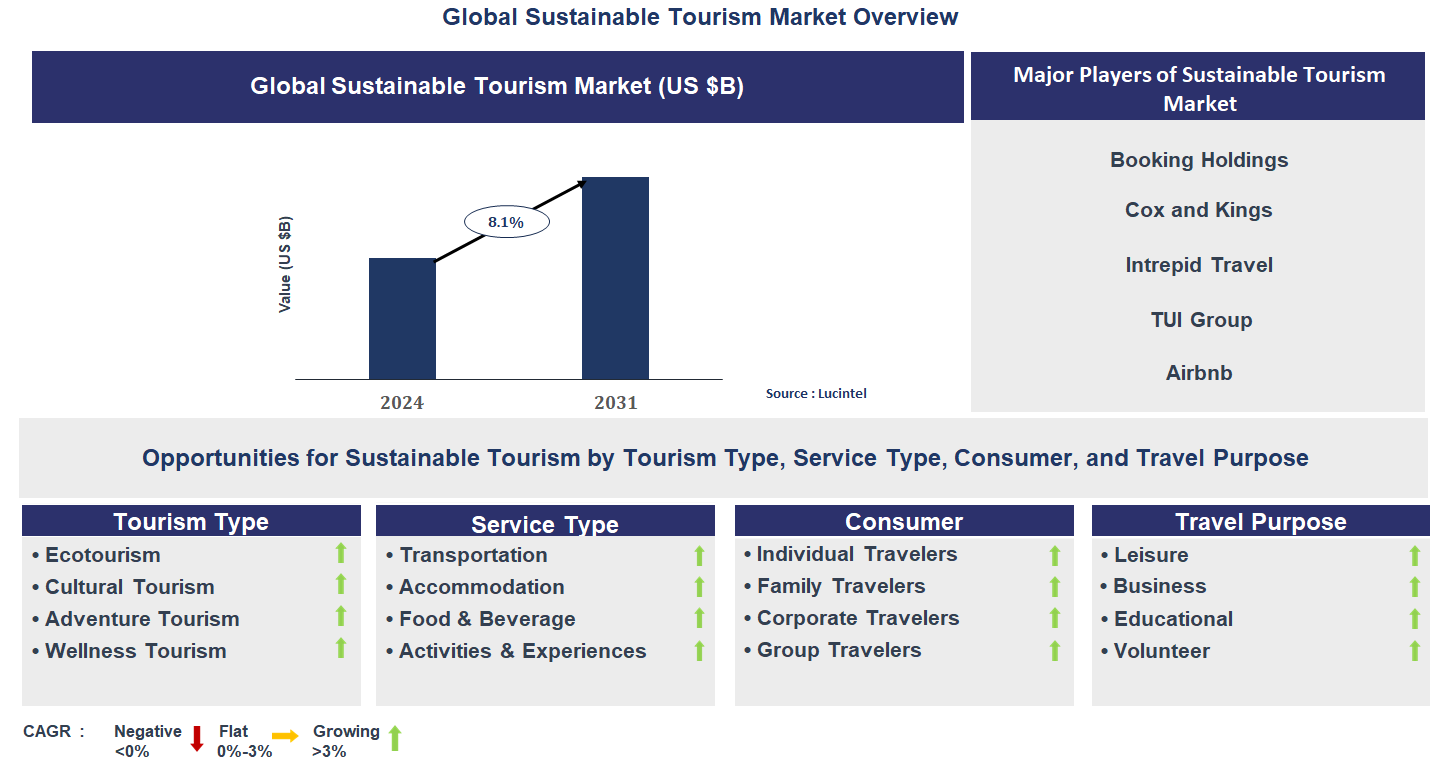
Sustainable Tourism Market Trends and Forecast

Emerging Trends in the Sustainable Tourism Market

The sustainable tourism economy is being remade by a number of new trends that indicate a more profound understanding of aesthetics, sustainability, and contemporary consumer values. The age of simplicity and standard products is over. Consumers now want niche, science-formulated solutions that are also consistent with larger issues of environmental concern and self-expression. These trends are impacting all the way from product development to marketing, making it a more professional and consumer-driven industry that is committed to health as well as environmental stewardship.
• Transition to Regenerative Tourism: One major trend is the increasing demand for tourism that is not only reducing harm but actually restoring and regenerating the environment and the local community. This is being led by growing consumer concern over the environment and worry about the non-biodegradable content of old-style wipes. The effect is a market shift where manufacturers are promoting their sustainability credentials as a major selling point. This is driving a new category of green-aware consumers and is pressuring the whole industry to move towards more sustainable manufacturing and disposal methods.
• Community-Based Tourism Rise: The trend is the market shift from generic products towards community-based tourism. There is increasing demand for travel experiences that benefit the local community directly and enable travelers to experience true culture and people. This is driven by developments in digital printing and manufacturing technology. This trend is building a new category of home décor that is highly customized. It enables brands to aim at specialized consumer needs and provide more efficient, problem-solving solutions for a range of interior design problems.
• Emphasis on Technology Integration for Sustainability: A prominent trend is the increased focus on rugs and carpets incorporating smart and useful attributes. This is because there is a need for products that can provide more than their aesthetic worth. Manufacturers are now producing rugs that include features such as anti-microbial treatments, sound-absorbing qualities, and stain resistance. The effect is a market in which technology and functionality are increasingly being used as differentiators. This trend resonates with consumers who want to have products that not only make their living area a better place but also contribute to an overall better life.
• Rise of Slow Tourism: One trend fueled by the growth of e-commerce is the utilization of direct-to-consumer (D2C) models. Brands are using social media and online channels more and more to promote their products and to target consumers directly. It enables them to evade traditional channels of retail and to assert control over their brand message. The result is a more accessible and competitive market. This trend is especially favored among smaller, creative brands that can establish a direct relationship with their target audience by using personalized content and targeted advertising.
• Personalization in Sustainable Travel: One trend fueled by a need for authenticity is the return to classic and handmade designs. Consumers are more and more appreciative of the craftsmanship and cultural heritage of hand-knotted and hand-woven rugs. The trend is developing a new segment that appreciates art and cultural heritage. The effect is a market in which brands are concentrating on making the user experience seamless and enjoyable. It minimizes the waste of products and keeps the rugs fresh and efficient for a longer duration.
These new trends are essentially redefining the sustainable tourism industry by making it consumer-driven, niche-oriented, and ethically informed. With an emphasis on sustainability and multi-functionality, the bar for product effectiveness and value is being set higher. Concurrently, the transition to a more multi-purpose and consumer-direct model is positioning the industry in accordance with contemporary consumer values. In the end, these trends are propelling the market toward a future in which personal care wipes are a wiser, more holistic, and more responsible component of a personal care regimen.
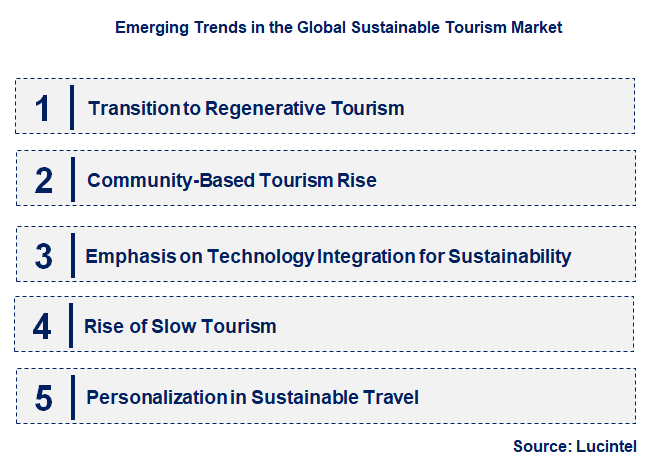
Emerging Trends in the Sustainable Tourism Market

Recent Development in the Sustainable Tourism Market

The sustainable tourism market is being shaped today by several significant recent trends that are affecting its growth and competitive dynamics. These events are not isolated incidents but are linked, evidencing a larger transformation in consumer attitudes and technology capabilities. The market is becoming increasingly sophisticated, fueled by scientific advancement, an emphasis on efficacy and safety, and new models for engaging consumers.
• Plant-Based and Biodegradable Materials Introduction: One of the major developments is the industry-wide introduction of plant-based and biodegradable materials. The industry is shifting from conventional non-woven textiles towards making products that are more green. This is a long-standing demand for green products, and the effect is that the market becomes more diverse with a broader range of environmentally aware consumers being served, enhancing customer satisfaction and brand loyalty. It also enables brands to become leaders in the sustainability domain.
• Greater Availability of Multi-functional Products: One of the key developments is the widespread availability of multi-functional personal care wipes. With consumer demand for convenience and efficiency, the products are designed to do more than merely cleanse. They may have moisturizers, makeup removers, or even antibacterial elements in them. The result is a dramatic growth of the markets "premium" segment. This trend is compelling established brands to re-engineer their products in order to keep pace and is establishing a new market for multi-purpose, high-value products.
• Transition to Direct-to-Consumer and E-commerce Platforms: The move to online sales and direct-to-consumer (D2C) platforms is a major trend. Brands are today using e-commerce sites and their own websites to connect with customers without the intermediation of conventional retail. The effect is a more competitive environment with more choices for consumers. This evolution also enables brands to own their brand message, connect directly with customers, and acquire valuable feedback for future product innovation.
• Expansion of Mens Grooming Segment: One of the recent trends is increasing popularity of personal care wipes in the mens grooming segment. This is fueled by growing awareness among men for personal hygiene and looking for convenient, on-the-go products. The effect is a dramatic increase in market accessibility and a fresh consumer base. This strategy also assists brands in first-time buyers who are searching for a more affordable way to enter the personal care market.
• Formulation and Ingredient Transparency Innovations: The market is experiencing a significant trend in the field of formulation and ingredient transparency. Companies are launching products with transparent, easy-to-comprehend ingredient labels and an increased focus on natural and organic ingredients. This trend is in response to consumer demand for safety and worthiness. The effect is a more accessible and low-risk experience. It also gives consumers a significant selling point if they are worried about chemicals used in personal care products.
These new trends are all converging to affect the sustainable tourism industry as a whole by driving it toward a more specialized, ethical, and consumer-oriented model. With its emphasis on sustainability and multiple functionalities, product effectiveness and worth are being maximized. At the same time, changes to online sales and the emergence of niche segments are transforming the markets distribution and accessibility norms, making it grow bigger and more relevant for the new generation of consumers.

Strategic Growth Opportunities in the Sustainable Tourism Market

The sustainable tourism industry offers a number of strategic growth opportunities in its major applications. With changing consumer tastes and an increased emphasis on health and wellness, firms can use these opportunities to innovate and gain new market share. These possibilities go beyond established product formulations and involve innovation in marketing, distribution, and product specialization. Finding and taking advantage of these strategic areas of growth will be important for firms that want to realize long-term success in this volatile market.
• Baby and Infant Care Segment Opportunity: Growth opportunity is high in the baby and infant care product segment. As parents are increasingly aware of skin sensitivities and green issues, there is growing demand for top-quality, hypoallergenic, and biodegradable infant wipes. Companies can take advantage of this by creating special, certified, and delicate products for baby use. This approach enables brands to demand premium prices, create a reputation for high quality, and attract a segment that cares about the health and wellness of their children.
• Opportunity in the Facial and Skincare Segment: The facial and skincare segment represents a massive opportunity for growth. As more and more consumers embrace multi-step skincare, there is increasing demand for specialized wipes that can cleanse, tone, and moisturize. Bases can be set apart by emphasizing products that are designed for particular skin types and issues, like acne or sensitive skin. This not only reaches a widening base of consumers who are health-conscious, but it also creates a good brand reputation and maintains long-term customer loyalty by associating with what they believe in.
• E-commerce and Direct-to-Consumer Channel Opportunity: The growth of e-commerce provides a huge opportunity for growth. With a well-developed online presence and utilization of direct-to-consumer (D2C) models, companies can cut through the hurdles of conventional retail and expand their customer base. It enables enterprises to dictate their brand message, connect with customers on social media and content marketing, and personalize the product recommendation. It is also made easier to adopt the data-driven method, gaining valuable data from consumer behavior and preferences to inform product development in the future.
• Travel and On-the-Go Opportunity: One of the most important growth opportunities is creating products that are particularly promoted for travel and on-the-go usage. With people once again traveling and commuting, there is an increasing need for ready-to-use, portable, and multi-functional wipes that are great for hands, face, and surfaces. Businesses can design products and marketing strategies that are specific to the individual requirements of individuals looking for a smooth and effective solution. This approach targets an untapped market and offers a new direction for expansion.
• Growth Opportunity in Sustainability Market: There is a growth opportunity in sustainability presented by the market. Businesses can design products that not only break down biologically but also employ sustainable production methods and green packaging. This may include designing a subscription model for plant-based wipes or collaborating with environmental groups to market proper disposal. This approach offers a unique selling point and fosters a robust customer relationship. It transitions the marketplace from an entirely transactional system to a more purpose-driven and value-based one.
These growth opportunities, which involve strategic growth initiatives, are set to propel the sustainable tourism industry forward. With emphasis on niche markets and direct-to-consumer channels, businesses can tap into new markets and establish new sources of revenue. Specialized and sustainable products also cater to contemporary consumer culture, while potential for travel-friendly models heralds a future where the market is not only larger but also more innovative and customized to each individuals particular requirements.

Sustainable Tourism Market Driver and Challenges

The sustainable tourism industry is shaped by a dynamic set of prime drivers and challenges that are charting its path. The prime drivers are mostly focused on evolving consumer lifestyles, a greater emphasis on hygiene, and a growing interest in green products. Yet, the industry is also confronted with some major challenges, such as environmental issues, stiff competition, and a failure to establish clear regulatory norms. Knowledge of these factors is key to any company or organization seeking to excel in this changing market.
The factors responsible for driving the sustainable tourism market include:
1. Rising Awareness towards Hygiene and Cleanliness: The major driver is rising awareness among consumers regarding the need for hygiene and cleanliness. This has resulted in increased demand for easy and effective cleansing products. This driver is caused by the ubiquitous availability of information through online platforms and social media, which is changing consumer behavior and making wipes an integral part of a healthy lifestyle.
2. Urbanization and Changing Lifestyles: The global phenomenon of urbanization and hectic lifestyles is a key driver. More individuals are urban dwelling and increasingly short on time for their traditional cleansing rituals, creating higher demands for portable and convenient personal care products. Wipes are perceived as a functional and convenient substitute for soap and water, driving their usage across a broad array of applications.
3. Increasing Disposable Income and Consumer Expenditure: The sector is propelled by rising disposable incomes, especially across emerging markets. As individuals financial abilities increase, they become more inclined to spend on personal care and hygiene items. This economic shift is enabling brands to grow their reach in new markets as well as to develop high-value products targeting a richer set of consumers, thus propelling market growth and profitability.
4. Technology Advances in Formulation and Production: The sustainable tourism industry is propelled by ongoing technological innovation. Advancements in new materials, such as plant fibers and compostable substrates, have enhanced wipes in terms of their effectiveness and eco-friendliness. The innovations not only enhanced the consumer experience but also resolved historic concerns regarding disposal and sustainability.
5. Role of E-commerce and Digital Marketing: Another driver is the rise of e-commerce websites. Online shopping has brought personal care wipe products to the doorstep of people all over the world. This driver has reduced the entry barriers for new brands and has increased the choices available to consumers. The ease of online shopping and the convenience of comparing products and viewing reviews are key drivers of purchasing behavior.
Challenges in the sustainable tourism market are:
1. Environmental issues and Waste Management: One of the primary challenges is the increase in concern over the environmental effects of non-biodegradable wipes. Most conventional products have plastic fibers that are not degraded by landfills or sewer systems. The issue has the potential to cause pollution and infrastructure clogging. This challenge is compelling companies to invest in sustainable materials to counter consumer and regulatory pressure.
2. High Competition and Market Over-Saturation: The market is competitively saturated with numerous types of brands, including multinational brands and local ones. This high competition does not allow new players to gain traction and existing brands to hold onto their share of the market. The challenge is such that the brands need to invest significantly in marketing, product development, and brand establishment so that they can differentiate themselves.
3. Deficiency of Clear Regulatory Standards: The industry is confronted with issues surrounding deficiency of clear regulatory standards, especially with the term "flushable." This has the potential to confuse consumers and ruin the reputation of the industry. This issue requires the establishment of clear, industry-wide standards and consumer education campaigns to enhance trust and ensure products are properly used and discarded.
The market for sustainable tourism is driven by robust drivers such as increasing incomes, emphasis on hygiene, and technological development. These are forming a conducive setting for growth and expansion. The future of the market also rests on how it tackles major issues. Product environmental footprint, fierce competition, and regulatory uncertainty are major challenges that need to be addressed. The capacity of businesses to innovate sustainably, maintain product efficiency, and establish consumer confidence will be central to the success and sustainability of the market in the long term.

List of Sustainable Tourism Companies

Companies in the market compete on the basis of product quality offered. Major players in this market focus on expanding their manufacturing facilities, R&D investments, infrastructural development, and leverage integration opportunities across the value chain. With these strategies sustainable tourism companies cater increasing demand, ensure competitive effectiveness, develop innovative products & technologies, reduce production costs, and expand their customer base. Some of the sustainable tourism companies profiled in this report include-
• Booking Holdings
• Cox and Kings
• Intrepid Travel
• TUI Group
• Airbnb
• Hilton Worldwide
• Travelocity
• Sustainable Travel International
• Tripadvisor
• Expedia Group

Sustainable Tourism Market by Segment

The study includes a forecast for the global sustainable tourism market by tourism type, service type, consumer, travel purpose, and region.

Sustainable Tourism Market by Tourism Type [Value from 2019 to 2031]:


• Ecotourism
• Cultural Tourism
• Adventure Tourism
• Wellness Tourism

Sustainable Tourism Market by Service Type [Value from 2019 to 2031]:


• Transportation
• Accommodation
• Food & Beverage
• Activities & Experiences

Sustainable Tourism Market by Consumer [Value from 2019 to 2031]:


• Individual Travelers
• Family Travelers
• Corporate Travelers
• Group Travelers

Sustainable Tourism Market by Travel Purpose [Value from 2019 to 2031]:


• Leisure
• Business
• Educational
• Volunteer

Sustainable Tourism Market by Region [Value from 2019 to 2031]:


• North America
• Europe
• Asia Pacific
• The Rest of the World

Country Wise Outlook for the Sustainable Tourism Market

The sustainable tourism marketplace is in the midst of profound change, fueled by growing consumer interest in environmental stewardship, cultural conservation, and social justice. A market once characterized as a niche opportunity for green tourists is increasingly becoming mainstream within the international tourist industry. This evolution of the market is further influenced by technological advancements, an increased consciousness regarding climate change, as well as the need for more sincere and real travel experiences.
• United States: The sustainable tourism sector in the United States is witnessing healthy growth, fueled by a solid consumer base of millennials and Gen Z who pay attention to ethical and low-impact tourism. The latest trend has been the increase in eco-friendly hotels and the growth of carbon-neutral travel modes. National parks and protected habitats are also witnessing growth from travelers who are keen on conservation. The market is further being boosted by governments with friendly policies and corporate green initiatives.
• China: Chinas sustainable tourism industry is expanding vigorously, driven by urbanization, a growing middle class, and expanding government backing for green measures. One of the major developments is surging demand for rural and ecotourism activities that emphasize cultural heritage conservation and community involvement. While the government is making large investments in green infrastructure and a national park system, the private sector is also teaming up with local communities to provide environmentally friendly travel packages and market off-the-beaten-path destinations.
• Germany: The German sustainable tourism industry is dominated by the focus on quality, durability, and sustainability of the product. In recent times, there has been an increased appetite for sustainable and plastic-free travel that abides by stringent environmental requirements. German consumers are very particular and prefer travel businesses with open sourcing and a long-term focus on safety and the environment. There is also a clear trend in the market for products and services that are compatible with underfloor heating and offer sound insulation.
• India: Indias sustainable tourism sector is in a phase of quick growth, fueled by an emerging middle class and increasing demand for culture and nature-based tourism. One major development has been the governments Swadesh Darshan program, which targets the creation of environmentally friendly tourist circuits. Meanwhile, private enterprises and local communities have also begun to provide a more diverse range of sustainable products and services, ranging from homestays to nature-based adventure travel.
• Japan: Japans sustainable tourism industry is highly evolved and motivated by a culture of fastidious attention to detail and high expectations for high-quality, gentle products. Recent trends have included a high emphasis on minimalist aesthetics and lightweight materials that provide optimum convenience without compromising effectiveness. The market also favors products with subtle, natural fragrances and elegant, minimalist packaging. Brands are innovating to create products that are not just effective but also provide a pleasant sensory experience. There is also a notable trend toward multi-functional, all-in-one products that simplify the complex personal care routine.

Lucintel Analytics Dashboard

Features of the Global Sustainable Tourism Market

Market Size Estimates: Sustainable tourism market size estimation in terms of value ($B).
Trend and Forecast Analysis: Market trends (2019 to 2024) and forecast (2025 to 2031) by various segments and regions.
Segmentation Analysis: Sustainable tourism market size by various segments, such as by tourism type, service type, consumer, travel purpose, and region in terms of value ($B).
Regional Analysis: Sustainable tourism market breakdown by North America, Europe, Asia Pacific, and Rest of the World.
Growth Opportunities: Analysis of growth opportunities in different tourism types, service types, consumer, travel purpose, and regions for the sustainable tourism market.
Strategic Analysis: This includes M&A, new product development, and competitive landscape of the sustainable tourism market.
Analysis of competitive intensity of the industry based on Porter’s Five Forces model.

Lucintel Consulting Services

FAQ

Q1. What is the growth forecast for sustainable tourism market?
Answer: The global sustainable tourism market is expected to grow with a CAGR of 8.1% from 2025 to 2031.
Q2. What are the major drivers influencing the growth of the sustainable tourism market?
Answer: The major drivers for this market are the rising demand for authentic, responsible, & community-based travel experiences and the growing environmental awareness influencing traveler choices towards sustainilbilty.
Q3. What are the major segments for sustainable tourism market?
Answer: The future of the sustainable tourism market looks promising with opportunities in the transportation, accommodation, food & beverage, and activities & experience markets.
Q4. Who are the key sustainable tourism market companies?
Answer: Some of the key sustainable tourism companies are as follows:
• Booking Holdings
• Cox and Kings
• Intrepid Travel
• TUI Group
• Airbnb
• Hilton Worldwide
• Travelocity
• Sustainable Travel International
• Tripadvisor
• Expedia Group
Q5. Which sustainable tourism market segment will be the largest in future?
Answer: Lucintel forecasts that, within the tourism type category, wellness tourism is expected to witness the highest growth over the forecast period.
Q6. In sustainable tourism market, which region is expected to be the largest in next 5 years?
Answer: In terms of region, APAC is expected to witness the highest growth over the forecast period.
Q7. Do we receive customization in this report?
Answer: Yes, Lucintel provides 10% customization without any additional cost.

This report answers following 11 key questions:

Q.1. What are some of the most promising, high-growth opportunities for the sustainable tourism market by tourism type (ecotourism, cultural tourism, adventure tourism, and wellness tourism), service type (transportation, accommodation, food & beverage, and activities & experiences), consumer (individual travelers, family travelers, corporate travelers, and group travelers), travel purpose (leisure, business, educational, and volunteer), and region (North America, Europe, Asia Pacific, and the Rest of the World)?
Q.2. Which segments will grow at a faster pace and why?
Q.3. Which region will grow at a faster pace and why?
Q.4. What are the key factors affecting market dynamics? What are the key challenges and business risks in this market?
Q.5. What are the business risks and competitive threats in this market?
Q.6. What are the emerging trends in this market and the reasons behind them?
Q.7. What are some of the changing demands of customers in the market?
Q.8. What are the new developments in the market? Which companies are leading these developments?
Q.9. Who are the major players in this market? What strategic initiatives are key players pursuing for business growth?
Q.10. What are some of the competing products in this market and how big of a threat do they pose for loss of market share by material or product substitution?
Q.11. What M&A activity has occurred in the last 5 years and what has its impact been on the industry?

For any questions related to Sustainable Tourism Market, Sustainable Tourism Market Size, Sustainable Tourism Market Growth, Sustainable Tourism Market Analysis, Sustainable Tourism Market Report, Sustainable Tourism Market Share, Sustainable Tourism Market Trends, Sustainable Tourism Market Forecast, Sustainable Tourism Companies, write Lucintel analyst at email: helpdesk@lucintel.com. We will be glad to get back to you soon.
                                           Table of Contents

            1. Executive Summary

            2. Market Overview

                        2.1 Background and Classifications
                        2.2 Supply Chain

            3. Market Trends & Forecast Analysis

                        3.1 Macroeconomic Trends and Forecasts
                        3.2 Industry Drivers and Challenges
                        3.3 PESTLE Analysis
                        3.4 Patent Analysis
                        3.5 Regulatory Environment
                        3.6 Global Sustainable Tourism Market Trends and Forecast

            4. Global Sustainable Tourism Market by Tourism Type

                        4.1 Overview
                        4.2 Attractiveness Analysis by Tourism Type
                        4.3 Ecotourism : Trends and Forecast 2025 to 2031
                        4.4 Cultural Tourism : Trends and Forecast 2025 to 2031
                        4.5 Adventure Tourism : Trends and Forecast 2025 to 2031
                        4.6 Wellness Tourism : Trends and Forecast 2025 to 2031

            5. Global Sustainable Tourism Market by Service Type

                        5.1 Overview
                        5.2 Attractiveness Analysis by Service Type
                        5.3 Transportation : Trends and Forecast 2025 to 2031
                        5.4 Accommodation : Trends and Forecast 2025 to 2031
                        5.5 Food & Beverage : Trends and Forecast 2025 to 2031
                        5.6 Activities & Experiences : Trends and Forecast 2025 to 2031

            6. Global Sustainable Tourism Market by Consumer

                        6.1 Overview
                        6.2 Attractiveness Analysis by Consumer
                        6.3 Individual Travelers : Trends and Forecast 2025 to 2031
                        6.4 Family Travelers : Trends and Forecast 2025 to 2031
                        6.5 Corporate Travelers : Trends and Forecast 2025 to 2031
                        6.6 Group Travelers : Trends and Forecast 2025 to 2031

            7. Global Sustainable Tourism Market by Travel Purpose

                        7.1 Overview
                        7.2 Attractiveness Analysis by Travel Purpose
                        7.3 Leisure : Trends and Forecast 2025 to 2031
                        7.4 Business : Trends and Forecast 2025 to 2031
                        7.5 Educational : Trends and Forecast 2025 to 2031
                        7.6 Volunteer : Trends and Forecast 2025 to 2031

            8. Regional Analysis

                        8.1 Overview
                        8.2 Global Sustainable Tourism Market by Region

            9. North American Sustainable Tourism Market

                        9.1 Overview
                        9.2 North American Sustainable Tourism Market by Tourism Type
                        9.3 North American Sustainable Tourism Market by Service Type
                        9.4 The United States Sustainable Tourism Market
                        9.5 Canadian Sustainable Tourism Market
                        9.6 Mexican Sustainable Tourism Market

            10. European Sustainable Tourism Market

                        10.1 Overview
                        10.2 European Sustainable Tourism Market by Tourism Type
                        10.3 European Sustainable Tourism Market by Service Type
                        10.4 German Sustainable Tourism Market
                        10.5 French Sustainable Tourism Market
                        10.6 Italian Sustainable Tourism Market
                        10.7 Spanish Sustainable Tourism Market
                        10.8 The United Kingdom Sustainable Tourism Market

            11. APAC Sustainable Tourism Market

                        11.1 Overview
                        11.2 APAC Sustainable Tourism Market by Tourism Type
                        11.3 APAC Sustainable Tourism Market by Service Type
                        11.4 Chinese Sustainable Tourism Market
                        11.5 Indian Sustainable Tourism Market
                        11.6 Japanese Sustainable Tourism Market
                        11.7 South Korean Sustainable Tourism Market
                        11.8 Indonesian Sustainable Tourism Market

            12. ROW Sustainable Tourism Market

                        12.1 Overview
                        12.2 ROW Sustainable Tourism Market by Tourism Type
                        12.3 ROW Sustainable Tourism Market by Service Type
                        12.4 Middle Eastern Sustainable Tourism Market
                        12.5 South American Sustainable Tourism Market
                        12.6 African Sustainable Tourism Market

            13. Competitor Analysis

                        13.1 Product Portfolio Analysis
                        13.2 Operational Integration
                        13.3 Porter’s Five Forces Analysis
                                    • Competitive Rivalry
                                    • Bargaining Power of Buyers
                                    • Bargaining Power of Suppliers
                                    • Threat of Substitutes
                                    • Threat of New Entrants
                        13.4 Market Share Analysis

            14. Opportunities & Strategic Analysis

                        14.1 Value Chain Analysis
                        14.2 Growth Opportunity Analysis
                                    14.2.1 Growth Opportunity by Tourism Type
                                    14.2.2 Growth Opportunity by Service Type
                                    14.2.3 Growth Opportunity by Consumer
                                    14.2.4 Growth Opportunity by Travel Purpose
                        14.3 Emerging Trends in the Global Sustainable Tourism Market
                        14.4 Strategic Analysis
                                    14.4.1 New Product Development
                                    14.4.2 Certification and Licensing
                                    14.4.3 Mergers, Acquisitions, Agreements, Collaborations, and Joint Ventures

            15. Company Profiles of the Leading Players Across the Value Chain

                        15.1 Competitive Analysis
                        15.2 Booking Holdings
                                    • Company Overview
                                    • Sustainable Tourism Market Business Overview
                                    • New Product Development
                                    • Merger, Acquisition, and Collaboration
                                    • Certification and Licensing
                        15.3 Cox and Kings
                                    • Company Overview
                                    • Sustainable Tourism Market Business Overview
                                    • New Product Development
                                    • Merger, Acquisition, and Collaboration
                                    • Certification and Licensing
                        15.4 Intrepid Travel
                                    • Company Overview
                                    • Sustainable Tourism Market Business Overview
                                    • New Product Development
                                    • Merger, Acquisition, and Collaboration
                                    • Certification and Licensing
                        15.5 TUI Group
                                    • Company Overview
                                    • Sustainable Tourism Market Business Overview
                                    • New Product Development
                                    • Merger, Acquisition, and Collaboration
                                    • Certification and Licensing
                        15.6 Airbnb
                                    • Company Overview
                                    • Sustainable Tourism Market Business Overview
                                    • New Product Development
                                    • Merger, Acquisition, and Collaboration
                                    • Certification and Licensing
                        15.7 Hilton Worldwide
                                    • Company Overview
                                    • Sustainable Tourism Market Business Overview
                                    • New Product Development
                                    • Merger, Acquisition, and Collaboration
                                    • Certification and Licensing
                        15.8 Travelocity
                                    • Company Overview
                                    • Sustainable Tourism Market Business Overview
                                    • New Product Development
                                    • Merger, Acquisition, and Collaboration
                                    • Certification and Licensing
                        15.9 Sustainable Travel International
                                    • Company Overview
                                    • Sustainable Tourism Market Business Overview
                                    • New Product Development
                                    • Merger, Acquisition, and Collaboration
                                    • Certification and Licensing
                        15.10 Tripadvisor
                                    • Company Overview
                                    • Sustainable Tourism Market Business Overview
                                    • New Product Development
                                    • Merger, Acquisition, and Collaboration
                                    • Certification and Licensing
                        15.11 Expedia Group
                                    • Company Overview
                                    • Sustainable Tourism Market Business Overview
                                    • New Product Development
                                    • Merger, Acquisition, and Collaboration
                                    • Certification and Licensing

            16. Appendix

                        16.1 List of Figures
                        16.2 List of Tables
                        16.3 Research Methodology
                        16.4 Disclaimer
                        16.5 Copyright
                        16.6 Abbreviations and Technical Units
                        16.7 About Us
                        16.8 Contact Us

                                               List of Figures


            Chapter 1

                        Figure 1.1: Trends and Forecast for the Global Sustainable Tourism Market

            Chapter 2

                        Figure 2.1: Usage of Sustainable Tourism Market
                        Figure 2.2: Classification of the Global Sustainable Tourism Market
                        Figure 2.3: Supply Chain of the Global Sustainable Tourism Market

            Chapter 3

                        Figure 3.1: Trends of the Global GDP Growth Rate
                        Figure 3.2: Trends of the Global Population Growth Rate
                        Figure 3.3: Trends of the Global Inflation Rate
                        Figure 3.4: Trends of the Global Unemployment Rate
                        Figure 3.5: Trends of the Regional GDP Growth Rate
                        Figure 3.6: Trends of the Regional Population Growth Rate
                        Figure 3.7: Trends of the Regional Inflation Rate
                        Figure 3.8: Trends of the Regional Unemployment Rate
                        Figure 3.9: Trends of Regional Per Capita Income
                        Figure 3.10: Forecast for the Global GDP Growth Rate
                        Figure 3.11: Forecast for the Global Population Growth Rate
                        Figure 3.12: Forecast for the Global Inflation Rate
                        Figure 3.13: Forecast for the Global Unemployment Rate
                        Figure 3.14: Forecast for the Regional GDP Growth Rate
                        Figure 3.15: Forecast for the Regional Population Growth Rate
                        Figure 3.16: Forecast for the Regional Inflation Rate
                        Figure 3.17: Forecast for the Regional Unemployment Rate
                        Figure 3.18: Forecast for Regional Per Capita Income
                        Figure 3.19: Driver and Challenges of the Sustainable Tourism Market

            Chapter 4

                        Figure 4.1: Global Sustainable Tourism Market by Tourism Type in 2019, 2024, and 2031
                        Figure 4.2: Trends of the Global Sustainable Tourism Market ($B) by Tourism Type
                        Figure 4.3: Forecast for the Global Sustainable Tourism Market ($B) by Tourism Type
                        Figure 4.4: Trends and Forecast for Ecotourism in the Global Sustainable Tourism Market (2019-2031)
                        Figure 4.5: Trends and Forecast for Cultural Tourism in the Global Sustainable Tourism Market (2019-2031)
                        Figure 4.6: Trends and Forecast for Adventure Tourism in the Global Sustainable Tourism Market (2019-2031)
                        Figure 4.7: Trends and Forecast for Wellness Tourism in the Global Sustainable Tourism Market (2019-2031)

            Chapter 5

                        Figure 5.1: Global Sustainable Tourism Market by Service Type in 2019, 2024, and 2031
                        Figure 5.2: Trends of the Global Sustainable Tourism Market ($B) by Service Type
                        Figure 5.3: Forecast for the Global Sustainable Tourism Market ($B) by Service Type
                        Figure 5.4: Trends and Forecast for Transportation in the Global Sustainable Tourism Market (2019-2031)
                        Figure 5.5: Trends and Forecast for Accommodation in the Global Sustainable Tourism Market (2019-2031)
                        Figure 5.6: Trends and Forecast for Food & Beverage in the Global Sustainable Tourism Market (2019-2031)
                        Figure 5.7: Trends and Forecast for Activities & Experiences in the Global Sustainable Tourism Market (2019-2031)

            Chapter 6

                        Figure 6.1: Global Sustainable Tourism Market by Consumer in 2019, 2024, and 2031
                        Figure 6.2: Trends of the Global Sustainable Tourism Market ($B) by Consumer
                        Figure 6.3: Forecast for the Global Sustainable Tourism Market ($B) by Consumer
                        Figure 6.4: Trends and Forecast for Individual Travelers in the Global Sustainable Tourism Market (2019-2031)
                        Figure 6.5: Trends and Forecast for Family Travelers in the Global Sustainable Tourism Market (2019-2031)
                        Figure 6.6: Trends and Forecast for Corporate Travelers in the Global Sustainable Tourism Market (2019-2031)
                        Figure 6.7: Trends and Forecast for Group Travelers in the Global Sustainable Tourism Market (2019-2031)

            Chapter 7

                        Figure 7.1: Global Sustainable Tourism Market by Travel Purpose in 2019, 2024, and 2031
                        Figure 7.2: Trends of the Global Sustainable Tourism Market ($B) by Travel Purpose
                        Figure 7.3: Forecast for the Global Sustainable Tourism Market ($B) by Travel Purpose
                        Figure 7.4: Trends and Forecast for Leisure in the Global Sustainable Tourism Market (2019-2031)
                        Figure 7.5: Trends and Forecast for Business in the Global Sustainable Tourism Market (2019-2031)
                        Figure 7.6: Trends and Forecast for Educational in the Global Sustainable Tourism Market (2019-2031)
                        Figure 7.7: Trends and Forecast for Volunteer in the Global Sustainable Tourism Market (2019-2031)

            Chapter 8

                        Figure 8.1: Trends of the Global Sustainable Tourism Market ($B) by Region (2019-2024)
                        Figure 8.2: Forecast for the Global Sustainable Tourism Market ($B) by Region (2025-2031)

            Chapter 9

                        Figure 9.1: Trends and Forecast for the North American Sustainable Tourism Market (2019-2031)
                        Figure 9.2: North American Sustainable Tourism Market by Tourism Type in 2019, 2024, and 2031
                        Figure 9.3: Trends of the North American Sustainable Tourism Market ($B) by Tourism Type (2019-2024)
                        Figure 9.4: Forecast for the North American Sustainable Tourism Market ($B) by Tourism Type (2025-2031)
                        Figure 9.5: North American Sustainable Tourism Market by Service Type in 2019, 2024, and 2031
                        Figure 9.6: Trends of the North American Sustainable Tourism Market ($B) by Service Type (2019-2024)
                        Figure 9.7: Forecast for the North American Sustainable Tourism Market ($B) by Service Type (2025-2031)
                        Figure 9.8: North American Sustainable Tourism Market by Consumer in 2019, 2024, and 2031
                        Figure 9.9: Trends of the North American Sustainable Tourism Market ($B) by Consumer (2019-2024)
                        Figure 9.10: Forecast for the North American Sustainable Tourism Market ($B) by Consumer (2025-2031)
                        Figure 9.11: North American Sustainable Tourism Market by Travel Purpose in 2019, 2024, and 2031
                        Figure 9.12: Trends of the North American Sustainable Tourism Market ($B) by Travel Purpose (2019-2024)
                        Figure 9.13: Forecast for the North American Sustainable Tourism Market ($B) by Travel Purpose (2025-2031)
                        Figure 9.14: Trends and Forecast for the United States Sustainable Tourism Market ($B) (2019-2031)
                        Figure 9.15: Trends and Forecast for the Mexican Sustainable Tourism Market ($B) (2019-2031)
                        Figure 9.16: Trends and Forecast for the Canadian Sustainable Tourism Market ($B) (2019-2031)

            Chapter 10

                        Figure 10.1: Trends and Forecast for the European Sustainable Tourism Market (2019-2031)
                        Figure 10.2: European Sustainable Tourism Market by Tourism Type in 2019, 2024, and 2031
                        Figure 10.3: Trends of the European Sustainable Tourism Market ($B) by Tourism Type (2019-2024)
                        Figure 10.4: Forecast for the European Sustainable Tourism Market ($B) by Tourism Type (2025-2031)
                        Figure 10.5: European Sustainable Tourism Market by Service Type in 2019, 2024, and 2031
                        Figure 10.6: Trends of the European Sustainable Tourism Market ($B) by Service Type (2019-2024)
                        Figure 10.7: Forecast for the European Sustainable Tourism Market ($B) by Service Type (2025-2031)
                        Figure 10.8: European Sustainable Tourism Market by Consumer in 2019, 2024, and 2031
                        Figure 10.9: Trends of the European Sustainable Tourism Market ($B) by Consumer (2019-2024)
                        Figure 10.10: Forecast for the European Sustainable Tourism Market ($B) by Consumer (2025-2031)
                        Figure 10.11: European Sustainable Tourism Market by Travel Purpose in 2019, 2024, and 2031
                        Figure 10.12: Trends of the European Sustainable Tourism Market ($B) by Travel Purpose (2019-2024)
                        Figure 10.13: Forecast for the European Sustainable Tourism Market ($B) by Travel Purpose (2025-2031)
                        Figure 10.14: Trends and Forecast for the German Sustainable Tourism Market ($B) (2019-2031)
                        Figure 10.15: Trends and Forecast for the French Sustainable Tourism Market ($B) (2019-2031)
                        Figure 10.16: Trends and Forecast for the Spanish Sustainable Tourism Market ($B) (2019-2031)
                        Figure 10.17: Trends and Forecast for the Italian Sustainable Tourism Market ($B) (2019-2031)
                        Figure 10.18: Trends and Forecast for the United Kingdom Sustainable Tourism Market ($B) (2019-2031)

            Chapter 11

                        Figure 11.1: Trends and Forecast for the APAC Sustainable Tourism Market (2019-2031)
                        Figure 11.2: APAC Sustainable Tourism Market by Tourism Type in 2019, 2024, and 2031
                        Figure 11.3: Trends of the APAC Sustainable Tourism Market ($B) by Tourism Type (2019-2024)
                        Figure 11.4: Forecast for the APAC Sustainable Tourism Market ($B) by Tourism Type (2025-2031)
                        Figure 11.5: APAC Sustainable Tourism Market by Service Type in 2019, 2024, and 2031
                        Figure 11.6: Trends of the APAC Sustainable Tourism Market ($B) by Service Type (2019-2024)
                        Figure 11.7: Forecast for the APAC Sustainable Tourism Market ($B) by Service Type (2025-2031)
                        Figure 11.8: APAC Sustainable Tourism Market by Consumer in 2019, 2024, and 2031
                        Figure 11.9: Trends of the APAC Sustainable Tourism Market ($B) by Consumer (2019-2024)
                        Figure 11.10: Forecast for the APAC Sustainable Tourism Market ($B) by Consumer (2025-2031)
                        Figure 11.11: APAC Sustainable Tourism Market by Travel Purpose in 2019, 2024, and 2031
                        Figure 11.12: Trends of the APAC Sustainable Tourism Market ($B) by Travel Purpose (2019-2024)
                        Figure 11.13: Forecast for the APAC Sustainable Tourism Market ($B) by Travel Purpose (2025-2031)
                        Figure 11.14: Trends and Forecast for the Japanese Sustainable Tourism Market ($B) (2019-2031)
                        Figure 11.15: Trends and Forecast for the Indian Sustainable Tourism Market ($B) (2019-2031)
                        Figure 11.16: Trends and Forecast for the Chinese Sustainable Tourism Market ($B) (2019-2031)
                        Figure 11.17: Trends and Forecast for the South Korean Sustainable Tourism Market ($B) (2019-2031)
                        Figure 11.18: Trends and Forecast for the Indonesian Sustainable Tourism Market ($B) (2019-2031)

            Chapter 12

                        Figure 12.1: Trends and Forecast for the ROW Sustainable Tourism Market (2019-2031)
                        Figure 12.2: ROW Sustainable Tourism Market by Tourism Type in 2019, 2024, and 2031
                        Figure 12.3: Trends of the ROW Sustainable Tourism Market ($B) by Tourism Type (2019-2024)
                        Figure 12.4: Forecast for the ROW Sustainable Tourism Market ($B) by Tourism Type (2025-2031)
                        Figure 12.5: ROW Sustainable Tourism Market by Service Type in 2019, 2024, and 2031
                        Figure 12.6: Trends of the ROW Sustainable Tourism Market ($B) by Service Type (2019-2024)
                        Figure 12.7: Forecast for the ROW Sustainable Tourism Market ($B) by Service Type (2025-2031)
                        Figure 12.8: ROW Sustainable Tourism Market by Consumer in 2019, 2024, and 2031
                        Figure 12.9: Trends of the ROW Sustainable Tourism Market ($B) by Consumer (2019-2024)
                        Figure 12.10: Forecast for the ROW Sustainable Tourism Market ($B) by Consumer (2025-2031)
                        Figure 12.11: ROW Sustainable Tourism Market by Travel Purpose in 2019, 2024, and 2031
                        Figure 12.12: Trends of the ROW Sustainable Tourism Market ($B) by Travel Purpose (2019-2024)
                        Figure 12.13: Forecast for the ROW Sustainable Tourism Market ($B) by Travel Purpose (2025-2031)
                        Figure 12.14: Trends and Forecast for the Middle Eastern Sustainable Tourism Market ($B) (2019-2031)
                        Figure 12.15: Trends and Forecast for the South American Sustainable Tourism Market ($B) (2019-2031)
                        Figure 12.16: Trends and Forecast for the African Sustainable Tourism Market ($B) (2019-2031)

            Chapter 13

                        Figure 13.1: Porter’s Five Forces Analysis of the Global Sustainable Tourism Market
                        Figure 13.2: Market Share (%) of Top Players in the Global Sustainable Tourism Market (2024)

            Chapter 14

                        Figure 14.1: Growth Opportunities for the Global Sustainable Tourism Market by Tourism Type
                        Figure 14.2: Growth Opportunities for the Global Sustainable Tourism Market by Service Type
                        Figure 14.3: Growth Opportunities for the Global Sustainable Tourism Market by Consumer
                        Figure 14.4: Growth Opportunities for the Global Sustainable Tourism Market by Travel Purpose
                        Figure 14.5: Growth Opportunities for the Global Sustainable Tourism Market by Region
                        Figure 14.6: Emerging Trends in the Global Sustainable Tourism Market

                                               List of Tables


            Chapter 1

                        Table 1.1: Growth Rate (%, 2023-2024) and CAGR (%, 2025-2031) of the Sustainable Tourism Market by Tourism Type, Service Type, Consumer, and Travel Purpose
                        Table 1.2: Attractiveness Analysis for the Sustainable Tourism Market by Region
                        Table 1.3: Global Sustainable Tourism Market Parameters and Attributes

            Chapter 3

                        Table 3.1: Trends of the Global Sustainable Tourism Market (2019-2024)
                        Table 3.2: Forecast for the Global Sustainable Tourism Market (2025-2031)

            Chapter 4

                        Table 4.1: Attractiveness Analysis for the Global Sustainable Tourism Market by Tourism Type
                        Table 4.2: Market Size and CAGR of Various Tourism Type in the Global Sustainable Tourism Market (2019-2024)
                        Table 4.3: Market Size and CAGR of Various Tourism Type in the Global Sustainable Tourism Market (2025-2031)
                        Table 4.4: Trends of Ecotourism in the Global Sustainable Tourism Market (2019-2024)
                        Table 4.5: Forecast for Ecotourism in the Global Sustainable Tourism Market (2025-2031)
                        Table 4.6: Trends of Cultural Tourism in the Global Sustainable Tourism Market (2019-2024)
                        Table 4.7: Forecast for Cultural Tourism in the Global Sustainable Tourism Market (2025-2031)
                        Table 4.8: Trends of Adventure Tourism in the Global Sustainable Tourism Market (2019-2024)
                        Table 4.9: Forecast for Adventure Tourism in the Global Sustainable Tourism Market (2025-2031)
                        Table 4.10: Trends of Wellness Tourism in the Global Sustainable Tourism Market (2019-2024)
                        Table 4.11: Forecast for Wellness Tourism in the Global Sustainable Tourism Market (2025-2031)

            Chapter 5

                        Table 5.1: Attractiveness Analysis for the Global Sustainable Tourism Market by Service Type
                        Table 5.2: Market Size and CAGR of Various Service Type in the Global Sustainable Tourism Market (2019-2024)
                        Table 5.3: Market Size and CAGR of Various Service Type in the Global Sustainable Tourism Market (2025-2031)
                        Table 5.4: Trends of Transportation in the Global Sustainable Tourism Market (2019-2024)
                        Table 5.5: Forecast for Transportation in the Global Sustainable Tourism Market (2025-2031)
                        Table 5.6: Trends of Accommodation in the Global Sustainable Tourism Market (2019-2024)
                        Table 5.7: Forecast for Accommodation in the Global Sustainable Tourism Market (2025-2031)
                        Table 5.8: Trends of Food & Beverage in the Global Sustainable Tourism Market (2019-2024)
                        Table 5.9: Forecast for Food & Beverage in the Global Sustainable Tourism Market (2025-2031)
                        Table 5.10: Trends of Activities & Experiences in the Global Sustainable Tourism Market (2019-2024)
                        Table 5.11: Forecast for Activities & Experiences in the Global Sustainable Tourism Market (2025-2031)

            Chapter 6

                        Table 6.1: Attractiveness Analysis for the Global Sustainable Tourism Market by Consumer
                        Table 6.2: Market Size and CAGR of Various Consumer in the Global Sustainable Tourism Market (2019-2024)
                        Table 6.3: Market Size and CAGR of Various Consumer in the Global Sustainable Tourism Market (2025-2031)
                        Table 6.4: Trends of Individual Travelers in the Global Sustainable Tourism Market (2019-2024)
                        Table 6.5: Forecast for Individual Travelers in the Global Sustainable Tourism Market (2025-2031)
                        Table 6.6: Trends of Family Travelers in the Global Sustainable Tourism Market (2019-2024)
                        Table 6.7: Forecast for Family Travelers in the Global Sustainable Tourism Market (2025-2031)
                        Table 6.8: Trends of Corporate Travelers in the Global Sustainable Tourism Market (2019-2024)
                        Table 6.9: Forecast for Corporate Travelers in the Global Sustainable Tourism Market (2025-2031)
                        Table 6.10: Trends of Group Travelers in the Global Sustainable Tourism Market (2019-2024)
                        Table 6.11: Forecast for Group Travelers in the Global Sustainable Tourism Market (2025-2031)

            Chapter 7

                        Table 7.1: Attractiveness Analysis for the Global Sustainable Tourism Market by Travel Purpose
                        Table 7.2: Market Size and CAGR of Various Travel Purpose in the Global Sustainable Tourism Market (2019-2024)
                        Table 7.3: Market Size and CAGR of Various Travel Purpose in the Global Sustainable Tourism Market (2025-2031)
                        Table 7.4: Trends of Leisure in the Global Sustainable Tourism Market (2019-2024)
                        Table 7.5: Forecast for Leisure in the Global Sustainable Tourism Market (2025-2031)
                        Table 7.6: Trends of Business in the Global Sustainable Tourism Market (2019-2024)
                        Table 7.7: Forecast for Business in the Global Sustainable Tourism Market (2025-2031)
                        Table 7.8: Trends of Educational in the Global Sustainable Tourism Market (2019-2024)
                        Table 7.9: Forecast for Educational in the Global Sustainable Tourism Market (2025-2031)
                        Table 7.10: Trends of Volunteer in the Global Sustainable Tourism Market (2019-2024)
                        Table 7.11: Forecast for Volunteer in the Global Sustainable Tourism Market (2025-2031)

            Chapter 8

                        Table 8.1: Market Size and CAGR of Various Regions in the Global Sustainable Tourism Market (2019-2024)
                        Table 8.2: Market Size and CAGR of Various Regions in the Global Sustainable Tourism Market (2025-2031)

            Chapter 9

                        Table 9.1: Trends of the North American Sustainable Tourism Market (2019-2024)
                        Table 9.2: Forecast for the North American Sustainable Tourism Market (2025-2031)
                        Table 9.3: Market Size and CAGR of Various Tourism Type in the North American Sustainable Tourism Market (2019-2024)
                        Table 9.4: Market Size and CAGR of Various Tourism Type in the North American Sustainable Tourism Market (2025-2031)
                        Table 9.5: Market Size and CAGR of Various Service Type in the North American Sustainable Tourism Market (2019-2024)
                        Table 9.6: Market Size and CAGR of Various Service Type in the North American Sustainable Tourism Market (2025-2031)
                        Table 9.7: Market Size and CAGR of Various Consumer in the North American Sustainable Tourism Market (2019-2024)
                        Table 9.8: Market Size and CAGR of Various Consumer in the North American Sustainable Tourism Market (2025-2031)
                        Table 9.9: Market Size and CAGR of Various Travel Purpose in the North American Sustainable Tourism Market (2019-2024)
                        Table 9.10: Market Size and CAGR of Various Travel Purpose in the North American Sustainable Tourism Market (2025-2031)
                        Table 9.11: Trends and Forecast for the United States Sustainable Tourism Market (2019-2031)
                        Table 9.12: Trends and Forecast for the Mexican Sustainable Tourism Market (2019-2031)
                        Table 9.13: Trends and Forecast for the Canadian Sustainable Tourism Market (2019-2031)

            Chapter 10

                        Table 10.1: Trends of the European Sustainable Tourism Market (2019-2024)
                        Table 10.2: Forecast for the European Sustainable Tourism Market (2025-2031)
                        Table 10.3: Market Size and CAGR of Various Tourism Type in the European Sustainable Tourism Market (2019-2024)
                        Table 10.4: Market Size and CAGR of Various Tourism Type in the European Sustainable Tourism Market (2025-2031)
                        Table 10.5: Market Size and CAGR of Various Service Type in the European Sustainable Tourism Market (2019-2024)
                        Table 10.6: Market Size and CAGR of Various Service Type in the European Sustainable Tourism Market (2025-2031)
                        Table 10.7: Market Size and CAGR of Various Consumer in the European Sustainable Tourism Market (2019-2024)
                        Table 10.8: Market Size and CAGR of Various Consumer in the European Sustainable Tourism Market (2025-2031)
                        Table 10.9: Market Size and CAGR of Various Travel Purpose in the European Sustainable Tourism Market (2019-2024)
                        Table 10.10: Market Size and CAGR of Various Travel Purpose in the European Sustainable Tourism Market (2025-2031,)
                        Table 10.11: Trends and Forecast for the German Sustainable Tourism Market (2019-2031)
                        Table 10.12: Trends and Forecast for the French Sustainable Tourism Market (2019-2031)
                        Table 10.13: Trends and Forecast for the Spanish Sustainable Tourism Market (2019-2031)
                        Table 10.14: Trends and Forecast for the Italian Sustainable Tourism Market (2019-2031)
                        Table 10.15: Trends and Forecast for the United Kingdom Sustainable Tourism Market (2019-2031)

            Chapter 11

                        Table 11.1: Trends of the APAC Sustainable Tourism Market (2019-2024)
                        Table 11.2: Forecast for the APAC Sustainable Tourism Market (2025-2031)
                        Table 11.3: Market Size and CAGR of Various Tourism Type in the APAC Sustainable Tourism Market (2019-2024)
                        Table 11.4: Market Size and CAGR of Various Tourism Type in the APAC Sustainable Tourism Market (2025-2031)
                        Table 11.5: Market Size and CAGR of Various Service Type in the APAC Sustainable Tourism Market (2019-2024)
                        Table 11.6: Market Size and CAGR of Various Service Type in the APAC Sustainable Tourism Market (2025-2031)
                        Table 11.7: Market Size and CAGR of Various Consumer in the APAC Sustainable Tourism Market (2019-2024)
                        Table 11.8: Market Size and CAGR of Various Consumer in the APAC Sustainable Tourism Market (2025-2031)
                        Table 11.9: Market Size and CAGR of Various Travel Purpose in the APAC Sustainable Tourism Market (2019-2024)
                        Table 11.10: Market Size and CAGR of Various Travel Purpose in the APAC Sustainable Tourism Market (2025-2031)
                        Table 11.11: Trends and Forecast for the Japanese Sustainable Tourism Market (2019-2031)
                        Table 11.12: Trends and Forecast for the Indian Sustainable Tourism Market (2019-2031)
                        Table 11.13: Trends and Forecast for the Chinese Sustainable Tourism Market (2019-2031)
                        Table 11.14: Trends and Forecast for the South Korean Sustainable Tourism Market (2019-2031)
                        Table 11.15: Trends and Forecast for the Indonesian Sustainable Tourism Market (2019-2031)

            Chapter 12

                        Table 12.1: Trends of the ROW Sustainable Tourism Market (2019-2024)
                        Table 12.2: Forecast for the ROW Sustainable Tourism Market (2025-2031)
                        Table 12.3: Market Size and CAGR of Various Tourism Type in the ROW Sustainable Tourism Market (2019-2024)
                        Table 12.4: Market Size and CAGR of Various Tourism Type in the ROW Sustainable Tourism Market (2025-2031)
                        Table 12.5: Market Size and CAGR of Various Service Type in the ROW Sustainable Tourism Market (2019-2024)
                        Table 12.6: Market Size and CAGR of Various Service Type in the ROW Sustainable Tourism Market (2025-2031)
                        Table 12.7: Market Size and CAGR of Various Consumer in the ROW Sustainable Tourism Market (2019-2024)
                        Table 12.8: Market Size and CAGR of Various Consumer in the ROW Sustainable Tourism Market (2025-2031)
                        Table 12.9: Market Size and CAGR of Various Travel Purpose in the ROW Sustainable Tourism Market (2019-2024)
                        Table 12.10: Market Size and CAGR of Various Travel Purpose in the ROW Sustainable Tourism Market (2025-2031)
                        Table 12.11: Trends and Forecast for the Middle Eastern Sustainable Tourism Market (2019-2031)
                        Table 12.12: Trends and Forecast for the South American Sustainable Tourism Market (2019-2031)
                        Table 12.13: Trends and Forecast for the African Sustainable Tourism Market (2019-2031)

            Chapter 13

                        Table 13.1: Product Mapping of Sustainable Tourism Suppliers Based on Segments
                        Table 13.2: Operational Integration of Sustainable Tourism Manufacturers
                        Table 13.3: Rankings of Suppliers Based on Sustainable Tourism Revenue

            Chapter 14

                        Table 14.1: New Product Launches by Major Sustainable Tourism Producers (2019-2024)
                        Table 14.2: Certification Acquired by Major Competitor in the Global Sustainable Tourism Market

.

Buy full report or by chapter as follows

Limited Time Offer

Price by License Type:
[-] Hide Chapter Details
[Chapter Number] [Chapter Name] [Chapter Number Of Pages] [Chapter Price]
Title/Chapter Name Pages Price
Full Report: Sustainable Tourism Market Report: Trends, Forecast and Competitive Analysis to 2031 Full Report $ 2,990
A 150 Page Report
Lucintel has been in the business of market research and management consulting since 2000 and has published over 1000 market intelligence reports in various markets / applications and served over 1,000 clients worldwide. This study is a culmination of four months of full-time effort performed by Lucintel's analyst team. The analysts used the following sources for the creation and completion of this valuable report:
  • In-depth interviews of the major players in this market
  • Detailed secondary research from competitors’ financial statements and published data 
  • Extensive searches of published works, market, and database information pertaining to industry news, company press releases, and customer intentions
  • A compilation of the experiences, judgments, and insights of Lucintel’s professionals, who have analyzed and tracked this market over the years.
Extensive research and interviews are conducted across the supply chain of this market to estimate market share, market size, trends, drivers, challenges, and forecasts. Below is a brief summary of the primary interviews that were conducted by job function for this report.
 
Thus, Lucintel compiles vast amounts of data from numerous sources, validates the integrity of that data, and performs a comprehensive analysis. Lucintel then organizes the data, its findings, and insights into a concise report designed to support the strategic decision-making process. The figure below is a graphical representation of Lucintel’s research process. 
 

Please sign in below to get report brochure - Sustainable Tourism Market Report.

At Lucintel, we respect your privacy and maintain the confidentiality of information / data provided by you
(Please enter your corporate email. * These fields are mandatory )

Follow us on

