
Close Lucintel Chat
Didn't Find What You're Looking for?
Call us at +1972 636 5056 or write at helpdesk@Lucintel.com
Ask an Expert Provide Custom Requirements Download Sample Report Search Available Reports
  • helpdesk@Lucintel.com
  • |
  • Call Lucintel +1 972 636 5056
  • |
  • Login
  • |
  • Register
  • |
  • Search
  • |
'
...

The Impact of COVID-19 is included in Surfing Equipment Market Report. Buy it today to get an advantage.

Request the impact of COVID-19 on your product or industry


Surfing Equipment Market Trends and Forecast

The future of the global surfing equipment market looks promising with opportunities in the surfboard, apparel, and accessory markets. The global surfing equipment market is expected to grow with a CAGR of 3.6% from 2025 to 2031. The major drivers for this market are the increasing popularity of water sports, the rising demand for adventure tourism, and the growing awareness of outdoor activities.

• Lucintel forecasts that, within the distribution channel category, online is expected to witness higher growth over the forecast period.
• Within the product category, surfboard is expected to witness the highest growth.
• In terms of region, APAC is expected to witness the highest growth over the forecast period.
Gain valuable insights for your business decisions with our comprehensive 150+ page report. Sample figures with some insights are shown below.
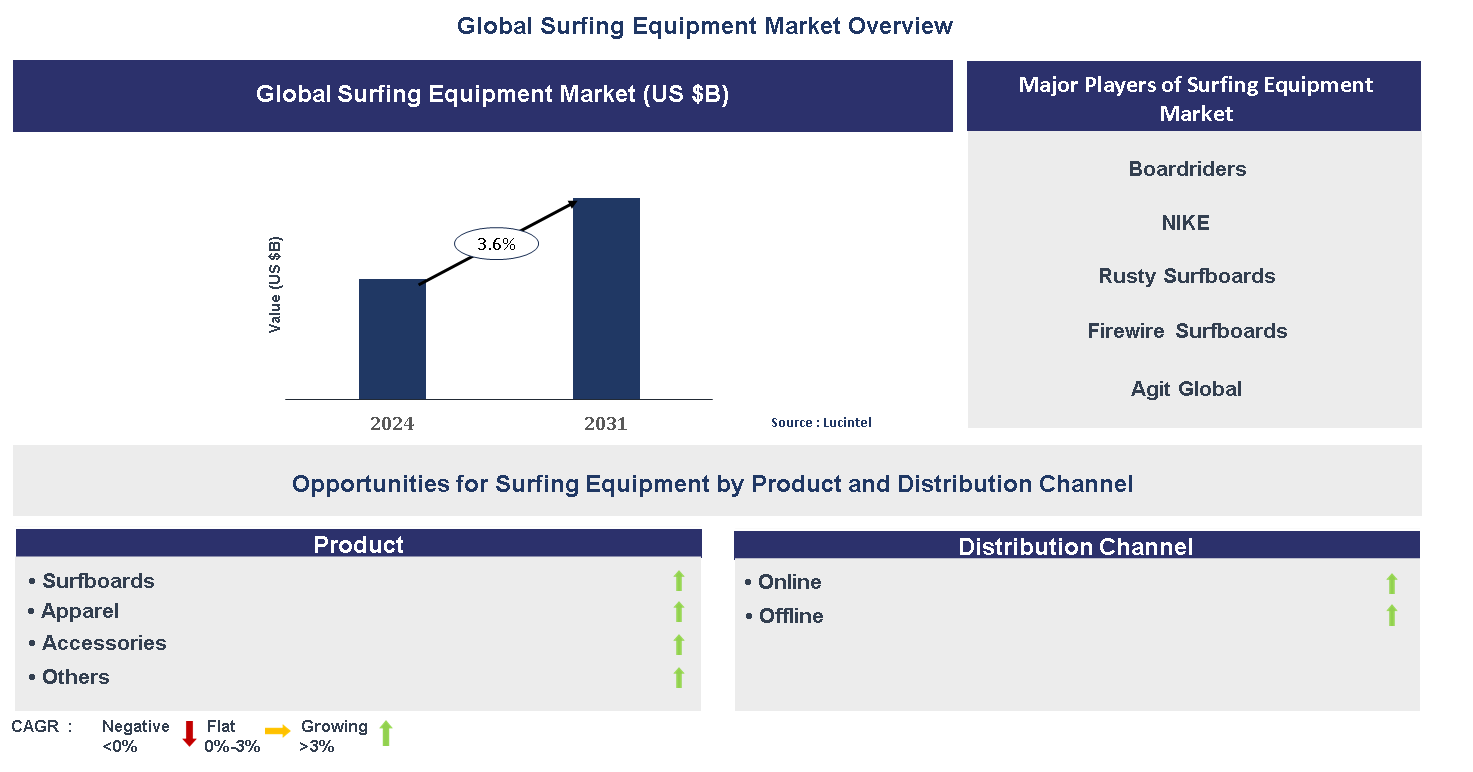
Surfing Equipment Market Trends and Forecast

Emerging Trends in the Surfing Equipment Market

The surfing equipment market is being remolded by a number of significant trends, catapulting the sport beyond the niche activity to a more mainstream and technologically connected lifestyle pursuit. These trends are fueled by consumer interest in sustainability, customized products, and increased access to the sport. As the sport of surfing continues to gain popularity around the world, manufacturers are developing new products to address the needs of a wide variety of surfers, from novice to professional.
• Eco-Friendly and Sustainable Materials: One of the key trends is towards sustainable production. Customers are now demanding products that have lower environmental footprints. In response, there has been the innovation of surfboards crafted from recycled EPS foam and plant-based bio-resins, and wetsuits constructed from natural rubber and limestone neoprene. This trend not only sits well with green surfers but also enables companies to develop a stronger, more ethical brand, positioning them in the market differently.
• Smart Equipment and Technological Integration: Technology integration is a major trend. Companies are integrating smart technology into equipment, like GPS-equipped fins that monitor speed and distance, and wetsuits with onboard sensors that measure performance metrics. In addition, computer-aided design (CAD) and 3D printing are allowing companies to produce highly bespoke and accurate board shapes. This high-tech process increases the surfing experience as well as offering valuable performance data for training and improvement.
• Expansion of Surf Parks and Wave Pools: The development of artificial wave pools is a revolutionary trend. These centers, offering predictable and consistent waves, are making it possible for individuals away from the seashore to experience surfing. This has opened up a new, focused market for gear in these controlled settings. It also offers a great gateway for novice surfers, who tend to need to buy or lease an entire set of gear, leading to demand for beginner gear.
• Personalization and Customization: There is also an increasing trend towards customization, where surfers demand boards that are specifically suited to their particular style, ability, and physique. Companies are providing online configurators where consumers can select everything from board shape and size to fin setup and art. Both high-end consumers who desire distinctive boards and newbie surfers who wish to have equipment that is perfectly adapted to their learning curve are supported by this trend.
• Fashion as Lifestyle and Performance Wear: The surf apparel industry is merging functional surf wear with lifestyle apparel. Brands are creating products that serve both in-water performance and after-surf relaxation. This is being spurred by surfers who desire versatile clothing that can be used throughout the day. It has produced product innovations, including quick-drying materials and UV-protective apparel, that are comfortable, protective, yet highly stylish.
These trends are transforming the surf equipment market by making the sport more accessible to the masses, embracing environmental stewardship, and harnessing technology in order to provide more personalized, high-performance products.
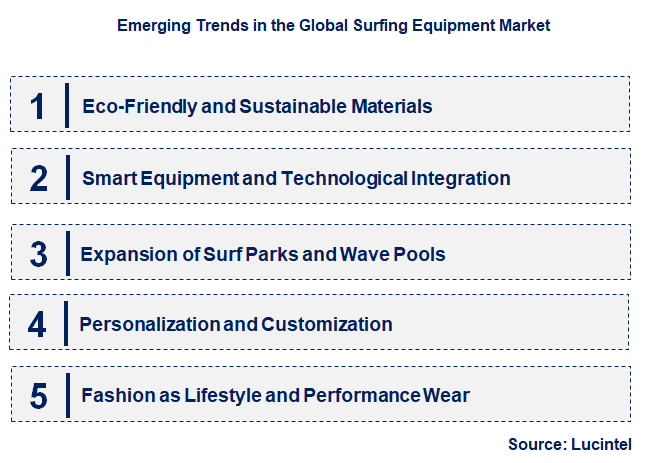
Emerging Trends in the Surfing Equipment Market

Recent Development in the Surfing Equipment Market

The surfing equipment industry is experiencing a phase of dynamic change, fueled by growth in a global community of surfers and technological and material innovation. These innovations are not only enhancing the performance of equipment but also responding to major consumer issues around sustainability and ease of use. The industry is shifting away from conventional product cycles with an emphasis on producing equipment that is more sustainable, environmentally friendly, and accessible to a broader market.
• Material Innovation for Performance and Sustainability: One of the essential developments is the application of new materials that not only improve performance but also environmental sustainability. Companies are substituting conventional polyurethane and fiberglass with eco-friendly alternatives such as recycled EPS foam cores and bio-based epoxy resins. Wetsuits are manufactured using plant-based or recycled rubber instead of petroleum-based neoprene. This innovation meets increasing consumer demand for greener products and has resulted in the production of lighter, tougher boards and more flexible wetsuits.
• Digital Integration and Smart Equipment: One of the most important innovations is the emergence of smart equipment. This involves fins and watches with onboard sensors that monitor wave count, speed, and distance. The information can be utilized to study performance and assist surfers in optimizing their technique. The employment of sophisticated software for board shaping and fin design makes it possible to achieve unparalleled accuracy and customization, which facilitates the production of equipment suitable for particular surfing styles and conditions.
• Expansion of the Rental and Sharing Economy: The higher demand for surf tourism and wave pools has spurred significant growth in the rental and sharing economy for surfing gear. Rather than buying costly equipment, most new and traveling surfers are opting to rent. This has developed a new business model for resorts and surf shops, which can provide boards and wetsuits of multiple types for various skill levels and conditions.
• Artificial Wave Technology and Its Impact: One of the most significant impacts is the spread of artificial wave technology. Wave parks like Kelly Slater Surf Ranch have introduced a new, controlled environment for surfing. Not only has this made it accessible to inland populations, but it has also resulted in the emergence of a specialized branch of equipment. Wave pool boards are commonly shorter and heavier, designed for the repeatable wave form and high-session volume that wave parks provide.
• Growth of Direct-to-Consumer Brands: A shift in the traditional model of distribution, which was controlled by surf shops, is being threatened by a growth in direct-to-consumer (D2C) brands. These D2C brands make use of the internet and social media in order to link directly with customers. They are able to provide more competitive pricing and more products, including highly customizable ones. The growth of D2C brands is increasing competition in the market and giving consumers more choice.
These advancements are cumulatively affecting the surfing gear market by making it a more innovative, user-friendly, and eco-friendly industry. They are changing the perception of what it is to be a surfer and opening up the market beyond its historical coastal dwellers.

Strategic Growth Opportunities in the Surfing Equipment Market

The surfing equipment market offers a range of strategic growth opportunities by appealing to particular applications and user bases. With the demographic for the sport expanding, so too are the needs of those who participate. Companies that are able to recognize and meet these specific applications will be positioned well to pick up market share and build brand loyalty. Such opportunities extend beyond traditional surfing locations and are fueled by new technologies and increased global participation.
• Surf School and Beginner Segment: It is a significant growth area. Surfing’s inclusion in the Olympics and the creation of wave pools are bringing on board a huge number of newcomers. It is a segment that demands affordable, forgiving, and rugged gear. Opportunities for strategic play here include creating safer and easier-to-learn soft-top and foam boards. Also, collaborating with surf schools and providing packages of rentals and lessons can be a pipeline for future sales of equipment as the beginner advances to higher-end gear.
• Sustainable and Environmentally Friendly Segment: As environmental concern grows, there is a strategic potential to reach the environmentally aware surfer. This entails producing and promoting products constructed from sustainable and recycled materials. Branding can revolve around incorporating bio-resins, recyclable plastics, and plant-based neoprene in wetsuits. This not only satisfies a consumer market that values sustainability but also makes the brand a leader in a socially conscious sector, which can charge a premium and establish robust brand trust.
• Urban and Inland Surfing Segment: The use of artificial wave technology has opened up a huge growth potential in urban and inland regions. This segment requires equipment suited for controlled environments and cramped storage space. Brands may design compact, light, and portable gear, as well as foldable or collapsible items. Strategic opportunities include opening retail stores close to wave parks and cooperating with these complexes to offer equipment rentals and sales.
• Professional and Performance Segment: This segment, while smaller in volume but larger in potential for brand development and innovation, is a vital platform for quality and innovation. Professional surfers and high-level enthusiasts need high-performance, specially designed equipment. Brands can put money into research and development to produce innovative designs, new materials, and intelligent technology that promotes speed and agility. Having professional surfers sponsor them and use their input to design new products can cement a brand’s image of quality and innovation.
• Surf Travel and Tourism Segment: Surf tourism growth brings the potential to serve travelers. The segment needs rugged, portable, and dependable gear that can survive the test of travel. Opportunities involve creating travel board bag and luggage with special designs and collaborating with surf resorts and tour operators in co-branded products or rentals. This enables brands to access the global surf travel market and connect with consumers in major surfing hotspots.
These opportunities are influencing the surfing equipment market through diversification and specialization. They are prompting brands to develop innovative thinking on product development, distribution, and marketing to address the needs of a variety of consumers.

Surfing Equipment Market Driver and Challenges

The market of surfing equipment is fueled by a mix of forces that drive its expansion, yet with serious challenges that need strategic maneuvering. The dynamics in the industry are shaped by technology, the environment, and a changing clientele. A balanced appreciation of these driving forces is important to all players. The destiny of the market rests on how well businesses can harness the growth drivers and dampen the associated challenges.
The factors responsible for driving the surfing equipment market include:
1. Growing Popularity and Mainstream Take-up of Surfing: One of the main drivers is increasing popularity of surfing, driven by its inclusion on large-scale events such as the Olympics. This has introduced the sport to the mainstream, drawing in a new, diverse range of participants. This exposure has generated a high level of demand for all equipment types, ranging from starter boards and wetsuits to specialized equipment, hence increasing the size of the overall market and inviting new competitors.
2. Materials Technology Advances: The consistent advance in materials is a major force. The creation of lighter, stronger, and more resilient materials such as high-density foam, carbon fiber, and advanced composites enables manufacturers to make more capable and resilient boards. These technology advances contribute to a better user experience, resulting in repeat business and increased demand for high-end, custom goods among both professional and recreational surfers.
3. Artificial Wave Park Proliferation: Development of artificial wave parks is one of the leading market growth drivers. Artificial wave parks bring surfing closer to those dwelling inland and allow for a constant, controlled environment for training and education. This has generated a new market for the equipment, and it has reduced the threshold of entry, bringing in thousands of new entrants to the sport who now must purchase or rent equipment.
4. Surf Tourism Growth: Growth in surf tourism is one of the main drivers. Increased travel to coastal regions for learning or practicing surfing is boosting the demand for rental gears and accessories at surf schools and holiday resorts. This also fosters a culture of buying travel-ready gears like lightweight boards and dedicated board bags, which is a major source of market growth in major tourist areas.
5. Social Media and Influencer Marketing: The influence of social media and influencer marketing has turned surfing into an aspirational sport. Brands have successfully utilized platforms such as Instagram and TikTok to promote the surfing lifestyle, new products, and innovative surfers. This has successfully created a strong community and directly affects consumer purchasing behavior, drives demand, and generates brand loyalty across a global audience.
Challenges in the surfing equipment market are:
1. High Cost and Entry Barrier: The cost of surfing gear is high, which poses a significant challenge to new entrants. A complete set, i.e., board, wetsuit, and accessories, can represent a considerable investment. The high entry barrier will discourage potential entrants, especially in developing economies where disposable income is not substantial.
2. Environmental Issues: The sport of surfing encounters issues about its environmental impact. Classical surfboards are constructed using polyurethane foam and fiberglass, neither of which is biodegradable. The petroleum-based neoprene used in wetsuits is another point of concern. This has resulted in calls for more sustainable alternatives, but these tend to be more costly, thus introducing a tension between consumer values and price.
3. Seasonal and Geographic Limitations: The surfing market is intrinsically seasonal and geographic. Equipment sales can be very seasonal in most areas, which means that inventory control and revenue projections are problematic. In addition, the sport is confined to coastal or near-coastal areas, or places with wave pools, which confines the physical extent of the market and can complicate reaching steady, year-round sales.
The combined effect of these drivers and challenges is a market in the midst of a significant transformation. Whereas the drivers are propelling the market to new heights and expanding its reach, the challenges compel the industry to innovate and evolve. Success will hinge on the capacity of brands to make the sport more convenient, sustainable, and technologically driven while charting a complicated path of consumer demands and market constraints.

List of Surfing Equipment Companies

Companies in the market compete on the basis of product quality offered. Major players in this market focus on expanding their manufacturing facilities, R&D investments, infrastructural development, and leverage integration opportunities across the value chain. With these strategies surfing equipment companies cater increasing demand, ensure competitive effectiveness, develop innovative products & technologies, reduce production costs, and expand their customer base. Some of the surfing equipment companies profiled in this report include-
• Boardriders
• NIKE
• Rusty Surfboards
• Firewire Surfboards
• Agit Global

Surfing Equipment Market by Segment

The study includes a forecast for the global surfing equipment market by product, distribution channel, and region.

Surfing Equipment Market by Product [Value from 2019 to 2031]:


• Surfboards
• Apparel
• Accessories
• Others

Surfing Equipment Market by Distribution Channel [Value from 2019 to 2031]:


• Online
• Offline

Surfing Equipment Market by Region [Value from 2019 to 2031]:


• North America
• Europe
• Asia Pacific
• The Rest of the World

Country Wise Outlook for the Surfing Equipment Market

The world surfing equipment market is going through a time of intense growth and advancement. This is being fueled by increased popularity of the sport, its addition to high-profile events such as the Olympics, and an increased emphasis on sustainability. Recent trends are taking the market away from its historical beach-based locations, with new technologies such as wave pools making the sport more accessible to more people.
• United States: The United States, with its long coastline and deep surf culture, is still a leading force. New developments are marked by a strong focus on technological innovation and sustainable methods. There is increased demand for environmentally friendly boards made from recycled foam and bio-resins. The market has experienced an upsurge in demand for high-performance custom boards and intelligent accessories, which is indicative of a shift towards customized gear.
• China: China’s surf equipment market is in a state of fast expansion. Current developments are fueled by the government’s encouragement of water sports and the growth of a millennial and Gen Z consumer base for new recreational sports. The market is seeing a strong demand for soft-top boards and entry-level boards as surf schools and clubs mushroom in coastal cities such as Hainan.
• Germany: The surfing equipment market in Germany is exceptional in that it is a coastal-free market fueled by surf tourism and an emerging wave pool scene. Major trends involve a premium, high-end approach to gear for surfer travelers traveling to places such as Portugal and France. The market is also witnessing an increase in demand for sustainable apparel and wetsuits. German companies are leading the development of artificial wave technology, creating a new category for specialized equipment and boards tailored for these controlled environments.
• India: The Indian surfing equipment market is in its early stage but is growing at a very fast pace. This is fueled by a growing adventure sports culture and higher disposable income among the youth. One of the most significant developments is the setting up of additional surf schools and clubs in coastal states such as Karnataka and Tamil Nadu, which is boosting the demand for rental and entry-level equipment. The market is greatly impacted by world trends via online platforms, but the biggest setback is domestic manufacturing and the exorbitant price of importing machinery.
• Japan: The Japanese surfing equipment market is technologically sophisticated and mature. Current trends are characterized by intense product miniaturization and new material development. The addition of surfing at the Tokyo Olympics has stimulated interest, causing an upsurge in demand for performance-based equipment. The market is also experiencing a trend in small surfboards and foldable wetsuits for urban residents with limited storage.

Lucintel Analytics Dashboard

Features of the Global Surfing Equipment Market

Market Size Estimates: Surfing equipment market size estimation in terms of value ($B).
Trend and Forecast Analysis: Market trends (2019 to 2024) and forecast (2025 to 2031) by various segments and regions.
Segmentation Analysis: Surfing equipment market size by product, distribution channel, and region in terms of value ($B).
Regional Analysis: Surfing equipment market breakdown by North America, Europe, Asia Pacific, and Rest of the World.
Growth Opportunities: Analysis of growth opportunities in different product, distribution channel, and regions for the surfing equipment market.
Strategic Analysis: This includes M&A, new product development, and competitive landscape of the surfing equipment market.
Analysis of competitive intensity of the industry based on Porter’s Five Forces model.

Lucintel Consulting Services

FAQ

Q1. What is the growth forecast for surfing equipment market?
Answer: The global surfing equipment market is expected to grow with a CAGR of 3.6% from 2025 to 2031.
Q2. What are the major drivers influencing the growth of the surfing equipment market?
Answer: The major drivers for this market are the increasing popularity of water sports, the rising demand for adventure tourism, and the growing awareness of outdoor activities.
Q3. What are the major segments for surfing equipment market?
Answer: The future of the surfing equipment market looks promising with opportunities in the surfboard, apparel, and accessory markets.
Q4. Who are the key surfing equipment market companies?
Answer: Some of the key surfing equipment companies are as follows:
• Boardriders
• NIKE
• Rusty Surfboards
• Firewire Surfboards
• Agit Global
Q5. Which surfing equipment market segment will be the largest in future?
Answer: Lucintel forecasts that, within the distribution channel category, online is expected to witness higher growth over the forecast period.
Q6. In surfing equipment market, which region is expected to be the largest in next 5 years?
Answer: In terms of region, APAC is expected to witness the highest growth over the forecast period.
Q7. Do we receive customization in this report?
Answer: Yes, Lucintel provides 10% customization without any additional cost.

This report answers following 11 key questions:

Q.1. What are some of the most promising, high-growth opportunities for the surfing equipment market by product (surfboards, apparel, accessories, and others), distribution channel (online and offline), and region (North America, Europe, Asia Pacific, and the Rest of the World)?
Q.2. Which segments will grow at a faster pace and why?
Q.3. Which region will grow at a faster pace and why?
Q.4. What are the key factors affecting market dynamics? What are the key challenges and business risks in this market?
Q.5. What are the business risks and competitive threats in this market?
Q.6. What are the emerging trends in this market and the reasons behind them?
Q.7. What are some of the changing demands of customers in the market?
Q.8. What are the new developments in the market? Which companies are leading these developments?
Q.9. Who are the major players in this market? What strategic initiatives are key players pursuing for business growth?
Q.10. What are some of the competing products in this market and how big of a threat do they pose for loss of market share by material or product substitution?
Q.11. What M&A activity has occurred in the last 5 years and what has its impact been on the industry?

For any questions related to Surfing Equipment Market, Surfing Equipment Market Size, Surfing Equipment Market Growth, Surfing Equipment Market Analysis, Surfing Equipment Market Report, Surfing Equipment Market Share, Surfing Equipment Market Trends, Surfing Equipment Market Forecast, Surfing Equipment Companies, write Lucintel analyst at email: helpdesk@lucintel.com. We will be glad to get back to you soon.
                                           Table of Contents

            1. Executive Summary

            2. Market Overview

                        2.1 Background and Classifications
                        2.2 Supply Chain

            3. Market Trends & Forecast Analysis

                        3.1 Macroeconomic Trends and Forecasts
                        3.2 Industry Drivers and Challenges
                        3.3 PESTLE Analysis
                        3.4 Patent Analysis
                        3.5 Regulatory Environment
                        3.6 Global Surfing Equipment Market Trends and Forecast

            4. Global Surfing Equipment Market by Product

                        4.1 Overview
                        4.2 Attractiveness Analysis by Product
                        4.3 Surfboards : Trends and Forecast 2025 to 2031
                        4.4 Apparel : Trends and Forecast 2025 to 2031
                        4.5 Accessories : Trends and Forecast 2025 to 2031
                        4.6 Others : Trends and Forecast 2025 to 2031

            5. Global Surfing Equipment Market by Distribution Channel

                        5.1 Overview
                        5.2 Attractiveness Analysis by Distribution Channel
                        5.3 Online : Trends and Forecast 2025 to 2031
                        5.4 Offline : Trends and Forecast 2025 to 2031

            6. Regional Analysis

                        6.1 Overview
                        6.2 Global Surfing Equipment Market by Region

            7. North American Surfing Equipment Market

                        7.1 Overview
                        7.2 North American Surfing Equipment Market by Distribution Channel
                        7.3 North American Surfing Equipment Market by Product
                        7.4 The United States Surfing Equipment Market
                        7.5 Canadian Surfing Equipment Market
                        7.6 Mexican Surfing Equipment Market

            8. European Surfing Equipment Market

                        8.1 Overview
                        8.2 European Surfing Equipment Market by Distribution Channel
                        8.3 European Surfing Equipment Market by Product
                        8.4 German Surfing Equipment Market
                        8.5 French Surfing Equipment Market
                        8.6 Italian Surfing Equipment Market
                        8.7 Spanish Surfing Equipment Market
                        8.8 The United Kingdom Surfing Equipment Market

            9. APAC Surfing Equipment Market

                        9.1 Overview
                        9.2 APAC Surfing Equipment Market by Distribution Channel
                        9.3 APAC Surfing Equipment Market by Product
                        9.4 Chinese Surfing Equipment Market
                        9.5 Indian Surfing Equipment Market
                        9.6 Japanese Surfing Equipment Market
                        9.7 South Korean Surfing Equipment Market
                        9.8 Indonesian Surfing Equipment Market

            10. ROW Surfing Equipment Market

                        10.1 Overview
                        10.2 ROW Surfing Equipment Market by Distribution Channel
                        10.3 ROW Surfing Equipment Market by Product
                        10.4 Middle Eastern Surfing Equipment Market
                        10.5 South American Surfing Equipment Market
                        10.6 African Surfing Equipment Market

            11. Competitor Analysis

                        11.1 Product Portfolio Analysis
                        11.2 Operational Integration
                        11.3 Porter’s Five Forces Analysis
                                    • Competitive Rivalry
                                    • Bargaining Power of Buyers
                                    • Bargaining Power of Suppliers
                                    • Threat of Substitutes
                                    • Threat of New Entrants
                        11.4 Market Share Analysis

            12. Opportunities & Strategic Analysis

                        12.1 Value Chain Analysis
                        12.2 Growth Opportunity Analysis
                                    12.2.1 Growth Opportunity by Product
                                    12.2.2 Growth Opportunity by Distribution Channel
                        12.3 Emerging Trends in the Global Surfing Equipment Market
                        12.4 Strategic Analysis
                                    12.4.1 New Product Development
                                    12.4.2 Certification and Licensing
                                    12.4.3 Mergers, Acquisitions, Agreements, Collaborations, and Joint Ventures

            13. Company Profiles of the Leading Players Across the Value Chain

                        13.1 Competitive Analysis
                        13.2 Boardriders
                                    • Company Overview
                                    • Surfing Equipment Market Business Overview
                                    • New Product Development
                                    • Merger, Acquisition, and Collaboration
                                    • Certification and Licensing
                        13.3 NIKE
                                    • Company Overview
                                    • Surfing Equipment Market Business Overview
                                    • New Product Development
                                    • Merger, Acquisition, and Collaboration
                                    • Certification and Licensing
                        13.4 Rusty Surfboards
                                    • Company Overview
                                    • Surfing Equipment Market Business Overview
                                    • New Product Development
                                    • Merger, Acquisition, and Collaboration
                                    • Certification and Licensing
                        13.5 Firewire Surfboards
                                    • Company Overview
                                    • Surfing Equipment Market Business Overview
                                    • New Product Development
                                    • Merger, Acquisition, and Collaboration
                                    • Certification and Licensing
                        13.6 Agit Global
                                    • Company Overview
                                    • Surfing Equipment Market Business Overview
                                    • New Product Development
                                    • Merger, Acquisition, and Collaboration
                                    • Certification and Licensing

            14. Appendix

                        14.1 List of Figures
                        14.2 List of Tables
                        14.3 Research Methodology
                        14.4 Disclaimer
                        14.5 Copyright
                        14.6 Abbreviations and Technical Units
                        14.7 About Us
                        14.8 Contact Us

                                               List of Figures


            Chapter 1

                        Figure 1.1: Trends and Forecast for the Global Surfing Equipment Market

            Chapter 2

                        Figure 2.1: Usage of Surfing Equipment Market
                        Figure 2.2: Classification of the Global Surfing Equipment Market
                        Figure 2.3: Supply Chain of the Global Surfing Equipment Market

            Chapter 3

                        Figure 3.1: Trends of the Global GDP Growth Rate
                        Figure 3.2: Trends of the Global Population Growth Rate
                        Figure 3.3: Trends of the Global Inflation Rate
                        Figure 3.4: Trends of the Global Unemployment Rate
                        Figure 3.5: Trends of the Regional GDP Growth Rate
                        Figure 3.6: Trends of the Regional Population Growth Rate
                        Figure 3.7: Trends of the Regional Inflation Rate
                        Figure 3.8: Trends of the Regional Unemployment Rate
                        Figure 3.9: Trends of Regional Per Capita Income
                        Figure 3.10: Forecast for the Global GDP Growth Rate
                        Figure 3.11: Forecast for the Global Population Growth Rate
                        Figure 3.12: Forecast for the Global Inflation Rate
                        Figure 3.13: Forecast for the Global Unemployment Rate
                        Figure 3.14: Forecast for the Regional GDP Growth Rate
                        Figure 3.15: Forecast for the Regional Population Growth Rate
                        Figure 3.16: Forecast for the Regional Inflation Rate
                        Figure 3.17: Forecast for the Regional Unemployment Rate
                        Figure 3.18: Forecast for Regional Per Capita Income
                        Figure 3.19: Driver and Challenges of the Surfing Equipment Market

            Chapter 4

                        Figure 4.1: Global Surfing Equipment Market by Product in 2019, 2024, and 2031
                        Figure 4.2: Trends of the Global Surfing Equipment Market ($B) by Product
                        Figure 4.3: Forecast for the Global Surfing Equipment Market ($B) by Product
                        Figure 4.4: Trends and Forecast for Surfboards in the Global Surfing Equipment Market (2019-2031)
                        Figure 4.5: Trends and Forecast for Apparel in the Global Surfing Equipment Market (2019-2031)
                        Figure 4.6: Trends and Forecast for Accessories in the Global Surfing Equipment Market (2019-2031)
                        Figure 4.7: Trends and Forecast for Others in the Global Surfing Equipment Market (2019-2031)

            Chapter 5

                        Figure 5.1: Global Surfing Equipment Market by Distribution Channel in 2019, 2024, and 2031
                        Figure 5.2: Trends of the Global Surfing Equipment Market ($B) by Distribution Channel
                        Figure 5.3: Forecast for the Global Surfing Equipment Market ($B) by Distribution Channel
                        Figure 5.4: Trends and Forecast for Online in the Global Surfing Equipment Market (2019-2031)
                        Figure 5.5: Trends and Forecast for Offline in the Global Surfing Equipment Market (2019-2031)

            Chapter 6

                        Figure 6.1: Trends of the Global Surfing Equipment Market ($B) by Region (2019-2024)
                        Figure 6.2: Forecast for the Global Surfing Equipment Market ($B) by Region (2025-2031)

            Chapter 7

                        Figure 7.1: Trends and Forecast for the North American Surfing Equipment Market (2019-2031)
                        Figure 7.2: North American Surfing Equipment Market by Product in 2019, 2024, and 2031
                        Figure 7.3: Trends of the North American Surfing Equipment Market ($B) by Product (2019-2024)
                        Figure 7.4: Forecast for the North American Surfing Equipment Market ($B) by Product (2025-2031)
                        Figure 7.5: North American Surfing Equipment Market by Distribution Channel in 2019, 2024, and 2031
                        Figure 7.6: Trends of the North American Surfing Equipment Market ($B) by Distribution Channel (2019-2024)
                        Figure 7.7: Forecast for the North American Surfing Equipment Market ($B) by Distribution Channel (2025-2031)
                        Figure 7.8: Trends and Forecast for the United States Surfing Equipment Market ($B) (2019-2031)
                        Figure 7.9: Trends and Forecast for the Mexican Surfing Equipment Market ($B) (2019-2031)
                        Figure 7.10: Trends and Forecast for the Canadian Surfing Equipment Market ($B) (2019-2031)

            Chapter 8

                        Figure 8.1: Trends and Forecast for the European Surfing Equipment Market (2019-2031)
                        Figure 8.2: European Surfing Equipment Market by Product in 2019, 2024, and 2031
                        Figure 8.3: Trends of the European Surfing Equipment Market ($B) by Product (2019-2024)
                        Figure 8.4: Forecast for the European Surfing Equipment Market ($B) by Product (2025-2031)
                        Figure 8.5: European Surfing Equipment Market by Distribution Channel in 2019, 2024, and 2031
                        Figure 8.6: Trends of the European Surfing Equipment Market ($B) by Distribution Channel (2019-2024)
                        Figure 8.7: Forecast for the European Surfing Equipment Market ($B) by Distribution Channel (2025-2031)
                        Figure 8.8: Trends and Forecast for the German Surfing Equipment Market ($B) (2019-2031)
                        Figure 8.9: Trends and Forecast for the French Surfing Equipment Market ($B) (2019-2031)
                        Figure 8.10: Trends and Forecast for the Spanish Surfing Equipment Market ($B) (2019-2031)
                        Figure 8.11: Trends and Forecast for the Italian Surfing Equipment Market ($B) (2019-2031)
                        Figure 8.12: Trends and Forecast for the United Kingdom Surfing Equipment Market ($B) (2019-2031)

            Chapter 9

                        Figure 9.1: Trends and Forecast for the APAC Surfing Equipment Market (2019-2031)
                        Figure 9.2: APAC Surfing Equipment Market by Product in 2019, 2024, and 2031
                        Figure 9.3: Trends of the APAC Surfing Equipment Market ($B) by Product (2019-2024)
                        Figure 9.4: Forecast for the APAC Surfing Equipment Market ($B) by Product (2025-2031)
                        Figure 9.5: APAC Surfing Equipment Market by Distribution Channel in 2019, 2024, and 2031
                        Figure 9.6: Trends of the APAC Surfing Equipment Market ($B) by Distribution Channel (2019-2024)
                        Figure 9.7: Forecast for the APAC Surfing Equipment Market ($B) by Distribution Channel (2025-2031)
                        Figure 9.8: Trends and Forecast for the Japanese Surfing Equipment Market ($B) (2019-2031)
                        Figure 9.9: Trends and Forecast for the Indian Surfing Equipment Market ($B) (2019-2031)
                        Figure 9.10: Trends and Forecast for the Chinese Surfing Equipment Market ($B) (2019-2031)
                        Figure 9.11: Trends and Forecast for the South Korean Surfing Equipment Market ($B) (2019-2031)
                        Figure 9.12: Trends and Forecast for the Indonesian Surfing Equipment Market ($B) (2019-2031)

            Chapter 10

                        Figure 10.1: Trends and Forecast for the ROW Surfing Equipment Market (2019-2031)
                        Figure 10.2: ROW Surfing Equipment Market by Product in 2019, 2024, and 2031
                        Figure 10.3: Trends of the ROW Surfing Equipment Market ($B) by Product (2019-2024)
                        Figure 10.4: Forecast for the ROW Surfing Equipment Market ($B) by Product (2025-2031)
                        Figure 10.5: ROW Surfing Equipment Market by Distribution Channel in 2019, 2024, and 2031
                        Figure 10.6: Trends of the ROW Surfing Equipment Market ($B) by Distribution Channel (2019-2024)
                        Figure 10.7: Forecast for the ROW Surfing Equipment Market ($B) by Distribution Channel (2025-2031)
                        Figure 10.8: Trends and Forecast for the Middle Eastern Surfing Equipment Market ($B) (2019-2031)
                        Figure 10.9: Trends and Forecast for the South American Surfing Equipment Market ($B) (2019-2031)
                        Figure 10.10: Trends and Forecast for the African Surfing Equipment Market ($B) (2019-2031)

            Chapter 11

                        Figure 11.1: Porter’s Five Forces Analysis of the Global Surfing Equipment Market
                        Figure 11.2: Market Share (%) of Top Players in the Global Surfing Equipment Market (2024)

            Chapter 12

                        Figure 12.1: Growth Opportunities for the Global Surfing Equipment Market by Product
                        Figure 12.2: Growth Opportunities for the Global Surfing Equipment Market by Distribution Channel
                        Figure 12.3: Growth Opportunities for the Global Surfing Equipment Market by Region
                        Figure 12.4: Emerging Trends in the Global Surfing Equipment Market

                                               List of Tables


            Chapter 1

                        Table 1.1: Growth Rate (%, 2023-2024) and CAGR (%, 2025-2031) of the Surfing Equipment Market by Product and Distribution Channel
                        Table 1.2: Attractiveness Analysis for the Surfing Equipment Market by Region
                        Table 1.3: Global Surfing Equipment Market Parameters and Attributes

            Chapter 3

                        Table 3.1: Trends of the Global Surfing Equipment Market (2019-2024)
                        Table 3.2: Forecast for the Global Surfing Equipment Market (2025-2031)

            Chapter 4

                        Table 4.1: Attractiveness Analysis for the Global Surfing Equipment Market by Product
                        Table 4.2: Market Size and CAGR of Various Product in the Global Surfing Equipment Market (2019-2024)
                        Table 4.3: Market Size and CAGR of Various Product in the Global Surfing Equipment Market (2025-2031)
                        Table 4.4: Trends of Surfboards in the Global Surfing Equipment Market (2019-2024)
                        Table 4.5: Forecast for Surfboards in the Global Surfing Equipment Market (2025-2031)
                        Table 4.6: Trends of Apparel in the Global Surfing Equipment Market (2019-2024)
                        Table 4.7: Forecast for Apparel in the Global Surfing Equipment Market (2025-2031)
                        Table 4.8: Trends of Accessories in the Global Surfing Equipment Market (2019-2024)
                        Table 4.9: Forecast for Accessories in the Global Surfing Equipment Market (2025-2031)
                        Table 4.10: Trends of Others in the Global Surfing Equipment Market (2019-2024)
                        Table 4.11: Forecast for Others in the Global Surfing Equipment Market (2025-2031)

            Chapter 5

                        Table 5.1: Attractiveness Analysis for the Global Surfing Equipment Market by Distribution Channel
                        Table 5.2: Market Size and CAGR of Various Distribution Channel in the Global Surfing Equipment Market (2019-2024)
                        Table 5.3: Market Size and CAGR of Various Distribution Channel in the Global Surfing Equipment Market (2025-2031)
                        Table 5.4: Trends of Online in the Global Surfing Equipment Market (2019-2024)
                        Table 5.5: Forecast for Online in the Global Surfing Equipment Market (2025-2031)
                        Table 5.6: Trends of Offline in the Global Surfing Equipment Market (2019-2024)
                        Table 5.7: Forecast for Offline in the Global Surfing Equipment Market (2025-2031)

            Chapter 6

                        Table 6.1: Market Size and CAGR of Various Regions in the Global Surfing Equipment Market (2019-2024)
                        Table 6.2: Market Size and CAGR of Various Regions in the Global Surfing Equipment Market (2025-2031)

            Chapter 7

                        Table 7.1: Trends of the North American Surfing Equipment Market (2019-2024)
                        Table 7.2: Forecast for the North American Surfing Equipment Market (2025-2031)
                        Table 7.3: Market Size and CAGR of Various Product in the North American Surfing Equipment Market (2019-2024)
                        Table 7.4: Market Size and CAGR of Various Product in the North American Surfing Equipment Market (2025-2031)
                        Table 7.5: Market Size and CAGR of Various Distribution Channel in the North American Surfing Equipment Market (2019-2024)
                        Table 7.6: Market Size and CAGR of Various Distribution Channel in the North American Surfing Equipment Market (2025-2031)
                        Table 7.7: Trends and Forecast for the United States Surfing Equipment Market (2019-2031)
                        Table 7.8: Trends and Forecast for the Mexican Surfing Equipment Market (2019-2031)
                        Table 7.9: Trends and Forecast for the Canadian Surfing Equipment Market (2019-2031)

            Chapter 8

                        Table 8.1: Trends of the European Surfing Equipment Market (2019-2024)
                        Table 8.2: Forecast for the European Surfing Equipment Market (2025-2031)
                        Table 8.3: Market Size and CAGR of Various Product in the European Surfing Equipment Market (2019-2024)
                        Table 8.4: Market Size and CAGR of Various Product in the European Surfing Equipment Market (2025-2031)
                        Table 8.5: Market Size and CAGR of Various Distribution Channel in the European Surfing Equipment Market (2019-2024)
                        Table 8.6: Market Size and CAGR of Various Distribution Channel in the European Surfing Equipment Market (2025-2031)
                        Table 8.7: Trends and Forecast for the German Surfing Equipment Market (2019-2031)
                        Table 8.8: Trends and Forecast for the French Surfing Equipment Market (2019-2031)
                        Table 8.9: Trends and Forecast for the Spanish Surfing Equipment Market (2019-2031)
                        Table 8.10: Trends and Forecast for the Italian Surfing Equipment Market (2019-2031)
                        Table 8.11: Trends and Forecast for the United Kingdom Surfing Equipment Market (2019-2031)

            Chapter 9

                        Table 9.1: Trends of the APAC Surfing Equipment Market (2019-2024)
                        Table 9.2: Forecast for the APAC Surfing Equipment Market (2025-2031)
                        Table 9.3: Market Size and CAGR of Various Product in the APAC Surfing Equipment Market (2019-2024)
                        Table 9.4: Market Size and CAGR of Various Product in the APAC Surfing Equipment Market (2025-2031)
                        Table 9.5: Market Size and CAGR of Various Distribution Channel in the APAC Surfing Equipment Market (2019-2024)
                        Table 9.6: Market Size and CAGR of Various Distribution Channel in the APAC Surfing Equipment Market (2025-2031)
                        Table 9.7: Trends and Forecast for the Japanese Surfing Equipment Market (2019-2031)
                        Table 9.8: Trends and Forecast for the Indian Surfing Equipment Market (2019-2031)
                        Table 9.9: Trends and Forecast for the Chinese Surfing Equipment Market (2019-2031)
                        Table 9.10: Trends and Forecast for the South Korean Surfing Equipment Market (2019-2031)
                        Table 9.11: Trends and Forecast for the Indonesian Surfing Equipment Market (2019-2031)

            Chapter 10

                        Table 10.1: Trends of the ROW Surfing Equipment Market (2019-2024)
                        Table 10.2: Forecast for the ROW Surfing Equipment Market (2025-2031)
                        Table 10.3: Market Size and CAGR of Various Product in the ROW Surfing Equipment Market (2019-2024)
                        Table 10.4: Market Size and CAGR of Various Product in the ROW Surfing Equipment Market (2025-2031)
                        Table 10.5: Market Size and CAGR of Various Distribution Channel in the ROW Surfing Equipment Market (2019-2024)
                        Table 10.6: Market Size and CAGR of Various Distribution Channel in the ROW Surfing Equipment Market (2025-2031)
                        Table 10.7: Trends and Forecast for the Middle Eastern Surfing Equipment Market (2019-2031)
                        Table 10.8: Trends and Forecast for the South American Surfing Equipment Market (2019-2031)
                        Table 10.9: Trends and Forecast for the African Surfing Equipment Market (2019-2031)

            Chapter 11

                        Table 11.1: Product Mapping of Surfing Equipment Suppliers Based on Segments
                        Table 11.2: Operational Integration of Surfing Equipment Manufacturers
                        Table 11.3: Rankings of Suppliers Based on Surfing Equipment Revenue

            Chapter 12

                        Table 12.1: New Product Launches by Major Surfing Equipment Producers (2019-2024)
                        Table 12.2: Certification Acquired by Major Competitor in the Global Surfing Equipment Market

.

Buy full report or by chapter as follows

Limited Time Offer

Price by License Type:
[-] Hide Chapter Details
[Chapter Number] [Chapter Name] [Chapter Number Of Pages] [Chapter Price]
Title/Chapter Name Pages Price
Full Report: Surfing Equipment Market Report: Trends, Forecast and Competitive Analysis to 2031 Full Report $ 2,990
A 150 Page Report
Lucintel has been in the business of market research and management consulting since 2000 and has published over 1000 market intelligence reports in various markets / applications and served over 1,000 clients worldwide. This study is a culmination of four months of full-time effort performed by Lucintel's analyst team. The analysts used the following sources for the creation and completion of this valuable report:
  • In-depth interviews of the major players in this market
  • Detailed secondary research from competitors’ financial statements and published data 
  • Extensive searches of published works, market, and database information pertaining to industry news, company press releases, and customer intentions
  • A compilation of the experiences, judgments, and insights of Lucintel’s professionals, who have analyzed and tracked this market over the years.
Extensive research and interviews are conducted across the supply chain of this market to estimate market share, market size, trends, drivers, challenges, and forecasts. Below is a brief summary of the primary interviews that were conducted by job function for this report.
 
Thus, Lucintel compiles vast amounts of data from numerous sources, validates the integrity of that data, and performs a comprehensive analysis. Lucintel then organizes the data, its findings, and insights into a concise report designed to support the strategic decision-making process. The figure below is a graphical representation of Lucintel’s research process. 
 

Please sign in below to get report brochure - Surfing Equipment Market Report.

At Lucintel, we respect your privacy and maintain the confidentiality of information / data provided by you
(Please enter your corporate email. * These fields are mandatory )

Follow us on