
Market Report · July 15, 2026

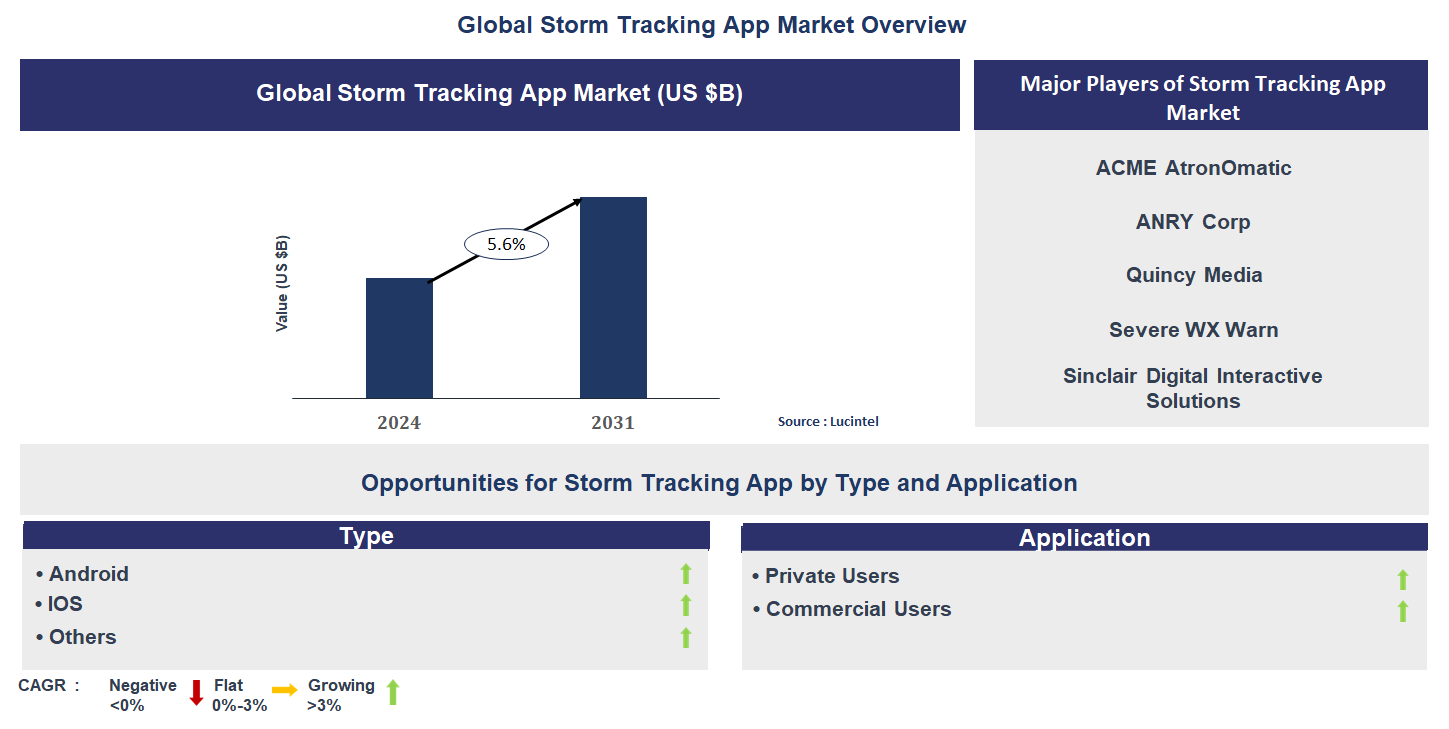
Key data points: The growth forecast = 5.6% annually for the next 7 years. Scroll below to get more insights. This market report covers trends, opportunities and forecasts in storm tracking app market to 2031 by type (android, IOS, and others), application (private users and commercial users), and region (North America, Europe, Asia Pacific, and the Rest of the World)
We'll send your sample report shortly.
• Lucintel forecasts that, within the type category, android is expected to witness higher growth over the forecast period.
• Within the application category, commercial user is expected to witness higher growth.
• In terms of region, APAC is expected to witness the highest growth over the forecast period. Gain valuable insights for your business decisions with our comprehensive 150+ page report. Sample figures with some insights are shown below.
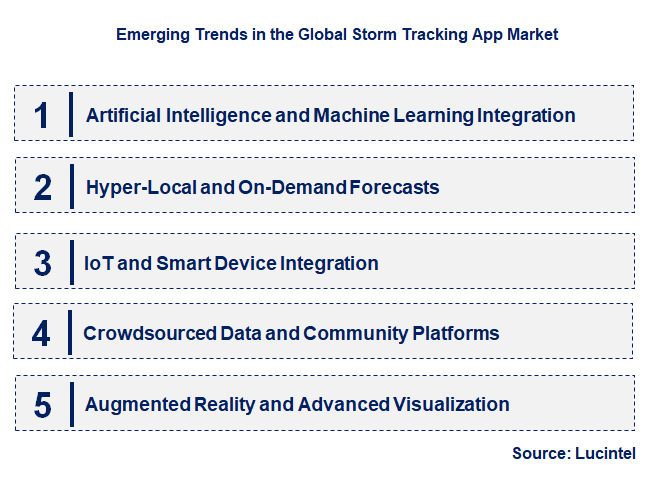
• Artificial Intelligence and Machine Learning Integration: One of the biggest trends is the application of artificial intelligence (AI) and machine learning (ML) to handle large volumes of weather information from satellites, radar, and ground sensors. The technology assists in recognizing intricate weather patterns and refining storm path forecasting accuracy. The contribution is a better and timelier forecasting system. AI-based models have the ability to process data quicker than conventional methods, enabling apps to give more sophisticated alerts for extreme weather conditions and making their overall accuracy higher.
• Hyper-Local and On-Demand Forecasts: There is increasing demand for hyper-local and on-demand weather. Users no longer desire broad regional forecasts; they desire to know their street or even their backyard’s weather. The effect is an extremely personalized user experience. This is fueled by the growth of GPS-capable smartphones and a network of ground-level weather sensors that offer real-time information, allowing apps to offer minute-by-minute updates and targeted alerts for a user’s precise location.
• IoT and Smart Device Integration: One of the new trends is integrating storm tracking apps with the Internet of Things (IoT) and smart devices. This involves linking apps with smart thermostats, sprinkler systems, and even windows. The effect is automatic and seamless reaction to weather events. For instance, a home automation system is able to switch temperatures or shut blinds ahead of a storm automatically, promoting safety and energy efficiency. This trend makes the app no longer a passive tool but an active component in personal and home safety.
• Crowdsourced Data and Community Platforms: The main trend is the use of crowdsourced data and community features. Applications now enable users to report on weather conditions, share storm damage photos, and pass along real-time observations to others. The result is a richer and more dynamic source of data. The move uses the power of the aggregate user base as a way to support official information, which can be especially helpful for delivering ground-based insights and an fuller sense of a storms effect.
• Augmented Reality and Advanced Visualization: One major trend is the application of AR and advanced data visualization to enhance storm tracking as an interactive and intuitive process. This involves applying AR to overlay a storm’s trajectory onto an actual-world map and developing 3D representations of weather patterns. The result is an experience that is more user-centric and visually appealing. By simplifying intricate weather information, these features keep users coming back and bring them in, and prepare them more effectively for an oncoming storm. Collectively, these trends are remaking the market by enhancing storm tracking apps to be smarter, more personalized, and integrated into everyday life, setting the industry up for tremendous future growth.
• AI Integration for Predictive Analysis: The significant advancement is the use of artificial intelligence (AI) and machine learning to build better predictive models. These technologies scan immense amounts of data from satellites, radar, and sensors to predict the path and intensity of a storm more accurately. The effect is fewer false alarms and a better warning system. By continuously learning from historical data and real-time observations, AI-powered apps are able to provide more trustworthy forecasts that help users make better decisions.
• Hyper-local and Real-time Data: A key development is the shift toward providing hyper-local, minute-by-minute data. Many apps are now using advanced radar and a network of ground-based sensors to provide highly specific information for a user’s exact location. The effect is one of a record level of personalization and immediacy. This advance is especially significant for activities very sensitive to weather fluctuations, like sports played outside, farming, and building construction, where real-time information can avoid accidents and save money.
• Multi-Hazard Alert Systems: The most recent innovation is the development of multi-hazard alert systems that integrate storm tracking with other alerts, e.g., for lightning, floods, and even earthquake activities. The result is a more holistic and complete safety device. By bringing together several threats onto one platform, these apps make it easier for people to prepare for emergencies by providing access to all the relevant information they might need during an emergency without having to constantly navigate between various apps.
• Advanced Visualization: One of the significant improvements is that advanced data visualization methods, such as 3D radar models, augmented reality, and high-resolution satellite images, are being employed. The effect is an easier-to-use and more intuitive interface. By displaying intricate meteorological information in a good-looking and easy-to-comprehend format, these apps engage a wider audience and equip them to easily understand the intensity and trajectory of a storm, which is imperative for fast decision-making.
• Government and Emergency Services Partnerships: One of the most significant advancements is the building of strategic alliances between government agencies, including the National Weather Service, and app developers. The result is increased credibility and reliability of the apps. By seamlessly incorporating official, real-time data and alerts into their apps, developers make sure their data is credible and authoritative, which is crucial to maintaining a user base that relies on the app for safety in an emergency. These innovations are all contributing together to the market by making storm tracking apps more intelligent, precise, and indispensable to public safety and emergency preparedness.
• Transportation and Aviation: One major strategic growth potential exists in delivering expert storm tracking services to transportation and aviation customers. Logistics firms and airlines need extremely precise, real-time information to map flight routes, schedule shipping routes, and provide for the safety of individuals. The payoff is access to a high-margin B2B market that relies on accurate weather intelligence to reduce risk and maximize operating efficiency.
• Farming and Agriculture: The farming and agriculture sector offers a large strategic growth potential. Farmers need accurate weather information to decide whether to plant, irrigate, or harvest their crops. Businesses can create storm tracking applications with features specific to agriculture like localized rain forecasts, soil moisture monitoring, and notification for extreme weather that may destroy crops. The effect is a new market segment that appreciates data-driven solutions to boost crop yield and safeguard valuable assets.
• Insurance and Risk Management: The insurance and risk management industry provides a high-value strategic growth opportunity. Companies can offer data and analytics services to insurance companies in order to assist them in evaluating risk, processing claims, and minimizing losses due to extreme weather conditions. The value is an entry in an industry with high profitability that depends on precise storm data in making pricing decisions and controlling exposure. By providing historical and forecasting weather information, businesses can emerge as a major risk assessment partner.
• Public Safety and Emergency Services: The strategic growth driver is collaboration with public safety organizations and emergency services. By delivering a specialized version of a storm tracking application that provides more advanced features such as real-time lightning maps and in-depth storm cell tracking, businesses can become a vital resource for first responders. The effect is high, non-cyclical demand with an emphasis on reliability and mission-critical functionality for the protection of life and property.
• Energy and Utilities: The energy and utilities sector is a major strategic growth market. The power industry requires exact storm tracking information to plan for outages, send repair teams, and maintain their grid assets. The result is a high-risk B2B marketplace that demands tailored weather intelligence to maintain grid stability and reliability. With specialized high-wind, lightning, and ice storm alerts, businesses can become an essential partner in upholding critical services. These growth opportunities of strategy are affecting the market through specialization and innovation. The sector is heading toward a new era of customized, high-performance storm tracking solutions that are instrumental in success across a variety of high-impact industries.
• ACME AtronOmatic
• ANRY Corp
• Quincy Media
• Severe WX Warn
• Sinclair Digital Interactive Solutions
• The E.W. Scripps Company
• The Weather Channel
• Android
• IOS
• Others
• Private Users
• Commercial Users
• North America
• Europe
• Asia Pacific
• The Rest of the World
• United States: In the US, recent advancements are motivated by a high incidence of severe weather phenomena such as tornadoes and hurricanes. High emphasis is being placed on predictive analytics and hyper-local analytics powered by AI and machine learning. One of the major developments is the inclusion of high-resolution, dual-polarization radar data, giving more accurate details of precipitation type and storm intensity. The industry is also witnessing growth in the subscription model, featuring enhanced features like real-time lightning detection and long-range forecast models for experts and enthusiasts alike.
• China: China’s market for storm tracking apps is growing at a fast rate, driven by government strategies for disaster management and a vast, technology-enabled populace. Emerging trends are centered on integrating large-scale data and public warning systems. There is a robust government initiative to develop integrated platforms that merge meteorological information with other public safety data. The market is also experiencing growth in the application of AI to analyze huge volumes of data from a dense array of weather stations and satellites, giving timely and precise warnings for natural hazards such as typhoons and flooding.
• Germany: The German market is a pioneer in meteorological technology and is characterized by an emphasis on accuracy and dependability. Recent trends revolve around high-fidelity weather models and domain-specific enterprise solutions. There exists an increasing need for storm tracking software offering in-depth information for sectors such as logistics, agriculture, and renewable energy. One of the major developments is the creation of proprietary models with very precise local weather forecasts. German firms are also incorporating information from private weather stations and academic research in order to offer a more complete and reliable forecast.
• India: India’s market for storm tracking apps is in a growth phase, being spurred by the adoption of smartphones and the recurrent nature of monsoon and cyclone events. Current developments concentrate on making accessible and multilingual platforms for a large group with varying demographics. There is a high government initiative to enhance public security through early warning systems. One of the main developments is the combination of location-based alerting and offline functionality to allow for important information to reach individuals in far-flung areas, necessary for good disaster readiness and response.
• Japan: Japan has an established and technologically advanced market for storm tracking applications, with innovations promoted by its high exposure to typhoons, earthquakes, and tsunamis. Latest developments revolve around multi-hazard warning systems and advanced data visualization. Japan is also at the forefront of combining meteorological information with seismic and tsunami warnings to present a complete image of impending danger. The market is also highly oriented towards intuitive and graphically appealing interfaces, which allow end-users to rapidly and precisely decipher complex weather information in a moment of crisis.


• ACME AtronOmatic
• ANRY Corp
• Quincy Media
• Severe WX Warn
• Sinclair Digital Interactive Solutions
• The E.W. Scripps Company
• The Weather Channel Q5. Which storm tracking app market segment will be the largest in future? Answer: Lucintel forecasts that, within the type category, android is expected to witness higher growth over the forecast period. Q6. In storm tracking app market, which region is expected to be the largest in next 5 years? Answer: In terms of region, APAC is expected to witness the highest growth over the forecast period. Q7. Do we receive customization in this report? Answer: Yes, Lucintel provides 10% customization without any additional cost.


Choose a license that fits your team. Instant PDF delivery.
Prices exclude taxes. Instant delivery. Custom licensing available on request.
Market Report · July 15, 2026
Market Report · June 26, 2026
Market Report · June 24, 2026
Trusted partner for strategic intelligence and business growth


Receive a complimentary market analysis tailored to your industry. Our analysts will identify key growth opportunities and competitive dynamics specific to your business.

Market size, growth rate, and key trend analysis for your specific sector.

Top competitor positioning and market share analysis.

Strategic recommendations backed by data-driven insights.
Get curated market intelligence and competitive moves straight to your inbox.
By subscribing, you agree to receive our monthly insights. Unsubscribe anytime.
Receive a complimentary market analysis tailored to your industry. Our analysts will identify key growth opportunities and competitive dynamics specific to your business.
Market size, growth rate, and key trend analysis for your specific sector.
Top competitor positioning and market share analysis.
Strategic recommendations backed by data-driven insights.
Get curated market intelligence, emerging trends, and competitive moves straight to your inbox each month.
By subscribing, you agree to receive our monthly insights. Unsubscribe anytime.
We'll send your sample report shortly.