
Market Report · July 31, 2026

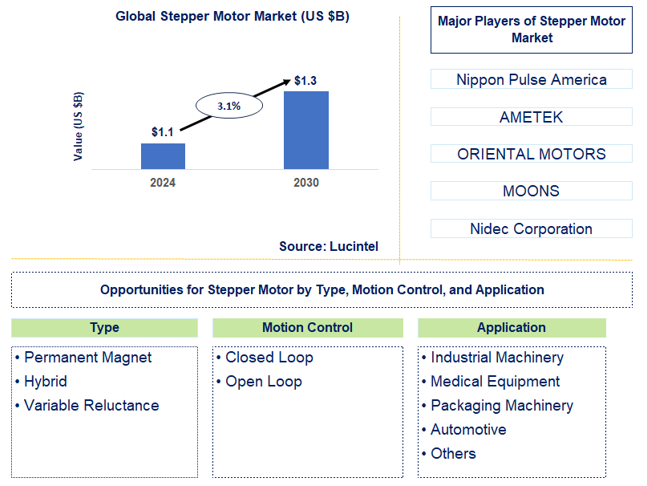
Key data points: The growth forecast = 1.8% annually for the next 7 years. Scroll below to get more insights. This market report covers trends, opportunities and forecasts in stepper motor market to 2031 by type (variable-reluctance, permanent magnet, and hybrid), application (cnc machine tool, industrial automation, office automation, printing equipment, and others), and region (North America, Europe, Asia Pacific, and the Rest of the World)
We'll send your sample report shortly.
• Lucintel forecasts that, within the type category, hybrid is expected to witness the highest growth over the forecast period.
• Within the application category, industrial automation is expected to witness the highest growth.
• In terms of region, APAC is expected to witness the highest growth over the forecast period. Gain valuable insights for your business decisions with our comprehensive 150+ page report. Sample figures with some insights are shown below.
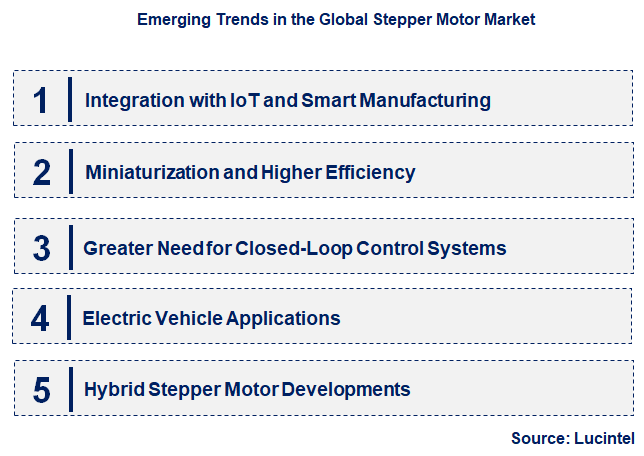
• Integration with IoT and Smart Manufacturing: The interconnection of stepper motors with the Internet of Things (IoT) is a rising trend in the automation industry. With IoT-based sensors, stepper motors can be monitored and controlled remotely, and real-time data about performance and condition is reported. It assists in predictive maintenance, lowering downtime, and enhancing operation efficiency. The trend towards smart manufacturing and Industry 4.0 is triggering demand for such technologies, making production systems more intelligent and connected.
• Miniaturization and Higher Efficiency: With industries looking for more efficient and smaller solutions, the process of miniaturization of stepper motors is becoming increasingly popular. Compact, high-performance stepper motors are being designed to suit applications in consumer electronics, robotics, and medical devices. The motivation is led by the need for high-performing motors in space-constrained locations without any compromise on precision and power. Moreover, energy efficiency is another major point of emphasis, with the production of stepper motors that consume less power but improve or at least preserve performance.
• Greater Need for Closed-Loop Control Systems: Closed-loop control systems, which integrate stepper motors with feedback control, are finding increased use in applications involving precise control of position and high reliability. Such systems provide benefits like increased torque, reduced heating, and higher efficiency over open-loop systems. The growing need for such systems is spurred by robotics, CNC machines, and automated manufacturing applications where high precision and reliability are vital.
• Electric Vehicle Applications: The increasing electric vehicle (EV) market offers a compelling opportunity for stepper motors. EVs demand high precision and efficient motor systems for actuators like steering, braking, and autonomous driving. Stepper motors are increasingly finding use in such applications because of their high precision and low power usage. With the global move towards EVs, the automotive industry's demand for stepper motors is likely to increase, fueling motor design and control system innovations.
• Hybrid Stepper Motor Developments: Hybrid stepper motors, which incorporate the strengths of both permanent magnet motors and variable reluctance motors, are becoming increasingly popular with their improved torque delivery and smoother operation. These motors are suitable for high-precision and low-noise applications like robotics, medical devices, and automation systems. With increasing demand for quieter and more energy-efficient motors, the hybrid stepper motor market is anticipated to increase, providing improved performance and greater flexibility for various industries. These new trends are transforming the stepper motor market by fueling innovation, enhancing performance, and creating new growth opportunities. The movement towards smart manufacturing, miniaturization, and hybrid motor solutions is revolutionizing industries, whereas the increasing use of stepper motors in electric vehicles and robotics will keep driving market growth.
• Advances in Motor Control Technology: Recent technological advances in motor control technology have greatly enhanced the performance and efficiency of stepper motors. Digital control systems and novel algorithms for accurate control have made possible improved torque, lowered power usage, and greater reliability. Such technology is especially useful in high-precision applications involving robotics, medical equipment, and CNC machinery, in which accuracy and performance are important.
• Energy-Efficient Stepper Motor Development: As increasing pressures are placed on energy consumption, there has been an intense emphasis on creating more energy-efficient stepper motors. Companies are particularly concentrating on minimizing power loss, enhancing efficiency, and prolonging motor lifespan. These advancements are assisting in addressing the increased demand for energy-saving technology in industrial automation, consumer electronics, and automotive industries.
• Introduction of Customizable Stepper Motors: The demand for specially designed solutions in applications like aerospace, robotics, and medical equipment has encouraged the development of stepper motors with customizable options. Stepper motors can be customized with certain requirements like torque, size, or special control capabilities. Customizing offers smoother integration into specialty applications and further opens up the market for stepper motors.
• Miniaturization of Stepper Motors: As consumer electronics and mobile device makers increasingly demand smaller solutions, stepper motor producers are concentrating on miniaturization. Smaller stepper motors without the loss of performance are creating new applications for stepper motors in small devices such as drones, wearables, and medical devices. Miniaturized stepper motors are becoming increasingly popular because they can be fitted into space-limited applications while staying efficient and reliable.
• Compatibility with Advanced Automation Systems: The increasing trend of automation in manufacturing, logistics, and healthcare has driven the evolution of stepper motors that can be easily integrated into high-end automation systems. The integration enables improved precision and control, which is imperative in applications such as robotics, CNC machining, and assembly lines. With the emergence of smart factories and Industry 4.0, the application of stepper motors in automation keeps on growing. These advancements are propelling the stepper motor industry ahead, offering room for expansion across industries. Advances in motor control technology, energy efficiency, and miniaturization are increasingly making stepper motors more versatile and suitable for multiple industries. With an expanding demand for automation and precision motion control, the stepper motor industry is expecting ongoing innovation and growth.
• Robotics: For the robotics industry, stepper motors are crucial to deliver accurate motion control in robotic arms, grippers, and other automated parts. With automation on the rise in manufacturing, healthcare, and logistics, the requirement for stepper motors is likely to grow. Their precision and reliability make them perfectly suited for the use in robotic applications where subtle movements are needed.
• 3D Printing: The market for 3D printing has grown extremely fast, and stepper motors are instrumental in moving 3D printers. Such motors provide precise control of the printing head and bed motion for highly detailed and accurate prints. While industries from medicine to the automotive sector adopt 3D printing for prototyping, custom production, and even end-use components, the demand for stepper motors in this application remains on the rise. Growth in this industry is anticipated to further increase demand for stepper motors, especially those with high torque and energy efficiency.
• Automotive: The automotive industry is progressively implementing stepper motors for numerous applications like electric vehicles (EVs), driver assistance systems, and automated manufacturing processes. Stepper motors are especially useful in the automation of car manufacturing lines, where they deliver accuracy for operations like welding, assembling, and painting. For operations like adjusting seats, mirrors, and windows, stepper motors find application in electric vehicles.
• Consumer Electronics: Consumer electronics is also witnessing growth in the applications of step motors, mainly in products such as printers, cameras, and home automation systems. These motors are used to give the high-precision motion required for tasks like lens motion in cameras, paper feeder drives in printers, and robotic vacuum cleaner motion. As consumer electronic devices become more sophisticated and automation in the home becomes more widespread, the demand for stepper motors will only grow.
• Industrial Automation: With more automated processes being used by industries worldwide, stepper motors are increasingly used in conveyor belts, CNC machines, and packaging equipment. Precise speed and position control makes stepper motors a good fit for these uses. With the advent of Industry 4.0 and implementation of artificial intelligence and machine learning in industrial applications, stepper motors will assume a crucial role in maintaining accuracy and reliability in automated systems. Industrial automation's requirements for high precision and ruggedness are pushing the market for stepper motors. The market for stepper motor is experiencing tremendous growth in different applications such as robotics, 3D printing, automotive, consumer electronics, and industrial automation. These industries are influencing demand for stepper motors, especially those that provide high precision, energy efficiency, and reliability. With industries keeping pace with new technologies, the market for stepper motors is also expected to grow, offering tremendous growth opportunities for suppliers and manufacturers.
• Shinano Kenshi
• Minebea
• Nippon Pulse Motor
• Haydon Kerk Motion Solutions
• Oriental Motor
• Panasonic
• Mechtex
• Anaheim Automation
• ElectroCraft
• Nanotec Electronic
• Variable-reluctance
• Permanent Magnet
• Hybrid
• CNC Machine Tool
• Industrial Automation
• Office Automation
• Printing Equipment
• Others
• North America
• Europe
• Asia Pacific
• The Rest of the World
• United States: The United States stepper motor market is enjoying growth through advances in automation and robotics. The motor and automotive industries, being high consumers of stepper motors, are more and more adopting these systems in order to achieve better precision and reliability. Improvements in control systems and advancements in more efficient and compact motors are enabling firms to enhance performance. Besides, the demand for electric vehicles (EVs) is also fueling the demand for accurate motor systems such as stepper motors in applications such as steering and control systems. With a heavy focus on manufacturing automation, the market for stepper motors is poised for increased growth.
• China: China also plays an important role in the global stepper motor market, both producing and consuming. Its fast-growing manufacturing sector, especially in electronics and automobiles, is driving demand for stepper motors. China's government policies promoting the implementation of smart manufacturing are accelerating industrial automation efforts. The growth of the robotics industry, particularly for medical devices and consumer electronics, is boosting stepper motor technology innovations.
• Germany: Germany, known for its engineering prowess, has experienced consistent growth in the stepper motor market, particularly in robotics and industrial automation. The nation's robust manufacturing sector, and especially in industries such as automotive, electronics, and aerospace, is propelling the need for high-performance stepper motors. Organizations are placing a greater emphasis on energy-efficient options, and integrated drive systems are just one example of innovation being popularized. Furthermore, Germany's initiative towards Industry 4.0 is speeding up the implementation of intelligent, automated solutions, further boosting the need for stepper motors.
• India: The Indian stepper motor market is experiencing rapid growth due to the increasing manufacturing and automation sector of the country. Industrial automation's rise of small and medium enterprises (SMEs) is fueling demand for economic and reliable stepper motors. Also, government initiatives in India to encourage "Make in India" are promoting domestic manufacturing of precision parts, such as stepper motors. Use of robots in industries like healthcare, textiles, and farming is demanding more sophisticated motion control systems.
• Japan: Japan remains the market leader in the stepper motor business, especially in high-end robotics, automation, and precision equipment. Japan has multiple high-technology industries, such as automotive and electronics, where stepper motors are applied to use with high-quality control applications. Japan's ongoing efforts towards robotics and autonomous innovations are boosting the demand for stepper motors, especially for robotics and medical devices. Japanese firms are also concentrating on manufacturing energy-efficient and small-sized stepper motors in order to satisfy the need for automation solutions.


• Shinano Kenshi
• Minebea
• Nippon Pulse Motor
• Haydon Kerk Motion Solutions
• Oriental Motor
• Panasonic
• Mechtex
• Anaheim Automation
• ElectroCraft
• Nanotec Electronic Q5. Which stepper motor market segment will be the largest in future? Answer: Lucintel forecasts that, within the type category, hybrid is expected to witness the highest growth over the forecast period. Q6. In stepper motor market, which region is expected to be the largest in next 5 years? Answer: In terms of region, APAC is expected to witness the highest growth over the forecast period. Q7. Do we receive customization in this report? Answer: Yes, Lucintel provides 10% customization without any additional cost.


Choose a license that fits your team. Instant PDF delivery.
Prices exclude taxes. Instant delivery. Custom licensing available on request.
Market Report · July 31, 2026
Market Report · July 22, 2026
Market Report · July 20, 2026
Trusted partner for strategic intelligence and business growth


Receive a complimentary market analysis tailored to your industry. Our analysts will identify key growth opportunities and competitive dynamics specific to your business.

Market size, growth rate, and key trend analysis for your specific sector.

Top competitor positioning and market share analysis.

Strategic recommendations backed by data-driven insights.
Get curated market intelligence and competitive moves straight to your inbox.
By subscribing, you agree to receive our monthly insights. Unsubscribe anytime.
Receive a complimentary market analysis tailored to your industry. Our analysts will identify key growth opportunities and competitive dynamics specific to your business.
Market size, growth rate, and key trend analysis for your specific sector.
Top competitor positioning and market share analysis.
Strategic recommendations backed by data-driven insights.
Get curated market intelligence, emerging trends, and competitive moves straight to your inbox each month.
By subscribing, you agree to receive our monthly insights. Unsubscribe anytime.
We'll send your sample report shortly.