
Report Feature
STAM Market Trends and Forecast
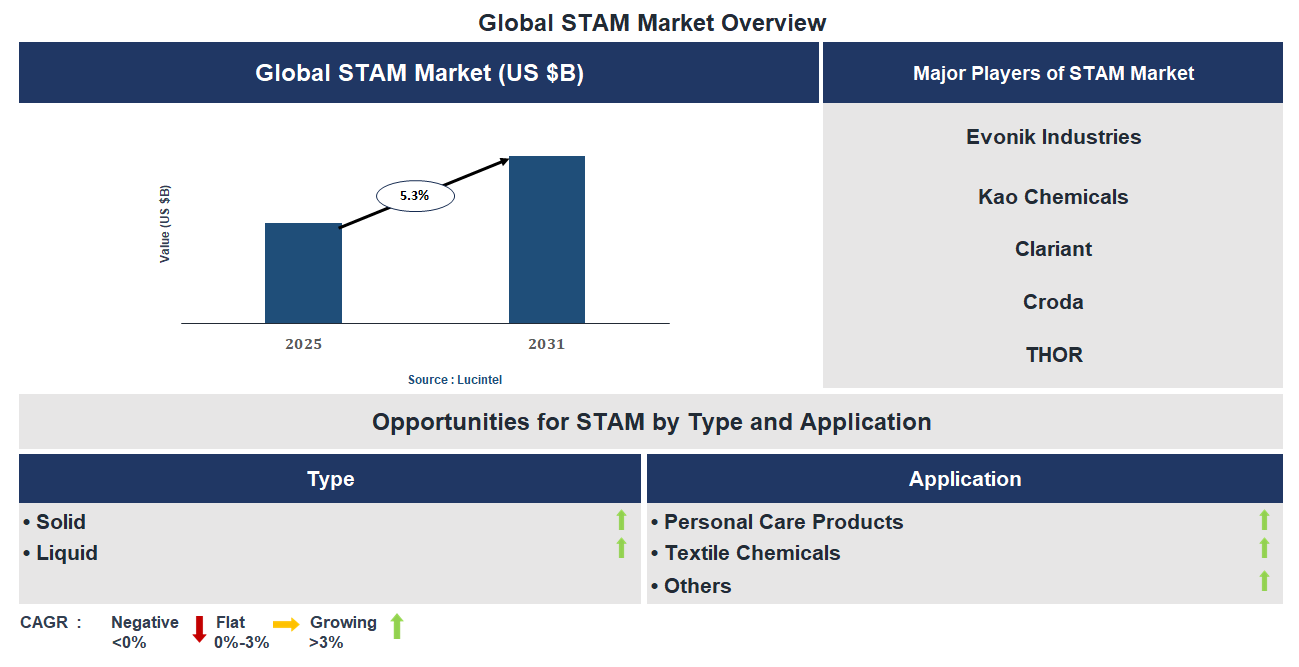
The future of the global STAM market looks promising with opportunities in the personal care product and textile chemical markets. The global STAM market is expected to grow with a CAGR of 5.3% from 2025 to 2031. The major drivers for this market are the increasing demand for personal care & cosmetic products, the rising awareness about sustainable and eco-friendly surfactants in formulations, and the expansion of the global home care and cleaning products.• Lucintel forecasts that, within the type category, liquid is expected to witness higher growth over the forecast period.
• Within the application category, textile chemical is expected to witness higher growth.
• In terms of region, APAC is expected to witness the highest growth over the forecast period. Gain valuable insights for your business decisions with our comprehensive 150+ page report. Sample figures with some insights are shown below.
Emerging Trends in the STAM Market
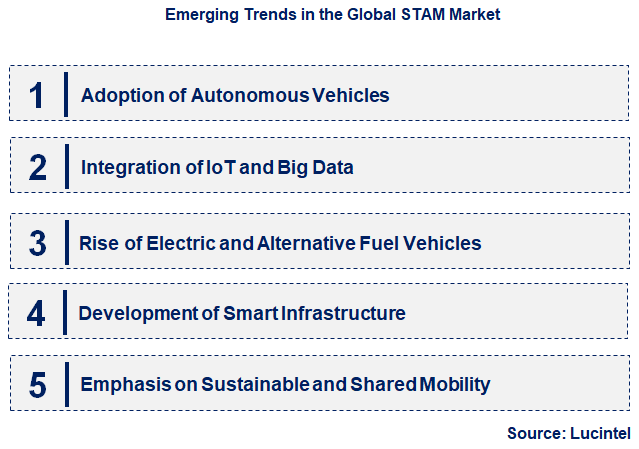
The STAM market is experiencing rapid evolution driven by technological advancements, changing consumer preferences, and increasing urbanization. As cities grow and the demand for efficient, sustainable transportation solutions rises, innovative trends are shaping the future of mobility. These developments are not only transforming how people and goods move but also influencing infrastructure, policy, and business models. Stakeholders must adapt to these shifts to stay competitive and meet emerging demands. The following five key trends highlight the major directions in the STAM market, illustrating how the landscape is being reshaped for a smarter, more connected future.• Adoption of Autonomous Vehicles: Autonomous vehicles (AVs) are increasingly integrated into urban and rural transportation systems. Advances in AI, sensor technology, and connectivity enable safer, more efficient self-driving cars and trucks. This trend reduces human error, enhances safety, and lowers operational costs. AVs also facilitate mobility for underserved populations and can optimize traffic flow, reducing congestion and emissions. As regulatory frameworks evolve, the deployment of AVs is expected to accelerate, fundamentally changing vehicle ownership, public transit, and freight logistics.
• Integration of IoT and Big Data: The Internet of Things (IoT) and big data analytics are revolutionizing transportation management. Connected devices collect real-time data on vehicle performance, traffic patterns, and environmental conditions. This information enables smarter routing, predictive maintenance, and improved safety measures. Urban planners and service providers leverage data insights to optimize infrastructure and reduce congestion. The integration of IoT and big data enhances operational efficiency, supports personalized mobility services, and fosters a more responsive transportation ecosystem, ultimately leading to more sustainable and user-centric mobility solutions.
• Rise of Electric and Alternative Fuel Vehicles: The shift toward electric vehicles (EVs) and alternative fuels is a major trend in the STAM market. Governments and corporations are investing heavily in EV infrastructure, such as charging stations, to support widespread adoption. This transition reduces reliance on fossil fuels, lowers greenhouse gas emissions, and aligns with sustainability goals. Advances in battery technology improve range and affordability, making EVs more accessible. The growth of alternative fuel vehicles, including hydrogen and biofuels, diversifies options for cleaner transportation, influencing vehicle manufacturing, energy markets, and policy frameworks.
• Development of Smart Infrastructure: Smart infrastructure, including intelligent traffic management systems, connected roads, and adaptive signaling, is transforming urban mobility. These systems utilize sensors, cameras, and communication networks to monitor and manage traffic flow dynamically. They reduce congestion, improve safety, and enhance the efficiency of public transit. Smart infrastructure also supports the integration of autonomous and electric vehicles, creating a cohesive ecosystem. Investment in such infrastructure is critical for sustainable urban development, enabling cities to handle increasing mobility demands while minimizing environmental impact.
• Emphasis on Sustainable and Shared Mobility: There is a growing focus on sustainable and shared mobility solutions to address urban congestion and environmental concerns. Car-sharing, ride-hailing, micro-mobility options like e-scooters and bikes, and integrated multimodal platforms are gaining popularity. These services reduce the number of private vehicles on the road, lower emissions, and promote equitable access to transportation. Policy incentives and technological innovations support the expansion of shared mobility. This trend encourages a shift from ownership to access-based models, fostering more sustainable, flexible, and inclusive transportation ecosystems. In summary, these trends are collectively reshaping the STAM market by fostering smarter, cleaner, and more efficient transportation systems. They promote sustainability, enhance safety, and improve user experience, ultimately leading to more connected and resilient urban environments. As these developments continue to evolve, stakeholders must adapt strategies to harness their full potential and address emerging challenges.
Recent Development in the STAM Market
The STAM market has experienced rapid growth driven by technological advancements, increasing urbanization, and the need for efficient transportation solutions. As cities expand and transportation networks become more complex, stakeholders are investing heavily in innovative systems to optimize asset utilization, reduce costs, and improve safety. Recent developments reflect a shift towards smarter, more integrated transportation infrastructure, supported by advancements in IoT, AI, and data analytics. These changes are transforming how assets are managed and how transportation services are delivered, creating new opportunities and challenges within the market.• Adoption of IoT Technologies: The integration of IoT devices into transportation infrastructure has enhanced real-time monitoring and data collection, leading to improved asset management and predictive maintenance. This development reduces downtime and operational costs, increasing efficiency and safety across transportation networks.
• AI-Driven Analytics: The deployment of AI algorithms enables predictive analytics for asset lifecycle management and traffic flow optimization. This results in smarter decision-making, reduced congestion, and enhanced safety, ultimately improving overall system performance.
• Smart Infrastructure Investments: Governments and private entities are investing heavily in smart infrastructure projects, including intelligent traffic signals and connected vehicle systems. These investments facilitate seamless communication between vehicles and infrastructure, reducing congestion and emissions.
• Increased Focus on Sustainability: The market is witnessing a shift towards eco-friendly transportation solutions, such as electric vehicles and green infrastructure. These initiatives aim to reduce carbon footprints and promote sustainable urban development, aligning with global environmental goals.
• Regulatory and Policy Developments: Governments are implementing new policies and standards to support the deployment of smart transportation systems. These regulations foster innovation, ensure safety, and promote interoperability across different platforms and technologies. In summary, these recent developments are significantly transforming the STAM market by enhancing operational efficiency, safety, and sustainability. The integration of advanced technologies and supportive policies is driving growth, creating a more connected and intelligent transportation ecosystem that benefits cities, businesses, and consumers alike.
Strategic Growth Opportunities in the STAM Market
The STAM market is experiencing rapid growth driven by technological advancements, increasing industrial applications, and a rising focus on sustainability. As industries such as automotive, aerospace, electronics, healthcare, and construction seek innovative surface treatment solutions, key growth opportunities are emerging across these sectors. These opportunities are shaping the future landscape of the STAM market, offering potential for increased efficiency, durability, and environmental compliance. Companies that capitalize on these trends can gain competitive advantages and meet evolving customer demands. The following are five key growth opportunities by application that are expected to significantly influence the market trajectory.• Automotive Industry: Enhanced corrosion resistance and lightweight materials are driving demand for advanced surface treatments, leading to improved vehicle durability and fuel efficiency. This growth boosts market revenue by enabling manufacturers to meet stringent environmental standards and consumer preferences for sustainable vehicles.
• Aerospace Sector: The need for high-performance, durable, and lightweight components is fueling the adoption of innovative surface treatments. These solutions extend the lifespan of aircraft parts, reduce maintenance costs, and improve safety, thereby expanding market opportunities in aerospace applications.
• Electronics and Semiconductor: As electronic devices become more compact and sophisticated, there is a rising demand for precise, contamination-free surface treatments. These processes enhance device performance, reliability, and miniaturization, opening new avenues for growth in electronics manufacturing.
• Healthcare and Medical Devices: The increasing use of biocompatible and sterilizable surface coatings in medical devices improves safety and functionality. This trend supports market expansion by addressing stringent regulatory standards and patient safety requirements.
• Construction and Infrastructure: The adoption of environmentally friendly and durable surface treatments enhances the longevity of construction materials. This growth opportunity aligns with sustainability goals and infrastructure development, driving demand in construction applications. In summary, these key growth opportunities across various applications are significantly impacting the STAM market by fostering innovation, improving product performance, and aligning with sustainability initiatives. As industries continue to evolve, the market is poised for substantial expansion driven by these strategic development areas.
STAM Market Driver and Challenges
The STAM market is influenced by a variety of technological, economic, and regulatory factors. Rapid advancements in IoT, AI, and data analytics are transforming transportation systems, making them more efficient and sustainable. Economic growth and urbanization drive the demand for smarter infrastructure, while regulatory policies aimed at reducing emissions and enhancing safety shape market dynamics. However, the market also faces challenges such as high implementation costs, data security concerns, and regulatory complexities. Understanding these drivers and challenges is essential for stakeholders to navigate the evolving landscape and capitalize on emerging opportunities. The factors responsible for driving the STAM market include:-• Technological Innovation: The integration of IoT, AI, and big data analytics enables real-time monitoring, predictive maintenance, and optimized routing, significantly improving transportation efficiency. These technological advancements reduce operational costs and enhance safety, making smart transportation solutions more attractive to cities and private operators. As technology continues to evolve rapidly, the market is expected to expand, driven by increased adoption of connected devices and intelligent systems.
• Urbanization and Population Growth: Rapid urbanization leads to increased traffic congestion and pollution, creating a pressing need for efficient transportation management. Governments and private entities are investing in smart infrastructure to address these issues, which boosts demand for asset management solutions. Growing populations in urban areas also necessitate scalable and sustainable transportation systems, further fueling market growth.
• Regulatory Policies and Government Initiatives: Governments worldwide are implementing policies to promote sustainable transportation, including incentives for electric vehicles and mandates for smart infrastructure deployment. These regulations encourage investments in STAM solutions to meet environmental standards and improve safety. Public-private partnerships and funding programs further accelerate market development, aligning regulatory frameworks with technological advancements.
• Economic Growth and Investment: Increased economic activity and infrastructure spending drive the adoption of advanced transportation management systems. Investments from private and public sectors aim to modernize transportation networks, reduce congestion, and improve asset utilization. This economic momentum supports innovation and expansion within the STAM market, attracting new entrants and fostering competitive growth. The challenges in the STAM market are:
• High Implementation and Maintenance Costs: Deploying advanced smart transportation systems requires significant capital investment in hardware, software, and infrastructure. Ongoing maintenance and upgrades add to operational expenses, which can be prohibitive for smaller municipalities or private operators. These costs may slow down adoption rates, especially in regions with limited budgets, impacting overall market growth.
• Data Security and Privacy Concerns: The extensive use of connected devices and data collection raises significant security risks. Cyberattacks and data breaches can compromise sensitive information, leading to financial losses and erosion of public trust. Ensuring robust cybersecurity measures and compliance with privacy regulations is critical but challenging, potentially hindering market expansion.
• Regulatory and Standardization Challenges: The lack of uniform standards and regulatory frameworks across regions complicates deployment and interoperability of STAM solutions. Differing policies can delay project approvals and increase costs. Additionally, evolving regulations require continuous adaptation, which can create uncertainty for investors and developers, impeding market progress. In summary, the STAM market is driven by technological innovation, urbanization, supportive policies, and economic growth, which collectively foster a conducive environment for expansion. However, high costs, security concerns, and regulatory complexities pose significant hurdles. Balancing these drivers and challenges will be crucial for sustainable growth, requiring collaborative efforts among stakeholders to develop cost-effective, secure, and standardized solutions. Overall, the markets future hinges on technological advancements and regulatory harmonization, which can unlock substantial opportunities for smarter, more efficient transportation systems worldwide.
List of STAM Companies
Companies in the market compete on the basis of product quality offered. Major players in this market focus on expanding their manufacturing facilities, R&D investments, infrastructural development, and leverage integration opportunities across the value chain. With these strategies STAM companies cater increasing demand, ensure competitive effectiveness, develop innovative products & technologies, reduce production costs, and expand their customer base. Some of the STAM companies profiled in this report include-• Evonik Industries
• Kao Chemicals
• Clariant
• Croda
• THOR
• Innospec
• Miwon Commercial
• Sino Lion
• Kiyu New Material
• Zhonghai Chemical
STAM Market by Segment
The study includes a forecast for the global STAM market by type, application, and region.STAM Market by Type [Value from 2019 to 2031]:
• Solid
• Liquid
STAM Market by Application [Value from 2019 to 2031]:
• Personal Care Products
• Textile Chemicals
• Others
STAM Market by Region [Value from 2019 to 2031]:
• North America
• Europe
• Asia Pacific
• The Rest of the World
Country Wise Outlook for the STAM Market
The STAM market has experienced rapid growth globally, driven by technological advancements, increasing urbanization, and the need for efficient transportation solutions. Countries are investing heavily in innovative infrastructure, digitalization, and sustainable practices to enhance mobility and asset management. These developments reflect a strategic shift towards smarter, more connected transportation systems that improve safety, reduce costs, and support environmental goals. As the market evolves, each country is adopting unique approaches aligned with their economic priorities and technological capabilities, shaping the future landscape of smart transportation and asset management worldwide.• United States: The US has seen significant investments in autonomous vehicle technology, with major companies testing and deploying self-driving cars. Smart infrastructure projects integrating IoT sensors for real-time traffic management are expanding in urban areas. The government promotes public-private partnerships to develop sustainable transportation solutions, including electric vehicle charging networks. Data analytics and AI are increasingly used for predictive maintenance of transportation assets, improving efficiency and safety. Additionally, federal initiatives support the modernization of transit systems, emphasizing digitalization and smart ticketing.
• China: China leads in the deployment of intelligent transportation systems, with extensive infrastructure for high-speed rail and urban metro networks. The country is advancing in AI-powered traffic management and autonomous vehicle pilot programs in major cities like Beijing and Shanghai. Investment in 5G connectivity enhances real-time data collection and communication across transportation networks. China’s focus on green transportation includes expanding electric vehicle adoption and smart grid integration. The government’s strategic plans aim to develop a comprehensive smart transportation ecosystem, integrating big data and IoT for optimized asset management.
• Germany: Germany emphasizes sustainable mobility and digital transformation in its transportation sector. The country is investing in smart traffic control systems and intelligent logistics solutions to reduce congestion and emissions. Industry leaders are developing innovative vehicle-to-infrastructure (V2I) communication technologies. Germany’s focus on electric mobility is supported by extensive charging infrastructure and incentives for EV adoption. The integration of AI and big data analytics enhances predictive maintenance and asset management for rail and road networks. Public transportation systems are increasingly digitized, improving service quality and operational efficiency.
• India: India is rapidly expanding its urban transportation infrastructure, with a focus on smart city projects and metro rail systems. The government promotes the adoption of electric vehicles and digital ticketing to reduce pollution and improve commuter experience. Investments in IoT-enabled traffic management and surveillance systems are enhancing urban mobility. The development of integrated transport corridors aims to streamline freight and passenger movement. India’s emphasis on affordable, scalable solutions is driving innovations in low-cost sensors and mobile-based asset management platforms, supporting sustainable growth in the sector.
• Japan: Japan continues to innovate in smart transportation, with advancements in autonomous vehicles and robotics for asset management. The country is upgrading its rail systems with AI-driven predictive maintenance and smart signaling technology. Japan’s focus on disaster-resilient infrastructure incorporates IoT sensors for real-time monitoring. The government promotes eco-friendly transportation through electric and hydrogen fuel cell vehicles. Smart city initiatives integrate transportation data to optimize traffic flow and reduce congestion. Japan’s technological expertise supports the development of integrated, intelligent transportation networks that enhance safety and efficiency across urban and rural areas.

Features of the Global STAM Market
Market Size Estimates: STAM market size estimation in terms of value ($B). Trend and Forecast Analysis: Market trends (2019 to 2024) and forecast (2025 to 2031) by various segments and regions. Segmentation Analysis: STAM market size by type, application, and region in terms of value ($B). Regional Analysis: STAM market breakdown by North America, Europe, Asia Pacific, and Rest of the World. Growth Opportunities: Analysis of growth opportunities in different types, applications, and regions for the STAM market. Strategic Analysis: This includes M&A, new product development, and competitive landscape of the STAM market. Analysis of competitive intensity of the industry based on Porter’s Five Forces model.
FAQ
Q1. What is the growth forecast for STAM market? Answer: The global STAM market is expected to grow with a CAGR of 5.3% from 2025 to 2031. Q2. What are the major drivers influencing the growth of the STAM market? Answer: The major drivers for this market are the increasing demand for personal care & cosmetic products, the rising awareness about sustainable and eco-friendly surfactants in formulations, and the expansion of the global home care and cleaning products. Q3. What are the major segments for STAM market? Answer: The future of the STAM market looks promising with opportunities in the personal care product and textile chemical markets. Q4. Who are the key STAM market companies? Answer: Some of the key STAM companies are as follows:• Evonik Industries
• Kao Chemicals
• Clariant
• Croda
• THOR
• Innospec
• Miwon Commercial
• Sino Lion
• Kiyu New Material
• Zhonghai Chemical Q5. Which STAM market segment will be the largest in future? Answer: Lucintel forecasts that, within the type category, liquid is expected to witness higher growth over the forecast period. Q6. In STAM market, which region is expected to be the largest in next 5 years? Answer: In terms of region, APAC is expected to witness the highest growth over the forecast period. Q7. Do we receive customization in this report? Answer: Yes, Lucintel provides 10% customization without any additional cost.
Table of Contents
List of Figures
List of Tables
Methodology
- In-depth interviews of the major players in this market
- Detailed secondary research from competitors’ financial statements and published data
- Extensive searches of published works, market, and database information pertaining to industry news, company press releases, and customer intentions
- A compilation of the experiences, judgments, and insights of Lucintel’s professionals, who have analyzed and tracked this market over the years.


Buy Now
Choose a license that fits your team. Instant PDF delivery.
Prices exclude taxes. Instant delivery. Custom licensing available on request.
Key Questions
- • What are some of the most promising, high-growth opportunities for the STAM market by type (solid and liquid), application (personal care products, textile chemicals, and others), and region (North America, Europe, Asia Pacific, and the Rest of the World)?
- • Which segments will grow at a faster pace and why?
- • Which region will grow at a faster pace and why?
- • What are the key factors affecting market dynamics? What are the key challenges and business risks in this market?
- • What are the business risks and competitive threats in this market?
- • What are the emerging trends in this market and the reasons behind them?
- • What are some of the changing demands of customers in the market?
- • What are the new developments in the market? Which companies are leading these developments?
- • Who are the major players in this market? What strategic initiatives are key players pursuing for business growth?
- • What are some of the competing products in this market and how big of a threat do they pose for loss of market share by material or product substitution?
- • What M&A activity has occurred in the last 5 years and what has its impact been on the industry? For any questions related to STAM Market, STAM Market Size, STAM Market Growth, STAM Market Analysis, STAM Market Report, STAM Market Share, STAM Market Trends, STAM Market Forecast, STAM Companies, write Lucintel analyst at email: helpdesk@lucintel.com. We will be glad to get back to you soon.


