
Report Feature
Sports Analytics Tool Market Trends and Forecast
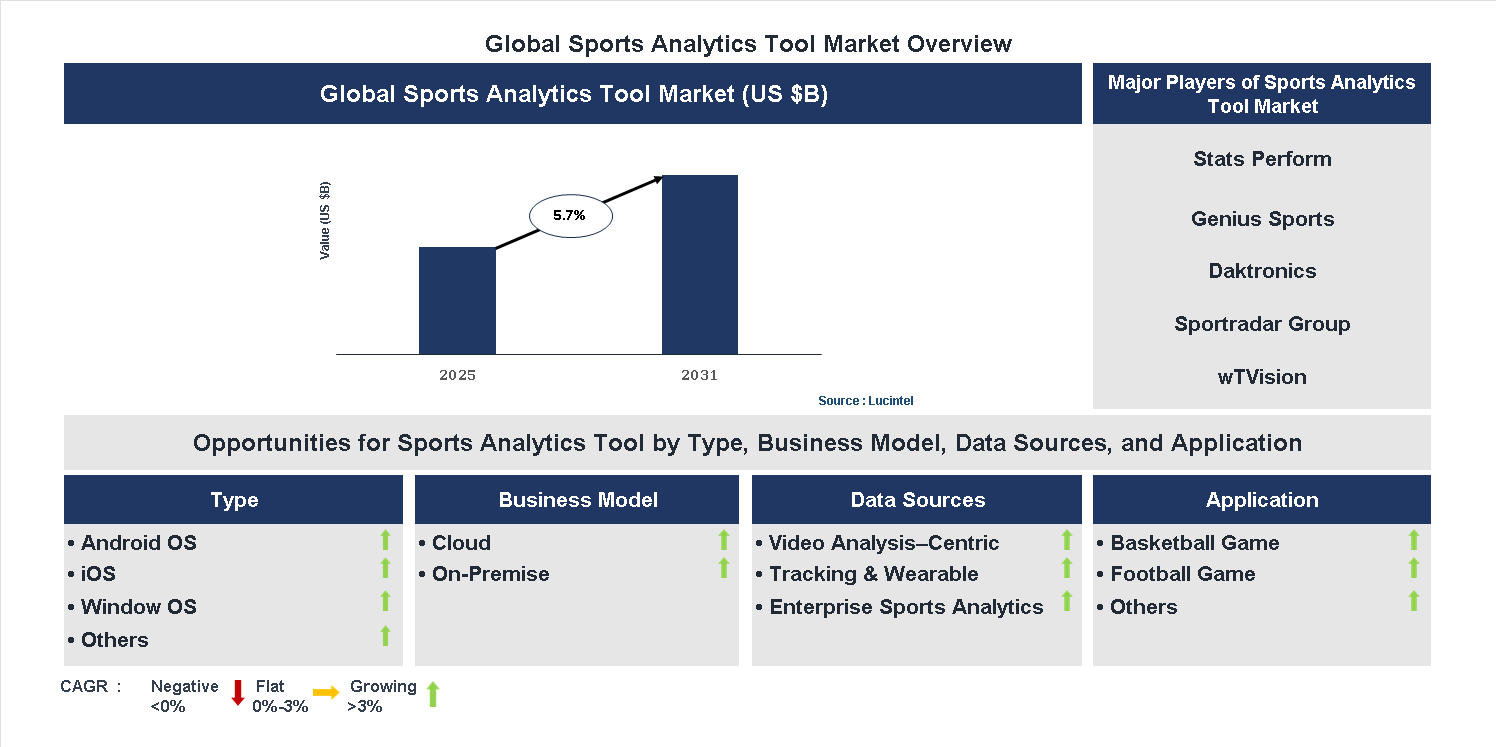
The future of the global sports analytics tool market looks promising with opportunities in the basketball game and football game markets. The global sports analytics tool market is expected to grow with a CAGR of 5.7% from 2025 to 2031. The major drivers for this market are the increasing demand for performance optimization insights, the rising adoption of data driven coaching methods, and the growing investment in advanced sports technology.• Lucintel forecasts that, within the type category, android OS is expected to witness the highest growth over the forecast period.
• Within the application category, football game is expected to witness higher growth.
• In terms of region, APAC is expected to witness the highest growth over the forecast period. Gain valuable insights for your business decisions with our comprehensive 150+ page report. Sample figures with some insights are shown below.
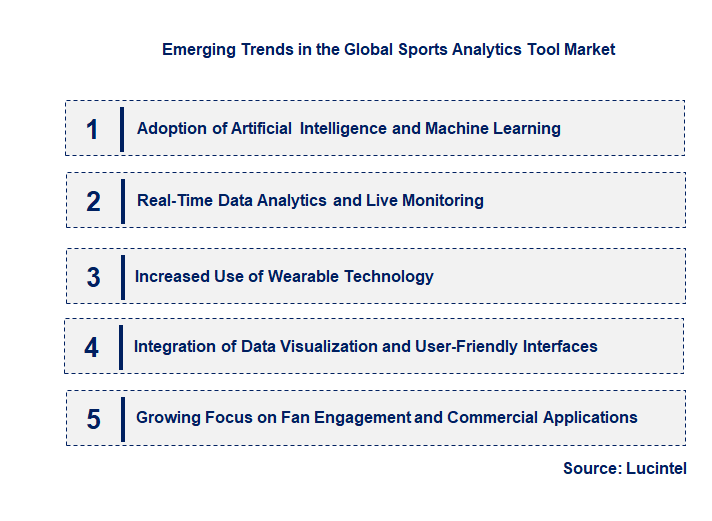
Emerging Trends in the Sports Analytics Tool Market
The sports analytics tool market is experiencing rapid growth driven by technological advancements, increasing demand for data-driven decision-making, and the expanding sports industry worldwide. As teams, coaches, and organizations seek competitive advantages, innovative analytics solutions are becoming essential. The integration of artificial intelligence, machine learning, and real-time data processing is transforming how sports performance is analyzed and optimized. These developments are not only enhancing athlete performance but also improving fan engagement and operational efficiency. The following key trends highlight the major shifts shaping this dynamic market and its future trajectory.• Adoption of Artificial Intelligence and Machine Learning: AI and ML are revolutionizing sports analytics by enabling predictive modeling, player performance forecasting, and injury prevention. These technologies analyze vast datasets to uncover hidden patterns, providing teams with actionable insights. The impact includes more accurate talent scouting, strategic game planning, and personalized training programs. As AI becomes more sophisticated, its integration into sports analytics tools will deepen, offering real-time decision support and enhancing overall competitive advantage.
• Real-Time Data Analytics and Live Monitoring: The demand for instant insights has led to the development of real-time analytics platforms. These tools collect and process live data from sensors, cameras, and wearables during games and training sessions. The immediate feedback helps coaches make quick tactical adjustments, improve player safety, and enhance fan experiences through live stats and visualizations. This trend is transforming traditional post-game analysis into dynamic, on-the-fly decision-making, increasing the agility and responsiveness of sports organizations.
• Increased Use of Wearable Technology: Wearables such as GPS trackers, heart rate monitors, and motion sensors are becoming integral to sports analytics. They provide continuous, detailed data on athlete biomechanics, fatigue levels, and recovery status. The insights gained help optimize training loads, prevent injuries, and extend athletes' careers. The proliferation of affordable, advanced wearables is democratizing access to high-quality data, enabling teams of all sizes to leverage analytics for performance improvement and health management.
• Integration of Data Visualization and User-Friendly Interfaces: As data volume grows, the importance of intuitive visualization tools has increased. Modern sports analytics platforms feature dashboards, heat maps, and interactive charts that simplify complex data, making insights accessible to coaches, players, and management. This trend enhances decision-making efficiency, fosters better communication, and encourages wider adoption of analytics tools across organizations. User-friendly interfaces are crucial for translating raw data into actionable strategies.
• Growing Focus On Fan Engagement And Commercial Applications: Sports analytics is expanding beyond performance to include fan experience and revenue generation. Data-driven insights are used to personalize content, optimize ticket sales, and enhance marketing strategies. Augmented reality and interactive apps create immersive experiences for fans, increasing loyalty and engagement. Additionally, analytics inform sponsorship decisions and media rights negotiations. This trend is broadening the market scope, making analytics a vital component of sports business strategies and transforming how organizations connect with their audiences. In summary, these trends are fundamentally reshaping the sports analytics tool market by fostering innovation, improving decision-making, and expanding applications beyond traditional performance metrics. The integration of advanced technologies and user-centric solutions is driving growth, creating new opportunities, and setting the stage for a more data-driven future in sports.
Recent Development in the Sports Analytics Tool Market
The sports analytics tool market is experiencing rapid growth driven by technological advancements and increasing demand for data-driven decision-making in sports. Teams, coaches, and organizations leverage analytics to enhance performance, strategize effectively, and improve fan engagement. As data collection and processing become more sophisticated, the market is expanding across various sports disciplines and regions. This evolution presents significant opportunities for innovation, investment, and competitive advantage, shaping the future landscape of sports management and entertainment.• Growing Adoption of AI and Machine Learning: The integration of AI and machine learning in sports analytics is revolutionizing data interpretation. These technologies enable predictive modeling, player performance analysis, and injury prevention, providing teams with actionable insights. As AI becomes more accessible and sophisticated, its adoption accelerates, leading to more personalized training programs and strategic decisions. This trend enhances competitive edge, improves athlete longevity, and attracts investments, significantly impacting the market’s growth trajectory.
• Expansion of Real-Time Data Analytics: Real-time analytics is transforming how teams and broadcasters analyze live sports events. Advanced sensors, cameras, and tracking systems generate instant data, allowing immediate tactical adjustments and enhanced viewer experiences. This development improves decision-making accuracy and fan engagement through interactive broadcasts. As technology advances, the volume and quality of real-time data increase, creating new revenue streams and market opportunities for analytics providers, thereby fueling overall industry expansion.
• Increasing Use of Wearable Devices: Wearable technology, such as GPS trackers and biometric sensors, is becoming integral to sports analytics. These devices collect detailed physiological and performance data, enabling precise monitoring of an athlete's health and performance. The proliferation of affordable, durable wearables broadens access for amateur and professional sports alike. This trend enhances training efficiency, injury management, and talent scouting, driving market growth and fostering innovation in sports science and analytics solutions.
• Rising Investment in Sports Data Infrastructure: Significant investments are being made to develop robust sports data infrastructure, including advanced data centers and cloud platforms. These investments facilitate large-scale data storage, processing, and sharing, ensuring secure and efficient analytics operations. Enhanced infrastructure supports the growing demand for complex analytics and cross-platform integration, attracting stakeholders from sports organizations, broadcasters, and tech firms. This development underpins the market’s scalability and long-term sustainability.
• Increasing Focus on Fan Engagement and Experience: Sports analytics is increasingly used to personalize fan experiences and boost engagement through targeted content, interactive apps, and augmented reality. Data-driven insights help organizations understand fan preferences and behaviors, enabling tailored marketing strategies. This focus enhances loyalty, expands fan bases, and creates new monetization opportunities. As fan engagement becomes central to sports business models, the market benefits from higher revenues and sustained growth driven by innovative analytics applications. These developments collectively are transforming the sports analytics tool market by enhancing technological capabilities, expanding data applications, and improving stakeholder engagement. The integration of AI, real-time analytics, wearable devices, infrastructure investments, and fan-centric strategies is driving market expansion and innovation. As a result, the industry is becoming more competitive, efficient, and customer-focused, positioning it for sustained growth and increased influence across the global sports ecosystem.
Strategic Growth Opportunities in the Sports Analytics Tool Market
The sports analytics tool market is experiencing rapid growth driven by technological advancements, increasing demand for data-driven decision-making, and the rising popularity of sports at all levels. Teams, coaches, and organizations leverage analytics to enhance performance, prevent injuries, and improve fan engagement. As data collection methods become more sophisticated, opportunities for innovation and expansion across various sports and regions continue to emerge, creating a dynamic landscape for stakeholders seeking competitive advantages and operational efficiencies.• Expansion into Emerging Sports Markets: The increasing popularity of emerging sports such as eSports, drone racing, and adventure sports presents new opportunities for sports analytics tools. These markets are often underserved, offering potential for early adoption and growth. Analytics can help organizers optimize event management, improve athlete performance, and enhance viewer engagement, thereby creating a competitive edge and expanding the overall market footprint.
• Integration with Wearable Technology for Real-Time Data: The integration of sports analytics tools with wearable devices enables real-time data collection on athlete performance, health metrics, and biomechanics. This opportunity allows teams and trainers to make immediate, informed decisions during training and competitions. Enhanced data accuracy and immediacy improve injury prevention, optimize training regimens, and boost overall athletic performance, making wearable technology a critical growth driver in the sports analytics ecosystem.
• Development Of AI-Driven Predictive Analytics Solutions: The adoption of artificial intelligence (AI) and machine learning in sports analytics offers predictive insights into player performance, injury risks, and game outcomes. These advanced solutions help teams strategize more effectively, scout talent, and make data-backed decisions. As AI algorithms become more sophisticated, their ability to analyze complex data sets will revolutionize sports management, providing a significant growth avenue for analytics providers.
• Increasing Adoption by Amateur and Youth Sports Organizations: While professional sports have traditionally been the primary users of analytics tools, amateur and youth sports organizations are increasingly adopting these technologies. This expansion is driven by decreasing costs, improved user interfaces, and the desire to develop young talent. Analytics can assist in talent identification, injury prevention, and performance tracking, broadening the market scope and fostering long-term growth in the sports analytics industry.
• Enhancement of Fan Engagement Through Data Visualization: Sports analytics tools are increasingly used to create engaging visual content for fans, such as interactive dashboards, augmented reality experiences, and personalized insights. These innovations enhance fan experience, loyalty, and engagement, providing new revenue streams for sports organizations. As digital consumption continues to rise, leveraging data visualization for fan interaction represents a significant growth opportunity within the sports analytics market. The overall market is poised for substantial expansion as these opportunities enable stakeholders to innovate, improve performance, and deepen fan engagement, ultimately driving sustained growth and competitive advantage across the sports industry.
Sports Analytics Tool Market Driver and Challenges
The sports analytics tool market is influenced by a variety of technological, economic, and regulatory factors that shape its growth and development. Advances in data collection, processing capabilities, and artificial intelligence have revolutionized how teams, leagues, and broadcasters analyze performance and audience engagement. Economic factors such as increasing investments in sports infrastructure and digital platforms drive demand for sophisticated analytics tools. Regulatory considerations, including data privacy laws and ethical standards, also impact market operations. Together, these drivers and challenges create a dynamic environment that requires continuous innovation and adaptation to sustain growth and competitiveness in the sports analytics industry. The factors responsible for driving the sports analytics tool market include:-• Technological Advancements: The rapid evolution of data collection devices, machine learning algorithms, and cloud computing has significantly enhanced the capabilities of sports analytics tools. These innovations enable real-time data analysis, predictive modeling, and detailed performance insights, which are crucial for teams and organizations seeking competitive advantages. As technology becomes more accessible and affordable, adoption rates increase across various sports disciplines, fueling market expansion. Additionally, the integration of wearable devices and IoT sensors provides granular data, further enriching analytics capabilities and enabling more precise decision-making processes.
• Growing Investment in Sports Infrastructure: Increased funding from private investors, sports franchises, and governing bodies is a major driver. This financial support facilitates the deployment of advanced analytics tools for player performance, injury prevention, and strategic planning. As sports organizations recognize the value of data-driven insights, they allocate substantial budgets to upgrade their technological infrastructure. This trend is particularly prominent in professional leagues and international tournaments, where competitive edge and fan engagement are critical. The rising economic importance of sports further accelerates investments, creating a robust market for analytics solutions.
• Rising Demand for Fan Engagement and Experience: Sports organizations are leveraging analytics tools to enhance fan engagement through personalized content, targeted marketing, and immersive experiences. Data-driven insights help tailor offerings to individual preferences, increasing loyalty and revenue streams. The proliferation of digital platforms and social media amplifies this trend, encouraging organizations to adopt analytics for better audience understanding. As fan expectations evolve, the market for analytics tools that facilitate engagement and monetization continues to grow, making it a key driver in the industry’s expansion.
• Increasing Adoption of Artificial Intelligence and Machine Learning: The integration of AI and ML into sports analytics is transforming how data is interpreted and utilized. These technologies enable predictive analytics, injury risk assessment, and tactical analysis with higher accuracy and efficiency. Teams and broadcasters are investing heavily in AI-driven solutions to gain competitive advantages and optimize performance. The ability to analyze vast datasets quickly and generate actionable insights is a significant factor propelling market growth. As AI and ML become more sophisticated and accessible, their adoption is expected to accelerate, further expanding the capabilities and scope of sports analytics tools. The challenges facing this sports analytics tool market include:-
• Data Privacy and Security Concerns: The increasing reliance on digital data collection raises significant privacy issues. Regulations such as GDPR and other data protection laws impose strict compliance requirements, complicating data management processes. Breaches or mishandling of sensitive athlete or fan data can lead to legal penalties and damage reputation. Ensuring robust cybersecurity measures and maintaining transparency with stakeholders are ongoing challenges that can hinder market growth. Additionally, balancing data utility with privacy rights remains a complex issue for organizations deploying analytics solutions.
• High Implementation Costs: The deployment of advanced sports analytics tools often involves substantial initial investments in hardware, software, and skilled personnel. Smaller organizations or emerging markets may find these costs prohibitive, limiting widespread adoption. The need for continuous updates, training, and maintenance further adds to the financial burden. This economic barrier can slow down market penetration, especially in regions where budget constraints are significant, thereby restricting the overall growth potential of the industry.
• Rapid Technological Changes and Integration Challenges: The fast-paced evolution of analytics technologies demands ongoing adaptation and integration efforts. Organizations face difficulties in keeping up with new tools, standards, and data formats, which can lead to compatibility issues and increased complexity. Integrating analytics solutions with existing IT infrastructure requires significant technical expertise and resources. Failure to effectively manage these transitions can result in underutilized investments and hinder the realization of full benefits, posing a substantial challenge to market players. In summary, the sports analytics tool market is driven by technological innovations, increased investments, and rising demand for enhanced fan experiences. However, challenges such as data privacy concerns, high costs, and rapid technological changes pose significant hurdles. The interplay of these factors influences the market’s trajectory, requiring stakeholders to innovate continuously and address regulatory and financial barriers. Overall, the market’s growth prospects remain promising, provided these challenges are effectively managed to harness the full potential of sports analytics.
List of Sports Analytics Tool Companies
Companies in the market compete on the basis of product quality offered. Major players in this market focus on expanding their manufacturing facilities, R&D investments, infrastructural development, and leverage integration opportunities across the value chain. With these strategies sports analytics tool companies cater increasing demand, ensure competitive effectiveness, develop innovative products & technologies, reduce production costs, and expand their customer base. Some of the sports analytics tool companies profiled in this report include-• Stats Perform
• Genius Sports
• Daktronics
• Sportradar Group
• wTVision
• BetConstruct
• Nacsport
• Chetu
• PrestoSports
• Fluendo
Sports Analytics Tool Market by Segment
The study includes a forecast for the global sports analytics tool market by type, business model, data sources, application, and region.Sports Analytics Tool Market by Type [Value from 2019 to 2031]:
• Android OS
• iOS
• Window OS
• Others
Sports Analytics Tool Market by Business Model [Value from 2019 to 2031]:
• Cloud
• On-Premise
Sports Analytics Tool Market by Data Sources [Value from 2019 to 2031]:
• Video Analysis–Centric
• Tracking & Wearable
• Enterprise Sports Analytics
Sports Analytics Tool Market by Application [Value from 2019 to 2031]:
• Basketball Game
• Football Game
• Others
Sports Analytics Tool Market by Region [Value from 2019 to 2031]:
• North America
• Europe
• Asia Pacific
• The Rest of the World
Country Wise Outlook for the Sports Analytics Tool Market
The sports analytics tool market has experienced rapid growth driven by technological advancements, increasing data availability, and the demand for performance optimization across professional and amateur sports. Countries are investing heavily in innovative solutions to gain competitive advantages, improve athlete performance, and enhance fan engagement. The United States, China, Germany, India, and Japan are leading this transformation, each contributing unique developments aligned with their sports ecosystems and technological capabilities. These countries are adopting new tools, integrating artificial intelligence, and expanding their analytics infrastructure to stay ahead in the global sports industry.• United States: The US sports analytics market has seen significant growth with major leagues like the NFL, NBA, and MLB adopting advanced data tools for player performance and injury prevention. Companies are developing AI-driven predictive models and real-time analytics platforms. Investment in startups specializing in sports data collection and visualization has increased, fostering innovation. Universities and research institutions are also collaborating with sports teams to develop customized analytics solutions, further accelerating market expansion.
• China: China is rapidly expanding its sports analytics capabilities, focusing on leveraging big data and AI to improve athlete training and game strategies. The government’s emphasis on sports development and hosting international events like the Olympics has spurred investments in sports technology. Chinese companies are developing localized analytics platforms tailored to popular sports such as basketball and soccer. Additionally, partnerships between tech giants and sports organizations are enhancing data collection and analysis, aiming to boost China’s competitive edge in international sports.
• Germany: Germany’s sports analytics market is characterized by a strong focus on football (soccer), with clubs utilizing advanced data tools for tactical analysis and player health management. The country is investing in wearable technology and motion tracking systems to gather detailed performance metrics. German startups are innovating in sports data visualization and fan engagement platforms. Collaboration between sports clubs, universities, and tech firms is fostering research-driven solutions that improve team strategies and athlete longevity.
• India: India’s sports analytics market is emerging, driven by the growing popularity of cricket and football. Investments are increasing in data-driven coaching and talent identification platforms. Startups are developing affordable analytics tools to support grassroots and professional levels. The government’s initiatives to promote sports infrastructure and digital literacy are facilitating market growth. Additionally, collaborations with international sports analytics firms are helping Indian teams adopt global best practices and enhance their competitive performance.
• Japan: Japan is advancing its sports analytics market through innovations in robotics, AI, and data integration, particularly in baseball and sumo wrestling. The country’s focus on technological excellence is reflected in the adoption of sophisticated tracking and analysis systems. Japanese companies are developing smart wearables and data management platforms to optimize athlete training and injury prevention. The government and private sector are investing in research to integrate analytics into sports medicine and rehabilitation, aiming to maintain Japan’s competitive edge in international sports.

Features of the Global Sports Analytics Tool Market
Market Size Estimates: Sports analytics tool market size estimation in terms of value ($B). Trend and Forecast Analysis: Market trends (2019 to 2024) and forecast (2025 to 2031) by various segments and regions. Segmentation Analysis: Sports analytics tool market size by various segments, such as by type, business model, data sources, application, and region in terms of value ($B). Regional Analysis: Sports analytics tool market breakdown by North America, Europe, Asia Pacific, and Rest of the World. Growth Opportunities: Analysis of growth opportunities in different types, business models, data sources, applications, and regions for the sports analytics tool market. Strategic Analysis: This includes M&A, new product development, and competitive landscape of the sports analytics tool market. Analysis of competitive intensity of the industry based on Porter’s Five Forces model.
FAQ
Q1. What is the growth forecast for sports analytics tool market? Answer: The global sports analytics tool market is expected to grow with a CAGR of 5.7% from 2025 to 2031. Q2. What are the major drivers influencing the growth of the sports analytics tool market? Answer: The major drivers for this market are the increasing demand for performance optimization insights, the rising adoption of data driven coaching methods, and the growing investment in advanced sports technology. Q3. What are the major segments for sports analytics tool market? Answer: The future of the sports analytics tool market looks promising with opportunities in the basketball game and football game markets. Q4. Who are the key sports analytics tool market companies? Answer: Some of the key sports analytics tool companies are as follows:• Stats Perform
• Genius Sports
• Daktronics
• Sportradar Group
• wTVision
• BetConstruct
• Nacsport
• Chetu
• PrestoSports
• Fluendo Q5. Which sports analytics tool market segment will be the largest in future? Answer: Lucintel forecasts that, within the type category, android OS is expected to witness the highest growth over the forecast period. Q6. In sports analytics tool market, which region is expected to be the largest in next 5 years? Answer: In terms of region, APAC is expected to witness the highest growth over the forecast period. Q7. Do we receive customization in this report? Answer: Yes, Lucintel provides 10% customization without any additional cost.
Table of Contents
List of Figures
List of Tables
Methodology
- In-depth interviews of the major players in this market
- Detailed secondary research from competitors’ financial statements and published data
- Extensive searches of published works, market, and database information pertaining to industry news, company press releases, and customer intentions
- A compilation of the experiences, judgments, and insights of Lucintel’s professionals, who have analyzed and tracked this market over the years.


Buy Now
Choose a license that fits your team. Instant PDF delivery.
Prices exclude taxes. Instant delivery. Custom licensing available on request.
Key Questions
- • What are some of the most promising, high-growth opportunities for the sports analytics tool market by type (android OS, iOS, window OS, and others), business model (cloud and on-premise), data sources (video analysis–centric, tracking & wearable, and enterprise sports analytics), application (basketball game, football game, and others), and region (North America, Europe, Asia Pacific, and the Rest of the World)?
- • Which segments will grow at a faster pace and why?
- • Which region will grow at a faster pace and why?
- • What are the key factors affecting market dynamics? What are the key challenges and business risks in this market?
- • What are the business risks and competitive threats in this market?
- • What are the emerging trends in this market and the reasons behind them?
- • What are some of the changing demands of customers in the market?
- • What are the new developments in the market? Which companies are leading these developments?
- • Who are the major players in this market? What strategic initiatives are key players pursuing for business growth?
- • What are some of the competing products in this market and how big of a threat do they pose for loss of market share by material or product substitution?
- • What M&A activity has occurred in the last 6 years and what has its impact been on the industry? For any questions related to Sports Analytics Tool Market, Sports Analytics Tool Market Size, Sports Analytics Tool Market Growth, Sports Analytics Tool Market Analysis, Sports Analytics Tool Market Report, Sports Analytics Tool Market Share, Sports Analytics Tool Market Trends, Sports Analytics Tool Market Forecast, Sports Analytics Tool Companies, write Lucintel analyst at email: helpdesk@lucintel.com. We will be glad to get back to you soon.


