
Market Report · July 22, 2026

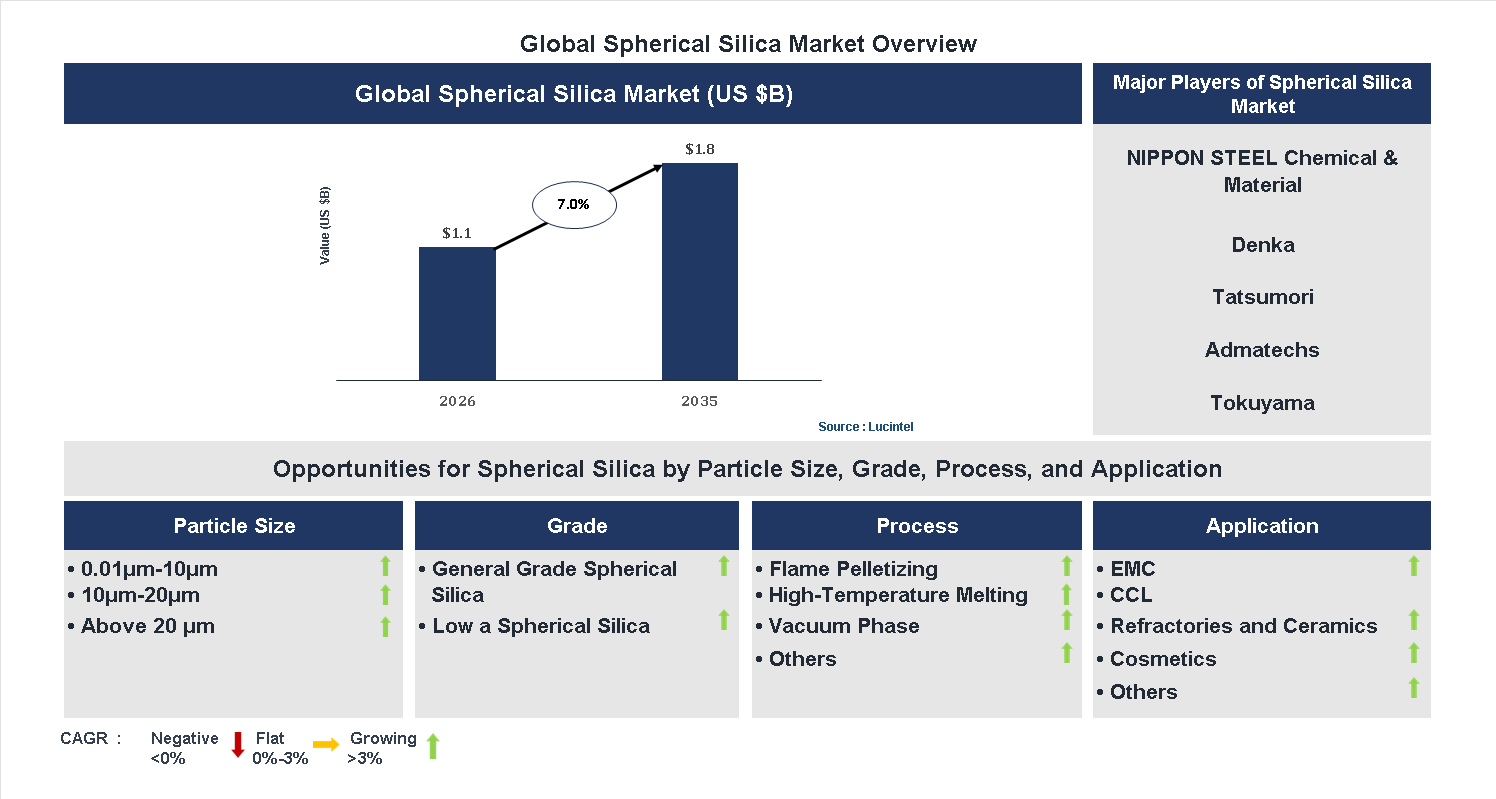
Key data points: The market size in 2035 = $1.8 billion, growth forecast = 7% annually for the next 8 years. Scroll below to get more insights. This market report covers trends, opportunities and forecasts in spherical silica market to 2035 by particle size (0.01μm-10μm, 10μm-20μm, and above 20 μm), grade (general grade spherical silica and low α spherical silica), process (flame pelletizing, high-temperature melting, vacuum phase, and others), application (EMC, CCL, refractories & ceramics, cosmetics, and others), and region (North America, Europe, Asia Pacific, and the Rest of the World)
We'll send your sample report shortly.
• Lucintel forecasts that, within the particle size category, 0.01 μm–10 μm is expected to witness the highest growth over the forecast period.
• Within the application category, EMC is expected to witness the highest growth.
• In terms of region, APAC is expected to witness the highest growth over the forecast period. Gain valuable insights for your business decisions with our comprehensive 150+ page report. Sample figures with some insights are shown below.
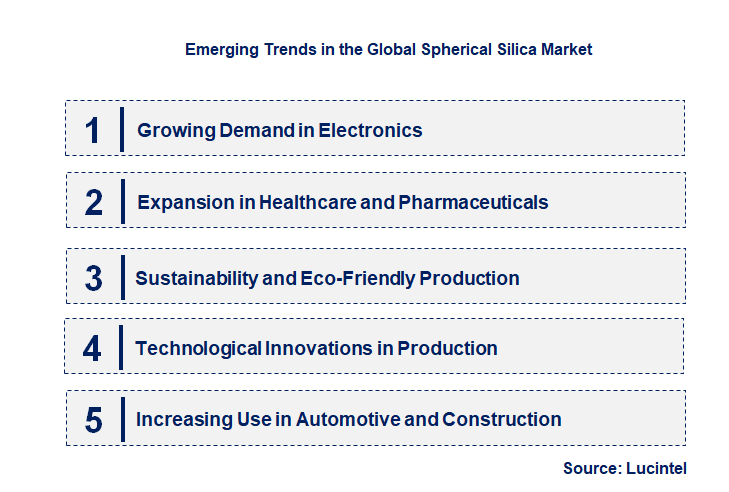
• Growing Demand in Electronics: The electronics industry is increasingly adopting spherical silica for its superior insulating properties and high purity. As electronic devices become more compact and efficient, the need for advanced materials like spherical silica rises. This trend boosts market growth, especially in manufacturing semiconductors, LEDs, and other electronic components. The demand for miniaturized, high-performance devices is driving innovation and expanding the application scope of spherical silica in electronics, making it a critical component in modern electronic manufacturing.
• Expansion in Healthcare and Pharmaceuticals: Spherical silica is gaining traction in healthcare for use in drug delivery systems, diagnostics, and medical devices. Its biocompatibility and high surface area make it ideal for targeted drug delivery and as a carrier in pharmaceutical formulations. The increasing focus on personalized medicine and minimally invasive procedures is fueling demand. This trend is prompting manufacturers to develop specialized spherical silica products that meet stringent medical standards, thereby opening new revenue streams and expanding the market’s reach into healthcare sectors.
• Sustainability and Eco-Friendly Production: Environmental concerns are prompting a shift towards sustainable manufacturing practices in the spherical silica industry. Companies are investing in greener production methods, such as using renewable energy sources and reducing waste. The development of bio-based and recyclable spherical silica products is also gaining momentum. These efforts not only reduce the environmental footprint but also meet the rising consumer and regulatory demand for eco-friendly materials, positioning the market as a responsible and forward-looking industry.
• Technological Innovations in Production: Advances in manufacturing technologies, such as sol-gel processes and spray drying, are enabling the production of higher-quality spherical silica with controlled particle size and purity. These innovations improve product performance and expand application possibilities. Enhanced production efficiency and cost reduction are also key benefits, making spherical silica more accessible across various industries. Continuous R&D efforts are expected to further refine these technologies, leading to more customized and high-performance products tailored to specific industry needs.
• Increasing Use in Automotive and Construction: The automotive industry is utilizing spherical silica for lightweight composites, insulation, and soundproofing materials. Similarly, the construction sector employs it for high-performance concrete and sealants. The demand for durable, lightweight, and energy-efficient materials is driving this trend. As vehicle electrification and green building initiatives grow, the role of spherical silica becomes more prominent. This diversification into new sectors is expanding the market’s scope and creating new growth opportunities, emphasizing its importance in sustainable and innovative material solutions. In summary, these emerging trends are significantly reshaping the spherical silica market by enhancing product capabilities, expanding application areas, and emphasizing sustainability. They are fostering innovation, driving demand across diverse industries, and positioning spherical silica as a vital material for future technological and environmental advancements.
• Enhanced Purity Standards: Recent advancements have led to higher purity spherical silica, essential for electronics and pharmaceutical applications. These improvements reduce impurities, ensuring better performance and safety. The increased purity standards also open new markets requiring stringent quality controls, boosting demand. Manufacturers are investing in advanced purification techniques, which enhance product consistency and reliability. This development strengthens the market by enabling spherical silica to meet diverse industry specifications, fostering innovation, and expanding application scope.
• Innovative Production Technologies: New production methods, such as sol-gel and spray drying, have increased manufacturing efficiency and scalability. These technologies reduce production costs and cycle times, enabling larger volume outputs. They also improve particle uniformity, which is critical for high-performance applications. The adoption of automation and process optimization further enhances productivity. These technological advancements allow companies to meet rising demand more effectively, strengthen supply chains, and reduce environmental impact, thereby supporting sustainable growth in the spherical silica market.
• Sustainability and Eco-friendly Practices: The industry is shifting towards greener production processes, including the use of renewable energy and waste minimization techniques. Innovations in recycling silica waste and reducing carbon emissions are gaining traction. These eco-friendly practices not only comply with stricter regulations but also appeal to environmentally conscious consumers. Companies adopting sustainable methods can differentiate themselves in the market, improve brand reputation, and access new customer segments. This focus on sustainability is expected to drive long-term growth and market acceptance.
• Expanding Application Areas: Spherical silica is increasingly used in emerging sectors such as renewable energy, biotechnology, and advanced coatings. Its unique properties enhance performance in solar panels, drug delivery systems, and protective coatings. The expanding application base creates new revenue streams and diversifies market risks. Industry players are investing in R&D to tailor products for specific uses, which accelerates adoption. This diversification supports market resilience and fosters innovation, ensuring sustained growth amid changing industry needs.
• Regulatory and Quality Compliance: Stricter regulations regarding product safety, environmental impact, and quality control are shaping the market. Companies are adopting advanced testing and certification processes to ensure compliance. This focus on regulatory adherence enhances product credibility and opens access to international markets. It also encourages innovation in formulation and manufacturing to meet evolving standards. Compliance-driven developments foster trust among consumers and stakeholders, ultimately strengthening the market’s integrity and facilitating global expansion. The recent developments in purity, technology, sustainability, application diversity, and compliance are collectively transforming the spherical silica market. These innovations are driving growth, improving product quality, and expanding market reach. As industries continue to evolve, these advancements will ensure the market remains competitive, sustainable, and capable of meeting future demands effectively.
• Expansion into the Electronics Industry: Spherical silica's unique properties, including high purity and excellent thermal stability, make it ideal for electronic applications such as semiconductors, LED manufacturing, and electronic packaging. The growing demand for miniaturized and high-performance electronic devices fuels the need for advanced materials like spherical silica. Manufacturers are investing in R&D to develop specialized grades that meet the stringent requirements of electronics, thereby opening new revenue streams and expanding market reach.
• Growing Use in the Healthcare Sector: The healthcare industry is increasingly adopting spherical silica for drug delivery systems, medical implants, and diagnostic tools due to its biocompatibility and chemical stability. Its ability to enhance the performance of pharmaceuticals and medical devices is driving demand. Additionally, spherical silica's use in wound dressings and tissue engineering scaffolds is gaining traction. This diversification into healthcare applications offers significant growth potential, supported by rising healthcare expenditure and technological innovations in medical materials.
• Rising Demand From the Automotive Industry: Spherical silica is increasingly used in automotive paints, coatings, and rubber components owing to its reinforcing properties, thermal stability, and durability. The shift towards lightweight and fuel-efficient vehicles necessitates advanced materials that improve performance and safety. Automotive manufacturers are adopting spherical silica to enhance the quality of exterior coatings and tires, which boosts overall vehicle performance. This trend is expected to continue as the automotive sector emphasizes sustainability and innovation, creating substantial growth opportunities.
• Technological advancements in Manufacturing Processes: Innovations such as spray drying, sol-gel techniques, and surface modification are improving the quality and functionality of spherical silica. These advancements enable the production of highly uniform, pure, and customizable spherical silica particles tailored for specific applications. Enhanced manufacturing efficiency reduces costs and allows for larger-scale production, meeting rising demand. Continuous R&D efforts are expected to further refine these processes, expanding the scope of spherical silica in various high-tech industries and fostering market growth.
• Increasing Adoption in the Coatings and Paints Industry: Spherical silica's ability to improve scratch resistance, UV stability, and gloss makes it a preferred additive in coatings and paints. Its use enhances the durability and aesthetic appeal of architectural, industrial, and automotive coatings. As environmental regulations favor low-VOC and eco-friendly formulations, spherical silica's inert nature aligns well with these standards. The ongoing demand for high-performance coatings in construction and transportation sectors presents significant growth opportunities, driven by innovations in formulation and application techniques. The overall market outlook is positively influenced by these diverse growth opportunities, which collectively drive innovation, expand application bases, and enhance competitiveness. As industries continue to evolve and demand higher-performance materials, the spherical silica market is poised for sustained growth, benefiting manufacturers and stakeholders through strategic investments and technological progress.
• Technological Innovation: The development of advanced manufacturing techniques has enabled the production of high-quality spherical silica with consistent particle size and purity. These innovations improve product performance in applications like rubber reinforcement, coatings, and electronics, thereby expanding market reach. Continuous R&D efforts are also leading to cost-effective production methods, making spherical silica more accessible to various industries. As technology evolves, the ability to customize silica properties for specific applications further fuels market growth, ensuring competitiveness and meeting increasing industry standards.
• Growing Automotive and Electronics Industries: The surge in automotive manufacturing, especially electric vehicles, has increased demand for lightweight, durable materials like spherical silica for tire reinforcement and insulation. Similarly, the electronics sector's expansion requires high-purity silica for semiconductors, displays, and other components. These industries' rapid growth directly correlates with increased consumption of spherical silica, driving market expansion. The trend towards miniaturization and enhanced performance in electronic devices further amplifies the need for specialized silica products, making this a significant growth driver.
• Environmental Regulations and Sustainability Initiatives: Stricter environmental standards worldwide are pushing manufacturers to adopt eco-friendly production processes and materials. Spherical silica, being a mineral-based product, aligns with sustainability goals due to its inert nature and recyclability. Regulatory pressures encourage innovation in production methods to reduce emissions and waste, fostering the development of greener manufacturing practices. These initiatives not only ensure compliance but also enhance brand reputation and market acceptance, ultimately driving demand for environmentally sustainable spherical silica solutions.
• Increasing Infrastructure Development: Rapid urbanization and infrastructure projects across emerging economies are fueling demand for construction materials, including spherical silica. Its use in concrete, sealants, and insulation enhances durability and performance, making it a preferred additive. Governments' investments in smart cities and sustainable infrastructure further boost consumption. The expanding construction sector offers significant growth opportunities for spherical silica suppliers, especially as infrastructure standards evolve to incorporate high-performance materials, ensuring long-term market stability and expansion. The challenges facing this Market include:-
• Raw Material Supply Constraints: The production of spherical silica depends heavily on high-quality silica sources, which are geographically limited. Fluctuations in raw material availability, geopolitical issues, and environmental restrictions can disrupt supply chains, leading to increased costs and production delays. Additionally, the need for consistent quality standards complicates sourcing, impacting overall market stability. Manufacturers must invest in diversified sourcing strategies and sustainable extraction practices to mitigate these risks, which can involve significant capital and operational adjustments.
• Environmental and Regulatory Compliance Costs: While spherical silica is environmentally friendly, its manufacturing process can generate emissions and waste that are subject to stringent regulations. Compliance with evolving environmental standards requires investments in cleaner technologies and waste management systems, increasing operational costs. Non-compliance risks include legal penalties and reputational damage, which can hinder market growth. Navigating complex regulatory landscapes across different regions demands substantial expertise and resources, posing ongoing challenges for producers aiming to maintain profitability and market access.
• Market Price Volatility: Fluctuations in raw material prices, energy costs, and transportation expenses contribute to market price volatility. Such unpredictability affects profit margins and pricing strategies, making it difficult for manufacturers to plan long-term investments. Price instability can also impact end-user industries' procurement decisions, potentially slowing demand growth. To counteract this, companies need to develop flexible supply chain management and hedging strategies, which require sophisticated financial planning and can increase operational complexity. The spherical silica market is shaped by technological advancements, expanding end-use industries, and sustainability initiatives that promote growth. However, raw material supply issues, regulatory compliance costs, and price volatility present significant challenges. These factors collectively influence market dynamics, requiring stakeholders to adopt innovative, sustainable, and flexible strategies. While opportunities abound, addressing these challenges is crucial for sustained growth and competitiveness in the spherical silica industry.
• NIPPON STEEL Chemical & Material
• Denka
• Tatsumori
• Admatechs
• Tokuyama
• Imerys
• Sibelco Korea
• AGC-Si
• Jiangsu Yoke Technology
• NOVORAY
• 0.01μm-10μm
• 10μm-20μm
• Above 20 μm
• General Grade Spherical Silica
• Low α Spherical Silica
• Flame Pelletizing
• High-Temperature Melting
• Vacuum Phase
• Others
• EMC
• CCL
• Refractories & Ceramics
• Cosmetics
• Others
• North America
• Europe
• Asia Pacific
• The Rest of the World
• United States: The US market has seen increased adoption of spherical silica in electronics and healthcare applications, driven by technological innovation and stringent quality standards. Major players are investing in sustainable production methods and expanding manufacturing capacities to meet rising demand. Regulatory frameworks favor eco-friendly practices, encouraging R&D in biodegradable and low-emission silica products. The US also witnesses a growing trend in the use of spherical silica in automotive and construction sectors, supported by infrastructure development and technological advancements.
• China: China remains the largest producer and consumer of spherical silica, with rapid industrialization fueling demand across sectors such as electronics, ceramics, and construction. The country has focused on expanding production capacity and improving product quality through technological upgrades. Government policies promoting environmental sustainability and innovation are encouraging the development of eco-friendly spherical silica. Additionally, China is investing heavily in research to develop high-purity and specialized silica variants to cater to advanced applications, strengthening its global market position.
• Germany: Germany's market is characterized by high-quality standards and innovation in spherical silica applications, particularly in automotive, pharmaceuticals, and electronics industries. The country emphasizes sustainable manufacturing practices and strict regulatory compliance, which has led to the development of environmentally friendly silica products. German companies are also investing in R&D to improve product performance and explore new applications, such as in renewable energy and advanced coatings. The focus on quality and innovation makes Germany a key player in the European spherical silica market.
• India: The Indian spherical silica market is witnessing rapid growth due to expanding construction, automotive, and electronics sectors. Increasing urbanization and infrastructure projects are driving demand for high-performance silica products. The country is focusing on enhancing local manufacturing capabilities and reducing import dependency through government initiatives. R&D efforts are underway to develop cost-effective and eco-friendly spherical silica variants suitable for diverse applications. The market is also benefiting from foreign investments and collaborations aimed at technological advancement and quality improvement.
• Japan: Japan's market is characterized by advanced technological integration and high standards of quality in spherical silica production. The country is leveraging its expertise in electronics, automotive, and healthcare industries to develop specialized silica products. Japan emphasizes sustainable manufacturing practices and innovation, including the development of silica with enhanced thermal and optical properties. The government and private sector are investing in R&D to explore new applications, such as in nanotechnology and renewable energy, maintaining Japan's position as a leader in high-quality spherical silica solutions.


• NIPPON STEEL Chemical & Material
• Denka
• Tatsumori
• Admatechs
• Tokuyama
• Imerys
• Sibelco Korea
• AGC-Si
• Jiangsu Yoke Technology
• NOVORAY Q6. Which spherical silica market segment will be the largest in future? Answer: Lucintel forecasts that, within the particle size category, 0.01 μm–10 μm is expected to witness the highest growth over the forecast period. Q7. In spherical silica market, which region is expected to be the largest in next 5 years? Answer: In terms of region, APAC is expected to witness the highest growth over the forecast period. Q8. Do we receive customization in this report? Answer: Yes, Lucintel provides 10% customization without any additional cost.


Choose a license that fits your team. Instant PDF delivery.
Prices exclude taxes. Instant delivery. Custom licensing available on request.
Market Report · July 22, 2026
Market Report · July 22, 2026
Market Report · July 22, 2026
Trusted partner for strategic intelligence and business growth


Receive a complimentary market analysis tailored to your industry. Our analysts will identify key growth opportunities and competitive dynamics specific to your business.

Market size, growth rate, and key trend analysis for your specific sector.

Top competitor positioning and market share analysis.

Strategic recommendations backed by data-driven insights.
Get curated market intelligence and competitive moves straight to your inbox.
By subscribing, you agree to receive our monthly insights. Unsubscribe anytime.
Receive a complimentary market analysis tailored to your industry. Our analysts will identify key growth opportunities and competitive dynamics specific to your business.
Market size, growth rate, and key trend analysis for your specific sector.
Top competitor positioning and market share analysis.
Strategic recommendations backed by data-driven insights.
Get curated market intelligence, emerging trends, and competitive moves straight to your inbox each month.
By subscribing, you agree to receive our monthly insights. Unsubscribe anytime.
We'll send your sample report shortly.