
Report Feature
Spectacle Market Trends and Forecast
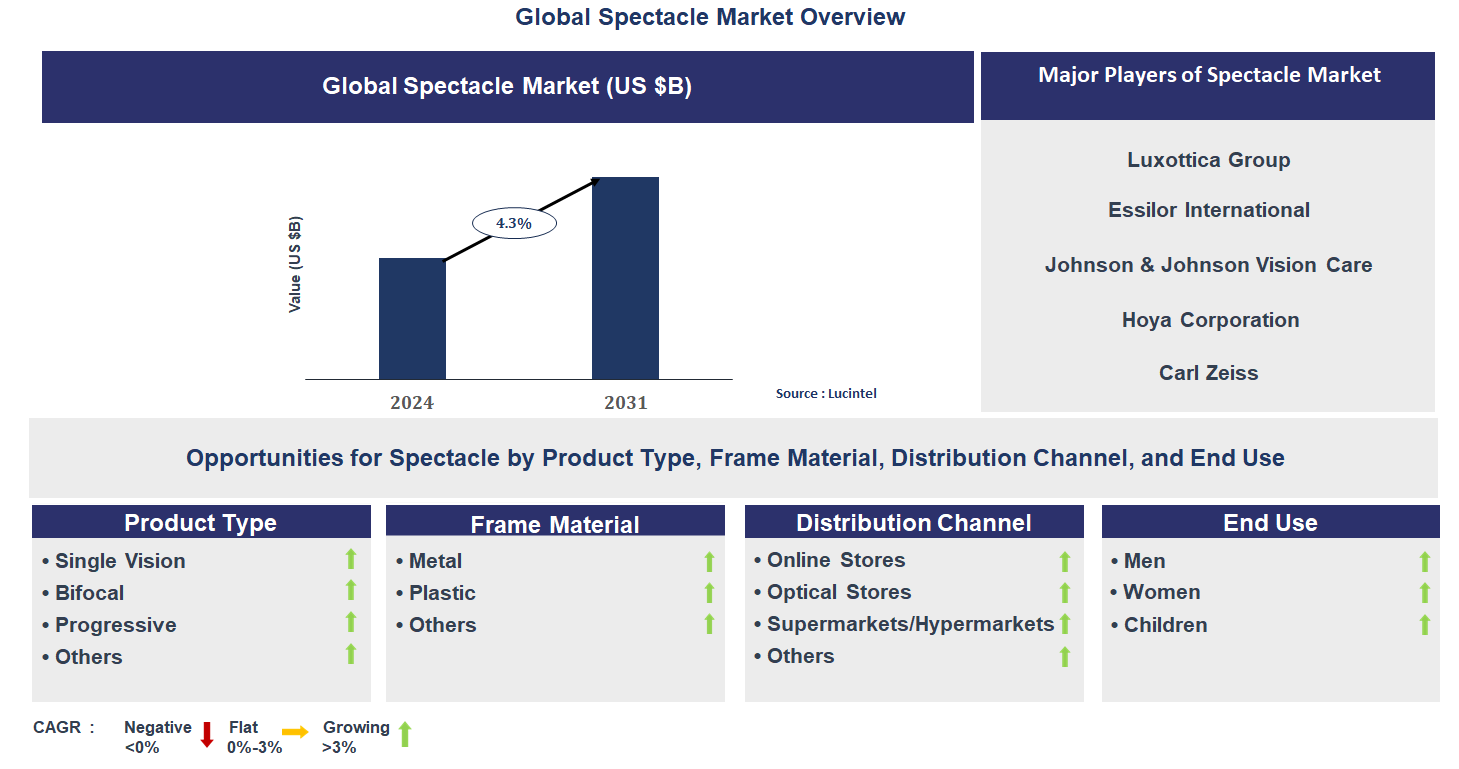
The future of the global spectacle market looks promising with opportunities in the online store, optical store, and supermarket/hypermarket markets. The global spectacle market is expected to grow with a CAGR of 4.3% from 2025 to 2031. The major drivers for this market are the increasing prevalence of vision disorders, the rising adoption of fashionable eyewear, and the growing aging population needing corrective lenses.• Lucintel forecasts that, within the product type category, single vision is expected to witness the highest growth over the forecast period.
• Within the distribution channel category, online store is expected to witness the highest growth.
• In terms of region, North America is expected to witness the highest growth over the forecast period. Gain valuable insights for your business decisions with our comprehensive 150+ page report. Sample figures with some insights are shown below.
Emerging Trends in the Spectacle Market
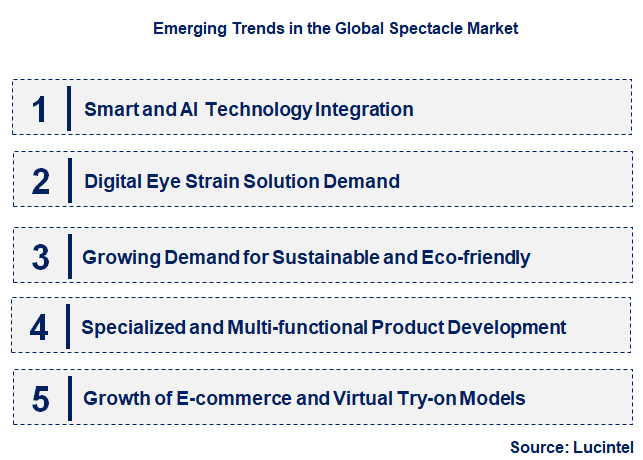
The spectacle market is being reformed by a new group of up-and-coming trends that are redefining its landscape. These trends are a function of a larger shift in consumer values, where products need to be not just functional but also conducive to personal health objectives and eco-consciousness. The sector is transcending a single, utilitarian product towards more specialization, sustainability, and customer-focused business models. Following are five significant trends that are defining the future of this market.• Smart and AI Technology Integration: One of the prominent trends is the emergence of smart glasses and AI integration. Brands have now begun developing products that do a variety of things within a single application, such as real-time translation and monitoring health metrics. This trend follows from consumer preferences for minimalism and effective products. It is enabling new brands to come into the market and is forcing existing companies to re-formulate their products to cater to the needs of an internet-savvy consumer base.
• Digital Eye Strain Solution Demand: The industry is experiencing a significant shift towards products that solve digital eye strain. Manufacturers are being pushed to provide superior lenses that incorporate blue light blocking, anti-reflective coatings, and ergonomic engineering. Customers are paying more attention to a brands ethical behavior, and therefore, transparency is becoming an important consideration in purchasing decisions. The trend is as a result of increased consumer sensitization of the health consequences of excessive screen exposure.
• Growing Demand for Sustainable and Eco-friendly Eyewear: The industry is also observing a significant trend towards sustainable and eco-friendly products. Brands are now introducing frames and lenses made of recycled or biodegradable materials. This is a direct reaction to a cultural change where personal care products are becoming gender-neutral. This trend is unveiling a considerable, untapped market space for brands to invest in and discover, offering a new path for growth and differentiation.
• Specialized and Multi-functional Product Development: A speeding trend is the universal development of specialized and multi-functional products for various skin types and issues. The market is experiencing growth in sensitive skin products and emphasis on products for a particular group, including athletes. The trend is moving toward products that provide several benefits in a single use, such as a pad that also provides skincare benefits to soothe and moisturize.
• Growth of E-commerce and Virtual Try-on Models: There is a growing trend towards technology-enabled specialty products. Although still in the nascent stages, this involves creating smart pads with sensors that can track multiple health indicators, including menstrual flow and temperature. This trend illustrates the growing assimilation of technology with personal care and is giving rise to a new, highly specialized segment of the market with great growth potential. These new trends are combining to redefine the spectacle market by increasing its sensitivity to consumer values and needs. The emphasis on multi-functional products and the utilization of new technology is driving a new segment of premium, value-oriented products. The growth in new business models and the expansion in the aesthetic and skincare segments are driving new opportunities for market expansion and revenue growth. Its future will be shaped by how well it is able to innovate and respond to these influential trends.
Recent Development in the Spectacle Market
The spectacle market has undergone a series of fast-paced and significant changes over the past few years, most of which have been a result of increased consumer interest in wellness and self-care. These changes are taking the market from a straightforward, problem-solving category to a more integrated, consumer-facing industry. The emphasis now is on such aspects as sustainability, therapeutic effect, and a more holistic path to health.• Implementation of Advanced Lens Coatings: One of the most important developments is the general implementation of advanced lens coatings. As a reaction to demands from consumers for more eye protection, producers are incorporating features such as anti-glare, anti-scratch, and blue light filters. This trend is essentially redefining product structure and the public image of a brand, setting a new standard for ethical and health-oriented manufacturing.
• New Developments in Frame Materials and Design: There has been a significant improvement in frame materials and design. Organizations are launching new products with features such as super-absorbent polymers that deal effectively with heavy flow yet remain ultra-thin. The market also witnesses an increase in pads with a breathable and skin-comfortable top sheet, which avoids irritation and discomfort. These innovations are improving sanitary napkins effectiveness and are one of the major drivers of enhancing consumer satisfaction.
• Expansion of E-commerce and Virtual Try-on Technology: One of the major developments is the expansion and extensive use of the e-commerce and subscription model. This type of business provides consumers with an easy means to buy a large selection of sanitary napkins at home. It creates a steady revenue flow for firms and enables them to establish an immediate connection with consumers. It facilitates new, niche brands to come into the market and compete with top giants as well.
• Amplification of Menstrual Hygiene Awareness Campaigns: One of the major developments is the amplification of menstrual hygiene awareness campaigns. Governments and non-government organizations are concentrating efforts on making the public aware of the significance of menstrual health and hygiene. This is shattering social taboos and is accelerating the use of sanitary napkins, especially in rural and developing countries. This development is not only propelling market growth but is also positively affecting society.
• Sustainable and Eco-Friendly Products: Another significant trend is increasing focus on sustainable and eco-friendly products. This involves recyclable packaging and sourcing ingredients that are environmentally and ethically responsible. Sustainable practices are now being emphasized through marketing by the brands. This trend is attracting a new generation of green consumers and is one of the main drivers of ongoing product innovation for the industry. These recent innovations are coming together to affect the spectacle market as a whole by driving it toward a more specialized, therapeutic, and consumer-driven future. The transition to sustainable ingredients and new formulas is meeting health and environmental demands. The emergence into new categories and new business models is opening up new avenues for market growth and brand differentiation.
Strategic Growth Opportunities in the Spectacle Market
The spectacle industry provides diverse strategic growth prospects in major applications based on a synergy between changes in consumer values and the need for greater specialization. To take advantage of these opportunities, firms need to transcend a one-size-fits-all strategy and concentrate on innovation and niche marketing. By discovering and fulfilling distinct needs across various market segments, brands can generate new sources of revenue and build a robust competitive position. The following expounds on five important opportunities for growth in the market.• Addressing the Niche Consumer Market: One key growth area is addressing niche consumer demand. This involves creating products for a particular group, e.g., teenagers, individuals with a certain skin sensitivity, or those with heavy flow. With this focus on a targeted demographic, brands create a loyal consumer base and differentiate themselves from others selling generic products. There are higher profit margins and a tighter brand identity here.
• Leveraging the Organic and Eco-friendly Segment: There is tremendous growth potential in the organic and eco-friendly segment. This entails creating products that are sourced from organic materials such as organic cotton or bamboo fiber and do not contain toxic chemicals. Brands can also use sustainable packaging strategically. This segment provides a high-value customer base that is ready to spend on products that share the same personal values and concern for the environment.
• Penetration into Rural and Underserved Markets: One of the most significant growth opportunities is penetration into rural and underserved markets. Although these markets will have lower disposable incomes, they are a huge, untapped consumer base. By providing an affordable but quality product and by allying with local communities and organizations, brands can gain traction in these markets and establish a sustainable long-term growth pattern.
• E-commerce Leveraging with Personalized Services: Direct-to-consumer and e-commerce models are a significant opportunity for growth. With a direct-to-consumer service, brands can eliminate distribution expenses and establish a one-to-one relationship with consumers. A subscription format provides a consistent and recurring revenue flow. Firms can also utilize sales data from the internet to learn more about consumer behavior and tastes, which can drive future product planning and promotion.
• Breaking into the Female Athlete and Active Lifestyle Segment: There is a strategic opportunity for growth in breaking into the female athlete and active lifestyle segment. This involves creating products that are specifically designed to be effective and comfortable to wear during exercise. These products may incorporate features such as high-end absorbency, emphasis on breathability, and non-slip construction. This segment is expanding at an aggressive rate and consists of a high-value customer base. These growth strategies are cumulatively affecting the spectacle industry by driving it towards a specialized and consumer-oriented future. By targeting niche applications and demographics, businesses are increasing the markets span. The focus on multi-functional value and alternative business models is forming new segments of value-based premium products. The strategic expansion of new markets further guarantees that the industry will keep improving and evolving to address world consumer needs.
Spectacle Market Driver and Challenges
The spectacle market is driven by a multifaceted interaction of key drivers and challenges that are affecting its growth and trend. The expansion of the markets is driven mainly by a growing global consciousness about personal health and hygiene, as well as a new generation of consumers with a keen emphasis on self-care. But the industry also encounters considerable challenges, such as a higher cost for premium products, a missing consumer knowledge in certain markets, and deep-rooted cultural taboos. The factors responsible for driving the spectacle market include: 1. Increasing Consumer Awareness of Health: One of the most important drivers is the increasing consumer awareness of health. Consumers are also more interested in the possible health hazards of traditional pads made with artificial materials and chemicals. This has created a significant shift towards organic and natural options. Demand for skin-friendly and chemically free products is a major driver of market growth. This is a mind-set change that has turned sanitary napkins into a daily essential for a much larger number of consumers. 2. Increasing Demand for Sustainable Products: Increasing demand for sustainable products is the key driver in this market. Customers are demanding more and more that brands incorporate ethically sourced ingredients and sustainable packaging. This has brought about the large-scale use of recyclable and biodegradable packaging. This is a big trend in the personal care market, and sanitary napkin brands that are open about what they do are gaining market share and are appealing to a new generation of sustainable buyers. 3. Government Programs and Campaigns: Government programs and campaigns for menstrual hygiene are a significant market driver, especially in emerging economies. These programs are designed to raise awareness and to bring sanitary napkins within the reach of every woman. This is an influential driver that is assisting in eliminating social stigmas and is accelerating the usage of these products, driving the market growth in a big way. 4. Increasing Disposable Incomes: Increasing disposable incomes, especially in emerging economies, are a key driver of the market. With the growing middle class, consumers have greater amounts of money to spend on personal care products. This enables them to upgrade from essential hygienic products to more specialized and premium sanitary napkins. This driver is strongly relevant in economies such as China and India, where economic growth is generating a huge new consumer base. 5. Expansion of E-commerce and Social Media: Expansion of e-commerce and social media is a primary driving force for the market. The two are facilitating easier access to a large audience for brands and to a variety of products for consumers. Bloggers and social media influencers are influential in informing consumers about the advantages of various sanitary napkins. This has opened the market to new brands as well. Challenges in the spectacle market are: 1. Cultural Taboos and Stigma: One of the biggest challenges for the market is the cultural taboos and stigma around menstruation in certain areas. It hinders open conversations regarding menstrual hygiene and limits access to the right products. This is one of the biggest challenges for brands and demands them to invest a lot of money in extensive education campaigns to build demand and alter consumer behavior. 2. Affordability and Accessibility: Affordability and accessibility of sanitary napkins are a significant issue, particularly in low-income areas. Pads can be regarded as luxury items by many women, and the expense is a significant drawback for frequent use. The task for brands is to create a product that is effective as well as affordable to numerous consumers. 3. Alternative Product Competition: The market is subjected to a major challenge from alternative products. Reusable cloth pads and menstrual cups are also becoming increasingly popular, especially among environmentally aware consumers. Although they represent a limited share of the market, they are increasingly becoming a threat to conventional sanitary napkin makers. The combined effect of these drivers and challenges is a market in a state of constant evolution. The pressures, most notably the increased emphasis on health, sustainability, and self-care, are compelling the industry to diversify and innovate. Brands are reacting by formulating tech-intense, expert, and organic products. The challenges, most notably cultural resistance and intense rivalry, are also compelling businesses to be more responsible and strategic.List of Spectacle Companies
Companies in the market compete on the basis of product quality offered. Major players in this market focus on expanding their manufacturing facilities, R&D investments, infrastructural development, and leverage integration opportunities across the value chain. With these strategies spectacle companies cater increasing demand, ensure competitive effectiveness, develop innovative products & technologies, reduce production costs, and expand their customer base. Some of the spectacle companies profiled in this report include-• Luxottica Group
• Essilor International
• Johnson & Johnson Vision Care
• Hoya Corporation
• Carl Zeiss
• Safilo Group
• Marchon Eyewear
• Fielmann
• De Rigo Vision
• Maui Jim
Spectacle Market by Segment
The study includes a forecast for the global spectacle market by product type, frame material, distribution channel, end use, and region.Spectacle Market by Product Type [Value from 2019 to 2031]:
• Single Vision
• Bifocal
• Progressive
• Others
Spectacle Market by Frame Material [Value from 2019 to 2031]:
• Metal
• Plastic
• Others
Spectacle Market by Distribution Channel [Value from 2019 to 2031]:
• Online Stores
• Optical Stores
• Supermarkets/Hypermarkets
• Others
Spectacle Market by End Use [Value from 2019 to 2031]:
• Men
• Women
• Children
Spectacle Market by Region [Value from 2019 to 2031]:
• North America
• Europe
• Asia Pacific
• The Rest of the World
Country Wise Outlook for the Spectacle Market
The international spectacle industry is at the cusp of a dramatic change, fueled by changing consumer needs, increasing health consciousness, and accelerating technological innovation. The transition is propelling the industry away from a mere vision-correcting instrument to one which encompasses fashion, wellbeing, and technology as well. With more and more people spending time on digital screens worldwide, so does the demand for specialized eyewear. Every significant country has market features that are distinct in reflecting its consumer, economic, and cultural attitudes toward eye wellness.• United States: In the United States, the spectacle market is trending toward premium and specialty product focus. One significant development is the trend toward a clean and wellness lifestyle. There is greater demand for products with newer coatings such as blue light filters and anti-reflective coatings. The market is also experiencing an increase in specialized products for eye strain and an emphasis on stylish, environmentally friendly frames. Direct-to-consumer companies and online channels are also a key factor, offering a broad spectrum of choices and enabling targeted advertising to an increasingly health-aware customer base.
• China: Chinas spectacle market is growing very fast, driven by a middle class that is growing rapidly and an increased emphasis on individual health. The market is experiencing a robust demand for smart glasses and products with both therapeutic and aesthetic values. The use of digital devices on a large scale has boosted demand for blue light blocking lenses to unprecedented levels. E-commerce websites and social media are the main growth drivers, with companies using influencers to access a massive consumer base spanning geographies and demographics.
• Germany: The German eyewear market is dominated by a high customer focus on the quality of products, effectiveness, and stringent safety standards. The country is among the top markets in Europe with a high demand for skin-safe and environmentally friendly personal care products. The industry is also witnessing an increase in sustainable product material and bespoke customization choices fueled by a high consumer demand for the zero-waste trend. German innovation revolves around developing high-performance products that are clinically proven and effective, with an emphasis on dermatological wellness and a minimal environmental impact.
• India: Indias eyewear market is growing fast due to increasing disposable incomes and an enhanced consciousness of eye care. Although the market remains dominated by low-cost, conventional treatments, there is a definite shift towards premium, multi-purpose products. There is a growing demand for premium products infused with traditional Ayurvedic ingredients, as the market sees this trend. The high availability of products across traditional retail, in addition to a rapidly expanding e-commerce industry, is one of the major growth drivers, enabling local as well as global brands to penetrate a wide base of consumers.
• Japan: The market for spectacles in Japan is mature and has a reputation for emphasizing cutting-edge technology and high product quality. The Japanese consumer calls for products that are not only good at what they do, but also gentle and luxurious. This has made it possible to create products that have distinctive characteristics, such as specialized products that are non-greasy and absorb quickly. The market is also registering a high demand for toning and skincare products that combine both toning and skin care features, based on a cultural focus on overall personal hygiene and keeping a clean and professional appearance.

Features of the Global Spectacle Market
Market Size Estimates: Spectacle market size estimation in terms of value ($B). Trend and Forecast Analysis: Market trends (2019 to 2024) and forecast (2025 to 2031) by various segments and regions. Segmentation Analysis: Spectacle market size by various segments, such as by product type, frame material, distribution channel, end use, and region in terms of value ($B). Regional Analysis: Spectacle market breakdown by North America, Europe, Asia Pacific, and Rest of the World. Growth Opportunities: Analysis of growth opportunities in different product type, frame material, distribution channel, end use, and regions for the spectacle market. Strategic Analysis: This includes M&A, new product development, and competitive landscape of the spectacle market. Analysis of competitive intensity of the industry based on Porter’s Five Forces model.
FAQ
Q1. What is the growth forecast for spectacle market? Answer: The global spectacle market is expected to grow with a CAGR of 4.3% from 2025 to 2031. Q2. What are the major drivers influencing the growth of the spectacle market? Answer: The major drivers for this market are the increasing prevalence of vision disorders, the rising adoption of fashionable eyewear, and the growing aging population needing corrective lenses. Q3. What are the major segments for spectacle market? Answer: The future of the spectacle market looks promising with opportunities in the online store, optical store, and supermarket/hypermarket markets. Q4. Who are the key spectacle market companies? Answer: Some of the key spectacle companies are as follows:• Luxottica Group
• Essilor International
• Johnson & Johnson Vision Care
• Hoya Corporation
• Carl Zeiss
• Safilo Group
• Marchon Eyewear
• Fielmann
• De Rigo Vision
• Maui Jim Q5. Which spectacle market segment will be the largest in future? Answer: Lucintel forecasts that, within the product type category, single vision is expected to witness the highest growth over the forecast period. Q6. In spectacle market, which region is expected to be the largest in next 5 years? Answer: In terms of region, North America is expected to witness the highest growth over the forecast period. Q7. Do we receive customization in this report? Answer: Yes, Lucintel provides 10% customization without any additional cost.
Table of Contents
List of Figures
List of Tables
Methodology
- In-depth interviews of the major players in this market
- Detailed secondary research from competitors’ financial statements and published data
- Extensive searches of published works, market, and database information pertaining to industry news, company press releases, and customer intentions
- A compilation of the experiences, judgments, and insights of Lucintel’s professionals, who have analyzed and tracked this market over the years.


Buy Now
Choose a license that fits your team. Instant PDF delivery.
Prices exclude taxes. Instant delivery. Custom licensing available on request.
Key Questions
- • What are some of the most promising, high-growth opportunities for the spectacle market by product type (single vision, bifocal, progressive, and others), frame material (metal, plastic, and others), distribution channel (online stores, optical stores, supermarkets/hypermarkets, and others), end use (men, women, and children), and region (North America, Europe, Asia Pacific, and the Rest of the World)?
- • Which segments will grow at a faster pace and why?
- • Which region will grow at a faster pace and why?
- • What are the key factors affecting market dynamics? What are the key challenges and business risks in this market?
- • What are the business risks and competitive threats in this market?
- • What are the emerging trends in this market and the reasons behind them?
- • What are some of the changing demands of customers in the market?
- • What are the new developments in the market? Which companies are leading these developments?
- • Who are the major players in this market? What strategic initiatives are key players pursuing for business growth?
- • What are some of the competing products in this market and how big of a threat do they pose for loss of market share by material or product substitution?
- • What M&A activity has occurred in the last 5 years and what has its impact been on the industry? For any questions related to Spectacle Market, Spectacle Market Size, Spectacle Market Growth, Spectacle Market Analysis, Spectacle Market Report, Spectacle Market Share, Spectacle Market Trends, Spectacle Market Forecast, Spectacle Companies, write Lucintel analyst at email: helpdesk@lucintel.com. We will be glad to get back to you soon.


