
Market Report · July 13, 2026

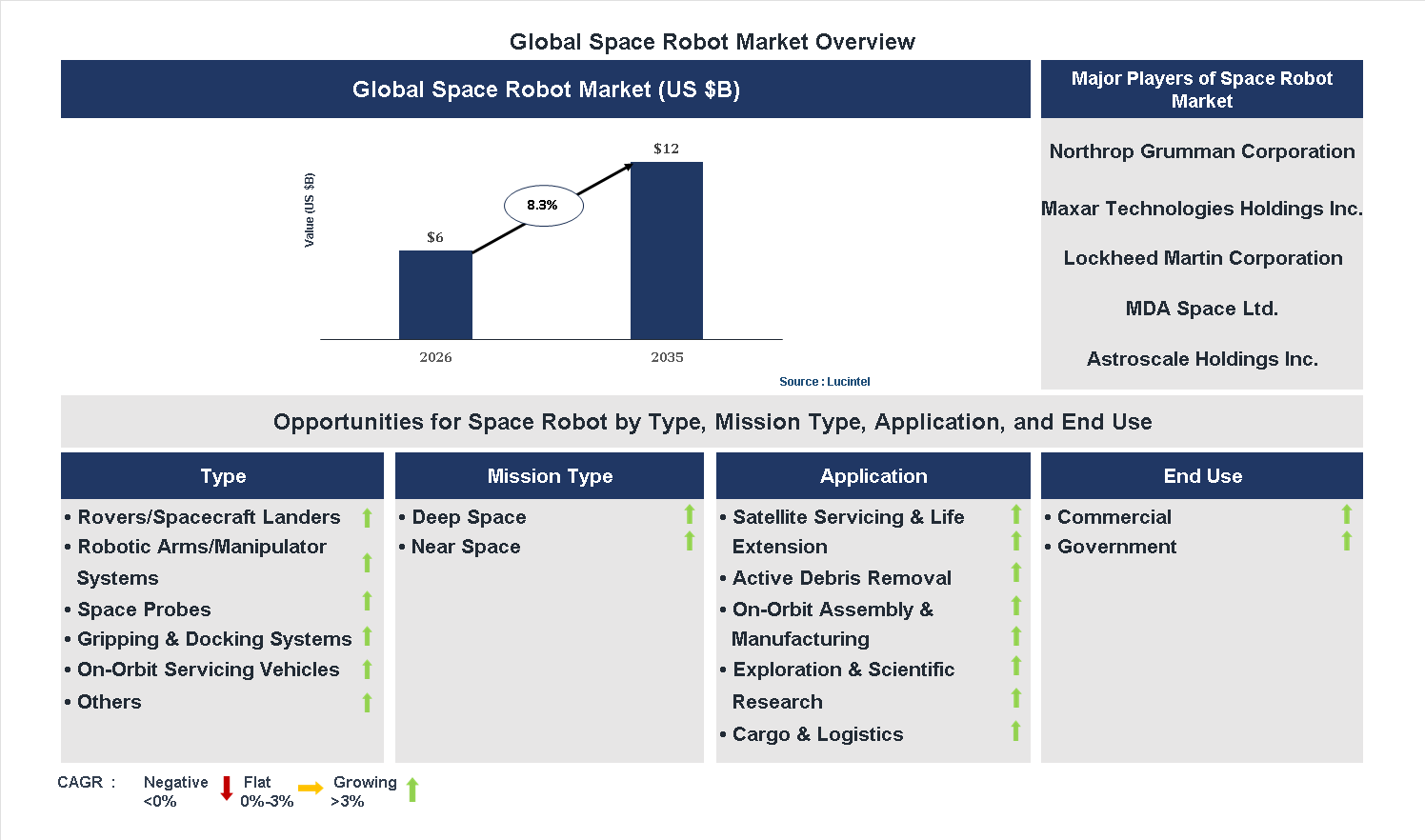
Key data points: The market size in 2035 = $12 billion, growth forecast = 8.3% annually for the next 8 years. Scroll below to get more insights. This market report covers trends, opportunities and forecasts in space robot market to 2035 by type (rovers/spacecraft landers, robotic arms/manipulator systems, space probes, gripping & docking systems, on-orbit servicing vehicles, and others), mission type (deep space and near space), application (satellite servicing & life extension, active debris removal, on-orbit assembly & manufacturing, exploration & scientific research, and cargo & logistics), end use (commercial and government), and region (North America, Europe, Asia Pacific, and the Rest of the World)
We'll send your sample report shortly.
• Lucintel forecasts that, within the type category, robotic arm/manipulator system is expected to witness the highest growth over the forecast period.
• Within the end use category, commercial is expected to witness higher growth.
• In terms of region, APAC is expected to witness the highest growth over the forecast period. Gain valuable insights for your business decisions with our comprehensive 150+ page report. Sample figures with some insights are shown below.
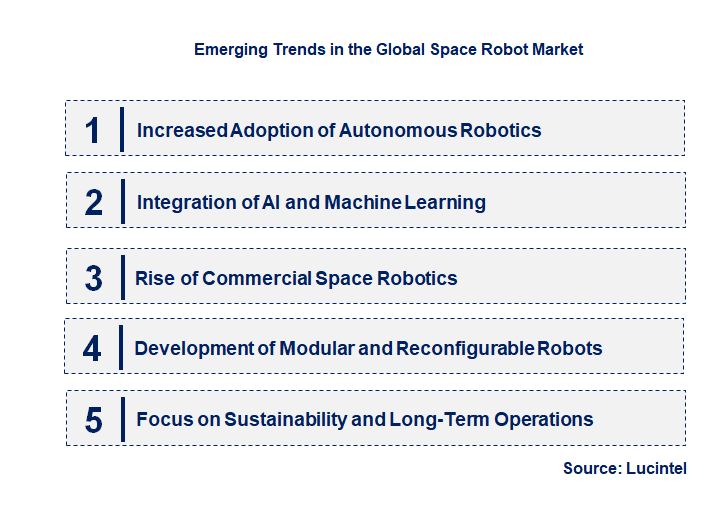
• Increased Adoption of Autonomous Robotics: The trend toward autonomous space robots is accelerating as advancements in AI and machine learning enable robots to perform complex tasks independently. These robots can navigate, identify objects, and execute missions with minimal human intervention, reducing costs and increasing operational efficiency. Autonomous systems are particularly valuable for deep-space exploration and long-duration missions where real-time control is limited. This shift enhances mission success rates and opens new possibilities for remote operations on planets, moons, and asteroids.
• Integration of AI and Machine Learning: AI and machine learning are becoming integral to space robotics, enabling smarter decision-making and adaptive behaviors. These technologies allow robots to analyze data, optimize task execution, and respond to unforeseen challenges autonomously. For example, AI-powered robots can identify geological features during planetary exploration or adjust their operations based on environmental conditions. This integration improves precision, reduces the need for constant human oversight, and accelerates mission timelines, making space robots more versatile and capable.
• Rise of Commercial Space Robotics: The commercial sector is increasingly investing in space robotics, driven by private companies ambitions to establish lunar bases, asteroid mining, and satellite servicing. Companies like SpaceX, Blue Origin, and others are developing robotic systems for cargo delivery, maintenance, and resource extraction. This trend diversifies the market, fosters innovation, and reduces reliance on government agencies. Commercial space robotics are also creating new revenue streams and partnerships, expanding the scope and scale of space activities beyond traditional government-led missions.
• Development of Modular and Reconfigurable Robots: Modular design approaches are gaining popularity, allowing space robots to be reconfigured for different tasks or missions. These adaptable systems can be assembled in space, upgraded, or repaired, extending their operational lifespan. Modular robots facilitate cost-effective mission planning and enable rapid deployment of specialized tools or sensors. This flexibility is crucial for complex missions such as planetary surface exploration, where different phases require different capabilities, and for responding to unexpected challenges during space operations.
• Focus on Sustainability and Long-term Operations: Sustainability is becoming a core focus, with efforts to develop robots capable of supporting long-term missions and reducing space debris. Innovations include robots designed for in-orbit servicing, debris removal, and resource utilization. These initiatives aim to create a sustainable space environment, minimize mission costs, and enable continuous human presence in space. Long-term robotic systems are essential for establishing lunar bases, Mars colonies, and other deep-space habitats, ensuring ongoing support for human explorers and scientific research. These trends are reshaping the space robot market by enhancing autonomy, integrating advanced technologies, expanding commercial involvement, promoting flexible designs, and emphasizing sustainability. Together, they are paving the way for more ambitious, efficient, and sustainable space exploration and operations, ultimately transforming how humanity interacts with and utilizes space.
• Growing Demand for Satellite Servicing: Expanding satellite constellations require maintenance, repair, and refueling, which space robots can perform efficiently. This reduces costs and extends satellite lifespan, making space operations more sustainable. Companies like Northrop Grumman and Astroscale are developing robotic servicing vehicles, boosting market growth. The ability to perform in-orbit repairs minimizes debris and enhances mission success rates, attracting more investments and fostering innovation in autonomous servicing systems.
• Advances in Planetary Exploration Robots: New robotic systems are enabling detailed exploration of planets, moons, and asteroids. These robots can operate in harsh environments, collect samples, and transmit data back to Earth. NASA’s Perseverance rover and ESA’s Rosalind Franklin are prime examples. These developments improve scientific understanding, support resource identification, and prepare for future human missions. The increased capability of exploration robots is attracting collaborations and funding, accelerating the pace of space discovery.
• Development of Autonomous Space Robots: Autonomous systems are becoming more sophisticated, capable of decision-making and complex task execution without human intervention. This reduces reliance on ground control and enhances mission efficiency. Companies like iSpace and Astrobotic are deploying autonomous robots for lunar and asteroid mining. These advancements are crucial for long-duration missions, enabling continuous operation in remote or hazardous environments, and are expected to lower operational costs while increasing mission success probabilities.
• Integration of AI and Machine Learning: AI-driven algorithms are improving robot navigation, object recognition, and task execution in space. These technologies enable real-time problem-solving and adaptive responses to unpredictable conditions. NASA’s Robonaut and other AI-enabled robots are demonstrating enhanced capabilities. The integration of AI accelerates mission timelines, reduces human workload, and enhances safety. This technological synergy is attracting investments and fostering the development of smarter, more capable space robots.
• Expansion of Commercial Space Robotics: Private companies are increasingly entering the space robotics sector, offering innovative solutions for satellite deployment, debris removal, and lunar infrastructure. Companies like SpaceX, Blue Origin, and startups are investing in robotic systems to support commercial space activities. This expansion is fostering competition, reducing costs, and accelerating technological advancements. The commercialization of space robotics is creating new revenue streams and expanding market opportunities, making space exploration more accessible and sustainable. The overall impact of these developments is transforming the space robot market into a dynamic, innovative sector. Increased technological capabilities and commercial investments are driving growth, reducing costs, and expanding applications. These advancements are enabling more ambitious missions, fostering international collaborations, and paving the way for sustainable space exploration and resource utilization, ultimately shaping the future of humanity’s presence in space.
• Satellite Servicing and Maintenance: Space robots are increasingly used for satellite repair, refueling, and upgrades, reducing costs and extending satellite lifespans. These robots can perform precise maneuvers in orbit, enabling on-demand servicing without human intervention. The development of modular robotic arms and autonomous docking systems enhances operational efficiency. Growing satellite constellations and the need for sustainable space operations are driving demand for reliable robotic servicing solutions across commercial and government sectors.
• Planetary Exploration and Surface Operations: Robotic systems are vital for exploring planets, moons, and asteroids, providing data and sample collection. Innovations in autonomous navigation, AI-driven decision-making, and ruggedized hardware enable robots to operate in extreme environments. These robots support scientific research, resource assessment, and site reconnaissance, reducing risks to human explorers. The expansion of missions by NASA, ESA, and private entities like SpaceX accelerates the deployment of versatile exploration robots for surface mobility and scientific tasks.
• Space Debris Removal and Management: The increasing accumulation of space debris poses risks to operational satellites and crewed missions. Space robots equipped with capture mechanisms, nets, and robotic arms are being developed to identify, track, and remove debris. These systems aim to mitigate collision hazards and ensure sustainable space activities. Governments and private companies are investing in debris removal technologies, fostering the growth of specialized robotic solutions that can operate autonomously or remotely in complex orbital environments.
• Maintenance and Construction of Space Stations: As space stations become more complex, robotic systems are essential for routine maintenance, repairs, and assembly tasks. Robots can perform welding, component replacement, and inspection, reducing the need for risky extravehicular activities. The development of dexterous robotic arms and modular systems enhances operational capabilities. This growth supports the expansion of commercial space habitats and future lunar or Martian bases, making space station management more efficient and cost-effective.
• Asteroid Mining and Resource Extraction: Robotic systems are central to the emerging industry of asteroid mining, enabling extraction of water, metals, and other valuable resources. Autonomous robots can operate in low-gravity environments, perform drilling, and process materials remotely. Advances in miniaturization, AI, and energy management are critical for sustainable operations. This opportunity opens new revenue streams, supports space manufacturing, and reduces Earths resource dependency, positioning space robots as key enablers of future off-world economies. These growth opportunities are transforming the space robot market into a vital sector for sustainable and innovative space exploration, commercial development, and environmental management. The integration of advanced robotics, AI, and miniaturization will unlock new capabilities, reduce costs, and expand the scope of missions, ultimately shaping the future of space activities and fostering a thriving industry.
• Technological Innovation: The rapid development of robotics, artificial intelligence, and sensor technologies is a primary driver. These innovations enable space robots to perform complex tasks such as satellite repair, asteroid mining, and planetary exploration with higher precision and autonomy. As technology advances, costs decrease, making space robotics more accessible for commercial and governmental projects. The integration of machine learning enhances decision-making capabilities, expanding the scope of applications. This continuous innovation accelerates market growth by opening new opportunities and improving operational efficiency in space missions.
• Increasing Space Exploration Activities: Governments and private companies are investing heavily in space exploration, driven by the potential for scientific discovery and commercial gains. Missions to Mars, lunar bases, and asteroid mining require sophisticated robotic systems for deployment, maintenance, and data collection. The rise of private players like SpaceX and Blue Origin has intensified competition, leading to increased demand for reliable space robots. These activities not only expand the market but also stimulate technological advancements, creating a positive feedback loop that propels the industry forward.
• Growing Commercial Space Industry: The commercialization of space activities, including satellite deployment, space tourism, and resource extraction, significantly boosts the demand for space robots. Companies seek autonomous systems to reduce operational costs and improve safety during space missions. The development of small, cost-effective robotic units facilitates rapid deployment and maintenance of satellite constellations. As commercial ventures expand, the need for versatile, durable, and efficient robotic solutions becomes critical, driving innovation and investment in the space robotics sector.
• Regulatory and Policy Frameworks: International and national regulations concerning space activities influence market growth. Policies related to space debris management, safety standards, and licensing procedures impact the deployment and operation of space robots. While clear regulations can foster a secure environment for investment, overly restrictive policies may hinder innovation and delay project timelines. Evolving legal frameworks require companies to adapt quickly, balancing compliance with technological progress, which in turn shapes the pace and scope of market development. The challenges facing the space robot market are:-
• High Development and Deployment Costs: Developing advanced space robots involves significant investment in research, testing, and manufacturing. The costs associated with launching, operating, and maintaining these systems are substantial, often limiting participation to well-funded governmental agencies and large corporations. Budget constraints and economic uncertainties can delay projects or reduce scope, hindering market expansion. Additionally, the high risk of mission failure due to harsh space conditions adds to the financial burden, making cost management a critical challenge for industry stakeholders.
• Technological Complexity and Reliability: Space robots must operate reliably in extreme environments with high radiation, vacuum conditions, and temperature fluctuations. Designing systems that can withstand these conditions over extended periods is complex and challenging. Failures can lead to mission setbacks, costly repairs, or loss of valuable assets. Ensuring robustness, redundancy, and autonomous fault management requires sophisticated engineering, which increases development time and costs. Overcoming these technological hurdles is essential for gaining stakeholder confidence and ensuring mission success.
• Regulatory and International Cooperation Challenges: Navigating the complex web of international treaties, national regulations, and space law presents significant hurdles. Discrepancies between regulatory frameworks can delay project approvals and complicate collaboration across borders. Issues related to space debris, resource rights, and safety standards require careful negotiation and compliance. These regulatory challenges can slow down innovation, increase costs, and limit the deployment of space robots, especially in joint international missions. Harmonizing policies and establishing clear legal frameworks are vital for sustainable growth in the market. The space robot market is driven by technological innovation, expanding exploration activities, a burgeoning commercial sector, and evolving regulatory landscapes. However, high costs, technological complexities, and regulatory hurdles pose significant challenges. These factors collectively influence the pace of market growth, technological progress, and investment strategies. While opportunities abound, stakeholders must navigate these challenges carefully to realize the full potential of space robotics. The markets future will depend on balancing innovation with regulatory compliance and cost management, ensuring sustainable development in this dynamic industry.
• Northrop Grumman Corporation
• Maxar Technologies Holdings Inc.
• Lockheed Martin Corporation
• MDA Space Ltd.
• Astroscale Holdings Inc.
• Blue Origin Enterprises, L.P.
• Redwire Corporation
• ASTROBOTIC TECHNOLOGY, INC.
• GITAI USA Inc.
• Starfish Space Inc.
• Rovers/Spacecraft Landers
• Robotic Arms/Manipulator Systems
• Space Probes
• Gripping & Docking Systems
• On-Orbit Servicing Vehicles
• Others
• Deep Space
• Near Space
• Satellite Servicing & Life Extension
• Active Debris Removal
• On-Orbit Assembly & Manufacturing
• Exploration & Scientific Research
• Cargo & Logistics
• Commercial
• Government
• North America
• Europe
• Asia Pacific
• The Rest of the World
• United States: The US leads in space robot technology with NASAs ongoing projects like the Robotic Refueling Mission and the development of the Mars rovers. Private companies such as SpaceX and Boeing are investing in robotic systems for satellite servicing and lunar missions. Recent advancements include autonomous docking and repair robots, enhancing mission sustainability and cost-effectiveness. The US government continues to prioritize space robotics to support deep space exploration and commercial ventures.
• China: China has made significant strides in space robotics, exemplified by the successful deployment of the Tianzhou cargo spacecraft with robotic arms and the Change lunar missions featuring robotic landers. The China National Space Administration (CNSA) is developing autonomous robots for lunar and Mars exploration, aiming to establish a sustainable presence on the Moon. Recent innovations focus on improving robotic dexterity and autonomy to support future manned and unmanned missions.
• Germany: Germany is advancing in space robotics through collaborations with the European Space Agency (ESA) and its own research institutions. The German Aerospace Center (DLR) has developed robotic arms and autonomous systems for satellite servicing and space station maintenance. Recent developments include enhanced robotic manipulators capable of complex tasks and increased integration of AI for autonomous decision-making in space operations.
• India: India is progressing in space robotics with ISROs initiatives to develop robotic systems for lunar and planetary exploration. The Chandrayaan missions have incorporated robotic components for surface analysis. India is also exploring robotic technologies for satellite servicing and space station support, aiming to reduce reliance on foreign technology. Recent efforts focus on cost-effective robotic solutions suitable for emerging space markets.
• Japan: Japan has a strong presence in space robotics, with the Japan Aerospace Exploration Agency (JAXA) leading projects like the Kibo robotic arm on the International Space Station and lunar exploration robots. The country is investing in autonomous robots for asteroid missions and lunar surface operations. Recent advancements include improved mobility and dexterity of robotic systems, supporting Japans goal of sustainable space exploration and international collaboration.


• Northrop Grumman Corporation
• Maxar Technologies Holdings Inc.
• Lockheed Martin Corporation
• MDA Space Ltd.
• Astroscale Holdings Inc.
• Blue Origin Enterprises, L.P.
• Redwire Corporation
• ASTROBOTIC TECHNOLOGY, INC.
• GITAI USA Inc.
• Starfish Space Inc. Q6. Which space robot market segment will be the largest in future? Answer: Lucintel forecasts that, within the type category, robotic arm/manipulator system is expected to witness the highest growth over the forecast period. Q7. In space robot market, which region is expected to be the largest in next 8 years? Answer: In terms of region, APAC is expected to witness the highest growth over the forecast period. Q8. Do we receive customization in this report? Answer: Yes, Lucintel provides 10% customization without any additional cost.


Choose a license that fits your team. Instant PDF delivery.
Prices exclude taxes. Instant delivery. Custom licensing available on request.
Market Report · July 13, 2026
Market Report · July 10, 2026
Market Report · July 9, 2026
Trusted partner for strategic intelligence and business growth


Receive a complimentary market analysis tailored to your industry. Our analysts will identify key growth opportunities and competitive dynamics specific to your business.

Market size, growth rate, and key trend analysis for your specific sector.

Top competitor positioning and market share analysis.

Strategic recommendations backed by data-driven insights.
Get curated market intelligence and competitive moves straight to your inbox.
By subscribing, you agree to receive our monthly insights. Unsubscribe anytime.
Receive a complimentary market analysis tailored to your industry. Our analysts will identify key growth opportunities and competitive dynamics specific to your business.
Market size, growth rate, and key trend analysis for your specific sector.
Top competitor positioning and market share analysis.
Strategic recommendations backed by data-driven insights.
Get curated market intelligence, emerging trends, and competitive moves straight to your inbox each month.
By subscribing, you agree to receive our monthly insights. Unsubscribe anytime.
We'll send your sample report shortly.