
Report Feature
Space and Satellite Insurance Market Trends and Forecast
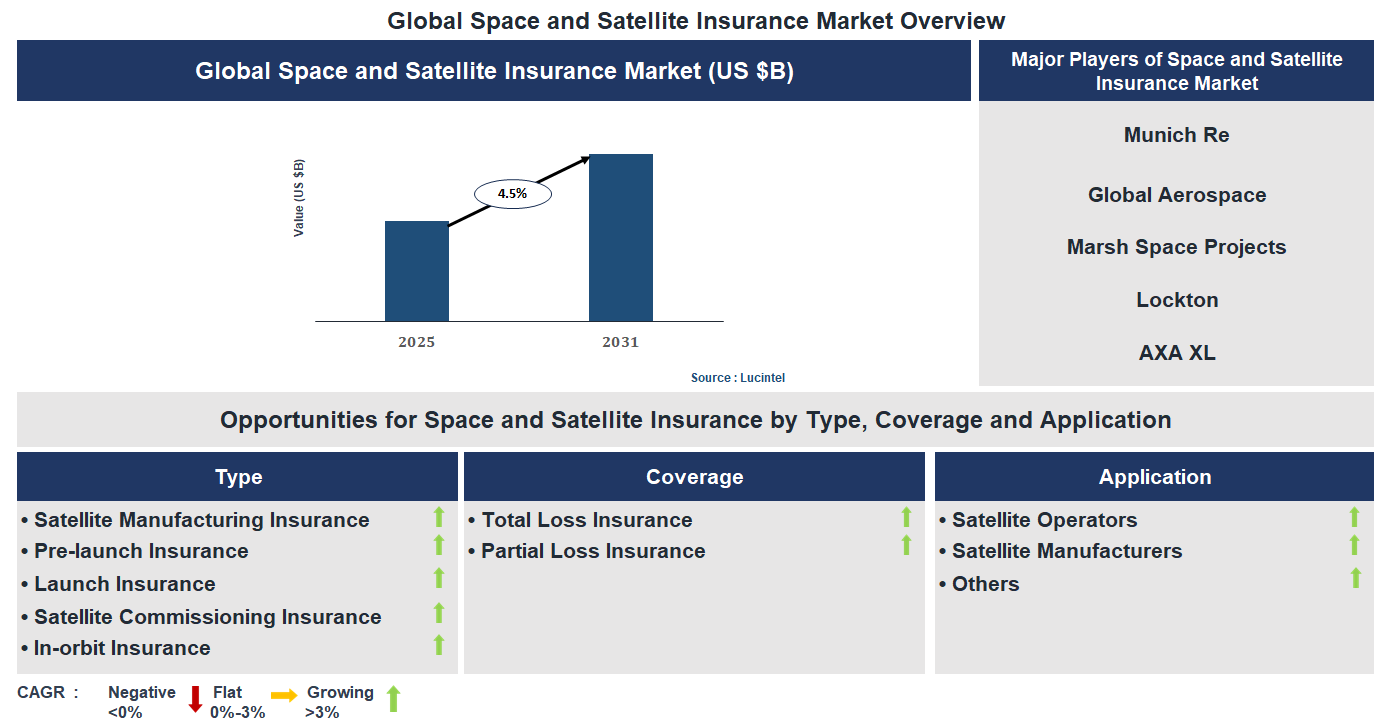
The future of the global space and satellite insurance market looks promising with opportunities in the satellite operator and satellite manufacturer markets. The global space and satellite insurance market is expected to grow with a CAGR of 4.5% from 2025 to 2031. The major drivers for this market are the increasing demand for satellite launches, the rising number of space exploration missions, and the growing concerns over satellite risks.• Lucintel forecasts that, within the type category, in-orbit insurance is expected to witness the highest growth over the forecast period.
• Within the application category, satellite operator is expected to witness higher growth.
• In terms of region, APAC is expected to witness the highest growth over the forecast period. Gain valuable insights for your business decisions with our comprehensive 150+ page report. Sample figures with some insights are shown below.
Emerging Trends in the Space and Satellite Insurance Market
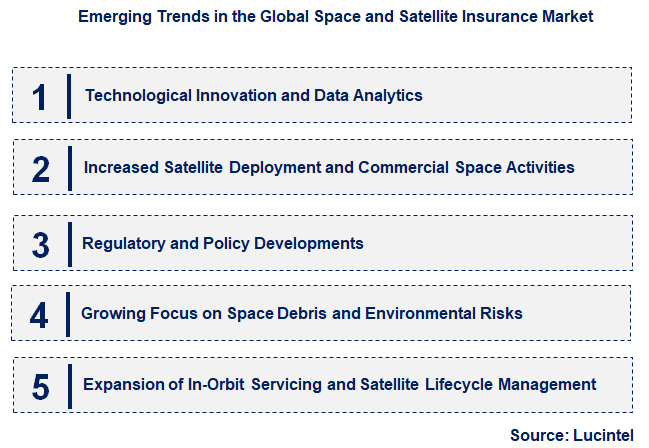
The space and satellite insurance market is experiencing rapid evolution driven by technological advancements, increased satellite deployment, and growing commercial interest in space activities. As the industry expands, insurers are adapting to new risks and opportunities, leading to innovative products and strategic partnerships. The markets growth is also influenced by regulatory developments, rising space exploration initiatives, and the increasing importance of satellite data across various sectors. These trends are fundamentally transforming how risks are assessed, managed, and insured, creating a dynamic environment that demands agility and forward-thinking strategies from industry stakeholders.• Technological Innovation and Data Analytics: The integration of advanced data analytics and AI is revolutionizing risk assessment and underwriting processes. Insurers now leverage real-time satellite data, machine learning algorithms, and predictive modeling to evaluate risks more accurately. This enhances pricing strategies, reduces claim uncertainties, and enables proactive risk management. As technology continues to evolve, insurers can offer more tailored coverage options, improve operational efficiency, and better anticipate potential satellite failures or space debris impacts, ultimately fostering a more resilient insurance ecosystem.
• Increased Satellite Deployment and Commercial Space Activities: The surge in satellite launches, driven by telecommunications, Earth observation, and emerging space tourism sectors, is expanding the market. This proliferation raises new insurance demands for satellite manufacturing, launch, and in-orbit operations. The increased volume of commercial space activities necessitates scalable insurance solutions that can accommodate diverse satellite types and mission profiles. Consequently, insurers are developing specialized policies to address the unique risks associated with a broader array of space assets, fueling market growth and competition.
• Regulatory and Policy Developments: Evolving international and national regulations are shaping the insurance landscape. Governments and space agencies are implementing stricter compliance standards, licensing procedures, and liability frameworks. These regulatory changes influence risk exposure and insurance requirements, prompting insurers to adapt their policies accordingly. Enhanced regulatory clarity also encourages more private sector participation and investment in space ventures, fostering a more structured and predictable market environment that benefits both insurers and clients.
• Growing Focus on Space Debris and Environmental Risks: The increasing amount of space debris poses significant risks to satellites and space missions. Insurers are prioritizing coverage for debris collision risks and environmental liabilities. This trend drives the development of innovative risk mitigation strategies, such as debris tracking and collision avoidance technologies. Addressing these environmental concerns not only reduces potential claims but also promotes sustainable space operations, aligning industry practices with global efforts to preserve the space environment for future generations.
• Expansion of In-Orbit Servicing and Satellite Lifecycle Management: New services like satellite refueling, repair, and end-of-life deorbiting are emerging, extending satellite lifespans and reducing replacement costs. Insurance products are evolving to cover these in-orbit servicing activities, which introduce new technical and operational risks. This trend enhances satellite longevity and operational flexibility, attracting more investment into space infrastructure. As in-orbit servicing becomes more prevalent, insurers will need to develop specialized policies that address the complexities of these innovative services, further transforming the market landscape. In summary, these emerging trends are reshaping the space and satellite insurance market by fostering innovation, expanding coverage options, and promoting sustainable practices. They are enabling industry stakeholders to better manage risks in an increasingly complex and competitive environment, ultimately supporting the growth of commercial space activities and technological advancements.
Recent Development in the Space and Satellite Insurance Market
The space and satellite insurance market is experiencing rapid growth driven by increased satellite launches, technological advancements, and expanding commercial space activities. As space exploration becomes more accessible, the demand for specialized insurance coverage rises to mitigate risks associated with satellite deployment, operation, and potential damage. This evolving landscape presents significant opportunities for insurers to develop innovative products, address emerging risks, and capitalize on the expanding market. The following developments highlight key areas shaping the future of space and satellite insurance.• Increased Satellite Launches: The surge in satellite launches, driven by government and commercial entities, has created a substantial demand for insurance coverage. This growth reduces financial risks associated with launch failures, satellite damage, and mission failures. Insurers are developing tailored policies to cover launch risks, in-orbit damages, and liability issues. As launch frequency continues to rise, the market is expected to see increased premium income, attracting more players and fostering innovation in coverage options.
• Technological Advancements in Satellite Design: Innovations in satellite technology, such as improved materials and autonomous systems, are reducing operational risks. These advancements enable more resilient satellite designs, decreasing the likelihood of failures and damage. Insurers are adapting by offering coverage that accounts for new technologies and associated risks. This evolution enhances confidence among satellite operators, encourages investment, and broadens the scope of insurable assets, ultimately stabilizing the market and encouraging further technological progress.
• Growing Commercial Space Activities: The rise of commercial space ventures, including satellite constellations and space tourism, has significantly increased insurance requirements. Companies seek comprehensive coverage for launch, in-orbit operations, and liability risks. Insurers are developing specialized policies to address these unique needs, fostering market growth. This trend attracts new entrants, stimulates product innovation, and broadens the market scope, making space insurance more accessible and tailored to diverse commercial activities.
• Regulatory Developments and International Cooperation: Evolving regulations and international agreements are shaping the space insurance landscape. Governments and agencies are establishing guidelines to ensure safety and liability management, which influence insurance policies. Enhanced cooperation facilitates risk assessment and claims management across borders. These developments promote transparency, reduce disputes, and encourage investment in space activities. A more standardized approach benefits insurers and clients by providing clearer frameworks and reducing uncertainties in the market.
• Rising Risks from Space Debris and Climate Change: The proliferation of space debris and the impacts of climate change pose new risks to satellites and space infrastructure. These factors threaten operational safety and increase the likelihood of damage, prompting insurers to reassess risk models. Developing coverage for debris-related damages and climate-related disruptions is crucial. Addressing these challenges will lead to more comprehensive policies, higher premiums, and a more resilient market capable of managing emerging threats effectively. The overall impact of these developments is a more dynamic, resilient, and innovative space and satellite insurance market. Increased activity and technological progress drive growth, while regulatory and risk management improvements foster stability. As new risks emerge, insurers adapt, ensuring continued market expansion and confidence among space industry stakeholders. This evolving landscape promises sustained growth and diversification in the space insurance sector.
Strategic Growth Opportunities in the Space and Satellite Insurance Market
The space and satellite insurance market is experiencing rapid growth driven by increasing satellite launches, technological advancements, and expanding commercial space activities. As space exploration and satellite deployment become more frequent, the need for comprehensive insurance coverage rises. Market players are focusing on innovative policies, risk assessment models, and strategic partnerships to capitalize on emerging opportunities. This evolving landscape presents significant potential for insurers to diversify offerings and address the unique risks associated with space missions, ensuring sustainable growth and market stability.• Growing Satellite Launch Activities Drive Insurance Demand: The surge in satellite launches, driven by commercial, governmental, and scientific missions, significantly increases the need for specialized insurance coverage. Insurers are developing tailored policies to mitigate risks associated with launch failures, satellite damage, and mission delays. As launch frequency continues to rise, the market is poised for expansion, with insurers leveraging advanced risk assessment tools to provide comprehensive coverage, thus supporting the growing space economy.
• Increasing Commercial Space Ventures Expand Market Opportunities: The rise of private companies engaging in space exploration, satellite deployment, and space tourism creates new insurance needs. These ventures often involve higher risks and innovative technologies, prompting insurers to develop customized policies. Strategic collaborations with space agencies and tech firms enable insurers to better understand and manage emerging risks, opening avenues for growth in niche segments like space tourism and asteroid mining.
• Technological Advancements Enhance Risk Management Capabilities: Innovations such as AI, big data analytics, and predictive modeling improve risk assessment accuracy in space insurance. These technologies enable insurers to evaluate complex variables, forecast potential failures, and price policies more effectively. As a result, insurers can offer more competitive premiums and coverage options, attracting a broader client base. Enhanced risk management also reduces claim incidences, fostering market confidence and stability.
• Regulatory Developments and International Cooperation Foster Market Growth: Evolving space laws and international agreements influence insurance requirements and standards. Increased cooperation among countries and regulatory bodies facilitates standardized policies and risk-sharing mechanisms. This environment encourages insurers to expand offerings and enter new markets, ensuring compliance and reducing legal uncertainties. Such developments support sustainable growth by creating a predictable framework for space activities and associated insurance services.
• Rising Demand for Satellite Insurance in Emerging Markets: Developing countries and new space programs are increasingly investing in satellite technology for communication, navigation, and earth observation. This growth creates a demand for affordable, accessible insurance solutions tailored to emerging markets needs. Insurers are developing flexible policies and local partnerships to penetrate these regions, expanding the global footprint. The influx of new clients and missions boosts overall market size and diversification, fostering long-term industry resilience. The overall impact of these opportunities is a dynamic, expanding market characterized by innovation, strategic collaborations, and increased global participation. As space activities grow in scope and complexity, insurers are positioned to play a crucial role in enabling sustainable space exploration and commercial ventures. This evolution promises enhanced risk management, diversified offerings, and robust market growth, shaping the future landscape of space and satellite insurance.
Space and Satellite Insurance Market Driver and Challenges
The space and satellite insurance market is influenced by a complex interplay of technological advancements, economic shifts, and regulatory frameworks. As space exploration and satellite deployment become more prevalent, the need for comprehensive insurance solutions grows. Rapid technological innovations, such as satellite miniaturization and reusable launch vehicles, are reshaping risk profiles. Economic factors, including increased investment in space infrastructure and government funding, drive market expansion. Simultaneously, evolving regulatory policies and international agreements impact operational standards and coverage requirements. Navigating these dynamic drivers and challenges is essential for stakeholders aiming to capitalize on opportunities while managing risks effectively in this rapidly evolving industry. The factors responsible for driving the space and satellite insurance market include:• Technological Innovation: The rapid development of satellite technology, including miniaturization and advanced materials, reduces manufacturing costs and enhances satellite performance. These innovations enable more frequent launches and deployments, increasing demand for insurance coverage to mitigate risks associated with new technologies. Additionally, advancements in launch vehicle reliability and reusable rockets lower launch costs, encouraging more satellite missions. As technology evolves, insurers develop specialized policies to address unique risks, fostering market growth. The integration of AI and predictive analytics further enhances risk assessment, making insurance products more tailored and accessible, thus fueling industry expansion.
• Growing Space Economy: The expanding commercial space sector, driven by private companies and increased government investments, significantly boosts the need for satellite insurance. The rise in satellite constellations for global internet coverage, Earth observation, and communication services necessitates comprehensive coverage options. As the space economy diversifies, insurers see opportunities to develop innovative products for different mission types. The influx of capital into space startups and infrastructure projects amplifies the market size. This economic growth not only increases the volume of insured assets but also encourages insurers to refine risk models, fostering a more robust and competitive insurance landscape.
• Regulatory Developments: Evolving international and national regulations influence the space insurance market by establishing standards for safety, liability, and operational procedures. Governments and space agencies implement policies that mandate insurance coverage for certain missions, ensuring financial protection against potential damages or failures. Regulatory clarity helps insurers assess risks more accurately and develop appropriate policies. Moreover, international agreements on space debris management and liability conventions impact coverage terms and premiums. As regulations become more comprehensive and stringent, insurers adapt their offerings, which can both challenge and stimulate market growth by promoting safer and more accountable space activities.
• Increasing Frequency of Space Missions: The surge in satellite launches, driven by demand for broadband, Earth observation, and scientific research, elevates the importance of insurance. More missions mean higher cumulative risks, prompting satellite operators to seek comprehensive coverage to mitigate potential losses from launch failures, in-orbit damages, or debris collisions. The rise in small satellite launches and rapid deployment cycles also introduces new risk profiles that insurers must address. This increased activity fosters innovation in insurance products, including flexible policies and coverage for emerging technologies, thereby expanding market opportunities and encouraging further investment in space missions.
• Risk Management and Data Analytics: The adoption of advanced data analytics and risk management tools enhances insurers ability to evaluate and price space-related risks accurately. Predictive modeling, satellite telemetry, and real-time monitoring enable proactive risk mitigation strategies. These technological capabilities reduce uncertainty and improve claims management, making insurance more reliable and attractive to clients. As insurers leverage big data, they can develop customized policies tailored to specific mission profiles, increasing market penetration. This trend promotes confidence among satellite operators and investors, supporting sustained growth in the space insurance sector by enabling more precise risk assessment and innovative coverage solutions. The challenges facing this space and satellite insurance market include:
• High Cost and Complexity of Space Missions: Space missions involve substantial financial investments and technical complexities, making risk assessment difficult. The high costs of satellite manufacturing, launch services, and in-orbit operations mean that failures can result in significant financial losses. The complexity of space systems, with numerous interdependent components, increases the likelihood of unforeseen failures. Insurers face challenges in accurately pricing policies due to limited historical data and the unpredictable nature of space risks. This complexity can lead to higher premiums, potentially limiting market growth and accessibility for smaller operators or startups.
• Regulatory Uncertainty and International Coordination: The evolving regulatory landscape and lack of uniform international standards pose challenges for the space insurance market. Discrepancies in national policies regarding liability, licensing, and safety protocols create uncertainties for insurers and operators. International coordination on space debris mitigation and liability conventions is still developing, which can lead to legal ambiguities and coverage gaps. These uncertainties hinder the development of standardized insurance products and may increase the risk premiums. Navigating diverse regulatory environments requires significant expertise and resources, potentially slowing market expansion and innovation.
• Increasing Space Debris and Collision Risks: The growing amount of space debris and the risk of collisions in orbit threaten satellite safety and insurance viability. Debris collisions can cause catastrophic damage, leading to substantial claims and financial losses. The proliferation of satellite constellations increases the probability of in-orbit accidents, complicating risk assessment. Insurers must account for these risks, which are difficult to predict and quantify accurately. The potential for debris-generating events also raises concerns about liability and the long-term sustainability of space activities. Managing these risks requires enhanced tracking, debris mitigation strategies, and possibly higher premiums, which can constrain market growth. In summary, the space and satellite insurance market is shaped by rapid technological advancements, expanding economic opportunities, and evolving regulatory frameworks. These drivers foster growth by enabling more frequent and complex missions, while innovations in data analytics improve risk management. However, high costs, regulatory uncertainties, and increasing space debris pose significant challenges that could hinder market expansion. Overall, the industry’s future depends on balancing technological progress and economic incentives with effective risk mitigation and regulatory cooperation. Strategic adaptation to these drivers and challenges will be crucial for sustained growth and resilience in this dynamic sector.
List of Space and Satellite Insurance Companies
Companies in the market compete on the basis of product quality offered. Major players in this market focus on expanding their manufacturing facilities, R&D investments, infrastructural development, and leverage integration opportunities across the value chain. With these strategies space and satellite insurance companies cater increasing demand, ensure competitive effectiveness, develop innovative products & technologies, reduce production costs, and expand their customer base. Some of the space and satellite insurance companies profiled in this report include-• Munich Re
• Global Aerospace
• Marsh Space Projects
• Lockton
• AXA XL
• Lloyds
• Expanse Insure
Space and Satellite Insurance Market by Segment
The study includes a forecast for the global space and satellite insurance market by type, coverage, application, and region.Space and Satellite Insurance Market by Type [Value from 2019 to 2031]:
• Satellite Manufacturing Insurance
• Pre-launch Insurance
• Launch Insurance
• Satellite Commissioning Insurance
• In-orbit Insurance
Space and Satellite Insurance Market by Coverage [Value from 2019 to 2031]:
• Total Loss Insurance
• Partial Loss Insurance
Space and Satellite Insurance Market by Application [Value from 2019 to 2031]:
• Satellite Operators
• Satellite Manufacturers
• Others
Space and Satellite Insurance Market by Region [Value from 2019 to 2031]:
• North America
• Europe
• Asia Pacific
• The Rest of the World
Country Wise Outlook for the Space and Satellite Insurance Market
The space and satellite insurance market has experienced significant growth driven by increased satellite launches, technological advancements, and rising demand for space-based services. As countries expand their space capabilities, the need for comprehensive insurance coverage has become crucial to mitigate risks associated with satellite deployment, operation, and potential damage. The market is evolving with innovative insurance products, increased collaboration among industry players, and regulatory developments. These trends reflect the global emphasis on securing space assets amid growing commercial and governmental space activities, shaping the future landscape of space insurance in major markets worldwide.• United States: The US remains a dominant player, with increased satellite launches by private companies like SpaceX and Blue Origin, leading to innovative insurance solutions. The Federal Aviation Administration (FAA) and other agencies are enhancing regulatory frameworks and boosting market confidence. The sector sees rising demand for insuring mega-constellations and commercial space ventures, with insurers developing tailored policies to address emerging risks.
• China: China’s space industry is rapidly expanding, with significant investments in satellite technology and space exploration. The government promotes domestic insurance providers to support national space projects, leading to the development of specialized satellite insurance products. International collaborations are increasing, and China is focusing on building a resilient insurance infrastructure to support its growing space ambitions.
• Germany: Germany is strengthening its position in space insurance through collaborations with European and global insurers. The country emphasizes risk assessment and innovative coverage options for satellite launches and operations. German companies are also investing in research to improve risk modeling and reduce premiums, aligning with Europes broader space policy initiatives.
• India: India’s space sector is witnessing rapid growth, driven by ISRO’s successful satellite missions and increased commercial launches. The country is developing its domestic insurance market to cater to these activities, focusing on cost-effective coverage solutions. India is also exploring public-private partnerships to enhance its space insurance capabilities and reduce dependency on foreign insurers.
• Japan: Japan continues to advance its space technology, with a focus on satellite-based navigation and communication systems. The country’s space insurance market is evolving with new policies tailored for small satellite launches and innovative space missions. Japanese insurers are adopting advanced risk management techniques, and international cooperation is fostering a more integrated global space insurance environment.

Features of the Global Space and Satellite Insurance Market
Market Size Estimates: Space and satellite insurance market size estimation in terms of value ($B). Trend and Forecast Analysis: Market trends (2019 to 2024) and forecast (2025 to 2031) by various segments and regions. Segmentation Analysis: Space and satellite insurance market size by type, coverage, application, and region in terms of value ($B). Regional Analysis: Space and satellite insurance market breakdown by North America, Europe, Asia Pacific, and Rest of the World. Growth Opportunities: Analysis of growth opportunities in different types, coverage, applications, and regions for the space and satellite insurance market. Strategic Analysis: This includes M&A, new product development, and competitive landscape of the space and satellite insurance market. Analysis of competitive intensity of the industry based on Porter’s Five Forces model.
FAQ
Q1. What is the growth forecast for space and satellite insurance market? Answer: The global space and satellite insurance market is expected to grow with a CAGR of 4.5% from 2025 to 2031. Q2. What are the major drivers influencing the growth of the space and satellite insurance market? Answer: The major drivers for this market are the increasing demand for satellite launches, the rising number of space exploration missions, and the growing concerns over satellite risks. Q3. What are the major segments for space and satellite insurance market? Answer: The future of the space and satellite insurance market looks promising with opportunities in the satellite operator and satellite manufacturer markets. Q4. Who are the key space and satellite insurance market companies? Answer: Some of the key space and satellite insurance companies are as follows:• Munich Re
• Global Aerospace
• Marsh Space Projects
• Lockton
• AXA XL
• Lloyds
• Expanse Insure Q5. Which space and satellite insurance market segment will be the largest in future? Answer: Lucintel forecasts that, within the type category, in-orbit insurance is expected to witness the highest growth over the forecast period. Q6. In space and satellite insurance market, which region is expected to be the largest in next 5 years? Answer: In terms of region, APAC is expected to witness the highest growth over the forecast period. Q7. Do we receive customization in this report? Answer: Yes, Lucintel provides 10% customization without any additional cost.
Table of Contents
List of Figures
List of Tables
Methodology
- In-depth interviews of the major players in this market
- Detailed secondary research from competitors’ financial statements and published data
- Extensive searches of published works, market, and database information pertaining to industry news, company press releases, and customer intentions
- A compilation of the experiences, judgments, and insights of Lucintel’s professionals, who have analyzed and tracked this market over the years.


Buy Now
Choose a license that fits your team. Instant PDF delivery.
Prices exclude taxes. Instant delivery. Custom licensing available on request.
Key Questions
- • What are some of the most promising, high-growth opportunities for the space and satellite insurance market by type (satellite manufacturing insurance, pre-launch insurance, launch insurance, satellite commissioning insurance, and in-orbit insurance), coverage (total loss insurance and partial loss insurance), application (satellite operators, satellite manufacturers, and others), and region (North America, Europe, Asia Pacific, and the Rest of the World)?
- • Which segments will grow at a faster pace and why?
- • Which region will grow at a faster pace and why?
- • What are the key factors affecting market dynamics? What are the key challenges and business risks in this market?
- • What are the business risks and competitive threats in this market?
- • What are the emerging trends in this market and the reasons behind them?
- • What are some of the changing demands of customers in the market?
- • What are the new developments in the market? Which companies are leading these developments?
- • Who are the major players in this market? What strategic initiatives are key players pursuing for business growth?
- • What are some of the competing products in this market and how big of a threat do they pose for loss of market share by material or product substitution?
- • What M&A activity has occurred in the last 6 years and what has its impact been on the industry? For any questions related to Space and Satellite Insurance Market, Space and Satellite Insurance Market Size, Space and Satellite Insurance Market Growth, Space and Satellite Insurance Market Analysis, Space and Satellite Insurance Market Report, Space and Satellite Insurance Market Share, Space and Satellite Insurance Market Trends, Space and Satellite Insurance Market Forecast, Space and Satellite Insurance Companies, write Lucintel analyst at email: helpdesk@lucintel.com. We will be glad to get back to you soon.


