
Market Report · July 31, 2026

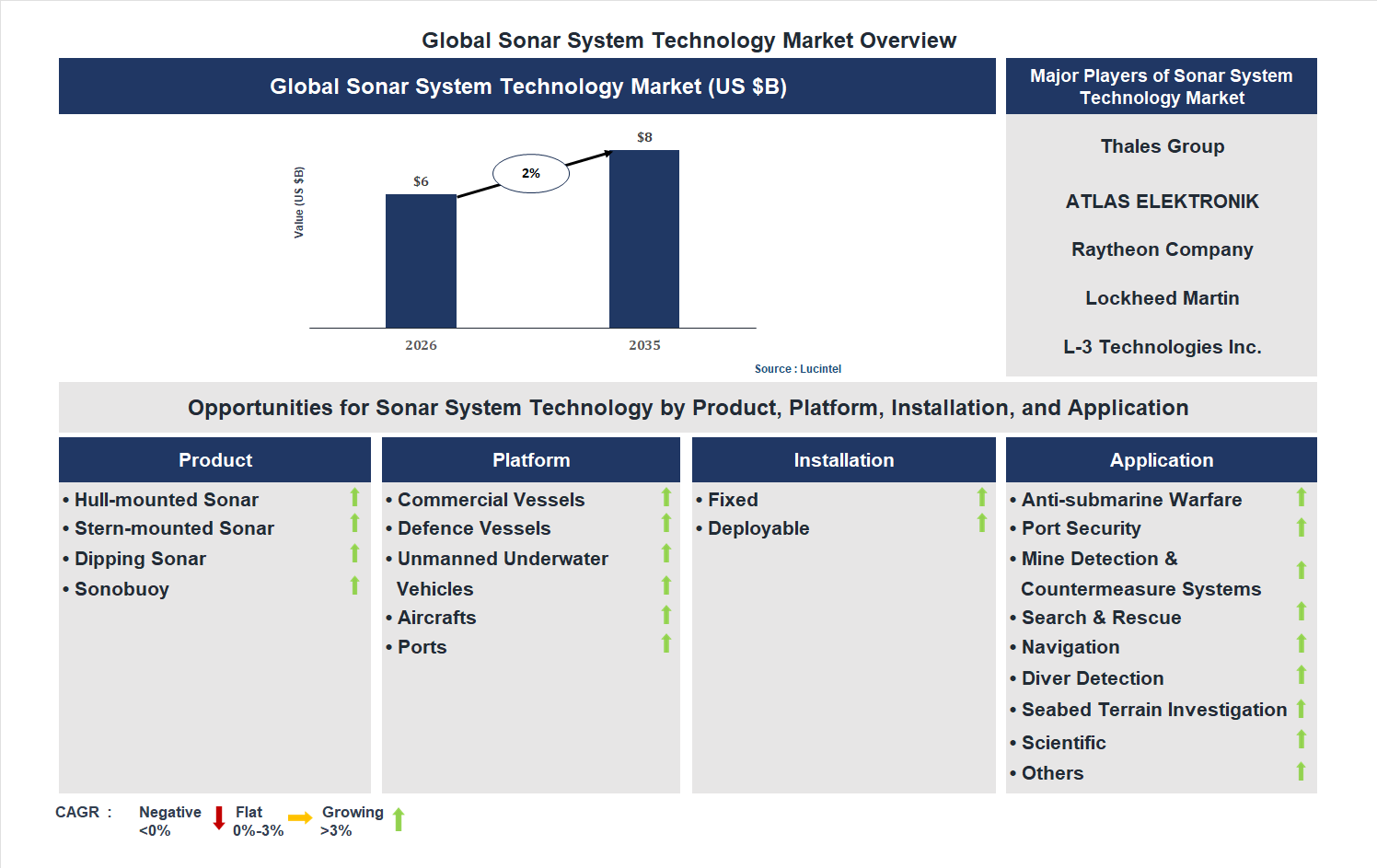
Key data points: The market size in 2035 = $8 billion, growth forecast = 2% annually for the next 8 years. Scroll below to get more insights. This market report covers trends, opportunities and forecasts in sonar system technology market to 2035 by product (hull-mounted sonar, stern-mounted sonar, dipping sonar, and sonobuoy), platform (commercial vessels, defense vessels, unmanned underwater vehicles, aircrafts, and ports), installation (fixed and deployable), application (anti-submarine warfare, port security, mine detection & countermeasure systems, search & rescue, navigation, diver detection, seabed terrain investigation, scientific, and others), and region (North America, Europe, Asia Pacific, and the Rest of the World)
We'll send your sample report shortly.
• Lucintel forecasts that, within the product category, hull-mounted sonar is expected to witness the highest growth over the forecast period.
• Within the application category, anti-submarine warfare is expected to witness the highest growth.
• In terms of region, APAC is expected to witness the highest growth over the forecast period. Gain valuable insights for your business decisions with our comprehensive 150+ page report. Sample figures with some insights are shown below.
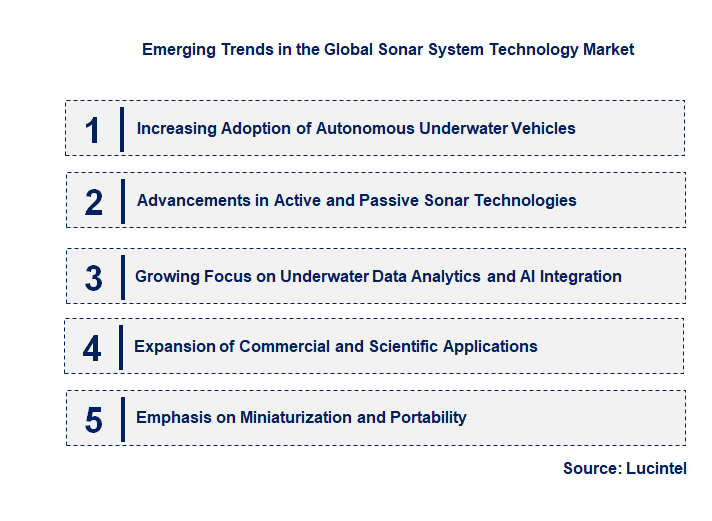
• Increasing Adoption of Autonomous Underwater Vehicles (AUVs): The integration of sonar systems with AUVs is revolutionizing underwater exploration and surveillance. These autonomous systems require advanced, miniaturized, and energy-efficient sonar technology to navigate complex underwater environments effectively. The trend enhances capabilities in oceanographic research, pipeline inspection, and military reconnaissance. As AUVs become more sophisticated, the demand for high-resolution imaging and real-time data transmission grows, driving innovation in sonar design. This synergy is expanding market reach and enabling more detailed, cost-effective underwater missions, ultimately transforming how industries approach underwater tasks.
• Advancements in Active and Passive Sonar Technologies: The development of more sensitive and selective active and passive sonar systems is a key trend. Active sonar provides detailed imaging, while passive sonar excels in stealth and detection of quiet submarines. Innovations such as broadband transducers, digital signal processing, and machine learning algorithms are improving detection accuracy and range. These advancements are critical for defense applications, underwater navigation, and marine life monitoring. Enhanced sonar capabilities are enabling operators to identify objects with greater precision and in challenging environments, thereby increasing operational effectiveness and safety across various sectors.
• Growing Focus on Underwater Data Analytics and AI Integration: The incorporation of artificial intelligence (AI) and data analytics into sonar systems is transforming data processing and interpretation. AI algorithms enable real-time analysis of vast underwater data, improving target identification, classification, and threat assessment. This trend enhances decision-making speed and accuracy, especially in defense and scientific research. Additionally, machine learning models are used to predict underwater conditions and optimize sonar performance. The integration of AI is making sonar systems smarter, more adaptive, and capable of handling complex underwater scenarios, which significantly boosts their utility and market competitiveness.
• Expansion of Commercial and Scientific Applications: Beyond military use, sonar technology is increasingly adopted in commercial sectors such as offshore oil and gas exploration, underwater construction, and environmental monitoring. Scientific applications include marine biology research and seabed mapping. Innovations in multi-beam and synthetic aperture sonar are providing high-resolution imaging over larger areas, improving survey efficiency. This diversification is expanding market opportunities and driving demand for specialized sonar solutions tailored to specific industry needs. As these applications grow, the market is becoming more versatile, with a broader customer base and increased revenue streams.
• Emphasis on Miniaturization and Portability: The trend toward smaller, lightweight, and portable sonar systems is gaining momentum. Advances in materials and electronics enable the development of compact devices suitable for handheld, drone-mounted, or small vessel deployment. This miniaturization enhances operational flexibility, reduces costs, and allows for deployment in previously inaccessible environments. Portable sonar systems are particularly valuable for search and rescue, environmental surveys, and recreational activities. The focus on portability is broadening the market scope, making sonar technology more accessible and versatile across diverse applications and user segments. These emerging trends are collectively reshaping the sonar system technology market by fostering innovation, expanding application domains, and improving system capabilities. The integration of autonomous systems, AI, and miniaturization is making sonar solutions more efficient, adaptable, and accessible. As a result, the market is poised for significant growth, driven by increased demand across defense, commercial, and scientific sectors, ultimately leading to smarter, more versatile underwater sensing solutions.
• Enhanced Underwater Detection Capabilities: The integration of AI and machine learning with sonar systems is improving target detection accuracy, reducing false alarms, and enabling real-time data processing. This advancement benefits naval defense, submarine navigation, and underwater surveillance, leading to safer and more efficient operations. The ability to distinguish between different objects underwater enhances security and exploration efforts, opening new markets for advanced sonar solutions.
• Miniaturization of Sonar Devices: Advances in materials and electronics are enabling smaller, lightweight sonar systems suitable for unmanned underwater vehicles (UUVs) and drones. These compact devices facilitate covert operations, environmental monitoring, and resource exploration in hard-to-reach areas. The miniaturization trend reduces costs and expands deployment options, making sonar technology accessible for diverse applications, including scientific research and commercial underwater inspections.
• Integration with Autonomous Systems: Combining sonar technology with autonomous underwater vehicles (AUVs) and remotely operated vehicles (ROVs) enhances their navigation, obstacle avoidance, and mapping capabilities. This integration improves operational efficiency in underwater infrastructure inspection, seabed mapping, and search-and-rescue missions. It also reduces human risk and operational costs, fostering growth in sectors like oil and gas, maritime security, and scientific research.
• Development of Multi-Mode Sonar Systems: Multi-mode sonar systems that combine active, passive, and synthetic aperture sonar provide comprehensive underwater imaging and detection. These systems offer high-resolution mapping and target identification in complex environments. Their versatility benefits military applications, underwater archaeology, and environmental monitoring, enabling detailed seabed surveys and improved situational awareness in challenging conditions.
• Advancements in Data Processing and Connectivity: Enhanced data processing algorithms and high-speed connectivity enable real-time analysis and remote operation of sonar systems. Cloud-based platforms facilitate data sharing and collaborative decision-making. These innovations support faster response times in defense, disaster management, and scientific exploration, while also improving system reliability and user experience, thus expanding market reach and application scope. These developments are significantly transforming the sonar system technology market by improving detection accuracy, reducing costs, and enabling new applications. Enhanced integration with autonomous systems and data connectivity is driving operational efficiencies and expanding market opportunities. As these innovations continue, the market is poised for sustained growth, with increased adoption across defense, scientific, and commercial sectors, ultimately leading to more advanced, reliable, and versatile underwater solutions.
• Increasing Adoption in Maritime Security and Defense: Sonar systems are crucial for submarine detection, mine countermeasures, and underwater surveillance. Governments and defense agencies are investing in advanced sonar technologies to enhance maritime security, especially in strategic waterways. The demand for stealthy, high-resolution sonar systems is rising, driven by geopolitical tensions and the need for real-time underwater threat detection. This growth is supported by innovations in active and passive sonar systems, enabling better detection capabilities and operational efficiency.
• Growing Use in Underwater Exploration and Marine Research: The expanding need for oceanographic research, underwater archaeology, and resource exploration is boosting sonar system deployment. Subsea mapping, seabed surveying, and habitat monitoring require high-precision sonar technology. The development of portable, high-frequency sonar devices allows scientists to explore previously inaccessible underwater environments. Increased funding for marine research initiatives and technological advancements in imaging and data processing are further propelling this segment’s growth.
• Integration of Sonar with Autonomous Underwater Vehicles (AUVs) and Drones: The deployment of autonomous underwater vehicles equipped with sonar systems is transforming underwater operations. These systems enable efficient, remote exploration, inspection, and data collection in challenging environments. The miniaturization of sonar technology and improvements in real-time data processing are making AUVs more capable and cost-effective. This integration supports applications in oil & gas, environmental monitoring, and military reconnaissance, opening new markets and enhancing operational capabilities.
• Technological Innovations Enhancing Sonar Performance and Efficiency: Advances in signal processing, machine learning, and materials are significantly improving sonar system performance. Innovations such as broadband sonar, synthetic aperture sonar, and adaptive beamforming provide higher resolution and better target discrimination. These developments reduce false alarms and improve detection in complex underwater environments. Enhanced power efficiency and miniaturization also enable deployment in smaller platforms, broadening application scope and increasing market competitiveness.
• Rising Demand for Commercial and Environmental Monitoring Applications: Sonar systems are increasingly used for offshore wind farm inspections, pipeline monitoring, and marine environmental assessments. These applications require reliable, high-resolution imaging to ensure safety and compliance. The growing focus on sustainable ocean management and climate change impacts is driving investment in advanced sonar solutions. The development of cost-effective, easy-to-operate systems is expanding market reach into commercial sectors, supporting sustainable development and environmental conservation efforts. These growth opportunities are collectively driving innovation, expanding application areas, and increasing market competitiveness. The integration of advanced technologies and rising demand across defense, research, and commercial sectors will sustain the market’s upward trajectory. Companies that capitalize on these opportunities through strategic investments and technological advancements will be well-positioned for long-term success in the evolving sonar system landscape.
• Technological Innovation: The continuous development of advanced sonar systems, including multi-beam and synthetic aperture sonar, enhances detection capabilities and operational efficiency. These innovations enable better underwater mapping, object detection, and threat identification, which are critical for defense, maritime security, and research applications. As technology progresses, the market benefits from increased adoption and integration into various platforms, fueling growth.
• Rising Defense Budgets: Governments worldwide are increasing their defense budgets to strengthen maritime security and naval capabilities. Sonar systems are vital for submarine detection, mine countermeasures, and underwater surveillance. The demand for sophisticated sonar solutions is driven by geopolitical tensions and the need to safeguard maritime borders, leading to sustained market expansion.
• Maritime Security and Surveillance Needs: The growing importance of maritime security due to piracy, smuggling, and illegal fishing has heightened the demand for reliable sonar systems. These systems are essential for underwater surveillance, port security, and search and rescue operations. The expanding scope of maritime activities necessitates advanced sonar technology, further propelling market growth.
• Economic Growth and Maritime Trade: The expansion of global maritime trade increases the need for efficient underwater detection systems to protect shipping routes and ports. Economic development in emerging markets also drives investments in naval and maritime infrastructure, which in turn boosts demand for sonar systems. This economic momentum supports market expansion and technological advancements. The challenges in the sonar system technology market are:
• High Costs and Budget Constraints: Developing and deploying advanced sonar systems require significant capital investment, which can be a barrier for some countries and organizations. Maintenance, upgrades, and operational costs further add to financial burdens. Budget constraints may limit the adoption of cutting-edge sonar technology, slowing market growth, especially in developing regions.
• Technological Complexity and Integration Issues: Sonar systems involve sophisticated technology that requires specialized expertise for operation and maintenance. Integrating new sonar systems with existing naval platforms can be complex and costly. Compatibility issues and the need for continuous technological updates pose challenges for manufacturers and end-users, potentially delaying deployment.
• Regulatory and Environmental Restrictions: Stringent regulations related to underwater acoustics and environmental impact can restrict the deployment of certain sonar systems. These restrictions aim to protect marine life but may limit operational capabilities and innovation. Navigating regulatory compliance adds complexity and can hinder market expansion in sensitive regions. The sonar system technology market is driven by rapid technological advancements, increased defense spending, and growing maritime security needs. However, high costs, technological complexities, and regulatory restrictions present notable challenges. These factors collectively influence market dynamics, requiring stakeholders to innovate and adapt strategically. The overall impact is a market poised for growth, provided that technological and regulatory hurdles are effectively managed, ensuring sustainable development and enhanced underwater detection capabilities.
• Thales Group
• ATLAS ELEKTRONIK
• Raytheon Company
• Lockheed Martin
• L-3 Technologies Inc.
• Hull-mounted Sonar
• Stern-mounted Sonar
• Dipping Sonar
• Sonobuoy
• Commercial Vessels
• Defense Vessels
• Unmanned Underwater Vehicles
• Aircrafts
• Ports
• Fixed
• Deployable
• Anti-submarine Warfare
• Port Security
• Mine Detection & Countermeasure Systems
• Search & Rescue
• Navigation
• Diver Detection
• Seabed Terrain Investigation
• Scientific
• Others
• North America
• Europe
• Asia Pacific
• The Rest of the World
• United States: The US has made substantial investments in advanced sonar systems, focusing on underwater surveillance, anti-submarine warfare, and autonomous underwater vehicles. Leading defense contractors are developing multi-function, high-resolution sonar arrays, and integrating AI for real-time data processing. The Navys modernization efforts include deploying next-generation sonar technologies to enhance maritime security and underwater domain awareness.
• China: China has rapidly advanced its sonar technology capabilities, emphasizing anti-submarine warfare and underwater reconnaissance. The country has developed sophisticated active and passive sonar systems for its naval fleet, including deep-sea exploration and submarine detection. Government-backed research initiatives aim to improve system sensitivity, range, and integration with other maritime sensors, strengthening China’s maritime strategic position.
• Germany: Germany has focused on commercial and scientific sonar applications, including underwater mapping, marine research, and offshore infrastructure inspection. The country has introduced innovative passive sonar systems with high resolution and low noise levels. German firms are also working on integrating sonar with autonomous underwater vehicles for environmental monitoring and resource exploration.
• India: India has increased its investment in indigenous sonar technology, primarily for naval defense and maritime security. The development of advanced hull-mounted and towed array sonar systems aims to improve submarine detection and underwater surveillance. India is also exploring sonar applications for deep-sea exploration and resource mapping, aligning with its strategic maritime interests.
• Japan: Japan has advanced its sonar systems for both defense and scientific purposes, focusing on underwater terrain mapping, tsunami detection, and submarine tracking. The country has developed highly sensitive passive sonar arrays and integrated them with AI-driven data analysis tools. Japan’s efforts aim to enhance its maritime domain awareness and contribute to regional security initiatives.


• Thales Group
• ATLAS ELEKTRONIK
• Raytheon Company
• Lockheed Martin
• L-3 Technologies Inc. Q6. Which sonar system technology market segment will be the largest in future? Answer: Lucintel forecasts that, within the product category, hull-mounted sonar is expected to witness the highest growth over the forecast period. Q7. In sonar system technology market, which region is expected to be the largest in next 8 years? Answer: In terms of region, APAC is expected to witness the highest growth over the forecast period. Q8. Do we receive customization in this report? Answer: Yes, Lucintel provides 10% customization without any additional cost.


Choose a license that fits your team. Instant PDF delivery.
Prices exclude taxes. Instant delivery. Custom licensing available on request.
Market Report · July 31, 2026
Market Report · July 31, 2026
Market Report · July 31, 2026
Trusted partner for strategic intelligence and business growth


Receive a complimentary market analysis tailored to your industry. Our analysts will identify key growth opportunities and competitive dynamics specific to your business.

Market size, growth rate, and key trend analysis for your specific sector.

Top competitor positioning and market share analysis.

Strategic recommendations backed by data-driven insights.
Get curated market intelligence and competitive moves straight to your inbox.
By subscribing, you agree to receive our monthly insights. Unsubscribe anytime.
Receive a complimentary market analysis tailored to your industry. Our analysts will identify key growth opportunities and competitive dynamics specific to your business.
Market size, growth rate, and key trend analysis for your specific sector.
Top competitor positioning and market share analysis.
Strategic recommendations backed by data-driven insights.
Get curated market intelligence, emerging trends, and competitive moves straight to your inbox each month.
By subscribing, you agree to receive our monthly insights. Unsubscribe anytime.
We'll send your sample report shortly.